Health-Related Quality of Life and Cognitive Functioning at On- and Off-Treatment Periods in Children Aged between 6-13 Years Old with Brain Tumors: A Prospective Longitudinal Study
Kyung Jin An,
1Yoo Sook Joung,
2Ki Woong Sung,
3and Ji-Hae Kim
21Department of Psychiatry, Seoul Metropolitan Eunpyeong Hospital, Seoul;
Departments of 2Psychiatry and 3Pediatrics, Samsung Medical Center, Sungkyunkwan University School of Medicine, Seoul, Korea.
Received: April 6, 2012 Revised: June 15, 2012 Accepted: June 21, 2012
Corresponding author: Dr. Yoo Sook Joung, Department of Psychiatry, Samsung Medical Center, Sungkyunkwan University School of Medicine, 50 Irwon-dong, Gangnam-gu, Seoul 135-710, Korea.
Tel: 82-2-3410-3589, Fax: 82-2-3410-0050 E-mail: [email protected]
∙ The authors have no financial conflicts of interest.
© Copyright:
Yonsei University College of Medicine 2013 This is an Open Access article distributed under the terms of the Creative Commons Attribution Non- Commercial License (http://creativecommons.org/
licenses/by-nc/3.0) which permits unrestricted non- commercial use, distribution, and reproduction in any medium, provided the original work is properly cited.
Purpose: Our study aimed to examine the relationship between intelligence and health-related quality of life (HRQOL) in children (6-13 years old) diagnosed as having a brain tumor. Materials and Methods: We administered a Korean version of the Wechsler Intelligence Scale for Children-III, the Pediatric Quality of Life In- ventory, version 4.0 (PedsQL), the Korean version of the Parenting Stress Index- Short Form, and the Korean Version of the Parenting Sense of Competence (K- PSOC) scale before or after initial radiotherapy (T1) and after treatment termination (T2). In total, 13 patients completed both the T1 and T2 interviews. Results: Scores significantly declined between T1 and T2 on the full-scale intelligence quotients (FIQ), verbal intelligence quotients (VIQ), performance intelligence quotients (PIQ), similarity and coding tests, as well as the K-PSOC, which measures parental anxiety. FIQ scores at T1 were correlated with the self-reported PedsQL total scores (r=0.739) and the parent proxy-report PedsQL scores for school functioning (r=0.706) at T2. Also, the FIQ scores at T2 were correlated with the self-reported PedsQL total scores (r=0.748) and scores for physical health (r=0.728) at T2. Con- clusion: The cognitive ability and intelligence level of the patients significantly de- clined between on and off treatment periods, and higher intelligence functioning at both on and off treatment was correlated with long-term higher HRQOL. Further investigations that monitor intelligence, HRQOL and parenting stress over a longer period, using a greater number of participants, are needed.
Key Words: Childhood brain tumors, intelligence, heath-related quality of life, parenting stress, prospective longitudinal study
INTRODUCTION
Brain tumors are the second most common form of childhood cancer, and account for approximately 20% of childhood cancer diagnoses.1 Due to the availability of aggressive combination therapies, including surgical resection, chemotherapy (CT), radiotherapy (RT), and peripheral blood stem cell transplantation, the prog- nosis for childhood brain tumors has improved considerably over the last several
We, therefore, aimed to compare intelligence, HRQOL, and parenting stress, satisfaction and efficacy in children with brain tumors between on and off treatment periods.
We also aimed to examine the relationship between intelli- gence levels at on and off treatment and HRQOL at off- treatment periods in children with brain tumors. We hypoth- esized that intelligence would decline from on treatment to off treatment periods, and higher intelligence would be as- sociated with a higher HRQOL. We also anticipated that HRQOL and parenting satisfaction and efficacy would in- crease, and parenting stress would decrease from on treat- ment to off treatment.
MATERIALS AND METHODS
Subjects
Between August 2007 and August 2010, 26 newly diag- nosed brain tumor patients were enrolled at the Children’s Cancer Unit at the Samsung Medical Center in Seoul, Re- public of Korea. After undergoing surgical resection, the patients received two cycles of pre-RT chemotherapy, which consisted of cisplatin, etoposide, vincristine, and cyclo- phosphamide (cycle A), and carboplatin, etoposide, vincris- tine, and ifosphamide (cycle B), followed by cranio-spinal radiotherapy (CSRT) with 23.4 Gy and local RT with 30.6 Gy in cases of metastasis (M) of stage 0 or 1 or CSRT 30.6 Gy and local RT with 23.4 Gy in cases of metastasis of stage 2 or 3. After four cycles of post-RT chemotherapy (cycles A, B, A, and B), tandem double high dose chemo- therapy with autologous stem cell rescue was performed.
Intelligence, HRQOL, and parenting stress, satisfaction and efficacy scores were collected at interviews conducted ap- proximately before or after initial radiotherapy (T1) and again after treatment termination (T2). Fig. 1 is a schemat- ic diagram of the protocol.
In total, 13 patients who completed both T1 and T2 inter- views were included in this analysis.
Procedure
We gathered information concerning the patients’ diagno- ses, M stage, size of their residual tumor, and whether or not leptomeningeal seeding was present from their medical records.
We administered the Korean version of the Wechsler In- telligence Scale for Children-III (K-WISC-III)21 in order to assess intelligence; the Pediatric Quality of Life Inventory, decades.2 Approximately 65% of all children treated for
brain tumors now achieve long-term survival.3
However, due to the location of the tumors, the aggres- sive nature of the combined therapies, as well as the ex- tended duration of treatment, recovery and rehabilitation periods, children treated for brain tumors are liable to expe- rience long-term difficulties in many areas of their lives, both physically and mentally. Previous research suggests that children successfully treated for brain tumors may have difficulties reintegrating into normal life, maintaining peer relationships, and attaining normal academic milestones,4-6 and they are at greater risk of cognitive and mental difficul- ties compared to children who have been treated for other cancer variants.7,8 Parents of children with brain tumors like- wise reported high levels of distress, post-traumatic stress, and a lower quality of life.9,10 They further reported that their elevated stress level continued for 5 years or more post-di- agnosis.11
Pediatric health-related quality of life (HRQOL) is multi- dimensional, consisting at the minimum of physical, psy- chological (including emotional and cognitive), and social health dimensions, as delineated by the World Health Orga- nization guidelines.12 HRQOL has emerged as an important health outcome in pediatric cancer clinical trials.13,14 Studies addressing the long-term survival of childhood brain tumor patients have reported that such individuals had a lower HRQOL than both their non-diagnosed peers and other childhood cancer survivors.15-17
Intellectual impairment is associated with a younger age at diagnosis, the site and extent of the tumor, the type of sur- gery, development of infection, increases in intracranial pressure and most significantly the use of RT.2,18 Impairment has been shown to significantly impact HRQOL by interfer- ing with academic, vocational, and psycho-social function- ing, and is related with the development of significant psy- chological and behavioral problems.19,20 Furthermore, lower intelligence quotients (IQ) seems to be a strong risk factor in poor HRQOL.18
Previous cross-sectional studies found that children with brain tumors had a lower HRQOL, and that the parents of children with brain tumors tended to experience stress relat- ed to management behavior and temperament of the pa- tient, as well as their parent-child interactions compared to normal controls.17 However, only a few longitudinal studies examining the links between intelligence, HRQOL, and parenting stress, satisfaction and efficacy have been con- ducted in Korea.
Our study protocol was approved by our institutional re- view board, and written informed consent was obtained from each enrolled participant or, for minors, the partici- pant’s parents.
Statistical analysis
We analyzed the data using SPSS 17.0 software (version 17.0; SPSS, Chicago, IL, USA) for Windows.
We used the Mann-Whitney test and the Fisher’s exact test to evaluate differences in clinical variables between patients included in the final analysis and patients excluded at T1.
We used the Wilcoxon signed-rank test for comparisons of differences in clinical variables between T1 and T2.
Spearman’s rank correlation was used to assess relation- ships between intelligence at T1 and T2 and HRQOL at T2.
The statistical significance level was set at p<0.05.
RESULTS
Of the 26 patients who were eligible for study, 5 patients died before T2 assessment, 1 patient withdrew following T1 assessment and 2 patients declined to participate in T2 assessment. Further to this, 5 patients who were under 6 years of age at T1 assessment had to have their intelligence function assessed not by the K-WISC-III but with the Ko- rean version of the Wechsler Preschool and Primary Scales of Intelligence.25 They were therefore excluded because of the methodological need for testing to be the same for all participants.
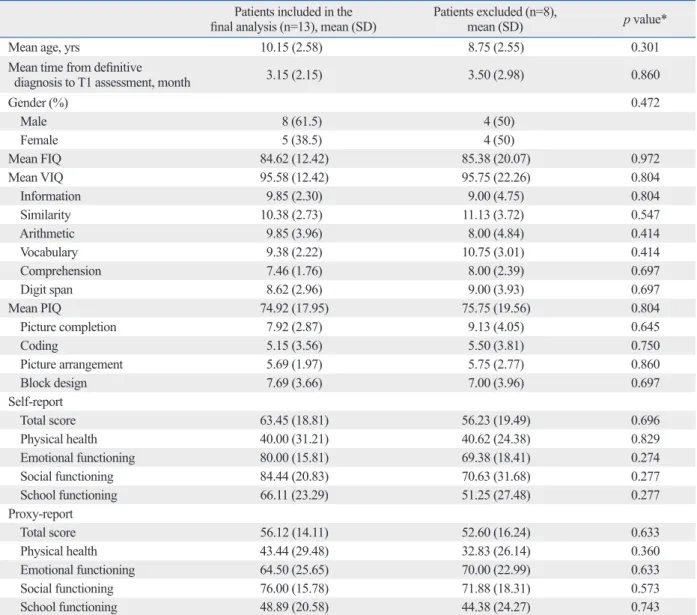
Comparing patients included in the final analysis with those who were not include, except for the 5 patients less than 6 years of age at T1 assessment, there were no signifi- cant differences in the mean age at diagnosis of brain tu- mors, the mean time from definitive diagnosis to T1 assess- ment, gender ratio, the mean intelligence scores, and mean PedsQL scores (Table 1).
The mean age at diagnosis of brain tumors was 10.15±2.58 years. The mean time from definitive diagnosis to T1 as- sessment was 3.15±2.15 months, and the mean time from version 4.0 (PedsQL)22,23 to assess HRQOL; the Korean
version of the Parenting Stress Index-Short Form (K-PSI- SF)24 to assess parenting stress, and the Korean Version of the Parenting Sense of Competence scale (K-PSOC),24 which measures parenting self-esteem and two aspects of parents’
self-reported competence, namely their feelings of satisfac- tion and efficacy in the parenting role.
The K-WISC-III (applicable for ages 6-16) consists of six verbal subtests: information, similarities, arithmetic, vo- cabulary, comprehension and digit span, and four perfor- mance subtests, namely picture completion, coding, picture arrangement, and block design. The full-scale intelligence quotients (FIQ) test is a measure of general cognitive ability;
the verbal intelligence quotients (VIQ) test, is a measure of abstract verbal reasoning ability; and the performance intel- ligence quotients (PIQ) test is a measure of perceptual rea- soning skills. For these, 10 scaled scores of subtests were calculated based on Korean age norms. Each test has an overall mean of 100 (50th percentile) and a standard devia- tion of 15. Scores of 90-109 are considered average, 80-89 are considered lower average, and 70-79 are considered as showing a borderline intellectual level. The subtests have a mean of 10 and a standard deviation of 3, with scores of 9-11 considered as average, 7-8 lower than average, and 5-6 borderline.
The PedsQL measures HRQOL over the month prior to the testing interview, and has four domains and 23 items:
physical functioning (8 items), emotional functioning (5 items), social functioning (5 items), and school functioning (5 items). It generates a total score as a summary of all four domains. A 5-point Likert-type scale is utilized (0=never a problem; 1=almost never a problem; 2=sometimes a prob- lem; 3=often a problem; 4=almost always a problem). Items are reverse-scored and linearly transformed to a 0 to 100 scale (0=100, 1=75, 2=50, 3=25, 4=0), so that higher scores indicate a higher HRQOL. Scale scores are computed as the sum of the items divided by the number of items an- swered. Age-specific versions of both the parent-reported format (applicable for ages 2-18) and the self-reported for- mat (applicable for ages 5-18 years) are available.
Fig. 1. Schema of the protocol. RT, radiotherapy; HDCT, high dose chemotherapy; ASCR, autologous stem cell rescue.
Surgery Pre-RT
chemotherapy RT
T1 assessment: approximately before or after RT
Post-RT
chemotherapy HDCT & ASCR Treatment termination T2 assessment: after treatment termination
The mean FIQ scores at T1 were correlated with mean self-reported PedsQL total scores (r=0.739) and the mean parent proxy-report PedsQL scores for school functioning (r=0.706) at T2. Also, the mean FIQ scores at T2 were cor- related with the mean self-reported PedsQL total scores (r=0.748) and scores for physical health (r=0.728) at T2 (Table 6).
DISCUSSION
The present study comprised an early stage investigation of the links between intelligence, HRQOL and parenting stress, T1 assessment to T2 assessment was 12.69±2.90 months.
At T1 assessment, 9 patients were pre-RT and 4 patients were post-RT. Table 2 lists the demographic information and the disease and treatment characteristics of the children involved.
The mean FIQ, VIQ, PIQ, similarity, and coding scores significantly declined from T1 to T2 (Table 3). The mean PedsQL scores at T1 were not significantly different from those obtained at T2 (Table 4).
The mean K-PSI-SF and the K-PSOC scores for sense of parenting competence at T1 were not significantly different from those obtained at T2, but the mean K-PSOC score for pa- rental anxiety significantly declined from T1 to T2 (Table 5).
Table 1. Demographic Characteristics, Intelligence Test Scores and PedsQL Scores between Patients Included in the Final Analysis and Patients Excluded during On-Treatment
Patients included in the
final analysis (n=13), mean (SD) Patients excluded (n=8),
mean (SD) p value*
Mean age, yrs 10.15 (2.58) 8.75 (2.55) 0.301
Mean time from definitive
diagnosis to T1 assessment, month 3.15 (2.15) 3.50 (2.98) 0.860
Gender (%) 0.472
Male 8 (61.5) 4 (50)
Female 5 (38.5) 4 (50)
Mean FIQ 84.62 (12.42) 85.38 (20.07) 0.972
Mean VIQ 95.58 (12.42) 95.75 (22.26) 0.804
Information 9.85 (2.30) 9.00 (4.75) 0.804
Similarity 10.38 (2.73) 11.13 (3.72) 0.547
Arithmetic 9.85 (3.96) 8.00 (4.84) 0.414
Vocabulary 9.38 (2.22) 10.75 (3.01) 0.414
Comprehension 7.46 (1.76) 8.00 (2.39) 0.697
Digit span 8.62 (2.96) 9.00 (3.93) 0.697
Mean PIQ 74.92 (17.95) 75.75 (19.56) 0.804
Picture completion 7.92 (2.87) 9.13 (4.05) 0.645
Coding 5.15 (3.56) 5.50 (3.81) 0.750
Picture arrangement 5.69 (1.97) 5.75 (2.77) 0.860
Block design 7.69 (3.66) 7.00 (3.96) 0.697
Self-report
Total score 63.45 (18.81) 56.23 (19.49) 0.696
Physical health 40.00 (31.21) 40.62 (24.38) 0.829
Emotional functioning 80.00 (15.81) 69.38 (18.41) 0.274
Social functioning 84.44 (20.83) 70.63 (31.68) 0.277
School functioning 66.11 (23.29) 51.25 (27.48) 0.277
Proxy-report
Total score 56.12 (14.11) 52.60 (16.24) 0.633
Physical health 43.44 (29.48) 32.83 (26.14) 0.360
Emotional functioning 64.50 (25.65) 70.00 (22.99) 0.633
Social functioning 76.00 (15.78) 71.88 (18.31) 0.573
School functioning 48.89 (20.58) 44.38 (24.27) 0.743
PedsQL, Pediatric Quality of Life Inventory, version 4.0; FIQ, full-scale intelligence quotients; VIQ, verbal intelligence quotients; PIQ, performance intel- ligence quotients.
*Mann-Whitney test or Fisher’s exact test.
coding scores significantly declined from on treatment to off treatment. Due to risk factors such as age at diagnosis, the site and extent of the tumor, surgery type, infection, and in- crease in intracranial pressure and the use of radiotherapy, children with brain tumors are at greater risk of declining in- telligence function, especially as demonstrated through per- formance tasks.20,26 These problems have been reported to extend into adulthood in long-term survivors of childhood cancer and can result in poor academic and vocational suc- cess, low self-esteem, and behavioral or emotional prob- satisfaction and efficacy in children diagnosed with brain tu-
mors and their families. We compared intelligence, HRQOL and parenting stress, satisfaction and efficacy between on treatment and off treatment periods, and examined the rela- tionship of intelligence at on and off treatment by assessing HRQOL in the off treatment period.
During on treatment, there were no significant differenc- es in intelligence and HRQOL between patients included and patients excluded.
We found that the mean FIQ, VIQ, PIQ, similarity, and
Table 2. Demographic Information and the Disease and Treatment Characteristics of Children with Brain Tumors N Age at
Diagnosis,
in months Sex Tumor type Tumor
site Surgery Hydroce-phalus Leptomen-
ingeal seeding
Residual tumor
(size
>1.5 cm)
Metastasis stage
FIQ VIQ PIQ The duration
(month) between T1 and T2
T1 T2 T1 T2 T1 T2
1 161 M MB I GTR Y N N 0 85 76 92 85 80 71 15
2 167 F MB I GTR Y N Y 0 73 71 96 93 50 50 11
3 140 F MB I GTR N N N 0 73 72 76 68 77 82 14
4 132 M MB I GTR N N Y 0 76 67 83 68 75 71 13
5 154 F ATRT S GTR N N N 0 100 103 108 118 91 85 19
6 90 M MB I GTR Y N N 0 99 99 104 105 94 92 15
7 116 M MB I STR N Y Y 3 86 74 89 76 85 78 14
8 113 M MB I GTR Y Y N 3 85 76 99 89 73 68 12
9 121 M MB I GTR N Y Y 3 112 104 112 105 108 101 13
10 79 M ATRT S GTR N Y Y 3 86 79 114 104 55 53 12
11 158 F MB S GTR N N N 0 79 79 89 83 73 79 10
12 147 M MB S STR N Y Y 2 75 70 105 99 44 43 9
13 80 F MB S STR Y N Y 0 71 53 79 67 69 47 8
N, number; M, male; F, female; MB, medulloblastoma; ATRT, atypical teratoid rhabdoid tumor; I, infratentorial; S, supratentorial; GTR, gross total resection;
STR, subtotal resection; Y, yes; N, no; FIQ, full-scale intelligence quotients; VIQ, verbal intelligence quotients; PIQ, performance intelligence quotients.
0: no evidence of gross subarachnoid hematogenous metastasis, 3: gross nodule seeding in the spinal subarachnoid space, T1: assessment during treat- ment, T2: assessment after treatment termination.
Table 3. Comparisons between Intelligence Test Scores during On-Treatment and Off-Treatment Periods in Children with Brain Tumors
T1 (mean±SD) T2 (mean±SD) p value
Mean FIQ 84.62 (12.42) 78.69 (14.88)* 0.008
Mean VIQ 95.58 (12.42) 89.23 (16.53)* 0.013
Information 9.85 (2.30) 8.69 (3.17) 0.058
Similarity 10.38 (2.73) 8.31 (2.46)* 0.004
Arithmetic 9.85 (3.96) 9.69 (4.13) 0.796
Vocabulary 9.38 (2.22) 9.08 (2.72) 0.578
Comprehension 7.46 (1.76) 6.31 (2.21) 0.090
Digit Span 8.62 (2.96) 7.77 (2.97) 0.304
Mean PIQ 74.92 (17.95) 70.77 (18.04)* 0.041
Picture completion 7.92 (2.87) 8.08 (2.90) 0.751
Coding 5.15 (3.56) 3.77 (2.39)* 0.016
Picture Arrangement 5.69 (1.97) 5.77 (3.59) 0.915
Block Design 7.69 (3.66) 7.23 (3.63) 0.386
FIQ, full-scale intelligence quotients; VIQ, verbal intelligence quotients; PIQ, performance intelligence quotients; SD, standard deviation.
T1: assessment during treatment, T2: assessment after treatment termination.
*p<0.05, Wilcoxon signed rank test.
Table 4. Comparison of the PedsQL Scores of Child Self-Assessment and Parental Proxy-Reporting at On-Treatment and Off- Treatment in Children with Brain Tumors
T1 (mean±SD) T2 (mean±SD) p value Healthy sample
(mean±SD) Self-report
Total score 63.45 (18.81) 64.47 (12.81) 0.612 88.16 (10.74)
Physical health 40.00 (31.21) 46.88 (26.24) 0.352 88.44 (12.33)
Emotional functioning 80.00 (15.81) 75.00 (13.23) 0.180 82.91 (18.52)
Social functioning 84.44 (20.83) 88.33 (16.00) 0.465 93.55 (11.28)
School functioning 66.11 (23.29) 64.47 (12.81) 0.833 87.22 (13.00)
Proxy-report
Total score 56.12 (14.11) 59.16 (14.24) 0.293 90.56 (9.47)
Physical health 43.44 (29.48) 49.32 (21.51) 0.225 92.02 (10.75)
Emotional functioning 64.50 (25.65) 71.36 (26.18) 0.129 84.43 (16.40)
Social functioning 76.00 (15.78) 67.32 (24.18) 0.462 94.97 (10.15)
School functioning 48.89 (20.58) 51.50 (13.95) 0.496 89.58 (12.18)
PedQL, Pediatric Quality of Life Inventory, version 4.0; SD, standard deviation.
T1: assessment during treatment, T2: assessment after treatment termination.
Healthy sample was derived from Kook and Varni.23
*p<0.05, Wilcoxon signed rank test.
Table 5. Comparisons between the K-PSI-SF and K-PSOC Scores On and Off Treatment in Children with Brain Tumors
T1 (mean±SD) T2 (mean±SD) p value
T2
K-PSI-SF
Stress related to difficult child 17.33 (4.64) 18.60 (2.41) 0.905
Stress related to parent-child interaction 24.17 (4.67) 23.00 (4.22) 0.231
Stress related to child’s learning 8.92 (2.75) 8.80 (2.44) 0.235
K-PSOC
Sense of parenting competence 28.25 (5.36) 29.00 (3.62) 0.478
Parental anxiety 13.08 (3.42) 11.40 (3.06)* 0.027
K-PSI-SF, Korean version of the Parenting Stress Index-Short Form; K-PSOC, Korean version of the Parenting Sense of Competence.
T1: assessment during treatment, T2: assessment after treatment termination.
*p<0.05, Wilcoxon signed rank test.
Table 6. Correlation of FIQ, VIQ and PIQ Scores at On- and Off-Treatment with the PedsQL Scores of Child Self-Assessment and Parental Proxy-Reports Off Treatment
T1 T2
FIQ VIQ PIQ FIQ VIQ PIQ
T2
Self-report
Total score 0.739* 0.395 0.450 0.748* 0.209 0.552
Physical health 0.594 0.368 0.285 0.728* 0.267 0.450
Emotional functioning -0.389 -0.167 -0.419 -0.667 -0.341 -0.604
Social functioning 0.494 0.463 0.367 0.607 0.548 0.383
School functioning 0.380 0.329 0.207 0.422 0.269 0.286
Proxy-report
Total score 0.174 0.059 0.114 0.264 0.073 0.109
Physical health 0.142 -0.151 0.153 0.128 -0.218 0.078
Emotional functioning -0.152 0.214 -0.145 -0.014 0.389 -0.110
Social functioning -0.027 -0.144 0.037 -0.005 -0.160 -0.027
School functioning 0.706* 0.431 0.339 0.530 0.307 0.213
FIQ, Full-Scale intelligence quotients; VIQ, verbal intelligence quotients; PIQ, performance intelligence quotients; PedQL, Pediatric Quality of Life Inventory, version 4.0.
T1: assessment during treatment, T2: assessment after treatment termination.
*p<0.05, Spearman correlation analysis.
normal control group.17 Since much of the parental emo- tional and physical burden (e.g. care-giving, fear of child death, increased sense of helplessness and depression) cre- ated by child illness is relieved once the treatment process has completed, it is reasonable to consider that parental anxiety level is also likely to decrease after treatment has concluded.30-32 Despite this, even after treatment termina- tion, parents of children with tumors often encounter long- term psychiatric sequelae, neuropsychological dysfunction, and other residual effects of the disease and its treatment, in addition to having an elevated risk of newly rising late ef- fects or further distress created by disease recurrence that re- quires significant long-term follow-up and care.30,32 A signifi- cant number of parents still suffer from clinical parenting distress after five years,11 and as many as 5% to 10% of par- ents go on to develop post-traumatic stress disorder after their child’s treatment has finished.32 Thus, careful monitor- ing of parental stress during off-treatment as well as on-treat- ment periods in cases of childhood brain tumor is needed.
In this study, decreased general cognitive ability in the on- treatment period was related to lower self-reported HRQOL and parent-rated HRQOL for school functioning in the off- treatment period, and a decreased general cognitive ability in off-treatment periods was related to lower self-reported HRQOL, specifically physical health off-treatment. In pre- vious studies, decreased cognitive ability was associated with low school achievement, low mid-life income33 and poor physical complaints.34 Since the prognosis of child- hood brain tumors has improved considerably in recent de- cades, HRQOL has received increasing attention in pediatric oncology. Accordingly, general studies have been conducted relating factors of HRQOL to IQ and have found a signifi- cant relationship;18 however, few studies have investigated the relationship of specific intelligence functions with spe- cific domains of HRQOL.
The present study has several limitations. Firstly, the par- ticipant number was small due to the low prevalence of childhood brain tumors. It will be necessary to confirm these results in an expanded patient group in a future study. Sec- ondly, even though a majority of the patients completed their T1 assessment before radiotherapy, there was still con- flict in the ordering of T1 assessment that may have influ- enced study findings. Thirdly, we did not conduct a long- term follow-up after treatment termination, and thus, could not evaluate later effects.
Despite these limitations, our results nevertheless show that intelligence significantly declined between on-treatment lems.8 Many studies on intelligence functioning in children
with brain tumors have utilized various Wechsler scales; for subjects younger than 6 years, the primary scale should be used, whereas the children’s scale should be used in chil- dren under the age of 16 years, after which the adult scale should be used.21,25 Due to scale differences, the compari- son of results when using different scales becomes prob- lematic.26 Our findings showed intelligence declines from on-treatment to off-treatment in brain tumors patients aged 6-16 years, assessed only by K-WISC-III. Reportedly, intel- lectual functioning declines quickly in the first few years after treatment termination, and then more gradually.27 Ac- cordingly, longer-term monitoring of intellectual function in children with brain tumors is warranted.
In this study, there were no significant differences found between on-treatment HRQOLs and the off-treatment HRQOLs. However, both the on-treatment HRQOL and the off-treatment HRQOL scores were lower than those ob- served in a study of Korean healthy children (Table 4),23 and recent cross-sectional research by our group showed that children with brain tumors had lower HRQOL than a control group.17 Therefore, we and many other researchers have been interested in the progression of HRQOL levels after brain tumor diagnosis and treatment termination. Pre- vious study results have differed from our findings: one lon- gitudinal study reported significant improvement in HRQOL at 1, 6 and 12 months after diagnosis, but the authors of the aforementioned study did not specify whether the 12 months assessment was performed after termination of the treat- ment and whether all the individual participants received the same modality of treatment.16 Moreover, differences in the duration, amount and frequency of RT and CT, subjec- tive responses to the impact of acute side effects, such as nausea, hair loss, and additional hospitalization, levels of individual concern about the long-term consequences of treatment, and trans-cultural and ethnic differences may re- sult in different results in terms of how patients consider their quality of life.28,29 For the most successful long-term monitoring of HRQOL after the termination of brain tumor treatment, it is necessary that the studied patients receive the same therapeutic modality.
In this study, there were no significant differences be- tween the level of parental stress at on and off treatment pe- riods, but parental anxiety significantly declined from on treatment to off treatment. Recent cross-sectional research by our group showed that the parents of children with brain tumors tended to experience more parenting stress than the
2004;7:79-92.
15. Speechley KN, Barrera M, Shaw AK, Morrison HI, Maunsell E.
Health-related quality of life among child and adolescent survi- vors of childhood cancer. J Clin Oncol 2006;24:2536-43.
16. Penn A, Lowis SP, Hunt LP, Shortman RI, Stevens MC, McCarter RL, et al. Health related quality of life in the first year after diag- nosis in children with brain tumours compared with matched healthy controls; a prospective longitudinal study. Eur J Cancer 2008;44:1243-52.
17. An KJ, Song MS, Sung KW, Joung YS. Health-related quality of life, activities of daily living and parenting stress in children with brain tumors. Psychiatry Investig 2011;8:250-5.
18. Reimers TS, Mortensen EL, Nysom K, Schmiegelow K. Health- related quality of life in long-term survivors of childhood brain tu- mors. Pediatr Blood Cancer 2009;53:1086-91.
19. Hocking MC, Hobbie WL, Deatrick JA, Lucas MS, Szabo MM, Volpe EM, et al. Neurocognitive and family functioning and qual- ity of life among young adult survivors of childhood brain tumors.
Clin Neuropsychol 2011;25:942-62.
20. Poggi G, Liscio M, Galbiati S, Adduci A, Massimino M, Gandola L, et al. Brain tumors in children and adolescents: cognitive and psychological disorders at different ages. Psychooncology 2005;
14:386-95.
21. Kwak KJ, Park HW, Kim CT. A Study for the Standardization of Korean WISC-3 (1). Korean J Dev Psychol 2002;15:19-33.
22. Varni JW, Limbers CA, Burwinkle TM. Parent proxy-report of their children’s health-related quality of life: an analysis of 13,878 parents’ reliability and validity across age subgroups using the PedsQL 4.0 Generic Core Scales. Health Qual Life Outcomes 2007;5:2.
23. Kook SH, Varni JW. Validation of the Korean version of the pedi- atric quality of life inventory 4.0 (PedsQL) generic core scales in school children and adolescents using the Rasch model. Health Qual Life Outcomes 2008;6:41.
24. Shin SJ, Chung MJ. Effects of stress, social support and efficacy on mothers’ parenting behaviors. Korean Assoc Child Stud 1998;19:27-42.
25. Park HW, Kwak KJ, Park KB. The development of Korean ver- sion of WPPSI: the standardization study (1). Korean J Psychol Dev 1996;9:60-70.
26. Saury JM, Emanuelson I. Cognitive consequences of the treat- ment of medulloblastoma among children. Pediatr Neurol 2011;
44:21-30.
27. Spiegler BJ, Bouffet E, Greenberg ML, Rutka JT, Mabbott DJ.
Change in neurocognitive functioning after treatment with cranial radiation in childhood. J Clin Oncol 2004;22:706-13.
28. Schell LM. Culture as a stressor: a revised model of biocultural interaction. Am J Phys Anthropol 1997;102:67-77.
29. Penn A, Lowis SP, Stevens MC, Hunt LP, Shortman RI, McCarter RJ, et al. Family, demographic and illness-related determinants of HRQL in children with brain tumours in the first year after diag- nosis. Pediatr Blood Cancer 2009;53:1092-9.
30. Hutchinson KC, Willard VW, Hardy KK, Bonner MJ. Adjustment of caregivers of pediatric patients with brain tumors: a cross-sec- tional analysis. Psychooncology 2009;18:515-23.
31. Freeman K, O’Dell C, Meola C. Childhood brain tumors: parental concerns and stressors by phase of illness. J Pediatr Oncol Nurs 2004;21:87-97.
32. Rabineau KM, Mabe PA, Vega RA. Parenting stress in pediatric oncology populations. J Pediatr Hematol Oncol 2008;30:358-65.
and off-treatment and that higher intelligence functioning in both periods was positively correlated with a higher HRQOL off treatment. In other words, higher intelligence was associ- ated with a better quality of life in the long term. Further in- vestigations that monitor intelligence functioning, HRQOL and parenting stress over a more sustained period are needed.
REFERENCES
1. Steliarova-Foucher E, Stiller C, Kaatsch P, Berrino F, Coebergh JW, Lacour B, et al. Geographical patterns and time trends of can- cer incidence and survival among children and adolescents in Eu- rope since the 1970s (the ACCISproject): an epidemiological study. Lancet 2004;364:2097-105.
2. Duffner PK. Risk factors for cognitive decline in children treated for brain tumors. Eur J Paediatr Neurol 2010;14:106-15.
3. Peris-Bonet R, Martínez-García C, Lacour B, Petrovich S, Giner- Ripoll B, Navajas A, et al. Childhood central nervous system tu- mours--incidence and survival in Europe (1978-1997): report from Automated Childhood Cancer Information System project.
Eur J Cancer 2006;42:2064-80.
4. Lannering B, Marky I, Lundberg A, Olsson E. Long-term sequel- ae after pediatric brain tumors: their effect on disability and quality of life. Med Pediatr Oncol 1990;18:304-10.
5. Mostow EN, Byrne J, Connelly RR, Mulvihill JJ. Quality of life in long-term survivors of CNS tumors of childhood and adoles- cence. J Clin Oncol 1991;9:592-9.
6. Zebrack BJ, Gurney JG, Oeffinger K, Whitton J, Packer RJ, Mertens A, et al. Psychological outcomes in long-term survivors of childhood brain cancer: a report from the childhood cancer sur- vivor study. J Clin Oncol 2004;22:999-1006.
7. Mulhern RK, Butler RW. Neurocognitive sequelae of childhood cancers and their treatment. Pediatr Rehabil 2004;7:1-14.
8. Zeltzer LK, Recklitis C, Buchbinder D, Zebrack B, Casillas J, Tsao JC, et al. Psychological status in childhood cancer survivors:
a report from the Childhood Cancer Survivor Study. J Clin Oncol 2009;27:2396-404.
9. Fuemmeler BF, Mullins LL, Marx BP. Posttraumatic stress and general distress among parents of children surviving a brain tu- mor. Child Health Care 2001;30:169-82.
10. Chien LY, Lo LH, Chen CJ, Chen YC, Chiang CC, Yu Chao YM.
Quality of life among primary caregivers of Taiwanese children with brain tumor. Cancer Nurs 2003;26:305-11.
11. Wijnberg-Williams BJ, Kamps WA, Klip EC, Hoekstra-Weebers JE. Psychological adjustment of parents of pediatric cancer pa- tients revisited: five years later. Psychooncology 2006;15:1-8.
12. World Health Organization. Constitution of the World Health Or- ganization: Basic Document. Geneva, Switzerland: World Health Organization; 1948.
13. Varni JW, Burwinkle TM, Lane MM. Health-related quality of life measurement in pediatric clinical practice: an appraisal and pre- cept for future research and application. Health Qual Life Out- comes 2005;3:34.
14. Matza LS, Swensen AR, Flood EM, Secnik K, Leidy NK. Assess- ment of health-related quality of life in children: a review of con- ceptual, methodological, and regulatory issues. Value Health
relationship between cognitive functions, somatization and behav- ioural coping in patients with multiple functional somatic symp- toms. Nord J Psychiatry 2011;65:216-24.
33. Spinks R, Arndt S, Caspers K, Yucuis R, McKirgan LW, Pfalzgraf C, et al. School achievement strongly predicts midlife IQ. Intelli- gence 2007;35:563-7.
34. Hall NM, Kuzminskyte R, Pedersen AD, Ørnbøl E, Fink P. The