Beneficial Effects of Adding Ketamine to Intravenous Patient- Controlled Analgesia with Fentanyl after the Nuss Procedure
in Pediatric Patients
Moon Ho Cha, Ji Hye Eom, Yoon Sook Lee, Woon Young Kim, Young Cheol Park, Sam Hong Min, and Jae Hwan Kim
Department of Anesthesiology and Pain Medicine, Korea University College of Medicine, Seoul, Korea.
Received: March 30, 2011 Revised: May 17, 2011 Accepted: June 21, 2011
Corresponding author: Dr. Jae Hwan Kim, Department of Anesthesiology and Pain Medicine, Korea University College of Medicine, 123 Jeokgeum-ro, Danwon-gu, Ansan 425-707, Korea.
Tel: 82-31-412-5295, Fax: 82-31-412-5294 E-mail: [email protected]
∙ The authors have no financial conflicts of interest.
© Copyright:
Yonsei University College of Medicine 2012 This is an Open Access article distributed under the terms of the Creative Commons Attribution Non- Commercial License (http://creativecommons.org/
licenses/by-nc/3.0) which permits unrestricted non- commercial use, distribution, and reproduction in any medium, provided the original work is properly cited.
Purpose: The aim of this prospective, double-blind, randomized study was to in- vestigate the analgesic effects of low-dose ketamine on intravenous patient-con- trolled analgesia (IV-PCA) with fentanyl for pain control in pediatric patients fol- lowing the Nuss procedure for pectus excavatum. Materials and Methods: Sixty pediatric patients undergoing the Nuss procedure were randomly assigned to re- ceive fentanyl (Group F, n=30) or fentanyl plus ketamine (Group FK, n=30). Ten minutes before the end of surgery, following the loading dose of each solution, 0.5 μg/kg/hr of fentanyl or 0.5 μg/kg/hr of fentanyl plus 0.15 mg/kg/hr of ketamine was infused via an IV-PCA pump (basal rate, 1 mL/hr; bolus, 0.5 mL; lock out in- terval, 30 min). Fentanyl consumption, pain score, ketorolac use, nausea/vomiting, ondansetron use, pruritus, respiratory depression, hallucination, dreaming, and par- ent satisfaction with pain control were measured throughout the 48 hours follow- ing surgery. Results: The pain scores, ketorolac use, and fentanyl consumption of Group FK were significantly lower than in Group F (p<0.05). The incidence of nausea/vomiting and ondansetron use in Group FK was significantly lower than in Group F (p<0.05). There were no reports of respiratory depression, hallucination or dreaming. Parent satisfaction with pain control was similar between the two groups.
Conclusion: We concluded that low-dose ketamine added to IV-PCA with fentanyl after the Nuss procedure in pediatric patients can reduce pain scores, consumption of fentanyl, and incidence of nausea/vomiting without increasing side effects.
Key Words: Fentanyl, funnel chest, ketamine, patient-controlled analgesia, pedi- atrics
INTRODUCTION
Pectus excavatum is a congenital deformity in which the sternum and the inferior costal cartilage area are depressed. Nuss, et al.1 described the Nuss procedure to correct pectus excavatum using specially made metal rods fitted to the chest defor- mity of the patient. Bending of the rod pushes against the depressed costa and ster- num, thereby restoring the chest to its normal shape. The procedure has excellent
Acemedical, Seoul, Korea) were excluded.
One hour prior to the induction of anesthesia, 0.1 mg/kg of atropine was injected intramuscularly as premedication.
An IV line was introduced and a dextrose/saline solution was infused at 4 mL/kg/hr during the operation. Anesthesia was induced by 5 mg/kg of thiopental sodium and 0.6 mg/
kg of rocuronium. After the trachea was intubated, anesthe- sia was maintained with 1.5 L/min of oxygen, 1.5 L/min of nitrous oxide and 1.5-2.5 vol% of sevoflurane. Throughout the operation, blood pressure, electrocardiogram, end-tidal carbon dioxide concentration and pulse oximetry saturation were routinely monitored.
Ten minutes before the end of surgery, a loading dose of 1 μg/kg of IV fentanyl or 1 μg/kg of IV fentanyl plus 0.3 mg/kg of IV ketamine was injected for respective each group. Subsequently, 0.5 μg/kg/hr of fentanyl or 0.5 μg/kg/
hr of fentanyl plus 0.15 mg/kg/hr of ketamine was infused via an IV-PCA pump with a basal rate of 1 mL/hr respec- tively to each group. Drug concentrations were prepared for each patient according to his/her body weight, totaling 1 mL of drug preparation comprising 0.5 μg/kg of fentanyl or 0.5 μg/kg of fentanyl plus 0.15 mg/kg of ketamine for each group. When patients experienced pain, they or their guard- ians pushed the demand button, and, thereafter, a 0.5 mL drug bolus, comprising 0.25 μg/kg of fentanyl or 0.25 μg/
kg of fentanyl plus 0.075 mg/kg of ketamine for each re- spective group, was injected. The frequency of bolus injec- tion was limited to two times per one hour. The total vol- ume of IV-PCA medication was determined to be 100 mL, corresponding to 50 μg/kg of fentanyl or 50 μg/kg of fen- tanyl plus 15 mg/kg of ketamine for each group, i.e. the maximum dose over 48 hours. The intensity of pain was as- sessed using a visual analogue scale (VAS) ranging from 0 (no pain) to 10 (worst imaginable pain). VAS and cumula- tive fentanyl consumption were measured at 1, 6, 12, 24, and 48 hours after the surgery. For patients who responded with pain greater than 4 on the VAS, 0.5 mg/kg of IV ketor- olac was administered and the administration was recorded.
A blinded anesthesiologist assessed and recorded the de- velopment of side effects including nausea/vomiting, pruri- tus, respiratory depression, hallucination, and dreaming at 1, 6, 12, 24, and 48 hours after surgery. Nausea was defined as the subjective sensation of discomfort associated with the awareness of the urge to vomit. Vomiting was defined as a forceful expulsion of gastric contents through the mouth.
In cases of severe nausea/vomiting, or nausea/vomiting that did not resolve, we administered 0.1 mg/kg of IV ondanse- esthetic results and helps improve lung function. However,
the Nuss procedure can induce severe postsurgical pain due to the expansion of the thorax. This pain can be controlled with intravenous patient-controlled analgesia (IV-PCA) us- ing opioids.2-4
Strong pain stimuli activate N-methyl-D-aspartate (NMDA) receptors and produce hyperexcitability of dorsal root neu- rons.5 This trigger induces central sensitization, the wind-up phenomenon, and pain memory. An NMDA receptor antag- onist can prevent the induction of central sensitization caused by stimulation of peripheral nociception as well as by block- ing the wind-up phenomenon.5 When used in a large dose for a prolonged period as well as at the very early stage of therapy, opioids can induce hyperalgesia and tolerance, which may lead to increased postoperative pain.6,7 Increased postoperative pain, in turn, leads to the need for higher dos- es of opioids. Ketamine, by blocking NMDA receptors, can prevent the development of central sensitization and opioid resistance.5,7 Therein is the basis for using ketamine as an adjuvant to opioids in postoperative pain control.
However, clinical trials of ketamine added to IV-PCA with opioids in postoperative pain control have demonstrated con- tradictory results.8-11 The effects of ketamine combined with fentanyl in IV-PCA for postoperative pain control for the Nuss procedure have not been examined. Therefore, we in- vestigated the analgesic effects of low-dose ketamine on IV- PCA with fentanyl for pain control following the Nuss proce- dure for pectus excavatum repair in pediatric patients.
MATERIALS AND METHODS
This prospective, double-blind randomized study was ap- proved by the Institutional Review Board. Written informed consent for the study was obtained from the parents of all children enrolled in the study. Sixty children, American So- ciety of Anesthesiologists physical status I or II, aged 6-16 years, who underwent the Nuss procedure for repair of pec- tus excavatum were enrolled in this study. The patients were divided randomly into two groups. Group F was given fen- tanyl only, and Group FK was given fentanyl plus ketamine.
The equipment and procedure were explained in detail. Pa- tients with congenital heart disease, lung parenchymal dis- ease, gastrointestinal disease, psychiatric disease, skin dis- ease, a history of motion sickness or postoperative nausea/
vomiting, drug contraindications, or who were unable to un- derstand how to use the IV-PCA device (AutoMed 3200,
as mean±SD or as the number of patients (%). Statistical analyses were performed using the statistical software pack- age SPSS version 12 for Windows (SPSS Inc., Chicago, IL, USA). For numerical variables, independent t-tests were employed to compare inter-group differences and chi-square or Fisher’s exact tests were adopted for categorical vari- ables. Differences were regarded as statistically significant when the p value was less than 0.05.
RESULTS
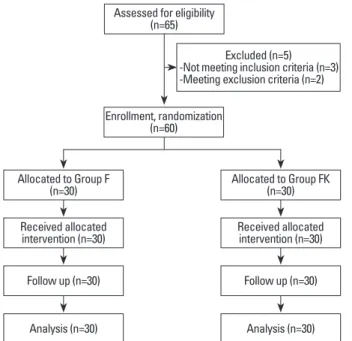
Sixty five patients were assessed for eligibility. Three pa- tients were not included in the study due to being younger than 6 years of age. Two patients were excluded due to his- tory of motion sickness. In total, sixty patients were enrolled for the study. Thirty patients were randomly allocated to each group (Fig. 1). Gender, age, weight, and duration of an- esthesia were not significantly different between the two groups (Table 1).
The VAS pain scores of Group FK were significantly lower than those of Group F at 6, 24, and 48 hours after sur- gery (p<0.05) (Table 2). There were 7 (23%) patients who re- quired additional analgesic, ketorolac, during the 48 hours after surgery, in Group FK, significantly lower than the 18 patients (53%) in Group F (p<0.01).
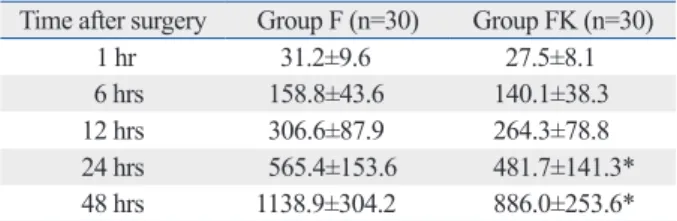
The cumulative fentanyl consumption was significantly reduced in Group FK compared to Group F, at 24 and 48 hours after surgery (p<0.05) (Table 3).
tron. Pruritus was defined as the subjective sensation of itching without skin lesions and was treated with 0.1 mg/kg of IV chlorophenyramine or 1 μg/kg of IV naloxone, in se- vere cases only. Respiratory depression was defined as pulse oximetry saturation levels less than 90% at room air or a respiration rate less than 10/min. Respiratory depression, if present, was managed with oxygen insufflation via nasal cannula at 5 L/min. When respiratory depression was not corrected by oxygen insufflations, 1 μg/kg of IV naloxone was administered. If the respiratory depression was still not corrected by these measures, the IV-PCA infusion rate was to be reduced by 50% every hour, until it was resolved. Res- piration rate and pulse oximetry saturation were to be moni- tored throughout these measures until the respiratory depres- sion was resolved. Hallucination and dreaming were defined as any sensation that was not caused by an external event, and if present, the IV-PCA infusion rate would be reduced by 50% every hour, until symptoms were resolved. Overall parent satisfaction with pain control was determined at 48 hours after surgery as either satisfactory or unsatisfactory.
Michelet, et al.9 hypothesized a 25% reduction in mor- phine consumption with an expected standard deviation of 30% in a calculated sample size of 24 subjects per group, detecting a difference with a power of 0.80 and a 5% risk of type I error. Based on their study,9 we expected that fentan- yl plus ketamine IV-PCA could reduce fentanyl consump- tion by 25% in a sample size of 24 patients per group with the same statistical power. We planned to enroll enough pa- tients to obtain 30 patients per group. Values were expressed
Fig. 1. Flow diagram of the progress through the trial. Group F, fentanyl group; Group FK, fentanyl plus ketamine group.
Table 1. Patient Characteristics
Group F
(n=30) Group FK
(n=30)
Sex (M/F) 23/7 25/5
Age (yrs) 10.2±2.9 9.9±2.7
Weight (kg) 34.4±9.2 31.2±8.9
Duration of anesthesia (min) 106.0±13.9 110.2±16.8 Group F, fentanyl group; Group FK, fentanyl plus ketamine group.
Values are mean±SD or number of patients.
Table 2. Postoperative Pain Scores Using the Visual Ana- logue Scale (VAS)
Time after surgery Group F (n=30) Group FK (n=30)
1 hr 3.3±0.7 3.1±0.7
6 hrs 2.9±0.7 2.5±0.6*
12 hrs 2.5±0.7 2.2±0.6
24 hrs 1.9±0.5 1.4±0.5*
48 hrs 1.6±0.6 1.0±0.5*
Group F, fentanyl group; Group FK, fentanyl plus ketamine group.
Values are mean±SD.
*p<0.05 versus Group F.
Assessed for eligibility (n=65)
Enrollment, randomization (n=60)
Allocated to Group F
(n=30) Allocated to Group FK
(n=30) Received allocated
intervention (n=30) Received allocated intervention (n=30)
Follow up (n=30) Follow up (n=30)
Analysis (n=30) Analysis (n=30)
Excluded (n=5) -Not meeting inclusion criteria (n=3) -Meeting exclusion criteria (n=2)
yl in IV-PCA, which has been shown to be effective for pain control with fewer side effects after the Nuss procedure in pediatric patients.3
Ketamine has analgesic properties in subanesthetic dos- es.5,7 Small doses of ketamine act specifically to prevent opioid tolerance and pain sensitization.7 Low-dose ket- amine is defined as a single injection of less than 1 mg/kg or continuous infusion of less than 20 μg/kg/min.12 The in- cidence of psychomimetic effects and cognitive impairment is negligible at doses less than 2.5 μg/kg/min and increases with higher doses of ketamine.12 It has been reported that a 2.5 μg/kg/min infusion of ketamine on IV-PCA can de- crease morphine consumption and the incidence of nau- sea.13 Therefore, we decided to test a basal infusion rate of ketamine at 2.5 μg/kg/min (=0.15 mg/kg/hr).
In review, Subramaniam, et al.14 concluded that a small dose of ketamine is a safe and useful adjuvant to standard IV or epidural opioid-analgesia, however, adding ketamine to IV-PCA with morphine showed no beneficial effect in postoperative pain control. Subsequently, conflicting results exist concerning the potential benefits of adding ketamine to opioids in IV-PCA for postoperative pain control.8-20 The results can be categorized by several types of surgery.
For thoracic surgery, Nesher, et al.8,15 studied patients un- dergoing thoracotomy and reported that a bolus of 5 mg of ketamine plus 1 mg of morphine IV-PCA (lockout 7 min) resulted in a reduction in pain score and a 45-50% reduc- tion in morphine consumption with cardiovascular stability and better respiratory parameters. Michelet, et al.9 studied patients undergoing thoracic surgery and reported that add- ing ketamine 1 mg/mL to morphine 1 mg/mL IV-PCA (a bolus of 0.015 mL/kg per every 10 min) resulted in reduc- tions in morphine consumption and pain score and a reduc- tion in nocturnal desaturation.
The benefit of adding ketamine to morphine in IV-PCA for orthopedic surgery remains unclear. Javery, et al.16 stud- ied patients undergoing lumbar microdiscectomy and re- ported that ketamine 1 mg/mL added to morphine 1 mg/mL IV-PCA (bolus 1 mL, lockout 6 min) reduced pain scores and halved morphine consumption. Kollender, et al.17 stud- ied patients undergoing orthopedic-oncological surgery and found that a bolus of 5 mg ketamine plus 1 mg morphine IV-PCA (lockout 7 min) resulted in a 60% reduction in morphine consumption and reductions in pain score and ad- ditional analgesic use. However, Sveticic, et al.10 studied patients undergoing major orthopedic surgery and reported that a bolus of 1.5 mg ketamine plus 1.5 mg morphine in The incidence of nausea/vomiting was 23% in Group
FK, significantly lower than 53% in Group F (p<0.05) (Ta- ble 4). The number of patients who required the antiemetic, ondansetron, during the 48 hours after surgery was 3 (10%) in Group FK, significantly lower than 11 patients (37%) in Group F (p<0.05). The degree of pruritus was not severe, and the incidence of pruritus was not different between the two groups (Table 4). There were no reports of respiratory depression, hallucination, or dreaming in either group (Ta- ble 4). No patients required administration of naloxone or chlorophenyramine. The number of parents satisfied with pain control was 25 (83%) in Group F and 28 (93%) in Group FK, and the difference was not significant.
DISCUSSION
In our study, administration of IV-PCA with fentanyl plus low-dose ketamine resulted in reductions of the fentanyl consumption and pain scores as well as a decrease in nau- sea/vomiting over fentanyl alone.
Opioids in IV-PCA are used widely in the management of severe postoperative pain after the Nuss procedure.2-4 Control of severe pain requires more opioids. However, higher doses of opioids are associated with significant side effects in- cluding respiratory depression, nausea/vomiting, sedation, constipation, urinary retention, as well as acute tolerance. In our study, we infused a basal rate of 0.5 μg/kg/hr of fentan- Table 3. Cumulative Fentanyl Consumption (μg) after the Surgery
Time after surgery Group F (n=30) Group FK (n=30)
1 hr 31.2±9.6 27.5±8.1
6 hrs 158.8±43.6 140.1±38.3
12 hrs 306.6±87.9 264.3±78.8
24 hrs 565.4±153.6 481.7±141.3*
48 hrs 1138.9±304.2 886.0±253.6*
Group F, fentanyl group; Group FK, fentanyl plus ketamine group.
Values are mean±SD.
*p<0.05 versus Group F.
Table 4. Incidence of Side Effects
Group F (n=30) Group FK (n=30)
Nausea/Vomiting 16 (53) 7 (23)*
Pruritus 4 (13) 2 (7)
Respiratory depression 0 (0) 0 (0)
Hallucination 0 (0) 0 (0)
Dreaming 0 (0) 0 (0)
Group F, fentanyl group; Group FK, fentanyl plus ketamine group.
Values are number of patients (%).
*p<0.05 versus Group F.
amine, could induce nausea/vomiting. In our study, 2.5 μg/
kg/min of ketamine, was low enough to avoid emetic ef- fects. The incidence of patients who used the antiemetic, ondansetron, during the 48 hours after surgery was 10% in the fentanyl plus ketamine group and was lower than 37%
in the fentanyl group.
Pruritus is a common side effect of opioid administration, however, the incidence and severity is lower in the IV route than in the epidural or intrathecal route.22 The incidence of pruritus is 0-10% when fentanyl IV-PCA is used after the Nuss procedure.2,3 In our study, the incidence of pruritus was 13% in the fentanyl group and 7% in the fentanyl plus ketamine group. Although, the incidence was almost two times higher in the fentanyl group than in the fentanyl plus ketamine group, the incidences of both groups were too low to differentiate with statistical significance in either group. There were no instances of severe pruritus which re- quired treatment in both groups.
Thoracic surgery can lead to respiratory depression due to severe pain, inhibiting thoracic expansion while breath- ing. Adequate analgesia to reduce postoperative pain en- hances the ability to breathe deeply and cough effectively, alleviating respiratory depression.23 However, opioids in large doses can worsen respiration rates, oxygenation, and ventilation. Therefore, a reasonable amount of opioids and adjuvant to opioids are important to pain control as well as respiration. High doses of ketamine can have respiratory depressive effects, but respiratory depression associated with small doses of ketamine is minimal.8,9,15,21 Ketamine also sustains the patency of small and large airways, thus preventing obstruction, including the kind that can occur in patients under the effect of opioids. In our study, the infu- sion rates of 0.5 μg/kg/hr of fentanyl and 0.15 mg/kg/hr of ketamine were low enough to avoid respiratory depression.
These features lead to better respiration and a probable preservation of more than 90% of pulse oximetry saturation during the postoperative period.
Ketamine is associated with a risk of psychomimetic ef- fects, including hallucination, vivid dreaming, sedation, and dizziness. However, the safety of adding low-dose ketamine to morphine for postoperative IV-PCA regarding its psy- chomimetic effects is well established.8,13,15,17,18 Badrinath, et al.21 investigated the dose-dependent effects of ketamine and reported that a dose of 24 μg/kg/min can increase psy- chomimetic effects. Edwards, et al.24 used a dose-finding approach to study the combination of morphine and ket- amine in IV-PCA for postoperative pain in elderly patients IV-PCA (lockout 8 min) failed to demonstrate beneficial ef-
fects in morphine consumption and pain control.
The benefit of adding ketamine to morphine in IV-PCA for abdominal surgery also remains unclear. Adriaenssens, et al.13 studied patients undergoing abdominal surgery and reported that continuous infusion of ketamine 2.5 μg/kg/
min with morphine IV-PVA (loading dose 3 mg, bolus 1 mg, lockout 8 min) reduced pain score and morphine con- sumption. Unlügenç, et al.18 studied patients after major ab- dominal surgery and found that ketamine 1 mg/mL added to tramadol 5 mg/mL IV-PCA (loading dose 1 mg/kg, bolus 0.2 mg/kg, lockout 20 min, background infusion 0.4 mg/
kg/h) improved analgesia and reduced tramadol consump- tion. However, investigating patients undergoing total ab- dominal hysterectomy, Murdoch, et al.19 did not find any benefit of adding ketamine 0.75 mg/mL to morphine 1 mg/
mL IV-PCA (10 mL/m2 body surface area of loading dose, bolus 1 mL, lockout 5 min, background infusion 1 mL/h).
Reeves, et al.20 found no pain-reducing or morphine-spar- ing benefits of ketamine bolus 1 mg/mL plus morphine 1 mg/mL IV-PCA (bolus, lockout, and background infusions were determined by the anesthesiologists) in patients after major abdominal surgery.
In our study, adding ketamine to fentanyl IV-PCA reduced the cumulative fentanyl consumption by approximately 22%, reduced pain scores, and reduced additional analgesic use, with parent satisfaction in pain control. Although these reduction levels were different, the results appear to be in agreement with prior studies.8,9,13,15-18 We conclude that there is a benefit to adding ketamine to opioids for IV-PCA for thoracic surgery.8,9,15 However, controversies remain regard- ing the benefits of adding ketamine to opioids for IV-PCA for abdominal and orthopedic surgery.10-14,16-20 These contra- dictory results may reflect differences in the methodology of each study, degree of postoperative pain, nature of surgical procedure, and nature and source of postoperative pain.
There is a significant incidence of nausea/vomiting when fentanyl IV-PCA is used postoperatively after the Nuss pro- cedure, observed in 30-50% pediatric patients.2-4 In our study, the incidence of nausea/vomiting was 53% in the fentanyl group and 23% in the fentanyl plus ketamine group. Our results agree with prior studies that adding ketamine to morphine IV-PCA reduces the incidence of nausea/vomit- ing.13,15-17 However, nausea/vomiting can be induced by ket- amine itself in a dose dependent pattern. Badrinath, et al.21 investigated the dose-dependent effects of ketamine during propofol sedation and reported that 24 μg/kg/min of ket-
spiratory function, and nocturnal desaturation. Br J Anaesth 2007;99:396-403.
10. Sveticic G, Farzanegan F, Zmoos P, Zmoos S, Eichenberger U, Curatolo M. Is the combination of morphine with ketamine better than morphine alone for postoperative intravenous patient-con- trolled analgesia? Anesth Analg 2008;106:287-93.
11. Jensen LL, Handberg G, Helbo-Hansen HS, Skaarup I, Lohse T, Munk T, et al. No morphine sparing effect of ketamine added to morphine for patient-controlled intravenous analgesia after uterine artery embolization. Acta Anaesthesiol Scand 2008;52:479-86.
12. Schmid RL, Sandler AN, Katz J. Use and efficacy of low-dose ketamine in the management of acute postoperative pain: a review of current techniques and outcomes. Pain 1999;82:111-25.
13. Adriaenssens G, Vermeyen KM, Hoffmann VL, Mertens E, Adri- aensen HF. Postoperative analgesia with i.v. patient-controlled morphine: effect of adding ketamine. Br J Anaesth 1999;83:393-6.
14. Subramaniam K, Subramaniam B, Steinbrook RA. Ketamine as adjuvant analgesic to opioids: a quantitative and qualitative sys- tematic review. Anesth Analg 2004;99:482-95.
15. Nesher N, Serovian I, Marouani N, Chazan S, Weinbroum AA.
Ketamine spares morphine consumption after transthoracic lung and heart surgery without adverse hemodynamic effects. Pharma- col Res 2008;58:38-44.
16. Javery KB, Ussery TW, Steger HG, Colclough GW. Comparison of morphine and morphine with ketamine for postoperative anal- gesia. Can J Anaesth 1996;43:212-5.
17. Kollender Y, Bickels J, Stocki D, Maruoani N, Chazan S, Nirkin A, et al. Subanaesthetic ketamine spares postoperative morphine and controls pain better than standard morphine does alone in or- thopaedic-oncological patients. Eur J Cancer 2008;44:954-62.
18. Unlügenç H, Gündüz M, Ozalevli M, Akman H. A comparative study on the analgesic effect of tramadol, tramadol plus magne- sium, and tramadol plus ketamine for postoperative pain manage- ment after major abdominal surgery. Acta Anaesthesiol Scand 2002;46:1025-30.
19. Murdoch CJ, Crooks BA, Miller CD. Effect of the addition of ket- amine to morphine in patient-controlled analgesia. Anaesthesia 2002;57:484-8.
20. Reeves M, Lindholm DE, Myles PS, Fletcher H, Hunt JO. Adding ketamine to morphine for patient-controlled analgesia after major abdominal surgery: a double-blinded, randomized controlled trial.
Anesth Analg 2001;93:116-20.
21. Badrinath S, Avramov MN, Shadrick M, Witt TR, Ivankovich AD. The use of a ketamine-propofol combination during moni- tored anesthesia care. Anesth Analg 2000;90:858-62.
22. Werawatganon T, Charuluxanun S. Patient controlled intravenous opioid analgesia versus continuous epidural analgesia for pain af- ter intra-abdominal surgery. Cochrane Database Syst Rev 2005:
CD004088.
23. Fléron MH, Weiskopf RB, Bertrand M, Mouren S, Eyraud D, Go- det G, et al. A comparison of intrathecal opioid and intravenous analgesia for the incidence of cardiovascular, respiratory, and renal complications after abdominal aortic surgery. Anesth Analg 2003;97:2-12.
24. Edwards ND, Fletcher A, Cole JR, Peacock JE. Combined infu- sions of morphine and ketamine for postoperative pain in elderly patients. Anaesthesia 1993;48:124-7.
25. Grant IS, Nimmo WS, McNicol LR, Clements JA. Ketamine dis- position in children and adults. Br J Anaesth 1983;55:1107-11.
and found that vivid dreaming was a problem at doses of ketamine of 7.8 μg/kg/min. The incidence of psychomimet- ic symptoms associated with ketamine is lower in children than in adults.25 There were no hallucinations or cases of dreaming in our experiment. The dose of ketamine of 0.15 mg/kg/hr (=2.5 μg/kg/min) was low enough to avoid psy- chomimetic effects.
To the best of our knowledge, this study is the first report on the effects of adding ketamine to fentanyl IV-PCA for postoperative pain control after the Nuss procedure in chil- dren. We observed good parent satisfaction with pain con- trol, reduced pain scores, reduced need for additional anal- gesic, lower fentanyl consumption, reduced incidence of nausea/vomiting, and reduced need for antiemetics, without increased side effects. Therefore, if fentanyl IV-PCA is con- sidered for postoperative pain control following the Nuss procedure in children, we recommend adding low-dose ket- amine to the fentanyl IV-PCA.
REFERENCES
1. Nuss D, Kelly RE Jr, Croitoru DP, Katz ME. A 10-year review of a minimally invasive technique for the correction of pectus exca- vatum. J Pediatr Surg 1998;33:545-52.
2. Butkovic D, Kralik S, Matolic M, Kralik M, Toljan S, Radesic L.
Postoperative analgesia with intravenous fentanyl PCA vs epidural block after thoracoscopic pectus excavatum repair in children. Br J Anaesth 2007;98:677-81.
3. Ahn KR, Chung JW, Kwon JH, Kang KS, Lee JS, Yoo SH, et al.
Intravenous patient-controlled analgesia using fentanyl after nuss procedure in pediatric patients undergoing pectus excavatum re- pair. Korean J Anesthesiol 2005;49:624-9.
4. Rugyte DC, Kilda A, Karbonskiene A, Barauskas V. Systemic postoperative pain management following minimally invasive pec- tus excavatum repair in children and adolescents: a retrospective comparison of intravenous patient-controlled analgesia and contin- uous infusion with morphine. Pediatr Surg Int 2010;26:665-9.
5. Visser E, Schug SA. The role of ketamine in pain management.
Biomed Pharmacother 2006;60:341-8.
6. Phillips WJ, Currier BL. Analgesic pharmacology: II. Specific an- algesics. J Am Acad Orthop Surg 2004;12:221-33.
7. Laulin JP, Maurette P, Corcuff JB, Rivat C, Chauvin M, Simonnet G. The role of ketamine in preventing fentanyl-induced hyperal- gesia and subsequent acute morphine tolerance. Anesth Analg 2002;94:1263-9.
8. Nesher N, Ekstein MP, Paz Y, Marouani N, Chazan S, Weinbroum AA. Morphine with adjuvant ketamine vs higher dose of mor- phine alone for immediate postthoracotomy analgesia. Chest 2009;136:245-52.
9. Michelet P, Guervilly C, Hélaine A, Avaro JP, Blayac D, Gaillat F, et al. Adding ketamine to morphine for patient-controlled analge- sia after thoracic surgery: influence on morphine consumption, re-