Vol. 19, No. 3 pp. 619-623, 2018
Instructional Design of m-Learning for Effective PBL in Engineering Education
Keunsoo Lee
Dept. of Computer Science and Engineering(Computer System Institute), Hankyong National University
공학교육에서 효율적 PBL을 위한 m-러닝 교수설계
이근수
한경대학교 컴퓨터공학과
Abstract This paper aimed to design a computer course teaching-learning strategy for (m-learning?) to be used in a Problem Based Learning (PBL) environment. The research findings were as follows. Firstly, learning contents were provided as educational tools for mobile device usage. The educational contents provided were designed for effective usage on mobile devices, such as smartphones, thereby making mobile devices suitable for use as learning tools.
Secondly, learning contents for PBL were provided. PBL problems (for computer engineering courses) were made with the principles of teaching plans. The learning objectives were achieved through the problem-solving progress of the learners and their self-directed and cooperative learnings. Thirdly, learning resources were provided that were easily accessible through smartphones, laptops and PDAs. This study is about the PBL instructional design of creative engineering design subjects, which aims to foster talent. The PBL model developed in this study consists of Analysis, Design, Development, Implementation, and Evaluation. We made a plan for creative engineering design subjects based on PBL, and focused on the process of PBL. This research was able to establish the basis for PBL usage in Engineering Schools and help achieve its ultimate goal of endowing professional intellectuals with creative problem-solving abilities.
요 약 본 논문은 컴퓨터 교과목에 적용하기 위하여 문제중심학습 환경에서 m-러닝을 위한 교수-학습을 설계하는데 그 목적 이 있다. 연구 결과를 요약하면 다음과 같다. 첫째, 모바일 기기를 교육적 도구로 활용하기 위한 학습 콘텐츠를 제공하였다.
본 연구에서 제시한 콘텐츠는 스마트폰을 비롯한 모바일 기기에 효과적으로 구현될 수 있게 설계 및 제작되었기 때문에 모바 일 기기를 교육적 도구로 활용하는데 적합하다. 둘째, 문제중심학습을 위한 학습 콘텐츠를 제공하였다. 문제중심학습을 위한 교수설계의 원리를 바탕으로 컴퓨터공학 교과목에 대한 문제를 만들었으며, 문제의해결을 통해 학습자들은 자기주도적이고 팀원들과 협동학습을 통해 학습목표를 달성 할 수 있는데 의의가 있다. 셋째, 스마트폰, 노트북, PDA 등이 가지는 휴대성, 정보접근의 즉시성을 통해 손쉽게 학습 가능한 자료를 제공하였다. 본 연구는 현대산업 사회에서 요구하는 창의적 문제 해결 능력을 갖춘 인재를 양성하기 위하여 효율적으로 학습할 수 있도록 하기 위한 방안으로 창의공학설계 교과목에 대한 PBL 교수설계 모형을 개발하였다. 이 모형은 크게 5가지 절차로 구성되어 있는데 즉, 분석, 설계, 개발, 실행, 평가 로 구성된다.
개발한 PBL 교수설계 모형에 기반하여 창의 공학 설계 교과목을 설계하였다. 본 연구는 창의공학 설계 수업을 위한 PBL 교수 설계 과정에 초점을 두었다. 이는 공대에서 PBL 활용을 활성화 하기 위한 기틀을 마련한 계기가 되었으며 창의적 문제 해결력을 갖춘 전문 인재를 육성하고자 하는 공과 대학 교육의 궁극적인 교육 목표 달성에 큰 시사점을 준다.
Keywords : Access to information, Design of learning Contents, Immediacy, m-learning, PBL(Problem-Based Learning), Portability
This work was supported by a research grant from Hankyong National University for a academic exchange program in 2016.
*Corresponding Author : Keunsoo Lee(Hankyong National Univ.) Tel: +82-31-670-5161 email: [email protected]
Received February 26, 2018 Revised March 7, 2018 Accepted March 9, 2018 Published March 31, 2018
1. Introduction
In recent years, the spread of mobile device usage has been very rapid. It brought many changes to the way of life and education field was not an exception with its significant changes in teaching strategies.
Previous e-learning style has changed the perception of education and changed designs of learning strategies.
However, its educational style was not ideal due to its limitations such as physical and time limits. However, the innovations of technology has introduced m-learning which has significantly lowered boundaries of e-learning’s space limitations and now, attentions are on m-learning[14]. Its emergence is rather natural considering the trend of one person-one mobile device.
If e-learning provides environment where the learner is engaged in a self-directed study through enormous support of web based applications, m- learning is based on usage of wireless internet on mobile devices and hence is able to engage in a self-directed learning without restrictions on space and time. M-learning is a learning style where portable computer and mobile devices (such as laptops, PDA, smartphones and etc.) are used and given limitless access to learning contents without being restricted by location[1]. The term m-learning derived from the previously used term, e-learning, and with a word, mobile, it became mobile e-learning. M-learning can be defined as a learning style that utilizes wireless-mobile computing technologies for better mobility and to promote live communications[2].
Although m-learning’s potentials and its importance are prominent with its supply and demands are rising, yet services and contents related to m-learning is not readily available and also researches in this area are still lacking. Designs of practicality based assessments are required for the learning-teaching principles to carry out learning activities at many different types of learning environments and not being restricted by the school premises[1]. Furthermore development of mobile device contents is necessary for m-learning[1].
Therefore this paper aimed to design a learning-teaching plan of m-learning that can be applied to PBL classes based in real school environments[13].
2. Body
2.1 Plan of m-learning teaching-learning designs.
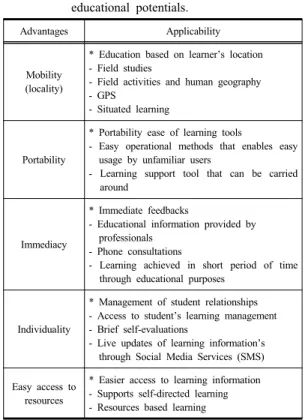
Mobile device’s potentials of its education applicability were deduced from the advantages of mobile devices as sown in Table 1.
Table 1. Advantages of Mobile Devices and its educational potentials.
Advantages Applicability
Mobility (locality)
* Education based on learner’s location - Field studies
- Field activities and human geography - GPS
- Situated learning
Portability
* Portability ease of learning tools
- Easy operational methods that enables easy usage by unfamiliar users
- Learning support tool that can be carried around
Immediacy
* Immediate feedbacks
- Educational information provided by professionals
- Phone consultations
- Learning achieved in short period of time through educational purposes
Individuality
* Management of student relationships - Access to student’s learning management - Brief self-evaluations
- Live updates of learning information’s through Social Media Services (SMS)
Easy access to resources
* Easier access to learning information - Supports self-directed learning - Resources based learning
The mobile device’s applicability to educational purposes were as follows[4]. Firstly, the utilization of mobility. Student were not limited to school locales to access their educational resources and hence students were able to continue with their learning regardless of
the location with unrestricted access to educational resources. Secondly, utilization of portability and immediacy. Mobile devices can be utilized as an educational support tool as students can access necessary information at any time and even the inexperienced users can easily learn how to use the device as it enables the user to carry it at all times.
Thirdly, the interactions of learner to learner and teacher to learner were encouraged. Mobile devices use wireless internet and hence allowed the user to connect to school’s discussion page and allows live communications with other students or with a teacher through their mobile phones. Fourthly, it’s secure but is able to bring out individuality. Students were able to access their private learning information and grades.
Furthermore, they were able to receive their academic progress and learning information through SMS.
Fifthly, it should consider changing information presentation of learning styles in regards to different learning types.
2.2 Plan of m-learning teaching-learning Designs.
2.2.1 Development process of m-learning contents.
M-learning contents development figure for PBL, showing in Figure 1 used incorporated Dick & Carey’s [5] and Trop & Sage’s teaching and learning figures of PBL[10].
Fig. 1. m-Learning Development Process
2.2.2 Process of PBL
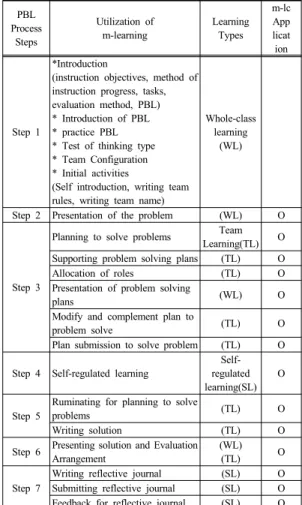
PBL teaching model of m-learning contents(m-lc) was developed on basis of Barrow & Myers’ suggested
PBL teaching model and model proposed by Kang was utilized and modified to produce the plan as shown in Table 2. [6-7].
Table 2. PBL Teaching Model of m-learning contents.
PBL Process
Steps
Utilization of m-learning
Learning Types
m-lc App licat ion
Step 1
*Introduction
(instruction objectives, method of instruction progress, tasks, evaluation method, PBL)
* Introduction of PBL
* practice PBL
* Test of thinking type
* Team Configuration
* Initial activities
(Self introduction, writing team rules, writing team name)
Whole-class learning
(WL)
Step 2 Presentation of the problem (WL) O
Step 3
Planning to solve problems Team Learning(TL) O Supporting problem solving plans (TL) O
Allocation of roles (TL) O
Presentation of problem solving
plans (WL) O
Modify and complement plan to
problem solve (TL) O
Plan submission to solve problem (TL) O
Step 4 Self-regulated learning
Self- regulated learning(SL)
O
Step 5
Ruminating for planning to solve
problems (TL) O
Writing solution (TL) O
Step 6 Presenting solution and Evaluation Arrangement
(WL)
(TL) O
Step 7
Writing reflective journal (SL) O Submitting reflective journal (SL) O Feedback for reflective journal (SL) O
To Utilize M-learning of Table 2., here is the step-by-step process : Step 1, Introduce the PBL, Apply the PBL, do the thinking type Test, Configurate the Team, Introduce oneself. Formulate the Group rules and Make the Group’s Name. Step 2, Present the problem. Step 3, Plan in solving the problem, Supporting plans in problem solving, Allocation of roles, Presentation of plans in problem solving, Modifying and complementing plans in problem solving, and Plan Submission of Problem Solving.
Step 4, Self-regulated learning. Step 5, Ruminate the
PBL Process
Steps
Activities Implementation of Contents
Step 1
*Introduction
(instruction objectives, method of instruction progress, tasks, evaluation method, PBL)
* Introduction of PBL
* practice PBL
* Test of thinking type
* Team Configuration
* Initial activities
(Self introduction, writing team rules, writing team name)
* Menu : Notice
* Menu : Learning Resources
*Menu
:Assignments room
Step 2 Presentation of the problem * Menu : Selection Problem
Step 3
Planning to solve problems
*Menu
:Assignments room
* Menu : Learning Resources Supporting problem solving
plans
Allocation of roles
Presentation of problem solving plans
Modify and complement plan to problem solve
Plan submission to solve problem
Step 4 Self-regulated learning
* Menu : Learning Resources
* Menu : Question
Step 5
Ruminating for planning to
solve problems *Menu
:Assignments room
*Menu :Study room Writing solution
Step 6
Presenting solution and Evaluation
Arrangement
Step 7
Writing reflective journal *Menu : reflective journal
*Menu
:Assignments room Submitting reflective journal
Feedback for reflective journal
plan of solving the problems with a solution. Step 6, Presentation of the solution and the Evaluation agreement. Step 7, Write and Submit a Reflective Journal and a Feedback about it.
Learning Types of Step 1 and Step 2 is Whole-class learning(WL). Learning Types of Step 3 are Team Learning(TL), (TL), (TL), (TL), (WL), (TL) and (TL).
Learning Type of Step 4 is Self-regulated learning(SL).
Learning Types of Step 5 are Team Learning(TL) and (TL). Learning Types of Step 6 are (WL) and (TL).
Learning Types of Step 7 are (SL), (SL) and (SL).
2.2.3 M-Learning Application.
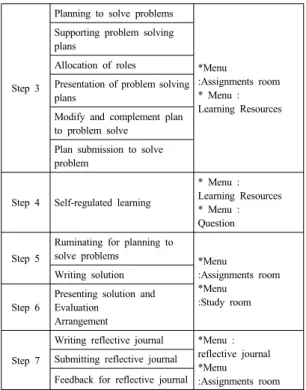
The application strategies for m-learning based on PBL procedures and its advantages are shown in Table 3. Based on contents obtained from m-learning application strategies, teaching and learning course plan was made. Course plan is to be implemented to classes[8-12].
The Implementation of Contents of Table 3. were as follows. Step 1, we implement Notice, Learning Resources and Assignments room. Step 2, we implement Selection Problem. Step 3, we implement Assignments room and Learning Resources. Step 4, we implement Learning Resources and Question. Step 5 and Step 6, we implement Assignments room and :Study room. Step 7, we implement reflective journal and Assignments room.
Table 3. M-learning Application Strategies for PBL
3. Conclusion
This paper aimed to design a computer course plan of teaching-learning for m-learning in problem based learning environments. The research findings were as follows. Firstly, educational contents were provided that utilizes mobile devices as a learning tool. The provided educational contents were designed for effective usage on mobile devices such as smartphones, therefore, mobile devices are suitable as learning tools.
Secondly, provided educational contents were designed for problem based learning. PBL problems (for computer engineering course) were made with principles of teaching plans. The learning objectives were achieved through the problem solving progress of learners and through learner’s self-directed and cooperative learnings. Thirdly, by considering the immediacy and portability that mobile devices feature, learning contents provided easy access to learning and resources. Due to the portability and wireless internet access advantages of smartphones, it enabled the
learners to connect to the learning contents without being restricted by their location. Furthermore, by providing smartphone based contents, it engaged leaner’s interest as well as engaging them in a self-directed learning. Such implication gives arise to achieving the ultimate educational goal of School of Engineering to train a professional intellectual with creative problem solving abilities.
References
[1] Sue-Jen Chen, Instructional Design Strategies for Intensive Online Courses :
An Objectivist-Constructivist Blended Approach vol. 6, No. 1, Spring 2007.
[2] Salman Khan, The one world schoolhouse, pp. 1, 2012.
[3] Joseph Hitt, Problem-Based Learning in Engineering, 2010.
[4] Yukiko Inoue, Online education and lifelong learning, 2007.
[5] EduCitizenship 2020, international consulting group made up of Carla Cross, Karen Hamilton, Debbie Plested and Mary Rezk. Avialable from:
https://education-2020.wikispaces.com/Blended+Learning , 2010.
[6] Margaret Driscoll, Blended Learning: Let's Get Beyond the Hype, May 2012.
[7] Advances in Health Sciences Education, December 2009.
[8] Abdallah M. Hasna, Problem Based Learning in Engineering Design, 2013.
[9] The Psychology of Learning Environments EDUCAUSE Review, vol. 41, no. 6, 2006.
[10] Keunsoo Lee, Applying the PBL Instructional Design Creative Engineering Design Study, Journal of the Korea Academia- Industrial cooperation Society, vol. 15 no. 7, pp. 4573-4579, 2014.
DOI: https://doi.org/10.5762/KAIS.2014.15.7.4573 [11] Oyunsuren Buriad, Mongolian online education
environment, research and design, 2013.
[12] Jong Im Chue, Learning through PBL, pp. 119-120, 2010.
[13] Sung-Eun Lee, Yoon-Jung Huh, Community-Based Art Project Using PBL and Google Maps, Asia-pacific Journal of Multimedia Services Convergent with Art, Humanities, and Sociology, vol. 7, no. 10, pp. 169-181, Oct. 2017.
DOI: http://dx.doi.org/10.14257/ajmahs.2017.10.06 [14] Jung-Ae Nam, The Case Analysis of Recent Mobile
Game-based English Learning and the Study of Teaching Application, Asia-pacific Journal of Multimedia Services Convergent with Art, Humanities, and Sociology, vol. 7,
no. 11, pp. 387-394, Nov. 2017.
DOI: http://dx.doi.org/10.14257/ajmahs.2017.11.67
Keunsoo Lee [Regular member]
•Feb. 1983 : Soongsil Univ., Computer Science, MS
•Aug. 1993 : Soongsil Univ., Computer Science, PhD
•Feb. 1989 ∼ current : Hankyong Univ., Dept. of Computer Science and Engineering, Professor
<Research Interests>
Pattern recognition, Knowledge-based system, Motion understanding, Video search, PBL, Educational engineering, and Engineering design