Sung-Soo Chung et al.
1122 Asian Spine J 2016;10(6):1122-1131
A Nationwide Retrospective Study of Opioid Management Patterns in 2,468 Patients with Spinal Pain in Korea
Sung-Soo Chung
1, Chun-Kun Park
2, Kyu-Jung Cho
3, Kyoung Hyo Choi
4, Jin-Hyok Kim
5, Sung-Bum Kim
6, Sung-Uk Kuh
7, Jae Chul Lee
8, Jae Hyup Lee
9, Kyu-Yeol Lee
10, Sun-Ho Lee
11, Seong-Hwan Moon
12,
Si-Young Park
13, Jae Hang Shim
14, Byung-Chul Son
15, Myung Ha Yoon
16, Hye-Jeong Park
171Department of Orthopedic Surgery, Samsung Medical Center, Sungkyunkwan University School of Medicine, Seoul, Korea
2Department of Neurosurgery, Good Doctor Teun Teun Hospital, Anyang, Korea
3Department of Orthopedic Surgery, Inha University Hospital, Inha University School of Medicine, Incheon, Korea
4Department of Rehabilitation Medicine, Asan Medical Center, University of Ulsan College of Medicine, Seoul, Korea
5Department of Orthopedic Surgery, Inje University Sanggye Paik Hospital, Inje University College of Medicine, Seoul, Korea
6Department of Neurosurgery, Kyung Hee University Medical Center, Kyung Hee University School of Medicine, Seoul, Korea
7Department of Neurosurgery, Gangnam Severance Hospital, Yonsei University Medical Center, Seoul, Korea
8Department of Orthopedic Surgery, Soonchunhyang University Hospital, Soonchunhyang University College of Medicine, Seoul, Korea
9Department of Orthopedic Surgery, SMG-SNU Boramae Medical Center, Seoul, Korea
10Department of Orthopedic Surgery, Dong-A University Medical Center, Dong-A University College of Medicine, Busan, Korea
11Department of Neurosurgery, Samsung Medical Center, Sungkyunkwan University School of Medicine, Seoul, Korea
12Department of Orthopedic Surgery, Severance Hospital, Yonsei University Health System, Seoul, Korea
13Department of Orthopedic Surgery, Korea University Anam Hospital, Korea University College of Medicine, Seoul, Korea
14Department of Anesthesia and Pain Medicine, Hanyang University Guri Hospital, Hanyang University College of Medicine, Guri, Korea
15Department of Neurosurgery, Seoul St. Mary’s Hospital, College of Medicine, The Catholic University of Korea, Seoul, Korea
16Department of Anesthesiology and Pain Medicine, Chonnam National University Hospital, Chonnam National University Medical School, Gwangju, Korea
17Mundipharma Korea Ltd., Seoul, Korea
Study Design: Retrospective patient data collection and investigator survey.
Purpose: To investigate patterns of opioid treatment for pain caused by spinal disorders in Korea.
Overview of Literature: Opioid analgesic prescription and adequacy of consumption measures in Korea have markedly increased in the past decade, suggesting changing patterns in pain management practice; however, there is lack of integrated data specific to Korean population.
Methods: Patient data were collected from medical records at 34 university hospitals in Korea. Outpatients receiving opioids for pain caused by spinal disorders were included in the study. Treatment patterns, including opioid types, doses, treatment duration, outcomes, and adverse drug reactions (ADRs), were evaluated. Investigators were interviewed on their perceptions of opioid use for spinal disorders.
Results: Among 2,468 analyzed cases, spinal stenosis (42.8%) was the most common presentation, followed by disc herniation (24.2%) and vertebral fracture (17.5%). In addition, a greater proportion of patients experienced severe pain (73.9%) rather than moderate (19.9%) or mild (0.7%) pain. Oxycodone (51.9%) and fentanyl (50.8%) were the most frequently prescribed opioids; most patients
Copyright Ⓒ 2016 by Korean Society of Spine Surgery
This is an Open Access article distributed under the terms of the Creative Commons Attribution Non-Commercial License (http://creativecommons.org/licenses/by-nc/3.0/) which permits unrestricted non-commercial use, distribution, and reproduction in any medium, provided the original work is properly cited.
Asian Spine Journal • pISSN 1976-1902 eISSN 1976-7846 • www.asianspinejournal.org
Received Oct 27, 2016; Revised Nov 18, 2016; Accepted Nov 18, 2016 Corresponding author: Chun-Kun Park
Department of Neurosurgery, Good Doctor Teun Teun Hospital, 775 Gyeongsu-Daero Dongan-gu, Anyang 14041, Korea
Tel: +82-31-8086-8357, Fax: +82-2-534-4799, E-mail: [email protected]
ASJ A SJ
Clinical Study Asian Spine J 2016;10(6):1122-1131 • https://doi.org/10.4184/asj.2016.10.6.1122
Introduction
Spine and back pain are among the most common sources of chronic noncancer pain among adults. Low back pain is a globally prevalent concern, with an estimated lifetime prevalence of approximately 40% [1]. The UK National Institute for Health and Care Excellence and the Ameri- can College of Physicians/American Pain Society (ACP/
APS) guidelines provide recommendations for managing chronic low back pain through various pharmacologi- cal and nonpharmacological treatment modalities [2,3].
Despite the variety of treatment modalities in use, a con- siderable amount of needs in chronic pain management remain unmet. For example, pain-relieving medications were estimated to be the most commonly prescribed pharmacotherapy in ambulatory care in the United States (US) [4].
Pharmacotherapies recommended by the ACP/APS guidelines for subacute and chronic back pain include ac- etaminophen, benzodiazepine, tramadol, and opioids [2].
Opioids are considered effective for reducing nociceptive pain and are moderately effective for neuropathic pain;
however, tolerability issues such as nausea and vomiting tend to limit their application in clinical practice. Despite these limitations, opioids can be both effective and safe, if appropriately used [3,5].
Long-term use of opioids for chronic noncancer pain remains controversial owing to concerns regarding an- algesic tolerance and drug dependence [6-10]. The ratio of opioid to total analgesic use in Korea is still relatively low compared with Western countries. In a study evaluat- ing the adequacy of opioid use at the national level with the Adequacy of Consumption Measure (ACM), Korea was listed with a 47.0% adequacy score for opioid con-
sumption in 2010 [11]. This implies that less than half of the patients in Korea who required opioid treatment actually received it. In 2010, the adequacy scores of other countries were as follows: USA, 229.7%; Canada, 312.6%;
France, 73.5%; UK, 66.4%; Japan, 15.5%; and China, 1.2%
[11]. This indirectly indicates limited usage of opioids for management of spinal pain in Korea.
Nevertheless, opioid usage in Korea is growing rapidly.
The adequacy level of opioid consumption, as indicated by the ACM, has increased by over six-fold during the 2006–
2010 period [11,12]. Such a remarkable improvement suggests changing attitudes toward pain management [9]. Considering the lack of integrated data specific to the Korean population, we sought to better understand the ef- fectiveness and safety of opioid use in the management of different types of spinal pain arising from multiple causes [5,13].
This retrospective study was designed to investigate the following: (1) patterns of opioid usage in patients with pain caused by spinal disorders; (2) physicians’ percep- tions on opioid usage; and (3) opioid analgesic usage for spinal disorders.
Materials and Methods
1. Patients
Since this study was a retrospective study, the Institutional Review Boards of the 34 participating hospitals approved the study and granted waiver for collecting informed con- sent from patients. All information was anonymized in order to maintain patient confidentiality. Data were col- lected from medical records of 34 university hospitals in Korea. The list of patients was acquired from August 2011 were prescribed relatively low doses. The median duration of opioid treatment was 84 days. Pain relief was superior in patients with longer treatment duration (≥2 months) or with nociceptive pain than in those with shorter treatment duration or with neuropathic or mixed-type pain. ADRs were observed in 8.6% of cases. According to the investigators’ survey, “excellent analgesic effect” was a perceived advantage of opioids, while safety concerns were a disadvantage.
Conclusions: Opioid usage patterns in patients with spinal disorders are in alignment with international guidelines for spinal pain management. Future prospective studies may address the suitability of opioids for spinal pain treatment by using appropriate objec- tive measurement tools.
Keywords: Spine; Spinal diseases; Chronic pain; Opioid
database, which included patients who visited hospitals due to spinal disorders in November 2010 or earlier, with an aim to collect data of more than 50 patients per investi- gator. In outpatient clinics with <50 patients in November 2010, patients from the preceding month were included until the number reached 50. The investigators reviewed patient medical records and extracted information includ- ing demographics, diagnoses, type and dose of the pre- scribed opioids, and comorbidities. Korean outpatients of both sexes, aged ≥20 years, who received opioids at least once to treat pain arising from spinal diseases in Novem- ber 2010 or earlier were eligible for inclusion.
Exclusion criteria were used to eliminate cases wherein external factors may have influenced clinical decisions regarding opioid usage. Any patient participating in an in- terventional study during the study period was excluded.
In addition, patients with cancer-related pain caused by primary or metastatic spinal cancer were excluded. In or- der to minimize selection bias, 50 consecutive cases were enrolled per investigator from the patients who met the selection criteria.
2. Definitions
Spinal disorders assessed in this study included, but were not limited to, spinal stenosis, disc herniation, vertebral fracture, persistent postoperative back pain, unspecified back pain, intervertebral disc disorders, spondylolisthesis, spinal cord injury, and spinal infection. Diagnosis was considered as a multiple-option item in the case report form because the medical records often described more than one spinal condition per patient.
Opioid analgesics included, but were not limited to, oxycodone (immediate release [IR], prolonged release [PR], and other composite formulations), fentanyl, hy- dromorphone, and codeine in combination with acet- aminophen and ibuprofen. These commercially available medications are classified as “narcotics” by the Act on the Control of Narcotics, the Enforcement of Decree of the Act on the Control of Narcotics, and other relevant laws in Korea. A codeine combination is classified as a narcotic in Korea, but codeine is otherwise classified as a weak opioid according to the analgesic ladder published by the World Health Organization [14].
Pain intensity was recorded using a numeric rating scale (NRS [15,16]) where available. NRS scores were converted into following categories: “severe pain” for scores 7–10,
“moderate pain” for scores 4–6, and “mild pain” for scores 1–3. In cases where no NRS values were recorded, pain in- tensity was assessed as severe, moderate, or mild accord- ing to the descriptions in the medical records. Pain in- tensity was examined at the initiation of opioid treatment and 1 and 2 months after treatment initiation. Moreover, adverse drug reactions (ADRs) after opioid administra- tion were recorded.
3. Investigators’ questionnaire
Participating investigators and subinvestigators were in- terviewed to assess their perceptions regarding the usage of opioid analgesics. Investigators were also asked about their concerns regarding opioid dependency and their ex- periences with dependent patients. In addition, they were asked to suggest actions or measures that may improve opioid usage in Korea.
4. Statistical analyses
Descriptive statistics were used to summarize patient characteristics and opioid treatment patterns. Means and standard deviations or medians and ranges were used for continuous data. Categorical data were presented as numbers and percentages. The number of cases and the percentages of ADRs were presented as well. Results of the investigators’ questionnaire were descriptively sum- marized.
Pearson’s chi-square test was used to identify statisti- cally significant relationships (1) between type of pain ex- perienced and presence/absence of pain relief with opioid treatment and (2) between duration of opioid treatment and presence/absence of pain relief. All reported p-values were two sided; p-values <0.05 were considered signifi- cant. Statistical analyses were performed using SAS ver. 9.1 (SAS Institute, Cary, NC, USA).
Results
1. Baseline characteristics
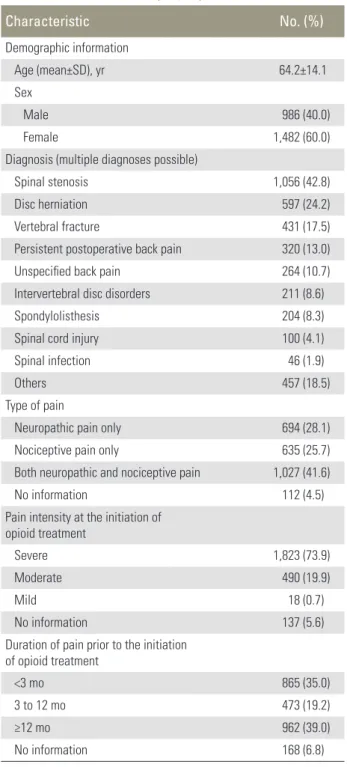
In total, data regarding 2,483 cases were collected from 34 hospitals. Of these, 2,468 cases were analyzed after exclud- ing 15 cases with protocol violations. Table 1 summarizes patient characteristics. The study population contained more female (60.0%) than male (40.0%) patients, and
the mean age was 64.2 years. Spinal stenosis (42.8%) was the most common diagnosis, followed by disc herniation (24.2%), vertebral fracture (17.5%), persistent postopera- tive back pain (13.0%), and unspecified back pain (10.7%).
Of the 2,468 patients analyzed, 694 (28.1%), 635 (25.7
%), and 1,027 (41.6%) patients reported neuropathic, no- ciceptive, and mixed (both neuropathic and nociceptive)
pain, respectively. Before initiating opioid therapy, 1,823 (73.9%) patients experienced severe pain, 490 (19.9%) ex- perienced moderate pain, whereas 18 (0.7%) experienced mild pain. Only 593 (24.0%) patients underwent an NRS assessment of pain intensity; the mean pain score was 7.5. The results majorly indicated severe pain levels in the study population.
The duration of pain before initiating opioid treatment was <3 months in 865 (35.0%) patients, 3–12 months in 473 (19.2%) patients, and ≥12 months in 962 (39.0%) pa- tients (Table 1).
2. Nonopioid analgesia before initiation of opioid treatment
Over half of the patients (1,389/2,468; 56.3%) were treated with nonopioid analgesics before receiving opi- oids for spinal pain. Of these, 847 (34.3%) patients had received weak opioids (including tramadol), 639 (25.9%) patients had received nonsteroidal anti-inflammatory drugs (NSAIDs), and 264 (10.7%) patients had received anticonvulsants.
3. Opioid treatment patterns
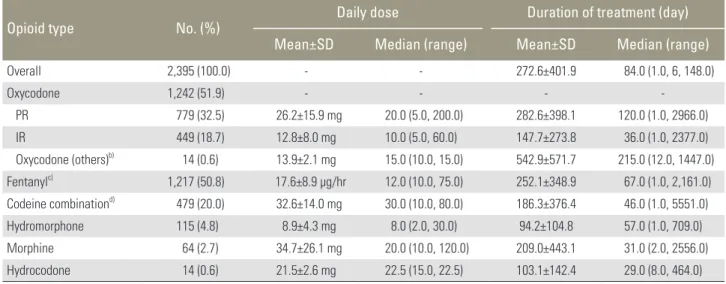
Prescriptions were classified as regular or pro re nata (PRN). In 2,060 (83.5%) patients, opioid therapy was administered regularly, whereas in 408 (16.5%) patients, it was prescribed only when required. The opioid types prescribed, daily doses, and treatment duration for each opioid analgesic are summarized in Table 2. Oxycodone (PR, IR, and other composite drugs combined) was the most commonly prescribed drug (in 51.9% patients), followed by fentanyl (50.8%) and codeine combinations (20.0%). The median daily dose of fentanyl was 12.0 μg/
hr (range, 10.0–75.0 μg/hr), while the median daily doses of oxycodone PR and IR were 20.0 mg (range, 5.0–200.0 mg) and 10.0 mg (range, 5.0–60.0 mg), respectively. The median daily dose of codeine combinations was 30.0 mg (range, 10.0–80.0 mg). The patients in this study had re- ceived relatively low-dose opioid prescriptions according to the recommendations of the Korean Ministry of Health and Welfare’s 2012 Cancer Pain Treatment Guideline [17].
The median treatment duration of fentanyl, oxycodone PR, and codeine combinations was 67, 120, and 46 days, respectively.
Table 1. Patient characteristics (n=2,468)
Characteristic No. (%)
Demographic information
Age (mean±SD), yr 64.2±14.1
Sex
Male 986 (40.0)
Female 1,482 (60.0)
Diagnosis (multiple diagnoses possible)
Spinal stenosis 1,056 (42.8)
Disc herniation 597 (24.2)
Vertebral fracture 431 (17.5)
Persistent postoperative back pain 320 (13.0)
Unspecified back pain 264 (10.7)
Intervertebral disc disorders 211 (8.6)
Spondylolisthesis 204 (8.3)
Spinal cord injury 100 (4.1)
Spinal infection 46 (1.9)
Others 457 (18.5)
Type of pain
Neuropathic pain only 694 (28.1)
Nociceptive pain only 635 (25.7)
Both neuropathic and nociceptive pain 1,027 (41.6)
No information 112 (4.5)
Pain intensity at the initiation of opioid treatment
Severe 1,823 (73.9)
Moderate 490 (19.9)
Mild 18 (0.7)
No information 137 (5.6)
Duration of pain prior to the initiation of opioid treatment
<3 mo 865 (35.0)
3 to 12 mo 473 (19.2)
≥12 mo 962 (39.0)
No information 168 (6.8)
SD, standard deviation.
4. Opioid treatment outcomes and relationships with pain type and treatment duration
Achievement of pain relief with opioid treatment was significantly related to the type of pain. The proportion of patients experiencing pain relief differed across the three types of pain, and the difference was significant (p<0.0001) (Table 3). The proportion of patients who experienced pain relief was highest in the group with nociceptive pain alone (63.3%), followed by that with neuropathic pain alone (56.5%) and that with mixed-type pain (47.0%) (Table 3).
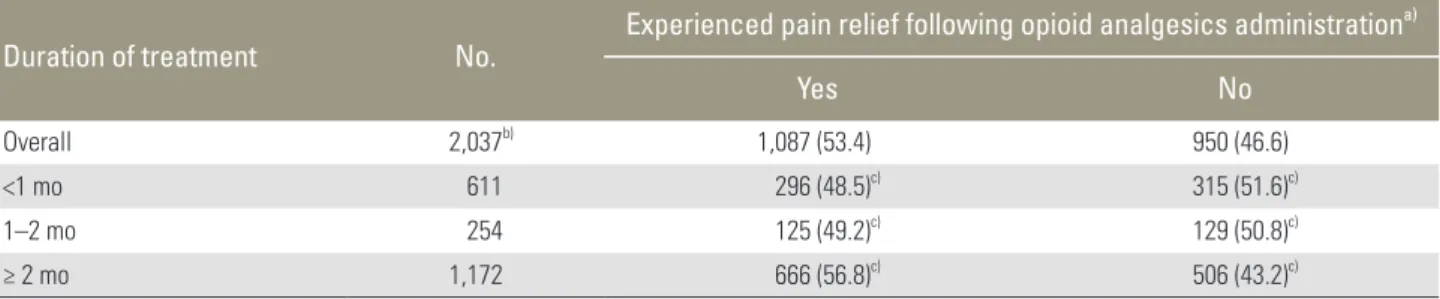
Moreover, achievement of pain relief was significantly related to opioid treatment duration (<1 month, 1–2 months, and ≥2 months); statistically significant differ-
ences were noted across all three treatment duration cat- egories (p=0.0013) (Table 4). In comparison with shorter treatment durations, treatment duration of ≥2 months resulted in a greater proportion of patients experiencing pain relief (Table 4).
5. Concomitant treatment for spinal pain management Of the 2,468 patients, 1,467 (59.4%) patients received concomitant treatment with surgery, physical therapy, or nonsurgical interventions for pain control in addition to opioid therapy. Concomitant analgesics were prescribed in 1,513 (61.3%) patients. The most frequently prescribed concomitant drug was tramadol in 779 (31.6%) patients, followed by NSAIDs in 685 (27.8%) patients and anticon- Table 2. Opioid types, dosages and treatment durations (n=2,395a))
Opioid type No. (%) Daily dose Duration of treatment (day)
Mean±SD Median (range) Mean±SD Median (range)
Overall 2,395 (100.0) - - 272.6±401.9 84.0 (1.0, 6, 148.0)
Oxycodone 1,242 (51.9) - - - -
PR 779 (32.5) 26.2±15.9 mg 20.0 (5.0, 200.0) 282.6±398.1 120.0 (1.0, 2966.0)
IR 449 (18.7) 12.8±8.0 mg 10.0 (5.0, 60.0) 147.7±273.8 36.0 (1.0, 2377.0)
Oxycodone (others)b) 14 (0.6) 13.9±2.1 mg 15.0 (10.0, 15.0) 542.9±571.7 215.0 (12.0, 1447.0) Fentanylc) 1,217 (50.8) 17.6±8.9 μg/hr 12.0 (10.0, 75.0) 252.1±348.9 67.0 (1.0, 2,161.0) Codeine combinationd) 479 (20.0) 32.6±14.0 mg 30.0 (10.0, 80.0) 186.3±376.4 46.0 (1.0, 5551.0)
Hydromorphone 115 (4.8) 8.9±4.3 mg 8.0 (2.0, 30.0) 94.2±104.8 57.0 (1.0, 709.0)
Morphine 64 (2.7) 34.7±26.1 mg 20.0 (10.0, 120.0) 209.0±443.1 31.0 (2.0, 2556.0)
Hydrocodone 14 (0.6) 21.5±2.6 mg 22.5 (15.0, 22.5) 103.1±142.4 29.0 (8.0, 464.0)
SD, standard deviation; PR, prolonged release; IR, immediate release.
a)Data on the type of opioids, dosages and treatment durations were not obtainable from 73 patients; b)Oxycodone (others) indicates composite drugs;
c)Units for fentanyl are expressed as μg/hr; d) The dose refers to the quantity of codeine in the codeine combination.
Table 3. Proportion of patients experiencing pain relief with opioid analgesic treatment by type of pain (n=1,945)
Type of pain No. Experienced pain relief with opioid analgesic treatmenta)
Yes No
Overall 1,945b) 1,055 (54.2) 890 (45.8)
Nociceptive pain only 504 319 (63.3)c) 185 (36.7)c)
Neuropathic pain only 620 350 (56.5)c) 270 (43.5)c)
Both neuropathic and nociceptive pain 821 386 (47.0)c) 435 (53.0)c)
Values presented in parentheses are %.
a)Pearson’s chi-square test was used to test for statistically significant association between type of pain and experience of pain relief with treat- ment (Yes/No) (p=0.001); b) Data on the type of pain and experience of pain relief (Yes/No) were not obtainable for 523 patients; c) Percentages given in brackets indicate the proportion that experienced pain relief (Yes/No) for each type of pain.
vulsants in 389 (15.8%) patients (Table 5).
6. Investigator survey results
Investigators’ perceptions regarding opioid treatment for spinal disorders are presented in Table 6. In total, 75 in- vestigators and subinvestigators responded to the survey.
Of these respondents, 30 (40.0%) had expertise in ortho- pedics, 25 (33.3%) in neurosurgery, 18 (24.0%) in anesthe- siology and pain medicine, and 2 (2.7%) in rehabilitation
medicine.
Among these, 72 (96.0%) respondents perceived “excel- lent analgesic effect” as the primary advantage of opioid analgesics in outpatient clinics; 50 (66.7%) investiga- tors responded that “concern for early side effects” was a disadvantage of opioid analgesics. “Long-term safety concerns including drug dependence” were chosen by 34 (45.3%) respondents, and 60 (80.0%) investigators had experienced patients with opioid dependence; however, most (81.7%) investigators answered that true cases of Table 4. Proportion of patients experiencing pain relief with opioid analgesic treatment by duration of treatment (n=2,037)
Duration of treatment No. Experienced pain relief following opioid analgesics administrationa)
Yes No
Overall 2,037b) 1,087 (53.4) 950 (46.6)
<1 mo 611 296 (48.5)c) 315 (51.6)c)
1–2 mo 254 125 (49.2)c) 129 (50.8)c)
≥ 2 mo 1,172 666 (56.8)c) 506 (43.2)c)
Values presented in parentheses are %.
a)Pearson’s chi-square test was used to test for statistically significant association between opioid therapy duration and experience of relief (Yes/
No) (p=0.013); b) Data on the duration of opioid therapy and experience of pain relief (Yes/No) were not obtainable for 431 patients; c)Percentages given in brackets indicate the proportion experiencing pain relief (Yes/No) for each treatment duration category.
Table 5. Concomitant treatment for management of spinal pain in addition to opioid treatment (n=2,468)
Category (details) No. (%)
Concomitant non-pharmacological therapy for management of spinal pain other than opioid treatment
Yes 1,467 (59.4)
Non-surgical intervention 927 (37.6)
Surgical treatment 521 (21.1)
Physical therapy 439 (17.8)
Chinese medicine (acupuncture, moxibustion,
heat/ice pack, herbal medicine) 53 (2.1)
Others 100 (4.1)
No 897 (36.4)
No information 104 (4.2)
Concomitant pharmacotherapy for management of spinal pain besides opioid treatment
Yes 1,513 (61.3)
Tramadol and tramadol Combinations 779 (31.6)
Non-steroidal anti-inflammatory drugs 685 (27.8)
Anticonvulsants 389 (15.8)
Others 404 (16.4)
No 955 (38.7)
No information 0 (0.0)
NSAIDs, non-steroidal anti-inflammatory drugs.
drug dependence were rarely observed.
For improved use of opioid analgesics, a majority of investigators suggested solutions such as “development of drugs with fewer side effects and easier titration” (76.0%) and “guidelines and clinical data applicable to the Korean population” (70.7%).
7. Adverse drug reactions
Of the 2,468 patients eligible for analysis, 211 patients (of 2,468 [8.6%] patients, 259 cases) experienced ADRs wherein opioid analgesic-related causality could not be ruled out. ADR severity was mild in 49.7% (157/259) cas- es, moderate in 21.2% (67/259) cases, and severe in 11.1%
(35/259) cases. The three most frequently reported ADRs were vomiting, constipation, and dizziness (Table 7).
Discussion
This study aimed to provide an original integrated set of Table 6. Investigators’ perceptions and suggestions regarding opioid analgesic use in Korea (n=75)
Category (details) No. (%)a)
Perceived advantages of opioid analgesic prescription in outpatient clinics
Excellent analgesic effect 72 (96.0)
Useful for controlling persistent pain following surgery 42 (56.0)
Useful for patients in whom surgery is prohibitively difficult 36 (48.0)
Useful as a conservative preoperative treatment 20 (26.7)
Others 1 (1.3)
Perceived drawbacks of opioid analgesic prescription in outpatient clinics
Concerns for early side effects 50 (66.7)
Long-term safety concerns, including drug dependence 34 (45.3)
Ongoing side effect concerns 33 (44.0)
Short reimbursement period 21 (28.0)
Complex administrative processes including issuance of opioid prescription 19 (25.3)
Burdensome procedure required for explanation to patients 18 (24.0)
Others 2 (2.7)
Suggestions for better opioid analgesic use
Development of drugs with fewer side effects and easier titration 57 (76.0)
Development of guidelines and better clinical data applicable to Koreans 53 (70.7)
Better administrative conditions including reimbursement and regulations 38 (50.7)
Meetings for idea exchange and education regarding analgesic use 28 (37.3)
Others 1 (1.3)
a)Respondents comprised 75 principal investigators and sub-investigators participating in this study. Areas of expertise include Orthopaedics, Neuro- surgery, Anaesthesiology and Pain Medicine, and Rehabilitation Medicine.
Table 7. Incidence of adverse drug reactions (n=2,468) Adverse drug reaction (ADR)a) No. (%) Total number of patients with ADRs 211 (8.6)
Vomiting 85 (3.4)
Constipation 64 (2.6)
Dizziness 30 (1.2)
Somnolence 15 (0.6)
Pruritus 12 (0.5)
Gastrointestinal disorder 7 (0.3)
Dyspepsia 5 (0.2)
Abdominal discomfort 3 (0.1)
Headache 3 (0.1)
Decreased appetite 3 (0.1)
a)ADRs considered as possibly related to the administration of opioid analgesics are shown in the table above. Multiple ADRs could be recorded for individual patients. Only the 10 most frequently reported ADRs are listed.
data on the issue of opioid treatment practice for spinal pain in Korea. Through a nationwide investigation to observe treatment patterns across the country, this study achieved its primary goals with a large cohort of 2468 pa- tients.
The management of spinal pain requires active treat- ment plans and implementation. Recommended treat- ment modalities for spinal pain management can be clas- sified into four categories: interventional pain therapies, complex medication (including opioids and neuropathic pain medications), high-intensity cognitive behavioral therapy-based programs, and spinal surgery [18]. Despite various treatment modalities, there has been very limited systematic research to guide and improve the use of opi- oid analgesics for managing spinal disorder-associated pain. This may be a reason for conservative opioid pre- scription practices. For example, an observational study that examined opioid use for spinal and radicular pain in 25,479 patients revealed that only 3.4% (867) patients were treated with opioids [6].
In a manual guiding the use of opioids for persistent pain, the British Pain Society (BPS) recommends strict restrictions on the use of strong opioids [19]. The guide- lines state that (1) opioids should not be used as a first- line treatment, (2) patients should be adequately informed about the long-term effects of opioids, including the pos- sibility of adverse events, (3) mental health history should be recorded before treatment to aid exclusion of patients with depression or substance misuse disorders, and (4) whenever possible, modified-release opioid formulations at regular intervals should be used. In addition, the BPS guidelines for low back pain recommend that the lowest dose possible should be used for the shortest time possible [18,19]. Other recent guidelines and physician resources for opioid prescription, such as guidelines from the Cen- ters for Disease Control and Prevention and the UK Royal College of Anaesthetists, state that opioids are not effec- tive for long-term use [20,21].
Our results indicate that the current prescribing prac- tice in Korea is generally in alignment with the BPS guidelines in terms of opioid dosage. Most cases in our study were prescribed daily doses of opioids that were in the lowest range recommended in the Korean Ministry of Health and Welfare’s Cancer Pain Treatment Guidelines [17]; however, our data also revealed that 50% of patients had received opioid analgesics for >3 months, which may be attributed to the lack of adequate treatment options for
chronic pain.
This study indicates that opioid analgesics are a more appropriate treatment option for nociceptive pain than for neuropathic or mixed-type pain. In general, opioids are known to be excellent pain relievers, particularly for noci- ceptive pain. In addition, higher opioid doses are needed more often for treatment of neuropathic pain than for no- ciceptive pain [22]. Therefore, the results from this study are in agreement with the existing knowledge; however, we note that our observations regarding the type of pain could be alternatively interpreted, that is, patients with neuropathic or mixed-type pain may generally not have had the opportunity to receive more optimal treatment with opioids or concomitant adjuvants to reach adequate levels of pain control.
To the best of our knowledge, there are no local reports dedicated to physician surveys investigating opioid usage for managing spinal pain. The results of our investigators’
survey suggest that Korean physicians adequately under- stand the efficacy parameters of opioid usage; however, they are concerned regarding the safety issues such as addiction although the ADRs from opioid usage in this study were limited to 8.6%, and there were no reports of actual addiction. These concerns may contribute to the modest opioid usage index in Korea, which is still below 50% [22]. Although the guidelines for use of opioids in cancer pain management are relatively well established [17] and adopted in clinical practice in Korea, use of opi- oids for noncancer pain treatment (including spinal dis- orders) is estimated to be much lower. As indicated by the investigators’ survey responses, there is need for more lo- cal clinical data and development of improved guidelines for use of opioids to treat spinal pain in Korea.
The NRS is a well-validated and preferred unidimen- sional self-report tool for pain assessment [23,24]; thus, it should be used more widely in clinical settings. Neverthe- less, in this study, NRS pain assessments were only record- ed for 24.0% of the 2,468 patients. Because the suitability of pain alleviation by opioid therapy cannot be fully sup- ported or rejected unless appropriate, standardized meth- ods for pain measurement are applied [5,13,15,16,25-27].
Our data imply that additional education is needed on regular assessment and documentation of pain in clinical practice.
We note several limitations inherent to the nature of the study. First, we only assessed patients who received opioid treatment for spinal disorders and did not examine the
entire spinal disorder population. Thus, it is difficult to analyze global factors that affect clinical decisions related to spinal pain management, for example, the data col- lected do not permit us to explain how clinical decisions were made on whether to prescribe opioid analgesics or to choose other treatment modalities. Second, certain pa- tients were receiving ongoing opioid treatment at the time of data collection and had not yet completed the full treat- ment course. For such patients, data for the entire treat- ment duration and ultimate outcomes of opioid treatment were not available at the point of data collection. Third, reporting of adverse events or ADRs may have been in- complete owing to the retrospective nature of the study.
Conclusions
To the best of our knowledge, this is the first large-scale report on patterns of opioid treatment in 2468 patients with spinal disorders in university hospitals across Korea.
The findings demonstrated an overall alignment of cur- rent practices in Korea with international guidelines for opioid-based management of spinal pain. In particular, the results may be a valuable local source of preliminary data for treatment guidelines on spinal disorders in Ko- rea. The findings underscore the importance of objective measurements and appropriate documentation of pain to guide opioid usage for management of spinal pain in Ko- rea.
Conflict of Interest
Hye-Jeong Park is an employee of Mundipharma Korea Ltd. All other authors have no relevant conflicts of interest to declare.
Acknowledgments
This study was sponsored by Mundipharma Korea Ltd.
We would like to thank the following investigators for their contributions to the study: Jae-Sung Ahn, Ki- Chan An, Hyun-Chul Choi, Sang-Sik Choi, Seung-Won Choi, Tai-Hyong Cho, Chun-Kee Chung, Ho-Gyun Ha, Changju Hwang, Soo-Bin Im, Sang-Ryong Jeon, Ju-Ho Jeong, Chang-Nam Kang, Dae-Hyun Kim, Dong-Hee Kim, Dong-Soo Kim, Eung-Ha Kim, Keung-Nyun Kim, Sang-Hyun Kim, Se-Hoon Kim, Seok-Woo Kim, Sang- Bong Ko, Ki-Hyung Koo, Kwang-Bok Lee, Jung-Hee Lee,
Sang-Eun Lee, Woo-Yong Lee, Francis Sahngun Nahm, Kun-Woo Park, Jin-Woo Shin, Sung-Eun Sim, Geun-Sung Song, Sang Hoon Yoon and Seung Hwan Yoon.
References
1. Hoy D, Bain C, Williams G, et al. A systematic review of the global prevalence of low back pain. Arthritis Rheum 2012;64:2028-37.
2. Chou R, Qaseem A, Snow V, et al. Diagnosis and treatment of low back pain: a joint clinical practice guideline from the American College of Physicians and the American Pain Society. Ann Intern Med 2007;
147:478-91.
3. National Institute for Health and Clinical Excellence.
Low back pain in adults: early management. Clinical guideline CG88 2009 [Internet]. London: National Institute for Health and Care Excellence: c2016 [cited 2016 Oct 10]. Available from: https://www.nice.org.
uk/guidance/cg88/resources/low-back-pain-in- adults-early-management-975695607493.
4. Raofi S, Schappert SM. Medication therapy in am- bulatory medical care: United States, 2003-04. Vital Health Stat 13 2006;(163):1-40.
5. Morlion B. Pharmacotherapy of low back pain:
targeting nociceptive and neuropathic pain compo- nents. Curr Med Res Opin 2010;27:11-33.
6. Fanciullo GJ, Ball PA, Girault G, Rose RJ, Hanscom B, Weinstein JN. An observational study on the preva- lence and pattern of opioid use in 25,479 patients with spine and radicular pain. Spine 2002;27:201-5.
7. Gadzhanova S, Bell JS, Roughead EE. What analge- sics do older people use prior to initiating oxycodone for non-cancer pain? A retrospective database study.
Drugs Aging 2013;30:921-6.
8. Pergolizzi J, Boger RH, Budd K, et al. Opioids and the management of chronic severe pain in the el- derly: consensus statement of an International Expert Panel with focus on the six clinically most often used World Health Organization Step III opioids (bu- prenorphine, fentanyl, hydromorphone, methadone, morphine, oxycodone). Pain Pract 2008;8:287-313.
9. Vallerand A, Nowak L. Chronic opioid therapy for nonmalignant pain: the patient’s perspective. Part I-- life before and after opioid therapy. Pain Manag Nurs 2009;10:165-72.
10. van Ojik AL, Jansen PA, Brouwers JR, van Roon EN.
Treatment of chronic pain in older people: evidence- based choice of strong-acting opioids. Drugs Aging 2012;29:615-25.
11. Duthey B, Scholten W. Adequacy of opioid analgesic consumption at country, global, and regional levels in 2010, its relationship with development level, and changes compared with 2006. J Pain Symptom Man- age 2014;47:283-97.
12. Seya MJ, Gelders SF, Achara OU, Milani B, Scholten WK. A first comparison between the consumption of and the need for opioid analgesics at country, region- al, and global levels. J Pain Palliat Care Pharmacother 2011;25:6-18.
13. Fine PG, Mahajan G, McPherson ML. Long-acting opioids and short-acting opioids: appropriate use in chronic pain management. Pain Med 2009;10 Suppl 2:S79-88.
14. Best Practice Advocacy Centre New Zealand. WHO Analgesic Ladder: which opioid to use at step two?
Best Pract J 2008;(18):20-3.
15. Breivik H, Cherny N, Collett B, et al. Cancer-related pain: a pan-European survey of prevalence, treat- ment, and patient attitudes. Ann Oncol 2009;20:1420- 33.
16. Breivik H, Collett B, Ventafridda V, Cohen R, Gal- lacher D. Survey of chronic pain in Europe: preva- lence, impact on daily life, and treatment. Eur J Pain 2006;10:287-333.
17. Korean Ministry of Health and Welfare. Cancer pain management guideline. 5th ed. Seoul: Korean Ministry of Health and Welfare; 2012.
18. Lee J, Gupta S, Price C, Baranowski AP; British Pain Society. Low back and radicular pain: a pathway for care developed by the British Pain Society. Br J An- aesth 2013;111:112-20.
19. British Pain Society. Opioids for persistent pain:
summary of guidance on good practice from the British Pain Society. Br J Pain 2012;6:9-10.
20. Dowell D, Haegerich TM, Chou R. CDC Guideline for Prescribing Opioids for Chronic Pain: United States, 2016. JAMA 2016;315:1624-45.
21. Royal College of Anaesthetists Faculty of Pain Medi- cine. Opioids Aware: A resource for patients and healthcare professionals to support prescribing of opioid medicines for pain [Internet]. London: The Royal College of Anaesthetists; [cited 2016 Oct 10].
Available from: https://www.fpm.ac.uk/faculty-of- pain-medicine/opioids-aware.
22. Ballantyne JC. Opioid analgesia: perspectives on right use and utility. Pain Physician 2007;10:479-91.
23. Briggs M, Closs JS. A descriptive study of the use of visual analogue scales and verbal rating scales for the assessment of postoperative pain in orthopedic pa- tients. J Pain Symptom Manage 1999;18:438-46.
24. Fosnocht DE, Chapman CR, Swanson ER, Donald- son GW. Correlation of change in visual analog scale with pain relief in the ED. Am J Emerg Med 2005;23:
55-9.
25. Breuer B, Fleishman SB, Cruciani RA, Portenoy RK.
Medical oncologists’ attitudes and practice in cancer pain management: a national survey. J Clin Oncol 2011;29:4769-75.
26. Gourlay DL, Heit HA, Almahrezi A. Universal pre- cautions in pain medicine: a rational approach to the treatment of chronic pain. Pain Med 2005;6:107-12.
27. Silvoniemi M, Vasankari T, Vahlberg T, Vuorinen E, Clemens KE, Salminen E. Physicians’ self-assessment of cancer pain treatment skills: more training re- quired. Support Care Cancer 2012;20:2747-53.