Safety and Immunogenicity of a New Trivalent Inactivated Split-virus Influenza Vaccine in Healthy Korean Children:
A Randomized, Double-blinded, Active-controlled, Phase III Study
We report results of a randomized, double-blinded, active-controlled, phase III study conducted to evaluate the immunogenicity and safety of a new trivalent inactivated split- virus influenza vaccine (GC501) manufactured by the Green Cross Corporation in Korea. A total of 283 healthy children aged 6 months to < 18 yr were randomized to receive either GC501 or control. Of the GC501 recipients, seroconversion occurred in 48.5% for A/H1N1, 67.7% for A/H3N2 and 52% for influenza B. The proportion of subjects who had post- vaccination hemagglutination-inhibition titers of 1:40 or greater was 90.7% for A/H1N1, 86.8% for A/H3N2 and 82.4% for influenza B in the GC501 recipients. No serious adverse events related to vaccination, or withdrawals because of adverse events were reported. The majority of solicited adverse events were mild in intensity. GC501 vaccine has good tolerability and favorable immunogenicity in children aged 6 months to < 18 yr. The addition of one more brand of influenza vaccine may allow for better global accessibility of vaccine for epidemics or future pandemics.
Key Words: Influenza Vaccines; Child; Immunogenicity; Safety Jin-Han Kang1, Chi-Eun Oh2, Jina Lee3,
Soo-Young Lee4, Sung-Ho Cha5, Dong Soo Kim6, Hyun-Hee Kim7, Jung-Hyun Lee8, Jin-Tack Kim9, Sang-Hyuk Ma10, Young-Jin Hong11, Hee Jin Cheong12 and Hoan-Jong Lee13
1Department of Pediatrics, Seoul St. Mary’s Hospital, The Catholic University of Korea, Seoul; 2Department of Pediatrics, Kosin University College of Medicine, Busan; 3Department of Pediatrics, Seoul National University Bundang Hospital, Seongnam; 4Department of Pediatrics, Incheon St. Mary’s Hospital, The Catholic University of Korea, Incheon; 5Department of Pediatrics, Kyunghee University College of Medicine, Seoul; 6Department of Pediatrics, Yonsei University College of Medicine, Seoul; 7Department of Pediatrics, Bucheon St. Mary’s Hospital, The Catholic University of Korea, Bucheon; 8Department of Pediatrics, St. Vincent’s Hospital, The Catholic University of Korea, Suwon; 9Department of Pediatrics, Uijeongbu St. Mary’s Hospital, The Catholic University of Korea, Uijongbu; 10Department of Pediatrics, Changwon Fatima Hospital, Changwon;
11Department of Pediatrics, Inha University College of Medicine, Incheon; 12Department of Internal Medicine, Korea University College of Medicine, Seoul; 13Department of Pediatrics, Seoul National University College of Medicine, Seoul, Korea Received: 28 June 2011
Accepted: 6 September 2011 Address for Correspondence:
Hoan-Jong Lee, MD
Department of Pediatrics, Seoul National University Children’s Hospital, 101 Daehak-ro, Jongno-gu, Seoul 110-769, Korea Tel: +82.2-2072-3633, Fax: +82.2-745-4703
E-mail: [email protected]
This work was supported by a Seoul National University Hospital grant (no. 0620082748), that was underwritten by the Green Cross Corporation, Yongin, Republic of Korea (2008).
http://dx.doi.org/10.3346/jkms.2011.26.11.1421 • J Korean Med Sci 2011; 26: 1421-1427
INTRODUCTION
Because children have a high infection rate during community outbreaks of influenza and have an important role in transmis- sion of influenza (1, 2), sufficient vaccination coverage among children can reduce age-specific and population-level illness attack rates (3). In Korea, annual influenza immunization for all children 6 months through 59 months of age and children who
are at increased risk of severe complications from influenza vi- ral infection is included in the national immunization program.
Influenza immunization for healthy children ≥ 60 months of age is recommended as an optional vaccine by the Korean Pe- diatric Society and the decision for administration can be made by their parents or physicians.
The influenza vaccine use in Korea has increased and the num- ber of doses distributed/1,000 total population each year in 2003
reached the highest level in the world (4). However, all influenza vaccines were imported from manufacturers located in vaccine- producing countries. Recently Green Cross Corporation (Yon- gin, Republic of Korea) completed the influenza vaccine plant in Hwasun, Jeonnam Province, Korea. The first domestically de- veloped, seasonal, trivalent inactivated influenza vaccine was available for clinical trial in 2008, and a clinical trial has been performed to examine the immunogenicity and safety of this influenza vaccine in healthy children and adolescents. There has been no publication on clinical trial of seasonal influenza vaccine in Korean children. It has been reported that this vac- cine was well tolerated and induced robust immune response in both young adults and the elderly (5).
MATERIALS AND METHODS Study design
The purpose of this study was to evaluate the immunogenicity and safety of a new trivalent inactivated split-virus influenza vac- cine (GC501, Green Cross Corporation) in healthy children from 6 months to < 18 yr of age. This study was conducted as a phase III, randomized, double-blinded, active-controlled, multi-cen- ter trial at nine sites in Seoul, Gyeonggi and Gyeongnam prov- ince, the Republic of Korea. Subjects who met the entry criteria for the study were randomized in a 4:1 ratio to receive either a Green Cross influenza vaccine or active control (Fluarix®, Glaxo- SmithKline Biologicals, Rixensart, Belgium). Because this study was not designed as an active control non-inferiority trial, the active control was not chosen to compare immunogenicity. The active control was used to provide information for vaccine de- velopment and production strategies in the future. The study sub- jects received different doses of the vaccine according to their ages. The subjects from 6 months to < 3 yr of age received 0.25 mL dose of vaccine and the subjects from 3 to < 18 yr of age re- ceived 0.5 mL dose of vaccine.
Subjects younger than 9 yr of age who had not been previous- ly immunized against influenza received 2 doses of vaccine with one injection at day 0 and the other at day 28 (6). The vaccine was administered by intramuscular injection.
Vaccines
The study vaccine is a purified, split-virus vaccine with each dose containing 15 μg each of the three contemporary influenza hem- agglutinin antigens per 0.5 mL dose (total 45 μg). The vaccine was composed of the 2008-2009 Northern Hemisphere recom- mended formulation: A/Brisbane/59/2007 IVR-148(H1N1), A/
Uruguay/716/2007 NYMC X-175C (H3N2), and B/Florida/4/
2006. The vaccine was prepared in embryonated chicken eggs with standard techniques. The control vaccine (Fluarix®) was a 0.5 mL commercial trivalent, inactivated split vaccine (Fluarix®) in pre-filled syringes containing 15 μg of each of the three con-
temporary influenza hemagglutinin antigens. The control vac- cine contained A/Brisbane/59/2007 IVR-148 (H1N1), A/Uru- guay/716/2007 NYMC X-175C (H3N2), and B/Brisbane/3/2007.
Subjects
Healthy children from 6 months to < 18 yr of age were eligible for enrollment. Exclusion criteria included hypersensitivity to any component of the vaccines (including eggs); immunosup- pressive disorder; receipt of immunosuppressive or immuno- modulating agents; history of Guillain-Barré syndrome; Down syndrome or cytogenetic disorder; any coagulation disorder con- traindicating intramuscular injection; a current febrile illness or other acute illness; administration of gamma globulin during the previous 3 months; receipt of an influenza vaccine during the previous 6 months; and receipt of licensed inactivated or live vaccines within the preceding one month.
Safety assessment
At the first visit, parents were given a digital thermometer and a diary card containing a list of solicited adverse events and their grades. On the day of immunization day subjects were observed at the study site for a period of 30 min after vaccination to detect any immediate adverse reactions. For the next 7 days subjects or their parents recorded, in the diary card, the severity of solic- ited local and systemic adverse events, axillary temperature and concomitant medications taken. Subjects used a standard scale to grade adverse events (7).
The solicited local adverse events included; pain, tenderness, redness and swelling. The solicited systemic adverse events were;
fever, headache, malaise, shivering, fatigue, sweating, myalgia and arthralgia. The reports of other complaints were collected during the 28 days period after vaccination. Serious adverse events were reported within 24 hr.
Immunogenicity assessment
Sampling for immunogenicity assays was performed pre-first dose (day 0) and 28 days after the last vaccination. Antibody re- sponses were detected by means of hemagglutination-inhibi- tion (HI) assays, according to established procedures and with use of chicken erythrocytes (8, 9), at the Korea University Guro Hospital. Titers of anti–hemagglutinin antibodies that were be- low the detection limit (i.e., < 1:10) were assigned a value of 1:5, and titers above 1:5,120 were assigned a value of 1:5,120.
The primary immunogenicity end points after vaccination were the proportion of subjects with seroconversion (a prevac- cination titer of less than 1:10 with a post vaccination antibody titer of 1:40 or more or a prevaccination titer of 1:10 or more with a 4-fold or more increase in antibody titer) and the proportion of subjects with an antibody titer of 1:40 or more on hemagglu- tination-inhibition assays (seroprotection rate). The secondary immunogenicity end points after vaccination were the geomet-
ric mean titer (GMT) and geometric mean titer ratio (i.e., the ratio of the geometric mean titer after vaccination to the geomet- ric mean titer before vaccination, GMTR) and the proportion of subjects with a prevaccination titer of less than 1:40 with a 4-fold or more increase in antibody titer.
Statistical analysis
The primary objectives of this study were to demonstrate that the lower boundary of the two-sided 95% confidence interval (CI) for the percent of subjects achieving seroconversion for HI antibody met or exceeded 40% and the lower boundary of the two-sided 95% CI for the percent of subjects achieving an HI an- tibody titer ≥ 1:40 met or exceeded 70% (10).
The sample size was chosen based on the power required to meet the immunogenicity endpoints. The true seroconversion rate was assumed to be at least 55%, so that with a total sample size of N = 155, the power for this comparison would exceed 96.3% for each antigen. Assuming the true seroprotection rate was at least 85%, then with a total sample size of N = 85, the pow- er for this comparison would exceed 96.3% for each antigen. A sample size of 222 subjects in study group was designed to ob- tain at least 155 evaluable subjects, allowing an attrition rate up to 30%. A sample size of 58 subjects in the control group was de- cided as 25% of study group, allowing an attrition rate up to 30%.
The immunological and safety endpoint analyses were de- scriptive with calculation of two-sided 95% CI. For dichotomous variables, the 95% CI was calculated with the exact method for proportions. Geometric mean titers and 95% CI were calculated using the mean, and lower and upper limits of the 95% CI of log- transformed titers. For categorical variables, statistical summa- ries included counts and percentages relative to the group. All of the comparisons use the chi-square test or Fisher’s exact test for contingency tables and the t-test for continuous variables.
The safety population included all subjects that received a dose of influenza vaccine. All tests were two-sided with a significant level of 0.05. Statistical analyses were performed using SPSS ver-
sion 12.0 (SPSS Inc., Chicago, IL, USA).
Ethics statement
The study was conducted in accordance with the Declaration of Helsinki and the standards of Korean Good Clinical Practice by the Korea Food and Drug Administration. The protocol and con- sent forms were approved by the institutional review board of each participating study site and Korea Food and Drug Admin- istration (Biopharmaceutical Policy Division-No. 619). Informed written consent was obtained from all parents and/or partici- pants following a detailed explanation of schedules and the con- tents of the study.
RESULTS Study subjects
From September 25 to November 12, 2008, 283 subjects were enrolled. One subject dropped out after consent but before the first vaccine dose. Overall, 282 subjects who received the GC501
Table 1. Demographic characteristics of the subjects
Characteristics GC501 (n = 226) Control (n = 56) Age (yr)
Mean ± SD Median Min-max
6.8 ± 4.4 6.0 0.0, 17.0
7.3 ± 4.0 7.0 0.0, 17.0 Sex-No. (%)
Male Female
114 (50.4) 112 (49.6)
27 (48.2) 29 (51.8) Body weight (kg)
Mean ± SD Median Min-max
28.8 ± 16.6 22.8 7.5, 80.0
30.1 ± 16.7 26.3 8.0, 83.4 Height (cm)
Mean ± SD Median Min-max
121.2 ± 27.4 120.0 57.0, 175.0
123.9 ± 25.5 125.8 60.0, 178.0 Dose-No. (%)
One dose Two dose
206 (91.2) 20 (8.9)
55 (98.2) 1 (1.8)
Fig. 1. Enrollment and follow-up of the study subjects.
or control were included in the safety population (Table 1). A total of 255 subjects who received 1 or 2 doses of the GC501/con- trol as their immunization status, and had a valid serology re- sult were included in the immunogenicity population. Of the 255 subjects, 253 completed the study protocol (Fig. 1).
Immunogenicity
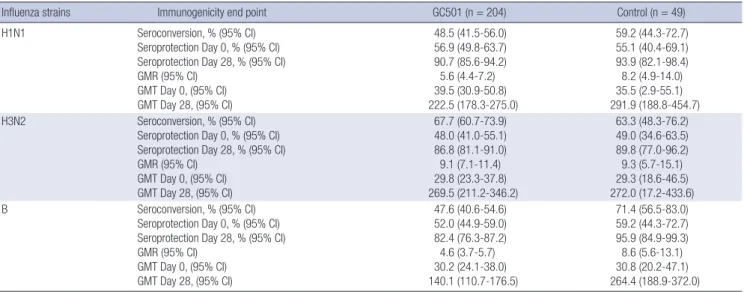
Table 2 presents the immunogenicity data on the GC501 and control vaccine groups by per protocol analysis. Seroconversion occurred in 48.5% for A/H1N1, 67.7% for A/H3N2 and 52% for B in the GC501 group. The lower boundary of the two-sided 95%
CI for the seroconversion rate of each subtype exceeded 40%. For each strain, the proportion of subjects with a baseline HI titers of 1:40 or greater were similar for the GC501 and control vaccine groups. The proportion of subjects who had post-vaccination HI titers of 1:40 or greater was 90.7% for A/H1N1, 86.8% for A/H3N2 and 82.4% for B in the GC501 group. The lower boundary of the two-sided 95% CI for the seroprotection rate of each subtype exceeded 70%. Between the GC501 and control vaccine groups, the seroconversion rates and the seroprotection rates were com- parable for A/H1N1 and A/H3N2. But for B strain, the serocon- version rates (P = 0.004) and the seroprotection rates (P = 0.014)
were lower in the GC501 group than the control group. Geomet- ric mean ratio was 5.6 for A/H1N1, 9.1 for A/H3N2, and 4.6 for B in the GC501 group.
Table 3 presents the seroprotection rates of the GC501 and con- trol vaccine groups according to age by intention to treat analy- sis. Among subjects younger than 3 years of age in GC501 group, the proportion of subjects who achieved seroprotection was 75%
(95% CI, 56.3-87.9) for the H1N1, 53.1% (95% CI, 35.0-70.5) for H3N2, and 40.6% (95% CI, 24.2-59.2) for B strain. The seropro- tection rates were lower among subjects younger than 3 yr of age compared to those 3 yr of age or older in GC501 group.
Safety
Solicited local and systemic adverse events were reported with- in seven days of vaccination and are shown in Table 4. Follow- ing vaccination, the solicited local adverse events were reported by 142 (62.8%) out of 226 subjects, and the most common local adverse events was tenderness, which occurred in 119 (52.7%) subjects. The solicited systemic adverse events were reported by 73 (32.3%) out of 226 subjects and the most commonly report- ed solicited systemic adverse event was fatigue which occurred in 43 (19.0%) subjects. Fever was reported in 5 (3.1%) out of 226
Table 2. Immunogenicity endpoint results
Influenza strains Immunogenicity end point GC501 (n = 204) Control (n = 49)
H1N1 Seroconversion, % (95% CI)
Seroprotection Day 0, % (95% CI) Seroprotection Day 28, % (95% CI) GMR (95% CI)
GMT Day 0, (95% CI) GMT Day 28, (95% CI)
48.5 (41.5-56.0) 56.9 (49.8-63.7) 90.7 (85.6-94.2) 5.6 (4.4-7.2) 39.5 (30.9-50.8) 222.5 (178.3-275.0)
59.2 (44.3-72.7) 55.1 (40.4-69.1) 93.9 (82.1-98.4) 8.2 (4.9-14.0) 35.5 (2.9-55.1) 291.9 (188.8-454.7)
H3N2 Seroconversion, % (95% CI)
Seroprotection Day 0, % (95% CI) Seroprotection Day 28, % (95% CI) GMR (95% CI)
GMT Day 0, (95% CI) GMT Day 28, (95% CI)
67.7 (60.7-73.9) 48.0 (41.0-55.1) 86.8 (81.1-91.0) 9.1 (7.1-11.4) 29.8 (23.3-37.8) 269.5 (211.2-346.2)
63.3 (48.3-76.2) 49.0 (34.6-63.5) 89.8 (77.0-96.2) 9.3 (5.7-15.1) 29.3 (18.6-46.5) 272.0 (17.2-433.6)
B Seroconversion, % (95% CI)
Seroprotection Day 0, % (95% CI) Seroprotection Day 28, % (95% CI) GMR (95% CI)
GMT Day 0, (95% CI) GMT Day 28, (95% CI)
47.6 (40.6-54.6) 52.0 (44.9-59.0) 82.4 (76.3-87.2) 4.6 (3.7-5.7) 30.2 (24.1-38.0) 140.1 (110.7-176.5)
71.4 (56.5-83.0) 59.2 (44.3-72.7) 95.9 (84.9-99.3) 8.6 (5.6-13.1) 30.8 (20.2-47.1) 264.4 (188.9-372.0) Seroconversion was defined as a prevaccination antibody titer of 1:10 or less and a postvaccination titer of 1:40 or more. Seroprotection was defined as a postvaccination anti- body titer of 1:40 or more. CI, confidence interval; GMR, geometric mean of post- to pre-vaccination titer ratios; GMT, geometric mean titer.
Table 3. Percentage of subjects with seroprotective levels of antibodies by influenza strain and age group
Influenza strains 6 mo - < 3 yr 3 - < 9 yr 9 - < 18 yr
GC501 (n = 32) Control (n = 5) GC501 (n = 104) Control (n = 24) GC501 (n = 69) Control (n = 21)
H1N1 day 0 9.4 (2.5, 26.2) 0 61.5 (51.5, 70.8) 62.5 (40.8, 80.5) 71.0 (58.7, 81.0) 57.1 (34.4, 77.4)
H1N1 day 28 75.0 (56.3, 87.9) 80.0 (29.9, 99.0) 92.3 (85.0, 96.4) 91.7 (71.5, 98.5) 95.7 (87.0, 98.9) 100 H3N2 day 0 12.5 (4.1, 29.9) 20.0 (1.1, 70.1) 63.5 (53.4, 72.5) 62.5 (40.8, 80.5) 40.6 (29.1, 53.1) 42.8 (22.6, 65.6) H3N2 day 28 53.1 (35.0, 70.5) 80.0 (29.9, 99.0) 93.3 (86.2, 97.0) 100 92.8 (83.2, 97.3) 81.0 (57.4, 93.7)
B day 0 6.25 (1.1, 22.2) 0 53.8 (43.8, 63.6) 54.2 (33.2, 73.8) 69.6 (57.2, 79.8) 81.0 (57.4, 93.7)
B day 28 40.6 (24.2, 59.2) 80 (29.9, 99.0) 87.5 (79.2, 92.9) 100 92.8 (83.2, 97.3) 95.2 (74.1, 99.8) Data are presented % (95% confidence interval). Seroprotective level was defined as an antibody titer of 1:40 or more. mo, months; yr, years.
subjects and 2 of these had fever > 38.5°C. The majority of so- licited adverse events were mild in intensity.
Unsolicited adverse events were reported by 53 (23.5%) out of 226 subjects during the study period. The most common events were respiratory related disorders (n = 33, 14.6%). No serious adverse events related to vaccination, or withdrawals because of adverse events were reported.
DISCUSSION
Immunization against influenza is considered to be a key pub- lic-health intervention to control both seasonal epidemics and pandemic influenza. In 2006, Global Action Plan (GAP) was de- veloped by WHO for increasing the supply of influenza pandem- ic vaccines in order to reduce the anticipated gap between po- tential vaccine demand and supply during an influenza pan- demic. They identified three main approaches: an increase in seasonal vaccine use; an increase in production capacity; and further research and development. Major progress in the devel- opment of new production capacity has been achieved by WHO support to the manufacturers of 11 developing countries. One of them is Green Cross Corporation in the Republic of Korea (11).
This study evaluated the safety and the immunogenicity of the first Korean influenza vaccine in healthy children. This influen- za vaccine appeared to be safe and well tolerated. The adverse events were generally mild and consistent with previous reports for inactivated influenza vaccine in children (12, 13).
The FDA provides recommendations for clinical data to sup- port license approvals for new seasonal inactivated influenza vaccines (10). The recommendations have been modified from guidelines by “Committee for Medicinal Products for Human
Use of the European Medicines Agency” (14). For the pediatric population, the requirements are that the lower boundary of the two-sided 95% CI for the percent of subjects achieving serocon- version for HI antibody should meet or exceed 40% and the lower boundary of the two-sided 95% CI for the percent of subjects achieving an HI antibody titer ≥ 1:40 should meet or exceed 70%. Overall, the GC501 vaccine met the criteria. Previous stud- ies reported that split-virus influenza vaccines were shown to be immunogenic for healthy children (15). The immunogenicity data of this study were consistent with previous reports that were included healthy children (15-17). However, subjects younger than 3 yr of age in GC501 group had lower antibody response to vaccine, especially for H3N2 and B antigens. In terms of the an- tibody responses to influenza B antigens after vaccination, the responses can be lower than responses to influenza A antigen in young children (13, 18). The numbers of subject younger than 3 yr of age were only 32 and 5 in the GC501 group and control group, respectively. The result suggest that studies evaluating efficacy of the GC501 vaccine or non-inferiority immunogenic- ity trials of HI antibody responses to the GC501 vaccine as com- pared to a licensed seasonal inactivated influenza vaccine are needed in young children.
The limitations of this study include the following. First, al- though it had active control group, the control group was not chosen to compare to the immunogenicity of GC501 group and the size of control group was small. Therefore, there was no use- ful information from the active control. Second, the study design was not stratified for the various age groups. The results showed that immunogenicity of GC501 vaccine satisfied the criteria sug- gested by FDA as a whole. However, immunogenicity among young children was not satisfactory, and the small number of Table 4. Solicited adverse events within 7 days after vaccination
Adverse events
GC501 (n = 226)
% (95% CI) Control (n = 56)
% (95% CI)
Any ≥ Grade 2 Any ≥ Grade 2
Solicited local events Pain
Tenderness Redness Swelling
50.0 (43.3, 56.7) 52.7 (45.9, 59.3) 26.1 (20.6, 32.4) 11.5 (7.8, 16.6)
1.3 (0.3, 4.2) 2.2 (0.8, 5.4) 7.1 (4.2, 11.5)
3.1 (1.4, 6.5)
48.2 (34.8, 61.8) 55.4 (41.6, 68.4) 19.6 (10.7, 32.8) 17.9 (9.3, 30.9)
0 (NA)
1.8 (0.1, 10.8) 1.8 (0.1, 10.8) 1.8 (0.1, 10.8) Solicited systemic events
Fever Headache Malaise Shivering Fatigue Sweating Myalgia Arthralgia
3.1 (1.4, 6.54) 9.7 (6.3, 14.6) 9.3 (6.0, 14.0) 5.8 (3.2, 9.9) 19.0 (14.3, 24.9)
6.2 (3.6, 10.4) 13.7 (9.7, 19.1) 3.1 (1.4, 6.5)
1.3 (0.3, 4.2) 1.8 (0.6, 4.8) 0.9 (0.2, 3.5) 0.9 (0.2, 3.5) 1.3 (0.3, 4.2) 0.9 (0.2, 3.5) 2.7 (1.1, 6.0) 0 (NA)
0 (NA)
10.7 (4.4, 22.6) 1.8 (0.1, 10.8) 8.9 (3.3, 20.4) 8.9 (3.3, 20.4) 0 (NA)
17.9 (9.3, 30.9) 3.6 (0.6, 13.4)
0 (NA)
1.8 (0.1, 10.8) 0 (NA) 0 (NA) 0 (NA) 0 (NA)
1.8 (0.1, 10.8) 0 (NA)
Pain was grade 0 (absent), grade 1 (does not interfere with activity), grade 2 (repeated use of non-narcotic pain reliever > 24 hr or interferes with activity), grade 3 (any use of narcotic pain reliever or prevents daily activity), or grade 4 (emergency room visit or hospitalization). Tenderness was grade 0 (absent), grade 1 (mild discomfort to touch), grade 2 (discomfort with movement), grade 3 (significant discomfort at rest), or grade 4 (emergency room visit or hospitalization). Fever was grade 0 ( < 38.0°C), grade 1 (38.0-38.4°C), grade 2 (38.5-38.9°C), grade 3 (39.0-40.0°C), or grade 4 ( > 40.0°C). Other adverse events were grade 1 (does not interfere with activity), grade 2 (interferes with activity), grade 3 (prevents daily activity), or grade 4 (emergency room visit or hospitalization). CI, confidence interval; NA, not applicable.
subjects in this age group precludes any conclusion. Because the recommended doses and amounts of vaccine were differ- ent according to age, lack of stratification of age was the limita- tion of this study.
The results of this study indicate that GC501 vaccine has good tolerability and favorable immunogenicity in children aged 6 months to < 18 yr. An addition of one more brand of influenza vaccine might give better global accessibility of vaccine to epi- demics or future pandemics.
REFERENCES
1. Miller E, Hoschler K, Hardelid P, Stanford E, Andrews N, Zambon M.
Incidence of 2009 pandemic influenza A H1N1 infection in England: a cross-sectional serological study. Lancet 2010; 375: 1100-8.
2. Monto AS, Kioumehr F. The Tecumseh Study of Respiratory Illness. IX.
Occurence of influenza in the community, 1966-1971. Am J Epidemiol 1975; 102: 553-63.
3. Basta NE, Chao DL, Halloran ME, Matrajt L, Longini IM Jr. Strategies for pandemic and seasonal influenza vaccination of schoolchildren in the United States. Am J Epidemiol 2009; 170: 679-86.
4. Macroepidemiology of Influenza Vaccination (MIV) Study Group. The macro-epidemiology of influenza vaccination in 56 countries, 1997-2003.
Vaccine 2005; 23: 5133-43.
5. Song JY, Cheong HJ, Woo HJ, Wie SH, Lee JS, Chung MH, Kim YR, Jung SI, Park KH, Kim TH, Uh ST, Kim WJ. Immunogenicity and safety of tri- valent inactivated influenza vaccine: a randomized, double-blind, multi- center, phase 3 clinical trial in a vaccine-limited country. J Korean Med Sci 2011; 26: 191-5.
6. Fiore AE, Uyeki TM, Broder K, Finelli L, Euler GL, Singleton JA, Iskander JK, Wortley PM, Shay DK, Bresee JS, Cox NJ; Centers for Disease Con- trol and Prevention. Prevention and control of influenza with vaccines, recommendations of the Advisory Committee on Immunization Practices (ACIP), 2010. MMWR Recomm Rep 2010; 59: 1-62.
7. U.S. Department of Health and Human Services, Food and Drug Admin- istration, Center for Biologics Evaluation and Research. Guidance for in- dustry: toxicity grading scale for healthy adult and adolescent volunteers enrolled in preventive vaccine clinical trials. 2007. Available at http://
www.fda.gov/BiologicsBloodVaccines/GuidanceComplianceRegulato- ryInformation/Giuidances/Vaccines/ucm074775.htm [accessed on April 15, 2011].
8. Hannoun C, Megas F, Piercy J. Immunogenicity and protective efficacy of influenza vaccination. Virus Res 2004; 103: 133-8.
9. Song JY, Cheong HJ, Hwang IS, Choi WS, Jo YM, Park DW, Cho GJ, Hwang TG, Kim WJ. Long-term immunogenicity of influenza vaccine among the elderly: risk factors for poor immune response and persistence. Vaccine 2010; 28: 3929-35.
10. U.S. Department of Health and Human Services, Food and Drug Admin- istration, Center for Biologics Evaluation and Research. Guidance for industry: clinical data needed to support the licensure of seasonal inacti- vated influenza vaccines. 2007. Available at http://www.fda.gov/down- loads/BiologicsBloodVaccines/GuidanceComplianceRegulatoryInforma- tion/Guidances/Vaccines/ucm091985.pdf [accessed on April 15, 2011].
11. World Health Organization. The global action plan for influenza vaccines.
Available at http://www.who.int/influenza_vaccines_plan/resources/
5report_gap_ag_5may11. pdf [accessed on August 05, 2011].
12. Neuzil K, Jackson L, Nelson J, Klimov A, Cox N, Bridges C, Dunn J, DeSte- fano F, Shay D. Immunogenicity and reactogenicity of 1 versus 2 doses of trivalent inactivated influenza vaccine in vaccine-naive 5-8-year-old children. J Infect Dis 2006; 194: 1032-9.
13. Englund JA, Walter EB, Fairchok MP, Monto AS, Neuzil KM. A compari- son of 2 influenza vaccine schedules in 6- to 23-month-old children. Pe- diatrics 2005; 115: 1039-47.
14. Committee for Proprietary Medicinal Products. Note for guidance on harmonisation of requirements for influenza vaccines (CPMP/BWP/
214/96). The European Agency for the Evaluation of Medicinal Products, March 1997. Available at http://www.ema.europa.eu/pdfs/human/
bwp/021496en.pdf [accessed on April 15, 2011].
15. Ruben FL. Inactivated influenza virus vaccines in children. Clin Infect Dis 2004; 38: 678-88.
16. Kanra G, Marchisio P, Feiterna-Sperling C, Gaedicke G, Lazar H, Durrer P, Kürsteiner O, Herzog C, Kara A, Principi N. Comparison of immuno- genicity and tolerability of a virosome-adjuvanted and a split influenza vaccine in children. Pediatr Infect Dis J 2004; 23: 300-6.
17. Gonzalez M, Pirez MC, Ward E, Dibarboure H, García A, Picolet H. Safe- ty and immunogenicity of a paediatric presentation of an influenza vac- cine. Arch Dis Child 2000; 83: 488-91.
18. Hoberman A, Greenberg DP, Paradise JL, Rockette HE, Lave JR, Kearney DH, Colborn DK, Kurs-Lasky M, Haralam MA, Byers CJ, Zoffel LM, Fa- bian IA, Bernard BS, Kerr JD. Effectiveness of inactivated influenza vac- cine in preventing acute otitis media in young children: a randomized controlled trial. JAMA 2003; 290: 1608-16.
AUTHOR SUMMARY
Safety and Immunogenicity of a New Trivalent Inactivated Split-virus Influenza Vaccine in Healthy Korean Children: A Randomized, Double-blinded,
Active-controlled, Phase III Study
Jin-Han Kang, Chi-Eun Oh, Jina Lee, Soo-Young Lee, Sung-Ho Cha, Dong Soo Kim, Hyun-Hee Kim, Jung-Hyun Lee, Jin-Tack Kim, Sang-Hyuk Ma, Young-Jin Hong, Hee Jin Cheong and Hoan-Jong Lee
We evaluated the immunogenicity and safety of a new trivalent inactivated split-virus influenza vaccine (GC501) manufactured by the Green Cross Corporation in Korea. A total of 283 healthy children were randomized to receive either GC501 or control. Overall, the GC501 vaccine met both FDA and EMEA criteria. No serious adverse events related to vaccination were reported. GC501 vaccine has good tolerability and favorable immunogenicity. The addition of one more brand of influenza vaccine may allow for better global accessibility and affordability of vaccine for epidemics or future pandemics.