INTRODUCTION
Tsunami, a kind of natural disaster, is a very large wave mai- nly generated by an earthquake that flows on to the land and causes massive destruction. Although such a sudden-impact natural disaster may severely damage the medical facilities and disrupt public health system, only few reports are avail- able about the need of the medical care after tsunamis (1-3).
On 26 December 2004 at 7 a.m. (GMT: midnight, 25 De- cember), an earthquake measuring 9.0 on the Richter scale struck the area located about 160 km off the coast of Indone- sia’s Sumatra Island. It was the fourth-largest earthquake since such measurement began in 1899, according to the U.S. Geo- logical Survey’s National Earthquake Center. The quake cau- sed the huge tsunamis which reached as far as 1,600 km from the epicenter. At least five million people were affected in South-Asian countries such as Indonesia, Sri Lanka, Maldives, India, Thailand, Seychelles and Myanamar. The collective death toll from these countries exceeded 280,000 people, and at least one million persons were displaced (4). About two and half hours after the earthquake, the tsunami attacked the south-eastern coast of Sri Lanka. As a result of the tsunami, 29,729 people were killed and 16,665 injured according to the report of the government of Sri Lanka (5).
Two days after the disaster (28 December 2004), the Seoul National University Hospital began to organize the deploy- ment of a disaster medical assistance team (DMAT) to Sri Lan-
ka. The team has had the regular disaster drills in monthly basis since March 2004. The Korean DMAT was composed of 20 personnel: three emergency physicians, two surgeons (one general and one orthopedic surgeon), a physician, a pedi- atrician, a dermatologist, three general physicians, three nurs- es, two emergency medical technicians (EMTs), a pharmacist, and three support personnel. The DMAT carried the medi- cations for resuscitation, antibiotics, antimalarial drugs, flu- ids for intravenous infusion, and surgical kits (general and orthopedic). Other medications, preventive medicine like tetanus toxoid, and medicines for chronic disease (hyperten- sion, diabetes, asthma, etc.) were also taken. Two big tents (15 meter in length, 7 meter in width, and 2.5 meter in height) which can be automatically inflated within 10 min by the infusion of the air (Fig. 1), two electric generators, self-suffi- cient amount of foods, and potable water for at least 10 days were also prepared. On 29 December 2004, the DMAT de- parted for Sri Lanka and began to provide medical cares seven days after the disaster (2 January 2005). The Korean DMAT performed a total of 7 days of medical cares in 6 towns, from 2 to 8 January 2005. The names of towns were Weligama, Mirissa (town between Weligama and Matara), Matara, Tha- lalla (town near Dondra), Hambantota, and Dikwella, by the order of the date (Fig. 2). All towns but Hambantota were the parts of the Matara district. In the Matara district, there were more injured persons than the dead (8,288 vs. 1,158).
In contrast, injured victims (estimated as about 500 people) Young Ho Kwak, Sang Do Shin, Kyu Seok Kim, Woon Yong Kwon*, Gil Joon Suh
Department of Emergency Medicine, Seoul National University College of Medicine, Seoul; 1339 Seoul Emergency Information Center*, Seoul, Korea
Address for correspondence Gil Joon Suh, M.D.
Department of Emergency Medicine, Seoul National University College of Medicine, 28 Yongon-dong, Chongno-gu, Seoul 110-744, Korea
Tel : +82.2-2072-2196, Fax : +82.2-3672-8871 E-mail : [email protected]
143
Experience of a Korean Disaster Medical Assistance Team in Sri Lanka after the South Asia Tsunami
On 26 December 2004, a huge tsunami struck the coasts of South Asian countries and it resulted in 29,729 deaths and 16,665 injuries in Sri Lanka. This study char- acterizes the epidemiology, clinical data and time course of the medical problems seen by a Korean disaster medical assistance team (DMAT) during its deployment in Sri Lanka, from 2 to 8 January 2005. The team consisting of 20 surgical and medi- cal personnel began to provide care 7 days after tsunami in the southern part of Sri Lanka, the Matara and Hambantota districts. During this period, a total of 2,807 pa- tients visited our field clinics with 3,186 chief complaints. Using the triage and refer system, we performed 3,231 clinical examinations and made 3,259 diagnoses. The majority of victims had medical problems (82.4%) rather than injuries (17.6%), and most conditions (92.1%) were mild enough to be discharged after simple manage- ment. There were also substantial needs of surgical managements even in the sec- ond week following the tsunami. Our study also suggests that effective triage sys- tem, self-sufficient preparedness, and close collaboration with local authorities may be the critical points for the foreign DMAT activity.
Key Words : Natural Disasters; Relief Work; Patient Care Team; Wounds and Injuries
Received : 16 February 2005 Accepted : 8 August 2005
were much less than the dead in Hambantota, where about half of the total residents (about 4,500) were killed immedi- ately after the tsunami (5).
We began to see patients from 9:30 a.m. and finished at 5:00 p.m. to prepare the next day service. In the beginning of daily activity, we first made the two air tents inflated and used them as main building of our clinics. Other divisions such as pharmacy and observation area were also set up in small tents or available local buildings. When patients arrived at the team’s field clinic, they first underwent triage by two emergency physicians. After the triage, mildly injured vic- tims were directly sent to pharmacy or observation area for medication and injection. The other patients who required more specialized care were referred to the surgical or medical units. The surgical unit was composed of a general surgeon and an orthopedic surgeon, and the medical one consisting of a physician, a pediatrician, and a dermatologist. After the
examinations in these units, the patients were guided to the pharmacy and observation area (Fig. 3).
During the DMAT activities, security was maintained by local policemen, and the translation for communication was supported by 14 volunteers from the Korean International Cooperation Agency (KOICA) residing in Sri Lanka.
The purpose of this study is to characterize the epidemi- ology and time course of the medical problems seen by the DMAT during its deployment and the resources utilized by the DMAT during its deployment.
MAREIALS AND METHODS Study design
We performed a retrospective study of logs and medical records maintained by Seoul National University Hospital DMAT during its deployment to Sri Lanka from 2 to 8 Jan- uary 2005. This study was approved by the Institutional Re- view Board in the Seoul National University Hospital.
Study period
We performed the study from 15 January to 15 February 2005 at Seoul National University Hospital, Seoul, Korea.
Study population
We studied all patients in Sri Lanka presenting to our DMAT medical service for medical care from 2 to 8 January 2005.
Study protocol
Some authors extracted the demographic, epidemiological,
Fig. 1.Two air-inflatable tents. The left tent was a surgical unit and the right one a medical unit. These tents were inflated by two elec- tric generators within 10 min.
Fig. 3.Patients flow and relationship between of the parts of the field clinic. Arrows: the guided flow of the patients.
Observation area Pharmacy
Operation bed
Generator
Telecommunication unit
Triage
Emergency Surgical unit Medical unit bed
Triage area: emergency physicains Surgical unit: general & orthopedic surgeon Medical unit: physician, pediatrician, and dermatologist
Fig. 2.The southern province of Sri Lanka where the Korean disas- ter medical assistance team served. Six towns were helped; Weli- gama, Mirissa (between Weligama and Matara), Matara, Thalalla (near Dondra), Hambantota, and Dikwella. The distance from Weli- gama to Hamabantota is about 100 km.
clinical and time course data generally considered as impor- tant points (6), from the logs and the medical records (Table 1). Demographic data included age, gender, and census of each day’s deployment. We obtained clinical data, such as chief complaints, clinical diagnosis categories based on the 10th version of International Classification of Disease (ICD), and dispositions. If a patient had several complaints or diag- noses, each complaint or diagnosis was counted separately and included in this study.
We also collected data on the proportions of injury and dis- ease among the patients. We planned to analyze data from injured patients according to three subgroups, concerning the data of injury onset; before, during, and after the tsunami.
We obtained data on the resources utilized for managements that the DMAT provided. We divided the dispositions of the patients into four categories such as discharge to home, trans- fer to local hospitals, follow up to our DMAT mainly due to inadequate preparedness of local hospitals and withdrawal.
The withdrawal cases include the patients who had minimal injury and were sent home only after the registration.
We also observed the physical and mental conditions of the members of the DMAT using a designed questionnaire.
Data analysis
We divided all the patients into three age groups, pedi- atric (0-14 yr old), adult (15-64 yr old), and geriatric group (more than 65 yr old) for the purposes of comparison. We used simple statistics to summarize our data and compared among three age groups. We tried to find significant tendency of the proportions of injury and disease through the deploy- ments by using Spearman’s correlation coefficiency.
RESULTS Demographic findings
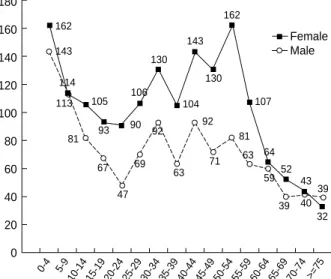
A total of 2,807 patients visited our DMAT for the 7 days and all were included for this study. The number of daily pa- tients ranged from 193 to 606, and the average was 401. The male to female ratio was 1:1.4 (1,159 vs. 1,637). The num- ber of patients in pediatric, adult, geriatric group and uniden- tified were 719 (25.6%), 1,834 (65.3%), 245 (8.7%), and 9 (0.3%), respectively (Table 2). The proportions of male in pe- diatric, adult and geriatric group were 46.9%, 38.4%, and 48.2%, respectively. Compared to the pediatric and geriatric groups, there were more female patients in the adult group (Fig. 4).
Clinical findings
A total of 2,807 patients underwent the triage. After triage, the patients who needed further management were guided to the first, sec, and third department in order and disposed.
The numbers of patients to be disposed to the first, second, and third department were 1,217, 1,200, 356, or 34, respec- tively (Fig. 5).
A total of 2,807 patients had 3,186 chief complaints. The number of patients with one, two, or three complaints were 2,798, 360, or 28, respectively. The most common complaints were respiratory ones (33.0%) including cough, sputum, rhi- norrhea, and throat pain. The second and third complaints
*Several complaints and diagnoses of a patient were counted sepa- rately and included. �Based on the 10th version of International Classifi- cation of Disease (ICD).
Categories Data points Definitions/examples Demographic Age
and epidemiologic pediatric 0-14 yr old
data adult 15-64 yr old
geriatric ≥65 yr old Gender
Daily census Others
visiting mode by walk, three-wheel car, car
residence home, relative’s house, refugee camp Clinical data Chief complaint*
onset
Clinical diagnosis*,�
injury injured by trauma disease chronic medical or
surgical conditions Management
medical oral medication, injection surgical wound repair, debriment, etc.
Disposition
discharge sent home after management transfer to local hospitals
follow up to the DMAT withdrawal sent home without
management Time course data Proportions of injury and disease
Table 1.Collected data from the logs and medical records of the Koran DMAT
Date Jan 2 Jan 3Jan 4 Jan 5 Jan 6 Jan 7 Jan 8 Total
Pediatric 100 115 45 129 141 151 38 719 25.6 (0-14 yr)
Adult 209 274 245 276 412 284 134 1,834 65.3 (15-64 yr)
Geriatiric 16 50 33 51 52 23 20 245 8.7
(≥65 yr)
Unidentified 3 0 1 2 1 1 1 9 0.3
Sum 328 439 324 458 606 459 193 2,807 100.0 Table 2.The number and demographic data of patient encoun- ters
N N N N N N N N %
N, Number; %, Percent.
were orthopedic (21.9%) and dermatologic problems (12.6%), respectively (Fig. 6).
A total of 3,259 clinical diagnoses were made except uncer- tain 110 cases. Of these diagnoses based on the 10th version of ICD, the most common diagnostic category was respirato- ry disease (32.0%). The second and third most common diag- noses were injury (17.6%) and musculoskeletal disorder (11.6
%), respectively (Table 3).
The proportion of disease was higher (82.4%) than that of injury (17.6%). There were more injured victims in the adult
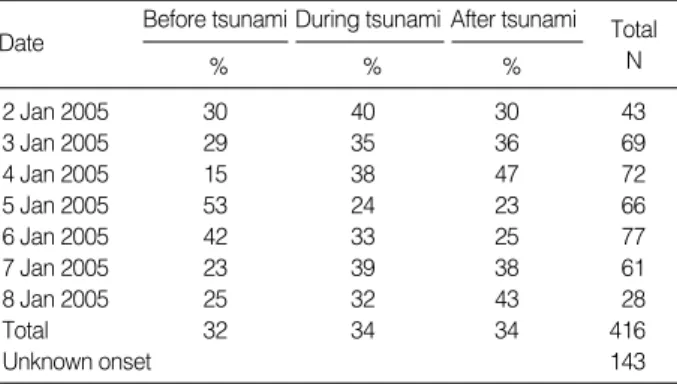
group than in the pediatric or geriatric age groups and in male rather than in female (Table 3). The proportions of the injured victims among before- (32%), during- (34%) and after-tsunami (34%) were not so different by the date (Table 4). The tendency of the proportion of injured victims was ana- lyzed by the date and the census using the Spearman’s rho (Fig. 7). The correlation curve showed the marginal negative correlation between the date after tsunami and the proportion of injured victims (r=-0.75, p=0.052).
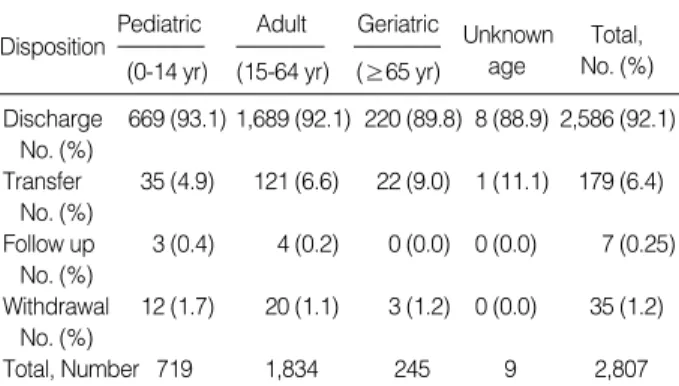
Information on the disposition was available for all the pa- tients. Most patients (92.1%) were safely discharged after short-term observation and management. Relatively, a few patients (6.4%) were transferred to local hospitals for further managements (Table 5). Surgical procedures for injuries were as follows; 133 dressings, 31 simple sutures, 22 debridements
Fig. 4.Distribution of the enrolled patients by gender and age group.
180 160 140 120 100 80 60 40 20 0
0-4 5-9
10-14 15-19 20-24 25-29 30-34 35-39 40-44 45-49 50-54 55-59 60-64 65-69 70-74 >=75 Female Male 162
92
69 47
67 52
64 107
59 130
143
104 130 106
93 90 81 113 105
114 143
63 81 71 92
63
39 40 39 32 43 162
Fig. 6.Distribution of chief complaints.
Fever Cardiovascular Chest pain Headache GI troubles Minor problem Wound and trauma Nonspecific Dermatologic Orthopedic Respiratory
0.75 0.97
3.2 3.6 4.2 4.6
7.6 7.7
12.6
21.9 33.0
0.00 5.00 10.00 15.00 20.00 25.00 30.00 35.00 (%)
Triage
2,807
Total
GS 226
319 OS
370 IM
52 1,590
(56.64%)
46
125
PD 374 34
DM 301 133
Discharge
9 2 19
3 1
Sum 2,014
GS 279
OS 368
IM 514
PD 410
DM 443
1st department
2nd department
3rd department 390
24.53%
34 (9.72%) GS
OS
IM
PD
DM
GS
OS
IM
PD
DM
Total Total
1,217 (43.36%)
356 (91.28%) 1,200
(75.47%)
34 (100%) Discharge Discharge
Discharge
Fig. 5.Patients flow according to the areas and the departments. GS, general surgery; OS, orthopedic surgery; IM, internal medicine; PD, pediatrics; DM, dermatology.
and sutures, 14 immobilizations, and 5 other surgical proce- dures including closed reduction. Other medical treatments included oral medicine (480 cases), intra-muscular or intra- venous injections (252 cases), ointment application (94 cases), tetanus prophylaxis (33 cases), and so on. Antibiotics were prescribed as parenteral and oral forms in 72 patients, oral form in 492 patients and topical form in 142 patients.
Self reports from the DMAT members
There was no severe illness among the members of DMAT.
The most common complaint was only mild fatigue, which failed to interrupt our activity. Until four weeks after the re- turn to our country, there have been no reports of disease or injury.
DISCUSSION
To our knowledge, this study is the first report to describe the operation of a DMAT after tsunami disaster. Previous stu-
Diagnosis by ICD-10*
Sum Pediatric Adult Geriatric
No. % No. % No. % No. %
Total� 3,259 770 2,179 310
Respiratory disorder 1,042 32.0 470 61.0 519 23.8 53 17.1
Injury 572 17.6 49 6.4 480 22.0 43 13.9
Musculoskeletal disorder 377 11.6 12 1.6 280 12.9 85 27.4
Skin and subcutaneous disorder 355 10.9 69 9.0 260 11.9 26 8.4
Digestive disorder 169 5.2 49 6.4 110 5.1 10 3.2
Unspecified symptoms and signs 157 4.8 45 5.8 95 4.4 17 5.5
Eye and ear disorder 136 4.2 32 4.2 92 4.2 12 3.9
Circulatory disorder 134 4.1 3 0.39 96 4.4 35 11.3
Nervous system disorder 86 2.6 6 0.78 74 3.4 6 1.9
Endocrine and metabolic disorder 59 1.8 2 0.26 49 2.3 8 2.6
Viral, fungal and parasite infection 57 1.8 10 1.30 43 2.0 4 1.3
Urogenital disorder 37 1.1 4 0.52 27 1.2 6 1.94
Psychotic and behavioral disorder 32 0.98 10 1.30 19 0.87 3 0.97
Pregnancy and delivery related disorder 15 0.46 1 0.13 14 0.64 0 0
Neoplasms 13 0.40 3 0.39 8 0.37 2 0.65
Bacterial and mycobacterial infection 8 0.25 2 0.26 6 0.28 0 0
Hematology and immune system disorder 7 0.21 1 0.13 6 0.28 0 0
Congenital disorder 3 0.09 2 0.26 1 0.05 0 0
Perinatal disorder 0 0 0 0 0 0 0 0
Unknown age 9
Table 3.The proportion of clinical diagnoses
*The International classification of disease 10th version. �The number of unknown cases was 110. Of these, 53 male patients 57 female patients. The number of cases with more than two diagnoses were 566 (21.0%) of all patients. %, Percent.
Before tsunami During tsunami After tsunami
2 Jan 2005 30 40 30 43
3 Jan 2005 29 35 36 69
4 Jan 2005 15 38 47 72
5 Jan 2005 53 24 23 66
6 Jan 2005 42 33 25 77
7 Jan 2005 23 39 38 61
8 Jan 2005 25 32 43 28
Total 32 34 34 416
Unknown onset 143
Table 4.The proportion of injured patients by the date and the onset of injury
% % %
N, Number; %, Percent.
Fig. 7.Correlation between the percent of the injured out of total daily patients and the date since the Tsunami disaster (r=-0.75, p=0.052 by Spearman’s rho).
Percent of injury
45 40 35 30 25 20 15 10 5 0
8 9 10 11 12 13 14
Date since tsunami (day)
Total Date N
dies mainly dealt with the function of a field hospital (1), or- thopedic procedures (2), or medical needs after tsunami except for the clinical experience of a DMAT. Although a tsunami is not a common natural disaster, it seems to be inevitable especially in the tsunami-prone Pacific region. This report will be helpful for those who prepare the DMAT response to the possible tsunamis in future.
Rapid response is critical for the effective emergency medi- cal services after natural disaster. Liang et al. pointed out that most of life-saving responses were needed within 24 hr after a disaster (7). Pretto et al. also suggested that deaths might have been prevented if the victim had received medical atten- tion in the first 6 hr after an earthquake (8). However, a pre- vious study revealed that even in the same countries, only 20
% of DMATs were able to reach the disaster scene within 24 hr. The causes of this delay were discussed as the destroyed transportation and communication (9). Our arrival time in Sri Lanka, seven days following the tsunami, was too late to take care of critical, life-threatening patients. When we arrived at the disaster site, the patients with severe injuries were al- ready evacuated and transferred. Although this may be a ma- jor flaw of our activity, long distance international trip and other administrative problems prevented us from starting early medical care. In earthquakes in foreign countries, other Korean DMATs also arrived at disaster site so late that they could not care patients in the acute phase after disaster. They suggested that the appropriate medical supports according to the type of disaster and the time from the onset of disaster should be required (10, 11). In fact, it is not so feasible to reach the foreign disaster site within 7 days following the occurrence of disaster (3). On the other hand, because of the natural character of a tsunami, incredible strength and impos- sible timely warning, it can cause immediate deaths rather than injuries. Therefore, there may not be a place for the life- saving cares by foreign DMAT activity (12). If the critical emergency care immediately after the tsunami is only con- cerned task, it is the best way to set up an effective local dis- aster medical system.
Most patients visiting our field clinic had minor medical problems. Of these patients, larger portion had medical dis- eases (82.4%) and most of them could be sent home (92.1%).
This finding is similar to that of the previous study at a field hospital following the hurricane Andrew in the United States (13). In the study, the authors described that 290 (18.8%) out of 1,544 patients had injury. In another study after the hurricane Inki, however, injury problems were more common than medical ones (40.4% vs. 38.6%) (14). Our data suggest that medical resources, not surgical, trauma-related resources is required in this DMAT setting.
According to our study, complaints and clinical diagnoses related to the respiratory system were the most common. Tho- se seemed to be the consequences of the respiratory infection which is easily propagated and aggravated due to the poor environments and the crowded shelters of the victims. The second and third common diagnoses were orthopedic and dermatologic ones, respectively. These findings indicate the medical needs were required even one week after the tsunami disaster.
Among the injured patients, young adults predominated.
It may be related to the characteristics of injury pattern after tsunami disaster. Because tsunami’s attacking speed and power are so overwhelming, extreme aged people can not escape fatal injury (12).
While medical problems are more common than injuries, the proportion of trauma patients was not small (17.6%), and their needs for medical care should not be underrated. Con- sidering the time sequence of injuries, about a third of the total injuries (34%) was the tsunami-related. The proportion is surprisingly high in terms of the period of our medical ac- tivity, which was done in the second week. This finding is dif- ferent from those of studies in developed countries or other disasters. In a study conducted in the United States, authors reported that only 1.2% of injuries were attributable to a Hur- ricane and most of injuries were caused during clean up activi- ties (13). According to our report, however, there were substan- tial patients with injury by tsunami even after a week, and numerous procedures, medications, and preventive measures were also required for those patients. This aspect of our DMAT activity may be associated with the taking an aetion in a devel- oping country. In developing countries, the impact after nat- ural disaster is amplified than in developed countries. They have much less resources of medical facilities, transportation, and communication (15). Even after several days, the injured patients could not be treated appropriately and they had to visit our clinics. Therefore, in a country with limited resources, both medical and surgical requirements should be met for a reasonably long time and it may be accomplished by foreign DMATs. Another supporting data on inadequate resources in developing countries are that one-third of injuries seen in patients began before the tsunami (32%) and one-third began after the tsunami (34%), suggesting the need to match medi- cal resources with baseline needs in the affected population.
When we examined whether there was the decreasing ten- dency of injured patients, our data showed marginal negative correlation. It is a new finding compared to an earlier reports,
Pediatric Adult Geriatric
Discharge 669 (93.1) 1,689 (92.1) 220 (89.8) 8 (88.9) 2,586 (92.1) No. (%)
Transfer 35 (4.9) 121 (6.6) 22 (9.0) 1 (11.1) 179 (6.4) No. (%)
Follow up 3 (0.4) 4 (0.2) 0 (0.0) 0 (0.0) 7 (0.25) No. (%)
Withdrawal 12 (1.7) 20 (1.1) 3 (1.2) 0 (0.0) 35 (1.2) No. (%)
Total, Number 719 1,834 245 9 2,807
Table 5.The proportion of disposition after management
(0-14 yr) (15-64 yr) (≥65 yr)
Disposition Unknown Total,
age No. (%)
which showed constant decrease in number of injured victims (1, 16, 17). This finding may be associated with the region- al variation on mortality and morbidity. Compared to the Hambantota area, the Matara district showed more injured patients than the dead (Table 2). When tsunami strikes rela- tively large area, there may be differences in destroying power which may cause different casualty pattern between some re- gions. In area such as Matara, where many victims were rather injured than dead, the surgical needs could not be met after several days. In Hambantota, because about half of the resi- dents were dead, survived people were not surgical patients but medical patients who lost their chronic medication and pharmacy. On the contrary to some previous studies which indicated the reducing need of trauma patients, our reports showed that geographical difference can make clinical differ- ence after tsunamis.
Our DMAT service was successful in many aspects. First of all, our study describes the largest number of patients by a DMAT, 2,807 comparing with previous studies that report- ed the number of patients from 134 to 2,090 (1, 2, 9, 13, 14, 16). We also covered fairly wide regions of the damaged coun- try, in two districts, from town Weligama to Hambantota.
The distance between two towns at both ends is about 100 km away and it takes about five hours by bus in Sri Lanka.
In spite of relatively hard works, there was no trouble in physi- cal and mental health of our members. Daily surveyed self- reporting questionnaires revealed no significance illnesses.
At the other point, unlike an earlier study, the shortage of critical drugs was not a problem of our team (14). Though our resuscitation medication and fluids were not consumed at the sites, there was no lack of important medications such as antibiotics, tetanus toxoid and insulin.
Our successful outcome may be attributable to some features of the team. First, we utilized the same triage system as that of our own emergency department. When a DMAT acts at post-impact phase of disaster, triage of DMAT is suggested to follow the typical procedure for most emergency department (18). By adopting this effective, familiar triage system, we co- uld see a great number of patients fast and offer more speciali- zed care for severe patients. After the triage by the emergen- cy physicians, the complicated patients were referred to two separate units, surgical and medical. The system accomplished the combined objectives of traditional DMAT function, sur- gical intervention and definite care (19, 20). They were also the most required role of our team in that damaged area.
Second good facet of the team was vigilant preparedness of self-sufficient equipments and foods. A DMAT can not rely on the local resources which may be quite limited and una- vailable. So, we brought all the food, potable water and sleep- ing bags we needed. Using the electric generators, we could inflate our tents, which made it possible to change our service sites day by day. They could be used as fine accommodation under the poor condition if needed. And this effectiveness of performance was achievable due to the regular and repeated
drills we had had before the disaster.
Third part is the close cooperation with local authorities and volunteers. The local authorities offered the security and gathering of patients which is the critical aspects of DMAT activity. The translation between a patient and a foreign doctor by the devoted volunteers facilitated the flow of the patients.
Although the reports of the foreign DMAT function are scarce in medical literature (21), collaboration with local personnel was one of the most valuable experiences in our team. With- out their assistance, our paramount goal, providing care for wounded people, could never be reached.
This study has some limitations. First, there may be ques- tions of whether the DMAT activity was truly beneficial for the affected population in Sri Lanka. The types of medical problems we saw were relatively minor and could have been seen by local medical care providers. Supporting evidence that the DMAT was beneficial, however, is that we saw thousand of patients and were self-sufficient in terms of our material support. Second, we failed to collect enough data to provide the extent of the severity among the patients, such as injury severity scores (ISS). We also failed to obtain the mortality data of the patients who died during our DMAT activity or subsequently at a hospital. Because this was not a prospective study, we did not collect the data on injury severity scores or mortality. Future studies concerning disaster assistance activi- ty should consider that aspect of care. Third, the study does not show the information on the local medical resources and epidemiologic data about medical problems or injuries before the tsunami in the country. As a foreign DMAT, we had no way to collect the information. Lack of the data prevented us from analyzing the baseline needs in affected population.
In conclusion, the majority of victims had medical prob- lems, and most conditions were mild enough to be discharg- ed, seven days after the South-Asia tsunami disaster. There were also substantial needs of surgical managements even in the second week. Our study also suggests that effective triage system, self-sufficient preparedness, and close collaboration with local authorities may be the critical points for the for- eign DMAT activity.
ACKNOWLEDGEMENT
We sincerely appreciate the local authorities and the vol- unteers of the KOICA in Sri Lanka for their kind help for our DMAT activities.
REFERENCES
1. Taylor PR, Emonson DL, Schlimmer JE. Operation Shaddock--the Australian Defense Force response to the tsunami disaster in Papua New Guinea. Med J Aust 1998; 169: 602-6.
2. Holian AC, Keith PP. Orthopaedic surgery after the Aitape tsunami.
Med J Aust 1998; 169: 606-9.
3. Asari Y, Koido Y, Nakamura K, Yamamoto Y, Ohta M. Analysis of medical needs on day 7 after the tsunami disaster in Papua New Gui- nea. Prehospital Disaster Med 2000; 15: 9-13.
4. World Health Organization. South Asia earthquake and tsunamis.
Available from: http://www.who.int/hac/crises/international/asia_
tsunami/en [accession date: 16 June 2005].
5. Disaster Management Unit of the Hon Prime Minister. Emergency Info. Available from: http://www.emergencyinfo.gov.lk/index.html [accession date: 15 February 2005].
6. Quick G, Hogan DE. Research in disaster medicine. In: Hogan DE and Burstein JL eds. Disaster Medicine. Philadelphia: Lippincott Williams & Wilkins, 2002; 395-403.
7. Liang NJ, Shih YT, Shih FY, Wu HM, Wang HJ, Shi SF, Liu MY, Wang BB. Disaster epidemiology and medical response in the Chi- Chi earthquake in Taiwan. Ann Emerg Med 2001; 38: 549-55.
8. Pretto EA, Angus DC, Abrams JI, Shen B, Bissell R, Ruiz Castro VM, Sawyers R, Watoh Y, Ceciliano N, Ricci E. An analysis of prehospi- tal mortality in an earthquake. Disaster Reanimatology Study Group.
Prehosp Disaster Med 1992; 7: 327-37.
9. Hsu EB, Ma M, Lin FY, VanRooyen MJ, Burkle FM Jr. Emergency medical assistance team response following Taiwan Chi-Chi earth- quake. Prehospital Disaster Med 2002; 17: 17-22.
10. Kim JW, Park SH, Jung YS, Cho JP. Analysis of medical service in the 1999 Turkey earthquake. J Korean Soc Emerg Med 2001; 12:
330-7.
11. Song HG, Kang BS, Song KJ, Jeong YK. Subacute-stage organized medical support services in a disaster area: analysis of medical sup- port in the 99 Taiwan earthquake. J Korean Soc Emerg Med 2000;
11: 362-71.
12. McCarty DL. Tsunamis. In: Hogan DE and Burstein JL eds. Disas-
ter Medicine. Philadelphia: Lippincott Williams & Wilkins, 2002;
229-34.
13. Alson R, Alexander D, Leonard RB, Stringer LW. Analysis of medi- cal treatment at a field hospital following Hurricane Andrew, 1992.
Ann Emerg Med 1993; 22: 1721-8.
14. Henderson AK, Lillibridge SR, Salinas C, Graves RW, Roth PB, Noji EK. Disaster medical assistance teams: providing health care to a community struck by Hurricane Iniki. Ann Emerg Med 1994; 23:
726-30.
15. Elder NJ, Greenouch PG. Managing disasters in austere environ- ments. In: Hogan DE and Burstein JL eds. Disaster Medicine. Phila- delphia: Lippincott Williams & Wilkins, 2002; 154-60.
16. Brewer RD, Morris PD, Cole TB. Hurricane-related emergency de- partment visits in an inland area: an analysis of the public health impact of Hurricane Hugo in North Carolina. Ann Emerg Med 1994;
23: 731-6.
17. Handrigan MT, Becker BM, Jagminas L, Becker TJ. Emergency medi- cal services in the reconstruction phase following a major earthquake:
a case study of the 1988 Armenia earthquake. Prehospital Disaster Med 1998; 13: 35-40.
18. Wallace AG. National Disaster Medical System: Disaster medical assistance teams. In: Hogan DE and Burstein JL eds. Disaster Me- dicine. Philadelphia: Lippincott Williams & Wilkins, 2002; 133-42.
19. Mahoney LE, Whiteside DF, Belue HE, Mortisugu KP, Esch VH.
Disaster medical assistance teams. Ann Emerg Med 1987; 16: 354-8.
20. Schultz CH, Koenig KL, Noji EK. A medical disaster response to reduce immediate mortality after an earthquake. N Engl J Med 1996;
334: 438-44.
21. Redmond AD, Watson S, Nightingale P. The south Manchester Acci- dent Rescue Team and the earthquake in Iran, June 1990. BMJ 1991;
302: 1521-3.