Investigation of the impact of dental fear on Child Oral Health Impact Profile scores
Ka Young Kim, So-Youn An
Department of Pediatric Dentistry, College of Dentistry, Wonkwang University, Daejeon, Korea
Background: The Child Oral Health Impact Profile (COHIP) is a measure of oral health-related quality of life (OHRQoL) in children and adolescents. This study examined the impact of dental fear on the OHRQoL by comparing the COHIP scores of children with and without dental fear.
Methods: The OHRQoL in children and adolescents was measured using the Korean version of the COHIP.
In total, 102 students (49 boys and 53 girls) filled in a questionnaire designed to evaluate dental fear and the OHRQoL in 2012 and 2014.
Results: In 2012, the group without dental fear showed higher COHIP scores than the group with dental fear;
the difference between the two groups was statistically significant. In 2014, the same pattern was observed, but the difference was non-significant for all COHIP items other than those pertaining to social-emotional well-being. Comparison of COHIP scores according to changes in fear showed that the group with continuous dental fear showed significantly lower overall COHIP, negative COHIP, and low social-emotional wellbeing scores, than the group without continuous fear in 2012 and 2014.
Conclusion: We expected children with dental fear to have poor oral health, affecting their OHRQoL; however, dental fear did not affect the OHRQoL.
Keywords: Child; Dental Fear; Impact Profile; Oral Health; Quality of Life.
This is an Open Access article distributed under the terms of the Creative Commons Attribution Non-Commercial License (http://creativecommons.org/licenses/by-nc/4.0/) which permits unrestricted non-commercial use, distribution, and reproduction in any medium, provided the original work is properly cited.
Received: August 29, 2019•Revised: October 12, 2019•Accepted: October 14, 2019
Corresponding Author:So-Youn An, Department of Pediatric dentistry & Wonkwang Bone Regeneration Research Institute, College of Dentistry, Wonkwang University, 77, Dunsan-ro, Seo-gu, Daejeon, Korea
Tel: +82-42-366-1135 Fax: +82-42-366-1115 E-mail: [email protected] Copyrightⓒ 2019 Journal of Dental Anesthesia and Pain Medicine
INTRODUCTION
In 1948, the World Health Organization (WHO) proposed that health was more important than the absence of disease.
More recently, the WHO Quality of Life Groups broadly stated that the subjective aspects of health depend on one’s perception of one’s own position in relation to the goals, hopes, standards, and concerns of the culture or value system within which one lives [1]. As the standards of living have increased and the life-span extended, the meaning of health now translates to improving the quality of life.
Like other health conditions, oral health too affects individuals’ quality of life [2]. Oral health implies the standard of oral and related tissue health that enables individuals to eat, talk, and socially engage without illness or discomfort. Previous methods of measuring oral health primarily used clinical dental indicators and only focused on the presence of oral disease [3]. Recently, as the concept of health has expanded beyond the absence of disease, quality-of-life measures have been developed to help assess the physical, mental, and social effects of oral health to quantify the extent to which oral disease interferes with daily life and well-being [4].
As a measure of the quality of life related to oral health,
Atchison and Dolan developed the Geriatric Oral Health Assessment Index in 1990 and Slade and Spencer developed the Oral Health Impact Profile (OHIP) in 1994 [5,6]. Currently, the OHIP is the most frequently used measure of the OHRQoL. However, it has been suggested that the standard OHIP is unsuitable for children.
Therefore, Broder developed the COHIP to measure the OHRQoL in children and adolescents [2]. The final questionnaire consists of 34 items and 5 conceptually distinct subscales: oral health, functional well-being, social/emotional well-being, school environment, and self-image [7]. The COHIP demonstrates good validity in measuring the OHRQoL [8]. Moreover, a study examining the validity of the Korean version of the COHIP was conducted. The results showed excellent validity [9]. However, few studies have measured the OHRQoL using the COHIP. Dental fear and anxiety are the main reasons for avoiding dental care [10]. According to the 2006 National Oral Health Survey, 4 out of 10 people reported not visiting a dentist in the preceding year and 50% of the reasons cited pertained to fear and anxiety regarding dental treatment [11]. Several studies exami- ning dental fear reported that this was related to sex and age, and avoiding dental care because of dental fear was associated with poor oral health [12-15].
Therefore, this study hypothesized that children with dental fear have poor oral health, affecting their OHRQoL. We aimed at examining the impact of dental fear on the OHRQoL by comparing the COHIP scores of middle school students with and without dental fear in Gyeonggi-do, South Korea.
METHODS
1. Participants and study period
We used random selection to recruit middle school students in Gyeonggi-do for evaluating the relationship between dental fear and the OHRQoL in children and adolescents. Of the total 242 students (130 boys and 111 girls) invited to participate, 102 (49 boys and 53 girls)
filled in questionnaires designed to evaluate dental fear and the OHRQoL in 2012 and 2014.
This study was approved by the Institutional Review Board (IRB) of Wonkwang University (WKIRB-201905- SB-036).
2. Methods and tools
Self-report questionnaires pertaining to dental fear and the OHRQoL were used. Dental fear was identified via
“yes” or “no” responses to, “Have you ever been afraid of a dental visit?” The OHRQoL in children and adolescents was measured using the Korean version of the COHIP. It consists of 34 items, including 10, 6, 8, 4, and 6 on oral health, functional, social-emotional, school environment, and self-image items, respectively.
Responses are provided using a scale as follows: 0 = never, 1 = almost never, 2 = sometimes, 3 = frequently, 4 = almost always. Scoring for 28 negative items is reversed, with higher scores representing positive OHRQoL; the overall COHIP score is calculated as the sum of the scores for all 34 items. The scores for the five subcategories are calculated as the sum of the scores for the items corresponding to each subscale.
3. Statistical analysis
The COHIP score is generally not considered to meet the assumption of normal distribution; the nonparametric analysis method is applied because the normality of the population cannot be assumed in normality tests.
Regarding descriptive statistics, continuous variables are expressed as the mean and standard deviations. Cross- analysis was performed to assess differences in dental fear according to the sex. The COHIP scores were compared according to dental fear and the Mann-Whitney U test was performed. A Wilcoxon signed-rank test was performed to compare the COHIP scores reflecting dental fear changes between 2012 and 2014. A Kruskal-Wallis test was performed to compare COHIP scores for changes in dental fear by year. The Bonferroni correction was performed as a post-test. Overall, type I error level was set at 0.05 SPSS version 19.0 was used for statistical
Table 1. Dental fear according to age and sex
Age Sex Dental fear
With (%) Without (%)
2012
Male 49 (48.0) 23 (46.9) 26 (53.1) Female 53 (52.0) 26 (49.1) 27 (50.9) Total 102 (100.0) 49 (48.0) 53 (52.0) P-value (by chi-square test) 0.83
2014
Male 49 (48.0) 17 (34.7) 32 (65.3) Female 53 (52.0) 25 (47.2) 28 (52.8) Total 102 (100.0) 42 (41.2) 60 (58.8) P-value (by chi-square test) 0.20
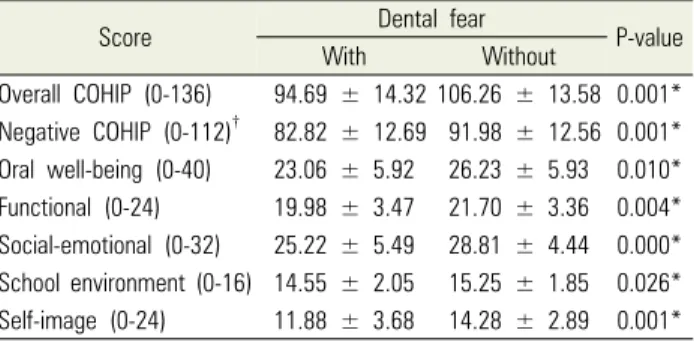
Table 2. Differences in the COHIP scores between children with or without dental fear in 2012
Score Dental fear
P-value
With Without
Overall COHIP (0-136) 94.69 ± 14.32 106.26 ± 13.58 0.001*
Negative COHIP (0-112)† 82.82 ± 12.69 91.98 ± 12.56 0.001*
Oral well-being (0-40) 23.06 ± 5.92 26.23 ± 5.93 0.010*
Functional (0-24) 19.98 ± 3.47 21.70 ± 3.36 0.004*
Social-emotional (0-32) 25.22 ± 5.49 28.81 ± 4.44 0.000*
School environment (0-16) 14.55 ± 2.05 15.25 ± 1.85 0.026*
Self-image (0-24) 11.88 ± 3.68 14.28 ± 2.89 0.001*
COHIP = Child Oral Health Impact Profile Values are Mean ± SD
Table 3. Differences in the COHIP scores between children with or without dental fear in 2014
Score Dental fear
P-value
With Without
Overall COHIP (0-136) 100.69 ± 14.39 103.85 ± 16.39 0.134 Negative COHIP (0-112) 87.95 ± 12.87 90.32 ± 14.44 0.203 Oral well-being (0-40) 25.64 ± 4.86 26.13 ± 5.50 0.827 Functional (0-24) 21.12 ± 3.32 21.22 ± 3.75 0.418 Social-emotional (0-32) 26.52 ± 5.36 28.17 ± 5.65 0.041*
School environment (0-16) 14.67 ± 2.19 14.80 ± 2.31 0.577 Self-image (0-24) 12.74 ± 3.03 13.53 ± 3.54 0.268 COHIP = Child Oral Health Impact Profile Values are Mean ± SD
Table 4. Changes in dental fear between 2012 and 2014 Dental fear change
2012 to 2014
Sex
Total (%) P-value (by chi-square
test) Male (%) Female (%)
With to With 14 (28.6) 14 (26.4) 28 (27.5)
0.105 With to Without 10 (20.4) 13 (24.5) 23 (22.5)
Without to With 3 (6.1) 11 (20.8) 14 (13.7) Without to Without 22 (44.9) 15 (28.3) 37 (36.3) Total 49 (100.0) 53 (100.0) 102 (100.0)
analyses (SPSS Inc., Chicago, Il, USA).
RESULTS
The number of students reporting dental fear in 2014 declined from 2012, but the difference between years was non-significant (P > 0.05). In terms of sex-based differences within each year, women were more likely to report dental fear in 2012 and 2014. However, there was no statistically significant difference in dental fear according to the sex (Table 1).
In 2012, the group without dental fear showed higher COHIP scores than the group with dental fear. This difference was statistically significant (P < 0.05; Table 2). However, in 2014, though the same pattern was observed, the difference was non-significant for all the COHIP items other than those pertaining to social- motional well-being (Table 3).
The analysis results regarding changes in dental fear
showed that 63.8% of the participants’ dental fear did not change over the 2 years, while that of 36.2% did.
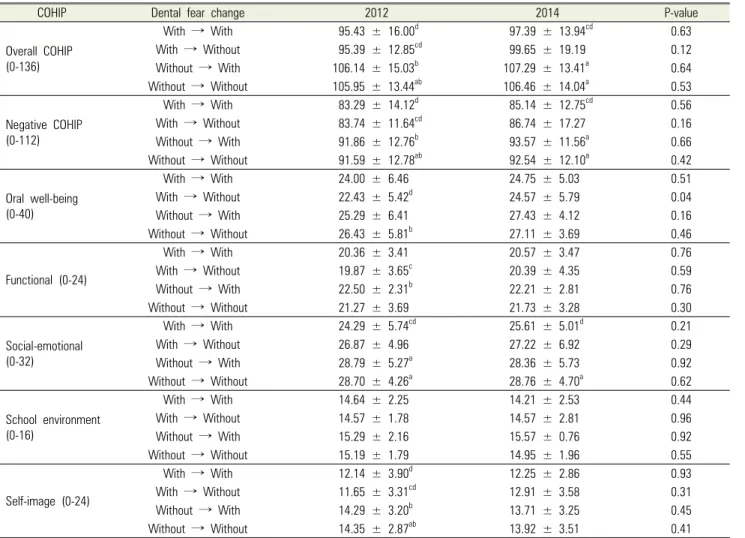
Sex-based differences dental fear were non-significant (Table 4). Comparison of the COHIP scores reflecting changes in fear showed that the group with continuous dental fear showed significantly lower COHIP scores than the group without continuous fear for the overall COHIP, negative COHIP, and social-emotional wellbeing items in 2012 and 2014 (Table 5).
DISCUSSION
This study’s results are meaningful in that the same questionnaire was administered to the same participants in 2012 and 2014 to examine changes in dental fear.
Additionally, the exploration of associations between indicators of the OHRQoL and dental fear was important.
Dental fear is often related to sex and age; it is reported more frequently in women than men and is inversely related to age. However, the apparent associations between dental fear and sex and age are neither consistent
Table 5. Changes in the COHIP scores according to changes in dental fear between 2012 and 2014
COHIP Dental fear change 2012 2014 P-value
Overall COHIP (0-136)
With → With 95.43 ± 16.00d 97.39 ± 13.94cd 0.63
With → Without 95.39 ± 12.85cd 99.65 ± 19.19 0.12
Without → With 106.14 ± 15.03b 107.29 ± 13.41a 0.64
Without → Without 105.95 ± 13.44ab 106.46 ± 14.04a 0.53
Negative COHIP (0-112)
With → With 83.29 ± 14.12d 85.14 ± 12.75cd 0.56
With → Without 83.74 ± 11.64cd 86.74 ± 17.27 0.16
Without → With 91.86 ± 12.76b 93.57 ± 11.56a 0.66
Without → Without 91.59 ± 12.78ab 92.54 ± 12.10a 0.42
Oral well-being (0-40)
With → With 24.00 ± 6.46 24.75 ± 5.03 0.51
With → Without 22.43 ± 5.42d 24.57 ± 5.79 0.04
Without → With 25.29 ± 6.41 27.43 ± 4.12 0.16
Without → Without 26.43 ± 5.81b 27.11 ± 3.69 0.46
Functional (0-24)
With → With 20.36 ± 3.41 20.57 ± 3.47 0.76
With → Without 19.87 ± 3.65c 20.39 ± 4.35 0.59
Without → With 22.50 ± 2.31b 22.21 ± 2.81 0.76
Without → Without 21.27 ± 3.69 21.73 ± 3.28 0.30
Social-emotional (0-32)
With → With 24.29 ± 5.74cd 25.61 ± 5.01d 0.21
With → Without 26.87 ± 4.96 27.22 ± 6.92 0.29
Without → With 28.79 ± 5.27a 28.36 ± 5.73 0.92
Without → Without 28.70 ± 4.26a 28.76 ± 4.70a 0.62
School environment (0-16)
With → With 14.64 ± 2.25 14.21 ± 2.53 0.44
With → Without 14.57 ± 1.78 14.57 ± 2.81 0.96
Without → With 15.29 ± 2.16 15.57 ± 0.76 0.92
Without → Without 15.19 ± 1.79 14.95 ± 1.96 0.55
Self-image (0-24)
With → With 12.14 ± 3.90d 12.25 ± 2.86 0.93
With → Without 11.65 ± 3.31cd 12.91 ± 3.58 0.31
Without → With 14.29 ± 3.20b 13.71 ± 3.25 0.45
Without → Without 14.35 ± 2.87ab 13.92 ± 3.51 0.41
P value from Kruskal-Wallis test
a, b, c, d: The superscript lower-case letters of the mean values indicate statistically significant differences between the dental fear change group (a = with → with, b = with → without, c = without → with, d = without → without) by the Bonferroni correction as a post-test.
nor universal [13].
In this study, the number of respondents who reported dental fear declined, from 48% in 2012 to 41.2% in 2014.
However, this result was non-significant. In previous studies examining the association between dental fear and age, Holtzman et al. [13] showed dental fear to be inversely proportionate to age; Berggren and Meynert [14] reported that younger patients showed higher fear levels than older patients. Moreover, Klingberg et al. [15]
posited that age was an important cause of dental fear in a study of 3,204 children aged 4-11 years. This suggests that the younger the children, the more likely they are to find the dental environment threatening.
Dental fear generally begins in childhood and is attributed
to the trauma of previous dental experiences [14]. With age, dental fear and anxiety decrease and are rarely problematic among adults, if handled correctly during childhood [13].
Moreover, sex has often been associated with dental fear and anxiety, which are reported more frequently in women than men. Both Moore et al. [16] and Schwarz and Birn [17] observed dental fear and anxiety more frequently in women than men. In 2012 and 2014, the number of women with dental fear was higher than men, but this difference was non-significant. Like the results of this study, a study conducted by Locker and Liddell [18] did not show any significant sex-related differences in dental fear. Further, Milgrom et al. [19] did not observe
any direct effect of the sex on dental fear. Peretz and Efrat [12] suggested that high levels of dental fear in women were not absolute and could vary according to the stimulus. Moreover, the final factor involved in identifying high dental anxiety levels is personal tempe- rament, the development of which is a continually conditioned process learned from responses to life’s experiences [12].
Dental fear and anxiety have been identified as important factors in delaying and avoiding dental care [13]. Evidently, oral health is affected by dental fear and avoidance [14]. This was confirmed in a study examining children's dental fear. Dental fear in children involves avoidance and more carious tooth surfaces [15].
The OHRQoL has been studied in connection with a wide range of oral conditions, such as caries, malo- cclusion, cleft lip and palate. A systematic review study established the relationship between the clinical oral health status and OHRQoL in children [4]. In a study evaluating the effectiveness of the Korean version of the COHIP, the overall COHIP score was significantly lower in children with caries and needing orthodontic treatment [9]. Nevertheless, the direct relationship between the oral condition and OHRQoL is difficult to define. This is because it is mediated by personal, social, and environ- mental variables influencing the understanding of the relationships among health, illness, and quality of life [4].
This study found that in 2012, the group with dental fear showed significantly lower COHIP scores than the group without dental fear. In 2014, though this still held true, this difference was non-significant for all items other than those pertaining to social-emotional well-being.
There was no direct correlation between dental fear and the COHIP scores.
Our longitudinal questionnaire-based survey demon- strated changes in dental fear over time. No significant sex-based differences in dental fear was observed.
However, it is noteworthy that the number of men within the group without dental fear, whose fear levels changed was very small than the women. The COHIP scores were compared to examine changes in dental fear. In both 2012
and 2014, the group with continuous dental fear showed lower overall COHIP, negative COHIP, and social- motional well-being scores than the group without continuous dental fear.
It is difficult to generalize the results of this study because the study participants were limited to one middle school in Gyeonggi-do. Further, due to the nature of longitudinal studies, the number of study participants was small, and the survey period was limited to two years.
The COHIP has proven to be an effective evaluation method for the OHRQoL, but there are few studies that have used it. In particular, longitudinal studies are rare.
To improve the OHRQoL, further studies on the COHIP index and oral health conditions are needed.
While previous studies examining dental fear explored epidemiological factors, such as sex, age, and parental fear, the current study was meaningful in that it attempted an objective comparison between indicators of the OHRQoL. In conclusion, there was no direct relationship between dental fear and the OHRQoL.
AUTHOR ORCIDs
Ka Young Kim: https://orcid.org/0000-0002-6177-3416 So-Youn An: https://orcid.org/0000-0002-8395-7881
DECLARATION OF INTEREST: The authors had no conflicts of interest to declare.
FUNDING: There is no financial support and sponsorship to declare.
REFERENCES
1. The WHOQOL Group. The World Health Organization quality of life assessment (WHOQOL): Position paper from the World Health Organization. Soc Sci Med 1995;
41: 1403-9.
2. Broder HL. Children’s oral health-related quality of life.
Community Dent Oral Epidemiol 2007; 35: 5-7.
3. Gherunpong S, Tsakos G, Sheiham A. Developing and
evaluating an oral health-related quality of life index for children; the CHILD-OIDP. Community Dent Health 2004; 21: 161-9.
4. Barbosa TS, Gavião MB. Oral health-related quality of life in children: Part II. Effects of clinical oral health status.
A systematic review. Int J Dent Hyg 2008; 6: 100-7.
5. Atchison KA, Dolan TA. Development of the Geriatric Oral Health Assessment Index. J Dent Educ 1990; 54:
680-7.
6. Slade GD, Spencer AJ. Development and evaluation of the Oral Health Impact Profile. Community Dent Health 1994; 11: 3-11.
7. Broder HL, McGrath C, Cisneros GJ. Questionnaire development: face validity and item impact testing of the Child Oral Health Impact Profile. Community Dent Oral Epidemiol 2007; 35 Suppl 1: 8-19.
8. Dunlow N, Phillips C, Broder HL. Concurrent validity of the COHIP. Community Dent Oral Epidemiol 2007;
35 Suppl 1: 41-9.
9. Ahn YS, Kim HY, Hong SM, Patton LL, Kim JH, Noh HJ. Validation of a Korean version of the Child Oral Health Impact Profile (COHIP) among 8- to 15-year-old school children. Int J Paediatr Dent 2012; 22: 292-301.
10. Doerr PA, Lang WP, Nyquist LV, Ronis DL. Factors associated with dental anxiety. J Am Dent Assoc 1998;
129: 1111-9.
11. Korea Health Promotion Institute. 2006 National Oral Health Survey Report. Available from https://www.
khealth.or.kr/board/ view?linkId=25027&menuId=
MENU01019, (Accessed on June 20, 2019)
12. Peretz B, Efrat J. Dental anxiety among young adolescent patients in Israel. Int J Paediatr Dent 2000; 10: 126-32.
13. Holtzman JM, Berg RG, Mann J, Berkey DB. The relationship of age and gender to fear and anxiety in response to dental care. Spec Care Dentist 1997; 17: 82-7.
14. Berggren U, Meynert G. Dental fear and avoidance: causes, symptoms, and consequences. J Am Dent Assoc 1984;
109: 247-51.
15. Klingberg G, Berggren U, Carlsson SG, Noren JG. Child dental fear: cause-related factors and clinical effects. Eur J Oral Sci 1995; 103: 405-12.
16. Moore R, Birn H, Kirkegaard E, Brodsgaard I, Scheutz F. Prevalence and characteristics of dental anxiety in Danish adults. Community Dent Oral Epidemiol 1993; 21: 292-6.
17. Schwarz E, Birn H. Dental anxiety in Danish and Chinese adults—A cross-cultural perspective. Soc Sci Med 1995;
41: 123-30.
18. Locker D, Liddell AM. Correlates of dental anxiety among older adults. J Dent Res 1991; 70: 198-203.
19. Milgrom P, Mancl L, King B, Weinstein P. Origins of childhood dental fear. Behav Res Ther 1995; 33: 313-9.