Introduction
It is reported that 90 % of people experience low back pain (LBP) at least once in their lifetime 1) . Due to the large social and economic loss that patients of this symptom have to pain put up with 2) , effective treatment is very impor- tant. Sciatica is a symptom, a form of pain that
radiates into the leg which is often accompanied with LBP 3) .
Acupuncture has been usually applied to LBP and sciatica. The effect of acupuncture on LBP has been reported by several RCT studies 4-10) . However clinical studies on the effect of specific acupuncture points are still lacking. So it remains unclear whether acupuncture on the special point has dominant efficacy.
Therefore this paper will report the result of a clinical study on the efficacy of the Kuesu point, a specific point of acupuncture, performed on female patients with LBP and accompanied sciatica.
received : 7 November 2007
received in revised from : 9 November 2007 accepted : 27 November 2007
Correspondence to : Dong-Il Kim
814, Siksa-dong ilsandong-gu, Goyang-si, Gyeonggi-do, Korea
(Tel : +82-31-961-9060 / Fax : +82-31-961-9009 E-mail : [email protected])
A Randomized Controlled Trial to Verify Effects of Kuesu Point on Low Back Pain and Accompanied Sciatica
Jeong-Won Lee, Dong-Il Kim
Dept. of Ob&Gy, College of Korean Medicine Dongguk Univ.
Original Article
Objective : Kuesu point is a newly discovered point, it is located in 3-cun from the centre of sacrum laterally, paralleled to the 4th foramen on the sacrum. This controlled trial was to evaluate the superior effect of Kuesu point on back pain which radiated to lower extremities.
Methods : Randomized Controlled Trial (RCT) and Single Blind in patient was designed. Patients (n=31) were randomized to two groups, Kuesu-point acupuncture group (Group A, n=16) and non Kuesu point acupuncture group (Group B, n=15).
Group A was acupunctured on B25 ( 大腸兪), B26 (關元兪) and B60 (崑崙) with Kuesu point. Group B was acupunctured on the same points without Kuesu point. The clinical subjects were female patients. Beside acupuncture, the other therapies were excluded. Clinical period was three weeks total. Each group was treated 4-5 times per week for 3 weeks. The outcome measurements were The Estimation Index of Backache (quality of life), Pain Rating Scale (pain intensity) and other physical examinations (ROM, SLR, etc.).
Results : 31 patients (Group A: n=16, Group B: n=15) were Randomized, 6 of them dropped out. Eventually 25 patients (Group A: n=15, Group B: n=10) were included in the analysis. Group A acupunctured on Kuesu point scored more significant Estimation Index of Backache and lower PRS (Pain Rating Scale) than Group B acupunctured without Kuesu point (p= 0.003/2). It turned out that the group acupunctured on Kuesu point show meaningful high improvement index. And other examination's results showed that the treatment effects of Group A are twice as better as Group B.
Conclusion : These results suggest that Kuesu point acupuncture was more effective on lower back pain and improved the life quality of patients, being compared with non Kuesu point acupuncture.
Key Words : acupuncture, sciatica, RCT, low back pain
Methods 1. Patients
From July 18, 2005 to February 25, 2006, volunteers for this trial were recruited among female patients in their 20s to 50s with LBP accompanied with sciatic neuralgia. People who were excluded from the study exhibited, red flags of lumbago 11) (fracture, tumor, or infection of lumbar, Cauda equina syndrome, etc), spond- ylolisthesis, spondylosis grade Ⅲ, Ⅳ(Meyerding Classification system), compression fractures, osteoporosis, scoliosis, people unqualified for basic health examination, and people with social histories of chronic LBP such as heavy labor.
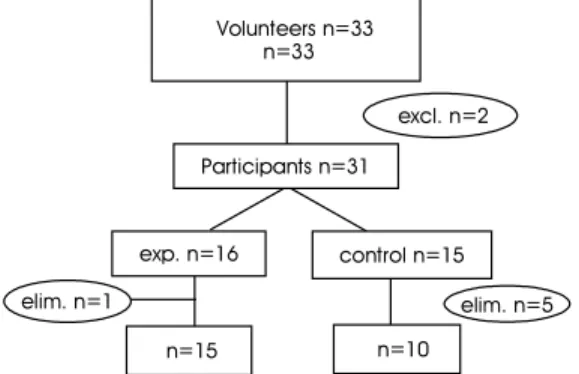
The total number of applicants was 33, but two were excluded due to spondylolisthesis.
2. Study design
For the method of this clinical study, the Randomized Controlled Trial (RCT) was chosen due to its benefits in reducing systemic bias and wide application in treatment studies.
The 31 participants were divided into the study group (group A, n=15), and the control group (group B, n=15) by the randomized controlled trial. Randomization took place by
lottery method.
Before proceeding with the clinical treatment, a test of homogeneity was carried out on the two groups considering 6 factors, evaluation index onlumbago, age, duration of disease, sten- osis in radiography, menopause, and obesity.
Six participants were eliminated due to lack of time, leaving the final participant number at 25 (experimental group n=15, control group, n=10).
3. Intervention
Group A was acupunctured on the B25 (2 points on both side), B26 (2 points on both side), B 60 (2 points on both side) and Kuesu point (2 points on both side) while the group B was acup- unctured on the same spots except the Kuesu point.
The site of acupuncture of the Kuesu point is 3-cun apart from the centre of the sacrum laterally and is paralleled to the 4th foramen on the sacrum. On the B25, B26, and B60 points, 5cm 0.35mm acupuncture needle was used and the 12cm 0.40mm longer needle were used on the Kuesu point. Raising and Thrusting, Twirling or Rotation techniques were used to gain
‘de-Qi’. The needles was inserted 4-5cun 90degrees relative to skin surface and when the patient gained the sensation of de-Qi the needles stayed still at the points. The needle was inserted for 11 minutes and this procedure was carried out in prone position.
After 3 weeks of acupuncture therapy, an evaluation of vital function, The Estimation Index of Backache, an evaluation on pain intensity, PRS (Pain Rating Scale), and other tests including ROM, SLR, Walking on the Heel test, Walking on the Toe test, MT, ST were carried out in order to evaluate the improvement in LBP and sciatica. The degree of improvement
Volunteers n=33 n=33
control n=15 excl. n=2 Participants n=31
n=10
elim. n=5 elim. n=1
exp. n=16
n=15
Fig. 1. Participant flow in the study; Six patients who
dropped out were excluded from the analysis.
of the two groups were compared in a statistical inspection.
Only acupuncture was used as a means of therapy and therefore medication, physical and exercise therapy were all excluded during this trial. All patients received the same instructions on things to watch out for. In order to minimize systematic bias, all factors except the acupu- ncture therapy of the Kuesu point were kept equal in the two groups. The Sham Therapy model was applied and single blind method was used, meaning that when treating the control group, the needle was placed on the Kuesu point and acupuncture was imitated so that the patients would not recognize the difference in therapy.
The duration of treatment was up to three weeks but for the patients whose symptoms disapp- eared before that, early termination of treatment was allowed. Treatment was carried out four to five times a week and the dropouts are cases with less than 2 sessions a week.
4. Data collection
1) Diagnosis and clinical outcomes (1) Basic Health Diagnosis
Age, medical history, present medical state, BMI (weight kg/ height m2) etc. are examined.
Tongue inspection, abdominal examination, pulse examination and systematic interview diagnosis are taken and patients with diabetes, cancer, long steroid administration are classified as unqua- lified for the study.
(2) Lumbar Examination (accompanied paper1 diagnosis)
a. Lumbosacral radiograph (choose 1 between X-ray, CT, MRI)
Check for intervertebral disc angle, Sagital canal distance, Disc space narrowing, Compression Fx,
scoliosis, osteoporosis, spondylosis, lordosis, kyposis, straightening, HIVD (Bulging, Protrusion, Extrusion, Sequestration disc).
b. The Estimation Index of Backache, total 100 points
Kim's study 12) data was used as a reference in the evaluation index of lumbago, and it is the main evaluation item of this study on life capacity.
c. PRS (Pain Rating Scale, 0~10points) 0: No Pain, 1-2: Hurts a Little Bit, 3-4: Hurts a Little More, 5-6: Hurts Even More, 7-8: Hurts a Whole Lot, 9-10: Hurts the Worst
d. Other Examinations
The ROM (range of motion) of lumbar spine, Special Tests (SLR test, Valsalva test, Walking on the heel test, Walking on the toe tests), Neurologic examination (Motor Test, Sensory Test), Neurologic Level (L5, S1 neuromuscular changes), Tender point palpation were carried out.
2) Statistical Analysis
SPSS (Statistical Program for Social Science) 10.0 for windows was used to organize data. The data was expressed as mean ±SD and we used the method of the t-test, which is useful for the comparison of the mean values of two indepe- ndent populations, with a significance level of p<0.05. For the cases in which the cell's expected frequency was larger than 5, the Chi-square Test was used, and for those below 5, both the Chi-square Test and the Fisher Test was used.
Result
1. Homogeneity of both groups
Before beginning clinical therapy, the exper-
imental group and the control group were approved to have the same conditions on six criteria: Lumbago examination index (p=0.2856), Age (p=0.944), Duration of disease (Chi-square Test p=0.901, Fisher Test p=1.00), Stenosis in radiography (Chi-square Test p=0.656, Fisher Test p=1.00), Menopause (Chi-square Test p=0.870, Fisher Test p=1.00), BMI (Chi-square Test p=0.467, Fisher Test p= 0.659).
2. Statistic Analysis of Symptom Improve- ment
1) The Estimation Index of LBP (total 0-100) The improvement-index (p=0.005/2) (=after index - before index / after index), and the difference between before and after treatment (D1-index, p=0.002/2, after index - before index) both indicate that the treatment received by group A is more effective than that of the group B. (Table1)
2) Pain Rating Scale (PRS)
The difference between before and after treatment (D2-index =before PRS-after PRS, p=
0.003/2 ) used in testing and group A's treatment proved to be more effective than the group B's.
(Table 2)
3) Other Examinations results
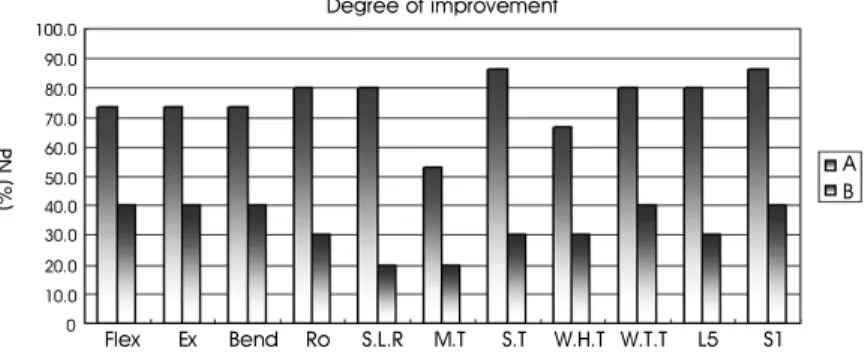
Basic pain elimination ratio (PN %ratio) with improved LBP and sciatica in all 11 items were ROM extension (group A 73.3 %, group B40.0
%), Motor test (MT, group A 53.3 %, group B 20.0 %), ROM curve (group A 73.3 %, group B 40.0 %), Walking on the heel test (group A 66.7
%, group B 30.0 %), Walking on the toe test (group A 80.0 %, group B 40.0 %). The efficacy of the treatment of the group A was twice as high as group B's.
Discussion
In this study, we carried out a Randomized Controlled Trial in order to objectively examine the efficacy of the Kuesu point which has been anticipated to have effects on patients with back and leg pain. The subjects of the clinical study were women with lumbago accompanied by sciatic neuralgia.
item A B
LBP Estimation Index improvement index 0.45 0.26
D1-index 38.80 19.00
The improvement-index : after index - before index/ after index
D
1-index : difference between before and after treatment(after index - before index) A : study group
B : control group
Table 1. Result of The Estimation Index of LBP
item A B
PRS D2-index 5.30 2.40
PRS : Pain Rating Scale D
2-index : before PRS-after PRS A : study group
B : control group
Table 2. Result of Pain Rating Scale
Group A received acupuncture in the usual diagnosis for back and sciatica, B25, B26, B60, along with the particular point under our scrutiny, the Kuesu point. Group B received the same treatment with the exception of the Kuesu point. The improvement after therapy was compared and assessed.
The Kuesu point is located 3-cun from the centre of sacrum laterally and is parallel to the 4th foramen on the sacrum. The needle was inserted 4-5cun 90degrees relative to skin surface. The sensation that patients feel after the needle is inserted (de-Qi) tends to move upwards but mostly it moves downwards as far as sole of the foot. It also produces heat and numbness.
The Kuesu point is a new point developed from clinical experience. In terms of meridian line, it is located on Urinal Bladder meridian which passes waist line along side the vertebra, and this comes down to hips and passes through popliteal region back of the knee. Anatomically speaking, the needle's inserted region starts from the surface of the skin, then goes to the acupuncture point → skin → subcutaneous tissue → Gluteaus maximus → Priformis muscle → and finally to
the Sciatic nerve.
Thirty-three women volunteered to take part in the study and two people were excluded due to spondylolisthesis. After 31 people were randomly classified into a group A (n=16) and a group B (n=15), 5 more people were eliminated leaving 25 final participants (group A n=15, group Bn=10).
Before treatment, the two groups were tested on sameness of 6 variables: estimation index of backache, age, duration of disease, stenosis in radiography, menopause, and obesity.
The efficacy of treatment was judged by The Estimation Index of Backache, which reflects the vital functions, PRS (Pain Rating Scale) and other tests (11 items: ROM flexion, extension, sidebending, rotation, SLR, Walking on the Heel test, Walking on the Toe test, MT, ST, L5 neuro- muscular changes, S1 neuromuscular changes).
The results of these exams were used to compare the improvement degrees of group A and group B after treatment and make a statistic assertion.
In The Estimation Index of Backache (total 100), both the improvement-index (=after index - before index/ after index, p=0.005/2) and D1- index (=after index - before index, p=0.002/2)
100.0
P N (% )
Degree of improvement
90.0 80.0 70.0 60.0 50.0 40.0 30.0 20.0 10.0 0