Original Article
비급성 요통에 대한 위수혈 자락관법의 효과 탐색: 예비 무작위 대조군 시험
김형석*
,†
⋅조재흥*,‡
⋅김고운*,‡
⋅정원석*,†
⋅박재현*,†
⋅신우철*,†
⋅정석희*,†
경희대학교 대학원 임상한의학교실*, 경희대학교한방병원 한방재활의학과†, 강동경희대학교한방병원 한방재활의학과‡
An Investigation on the Effects of Wet Cupping on Wisu (BL21) for Non-acute Low Back Pain: A Pilot Randomized Controlled Trial
Hyungsuk Kim, K.M.D.* ,† , Jae-Heung Cho, K.M.D.* ,‡ , Koh-Woon Kim, K.M.D.* ,‡ , Won-Seok Chung, K.M.D.* ,† , Jae-Hyun Park, K.M.D.* ,† , Woo-Chul Shin, K.M.D.* ,† , Seok-Hee Chung, K.M.D.* ,†
Department of Clinical Korean Medicine, Graduate School, Kyung Hee University*, Department of Korean Rehabilitation Medicine, Kyung Hee University Korean Medicine Hospital
†, Department of Korean Rehabilitation Medicine, Kyung Hee University Korean Medicine Hospital at Gangdong
‡Funding statement: This research did not receive any specific grants from funding agencies in the public, commercial, or not-for-profit sectors.
RECEIVED Sep 13, 2018 REVISED Oct 6, 2018 ACCEPTED Oct 11, 2018 CORRESPONDING TO
Seok-Hee Chung, Department of Korean Rehabilitation Medicine, Kyung Hee University Korean Medicine Hospital, 23
Kyungheedae-ro, Dongdaemun-gu, Seoul 02447, Korea
TEL (02) 958-9213 FAX (02) 958-9104 E-mail [email protected] Copyright © 2018 The Society of Korean Medicine Rehabilitation
Objectives This study was designed to investigate the effects of wet cupping on Wisu (BL12) in non-acute low back pain patients.
Methods We recruited 30 participants for this study. Fifteen patients were randomly as- signed to the Wisu (BL21) treatment group (WT group) and 15 were assigned to the non-acupoint treatment group (NT group). Both groups were treated with the pricking-cup- ping bloodletting method three times. Values at baseline and follow-up were analyzed by Wilcoxon signed rank test and the differences between the two groups were determined by Wilcoxon rank sum test. p-values less than 0.05 were considered significant. The primary outcome was the visual analogue scale (VAS), and secondary outcomes were the Oswestry disability index (ODI), Rolland-Morris disability questionnaire (RMDQ), Euroqol-5 dimension questionnaire (EQ-5D) and finger-to-ground distance (FTGD). These outcomes were measured on the day of first treatment before the procedure and on follow-up 7 days after the last treatment.
Results Significant changes were identified in the VAS for pain and ODI in each group after wet cupping treatment on Wisu (p<0.05). However, no significant changes were found be- tween groups. Meanwhile, RMDQ and EQ-5D were significantly decreased only in the NT group (p<0.05) without any differences between groups. FTGD was decreased in both groups, but not significantly.
Conclusions Wet cupping with both Wisu treatment and non-acupoint had significant ef- fects on non-acute low back pain, although there were no differences between the two groups. A large-scale study is needed to identify the effect of wet cupping on Wisu. (J Korean Med Rehabil 2018;28(4):21-32)
Key words Low back pain, Wet cupping, Wisu, BL21(Weishu)
Introduction»»»
According to data from the third Using of Korean Medicine Treatment and Investigation on Consumption Realities by the Korean Ministry of Health and Welfare, treatment for musculoskeletal and connective tissue dis- ease accounts for 50.2% of patient visits to a Korean Medicine doctor. Of these diseases, aside from acute presentations, low back pain was the main symptom (6.6%)1). Because of the high incidence of low back pain patients, clinical researchers have conducted numer- ous studies to address this issue2,3), especially studies on acupuncture4,5). Even though other techniques of Korean Medicine like cupping, moxibustion, pharmacupuncture, and chuna manipulation therapy are widely used by Korean Medicine doctors, they lack large-scale clinical trials with comparisons to acupuncture.
Wet cupping, a cupping therapy, is a procedure in which the target point of patient’s body is punctured with triangular acupuncture, lancet or automatic punc- turing gun, and then the area is covered and negatively pressured with a cup to squeeze out blood6). Wet cup- ping is known to improve nonspecific low back pain7,8), hypertension9), brachial pain10), carpal tunnel syndrome11), chronic neck pain12,13), oxygen saturation in chronic obstructive pulmonary disease14), and ulcers related to Behcet’s disease15), among other conditions. Of these studies, this technique is usually performed at the site of pain or the acupoint, which is selected by visceral pattern identification (臟腑辨證)16). Ouchpoints (阿是穴) such as Shinsu (腎兪, BL23), Kihaesu (氣海兪, BL24), Taejangsu (大腸兪, BL25) have been proven to have an anti-nociceptive effect on low back pain7,17). Wisu (胃兪, BL21) has not yet been studied for tr eating low back pain, although this point is related to the treatment point that Maigne18) and Choe19) suggested for cur ing low back pain. Furthermore, no studies have analyzed differences in the effects according to different treat- ment locations. In this study, wet cupping was per- formed for non-acute low back pain patients on either
Wisu or a designated non-acupoint to compare the effect.
This study recruited participants who had non-acute low back pain and randomized them into either a Wisu treatment group (WT group) or non-acupoint treatment group (NT group). Wet cupping was conducted on the designated area according to groups and the degree of pain, physical function and quality of life were eval- uated to see the feasibility of treating Wisu as a tr eat- ment point for low back pain.
This protocol was registered on clinical research in- formation service (CRIS) (registration number: KCT0002286)
Materials and Methods»»»
1. Participants
1) Inclusion criteria
We recruited 30 participants aged 18 to under 65 from the 1st of Apr il to the 30th of September, 2016.
We included participants who had a value of over 40 mm on the 100 mm visual analogue scale (VAS) for low back pain in the week before screening, appeared normal on neurological testing, and consented not to have other tr eatments that could affect the r esults of this study according to the investigator’s judgment.
This study was approved by the institutional review board (IRB) of Kyung Hee University Korean Medicine Hospital (approval number: KOMCIRB-160215-HR-007).
2) Exclusion criteria
Patients were excluded based on the following cri- teria:
(1) The cause of low back pain is not idiopathic, but due to a specific severe disease such as spine fracture or infection of spine, inflammatory spondylitis, malignant tumor, etc.
(2) History of spinal surgery or surgery scheduled during participation in this study
(3) More severe pain at sites other than the low back
Fig. 1. Pictures of treatment points of wet cupping. Conducting wet cupping on each treatment point (A) Wisu (BL21) treatment group and (B) Non-acupoint treatment group.
(4) Pregnant or lactating
(5) Low back pain due to menstruation
(6) Other chronic diseases that interfere with the ef- ficacy or r esults of the study
(7) Unable to agr ee or cooper ate with the study procedure due to cognitive impairment
(8) Injury related to lawsuit or compensation (9) Currently taking corticosteroids, narcotics, muscle
relaxants, or herbal medicine for low back pain or other drugs that researchers consider inappropriate (10) Any circumstances that researchers judge inadequate
2. Methods
This study had two arms, the WT gr oup and NT group. Block randomization was conducted using R 3.2.5 for Windows (The R Foundation) and the block size was six. Thirty participants were randomized to two groups.
VAS, Oswestry disability index (ODI), Roland-Morris disability questionnaire (RMDQ), Euroqol-5 dimensions questionnaire (EQ-5D), and finger-to-ground distance
(FTGD) were measured by an evaluator on the first visit.
The Wisu acupoint was designated according to the World Health Organization Guideline for Acupuncture Point Locations20), which is considered the international standard. A non-acupoint was selected as the midpoint between Wich’ang (胃倉, BL50) and the posterior axil- lary line (Fig. 1). Wet cupping was performed by a Korean Medicine doctor with more than 2 years of clin- ical experience. Participants in both groups were oper- ated with the medical lancet (28 G, Dongbang Medical, Seoul, Korea) by being punctured 20 times within the diameter of each cup, and then disposable suction cups (internal diameter 28 mm, Dongbang Medical, Seoul, Korea) were put on each point and pressured negatively using the suctioning tool with three full presses. After five minutes, the cups were removed and the area was disinfected.
Medical infrared (IR3000, Haedong Medical, Ulsan, Korea) was used to irradiate the treatment surface of the participant’s body for a distance of about 30 cm. It was turned on at the start of wet cupping and tur ned off 10 minutes after removal of the cups, for a total of
15 minutes. Wet cupping was repeated three times over an approximately 72-hour period. On follow-up, a week after the 3rd treatment, VAS, ODI, RMDQ, EQ-5D, and FTGD were evaluated. A 24-hour differ- ence was allowable at each visit.
3. Measurements
1) Primary outcome
VAS: The left end is ‘0 (No pain)’ and right end is
‘10 (worst possible, unbearable, excruciating pain)’.
Participants mark the spot corresponding to the degree of current low back pain. To see how much the pain decreases, participants were asked on follow-up to in- dicate the spot that compared to the very first value (baseline).
2) Secondary outcome (1) ODI
ODI evaluates 10 kinds of disabilities of daily living due to low back pain in terms of intensity of pain, per- sonal hygiene, lifting, walking, sitting, standing, sleeping, sexual life, social life and travelling by questionnaire.
Each category has 6 selections and a higher score in- dicates a more severe disability.
(2) RMDQ
Functional disability by low back pain is evaluated through this scale. There are 24 questions total.
Respondents select either “yes” or “no” for each question.
A higher score indicates a worse disability.
(3) EQ-5D
EQ-5D is used to evaluate health outcome and in- cludes the 5 categories of ‘mobility,’ ‘self-care,’ ‘usual ac- tivities,’ ‘pain/discomfort’ and ‘anxiety/depression.’
(4) FTGD
A participant stands on a firm box of 30 cm height with the medial side of the feet touching each other and without knee flexion. The patient is then instructed to flex the patient’s body downward as much as possible.
Then, the distance between the fingertip of the middle
finger and upper surface of the box is measured. If the fingertip is located higher than the box, the value is pos- itive and vice versa.
4. Statistics
SPSS 18.0 for Windows (IBM Corp., Armonk, NY, USA) was used for statistics. Data are expressed as mean ± standard deviation (SD), median and inter- quartile range (IQR). Chi-square test was performed to determine the gender ratio between the WT and NT groups and Wilcoxon signed rank test was conducted to see the change between baseline and follow-up in each group. To compare groups at the same point of time, Wilcoxon rank sum test was used. A p-value lower than 0.05 indicated significance.
Dropouts were dealt with using “intention to treat analysis” such that the last measured data were equally applied to the subsequent evaluation.
Results»»»
1. Participant flow chart and initial assessment of the subjects
Forty-four participants were screened in this study.
Fourteen were excluded because they either had VAS under 40 mm (n=7) or had other mor e sever e symp- toms than lower back pain (n=3) or refused to partic- ipate after explanation of the procedure (n=4). Thirty subjects were randomly allocated to the WT or NT group. A participant flow chart (Fig. 2) shows the pro- cedure for assignment; 15 participants were assigned to each group and three dropouts were verified, with one subject in the WT gr oup and the other two in the NT group. The WT group dropout was participating in an- other ongoing study and therefore was ineligible for this study. Two subjects in the NT gr oup failed to at- tend the scheduled day and so they were removed.
Fig. 2. Participant flow chart. VAS: visual analogue scale.
WT group NT group p-value
n 15 15 -
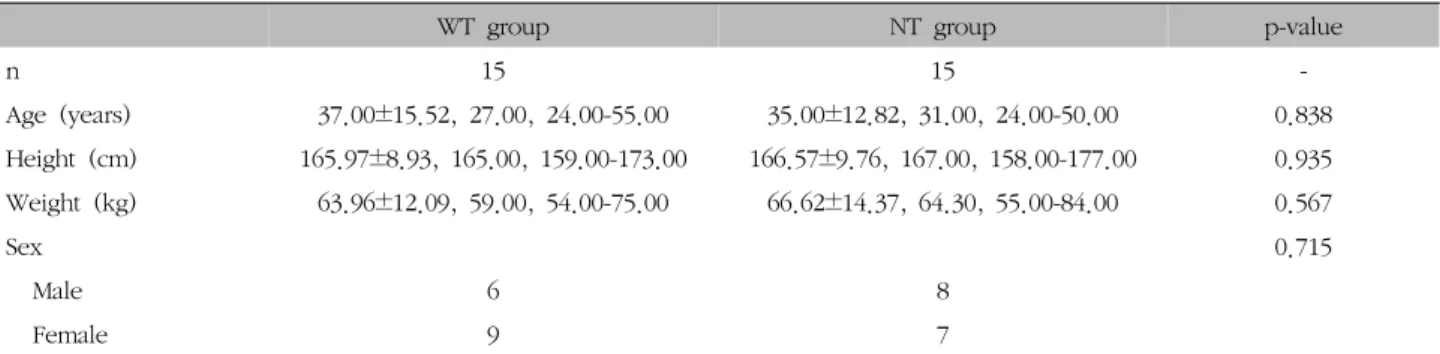
Age (years) 37.00±15.52, 27.00, 24.00-55.00 35.00±12.82, 31.00, 24.00-50.00 0.838 Height (cm) 165.97±8.93, 165.00, 159.00-173.00 166.57±9.76, 167.00, 158.00-177.00 0.935 Weight (kg) 63.96±12.09, 59.00, 54.00-75.00 66.62±14.37, 64.30, 55.00-84.00 0.567
Sex 0.715
Male 6 8
Female 9 7
Values represent mean ± standard deviation, median, interquartile range.
WT group: Wisu (BL21) treatment group, NT group: non-acupoint treatment group.
Table Ⅰ. General Characteristics of the Subjects
These 3 dropouts were processed with “intention to treat analysis” so each group had 15 participants for analysis.
There were no statistically significant differences in sex, age, height, or weight between the two groups at baseline (p>0.05) (Table Ⅰ).
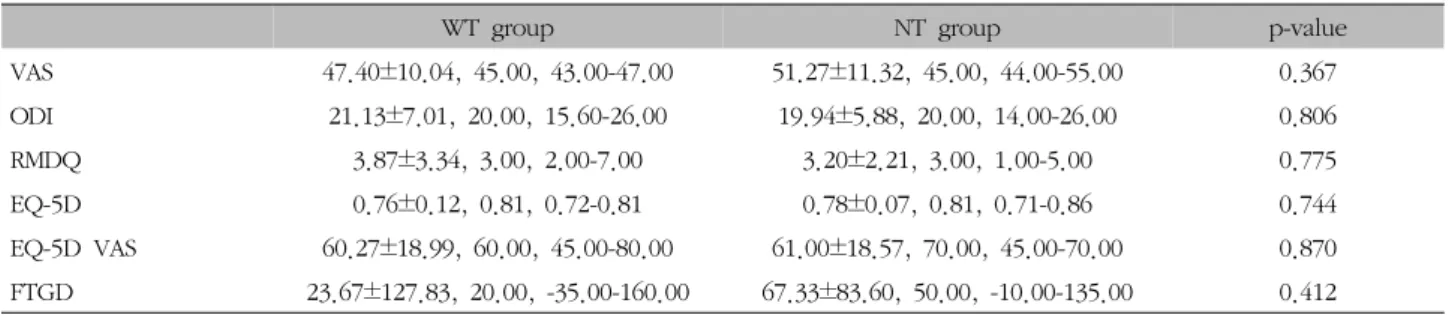
No significant difference was found between the two groups at baseline for VAS, ODI, RMDQ, EQ-5D or FTGD (p>0.05) (Table Ⅱ).
2. Change in VAS
Both the WT and NT gr oups showed a significant decline in VAS score. The WT gr oup had a significant decrease from the baseline value of 47.40±10.04 mm to the follow-up value of 33.20±14.36 mm (p<0.05).
The NT group VAS score decreased from 51.27±11.32 mm to 35.93±17.56 mm (p<0.05). There were no sig- nificant differences between gr oups at the same time point (p>0.05) (Table Ⅲ, Fig. 3).
WT group NT group p-value
VAS 47.40±10.04, 45.00, 43.00-47.00 51.27±11.32, 45.00, 44.00-55.00 0.367
ODI 21.13±7.01, 20.00, 15.60-26.00 19.94±5.88, 20.00, 14.00-26.00 0.806
RMDQ 3.87±3.34, 3.00, 2.00-7.00 3.20±2.21, 3.00, 1.00-5.00 0.775
EQ-5D 0.76±0.12, 0.81, 0.72-0.81 0.78±0.07, 0.81, 0.71-0.86 0.744
EQ-5D VAS 60.27±18.99, 60.00, 45.00-80.00 61.00±18.57, 70.00, 45.00-70.00 0.870 FTGD 23.67±127.83, 20.00, -35.00-160.00 67.33±83.60, 50.00, -10.00-135.00 0.412 Values represent mean ± standard deviation, median, interquartile range.
WT group: Wisu (BL21) treatment group, NT group: non-acupoint treatment group, VAS: visual analogue scale, ODI: Oswestry disability index, RMDQ: Rolland-Morris disability questionnaire, EQ-5D: Euroqol-5 dimensions questionnaire, FTGD: finger-to-ground distance.
Table Ⅱ. Baseline Evaluation of Subjects
VAS for WT group (n=15) NT group (n=15) p-value
Baseline (1st visit) 47.40±10.04, 45.00, 43.00-47.00 51.27±11.32, 45.00, 44.00-55.00
Follow-up (4th visit) 33.20±14.36, 33.00, 18.00-44.00 35.93±17.56, 36.00, 21.00-50.00 0.775
p-value 0.003
*0.001
*-
Values represent mean ± standard deviation, median, interquartile range.
VAS: visual analogue scale, WT group: Wisu (BL21) treatment group, NT group: non-acupoint treatment group.
*
p<0.05 was considered statistically significant.
Table Ⅲ. Comparison between Groups and Change in VAS
Fig. 3. Box plots of VAS. The lines across each of the boxes indicate the median. The upper and lower surfaces of the boxes are the third quartile and first quartile, respectively. Lines beyond the upper and lower surfaces are the maximum and minimum values excluding extremes and outliers, respectively. The small triangle is “extreme,” which represents 3-fold greater interquartile range. “Outliers” are expressed as small circles with the values from 1.5- to 3-fold interquartile range. Y axis shows VAS (mm). VAS:
visual analogue scale.
3. Change in ODI
ODI significantly decreased from baseline to fol-
low-up in the two groups, separately. The WT group decreased from 21.13±7.01% to 14.21±8.26% and the NT group from 19.94±5.88% to 12.45±8.31%, representing
EQ-5D for WT group (n=15) NT group (n=15) p-value Baseline (1st visit) 0.76±0.12, 0.81, 0.72-0.81 0.78±0.07, 0.81, 0.71-0.86
Follow-up (4th visit) 0.81±0.10, 0.86, 0.77-0.86 0.83±0.06, 0.86, 0.81-0.86 0.744
p-value 0.059 0.008
*-
Values represent mean ± standard deviation, median, interquartile range.
EQ-5D: Euroqol-5 dimensions questionnaire, WT group: Wisu (BL21) treatment group, NT group: non-acupoint treatment group.
*
p<0.05 was considered statistically significant.
Table Ⅵ. Comparison between Groups and Change in EQ-5D
RMDQ for WT group (n=15) NT group (n=15) p-value
Baseline (1st visit) 3.87±3.34, 3.00, 2.00-7.00 3.20±2.21, 3.00, 1.00-5.00
Follow-up (4th visit) 2.73±2.82, 2.00, 1.00-4.00 1.87±1.73, 1.00, 0.00-4.00 0.539
p-value 0.064 0.004
*-
Values represent mean ± standard deviation, median, interquartile range.
RMDQ: Rolland-Morris disability questionnaire, WT group: Wisu (BL21) treatment group, NT group: non-acupoint treatment group.
*
p<0.05 was considered statistically significant.
Table Ⅴ. Comparison between Groups and Change in RMDQ
ODI for WT group (n=15) NT group (n=15) p-value
Baseline (1st visit) 21.13±7.01, 20.00, 15.60-26.00 19.94±5.88, 20.00, 14.00-26.00
Follow-up (4th visit) 14.21±8.26, 14.00, 6.70-20.00 12.45±8.31, 12.00, 6.00-20.00 0.567
p-value 0.000
*0.000
*-
Values represent mean ± standard deviation, median, interquartile range.
ODI: Oswestry disability index, WT group: Wisu (BL21) treatment group, NT group: non-acupoint treatment group.
*
p<0.05 was considered statistically significant.
Table Ⅳ. Comparison between Groups and Change in ODI
significant reductions (p<0.05). No significant differ- ence was detected in ODI between the two groups (p>0.05) (Table Ⅳ).4. Change in RMDQ
There were no significant differences in RMDQ from baseline (3.87±3.34) to follow-up (2.73±2.82) in the WT group (p=0.064), while there was a significant decr ease from 3.20±2.21 to 1.87±1.73 (p<0.05) in the NT group.
No significant difference was found between the two groups (p>0.05) (Table Ⅴ).
5. Change in EQ-5D
The EQ-5D of the WT group increased from 0.76±0.12 at baseline to 0.81±0.10 on follow-up, which was not a significant change (p=0.059). In the NT gr oup, EQ-5D increased significantly from 0.78±0.07 to 0.83±0.06 (p
<0.05). There were no significant differences between the two groups (p>0.05) (Table Ⅵ).
6. Change in FTGD
FTGD decreased in both groups, but the decrease was not statistically significant at any of the time points (p>0.05) (Table Ⅶ).
FTGD for WT group (n=15) NT group (n=15) p-value Baseline (1st visit) 23.67±127.83, 20.00, -35.00-160.00 67.33±83.60, 50.00, -10.00-135.00
Follow-up (4th visit) 13.00±118.05, 20.00, -50.00-100.00 42.67±92.27, 40.00, -25.00-105.00 0.389
p-value 0.260 0.061 -
Values represent mean ± standard deviation, median, interquartile range.
FTGD: finger-to-ground distance, WT group: Wisu (BL21) treatment group, NT group: non-acupoint treatment group.
Table Ⅶ. Comparison between Groups and Change in FTGD
Discussion»»»
The standard clinical practice guidelines in Korean Medicine are developed with regard to major diseases due to the recent need to make Korean Medicine sci- entific and standardized. More and more studies are demonstrating the effects of various tools of Korean Medicine. Wet cupping therapy is a broadly used meth- od among Korean Medicine doctors21).
Non-acute low back pain patients in this study had more than 4 weeks of onset22). Acute low back pain lasting 4 or fewer weeks tends to simultaneously im- prove and there may be a distinct pathogenic mecha- nism23). Therefore, we limited participants to non-acute patients.
There have been several hypotheses regarding the pathophysiology of low back pain. One is that the sensory nerve branch of the posterior primary branch of the T12 spinal nerve is entrapped by a contracted erector spinae muscle at the level of the thoracolumbar junction, which is near the Wisu acupoint, causing low back pain in the area of the innervating iliac crest. This is related to thoracolumbar syndrome defined by Maigne18) who thought the cause of pain on the upper gluteal area was a dysfunction of the T12 bone, as well as Choe19), who insisted that contraction of the erector spinae near T12 arouses low back pain and most low back pain follows this mechanism. So, Wisu is considered a treat- ment point for low back pain.
The concept of using Wisu for treatment of low back pain is not new to Korean Medicine. Wisu is a transport point that controls the function of the stomach (胃). In
뺷Dongeuibogam (東醫寶鑑)뺸24), one of the representa- tive classics of Korean Medicine, the relationship be- tween the stomach and low back pain is described. The following statements show the belief that phlegm under- lies all diseases: “Phlegm comprises nine out of ten dis- eases (十病九痰);” “internal and external diseases exhibit numerous symptoms but all is fr om phlegm (其爲內外 疾病 非止百端 皆痰之所致也);” or “all the disease of hu- man being comes from phlegm (人之諸疾 悉出於痰).”
The most impor tant cause of phlegm is the condition of the spleen-stomach (脾胃). Most herbal medicinal formations have the main constituent of Pinellia ternata (半夏) from the chapter of “treatment for phlegm (痰飮 通治藥)” and this medicine has mer idian entr y to the spleen-stomach. Dysfunction of the spleen-stomach causes problems with the body fluid cycle, which is the main cause of phlegm25). This explains why Wisu can be chosen for low back pain.
Until now, the primary method for low back pain evaluation was the VAS. ODI shows functional disability and it is appropriate for severe cases. For mild symp- toms, RMDQ is more appropriate26). To assess change in the quality of life, we added EQ-5D. Moreover, we measured FTGD to obtain data on the range of motion of the lumbar spine.
The results from baseline and follow-up analyses are as follows. VAS and ODI showed significant effects in both the WT and NT group (p<0.05). RMDQ and EQ-5D decreased insignificantly in the WT group (p>0.05) and significantly in the NT gr oup (p<0.05). FTGD did not show a significant difference in either group (p>0.05).
There were not any significant differences between the
two groups (p>0.05).
The pain scale, the primary outcome of this study, showed improvement in both the WT and NT gr oup, but there was no significant difference. This result may come from nociceptive stimulation27), removal of oxida- tive agents28), and release of nitrousoxide29), which al- low wet cupping to provide analgesic effect in spite of the difference in treatment points. In addition, the Wisu acupoint conforms to the region of erector spi- nae and designated non-acupoint to latissimus dorsi, anatomically. Treatment of these areas helps blood cir- culation of the corresponding muscles and relaxes con- tracted muscles, accordingly improving the condition of both groups. We authors think that both chemical and anatomical mechanism contributed to releasing low back pain with wet cupping.
There were no significant change on RMDQ, EQ-5D and FTGD in WT group. However, this is a small-size pilot study so it is not proper to judge that those in- dicators are not improved by wet cupping on Wisu from this single research.
This study was designed to see if wet cupping on Wisu is more effective than on a non-acupoint. The ef- fect size of wet cupping on Wisu and the number of subjects in a large-scale clinical trial will be calculated.
The appropriate setting for a control group should also be considered. In acupuncture studies, unpunctured, more superficially punctured, and non-acupoint punc- tured3), ar e typically set as placebos. For dry cupping, sham cupping is currently being developed as a place- bo30). Preexisting methods for a control group for wet cupping include no treatment17,31), heat therapy11), and bloodletting with a lancet, but not cupping14). This is the first study to use different treatment points as a control. In the future, selecting a more effective treat- ing area and improving the method of wet cupping is necessary to differentiate the effect between active and control group. Furthermore, developing a proper pla- cebo model is also needed. For example, just stimulat- ing the skin with a tool that does not puncture the
skin, followed by dry suctioning on that area, can be conducted to blind participants and to evaluate the im- pact of puncture. Use of a placebo group will help produce objective results in future studies of wet cupping. Also, bee venom or pharmacupuncture on Wisu can be performed to activate the acupoint or muscles for study designs related to low back pain.
While cupping therapy can cause physiological re- sponses such as pigment response, coagulating re- sponse, purpura cutaneous reaction, blistering reaction, and tendering response, among others16), burns32) and lumbar abscesses33) are considered side effects. Accurate disinfection before and after the procedure is very im- portant to prevent these adverse events. Currently, by virtue of the wide use of disposable medical tools, in- fection such as hepatitis is rarely reported34). Sterile disposable lancets and suction cups were used and the disinfection procedure was performed before and after treatment. The treatment site was covered with gauze after wet cupping to prevent infection. However, two participants complained of a mild burning sensation on the skin lasting for two to three hours after the procedure. These complaints were not severe, but they seem to be related to the wet cupping pr ocedur e and they resolved after observation without any intervention.
Every participant has different endurance of skin to the surrounded environment so the same stimulation can be regarded as a little harmful case by case. It seems related to the intensity of the pressure and the lasting time of cupping. However, wet cupping of 5 minutes are mostly conducted in clinical situation of Korean Medicine21) and the fact that those sensations were dis- appeared automatically means that it is somewhat nor- mal response and not continuously harmful.
There are some limitations in this study. First of all, it is small sized pilot study so the r esults of this study should be interpreted with cautious consideration. It only provides the clues for feasibility, safety and effect size for future study. Secondly, because wet cupping was conducted by a Korean medicine doctor who has
basic knowledge for meridians and acupoints, blinding of the conductor was not satisfying. Thirdly, the rea- son for choosing Wisu as treating point is not sufficient. Because the acupoint was selected in this study from clinical experience, we can only suggest possible hypotheses with this clinical trial. Fourthly, the concept we suggested for the selection of treating point was because of the phlegm. If we had collected low back pain patients diagnosed as low back pain phlegm pattern differentiation, the result could have been different. Fifthly, in an anatomical respect, low back pain could have been categorized according to the problem of certain muscle. That way, the target of control group adjacent to lattisimus dorsi could have been another option for the treating point of low back pain. This can be one reason for the effectiveness of control group in this study. Lastly, both group in- cluded the use of infr ar ed ther apy for 15 minutes on the pain ar ea to r eflect the clincial scene of Korean Medicine which always uses the therapy. Infrared ther- apy is known to be effective for low back pain but the data are insufficient35) and the result of current study should be interpreted with the consideration the effect of the therapy. However, there is no study in the same design to compare. one more group of infra- red therapy alone can be added in the study design in the following study. The future study with large partic- ipants and modified grouping will be needed.
Conclusion»»»
Thirty non-acute low back pain patients were ran- domly assigned to either the WT or NT gr oup. Three rounds of pricking-cupping bloodletting were con- ducted and VAS, ODI, RMDQ, EQ-5D, and FTGD were measured. VAS, the primary outcome, and ODI showed a significant reduction between baseline and follow-up in both groups. RMDQ and EQ-5D declined insignif- icantly in the WT group, but it was significantly de-
creased in the NT group. FTGD insignificantly decreased in both groups. There were not any significant differ- ences between groups for any of the metrics assessed.
We conclude that wet cupping is equally effective on Wisu or the non-acupoint, but a larger study is needed in the future to compare the effect of those two treat- ing areas.
Acknowledgements»»»
We are grateful for those who participated in this study. Junyung Jeon contributed to recruit participants and make photographs of the treatment procedure.
Conflicts of Interest»»»
We declare that there is no conflicts of interest re- garding the publication of the article.