Is There an Association between Restless Legs Syndrome and Urticaria?
Restless legs syndrome (RLS) is a disease characterized by the urge to move the legs and sleep disturbances. Similarly, chronic spontaneous urticaria (CSU) is a dermatological disease characterized by pruritus and sleep disorders. In this study, we aimed to determine the prevalence and severity of RLS in patients with chronic spontaneous urticaria (CSU) and to compare the quality of sleep of patients with and without RLS in the CSU group using the Pittsburgh Sleep Quality Index. A total of 130 patients with CSU and 100 healthy controls were included in this study. The frequency of RLS, frequency of sleep disturbances, and average score of RLS in patients with CSU were statistically significantly higher than control groups (respectively P = 0.008, P = 0.009, P = 0.004). Subjective sleep quality, sleep latency and habitual sleep efficiency scores in patients with RLS were statistically significantly higher than patients without RLS (respectively P = 0.016, P = 0.007, P = 0.035). We claimed that pruritus of urticaria may decrease the quality of sleep in patients with RLS and it may trigger and worsen the restless legs syndrome. Furthermore, RLS and CSU may share a common etiology.
Keywords: Restless Legs Syndrome; Chronic Spontaneous Urticaria; Sleep Quality;
Pittsburgh Sleep Quality Index Serpil Tuna,1 Sevil Alan,2 Nehir Samancı,1
and Ayşe Akman Karakaş2
1Department of Physical Medicine and Rehabilitation, Akdeniz University School of Medicine, Antalya, Turkey; 2Department of Dermatology and Venereology, Akdeniz University School of Medicine, Antalya, Turkey
Received: 28 September 2015 Accepted: 17 February 2016 Address for Correspondence:
Sevil Alan, MD
Department of Dermatology and Venereology, Akdeniz University School of Medicine, Antalya 07070, Turkey E-mail: [email protected]
http://dx.doi.org/10.3346/jkms.2016.31.5.790 • J Korean Med Sci 2016; 31: 790-794
INTRODUCTION
Restless legs syndrome (RLS) is one of the most common diag- noses in sleep medicine and is characterized by the urge to move the legs, which increases at night and is usually relieved by move- ment. RLS causes sleep disturbance. The exact pathogenesis of RLS is unknown (1). RLS patients especially have difficulty fall- ing asleep or maintaining sleep (1,2). Criteria for the diagnosis of RLS were first introduced by the International Restless Leg Syndrome Study Group (IRLSSG) in 2003 (2). According to these, the urge to move the legs, worsening of symptoms with rest or inactivity, improvement with movement and impairment dur- ing evening or night hours compared to daytime are the diag- nostic indicators of RLS (2). RLS is idiopathic in nature in most cases, but can be secondary to conditions such as diabetes mel- litus (DM), renal failure, and iron deficiency anemia. The esti- mated prevalence of RLS in the general population ranges from 7% to 10% (1).
Urticaria is a common skin condition which is characterized by pruritic, pink or pale swellings (3). Chronic spontaneous ur- ticaria (CSU) is defined as the persistent symptoms of urticaria for six weeks or more (3,4). CSU is a disorder of unknown etiol- ogy associated with nocturnal awakenings and difficulty falling asleep (3,5). Sleep deprivation has been shown to have harmful effects on behavioural, physiological and psychological func- tioning. Skin disorders may be associated with sleep disturbance
and sleep deprivation, some associated with specific sleep dis- orders. There is very little literature focused on the frequency of sleep problems in the context of skin disorders (3). However, a study on this subject is not available so far in the literature.
In this study, we aimed to determine the frequency of RLS in patients with CSU and to explore the association between RLS and CSU.
MATERIALS AND METHODS Study population
In this cross-sectional study, 130 consecutive patients with CSU and 100 age and sex-matched healthy controls who were re- ferred to the Dermatology and Venereology outpatient clinic between July, 2013 and September, 2015 were included in this study. Patients with CSU associated with an underlying disease (systemic lupus erythematosus, malignancy, renal or hepatic insufficiency, blood dyscrasia, malabsorption, hypertension, diabetes, allergic rhinitis or bronchial asthma, chronic infec- tion, drug or alcohol abuse and other systemic disease), patients with physical urticaria, and urticaria due to medications or oth- er known etiology, were excluded from the study. Healthy con- trols had no symptoms or history of urticaria, NSAID/aspirin hypersensitivity and any other causes of symptomatic RLS in- cluding uremia, anemia, diabetes, pregnancy, polyneuropathy, rheumatoid arthritis, and any other patients with abnormal Dermatology
findings on neurological examination or with accompanying neurological disorder. Healthy controls and patients with chron- ic non-steroidal anti-inflammatory drug (NSAID)/aspirin in- take who took NSAIDs daily for at least 3 months were excluded from the study. Patients reported the severity of pruritus and disease duration.
Measurements
The urticaria activity score (UAS)
The UAS was calculated according to EAACI/GA2LEN/EDF gui- delines (6). The UAS was estimated according to the number of wheals and pruritus intensity, applying the following scheme:
no wheals/24 hr = 0, 20↓ wheals/24 hr = 1, 20-50 wheals/24 hr
= 2, 50↑ wheals/24 hr = 3 and pruritus intensity: no pruritus = 0, mild (present but not annoying or troublesome) = 1, moderate (troublesome but does not interfere with normal daily activity or sleep) = 2, intense (severe pruritus, which is laborious enough to interfere with normal daily activity or sleep) = 3. UAS scores:
daily (minimum = 0; maximum = 6). The UAS was classified as follows: 0-2 (mild), 3-4 (moderate) and 5-6 (severe) (6). Chronic urticaria patients were required to document their CU symp- toms once daily for 4 weeks using a diary.
Visual analogue scale (VAS)
The VAS referring to overall urticaria severity during the preced- ing 2 weeks was completed by the patient at each follow-up ap- pointment. The scale ranged from 0 to 10, 0 indicating no dis- ease and 10 indicating very severe urticaria.
Evaluation of RLS
All patients and control subjects were interviewed about their general demographic characteristics, medications, and four es- sential criteria for RLS, as described by the International Rest- less Legs Syndrome Study Group (IRLSSG) (7). Patients with all diagnostic criteria of IRLSSG were diagnosed with RLS. The IR- LSSG defined four criteria to allow a better recognition and stan- dardization of this diagnosis: (i) RLS consists of an urge to move the legs in association with some paraesthesias and disagree- able sensations, such as crawling, aching or burning in the legs;
(ii) the RLS sensations are relieved by movement (iii) the symp- toms have circadian rhythmicity and are worse at night; and (iv) the symptoms are also worse during periods of rest, especially long periods of inactivity. International RLS Rating Scale (IRLS) (designed by the IRLSSG) was used to determinate the severity of RLS in patients with RLS (8).
Evaluation of sleep quality
Pittsburgh Sleep Quality Index (PSQI) is the most commonly used retrospective self-report questionnaire that measures sleep quality over the previous month. This self-reported question- naire assesses sleep quality and contains 19 self-rated questions
yielding seven components: subjective sleep quality (SSQ), sleep latency (SL), sleep duration (SD), habitual sleep efficiency (HSE), sleep disturbances (SDis), use of sleep medications (USM), and daytime dysfunction (DD). Each component is scored from 0 to 3, yielding a global PSQI score between 0 and 21. A high PSQI score indicates poor sleep quality. A global PSQI score greater than 5 identifies patients with poor versus good SQ with 89.6%
sensitivity and 86.5% specificity (9). The Turkish version of the PSQI has been validated by Ağargün et al. (10).
Statistical analysis
A power analysis demonstrated that 40 patients would be re- quired in each group to detect significant differences in both groups with a power of 80% and a level of significance of α = 0.05.
Statistical analyses were performed by SPSS 18.00 (Statistical Package for Social Sciences, SPSS inc., Chicago, IL, USA). De- mographic characteristics and sleep quality of the patients and control groups were compared. Urticaria groups with RLS and without RLS were compared in terms of the demographic char- acteristics, disease duration, UAS, VAS scores and frequency of sleep disorders. PSQI scores of patients with RLS and non-RLS were compared. Normality of data was tested by Shapiro-Wilk test. Nominal variables were compared by χ2 tests. Numeric val- ues were compared using Mann-Whitney test or Student t-test.
Spearman’s nonparametric correlation test was used to evalu- ate the correlation between the parameters of PSQI scores and age, education level, RLS score, UAS and VAS score.
Ethics statement
This study protocol was reviewed and approved by the institu- tional review board of Akdeniz University School of Medicine (number 70904504/320) and was conducted according to the ethical standards of the Helsinki Declaration of 2000. All sub- Table 1. Sociodemographic and clinical features of CSU group and control group
Characteristics CSU group (n = 130)
Control group
(n = 100) P value Age (Mean ± SD) 41.98 ± 14.54 37.67 ± 11.65 0.649 Gender
Female
Male 94 (72.3%)
36 (27.7%) 58 (58%) 42 (42%)
0.86
Education Primary education High school College
62 (47.6%) 34 (26.2%) 34 (26.2%)
49 (49%) 25 (25%) 26 (26%)
0.282
Marital status Single/divorced*
Married 30 (23.0%)
100 (77.0%) 33 (33%) 67 (67%)
0.435
Smoking (+)† 42 (32.3%) 23 (23%) 0.507
RLS (+) 31 (23.8%) 12 (12%) 0.008
Poor sleep quality (+) 67 (51.5%) 29 (29%) 0.009 RLS score (Mean ± SS) 6.47 ± 1.17 1.97 ± 0.55 0.004 CSU, chronic spontaneous urticaria; RLS, restless legs syndrome.
*Only four divorced persons in CSU group and two divorced persons in control group;
†Current smokers and former smokers.
Table 2. Clinical and demographic features of RLS (+) patients and RLS (-) patients in the urticaria group
Characteristics RLS (+) n (%) RLS (-) n (%) P value Age (Mean ± SD)
Limits 45.36 ± 15.12
21-70 36.46 ± 13.22
18-70 0.032
Gender Male
Female 5 (17.8%)
23 (82.2%) 40 (35.7%) 72 (64.3%)
0.463
Obese 7 (25.0%) 12 (10.7%) 0.493
Atopy 5 (17.8%) 21(18.7%) 0.948
Use of antihistaminic drugs (+) 16 (57.1%) 48 (42.8%) 0.422 Family history of urticaria (+) 8 (28.5%) 28 (25.0%) 0.898 Poor sleep quality (+) 21 (75.0%) 69 (61.6%) 0.697 UAS (Mean ± SD)
Limits 3.24 ± 1.52
1-6 2.83 ± 1.32
1-6 0.432
VAS (Mean ± SD) Limits
7.95 ± 2.75 1-10
6.77 ± 3.08 0-10
0.135
Disease duration, months
(Mean ± SD) limits 82.75 ± 28.13
2-480 62.54 ± 10.84
2-360 0.524
BMI (Mean ± SD) Limits
27.32 ± 1.23 19.05-40.83
25.84 ± 0.72 17.01-36.57
0.998
RLS, restless legs syndrome; UAS, urticaria activity score; VAS, visual analog scale for severity of itch; BMI, body mass index.
Table 3. PSQI scores of CSU and control groups
Scores CSU (n = 130) CSU median (min-max) Control (n = 100) Control median (min-max) P value
SSQ 1.28 ± 0.10 1.00 (0.00-3.00) 0.92 ± 0.98 1.00 (0.00-3.00) 0.034
SL 1.55 ± 0.12 2.00 (0.00-3.00) 1.07 ± 0.10 1.00 (0.00-3.00) 0.008
SD 1.27 ± 0.13 1.00 (0.00-3.00) 0.66 ± 0.12 0.00 (0.00-3.00) 0.003
HSE 0.66 ± 0.10 0.00 (0.00-3.00) 0.20 ± 0.07 0.00 (0.00-2.00) 0.003
SDis 1.65 ± 0.84 2.00 (0.00-3.00) 1.25 ± 0.67 1.00 (0.00-2.00) 0.008
USM 0.35 ± 0.90 0.00 (0.00-3.00) 0.05 ± 0.40 0.00 (0.00-3.00) 0.017
DD 1.35 ± 0.11 1.00 (0.00-3.00) 0.87 ± 0.10 1.00 (0.00-3.00) 0.005
Global PSQI score 8.04 ± 0.54 7.00 (1.00-17.00) 5.09 ± 0.44 5.00 (0.00-14.00) < 0.001
CSU, chronic spontaneous urticaria; SSQ, subjective sleep quality; SL, sleep latency; SD, sleep duration; HSE, habitual sleep efficiency; SDis, sleep disturbances; USM, use of sleep medications; DD, daytime dysfunction; PSQI, Pittsburgh sleep quality index.
control group consisting of 100 healthy individuals with mean age 37.67 ± 11.65 were included in the study. RLS was diagnosed in 31 (23.8%) of 130 patients with CSU and 12 (12%) of 100 heal- thy individuals. The number of patients with RLS in the CSU group was significantly more frequent than the control group (P = 0.008). The frequency of poor sleep quality and RLS score in the CSU group were significantly higher than the control group (respectively P = 0.009, P = 0.004). The demographic and clini- cal features of patients and the control group are shown in Ta- ble 1.
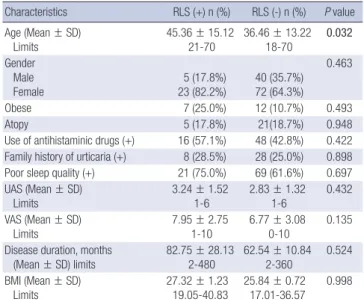
When we compared the demographic and clinical features of the patients with and without RLS in the CSU group, there was
Table 4. PSQI scores of RLS (+) patients and RLS (-) patients in the urticaria group
PSQI scores RLS (+) RLS (-) P value
SSQ 1.68 ± 0.78 1.15 ± 0.88 0.016
SL 2.05 ± 0.99 1.29 ± 0.92 0.007
SD 1.27 ± 0.12 1.34 ± 0.11 0.834
HSE 0.91 ± 0.17 0.49 ± 0.10 0.035
SDis 1.82 ± 0.13 1.54 ± 0.11 0.173
USM 0.45 ± 0.14 0.22 ± 0.09 0.318
DD 1.36 ± 0.17 1.27 ± 0.12 0.668
Total PSQI score 9.50 ± 4.97 7.24 ± 4.07 0.075 PSQI, Pittsburgh sleep quality index; RLS, restless legs syndrome; SSQ, subjective sleep quality; SL, sleep latency; SD, sleep duration; HSE, habitual sleep efficiency;
SDis, sleep disturbances; USM, use of sleep medications; DD, daytime dysfunction;
Total PSQI score, total Pittsburgh sleep quality index score.
jects submitted signed written informed consent.
RESULTS
A total of 130 CSU patients with mean age 41.98 ± 14.54 and a
Table 5. Correlation between RLS score and demographic/clinical parameters with PSQI scores
PSQI scores Age RLS score UAS VAS
r* P r P r P r P
SSQ 0.279 0.027 0.377 0.002 0.156 0.229 0.209 0.101
SL 0.135 0.209 0.373 0.003 0.312 0.065 0.375 0.002
SD 0.113 0.376 0.099 0.440 0.265 0.032 0.248 0.050
HSE 0.257 0.042 0.243 0.055 0.362 0.039 0.215 0.019
SDis 0.078 0.520 0.215 0.090 0.113 0.426 0.265 0.036
USM 0.072 0.577 0.162 0.206 -0.145 0.661 0.207 0.073
DD -0.274 0.03 0.073 0.572 0.117 0.290 0.234 0.065
Total PSQI 0.158 0.215 0.323 0.010 0.378 0.039 0.398 0.001
RLS, restless legs syndrome; PSQI, Pittsburgh sleep quality index; UAS, urticaria activity score; VAS, visual analog scale for severity of itch; SSQ, subjective sleep quality; SL, sleep latency; SD, sleep duration; HSE, habitual sleep efficiency; SDis, sleep disturbances; USM, use of sleep medications; DD, daytime dysfunction; Total PSQI score, total Pittsburgh sleep quality index score.
*Spearman’s correlation coefficient.
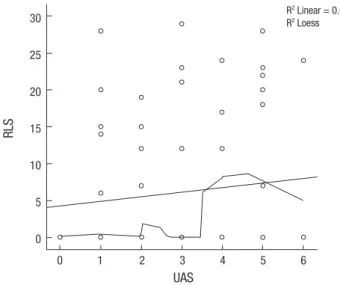
no significant difference between them in terms of VAS, UAS and poor sleep quality; but the mean ages of patients with RLS was higher than without RLS (P = 0.032) (Table 2). All PSQI scores of patients with CSU were significantly higher than the control group (Table 3). When we compared PSQI scores of patients with RLS and without RLS in the CSU group, subjective sleep quality (SSQ), sleep latency (SL) and habitual sleep efficiency of patients with RLS was higher than without RLS (respectively P = 0.016, P = 0.0097, P = 0.035) (Table 4). The frequency of poor sleep quality in the CSU group without RLS was higher than the control group (P = 0.001). Similarly, the frequency of poor sleep quality in the CSU group with RLS was higher than the control group (P = 0.001). Total PSQI scores in the CSU group were correlated with VAS, UAS and RLS scores (Table 5). There was no correlation between CSU and RLS (P = 0.377, r = 0.107) (Fig. 1).
DISCUSSION
In this study we showed that the prevalence (23.8%) of RLS in the CSU group was significantly higher than the control group (12%). The frequency of poor sleep quality and RLS score in the CSU group were significantly higher than the control group. Also, total PSQI scores in the CSU group were correlated with VAS, UAS, and RLS scores.
RLS is classified into the sleep disorders according to the in- ternational classification of sleep disorders. RLS is associated with nighttime sleep disturbance and subsequent daytime fa- tigue and sleepiness (11-13). Its prevalence in the general pop- ulation is estimated between 5% to 15% (1). In our study, the prevalence of RLS in the CSU group was increased approximate- ly 2-fold while it was similar to the general population in the control group. Also, RLS scores and poor sleep quality in CSU group were higher than in the control group. These results sug-
gest that sleep quality and RLS severity are affected by the pres- ence of CSU. This may also be through the effect of pruritus.
A study on the quality of sleep of CSU patients is not available so far in the literature. We showed that the number of patients with poor sleep quality in the CSU group was higher than in the control group. Maurer et al. (14) reported that almost all patients with CSU suffer somewhat from sleep disturbances three nights per week. The pruritus is one of the cardinal symptoms and the most important reason for sleep disturbances of patients with CSU. The pruritus severity is significantly associated with im- paired sleep quality in patients with CSU (5,15,16). We also found that the pruritus severity has been correlated with PSQI, VAS and RLS scores in patients with CSU (17-18). We believe that the reason for this increase of RLS score in patients with CSU is pruritus.
In our study, subjective SQ and sleep latency scores of the patients with RLS were higher than the patients without RLS.
RLS and CSU may be a potentiating effect on the sleep.
The pathophysiology of RLS is still unclear; nevertheless, the following mechanisms have been claimed: iron-related mecha- nisms, including reductions in iron and ferritin levels in the ce- rebrospinal fluid (CSF); genetic factors associated with altered brain iron levels; and altered microvascular flow in the legs (19).
Some neurotransmitters are speculated to play an important role in specific types of urticaria (19). Monoaminergic dysfunc- tion, especially involving the dopaminergic system, is also thou- ght to play a role in the pathophysiology of RLS (20). As the do- pamine is a prerequisite for the synthesis of noradrenaline, do- paminergic dysfunction in RLS affects noradrenergic neuro- transmission as well (20). It can be argued that there is a vicious cycle between them while the exact the cause-and-effect rela- tionship is unknown. While this association between RLS and CSU may have a biological explanation based on the abnormal monoaminergic neurotransmission system, the findings call for a more careful approach to CSU patients in order to improve their quality of sleep and their well-being.
We specify that our study also had a number of limitations.
First, we surveyed a small sample of patients with urticaria. As such, our results may not be representative of patients with ur- ticaria. Second, we did not perform any form of sleep monitor- ing, so our analysis was based on self-reported symptoms.
We claim that pruritus of urticaria may decrease the quality of sleep in patients with RLS and it may trigger and worsen the restless legs syndrome. Furthermore RLS and CSU may share common etiology. More comprehensive prospective studies are needed in this regard.
ACKNOWLEDGMENT
We thank to Dr Hakan Gülkesen for his help with statistical anal- ysis.
Fig. 1. Plot curve between RLS and UAS.
RLS
UAS
0 1 2 3 4 5 6 30
25
20
15
10
5
0
R2 Linear = 0.012 R2 Loess
DISCLOSURE
All authors have no potential conflicts of interest to disclose.
AUTHOR CONTRIBUTION
Conception and design: Alan S, Tuna S, Karakaş AA. Acquisi- tion of data: Alan S, Tuna S. Analysis and interpretation of data:
Alan S, Tuna S. First writing of manuscript: Tuna S, Alan S. Revi- sion of the manuscript: Alan S. Agreement with the manuscript contents and conclusions: all authors.
ORCID
Serpil Tuna http://orcid.org/0000-0001-8717-1141 Sevil Alan http://orcid.org/0000-0002-4233-0812 Nehir Samancı http://orcid.org/0000-0002-0110-1650 Ayşe Akman Karakaş http://orcid.org/0000-0002-5113-4178 REFERENCES
1. Wali SO, Abaalkhail B. Prevalence of restless legs syndrome and associat- ed risk factors among middle-aged Saudi population. Ann Thorac Med 2015; 10: 193-8.
2. Gupta R, Lahan V, Goel D. Prevalence of restless leg syndrome in subjects with depressive disorder. Indian J Psychiatry 2013; 55: 70-3.
3. Thorburn PT, Riha RL. Skin disorders and sleep in adults: where is the ev- idence? Sleep Med Rev 2010; 14: 351-8.
4. Kaplan AP. Chronic urticaria and angioedema. N Engl J Med 2002; 346:
175-9.
5. Yosipovitch G, Ansari N, Goon A, Chan YH, Goh CL. Clinical characteris- tics of pruritus in chronic idiopathic urticaria. Br J Dermatol 2002; 147:
32-6.
6. Zuberbier T, Aberer W, Asero R, Bindslev-Jensen C, Brzoza Z, Canonica GW, Church MK, Ensina LF, Giménez-Arnau A, Godse K, et al. The EAA- CI/GA(2) LEN/EDF/WAO Guideline for the definition, classification, di- agnosis, and management of urticaria: the 2013 revision and update. Al- lergy 2014; 69: 868-87.
7. Allen RP, Picchietti D, Hening WA, Trenkwalder C, Walters AS, Montplaisi J; Restless Legs Syndrome Diagnosis and Epidemiology workshop at the
National Institutes of Health; International Restless Legs Syndrome Study Group. Restless legs syndrome: diagnostic criteria, special considerations, and epidemiology. A report from the restless legs syndrome diagnosis and epidemiology workshop at the National Institutes of Health. Sleep Med 2003; 4: 101-19.
8. Walters AS, LeBrocq C, Dhar A, Hening W, Rosen R, Allen RP, Trenkwalder C; International Restless Legs Syndrome Study Group. Validation of the International Restless Legs Syndrome Study Group rating scale for rest- less legs syndrome. Sleep Med 2003; 4: 121-32.
9. Buysse DJ, Reynolds CF 3rd, Monk TH, Berman SR, Kupfer DJ. The Pitts- burgh Sleep Quality Index: a new instrument for psychiatric practice and research. Psychiatry Res 1989; 28: 193-213.
10. Ağargün MY, Kara H, Anlar Ö. The validity and reliability of the Pittsburgh Sleep Quality Index. Turk Psikiyatri Derg 1996; 7: 107-15.
11. Chiba S. Sleep psychiatry. Seishin Shinkeigaku Zasshi 2013; 115: 782-91.
12. Fietze I, Nötzel K, Blau A, Glos M, Penzel T. Portable sleep monitoring in patients with disorders in falling asleep or maintaining sleep. Nervenarzt 2012; 83: 1021-7.
13. Allen RP, Earley CJ. Restless legs syndrome: a review of clinical and patho- physiologic features. J Clin Neurophysiol 2001; 18: 128-47.
14. Maurer M, Ortonne JP, Zuberbier T. Chronic urticaria: an internet survey of health behaviours, symptom patterns and treatment needs in Europe- an adult patients. Br J Dermatol 2009; 160: 633-41.
15. Bender BG, Ballard R, Canono B, Murphy JR, Leung DY. Disease severity, scratching, and sleep quality in patients with atopic dermatitis. J Am Acad Dermatol 2008; 58: 415-20.
16. Zachariae R, Lei U, Haedersdal M, Zachariae C. Itch severity and quality of life in patients with pruritus: preliminary validity of a Danish adapta- tion of the itch severity scale. Acta Derm Venereol 2012; 92: 508-14.
17. Alan S, Canan F, Karakaş AA, Geçici N. Temperament and character pro- files of patients with chronic idiopathic urticaria. Postepy Dermatol Aler- gol 2015; 32: 167-72.
18. Trenkwalder C, Paulus W. Why do restless legs occur at rest?--pathophys- iology of neuronal structures in RLS. Neurophysiology of RLS (part 2). Clin Neurophysiol 2004; 115: 1975-88.
19. Suzuki K, Miyamoto M, Miyamoto T, Hirata K. Restless legs syndrome and leg motor restlessness in Parkinson’s disease. Parkinsons Dis 2015;
2015: 490938.
20. García-Borreguero D. Dopaminergic augmentation in restless legs syn- drome/Willis-Ekbom disease: identification and management. Sleep Med Clin 2015; 10: 287-92.