1. Introduction
In the study of American urban development, there are some clear distinctions between Honolulu and the mainland cities regarding the organization of ethnic social relations. These
salient features, which arose from Hawai’i’s unique modern history, have influenced the particular patterns of ethnic identity formation and interrelation in Honolulu.
First, no single ethnic group has occupied a numerical majority status, though political and economic power has been unequally distributed.1)
Multiculturalism and Socio-Spatial Segregation of Honolulu in the 1920s
Youngmin Lee*
1920년대 호놀룰루의 다문화주의와 집단간 사회-공간적 분리
이영민*
Abstract:It has been widely believed that the ethnic relations in Honolulu and Hawai’i in the early twentieth century were little associated with racist ideology because the white race was minority in terms of the racial composition. In reality, however, the racial and ethnic issues have played a major role in forming the past and present relations among ethnic groups. This study shows that the white-supremacy ideology exerted a strong influence on minority groups in Honolulu throughout the immigration and settling-down process, as much as in the mainland U.S. Clear occupational stratification and residential segregation among the ethnic groups in Honolulu represented almost the same situation as in mainland cities. The social segregation and spatial propinquity of their residential neighborhoods facilitated the construction of dichotomized identity: “Local” versus “Haole”. Such transformed identities were a product of on-going inter-ethnic negotiation process embedded in the non-white multi-ethnic neighborhoods.
Key Words : multiculturalism, ethnic relations, socio-spatial segregation, Honolulu, identity, “Local”, “Haole”
요약:20세기 초반 하와이와 호놀룰루의 민족집단 관계는 백인이 수적으로 소수집단을 구성하는 예외적인 상황이기에 인종차별주의 관념에 별로 영향을 받지 않았었다는 것이 일반적인 견해이다. 하지만 실제로 과거는 물론이고 현재에 이르기까지 민족집단 관계에 인종, 민족 이슈들이 큰 영향을 미쳤음은 분명하다. 이 연구는 20세기 초반 호놀룰루 유색 이민집단들의 이주와 정착 과정 내내 백인 지상주의 관념이 미국 본토에서와 마찬가지로 큰 영향을 미쳤음을 밝히고 있다. 직업의 차별화와 계층화, 그리고 거주지의 공간적 분 화가 미국 본토의 도시에서와 같이 호놀룰루에서도 인종, 민족집단 간에 분명하게 이루어졌었다. 유색인종집단의 직업에 따른 사회
적 분리 현상과 거주의 공간적 집중화 현상은 비백인집단의“로우컬”과 백인집단의“하올리”라고 하는 이원화된 대립적 정체성을 만
들어가는 계기가 되었다. 그러한 변형된 정체성은 비백인들로 구성된 다민족적 근린지구 내에 착근된 민족집단들의 상호 협상과정이 지속적으로 진행되면서 자연스럽게 창출된 결과물인 것이다.
주요어 : 다문화주의, 민족집단 관계, 사회-공간적 격리, 호놀룰루, 정체성, “로우컬”, “하올리”
* Associate Professor, Department of Social Studies, Ewha Womans University, [email protected]
Since it was first revealed to the Western World, Hawai’i has become a destination for Occidental capitalists and missionaries to achieve their goals.
Although never occupying a numerical preponderance in the population of Hawai’i, the white foreigners arose to economic elites in the process of economic transformation to capitalism, and consolidated political power over the native Hawai’ians. The Haole2) class, which was solidifying its economic and political hegemony through the plantation economy, sought sufficient and reliable labor forces all over the world.3)As a result, the different foreign groups were imported as the workers on the plantation such as Chinese, Portuguese, Japanese, Spanish, Germans, Filipinos, Koreans, Puerto Ricans, and other Pacific islanders. Even some African Americans were brought in from Alabama. The Haole planters, however, did not allow a single group to numerically predominate in the labor force.
They feared that a predominant single group would grow to an economic or political threat to themselves through class consciousness based on ethnic identity (Lind, 1980; Kirkpatrick, 1987).
This controlled distribution of ethnic populations by the Haole planters has constituted a fundamental and unique ingredient for the urban social geography of Honolulu up to the present.
Second, the large labor force for the development of the sugar industry was supplied mostly by immigrants from Asian countries.
Introduction of the large number of Asian workers was due to not only geographical proximity of Asia to Hawai’I but the docility and high productivity of Asian labor forces which met the planters’ needs.4)Also it is interesting to note that in contrast to the lumping conceptualization of “Asian American” in the mainland, which ignores separate cultural traditions and social characteristics, no such concept of “Asian American” has developed in Hawai’i as the various Asian ethnic groups became numerically
dominant in the paternalistic plantation system which encouraged segregated labor camps along ethnic lines.5) As a consequence, there is a marked consciousness of distinctive ethnic identity in the Asian population of Hawai’i (Hechter, 1978). Each Asian group has kept its ethnic identity without being reduced into a lumped concept of “Asian American.”
A third distinction from other states in the mainland U.S. is a sense of tolerance and mutual acceptance among ethnic groups. The local sense of mutual hospitality for coexistence may have derived from the native Hawai’ian legacy of
“Aloha Kanaka”-the love of one’s fellow human beings (Okamura, 1982; Grant and Ogawa, 1993).
The native islanders were willing to open their land to all visitors or settlers from the outside and absorb everyone into a community of mutual support (Hass, 1992). It is surely undeniable that this traditional Hawai’ian value helped the first Westerners settle peacefully in the Hawai’ian Islands. Based upon the traditional cultural value, ethnic multiculturalism gradually emerged from the plantation system which contained a variety of immigrant labor groups. Associated with this social situation, the legacy of tolerance has often became a part of the social norms of ethnic relationships and thus led to the relative absence of collective violence in order to “avoid fouling the social nest.” (Okamura, 1994)
In association with these distinctive features, Hawai’i has been long recognized as a harmonious multicultural society, where unmelting ethnicities live peacefully together. The relative absence of collective unrest and of racially or ethnically motivated violence has been considered as explicit evidence as to Hawai’i’s differences from the mainland, where relations among heterogeneous ethnic groups are often confrontational and violent. Yet is there not a problem in identifying the Hawai’ian case as a paradise of ethnic relations? Is the Hawai’ian
setting, especially the city of Honolulu, entirely free from the general process of immigrants’
socio-spatial adaptation characteristics as seen in the mainland?
This research is concerned with the fundamental contours of ethnic residential segregation in the city of Honolulu in the 1920s.
Against the widely spread belief that its ethnic relations and social geography can not be dealt with within the universal framework of a North American context, I argue that the Honolulu version of ethnic relations does not appear to be greatly different from the mainland one. It is based on the theoretical assumption that social ethnic inequality in a city is closely related to the geography of the urban residential structure.6
To uncover social segregation by discrimination in the early twentieth century Honolulu, this study attempts to reconstruct the social geography of residential segregation in Honolulu during the 1920s. First, I will present the development and the characteristics of Honolulu multi-ethnic population at this turning period of the twentieth century. Second, I will demonstrate the patterns and trends of basic social areas among various ethnic groups as well as occupational groups as a testimony to the on- going social and economic discrimination against non-Haole groups.
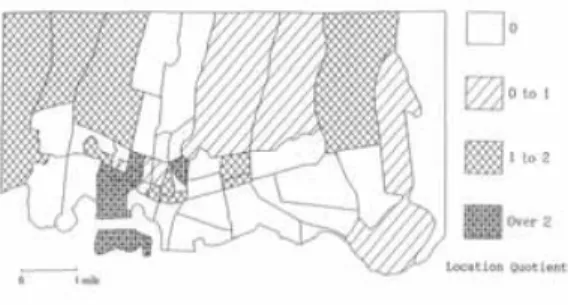
Ten per cent sample of people gainfully occupied is collected and analyzed from the manuscript census of 1920. Index of segregation7) for each group is measured to estimate the extent of social segregation and residential differentiation of particular groups in the urban areas of Honolulu. Forty six enumeration districts of Honolulu are used as the spatial units of measurement for the index. Along with this measurement, the more simpler method of location quotient8)is also calculated to show the distribution of the segregated sub-areas and the extent of concentration of a certain group within
the areas. While the index of segregation is useful to estimate and compare degrees of spatial separation of a particular group from the rest of the city’s population, location quotient is appropriate for identifying the detailed spatial distribution and concentration of the group’s population throughout the entire enumeration districts of the city.
2. Ethnic Constitution until 1920
Since the Hawai’ian economy before World War one predominantly relied on the sugar industry, the urban economy and employment of Honolulu were either directly managed by or partly dependent on sugar production. As far back as 1853, however, the Islands were still dominated by the overwhelming majority of the native population, and barely 10 per cent of Hawai’i’s total population was made up of foreign immigrant groups, such as the Haoles, Portuguese, and Chinese. By the end of the nineteenth century, these foreign groups as well as the native group were principally concentrated in Honolulu, the primary trading center which had already achieved prominence as a whaling vessel gathering port and as a stepping stone to the East Asia for mercantile trade (Beechert, 1991). These functions of Honolulu induced a continuous urban migration, and consequently the total population of Honolulu increased by 161 per cent during the last half of the nineteenth century.
Table 1 shows that both Hawai’i and Honolulu witnessed a steady increase in absolute number of population all the way through to 1920. To be sure, this population increase was caused by the full-scale development of the sugar plantation economy during the last quarter of the nineteenth century, designated as the era of “industrial
plantation.” (Beechert, 1985) The population growth was also greatly accelerated by Hawai’i’s annexation to the United States as its territory in 1898.9)
Most ethnic groups, except the Haole group, had increased as a ratio of Honolulu residents to their total population in Hawai’i all the way through 1920. To the former plantation laborers imported from foreign countries, moving to and seeking better life condition in Honolulu was one choice, two others being ways of returning to their home countries or moving further away to California after fulfilling the labor contract with the plantations. In the case of the Haole group, a high percentage of the urban population of Honolulu had remained constant since the very first time. The reason is that, right at the city, this group had been in charge of colonization of the whole Islands.
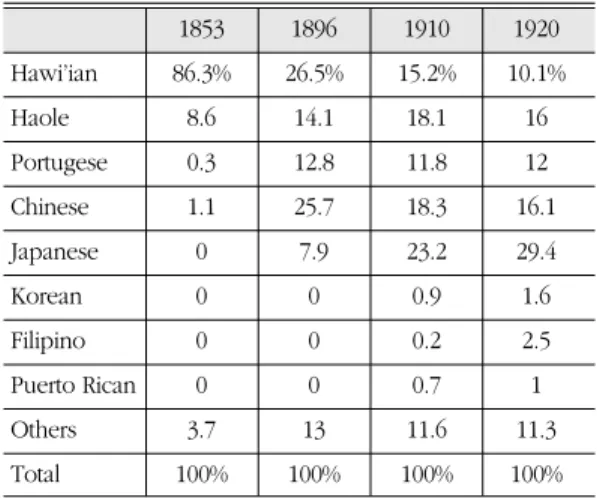
In 1920, there were eight major ethnic groups constituting more than one per cent of Honolulu’s population (Table 2). The native Hawai’ian group had remained so stagnant in
absolute population in Honolulu as to go on decreasing in the proportion to the city population. However, its total population in the entire Hawai’ian Islands in 1920 precipitously dropped to far less than half of that in 1863, due to epidemic of fatal diseases. Unfortunately, the
Table 2. Ethnic constitution in Honolulu, 1853 to 1920
1853 1896 1910 1920
Hawi’ian 86.3% 26.5% 15.2% 10.1%
Haole 8.6 14.1 18.1 16
Portugese 0.3 12.8 11.8 12
Chinese 1.1 25.7 18.3 16.1
Japanese 0 7.9 23.2 29.4
Korean 0 0 0.9 1.6
Filipino 0 0 0.2 2.5
Puerto Rican 0 0 0.7 1
Others 3.7 13 11.6 11.3
Total 100% 100% 100% 100%
Note: Absolute number of each group’s population is shown in Table 1.
Table 1. Population by ethnicity, Honolulu and Hawai’i, 1853 to 1920
1853 1896 1910 1920
HI HL HI HL HI HL HI HL
Hawi’ian 70036 9889(14.1) 31019 7918(25.5) 26041 7910(30.4) 23723 8459(35.7) Haole 1600 981(61.3) 7247 4208(58.1) 16857 9458(56.1) 22138 13306(60.1) Portuguese 87 32(36.8) 15191 3833(25.2) 22301 6147(27.6) 27002 9978(37)
Chinese 364 124(34.1) 21616 7693(35.6) 21674 9574(44.2) 23507 13383(56.9)
Japanese 0 0 24407 2381(9.8) 79675 12093(15.2) 109274 24522(22.4)
Korean 0 0 0 0 4533 460(10.1) 4950 1319(10)
Filipino 0 0 0 0 2361 87(3.7) 21031 2113(10)
Puerto Rican 0 0 0 0 4890 387(7.9) 5602 841(15)
Others 1050 426(40.6) 9540 3887(40.7) 13577 6067(44.7) 18685 9406(50.3) Total 73137 11455(15.7) 109020 29920(27.4) 191909 52183(27.2) 255912 83327(32.6) Note: 1) Enclosed in parenthesis are the percentages of each group’s Honolulu residents to its total population in Hawai’i.
2) HI=Hawai’i, HL=Honolulu.
Sources: Nordyke 1988(Table 3-1), Lind 1980(Table 5), Schmitt 1977(Table 1.12), US Census 1920(Table 1,19,20) Ethnicity
Native Hawai’ians were not immune to diseases which were introduced in the Islands by the Westerners. The absolute number of Haole and Portuguese constantly increased in the population of Honolulu, but their relative proportions in the city had not much changed.
The Chinese and Japanese groups, two crucial sources of the plantation labor forces in the last half of the nineteenth century, underwent substantial growth in proportion to the total population constitution of Honolulu. The increasing number of these two groups in population was mostly caused by their secondary migration from plantations scattered throughout the Hawai’ian Islands to the city of Honolulu.
Until the end of nineteenth century, the Chinese people accounted for most of the in-migration to Honolulu. After the U.S. annexation in 1898, however, the Chinese Exclusion Law, which was already enacted in the mainland in 1882, was applied to the Islands by the form of the Organic Act in 1900 (Chan, 1991), and hence made a negative influence on the subsequent immigration of Chinese laborers to Hawai’i. As a consequence, the size of the group’s secondary migration to Honolulu was relatively reduced.
The continued demand for plantation labor forces turned planters attention to another source of dependable workers, the Japanese. They were brought into Hawai’I in the largest numbers, some 200,000 men-power during several decades of the turning period from the nineteenth to the twentieth century. The subsequent huge influx of Japanese people to Honolulu primarily contributed to the continuous overall enlargement of the city’s population. In 1910, Japanese made up the largest portion of Honolulu population, although comprising only 23.2 of the total population.
This rapid in-migration to Honolulu was additionally supplemented by Koreans, Filipinos, and Puerto Ricans after the start of the twentieth
century. These groups were imported at one time or another by planters who sought effective control of the workers by avoiding the preponderance of one ethnic group on their plantations.10) These groups, however,left the plantations as fast as the preceding groups and moved to the city of Honolulu. These small groups, existed as minor groups among minorities, comprising only 2.5 per cent, 1.6 per cent, and 1 percent, respectively in 1920.
However, they played an important role of shaping the city’s peculiar multiethnic mosaic.
3. Social Stratification of Ethnicity
11)In 1920, as in the mainland cities, Haole group in Honolulu was greatly over-represented in both white collar and skilled blue collar classes(Table 3). As far as high white collar category is concerned, incautious glance at the percentages of Chinese (9.1%) and Japanese (10.3%) groups might lead us to hasty judgment that those groups fairly succeeded in social upward mobility. The values, however, came out of the abundance of their absolute number in the city’s population. The ratio of Chinese and Japanese high white collar workers to the people of other professions within each ethnic group, takes up only 5.5 per cent and 3.5 per cent respectively.
Concerning Chinese and Japanese representation in this class, another important fact should not be overlooked that their jobs in the category of high white collar class were closely related with the sectors of their own ethnic business and management. That is, these groups had enough amount of the ethnic population to keep
“institutional completeness”12), so that a certain amount of high white collar jobs should be reserved for ethnic businesses and institutes such as ethnic newspapers, religious institutions,
translation services, and the likes. On the contrary, the Haole group’s ratio (57.8%) in the high white collar class was not such a modest representation as it first appeared to be.
Considering the group’s share of the total population of Honolulu (18.1%), this group was much overly represented in the uppermost class.
In the case of the low white collar class, the three major groups of Haole, Chinese, and Japanese were comparatively more evenly represented than seen with the high white collar class, although the white (Caucasian) group still took up the largest share. A high representation of non-white groups in this category appears to reflect their upward social advancement, but it needs more careful and detailed explanation, too.
The sample data in this study was derived from all individuals gainfully occupied, not from heads of households, so that it includes the second or third generation young minorities who were born and raised in Hawai’i. The descendants of non- white labor immigrants had the skill of English literacy and got high education which helped them get high white collar occupations.
Unfortunately, however, these younger minorities workers experienced discrimination in the job market. The low white collar jobs seemed to be what they were forced to choose in the face of overt discrimination by the uppermost class.
In respect to non-Haole groups’ relatively high representation in this category, the similar condition as in the uppermost class should be Table 3. Ethnic distribution by class in Honolulu, 1920
Ethnicity High Low Petit Skilled Semi-Skilled Un-Skilled
Total white collar white collar Proprietor blue collar blue collar Blue collar
Haole 190 150 26 141 21 26 554
(57.8) (27.6) (9.9) (23.6) (5.7) (2.7) (18.1)
Hawai’ian 17 42 7 64 29 146 305
(5.2) (7.7) (2.7) (10.7) (7.9) (15.2) (10)
Chinese 30 121 75 85 113 125 549
(9.1) (22.2) (28.6) (14.2) (30.7) (13) (17.9)
Japanese 34 114 141 161 121 405 976
(10.3) (21) (53.8) (27) (32.9) (42.1) (31.9)
Portuguese 30 40 6 73 41 95 285
(9.1) (7.4) (2.3) (11.1) (11.1) (9.9) (9.3)
Filipino 0 4 1 13 10 79 107
(0) (0.7) (0.4) (2.2) (2.7) (8.2) (3.5)
Korean 2 2 3 7 4 33 51
(0.6) (0.4) (1.1) (1.2) (1.1) (3.4) (1.7)
Puerto Rican 0 2 0 3 2 23 30
(0) (0.4) (0) (0.5) (0.5) (2.4) (1)
Others 26 69 3 50 27 30 205
(7.9) (12.6) (1.1) (8.4) (7.3) (3.1) (6.7)
Total 329 544 262 597 368 962 3062
(100) (100) (100) (100) (100) (100) (100)
Note: Enclosed in Parenthesis are the percentage of class by ethnic groups.
Source: Manuscript census of the city of Honolulu, 1920 (10% sample of peoples gainfully occupied).
considered. As mentioned above, the existence of institutional completeness for individual ethnic groups made possible to create many kinds of employment within the boundaries of the ethnic economic enclaves. Many non-Haole low white collar workers, in the same way as non-Haole high white collar workers, were employed as clerks or bookkeepers in the sector of the ethnic businesses. Ethnic social network played the role of self-perpetuating system of employee recruitment and in many cases, family members or relatives were hired with for little or no pay.
The labor market of Honolulu in the beginning of this century must have been segmented along these ethnic boundaries as well as class boundaries.
Chinese and Japanese groups, which had a relatively older immigration history, were considerably concentrated in the class of petty proprietors, occupying 28.6 per cent and 53.8 per cent respectively. This over-representation could be to some degree explained by a theory of
“trader-minority group” or “middleman minorities”
(Bonacich, 1973; Bonacich and Modell, 1980;
Light and Bonacich, 1988; Fugita and O’brien, 1991). In Honolulu, such occupations as shopkeepers, vegetable and fish peddlers, and laundry servicemen were included in the trader- minority group, which provided their products and services to their own or outside their ethnic group. Associated with these small business sectors, it should be noted that vegetable and flower gardening by Chinese and Japanese, rice farming by Chinese, and fishing by Japanese and Hawai’ian were nearly monopolized along ethnic lines (Fuchs, 1961). Although they owned the means of production and some of them finally succeeded in amassing large capital, their wealth could not be comparable to upper class employers or employees at all.
In contrast to the white collar, the high blue collar class included all ethnic groups
representing each group in a quite balanced extent. This balanced representation of each ethnic group might be brought up as an indicator of harmonious inter-ethnic relationships.
However, antagonism and discrimination toward skilled Asian workers persistently existed. For instance, at the turn of the century and during following years, the policy of Territorial Craft Unions restricted membership only to Caucasians and Hawai’ians (Johannesen, 1956). Even in this hostile atmosphere, skilled Asians continued to expand in this category by enduring a lower rate of pay and by monopolizing all the work for their own people within each ethnic enclave economy (Johannesen, 1956). In this case, their own ethnic communities also worked as a springboard of fighting against obstacles imposed upon them.
In the categories of semi- and unskilled blue collar workers, all groups except Haole were moderately represented. One of the characteristics of the Honolulu labor market in the early twentieth century was the great abundance of unskilled and semi-skilled blue collar workers, predominantly employed as stevedores and servants. More specifically, the minor groups among minorities such as Filipinos, Koreans, and Puerto Ricans took up a much higher ratio than that anticipated in the unskilled class. Those new non-Haole urban laborers more recently released from their plantations contracts started to adjust to urban life at the bottom of the class ladder due to the lack of an employment network as well as lack of human capital.
4. Residential Segregation by Ethnicity and Class
The hypothesis of close association between class and ethnicity can be examined by the reconstruction of their spatial distribution. As in
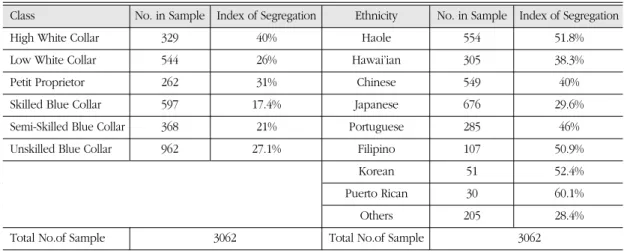
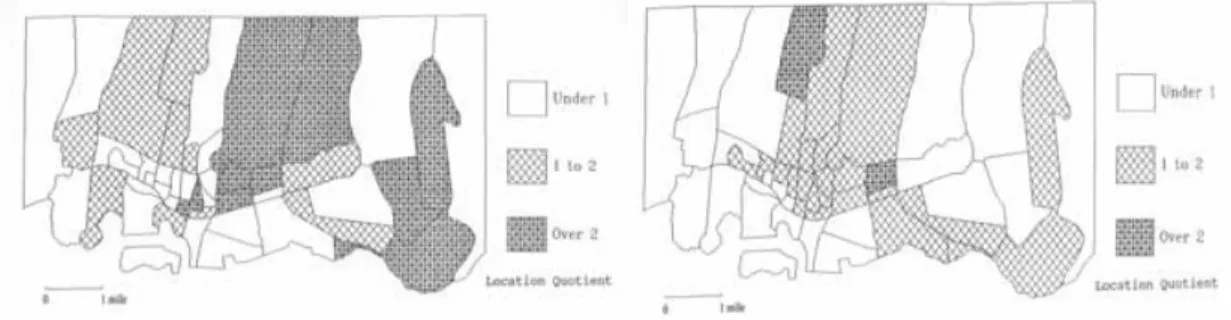
Table 4, the high white collar class had the highest segregation index of 40 per cent, which means they exhibit the strongest tendency to reside in particular zones compared with other class groups. The map of class distribution by location quotient easily demonstrates the high white collar class members’ strong inclination to spatial clustering (Figure 1). There are three heavily segregated zones for this group: the Territorial Government office area in downtown, the Makiki-Manoa valley area, and the Waikiki beach-Kaimuki area. With the exception of the Territorial Government office area which was inhabited by many single white governmental workers brought in from the mainland, the other areas were located in the suburban areas of pleasant physical environment beyond the end of the street car service lines of Honolulu Rapid Transit (HRT) Company. These strong cluster zones of the high white collar class almost completely superimpose with the strong segregation zones of Haole ethnic group (Figure 7).
Low white collar workers, although not as concentrated in some particular zones as high white collar workers, were moderately clustered on the areas surrounding the Punchbowl crater
above downtown, and the Waikiki-Kaimuki area (Figure 2). The moderately condensed zone of the low white collar class with a location quotient of more than one (LQ>1) was generally placed in the intermediate zone between the upper class in eastern Honolulu and the lower class of semi- and unskilled blue collar workers in western Honolulu.
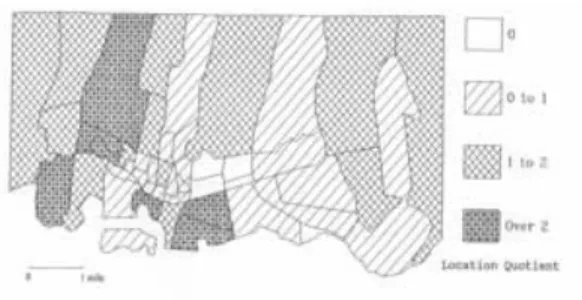
The locations of the petty proprietors clearly demonstrate the distinct characteristics of class and ethnic structure of Honolulu at that time (Figure 3). In the mainland cities, minority members were little allowed to partake in the normal channels of upward social mobility, so that they tended to create their own opportunities with self-employed occupations such as running small grocery shops or laundry services. In an attempt to maximize economic opportunities, they managed to monopolize the business or to expand the range of clients outside their own ethnic boundaries when faced with increased competition for opportunities within their own ethnic neighborhoods (Lyman, 1974; Portes and Manning, 1986).
In case of petit proprietors of Asian background, the contrasted forces of
Table 4. Degree of segregation among class and ethnicity, 1920
Class No. in Sample Index of Segregation Ethnicity No. in Sample Index of Segregation
High White Collar 329 40% Haole 554 51.8%
Low White Collar 544 26% Hawai’ian 305 38.3%
Petit Proprietor 262 31% Chinese 549 40%
Skilled Blue Collar 597 17.4% Japanese 676 29.6%
Semi-Skilled Blue Collar 368 21% Portuguese 285 46%
Unskilled Blue Collar 962 27.1% Filipino 107 50.9%
Korean 51 52.4%
Puerto Rican 30 60.1%
Others 205 28.4%
Total No.of Sample 3062 Total No.of Sample 3062
Source: Manuscript census of the city of Honolulu, 1920 (10% sample of peoples gainfully occupied).
discrimination by the power-holding group and the discriminated people’s own effort to prosper gave a peculiar dualistic patterns of location: a heavily segregated ghetto areas on the one hand, and a tendency of scattering distribution throughout the city on the other hand. To a degree, a similar spatial patterning also appears in Honolulu. Honolulu’s Chinatown is located right next to downtown and above Honolulu harbor,
and can be comparable to the Asian ethnic enclaves in the U.S. mainland. For a long time, Chinatown, not limited to the ethnic Chinese group, played a critical role as a central place for diverse ethnic businesses catering to members of several ethnicities. For the purpose of expanding client areas, the tendency of de-concentration might be reflected in the moderate clustering of small entrepreneurships along Honolulu’s main Figure 1. Class distribution – high white collar Figure 2. Class distribution – low white collar
Figure 3. Class distribution – petit proprietor Figure 4. Class distribution – skilled blue collar
Figure 5. Class distribution – semi-skilled blue collar Figure 6. Class distribution – unskilled blue collar
road at that time, King Street.
In relation to the spatial location of the petty proprietors in the early twentieth-century Honolulu, a more detailed explanation is needed for an unique phenomena differentiated from the mainland industrial cities. They heavily concentrated in the outskirts of the city such as the Waialae and Palolo Valley, the Upper Waikiki, the Upper Nuuanu and Pauoa Valley, the Upper Kalihi area, and the area along the ocean front. In addition to small retail shops, many petty proprietors in Honolulu were engaged in the primary economy of farming and fishing. Market gardening of flower and vegetable, and rice or taro growing were practiced by many workers of Asian background in the remote urban areas outside of residential districts, and traditional fishing was practiced by the native Hawai’ians and the Japanese along the coastal districts between the Honolulu Harbor and the Waikiki area.
In contrast to the white collar groups and the petty proprietors, the skilled blue collar workers had no heavy concentration areas (Figure 4). The lowest segregation index (17.4%) among six classes in Table 4 enables us easily to understand this phenomena. Its low residential segregation probably has a bearing on multi-ethnic mixture in this category. The other point to be considered is that blue collar occupations, as a geographer Hiebert points out (Hiebert, 1991), tend to be widely dispersed because sources of blue collar employment were somewhat scattered throughout a city. In the same manner, Honolulu had various sources of high blue collar occupations widely scattered all over the city such as Rapid Transit Service covering the whole city, building construction accompanying the relevant skilled workers, retail services like barber or tailor in need of accessibility to clients, etc.
Locational distribution of the semi- and unskilled blue collar workers in Honolulu (Figure
5 and 6) was quite different from the distribution of the skilled blue collar workers. Of course, some unskilled laborers such as servants or maids for private families tended to be widely dispersed throughout the city. Yet, many workers in these categories were more highly clustered in the western side rather than in the eastern side of Honolulu. Especially the districts of Kapalama and Kalihi were congested with the incoming former plantation workers. Many of them became employed as longshoremen in the neighboring Honolulu Harbor. In this division of the eastern white upper class zone versus the western non- white lower class zone, Chinatown at the western end of the Central Business District probably functioned as a boundary.
Although class was interwoven with ethnicity to build up a peculiar pattern of social geography of Honolulu, ethnicity more basically accounted for the outline. First of all, as in Table 4, the values of segregation index by ethnicity are generally higher than the ones by class. The Haole group in particular shows the highest clustering tendency among major ethnic groups.13) As stated earlier, heavy clustering zones of the Haole group (Figure 7) squarely coincide with the ones of the high white collar class (Figure 1).
The Japanese group was widely spread throughout the city without making any dense concentration zone of location quotient higher than 2 (Figure 10). Certainly, there were micro- scale Japanese colonies scattered around the city such as the Moiliili area (Lind, 1980). Broadly speaking, however, it is viewed that their propensity to agglomerate was weaker than the other groups.
Commonly found in the maps of other ethnic groups except part Hawai’ians and others, is their relatively high concentration in the western side of Honolulu. Precisely, the districts in the both sides of King Street from Chinatown to Kalihi Road, were inhabited by poor immigrant laborers.
The area could be comparable to the U.S.
mainland cities’ ethnic ghettos, which developed a negative image of crowdedness, impoverish- ment and cultural disruption. Especially, the Iwilei district which is located just to the west of Honolulu harbor and Chinatown was identified as a disreputable, crowded district containing Honolulu’s prison and a red light district (Johnson, 1991). This wide area including Iwilei
still remains as the most impoverished zone in the present Honolulu. At the northern side above these poverty areas were Portuguese clustering districts located (Figure 11). As widely known, Portuguese people had been introduced and treated by planters as intermediate class workers in the social hierarchy of Hawai’i plantation system, and this role was kept even in the urban economy of Honolulu.
Figure 7. Ethnic distribution – Haole Figure 8. Ethnic distribution – Hawai’ian
Figure 9. Ethnic distribution – Chinese Figure 10. Ethnic distribution – Japanese
Figure 11. Ethnic distribution – Portugese Figure 12. Ethnic distribution – Filipino
5. Conclusion
Although just a minority group in a numerical sense, the Haole group seized the status of majority through political hegemony and economic power in Hawai’i during the first half of this century. As strengthening politico- economic power through their role as large-scale sugar plantation entrepreneurs, Haole capitalists sought and imported large numbers of docile and cheap labor forces mostly from Asian countries. A type of cultural pluralism in which no group became a numerical dominance majority was induced by the colonialistic plantation economy.
Notwithstanding, power was not fairly dispersed over all groups but was concentrated in the white group which transplanted the mainland version of white-supremacy ideology in the Islands. More
important in the dichotomy of majority and minority, to be sure, are power relationships rather than absolute numerical population.
The immigrant laborers were, at first, inserted into the paternalistic plantation system where division of labor by ethnicity was tacitly encouraged by Haole capitalists. These Haoles simply feared of labor unrest which might be caused by dominance of one ethnic group. Even after moving to the city of Honolulu, the non- Haole laborers had little choices but to begin at the bottom rungs of the social class ladder partly due to the lack of human capital such as education, job-skills, and familiarity with the new culture, and also partly due to discrimination of inaccessibility to upper class labor market. The occupational specialization generated by the particular economic structure and social discrimination might have given rise to ethnic Figure 13. Ethnic distribution – Korean Figure 14. Ethnic distribution – Puerto Rican
Figure 15. Ethnic distribution – Others
identification or at least sensitivity to ethnic deprivation (Mejer, 1987), or evolution of a lower working-class consciousness and solidarity.
In broad sense, this can be summarized as a Haole versus non-Haole class differentiation.
From the onset, non-Haole immigrant laborers had shared similar class positions in the working class. Meanwhile class consciousness had been conceived over ethnic boundaries within the bottom class, subsequently contributing to the making of a local identity in contrast to a “Haole”
identity. In short, social discrimination functioned as a catalyst to the formation of collective group solidarity over ethnic differentiation.
A neighborhood constructed by social residential segregation played an important role in forming social identity. The most obvious tightly-knit ethnic neighborhoods were formed by the Haole group. The ethnic group, mostly confined to the white collar and the skilled blue collar classes, resisted most to invasion by the other group members. Doubtless, the Haole group’s neighborhoods nearly overlap the concentrated areas of the uppermost class in Honolulu. In contrast, the Kalihi-Kapalama districts appear to have been a gathering place of non-Haole blue collar workers who had moved away from the plantations. Although some ethnic groups had their own ethnic communities or social networks to help reinforce their separate sense of ethnicity, they also tried to evolve a inter-ethnic class consciousness partly with the help of the traditional spirit of mutual acceptance and congeniality. In the Kalihi-Kapalama area, ethnic consolidation of several ethnic groups and class consciousness were coincidentally fostered by spatial propinquity. Spatial ethnic segregation played a significant role in evolving and redefining the sense of ethnicity, and furthermore, by coalescing with class interest, contributed to formation of a sense of class consciousness among ethnic groups.
Notes
1) To the people of Hawai’i in 1900 right after annexed to the U.S. territory, Caucasians of American and British stocks constituted only about 6% of the Islands population. Added by Portuguese, the population took up about 18% and thereafter it gradually increased, but never exceeded 40% even till today. If excluding the military population and their dependents, the white percentage of today declines to only 22%.
2) This Hawai’ian term, “Haole”, combining two words “ha”
(breath) and “ole” (without), means “outsider” or
“foreigner” opposed to “Kanaka”, meaning Hawai’ian.
This term came to be a symbol for Caucasian or White who was the first foreigner race to the Islands, irrespective of his ethnic origin. As all the outsiders at the initial time had white skin, the term also came to acquire a color connotation. Yet it usually dose not cover Portuguese and people of Hispanic origin. For more details, see Whittaker (1986) and Geschwender and Carroll-Seguin (1988).
3) Thus many foreign groups had been imported to meet the need of labor in plantation economy such as Chinese, Portuguese, Japanese, Spanish, German, Filipinos, Koreans, Puerto Ricans, other Pacific islanders and even African Americans from Alabama. For the brief history of each group, See Nordyke (1989).
4) The Haole planters also had been greatly frustrated at that time by unavailability of native Hawai’ians and intractability of imported European laborers. For more details, see Beechert (1990).
5) Conversely, all whites except Portuguese in Hawai’i are lumped into one large category called “Haole”, just as various ethnic groups originated in Asian nations are simply bundled into “Asian Americans” or “Orientals” in the mainland.
6) There are a few studies dealing with the subject of residential segregation in Honolulu with the context of assimilation. See several studies (Lind, 1938; Yamamura and Sakumoto, 1954; Sakumoto, 1965). On the assumption that it is an indicator of race relations in the progress of assimilation, they proposed that the clear and persistent trend has been toward still further residential diffusion and a community in which people are little concerned about the ethnic origins of their neighbors. Without considering the structural barriers encompassing minority groups, they put stress on the
internal forces of ethnic segregation which were weakened with the progress of time.
7) For more detailed explanation and also the limits of these methods, see Boal (1987), Johnston (1994), Peach (1975).
8) For more details, see Jones and Eyles (1977), Smith (1975).
9) The development of sugar industry in Hawai’i was closely related with the imperialistic expansion of the United States. The planters in Hawai’i were eager to participate in the continuously expanding American market of sugar, but had disadvantage to pay large amount of duty. The U.S., which already had sufficient sugar produced in the territory and mainly supplied from the nearby Caribbean, was less interested in Hawai’i’s capacity of sugar production than in its geo-political significance. The desires by the two sides were combined into the conclusion of the Reciprocity Treaty in 1876 which permitted Hawai’i-produced sugar to be exported to the American market duty-free and in return, permitted the U.S. exclusively to use Pearl Harbor as a military base. Thereafter, Hawai’i witnessed the swift growth of sugar industry, transformed into a economic colony of the U.S. Their effort for mutual interests was culminated to the annexation of the Hawai’ian Islands to the U.S. territory in 1898 (Kent, 1983; Beechert, 1985).
10) As general U.S. laws were applied to Territory of Hawai’i since annexation of 1898, the Immigration Act which U.S. Congress enacted in 1924, also came into force in Hawai’i. One of provisions of this law pertains to inhibiting the aliens ineligible to citizenship from immigrating to this country, targeting oriental immigration. After the year, virtually suspended was the labor importation by planters from Asian nations except Philippine. Only Filipinos was allowed to enter Hawai’i as plantation labor because their country was subject to the United States in those days. After 1932, however, their immigration had been almost discontinued till after the end of World War Two due to Economic constraints in the Depression of 1930s (Chan, 1991).
11) This identification of class on the basis of occupation is primarily based on Hiebert’s (1991) classification. But his classification should be given some transformation in this paper to reflect the peculiar employment conditions in the early twenty century of Honolulu. For many decades until World War Two, Honolulu as a colonial city was playing a role of break-of-bulk center
of Hawai’i for the export of primary product and the import of manufactured goods, and thus was in the essentially pre-industrial economic situation. This economic base accounts for few number of urban proprietors (capitalists in the real sense) and huge number of stevedores (unskilled laborers). For more details, see Hiebert (1991), Thrift and Williams (1987), and Marston (1988).
12) If an ethnic group has sufficient number of people, it could create an institutionally complete set of activities and services for its members. Those institutions, once set up, contribute to the consolidation of ethnic identity by linking the group people and keeping them from outsiders, and consequently perpetuating the ethnic subculture (Breton, 1964; Driedger and Church, 1974).
13) In Table 4, minor groups of Filipino, Korean, and Puerto Rican, have the highest values more than 50%.
But those indexes result from their tiny number of absolute population so that it is not appropriate to horizontally compare these groups with the major groups on the basis of the indexes.
References
Beechert, E. D., 1985, Working in Hawai’i: A Labor History, University of Hawaii Press, Honolulu.
Beechert, E. D., 1990, The Caucasian worker in Hawai’i, 1778-1941, in Moore, C. et al.(eds.), Labour in the South Pacific, James Cook University, Townsville.
Beechert, E. D., 1991, Honolulu: Crossroads of the Pacific, Columbia University, New York.
Breton, R., 1964, Institutional completeness of ethnic communities and the personal relations of immigrants, American Journal of Sociology, 70, 193-205.
Boal, F. W., 1987, Segregation, in Pacione, M. (ed.), Social Geography: Progress and Prospect, Croom Helm, London.
Bonacich, E., 1973, A theory of middleman minorities, American Sociological Review, 38, 583-594.
Bonacich, E. and Modell, J., 1980, The Economic Basis of Ethnic Solidarity: A Study of Japanese Americans, University of California Press, Berkeley.
Chan, Sucheng, 1991, Asian American: An Interpretive History, Twayne Publishers, Boston.
Driedger, L. and Church, C., 1974, Residential segregation and institutional completeness: A comparison of ethnic minorities, Review of Canadian Sociology and Anthropology, 11, 30- 52.
Fuchs, L. H., 1961, Hawaii Pono, “Hawaii the Excellent”:
An Ethnic and Political History, Bess Press, Honolulu.
Fugita, S. and O’brien, D.J., 1991, Japanese American Ethnicity: The Persistence of Community, University of Washington Press, Seattle.
Geschwender, J. A. and Carroll-Seguin, R., 1988, The Portuguese and Haoles of Hawai’i: Implications for the origin of ethnicity, American Sociological Review, 53, 515-527.
Grant, G. and Ogawa, D. M., 1993, Living proof: Is Hawai’i the answer?, Annals of the American Academy of Political and Social Science, 530, 146-148.
Haas, M., 1992, Institutional Racism: The Case of Hawai’i, Greenwod Press, Westport.
Hechter, M., 1978, Group formation and the cultural division of labor, American Journal of Sociology, 84, 293-318.
Hiebert, D., 1991, Class, ethnicity and residential structure: The social geography of Winnipeg 1901-1921, Journal of Historical Geography, 17(1), 56-86.
Johannesen, E., 1956, The Hawai’ian Labor Movement: A Brief History, Bruce Humphries, Boston.
Johnson, D. D., 1991, The City and County of Honolulu:
A Governmental Chronicle, University of Hawaii Press, Honolulu.
Jones, E. and Eyles, J., 1977, An Introduction to Social Geography, Oxford University Press, London.
Kent, N., 1983, Hawai’i: Islands under the Influence, Monthly Review Press, New York.
Kirkpatrick, J., 1987, Ethnic antagonism and innovation in Hawai’i, in Boucher, J., et al.(eds.), Ethnic Conflict: International Perspectives, Sage Publications, London.
Light, I. and Bonacich, E., 1988, Immigrant Entrepreneurs: Koreans in Los Angeles 1965-
1982, University of California Press, Los Angeles.
Lind, A., 1938, An Island Community: Ecological Succession in Hawai’i, University of Chicago Press, Chicago.
Lind, A., 1980, Hawai’i’s People, University of Hawaii, Honolulu.
Lyman, S. M., 1974, Conflict and the web of group affiliations in San Francisco’s Chinatown 1850- 1910, Pacific Historical Review, 43, 473-499.
Marston, S. A., 1988, Neighborhood and politics: Irish ethnicity in nineteenth century Lowell Massachusetts, Annals of the Association of American Geographers, 78(1), 414-432.
Mejer, J. H., 1987, Capitalist stages, state formation, and ethnicity in Hawai’i, National Journal of Sociology, 1(2), 172-201.
Nordyke, E. C., 1989, The Peopling of Hawai’i, University of Hawaii Press, Honolulu.
Okamura, J. Y., 1982, Ethnicity and ethnic relations in Hawai’i, in Wu, D.(ed.), Ethnicity and Interpersonal Interaction: A Cross Cultural Study, Maruzen Asia, Singapore.
Okamura, J. Y., 1994, Multiculturalism in Hawai’i: A promise for whom?, Paper presented in Conference on Minority/Majority Discourse:
Problematizing Multiculturalism, August 11-13.
Peach, C., 1975, Introduction: The spatial analysis of ethnicity and class, in Peach, C. (ed.), Urban Social Segregation, Longman, London.
Portes, A. and Manning, R., 1986, The Immigrant enclave: Theory and empirical examples, in Nagel, J. and Olzak, S.(eds.), Competitive Ethnic Relations, Academic Press, Florida.
Sakumoto, R. E., 1965, Social Areas of Honolulu: A Study of the Ethnic Dimension in an Urban Social Structure, Ph.D. dissertation, Northwestern University.
Smith, D. M., 1975, Patterns in Human Geography: An Introduction to Numerical Methods, Penguin, London.
Thrift, N. and Williams, P.(eds.), 1987, Class and space:
The Making of Urban Society, Routledge &
Degan Paul, London and New York.
Whittaker, E., 1986, The Mainland HAOLE: The White
Experience in Hawai’i, Columbia University Press, New York.
Yamamura, D. Y. and Sakumoto, R., 1954, Residential segregation in Honolulu, Social Process in Hawai’i, 18, 35-46.
Correspondence: Youngmin Lee, Department of Social Studies, Ewha Womans University (e-mail:
교신: 이영민, 이화여자대학교 사회생활학과(이메일: ymlee@
ewha.ac.kr)
Recieved November 13, 2007 Accepted December 10, 2007