Influence of Extender Oil on Properties of Solution Styrene-Butadiene Rubber Composites
Sung-Seen Choi
†and Eunah Ko
Department of Chemistry, Sejong University, 209 Neungdong-ro, Gwangjin-gu, Seoul 143-747, Korea (Received August 12, 2015, Revised August 20, 2015, Accepted August 27, 2015)
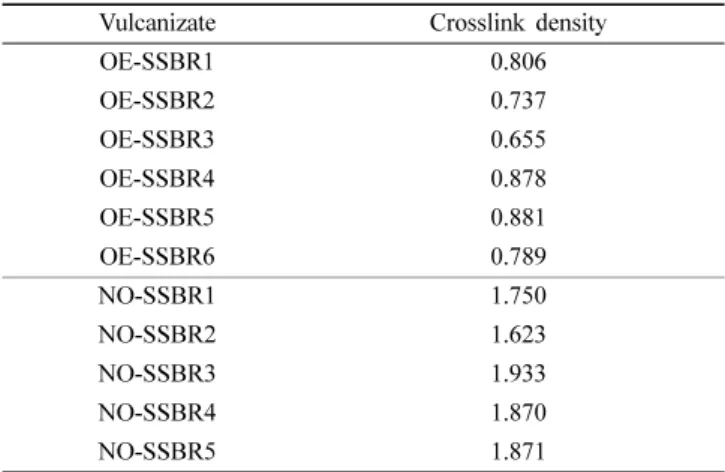
Abstract: Crosslink density of a rubber vulcanizate determines the chemical and physical properties, while bound rubber is an important factor to estimate reinforcement of a filled rubber compound. Extender oil is added to a raw rubber with very high molecular weight for improving processability of a rubber composite. Influence of extender oil on crosslink den- sity, bound rubber formation, and physical properties of solution styrene-butadiene rubber (SSBR) composites with differing microstructures was investigated. Crosslink densities of non-oil-extended SSBR (NO-SSBR) vulcanizates were higher than those of oil-extended SSBR (OE-SSBR) ones. Bound rubber contents of NO-SSBR compounds were also greater than those of OE-SSBR ones. The experimental results could be explained by interfering of extender oil. The OE-SSBR vulcanizates had low modulus but long elongation at break, whereas the NO-SSBR ones had high modulus but short elongation at break.
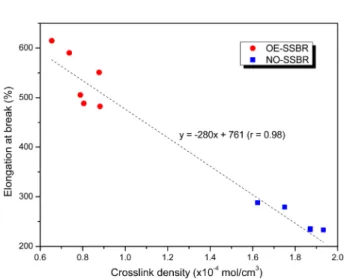
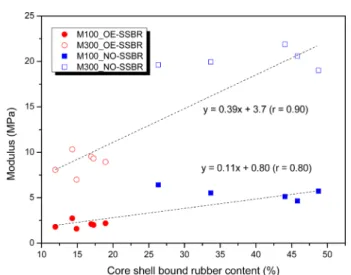
It was found that the crosslink densities affected the physical properties more than the bound rubber contents. The moduli increased with increase in the crosslink density irrespective of extender oil, while the elongation at break decreased. Each variation of the tensile strengths of NO-SSBR and OE-SSBR vulcanizates with the crosslink density showed a decreasing trend. Tear strength of the OE-SSBR vulcanizate increased with increase in the crosslink density, whereas variation of the tear strength of NO-SSBR vulcanizate with the crosslink density showed a weak decreasing trend.
Keywords: solution SBR, extender oil, crosslink density, bound rubber, physical property
Introduction
Characteristics of styrene-butadiene rubber (SBR) is deter- mined by ratios of three components of styrene, 1,2-unit, and 1,4-unit. Solution SBR (SSBR) has higher 1,2-unit content than emulsion SBR (ESBR) and it also has various micro- structures. Carbon black and silica are the most popular rein- forcing fillers in rubber compounds.
1-9One of common usages of SBR is manufacturing of tire tread and SSBR is usually used for silica-filled rubber compounds.
10-13Silica has a number of silanol groups, which results in poor silica dispersion in a rubber compound.
14-16Silane coupling agent is used for silica dispersion.
17,18It is known that SSBR is good for silica dispersion and can improve both wet grip and rolling resistance.
19-22Crosslink density of a rubber vulcanizate determines the physical properties.
23-27By increasing crosslink density, mod- ulus, hardness, resilience, and abrasion resistance increase, whereas elongation at break, heat buildup, and stress relax-
ation decrease. Bound rubber is an important factor to esti- mate rubber reinforcement. Mechanism and factors affecting the formation of bound rubber have been studied.
28-32The filler-polymer interactions such as physical adsorption, chemisorption, and mechanical interaction lead to bound rub- ber formation. Polarity, microstructure, and molecular weight of polymer influence the level of bound rubber content. Mod- els for bound rubber have been suggested and developed by several research groups.
33-41Filler particles in a filled rubber compound are covered by an inner shell of tightly bound rub- ber and the outer region of loosely bound rubber. The com- plex filler-rubber units are connected by rubber filaments. In our previous work,
42it was suggested that bound rubber was composed of core shell, primary layer, and secondary layer.
In a rubber industry manufacturing synthetic rubbers, oil is added to a raw rubber with very high molecular weight for improving processability of filled rubber compounds, which is called ‘oil-extended rubber’ and the oil is called ‘extender oil’. Extender oil by swelling the polymer and by providing lubrication between rubber molecules softens the stiff rubber chains. Processing oils including extender oil assist in mixing
†