C O M M E N T A R Y Open Access
Health care strategy for ensuring work ability in an aging Korea
Jungsun Park
1, Jong-tae Park
2, Soo Geun Kim
3, Cheol-In Yoo
4, Junseok Son
5, Jun Yim
6, Dae-seong Kim
2, Kyung Young Rhee
7and Yangho Kim
4*Abstract
The rapid aging trend in South Korea will cause a growing shortage of labor and decreasing quality of the labor force. The purpose of this commentary is to recommend a health care strategy to maintain and promote the work ability of employees in an aging Korea. Strategies to promote the work ability require the collaboration of governmental agencies at the central and local levels. First, the common goal should be the reinforcement of follow-up measure in general medical examinations and the promotion of healthy lifestyles for workers. Second, collaborating activities should be performed among the Worker’s Health Center, the Health Promotion Center, and community health centers. In conclusion, health care strategies for ensuring the work ability in an aging Korea require the collaboration of governmental agencies at the central and local levels.
Keywords: Work ability, Aging, Health promotion
Background
South Korea’s population is aging more rapidly than any other country [1, 2]. Since it became an aging society in 2000, the predictions are that South Korea will be an aged society by 2018 and a super-aged society by 2026 [1]. Labor shortages and a lack of skilled people are ex- pected due to a reduction in the size of the productive population (age 15–64) in 2017 and the mass retirement of “baby boomers” [1]. Further, the most economically active age group (30–49 years-old) in the productive population will decline continuously, from 49 % in 2005, to 42 % in 2020, and to 37 % by 2050. Similarly, the per- centage of elderly people (at least 50 years-old) was 25 % in 2010, and is expected to exceed 33 % in 2020 [1, 3].
Thus, the aging of the productive population will quickly reach the point when most current baby boomers have left the labor market (after 2030).
This aging of the workforce will likely increase the ac- cident rate because the elderly experience degradations of many physiological functions, such as sensory sys- tems, sense of equilibrium, and motor control [4, 5]. In
addition, the increased prevalence of chronic and degen- erative diseases due to aging will lead to a decreased quality of the labor force [6].
Thus, it is clear that the rapid aging trend in South Korea will have a significant impact on the quantity and quality of labor. Therefore, the purpose of this commentary is to recommend a health care strategy to maintain and promote the work ability of employees in an aging Korea.
The current health care system for employees in South Korea
The government’s comprehensive plan, ‘The Second Plan for Aging Society and Population (2011-2015)’, lacked life-cycle-specific health care measures (i.e. mea- sures for young and middle-aged workers) in the ‘pro- active health care system’ section [7]. It also placed the public health center for the community population at the center of most activities, including improvements in health screening and follow-up systems, establish- ment of a community-based integrated health care sys- tem, institutionalization of health care services, and introduction of chronic degenerative diseases manage- ment programs. Even though the Framework Act on Health and Medical Services Article 36 (Occupational Health Care) states that the government should take
* Correspondence:[email protected]
4Department of Occupational and Environmental Medicine, Ulsan University Hospital, University of Ulsan College of Medicine, Ulsan, South Korea Full list of author information is available at the end of the article
© 2016 The Author(s). Open Access This article is distributed under the terms of the Creative Commons Attribution 4.0 International License (http://creativecommons.org/licenses/by/4.0/), which permits unrestricted use, distribution, and reproduction in any medium, provided you give appropriate credit to the original author(s) and the source, provide a link to the Creative Commons license, and indicate if changes were made. The Creative Commons Public Domain Dedication waiver (http://creativecommons.org/publicdomain/zero/1.0/) applies to the data made available in this article, unless otherwise stated.
Park et al. Annals of Occupational and Environmental Medicine (2016) 28:42 DOI 10.1186/s40557-016-0127-y
measures to protect and promote employees’ health [8], almost none of these activities have been carried out for the employees, the most important target for man- agement of chronic degenerative diseases.
Based on the current Occupational Safety and Health Act, workers' medical examinations are to be carried out regularly in all workplaces, regardless of business size.
However, workplaces with fewer than 50 workers do not have professional personnel to perform follow-up mea- sures after medical examinations, and this is a significant problem in the current workers’ health care policy. In addition, workplaces with fewer than 2000 workers (or fewer than 3000 or 5000 workers in some sectors) are not required to appoint a doctor or nurse according to the Occupational Safety and Health Act [9]. Thus, a number of workplaces rely on external expertise for workers’ health care services, such as follow-up measures of periodic medical examinations. Follow-up measures for general medical examinations tend to be neglected com- pared to occupational medical examinations, although employers are required to perform these follow-ups. In addition, workplaces and external professional organiza- tions for occupational health programs lack specialized personnel, facilities, and equipment for health promotion and health promotion programs. Thus, establishment of a linkage with health promotion resources in the community is urgently needed.
Benchmark: strategies to promote work ability in aging Japan
Japan has guidelines on cooperation between community health and occupational health activities for workers’
health promotion at the level of the local community, and has performed cooperative activities since 2005 [10]. The implications of these policies and guidelines is as follows.
First, the law should have a provision for harmonization and collaboration of existing health services that were pre- viously carried out independently in different department of one ministry. Second, it is necessary to have common recognition of the collaborative activities. Each agency holds the value of the existing independent business, so it is necessary to share the recognition of the need and sig- nificance of collaborative activities for the community’s health problems through the exchange of information between institutions regarding health information and services. Third, it is important to establish guidelines for collaborative activities so there is a clear and mutual un- derstanding and a systematic project plan based on the consensus. Lastly, it is crucial to establish a local council to promote these collaborative activities.
Recommendation for policy
We described in detail a process leading to a recommen- dation for promoting work ability in an aging society in
a Table, which shows a logic for solution containing current status and problem identification, counter-measures for the problem, obstacles, and solution (Table 1).
The policy for promotion of work ability in a low-birth rate and aging society must be included in the 4thFive- Year Plan for Industrial Accident Prevention (2015–
2019) [11]. The principle to implement this policy is as follows: First, prevention programs should be tailored to the age of the workers (adolescence, middle age, seniors, etc.). Second, there should be prevention programs through collaboration among the relevant ministries (Ministry of Employment and Labor/Ministry of Health and Welfare/Ministry of Culture, Sports and Tourism, etc.). Third, prevention programs should be linked to community resources. The management of chronic de- generative diseases, using follow-up measure in general medical examinations, should be placed at the center of these principles.
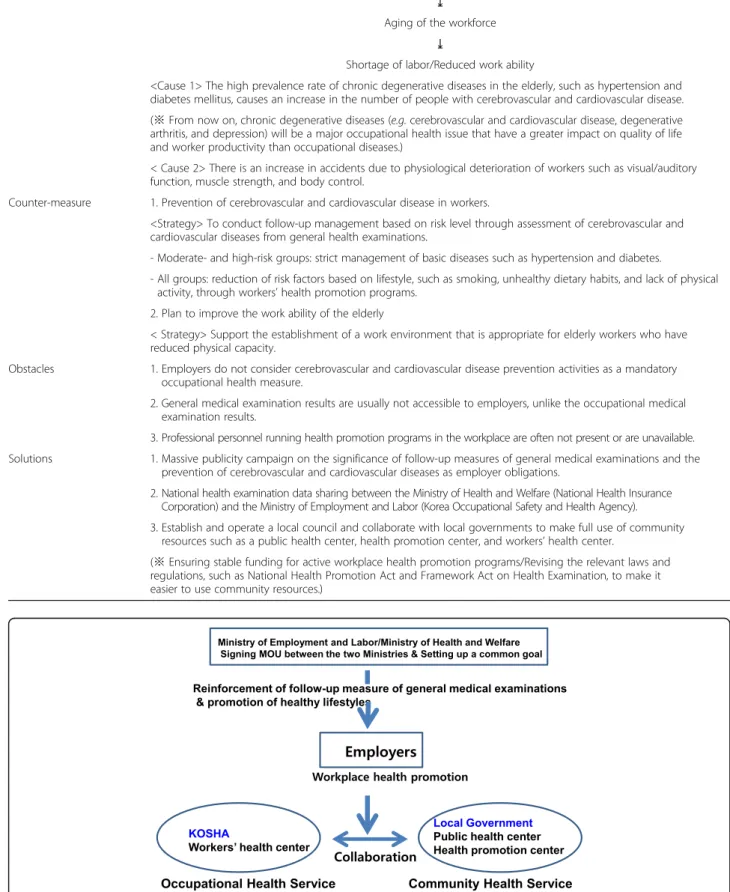
The principles and strategies to promote work ability through the collaboration of relevant agencies at the central and local level is as follows. A common goal–the reinforcement of follow-up measures of general medical examinations and the promotion of healthy lifestyles for workers–must be set up by signing a memorandum of understanding between the Ministry of Employment and Labor and the Department of Health and Welfare. In addition, the Ministry of Employment and Labor should inform all employers of the significance of follow-up measures of general medical examinations. Once this basic governmental policy is announced, workers’ health promotion activities by employers will gain momentum, conditions for collaboration will be established, and an environment for collaboration will be created that natur- ally leads to collaboration.
In order to promote cooperation between community health and occupational health activities for health pro- motion in workers in Korea, several points should be addressed (Fig. 1). First, workers’ health information should be shared between the National Health Insurance Corporation and the Korea Occupational Safety and Health Agency. Second, a standard code should be pre- sented to share data by linking the websites that each agency operates to provide integrated information.
Third, when setting up the cooperation, the target insti- tutions should be the Korea Occupational Safety and Health Agency, the National Health Insurance Corpor- ation, and the local government at the administrative agency level. The active organizations should be the Worker’s Health Center, the Health Promotion Center, and the community health centers, respectively, at the local activity level. Finally, there should be a steering team to promote employees’ work ability in the Ministry of Employment and Labor. Under the leadership of the Ministry of Employment and Labor, it will play the role
Park et al. Annals of Occupational and Environmental Medicine (2016) 28:42 Page 2 of 4
Table 1 Process leading to a recommendation for promoting work ability in an aging society
Current status and problem Low birth rate and aging population
⤓
Aging of the workforce
⤓
Shortage of labor/Reduced work ability
<Cause 1> The high prevalence rate of chronic degenerative diseases in the elderly, such as hypertension and diabetes mellitus, causes an increase in the number of people with cerebrovascular and cardiovascular disease.
(※ From now on, chronic degenerative diseases (e.g. cerebrovascular and cardiovascular disease, degenerative arthritis, and depression) will be a major occupational health issue that have a greater impact on quality of life and worker productivity than occupational diseases.)
< Cause 2> There is an increase in accidents due to physiological deterioration of workers such as visual/auditory function, muscle strength, and body control.
Counter-measure 1. Prevention of cerebrovascular and cardiovascular disease in workers.
<Strategy> To conduct follow-up management based on risk level through assessment of cerebrovascular and cardiovascular diseases from general health examinations.
- Moderate- and high-risk groups: strict management of basic diseases such as hypertension and diabetes.
- All groups: reduction of risk factors based on lifestyle, such as smoking, unhealthy dietary habits, and lack of physical activity, through workers’ health promotion programs.
2. Plan to improve the work ability of the elderly
< Strategy> Support the establishment of a work environment that is appropriate for elderly workers who have reduced physical capacity.
Obstacles 1. Employers do not consider cerebrovascular and cardiovascular disease prevention activities as a mandatory occupational health measure.
2. General medical examination results are usually not accessible to employers, unlike the occupational medical examination results.
3. Professional personnel running health promotion programs in the workplace are often not present or are unavailable.
Solutions 1. Massive publicity campaign on the significance of follow-up measures of general medical examinations and the prevention of cerebrovascular and cardiovascular diseases as employer obligations.
2. National health examination data sharing between the Ministry of Health and Welfare (National Health Insurance Corporation) and the Ministry of Employment and Labor (Korea Occupational Safety and Health Agency).
3. Establish and operate a local council and collaborate with local governments to make full use of community resources such as a public health center, health promotion center, and workers’ health center.
(※ Ensuring stable funding for active workplace health promotion programs/Revising the relevant laws and regulations, such as National Health Promotion Act and Framework Act on Health Examination, to make it easier to use community resources.)
Fig. 1 Reinforcement of workplace health promotion activities through the collaboration of central and local agencies in Korea
Park et al. Annals of Occupational and Environmental Medicine (2016) 28:42 Page 3 of 4
of a“control tower” to promote collaboration, and form a group consisting of about 10 individuals below the vice Minister who operate together. This should include all institutions participating in the collaboration, and should hold periodical conferences to monitor the process and results.
Conclusions
Health care strategies to promote the workability in an aging Korea require the collaboration of governmental agencies at the central and local levels.
Acknowledgement
This work was supported by Korea Occupational Safety and Health Agency (Grant number: 2015-OSHRI-822).
Funding
This work was supported by Korea Occupational Safety and Health Agency (Grant number: 2015-OSHRI-822).
We declare no roles of the funding body in the design of the study and collection, analysis, and interpretation of data and in writing the manuscript.
Availability of data and materials Not applicable.
Authors’ contributions
Conception and design of the work: JP, YK. The acquisition and interpretation of data for the work: DSK, JY, CIY, JS, KYR. Drafting the work; JP, SGK. Revising it critically for important intellectual content; YK, JTP. Final approval of the version to be published; YK. Agreement to be accountable for all aspects of the work in ensuring that questions related to the accuracy or integrity of any part of the work are appropriately investigated and resolved; YK.
Competing interests
The authors declare that they have no competing interests.
Consent for publication Not applicable.
Ethics approval and consent to participate Not applicable.
Author details
1Department of Occupational Health, Catholic University of Daegu, Gyongsan, South Korea.2Department of Occupational Medicine, Korea University Ansan Hospital, Ansan, South Korea.3Department of Occupational Medicine, Kangbuk Samsung Hospital, Sungkyunkwan University, School of Medicine, Seoul, South Korea.4Department of Occupational and Environmental Medicine, Ulsan University Hospital, University of Ulsan College of Medicine, Ulsan, South Korea.5Department of Occupational &
Environment medicine, Samsung Changwon Hospital, Sungkyunkwan University School of medicine, Changwon, South Korea.6Department of Preventive Medicine, Gachon University College of Medicine, Incheon, South Korea.7Occupational Safety and Health Research Institute, Korea
Occupational Safety and Health Agency, Ulsan, South Korea.
Received: 3 June 2016 Accepted: 31 August 2016
References
1. Statistics Korea. Population projections. 2010. Available at: http://kostat.go.
kr/portal/korea/kor_nw/2/1/index.board?bmode=read&aSeq=252623 (Accessed 29 Dec 2015).
2. United Nations. World Population Prospects The 2008 Revision. 2009.
Available at: http://www.un.org/esa/population/publications/wpp2008/
wpp2008_highlights.pdf (Accessed 29 Dec 2015).
3. Statistics Korea. Economically Active Population Survey. 2014. Available at: http://
kostat.go.kr/portal/korea/kor_nw/2/1/index.board?bmode=read&aSeq=328458 (Accessed 29 Dec 2015).
4. Lockhart TE, Smith JL, Woldstad JC. Effects of Aging on the Biomechanics of Slips and Falls. Hum Factors. 2005;47(4):708–29.
5. Rhee KY, Seo DU. Gender-specific incidence rate of industrial accidents and type of accident. OSH Issue Report. 2014;8(2):2–29.
6. Korean Ministry of Health and Welfare. The Fifth Korean National Health and Nutrition Examination Survey 2012. Seoul: Korean Ministry of Health and Welfare; 2013. Available at: http://stat.mw.go.kr/front/statData/publicationView.
jsp?bbsSeq=13&nttSeq=21193&menuId=47 (Accessed 29 Dec 2015).
7. Government of the Republic of Korea. The Second Plan for Ageing Society and Population. 2015.
8. Korean Ministry of Health and Welfare. Framework Act on Health and Medical Services. 2014 Available at: http://www.law.go.kr/eng/engLsSc.
do?menuId=2&query=MEDICAL%20SERVICE%20ACT#liBgcolor22 (Accessed 29 Dec 2015).
9. Korean Ministry of Employment and Labor. Occupational Safety and Health Act. 2015. Available at: http://www.law.go.kr/DRF/MDRFLawService.
jsp?OC=kosha2&ID=1766 (Accessed 29 Dec 2015).
10. Japanese Ministry of Health, Labour and Welfare (Japan). Guidelines on cooperation between community health and occupational health activities (revised version), 2007. Available at: www.mhlw.go.jp/shingi/2007/03/s0330- 7.html (in Japanese) (Accessed 29 Dec 2015).
11. Korean Ministry of Employment and Labor. The 4th Five-Year Plan for Industrial Accident Prevention (2015–2019). 2015.
• We accept pre-submission inquiries
• Our selector tool helps you to find the most relevant journal
• We provide round the clock customer support
• Convenient online submission
• Thorough peer review
• Inclusion in PubMed and all major indexing services
• Maximum visibility for your research Submit your manuscript at
www.biomedcentral.com/submit
Submit your next manuscript to BioMed Central and we will help you at every step:
Park et al. Annals of Occupational and Environmental Medicine (2016) 28:42 Page 4 of 4