INTRODUCTION
Hepatocellular carcinoma (HCC) accounts for 80–90% of pri- mary liver cancers. Worldwide, it is the fifth most common cancer and the third most common cause of cancer-related death.1 With no specific treatment, the prognosis is very poor, and the median survival for patients with early and advanced tumors is 6–9 months and 1–2 months, respectively.2,3 Several treatment options based on clinical guidelines are available, in- cluding surgical resection, percutaneous and transarterial in- terventions, systemic chemotherapy, liver transplantation (LT), and radiotherapy (RT).
Received: June 18, 2018
Corresponding author: Jinsil Seong, MD, PhD, Department of Radiation Oncolo- gy, Yonsei Cancer Center, Yonsei University College of Medicine, 50-1 Yonsei-ro, Seodaemun-gu, Seoul 03722, Korea.
Tel: +82-2-2228-8111, Fax: +82-2-2227-7823, E-mail: [email protected]
•The authors have no financial conflicts of interest.
© Copyright: Yonsei University College of Medicine 2018
This is an Open Access article distributed under the terms of the Creative Com- mons Attribution Non-Commercial License (https://creativecommons.org/licenses/
by-nc/4.0) which permits unrestricted non-commercial use, distribution, and repro- duction in any medium, provided the original work is properly cited.
Stereotactic Body Radiotherapy: Does It Have a Role in Management of Hepatocellular Carcinoma?
Seo Hee Choi and Jinsil Seong
Department of Radiation Oncology, Yonsei Cancer Center, Yonsei University College of Medicine, Seoul, Korea.
Stereotactic body radiotherapy (SBRT) is a form of radiotherapy that delivers high doses of irradiation with high precision in a small number of fractions. However, it has not frequently been performed for the liver due to the risk of radiation-induced liver toxicity. Furthermore, liver SBRT is cumbersome because it requires accurate patient repositioning, target localization, control of breathing-related motion, and confers a toxicity risk to the small bowel. Recently, with the advancement of modern technologies including intensity-modulated RT and image-guided RT, SBRT has been shown to significantly improve local control and survival outcomes for hepatocellular carcinoma (HCC), specifically those unfit for other local therapies. While it can be used as a stand- alone treatment for those patients, it can also be applied either as an alternative or as an adjunct to other HCC therapies (e.g., transarterial chemoembolization, and radiofrequency ablation). SBRT might be an effective and safe bridging therapy for pa- tients awaiting liver transplantation. Furthermore, in recent studies, SBRT has been shown to have a potential role as an immuno- stimulator, supporting the novel combination strategy of immunoradiotherapy for HCC. In this review, the role of SBRT with some technical issues is discussed. In addition, future implications of SBRT as an immunostimulator are considered.
Key Words: Hepatocellular carcinoma, liver tumors, radiotherapy, stereotactic body radiotherapy, intensity-modulated radio- therapy, immunotherapy
pISSN: 0513-5796 · eISSN: 1976-2437 Yonsei Med J 2018 Oct;59(8):912-922
https://doi.org/10.3349/ymj.2018.59.8.912
Previously, the role of RT for HCC has been questioned due to the relatively low radiation tolerance of the liver. However, with increasing clinical use and experiences, RT can be con- sidered an effective and safe local therapy for HCC. Moreover, the recent development of modern RT technologies, includ- ing image-guided RT (IGRT), intensity-modulated RT (IMRT), and stereotactic body RT (SBRT), has expanded the indica- tions of RT. Compared to three-dimensional conformal RT (3D-CRT), advantages of IMRT include inverse treatment planning method and possible use of many treatment fields, which provide high precision and good conformal dose distri- bution. Specifically, SBRT can be a useful locoregional treat- ment option for selected patients who are ineligible for trans- arterial chemoembolization (TACE) or radiofrequency ablation (RFA) and who have unresectable, small hepatic le- sions. Furthermore, SBRT precisely delivers higher ablative doses of irradiation in smaller volumes, providing excellent local control (LC) with potential survival benefits in HCC.
In this review, we will discuss the current role of SBRT for HCC as well as future implications of its use as an immunos- timulator.
THE PRINCIPLE OF STEREOTACTIC BODY RADIOTHERAPY
SBRT uses stereotactic non-coplanar conformal RT intended for a small number (usually 1–5 fractions) of significantly larg- er fraction sizes (usually 8–12 Gy/fraction) while limiting the dose to adjacent normal tissues.4 The sophisticated and steep dose gradient within the target volume usually leads to excel- lent conformity with steep dose fall-off and high dose delivery to the target volume. Since its development to treat intracra- nial malignancies, SBRT has been extended to treat a wide va- riety of extracranial tumors. SBRT for liver tumors was first in- troduced in the 1990s5; however, it has not frequently been performed because of the risk of radiation-induced liver dis- ease (RILD). Furthermore, liver SBRT is cumbersome because it requires accurate target localization, patient repositioning, control of breathing-related movement, and confers a toxicity risk to the adjacent small bowels.
Over the years, many retrospective studies have been per- formed with larger cohorts, and several phase I/II trials that enrolled patients who were ineligible for other local therapies have been conducted. Based on the vast body of evidence ac- cumulated as a result of these studies and trials, the recent National Comprehensive Cancer Network guidelines intro- duced SBRT as an option only in inoperable, ineligible for transplant tumors (category 2B).6 However, currently, tech- nological advances have made it possible for radiation to be precisely delivered to small liver tumors, while further reduc- ing the risk of RILD. The role of SBRT for HCC should be re- evaluated further with those recent advances in mind, as previous phase III trials lacked comparisons with other local therapies.
Patient selection
In the currently used guidelines,6-9 the recommended applica- tions of RT vary (Table 1). Although there is no specific recom- mendation for SBRT, several guidelines indicate external beam RT (EBRT) as an alternative option for single HCC with- out vascular invasion. Careful patient selection is required for SBRT in HCC. Although there is no definite limit to the size or number of tumors that can be treated with SBRT, most groups included patients with a maximum lesion size of ≤5 cm, al- though some included patients with tumors up to 10 cm.10,11 Regarding the number of lesions, patients with 1–3 tumors were usually treated, but again no cut-off value has been es- tablished. The number and size of tumors that can be consid- ered for SBRT are dependent on the non-tumoral liver volume that can be spared (usually 700 cm3). SBRT is also feasible for some lesions that are ineligible for surgery or percutaneous ablation. These unique cases require clinical consideration.
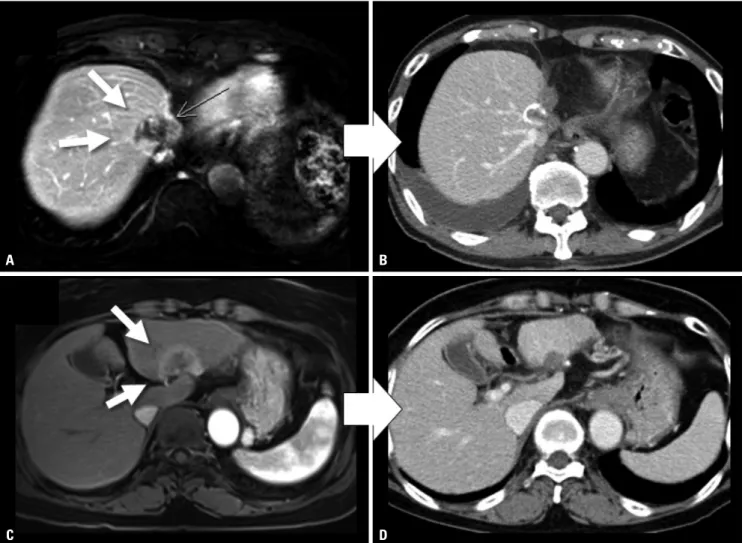
RFA is not indicated for tumors in the liver dome, given the difficulty of sono-guided tumor targeting under a poor sono- graphic visual field. Post-RFA failures are also frequent in the S1 region, especially the porta hepatis, because of the high risk of complications or multivascular tumor supply. Similar- ly, patients who are eligible for SBRT usually have a central le- sion of the liver dome, with direct invasion into the vessels, and/or with an insufficient outcome from other local thera- pies, including RFA and TACE (Fig. 1). Regarding liver func- tion, Child-Pugh class A or upper B are considered appropri- ate for SBRT, similar to the general guidelines of conventional RT for HCC. Dose modifications and strict dose constraint ad- herence would be required for tumors with Child-Pugh class B status.12 The safety of liver radiation for HCC in patients with Child-Pugh class C cirrhosis has not been established, as it is
Table 1. Comparison of Treatment Guidelines for Stereotactic Body Radiotherapy-Eligible Hepatocellular Carcinoma Guidelines
BCLC NCCN APPLE KLSCG-NCC
Single, ≤2 cm, without VI Subgroup Very early Resectable or transplantable Very early mUICC Stage I Primary or
preferred option
Resection (or LT/RFA/
PEI, if portal pressure/
bilirubin increased)
Resection or LT Resection (or LT/RFA/PEI, if portal pressure/bilirubin increased)
Resection or RFA
Alternative
option (-) Locoregional treatment
(Ablation, arterial directed
therapies, EBRT) EBRT TACE, PEI, or EBRT
Single, >2 cm, without VI Subgroup Early Resectable or transplantable Early mUICC Stage II Primary or
preferred option LT or RFA/PEI Resection or LT LT or RFA/PEI Resection or RFA Alternative
option (-) Locoregional treatment
(Ablation, arterial directed
therapies, EBRT) SABR, hypofractionated RT TACE, LT, or EBRT BCLC, Barcelona clinic liver cancer; NCCN, National Comprehensive Cancer Network; APPLE, Asia Pacific Primary Liver Cancer Expert Meeting; KLCSG-NCC, Ko- rean Liver Cancer Study Group and the National Cancer Center; VI, vascular invasion; LT, liver transplantation; RFA, radiofrequency ablation; PEI, percutaneous ethanol injection; EBRT, external-beam radiotherapy; mUICC, modified Union for International Cancer Control; TACE, transarterial chemoembolization; RT, radio- therapy; SABR, stereotactic ablative radiotherapy.
are more prone to liver toxicity after SBRT, in part because of underlying liver disease and comorbidities.17 In some studies, an increasing Child-Pugh score, a measure of liver toxicity correlating with overall survival (OS), occurred in 10% and 30% of patients with early- and advanced-stage HCC within 3 months after SBRT, respectively.14,18 However, there is a pauci- ty of data correlating the incidence of liver toxicity with SBRT dosimetric parameters for HCC. One Canadian group report- ed the risk factors associated with a decline in liver function after 6-fraction SBRT for HCC.19 Liver toxicity was defined as an increase in Child-Pugh score (≥2) 3 months after SBRT.
Baseline Child-Pugh scores (5 vs. 6) and higher liver doses (e.g., mean dose, effective volume, and doses to 700–900 cc) were strongly associated with liver function decline 3 months after SBRT. A lower baseline platelet count and portal vein thrombus were also associated with an increased risk.
unlikely that clinical trials are available for Child-Pugh class C patients.13,14
Liver toxicity after SBRT
The probability of RILD can increase when the radiation dose to the whole liver exceeds 35 Gy. Owing to advances in tech- nology, partial liver irradiation has been successful in reduc- ing the risk of RILD. According to Dawson and Ten Haken’s15 review, if the effective liver volume irradiated is less than 25%, very high RT doses (higher than 100 Gy) may be delivered with low risk of liver toxicity, as long as the liver function is proper. Therefore, SBRT to irradiate only a small volume of the liver can be performed safely for liver tumors. The most com- mon SBRT fractionation schemes for HCC according to the current literature include 3 fractions×10–20 Gy/fx, 4–6 frac- tions×8–10 Gy/fx, and 10 fractions×5–5.5 Gy/fx.16 Compared with patients with liver metastases, however, those with HCC
Fig. 1. CT scans of patient cases showing objective responses to SBRT of 60 Gy in 4 fractions for HCC. (A) Before SBRT, the CT scan showed a 3 cm-sized viable HCC after multiple TACE treatments at the dome of the liver (white arrows) (AFP/PIVKA-II: 1017 ng/mL/95 mAU/mL). (B) After SBRT, the 1-year post- SBRT CT scan showed radiologic CR with significantly decreased tumor markers approximating normal levels (AFP/PIVKA-II: 2.04 ng/mL /14 mAU/mL). (C) Before SBRT, a 4 cm-sized HCC was observed in the left lobe (white arrows) (AFP/PIVKA-II: 6.14 ng/mL/31 mAU/mL). (D) After SBRT, the 4-month post- SBRT CT scan showed radiologic CR with further reduced tumor marker levels (AFP/PIVKA-II: 3.38 ng/mL/31 mAU/mL). SBRT, stereotactic-body radio- therapy; HCC, hepatocellular carcinoma; TACE, transarterial chemoembolization; AFP, alpha-fetoprotein; PIVKA-II, prothrombin-induced by vitamin K ab- sence or antagonist-II; CR, complete response.
A B
C D
Respiration control
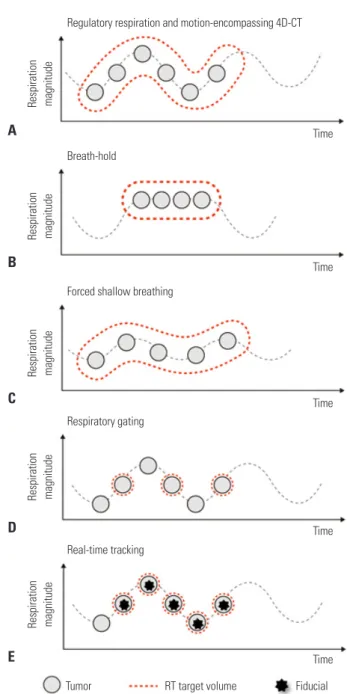
A critical issue in RT for HCC is the control of respiratory movement, as the liver moves over a considerable range dur- ing respiration. Several ways may be used to treat a moving tumor to ensure it receives the intended dose while reducing the dose to surrounding normal tissue: motion-encompassing four-dimensional CT (4D-CT) images, breath-hold, forced shallow breathing, respiratory gating, and real-time tumor tracking (Fig. 2). For SBRT, control of respiratory motion should be considered more strictly than for conventional RT.
When performing SBRT, many institutions use not only 4D- CT images but also other respiratory control methods. Specifi- cally, real-time tumor tracking using the surrogate on the body surface or an internal fiducial marker has demonstrated high accuracy. Internal fiducial markers can be residual radio- opaque lipiodol after TACE or a commercial fiducial marker which is inserted under sono-guidance.
Target delineation and dose constraints
Liver SBRT can be performed with various planning machines (e.g., step-and-shoot IMRT, volumetric-modulated arc thera- py, tomotherapy, and cyberknife). Several target volumes that are carefully contoured by a professional radiation oncologist are required for SBRT. Gross tumor volume (GTV) is defined as a primary tumor plus an abnormal portal area as indicated by magnetic resonance imaging (MRI). For patients whose le- sions are not easily detected by CT, incorporation of MRI in planning may also be necessary for more precise target delin- eation. The deformable image registration method could be also usefully utilized.20 Clinical target volume (CTV) is defined as GTV plus a 0.3–0.5 cm margin for subclinical disease. Inter- nal target volume is defined as the envelope of all CTVs from the different respiratory phases and is used for treatment planning as the equivalent of the planning target volume for SBRT. In addition to the target volume, the entire liver, the re- maining normal liver, both kidneys, the stomach, the duode- num, and the spinal cord should be meticulously contoured and taken into consideration during SBRT planning. In addi- tion to the dose constraint guidelines of the American Associ- ation of Physicists in Medicine Task Group,21 the following ex- plicit planning objectives should be defined when executing SBRT plans: 1) ≥700 mL of remaining normal liver should re- ceive ≤15 Gy; 2) maximum dose (Dmax) to bowel, duodenum, and stomach, <24 Gy; 3) Dmax to spinal cord, <18 Gy; and 4)
≥67% of each kidney should receive <15 Gy and V15 should be
<35%. According to the 2014 Korean Liver Cancer Study Group guidelines,8 normal liver volume receiving a total dose of <15 Gy must be ≥700 mL, or the mean normal liver dose (liver minus GTV) must be limited to <28 Gy for liver SBRT.
Fig. 2. Different motion management methods in RT. (A) The motion-en- compassing method refers to the covering of all possible positions of the moving tumor through the whole breathing cycle using 4D-CT images.
Subsequently, a large volume of normal tissue may be irradiated. (B) The breath-hold method refers to let the patient hold breaths for a few sec- onds under deep inspiration, and then deliver the radiation only when the liver is in a certain position. (C) The forced shallow breathing is a method of using a special external device such as an abdominal compressor to allow the patient to breathe shallow during radiation therapy. Although breath-hold and forced shallow breathing might result in patient discom- fort or inconvenience during treatment, it can reduce the respiratory mo- tion for liver tumors and enhance the accuracy. (D) The respiratory gating method is a method of turning on the radiation beam only during a specif- ic respiratory cycle, after accurately grasping the position of a tumor ac- cording to a patient‘s respiratory cycle in advance using 4D-CT images.
(E) The real-time tracking method refers to tracking the movement of the tumor along the respiratory cycle using the surrogate on the abdominal surface or internal fiducial marker and then delivering the radiation fol- lowing the tumor inside the body. No respiratory control and abdominal compression are needed. RT, radiotherapy; 4D, four-dimensional.
Time Respiration magnitude
Regulatory respiration and motion-encompassing 4D-CT
Time Respiration magnitude
Breath-hold
Time Respiration magnitude
Forced shallow breathing
Time Respiration magnitude
Respiratory gating
Time Respiration magnitude
Tumor RT target volume Fiducial
Real-time tracking A
B
C
D
E
CLINICAL OUTCOME OF STEREOTACTIC BODY RADIOTHERAPY FOR
HEPATOCELLULAR CARCINOMA
Curative therapies can improve survival in early-stage HCC patients. Resection, percutaneous ethanol injection, and RFA have been considered effective local treatment options. How- ever, when the effect of these treatments was limited due to the primary tumor location, RT can be considered as an alter- native definitive or salvage treatment. Moreover, RT may be a feasible alternative for patients with inoperable tumors or who refuse surgery. In several prospective10,12-14,22-26 and retro- spective11,27-37 papers, SBRT has been reported to be an effec- tive, safe, and noninvasive treatment modality in newly diag- nosed or recurrent cases when the position and size of the tumor are acceptable. In a recent meta-analysis,38 SBRT ex- hibited an LC rate of 87% with tolerable acute toxicities of grade >3 (4.9%) in HCCs.
Several prospective (phase I or II) trials that reported good outcomes of SBRT in HCCs have been conducted since 2001 (Table 2). In 2010, Goodman, et al.24 conducted a phase I study in patients with HCC or metastatic liver tumors. Radiation doses were escalated from 18–30 Gy in 1 fraction, and the 1-year LC rate was 77% with acceptable toxicity. The 2-year OS rate was 50% at a median follow-up of 17 months. Cardenes, et al.12 and Andolino, et al.13 performed prospective studies using 3–5-fraction SBRT in HCC patients with Child-Pugh class A or B disease. For Child-Pugh class A patients, 36–48 Gy in 3 fractions (dose-escalated) or 44 Gy in 3 fractions were used, while 40 Gy in 5 fractions were used for Child-Pugh class B patients. In all patients, the LC rate was higher than 90%, and the 2-year OS rate was 60%. In 2012, a phase II Kore- an study evaluated SBRT [median 57 Gy in 3 fractions (range, 42–60 Gy)] in 47 patients with early-stage HCC.10 The 2-year LC and OS rates were 94.6% and 68.7%, respectively. SBRT was well tolerated with a Child-Pugh class increase from A to B only in 13% of patients after RT. In Canada, Bujold, et al.14 reported phase I/II studies of 6-fraction SBRT in 102 Child- Pugh class A patients with advanced HCC who were ineligible for standard locoregional therapies. The median tumor size was 7.2 cm, which was higher than reported by other groups, and 55% of patients had portal vein thrombosis. The pre- scribed dose was 36 Gy in 6 fractions (range, 24–54 Gy), with the dose based on spared liver volume or other limiting nor- mal tissues. After a median follow-up of 31 months, the 1-year LC rate was 87%, and median survival was 17 months. Out- comes following SBRT for patients with liver dysfunction have also been prospectively assessed in 59 Child-Pugh class A-B9 patients.26 The median volume of HCC was 33.6 cc, and 20%
of participants had tumor thrombosis. The median OS of Child-Pugh class A and B patients was 45 and 17 months, re- spectively, with estimated 2-year LC rates of 92% and 82%, re- spectively. Four (11%) Child-Pugh class A patients and 8 Table 2.
Prospective Phase I/II Studies of Stereotactic Body Radiotherapy for HCC ReferenceDesignRT AimPatient numberIndicationMedian size (range), cmDoseMedian f/u (range), moLocal controlOverall survival Goodman, et al.24Phase IDefinitive/ SalvageHCC/metastasis (2/24)CP-A, Unresectable, tumors <5Dose escalation 18–30 Gy/1 fx17 (2–55)77% (1 yr)50% (2 yr) Cardenes, et al.12Phase I DefinitiveAll HCC (17)CP-A, CP-B, 1-3 lesions, ≤6 cm, PVT allowed, unavailable for resectionCP-A: 36–48 Gy/3 fx CP-B: 40 Gy/5 fx 24 (10–42)100%75% (1 yr) 60% (2 yr) Andolino, et al.13Phase IIDefinitiveAll HCC (60)CP-A, CP-B, liver-confined HCC, prior TACE included3.2 (1–6.5)CP-A: 44 Gy/3 fx CP-B: 40 Gy/5 fx27 (2–52)90% (2 yr) 67% (2 yr) Kang, et al.10Phase IISalvageAll HCC (47)CP-A, CP-B, Inoperable, Incomplete response after TACE, PVT allowed2.9 (1.3–7.8)57 (42–60) Gy/3 fx17 (6–38)95% (2 yr)69% (2 yr) Bujold, et al.14Phase I/II [Trial 1], subsequently phase II [Trial 2]DefinitiveAll HCC (102) (trial 1: 50, trial 2: 52)CP-A, PVT allowed, [trial 2] ≤5 tumors, <15 cm7.2 (1.4–23.1)36 (24–54) Gy/6 fx31 (2–36)87% (1 yr)Median 17 mo Kim, et al.25Phase IDefinitive/ SalvageAll HCC (18)CP-A, CP-B, ≤3 tumors, single ≤5 cm, multiple ≤sum 6 cm, previous Tx allowed1.9 (1.0–3.3)Dose escalation 36–60 Gy/4 fx23 (11–38)Radiologic CR: 89%, 49% (2 yr)69% (2 yr) Lasley, et al.26Phase I/II Definitive/ SalvageAll HCC (59)CP-A, CP-B, (Phase I → all CP-B possible, Phase II → only CP-B >7 possible) single ≤6 cm, multiple ≤sum 6 cm, 33.6 (2.0–107.3) ccCP-A: 38 Gy/3 fx CP-B: 40 Gy/5 fx 33 (3–61)92% for CP-A and 82% for CP-B (2 yr) Median 45 mo for CP-A, 17 mo for CP-B; 2-yr 72% for CP-A, 33% for CP-B (p=0.03) RT, radiotherapy; HCC, hepatocellular carcinoma; CP, Child-Pugh; PVT, portal vein thrombosis; TACE, transarterial chemoembolization; CR, complete response.
Child-Pugh class B patients (38%) experienced grade III/IV liver toxicity. For Child-Pugh class B patients (but not A), a dose to remained liver volume was associated with an in- creased risk of toxicity.
Multiple retrospective studies have also reported excellent outcomes with SBRT for patients with HCCs (Table 3). Pub- lished results of several retrospective studies have largely in- cluded instances in which surgical resection or percutaneous ablative therapies were difficult, unfeasible, or rejected, as well as some pools of intermediate or advanced-stage HCC.
Overall, promising outcomes with LC rates of 64–95% and OS rates of 43–87% at 2 years were reported. The wide variation in OS is due in part to different patient characteristics and the presence of tumor thrombosis in some series.
Huang, et al.30 performed Cox multivariable regression haz- ard analysis to compare OS curves of SBRT (n=36) and non- SBRT (n=138) patient groups [hazard ratio (HR), 2.44; p=0.005]
after adjustment for possible prognostic factors. The 2-year OS rates of SBRT recipients (n=28) and matched controls (n=28) (72.6% vs. 42.1%; p=0.013) were compared, concluding that SBRT significantly improved survival in patients with re- current unresectable HCC. Honda, et al.32 showed that SBRT combined with TACE is an effective and safe locoregional treatment of small solitary primary HCC with a 96% complete response (CR) rate. In the largest series, Sanuki, et al.31 report- ed on the outcomes of 185 patients with solitary HCCs ≤5 cm in size that were unsuitable for surgery or RFA. A total dose of 40 Gy or 35 Gy in 5 fractions was prescribed for Child-Pugh class A and B patients, respectively. Three-year LC and OS rates were 91% and 70%, respectively, with no significant dif- ference between dose levels. However, acute toxicity of ≥grade 3 was observed in 13% of patients, occurring more frequently in Child-Pugh class B patients. Occasionally, SBRT was also used for tumor thrombosis in portal vein or inferior vena cava,39 Barcelona-Clinic Liver Cancer stage C HCC,35 Child- Pugh class C patients,40 or large HCC ≥10 cm36,37,41 with accept- able response rates and survival outcomes. Jang, et al.33 sug- gested that there was a positive linear relationship between SBRT dose and 2-year LC and OS rates, which were highest at
>54 Gy. As several clinical trials have demonstrated the effica- cy and safety of SBRT, modern SBRT could provide an ablative dose to a tumor while sparing the remaining liver parenchyma.
SBRT as a curative treatment comparable to RFA According to the current guidelines of the European Associa- tion for the Study of the Liver and the American Association for the Study of Liver Diseases,42,43 RFA is recommended as the first-line treatment for early-stage HCC. However, RFA has significant limitations, including size discrepancies, tumor proximity to major vascular or biliary structures, and limited accessibility on ultrasonography.44 Since RFA is based on the principle of frictional heat production by frequency waves, heat conduction rates decrease with increasing tumor size,
resulting in inadequate tumor control. It is also well accepted that RFA of tumors in the liver dome is limited due to the in- visibility under ultrasonography guidance. Several reports have described that either subphrenic location or a short dis- tance from the diaphragm is associated with higher local re- currence after RFA.45,46 Another study showed that approxi- mately half of the tumors located in the liver dome recurred within 3 years after RFA due to inadequate ablation resulting from difficulties visualizing the tumor. SBRT can be a useful alternative in these situations. SBRT has a less strict indication for the size of tumors as discussed below. Furthermore, the therapeutic approach is not limited by tumor location when SBRT is implemented with daily IGRT. However, until now, little evidence has been available to determine the efficacy of SBRT compared to RFA.
Recently, a noteworthy study has attracted widespread at- tention from physicians due to the potential applications of SBRT and RFA. Wahl, et al.47 compared the outcomes of pa- tients with nonmetastatic, inoperable HCCs who received SBRT or RFA. For tumors <2 cm, there was no significant dif- ference between two treatments in freedom from local pro- gression (FFLP) [HR, 2.50; 95% confidence interval (CI), 0.72 to 8.67; p=0.15], but for tumors ≥2 cm, RFA was associated with a significantly worse FFLP (HR, 3.35; 95% CI, 1.17 to 9.62, p=0.025). More recently, an observational study analyzed a large cohort from the National Cancer Database to compare the effectiveness of RFA (n=3684) and SBRT (n=296) in pa- tients with stage I or II HCC.48 This study demonstrated the opposite result. The 5-year OS rate was significantly higher in the RFA group [29.8% (95% CI, 24.5–35.3%)] than in the SBRT group [19.3% (95% CI, 13.5–25.9%)] (p<0.001) in both propen- sity matching and probability-weighted analyses. The benefit of RFA was consistent across all subgroups and was robust to the effects of severe fibrosis or cirrhosis. However, this study may be limited by the biases related to its retrospective design although no other study with a similarly large cohort exists. A randomized clinical trial or more constructive studies would be helpful to confirm the results of these studies. A concerted effort should be made to identify a patient subgroup more suitable for RFA or SBRT shortly.
SBRT as a bridging treatment before liver transplantation
SBRT is also a suitable bridging therapy for patients with HCC awaiting LT. SBRT may enable patients with HCC to remain eligible for curative transplantation pending organ availabili- ty.49,50 O’Connor, et al.50 demonstrated that successful ortho- topic LT was undertaken following SBRT (median 6.3 months) in 10 patients with 11 HCCs. After the median follow-up of 62 months, the median time from SBRT to LT was 113 days (range, 8–794 days). The 5-year OS and disease-free survival rates were both 100%, with only 4 of 10 patients experiencing acute toxicity. Explant pathology revealed a CR rate of 27%
Table 3. Recent Retrospective Studies of SBRT for HCC ReferenceDesignRT AimPatient numberIndicationMedian size (cm)DoseMedian f/u (range), moLocal controlOverall survival Kwon, et al.28CyberknifeDefinitive/ Salvage42CP-A, CP-B, ≤100 cc, unavailable for other local therapies, no EHM30–39 Gy/3 fx29 (8–49)72% (1 yr), 68% (3 yr)93% (1 yr), 59% (3 yr) Seo, at al.11CyberknifeSalvage38CP-A, CP-B, <10 cm, all with TACE failure33–57 Gy/3–4 fx15 (3–27)66% (2 yr)61% (2 yr) Louis, et al.29CyberknifeDefinitive/ Salvage25CP-A, CP-B, PVT allowed, previous TACE, op, RFA, nexavar included
4.5 (1.8–10)45 Gy/3 fx13 (1–24)95% (1 yr)79% (1 yr) Huang, et al.30Cyberknife, Matched pair analysis (SBRT vs. other/no Tx)Salvage36CP-A, CP-B, CP-C, all with prior Tx, but tumor progressed
4.4 (1.1–12.3)37 (25–48 Gy) /4–5 fx 14 (2–35)88% (1 yr), 75% (2 yr)64% (2 yr) Honda, et al.32Linac, TACE alone vs. TACE → SBRTSalvage30CP-A, CP-B, solitary, ≤3 cm, all prior TACE, no PVT, no EHM1.6 (1–3)48 Gy/4 fx or 60 Gy/8 fx 12 (6–38)100%100% (1 yr), 100% (3 yr) Jang, et al.33CyberknifeDefinitive/ Salvage108CP-A, CP-B, unsuitable for other Tx or incomplete TACE3 (1–7)51 (33–60)/3 fx30 (4–81)87% (2 yr)63% (2 yr) Sanuki, et al.31Linac Definitive/ Salvage185CP-A, CP-B, single, unresectable, no LN mets or EHM2.7 (1–5)CP-A: 40 Gy/5 fx CP-B: 35 Gy/5 fx24 (3–80)91% (3 yr)70% (3 yr) Culleton, et al.343D-CRT, IMRT, or VMATDefinitive/ Salvage29CP-B, <10 cm, <5 tumors, life expectancy >3 months, KPS >60%, unresectable 8.66 (4.1–26.6)Median 30 Gy /6 fx
12 SD, 2 PR 6 intrahepatic PD (outfield)Median 8 months, 32% (1 yr) BCLC-C Bae, et al.35CyberknifeDefinitive/ Palliative35BCLC-C, CP-A, CP-B, vascular invasion or EHM45 (30–60) Gy /3–5 fx14 (1–44)69% (1 yr), 51% (3 yr)52% (1 yr), 21% (2 yr) Huge HCC Que, et al.36CyberknifeDefinitive/ Salvage22CP-A, CP-B, ≥10 cm, ECOG≤211.36 (10–18)Mainly 40 Gy /5 fx (26–40)11.5 (2–46)56% (1 yr), response rate 86.3%Median 11 mo, 50% (1 yr) Zhong, et al.37Total body gammaray stereotactic RT systemSalvage72Incomplete TACE → SBRT, ≥10 cm, ECOG≤212.6 (10.8–16.5)35.7 (33.8–39) /6 fx18 (4–70)Response rate 79%, low incidence of recur (8%)
Median 11 mo, 38% (1 yr), 12% (3 yr), 3% (5 yr), significantly higher with tumor encapsulation (56%, 1yr) Kuo, et al.41CyberknifeDefinitive/ Salvage≤4 cm: 52, >4 to <10 cm: 355, ≥10 cm: 34CP-A, CP-B≤71.8–1826–40 Gy /3–5 fx for tumors >5 cm, 39 Gy/ 3 fx for tumors ≤5 cm16 (2–72)Response rate 96%/91%/76% (p<0.001) 50%, 45%, 33% (3 yr) (no significant difference by size) RT, radiotherapy; HCC, hepatocellular carcinoma; CP, Child-Pugh; EHM, extrahepatic metastasis; TACE, transarterial chemoembolization; PVT, portal vein thrombosis; RFA, radiofrequency ablation; SBRT, stereotactic body radiotherapy; 3D-CRT, three-dimensional conformal radiotherapy; IMRT, intensity-modulated radiotherapy; VMAT, volumetric modulated arc therapy; LN, lymph node; KPS, Karnofsky performance status; SD, stable disease; PR, partial response; PD, progressive disease; BCLC, Barcelona-Clinic Liver Cancer.
while the remaining 8 tumors decreased or remained stable in size. In a recent paper by Sapisochin, et al.,51 379 patients who received LT after RFA (n=244), SBRT (n=36), or TACE (n=99) were compared to evaluate the efficacy and safety of bridging treatments. The drop-out and postoperative compli- cation rates were similar between the groups. The 3-year sur- vival from the time of transplant was 81% in the RFA group, 75% in the SBRT group, and 75% in the TACE group, which was not significantly different. Theirs was the first study to show that SBRT may be as effective and safe as TACE or RFA when used to maintain the candidacy of patients with HCC on the transplant waiting list.
A NEW ROLE FOR STEREOTACTIC BODY RADIOTHERAPY AS AN IMMUNOSTIMULATOR
Immunotherapy and HCC
Recent progress in the understanding of tumor biology and immune checkpoint has provided novel therapeutic strategies using immune checkpoint blockades. Over the years, different immunotherapeutic approaches have been evaluated for the treatment of HCC. Unlike certain other malignancies, HCC cells do not appear to be inherently immunogenic. However, recent papers that studied checkpoint inhibitors for HCC demonstrated promising results,52,53 and more phase I and II clinical studies are underway to investigate the effects of vari- ous immune checkpoint inhibitors, including cytotoxic T- lymphocyte-associated protein-4 inhibitors and anti-pro- grammed death-1 (anti-PD-1) antibody. Nevertheless, modest response rates have indicated that the efficacy of these checkpoint inhibitors appears to be insufficient.54,55 Therefore, the development of combination therapies appears to be necessary, which can not only provide direct tumoricid- al effects but also enhance the antitumor effect of immuno- therapy.
Recent preclinical studies had suggested that the effects of RT may be enhanced through the dissemination and activa- tion of tumor-associated antigens when RT was delivered in combination with immunotherapeutic agents, especially in a high dose per fraction. One important mechanism that can explain this enhancement is the abscopal effect which means the treatment may affect even untreated areas.56 This strategy is particularly appealing, as conforming RT to a small target volume may enhance the efficacy of immunotherapy in HCC, leading to the eradication of untreated macroscopic lesions and/or occult microscopic disease. Consequently, RT elicited systemic anti-tumor effects mediated by the immune system.
Preclinical data using human HCC tumor cultures and mu- rine models demonstrated that RT increased cell surface ex- pression of immunogenicity markers and increased sensitivity to dendritic cell therapy.57-59 Although further research is war-
ranted, several recent studies of the combination of RT and immunotherapy in the management of HCC have shown promising results.60-62
SBRT as an immunostimulator
Many preclinical studies demonstrated that high-dose per fraction RT has a beneficial outcome over classical RT frac- tionation,63-65 even though some in vitro models suggested an advantage for classical fractionated RT.66-68 To identify the spe- cific mechanism and confirm this hypothesis, Kim, et al.69 published a preclinical study. Using the murine HCC cell line HCA-1, the effect of radiation (10 Gy per one fraction) on pro- grammed death-ligand 1 (PD-L1) expression was measured.
The signaling pathways involved in the altered PD-L1 expres- sion, tumor growth, and survival rates were also evaluated.
Radiation upregulated PD-L1 expression in tumor cells through interferon (IFN)-γ/signal transducer and activator of transcription 3 (STAT3) signaling, which could facilitate the therapeutic action of anti-PD-L1 in the murine HCC model.
Furthermore, the combination of anti-PD-L1 and radiation significantly delayed tumor growth compared to treatment with anti-PD-L1 or radiation alone, enhancing survival signif- icantly (7-week survival; 90% vs. 0% or 30%, respectively, p<0.001). The underlying mechanism involved increasing apoptosis, decreasing tumor cell proliferation, as well as the restoration of CD8+ T cell functions.
The same group published another clinical study.70 The sol- uble PD-L1 (sPD-L1) level was measured (before/after RT, and 1 month after RT) and compared between the SBRT group and the conventional RT group. The sPD-L1 level increased after RT but decreased after 1 month in patients who under- went conventional RT, while it tended to increase continuous- ly for 1 month in SBRT patients. These results suggest that SBRT may be superior to conventional fractionated RT for combined use with immune checkpoint inhibitors. Other well-designed studies of RT combined with immune check- point inhibitors would be helpful to clarify the optimal RT scheme, dose, and time to implement the combination.
SBRT has been considered more immunogenic than con- ventional fractionation.71,72 According to previous studies, sev- eral possible mechanisms that act differently from those of conventional RT doses exist. First, although radiation-induced cell death is known to be caused predominantly by radiation- induced DNA damage or breaks, radiation delivered at higher doses per fraction (8–10 Gy) may induce other more signifi- cant vascular, stromal, and antitumor immune responses within the local tumor environment.73 Second, there is no danger signal when tumors are untreated, producing limited or tolerogenic antigen presentation. In contrast, upon receiv- ing a tumoricidal dose of radiation, dying tumor cells release a large number of tumor antigens, and those antigens act as danger signals which actively induce the immunogenic re- sponse. These tumor antigens also induce maturation of den-
dritic cells and increase antigen presentation by these cells.
These signals result in the activation and proliferation of tu- mor-specific CD8 T cells. The release of danger signals from tumor cells appears to be more active by ablative dose per 1 fraction than conventional dose per fraction. Third, radiation causes tumor cells to be more susceptible to immunogenic cell death. Radiation upregulates the major histocompatibility complex and first apoptosis signal receptor on tumor cells, in- creasing their susceptibility to T cell-mediated cytotoxicity as well as increasing PD-L1 on tumor cells.74 Therefore, radiation combined with immune checkpoint inhibitors offer a more effective combination strategy than radiation alone.
CONCLUSION
The use of SBRT for HCC appears to be a useful noninvasive option with an LC rate of approximately 90%. Numerous ad- vances in EBRT allow for more accurate targeting and sparing of normal liver parenchyma, making aggressive dose-fraction- ation strategies possible in daily practice. SBRT for HCC may be a curative treatment comparable to RFA as well as an effec- tive bridging treatment before LT, although further multi-in- stitutional prospective studies are warranted to confirm these results in the clinical setting. Moreover, a new role for SBRT as an immunostimulator is suggested by enhancing the antitu- mor effect of immune checkpoint inhibitors in addition to its tumoricidal effect.
ACKNOWLEDGEMENTS
The authors would like to thank Dong-Su Jang, MFA (Medical Illustrator, Medical Research Support Section, Yonsei Univer- sity College of Medicine, Seoul, Korea) for his help with the il- lustrations.
ORCID
Jinsil Seong https://orcid.org/0000-0003-1794-5951
REFERENCES
1. Torre LA, Bray F, Siegel RL, Ferlay J, Lortet-Tieulent J, Jemal A.
Global cancer statistics, 2012. CA Cancer J Clin 2015;65:87-108.
2. Jemal A, Bray F, Center MM, Ferlay J, Ward E, Forman D. Global cancer statistics. CA Cancer J Clin 2011;61:69-90.
3. El-Serag HB, Rudolph KL. Hepatocellular carcinoma: epidemiology and molecular carcinogenesis. Gastroenterology 2007;132:2557-76.
4. Potters L, Steinberg M, Rose C, Timmerman R, Ryu S, Hevezi JM, et al. American Society for Therapeutic Radiology and Oncology and American College of Radiology practice guideline for the per- formance of stereotactic body radiation therapy. Int J Radiat On- col Biol Phys 2004;60:1026-32.
5. Blomgren H, Lax I, Näslund I, Svanström R. Stereotactic high dose fraction radiation therapy of extracranial tumors using an accel-
erator. Clinical experience of the first thirty-one patients. Acta Oncol 1995;34:861-70.
6. Benson AB 3rd, D’Angelica MI, Abbott DE, Abrams TA, Alberts SR, Saenz DA, et al. NCCN guidelines insights: hepatobiliary can- cers, version 1.2017. J Natl Compr Canc Netw 2017;15:563-73.
7. Park HC, Yu JI, Cheng JC, Zeng ZC, Hong JH, Wang ML, et al.
Consensus for radiotherapy in hepatocellular carcinoma from the 5th Asia-Pacific Primary Liver Cancer Expert Meeting (APPLE 2014): current practice and future clinical trials. Liver Cancer 2016;5:162-74.
8. Korean Liver Cancer Study Group (KLCSG); National Cancer Center, Korea (NCC). 2014 KLCSG-NCC Korea Practice Guideline for the management of hepatocellular carcinoma. Gut Liver 2015;9:267-317.
9. Llovet JM, Brú C, Bruix J. Prognosis of hepatocellular carcinoma:
the BCLC staging classification. Semin Liver Dis 1999;19:329-38.
10. Kang JK, Kim MS, Cho CK, Yang KM, Yoo HJ, Kim JH, et al. Stereo- tactic body radiation therapy for inoperable hepatocellular carci- noma as a local salvage treatment after incomplete transarterial chemoembolization. Cancer 2012;118:5424-31.
11. Seo YS, Kim MS, Yoo SY, Cho CK, Choi CW, Kim JH, et al. Prelimi- nary result of stereotactic body radiotherapy as a local salvage treatment for inoperable hepatocellular carcinoma. J Surg Oncol 2010;102:209-14.
12. Cárdenes HR, Price TR, Perkins SM, Maluccio M, Kwo P, Breen TE, et al. Phase I feasibility trial of stereotactic body radiation therapy for primary hepatocellular carcinoma. Clin Transl Oncol 2010;12:218-25.
13. Andolino DL, Johnson CS, Maluccio M, Kwo P, Tector AJ, Zook J, et al. Stereotactic body radiotherapy for primary hepatocellular carcinoma. Int J Radiat Oncol Biol Phys 2011;81:e447-53.
14. Bujold A, Massey CA, Kim JJ, Brierley J, Cho C, Wong RK, et al. Se- quential phase I and II trials of stereotactic body radiotherapy for locally advanced hepatocellular carcinoma. J Clin Oncol 2013;
31:1631-9.
15. Dawson LA, Ten Haken RK. Partial volume tolerance of the liver to radiation. Semin Radiat Oncol 2005;15:279-83.
16. Wang PM, Chung NN, Hsu WC, Chang FL, Jang CJ, Scorsetti M.
Stereotactic body radiation therapy in hepatocellular carcinoma:
optimal treatment strategies based on liver segmentation and functional hepatic reserve. Rep Pract Oncol Radiother 2015;20:
417-24.
17. Bae SH, Kim MS, Jang WI, Cho CK, Yoo HJ, Kim KB, et al. Low he- patic toxicity in primary and metastatic liver cancers after stereo- tactic ablative radiotherapy using 3 fractions. J Korean Med Sci 2015;30:1055-61.
18. Infante-Rivard C, Esnaola S, Villeneuve JP. Clinical and statistical validity of conventional prognostic factors in predicting short- term survival among cirrhotics. Hepatology 1987;7:660-4.
19. Velec M, Haddad CR, Craig T, Wang L, Lindsay P, Brierley J, et al.
Predictors of liver toxicity following stereotactic body radiation therapy for hepatocellular carcinoma. Int J Radiat Oncol Biol Phys 2017;97:939-46.
20. Lee DS, Woo JY, Kim JW, Seong J. Re-irradiation of hepatocellular carcinoma: clinical applicability of deformable image registra- tion. Yonsei Med J 2016;57:41-9.
21. Benedict SH, Yenice KM, Followill D, Galvin JM, Hinson W, Kava- nagh B, et al. Stereotactic body radiation therapy: the report of AAPM Task Group 101. Med Phys 2010;37:4078-101.
22. Tse RV, Hawkins M, Lockwood G, Kim JJ, Cummings B, Knox J, et al. Phase I study of individualized stereotactic body radiotherapy for hepatocellular carcinoma and intrahepatic cholangiocarcino- ma. J Clin Oncol 2008;26:657-64.
23. Wulf J, Guckenberger M, Haedinger U, Oppitz U, Mueller G, Baier K, et al. Stereotactic radiotherapy of primary liver cancer and he- patic metastases. Acta Oncol 2006;45:838-47.
24. Goodman KA, Wiegner EA, Maturen KE, Zhang Z, Mo Q, Yang G, et al. Dose-escalation study of single-fraction stereotactic body radiotherapy for liver malignancies. Int J Radiat Oncol Biol Phys 2010;78:486-93.
25. Kim JW, Seong J, Lee IJ, Woo JY, Han KH. Phase I dose escalation study of helical intensity-modulated radiotherapy-based stereo- tactic body radiotherapy for hepatocellular carcinoma. Oncotar- get 2016;7:40756-66.
26. Lasley FD, Mannina EM, Johnson CS, Perkins SM, Althouse S, Maluccio M, et al. Treatment variables related to liver toxicity in patients with hepatocellular carcinoma, Child-Pugh class A and B enrolled in a phase 1-2 trial of stereotactic body radiation therapy.
Pract Radiat Oncol 2015;5:e443-9.
27. Choi BO, Choi IB, Jang HS, Kang YN, Jang JS, Bae SH, et al. Stereo- tactic body radiation therapy with or without transarterial che- moembolization for patients with primary hepatocellular carci- noma: preliminary analysis. BMC Cancer 2008;8:351.
28. Kwon JH, Bae SH, Kim JY, Choi BO, Jang HS, Jang JW, et al. Long- term effect of stereotactic body radiation therapy for primary he- patocellular carcinoma ineligible for local ablation therapy or surgical resection. Stereotactic radiotherapy for liver cancer. BMC Cancer 2010;10:475.
29. Louis C, Dewas S, Mirabel X, Lacornerie T, Adenis A, Bonodeau F, et al. Stereotactic radiotherapy of hepatocellular carcinoma: pre- liminary results. Technol Cancer Res Treat 2010;9:479-87.
30. Huang WY, Jen YM, Lee MS, Chang LP, Chen CM, Ko KH, et al.
Stereotactic body radiation therapy in recurrent hepatocellular carcinoma. Int J Radiat Oncol Biol Phys 2012;84:355-61.
31. Sanuki N, Takeda A, Oku Y, Mizuno T, Aoki Y, Eriguchi T, et al. Ste- reotactic body radiotherapy for small hepatocellular carcinoma: a retrospective outcome analysis in 185 patients. Acta Oncol 2014;
53:399-404.
32. Honda Y, Kimura T, Aikata H, Kobayashi T, Fukuhara T, Masaki K, et al. Stereotactic body radiation therapy combined with trans- catheter arterial chemoembolization for small hepatocellular carcinoma. J Gastroenterol Hepatol 2013;28:530-6.
33. Jang WI, Kim MS, Bae SH, Cho CK, Yoo HJ, Seo YS, et al. High- dose stereotactic body radiotherapy correlates increased local control and overall survival in patients with inoperable hepato- cellular carcinoma. Radiat Oncol 2013;8:250.
34. Culleton S, Jiang H, Haddad CR, Kim J, Brierley J, Brade A, et al.
Outcomes following definitive stereotactic body radiotherapy for patients with Child-Pugh B or C hepatocellular carcinoma. Ra- diother Oncol 2014;111:412-7.
35. Bae SH, Kim MS, Cho CK, Kim KB, Lee DH, Han CJ, et al. Feasibil- ity and efficacy of stereotactic ablative radiotherapy for Barcelona Clinic Liver Cancer-C stage hepatocellular carcinoma. J Korean Med Sci 2013;28:213-9.
36. Que JY, Lin LC, Lin KL, Lin CH, Lin YW, Yang CC. The efficacy of stereotactic body radiation therapy on huge hepatocellular carci- noma unsuitable for other local modalities. Radiat Oncol 2014;
9:120.
37. Zhong NB, Lv GM, Chen ZH. Stereotactic body radiotherapy combined with transarterial chemoembolization for huge (≥10 cm) hepatocellular carcinomas: a clinical study. Mol Clin Oncol 2014;2:839-44.
38. Qi WX, Fu S, Zhang Q, Guo XM. Charged particle therapy versus photon therapy for patients with hepatocellular carcinoma: a sys- tematic review and meta-analysis. Radiother Oncol 2015;114:289-95.
39. Xi M, Zhang L, Zhao L, Li QQ, Guo SP, Feng ZZ, et al. Effective-
ness of stereotactic body radiotherapy for hepatocellular carcino- ma with portal vein and/or inferior vena cava tumor thrombosis.
PLoS One 2013;8:e63864.
40. Nabavizadeh N, Waller JG, Fain R 3rd, Chen Y, Degnin CR, Elliott DA, et al. Safety and efficacy of accelerated hypofractionation and stereotactic body radiation therapy for hepatocellular carcinoma patients with varying degrees of hepatic impairment. Int J Radiat Oncol Biol Phys 2018;100:577-85.
41. Kuo HT, Que J, Lin LC, Yang CC, Koay LB, Lin CH. Impact of tu- mor size on outcome after stereotactic body radiation therapy for inoperable hepatocellular carcinoma. Medicine (Baltimore) 2017;
96:e9249.
42. Heimbach JK, Kulik LM, Finn RS, Sirlin CB, Abecassis MM, Rob- erts LR, et al. AASLD guidelines for the treatment of hepatocellu- lar carcinoma. Hepatology 2018;67:358-80.
43. European Association For The Study Of The Liver; European Or- ganisation For Research And Treatment Of Cancer. EASL-EORTC clinical practice guidelines: management of hepatocellular carci- noma. J Hepatol 2012;56:908-43.
44. Nishikawa H, Kimura T, Kita R, Osaki Y. Radiofrequency ablation for hepatocellular carcinoma. Int J Hyperthermia 2013;29:558-68.
45. Hori T, Nagata K, Hasuike S, Onaga M, Motoda M, Moriuchi A, et al. Risk factors for the local recurrence of hepatocellular carcino- ma after a single session of percutaneous radiofrequency abla- tion. J Gastroenterol 2003;38:977-81.
46. Kim YS, Lim HK, Rhim H, Lee MW, Choi D, Lee WJ, et al. Ten- year outcomes of percutaneous radiofrequency ablation as first- line therapy of early hepatocellular carcinoma: analysis of prog- nostic factors. J Hepatol 2013;58:89-97.
47. Wahl DR, Stenmark MH, Tao Y, Pollom EL, Caoili EM, Lawrence TS, et al. Outcomes after stereotactic body radiotherapy or radio- frequency ablation for hepatocellular carcinoma. J Clin Oncol 2016;34:452-9.
48. Rajyaguru DJ, Borgert AJ, Smith AL, Thomes RM, Conway PD, Halfdanarson TR, et al. Radiofrequency ablation versus stereotac- tic body radiotherapy for localized hepatocellular carcinoma in nonsurgically managed patients: analysis of the National Cancer Database. J Clin Oncol 2018;36:600-8.
49. Katz AW, Chawla S, Qu Z, Kashyap R, Milano MT, Hezel AF. Stereo- tactic hypofractionated radiation therapy as a bridge to transplan- tation for hepatocellular carcinoma: clinical outcome and patho- logic correlation. Int J Radiat Oncol Biol Phys 2012;83:895-900.
50. O’Connor JK, Trotter J, Davis GL, Dempster J, Klintmalm GB, Goldstein RM. Long-term outcomes of stereotactic body radia- tion therapy in the treatment of hepatocellular cancer as a bridge to transplantation. Liver Transpl 2012;18:949-54.
51. Sapisochin G, Barry A, Doherty M, Fischer S, Goldaracena N, Ro- sales R, et al. Stereotactic body radiotherapy vs. TACE or RFA as a bridge to transplant in patients with hepatocellular carcinoma.
An intention-to-treat analysis. J Hepatol 2017;67:92-9.
52. Rai V, Abdo J, Alsuwaidan AN, Agrawal S, Sharma P, Agrawal DK.
Cellular and molecular targets for the immunotherapy of hepato- cellular carcinoma. Mol Cell Biochem 2018;437:13-36.
53. Sangro B, Gomez-Martin C, de la Mata M, Iñarrairaegui M, Garralda E, Barrera P, et al. A clinical trial of CTLA-4 blockade with tremelimumab in patients with hepatocellular carcinoma and chronic hepatitis C. J Hepatol 2013;59:81-8.
54. Topalian SL, Hodi FS, Brahmer JR, Gettinger SN, Smith DC, Mc- Dermott DF, et al. Safety, activity, and immune correlates of anti- PD-1 antibody in cancer. N Engl J Med 2012;366:2443-54.
55. Brahmer JR, Tykodi SS, Chow LQ, Hwu WJ, Topalian SL, Hwu P, et al. Safety and activity of anti-PD-L1 antibody in patients with ad- vanced cancer. N Engl J Med 2012;366:2455-65.
56. Demaria S, Ng B, Devitt ML, Babb JS, Kawashima N, Liebes L, et al. Ionizing radiation inhibition of distant untreated tumors (ab- scopal effect) is immune mediated. Int J Radiat Oncol Biol Phys 2004;58:862-70.
57. Lin CC, Wang TE, Liu CY, Lin CP, Liu TP, Chen MJ, et al. Potentia- tion of the immunotherapeutic effect of autologous dendritic cells by pretreating hepatocellular carcinoma with low-dose radi- ation. Clin Invest Med 2008;31:E150-9.
58. Kawashita Y, Deb NJ, Garg M, Kabarriti R, Alfieri A, Takahashi M, et al. An autologous in situ tumor vaccination approach for hepa- tocellular carcinoma. 1. Flt3 ligand gene transfer increases antitu- mor effects of a radio-inducible suicide gene therapy in an ecto- pic tumor model. Radiat Res 2014;182:191-200.
59. Kawashita Y, Deb NJ, Garg MK, Kabarriti R, Fan Z, Alfieri AA, et al.
An autologous in situ tumor vaccination approach for hepatocel- lular carcinoma. 2. Tumor-specific immunity and cure after ra- dio-inducible suicide gene therapy and systemic CD40-ligand and Flt3-ligand gene therapy in an orthotopic tumor model. Ra- diat Res 2014;182:201-10.
60. Neve Polimeno M, Ierano C, D’Alterio C, Simona Losito N, Na- politano M, Portella L, et al. CXCR4 expression affects overall sur- vival of HCC patients whereas CXCR7 expression does not. Cell Mol Immunol 2015;12:474-82.
61. Trautmann F, Cojoc M, Kurth I, Melin N, Bouchez LC, Dubrovska A, et al. CXCR4 as biomarker for radioresistant cancer stem cells.
Int J Radiat Biol 2014;90:687-99.
62. Chen Y, Ramjiawan RR, Reiberger T, Ng MR, Hato T, Huang Y, et al. CXCR4 inhibition in tumor microenvironment facilitates anti- programmed death receptor-1 immunotherapy in sorafenib- treated hepatocellular carcinoma in mice. Hepatology 2015;61:
1591-602.
63. Rodriguez-Ruiz ME, Rodriguez I, Garasa S, Barbes B, Solorzano JL, Perez-Gracia JL, et al. Abscopal effects of radiotherapy are en- hanced by combined immunostimulatory mAbs and are depen- dent on CD8 T cells and crosspriming. Cancer Res 2016;76:5994- 6005.
64. Dewan MZ, Vanpouille-Box C, Kawashima N, DiNapoli S, Babb JS, Formenti SC, et al. Synergy of topical toll-like receptor 7 agonist with radiation and low-dose cyclophosphamide in a mouse mod-
el of cutaneous breast cancer. Clin Cancer Res 2012;18:6668-78.
65. Schaue D, Ratikan JA, Iwamoto KS, McBride WH. Maximizing tu- mor immunity with fractionated radiation. Int J Radiat Oncol Biol Phys 2012;83:1306-10.
66. Rubner Y, Muth C, Strnad A, Derer A, Sieber R, Buslei R, et al.
Fractionated radiotherapy is the main stimulus for the induction of cell death and of Hsp70 release of p53 mutated glioblastoma cell lines. Radiat Oncol 2014;9:89.
67. Kulzer L, Rubner Y, Deloch L, Allgäuer A, Frey B, Fietkau R, et al.
Norm- and hypo-fractionated radiotherapy is capable of activat- ing human dendritic cells. J Immunotoxicol 2014;11:328-36.
68. Tsai MH, Cook JA, Chandramouli GV, DeGraff W, Yan H, Zhao S, et al. Gene expression profiling of breast, prostate, and glioma cells following single versus fractionated doses of radiation. Can- cer Res 2007;67:3845-52.
69. Kim KJ, Kim JH, Lee SJ, Lee EJ, Shin EC, Seong J. Radiation im- proves antitumor effect of immune checkpoint inhibitor in murine hepatocellular carcinoma model. Oncotarget 2017;8:41242-55.
70. Kim HJ, Park S, Kim KJ, Seong J. Clinical significance of soluble pro- grammed cell death ligand-1 (sPD-L1) in hepatocellular carcinoma patients treated with radiotherapy. Radiother Oncol 2018 Jan 20 [Epub]. Available at: https://doi.org/10.1016/j.radonc.2017.11.027.
71. Sharabi AB, Nirschl CJ, Kochel CM, Nirschl TR, Francica BJ, Velar- de E, et al. Stereotactic radiation therapy augments antigen-spe- cific PD-1-mediated antitumor immune responses via cross-pre- sentation of tumor antigen. Cancer Immunol Res 2015;3:345-55.
72. Lee Y, Auh SL, Wang Y, Burnette B, Wang Y, Meng Y, et al. Thera- peutic effects of ablative radiation on local tumor require CD8+ T cells: changing strategies for cancer treatment. Blood 2009;114:
589-95.
73. Song CW, Lee YJ, Griffin RJ, Park I, Koonce NA, Hui S, et al. Indi- rect tumor cell death after high-dose hypofractionated irradia- tion: implications for stereotactic body radiation therapy and ste- reotactic radiation surgery. Int J Radiat Oncol Biol Phys 2015;93:
166-72.
74. Sharabi AB, Lim M, DeWeese TL, Drake CG. Radiation and checkpoint blockade immunotherapy: radiosensitisation and po- tential mechanisms of synergy. Lancet Oncol 2015;16:e498-509.