Firefighters are considered to have one of the most dangerous jobs. In the Republic of Korea (ROK), the number of fire ser- vice casualties has been reported to reach 2058 over the past 5 years.1 During fire suppression and first aid rescue, firefighters are exposed to hazardous environments, making them vulner- able to various physical and mental disorders.2,3 Extremely high temperatures and smoke, which contains gaseous pollut- ants and particulate toxins, at fire sites increase the risk of car- diovascular disease in firefighters.4-6 There is also a risk to the mental health of firefighters, as they often encounter injuries or deaths.7,8
Cohort Profile: Firefighter Research
on the Enhancement of Safety and Health (FRESH), a Prospective Cohort Study on Korean Firefighters
Yun Tae Kim1*, Woo Jin Kim2*, Jee Eun Choi1, Mun-joo Bae3, Heeseon Jang1, Chan Joo Lee4, Hye-Jeong Lee5, Dong Jin Im5, Byoung Seok Ye6, Mi-Ji Kim7, Yeoju Jeong7, Sung Soo Oh8, Young-Chul Jung9, Eun Seok Kang10, Sungha Park4, Seung Koo Lee5, Ki Soo Park7, Sang Baek Koh8, and Changsoo Kim2,11
1Department of Public Health, Yonsei University College of Medicine, Seoul;
2Department of Preventive Medicine, Yonsei University College of Medicine, Seoul;
3Department of Occupational and Environmental Health, Yonsei University Graduate School of Public Health, Seoul;
4Division of Cardiology, Yonsei Cardiovascular Hospital, Yonsei University College of Medicine, Seoul;
5Department of Radiology, Research Institute of Radiological Science, Yonsei University College of Medicine, Seoul;
6Department of Neurology, Yonsei University College of Medicine, Seoul;
7Department of Preventive Medicine and Institute of Health Science, Gyeongsang National University College of Medicine, Jinju;
8Department of Occupational and Environmental Medicine, Wonju Severance Christian Hospital, Yonsei University Wonju College of Medicine, Wonju;
9Department of Psychiatry, Yonsei University College of Medicine, Seoul;
10Division of Endocrinology and Metabolism, Department of Internal Medicine, Yonsei University College of Medicine, Seoul;
11Institute of Human Complexity and Systems Science, Yonsei University, Songdo, Korea.
Firefighters have a high risk of developing cardiovascular and mental disorders due to their physical and chemical environments.
However, in Korea, few studies have been conducted on environmental risk of firefighters. The Firefighter Research on the En- hancement of Safety and Health (FRESH) study aimed to discover the risk factors for cardiovascular disease and mental disorders among firefighters. Former and current firefighters were recruited from three university hospitals. A total of 1022 participants completed baseline health examinations from 2016 to 2017. All participants were scheduled for follow-ups every 2 years. Baseline health survey, laboratory testing of blood and urine samples, blood heavy metal concentration, urine polycyclic aromatic hydro- carbons (PAHs) metabolites, stress-related hormone test, natural killer cell activity, as well as physical and mental health exami- nations that focused on cardiovascular and mental disorders, were conducted. In addition, 3 Tesla (3T) brain magnetic resonance imaging (MRI) and neuropsychological tests were also performed to investigate structural and functional changes in the brains of 352 firefighters aged >40 years or new hires with less than 1 year of service.
Key Words: Firefighters, cohort studies, cardiovascular diseases, mental disorders, magnetic resonance imaging, Republic of Korea pISSN: 0513-5796 · eISSN: 1976-2437
Received: September 6, 2019 Revised: December 2, 2019 Accepted: December 2, 2019
Corresponding author: Changsoo Kim, MD, PhD, Department of Preventive Medicine, Yonsei University College of Medicine, 50-1 Yonsei-ro, Seodaemun-gu, Seoul 03722, Korea.
Tel: 82-2-2228-1860, Fax: 82-2-392-8133, E-mail: [email protected]
*Yun Tae Kim and Woo Jin Kim contributed equally to this work.
•The authors have no potential conflicts of interest to disclose.
© Copyright: Yonsei University College of Medicine 2020
This is an Open Access article distributed under the terms of the Creative Com- mons Attribution Non-Commercial License (https://creativecommons.org/licenses/
by-nc/4.0) which permits unrestricted non-commercial use, distribution, and repro- duction in any medium, provided the original work is properly cited.
Yonsei Med J 2020 Jan;61(1):103-109 https://doi.org/10.3349/ymj.2020.61.1.103
Several cohort studies have investigated the risk or protec- tive factors for physical and mental disorders among firefight- ers. Firefighter Obesity Research: Work-place Assessment to Reduce Disease (FORWARD) was a representative large-scale study that aimed to prevent long-term diseases caused by obesity in the United States.7 Another cohort study investigat- ed cancer risk among approximately 30000 firefighters work- ing in three U.S. cities.8 Representative large-scale studies have also been conducted in Europe. Using data from the Nordic occupational cancer project conducted in five Nordic coun- tries (Denmark, Finland, Island, Sweden, and Norway), 16422 male firefighters were tracked for 45 years to identify their can- cer patterns.9 Moreover, in Finland, a 13-year follow-up study was conducted on the association between musculoskeletal pain and other symptoms in firefighters.10-12 Most studies have shown that firefighters are at high risk of developing occupa- tional diseases.13-17
In Korea, a cohort of 33416 male firefighters, based on data from the Korea National Central Cancer Registry, was built to investigate cancer incidence from 1996 to 2007.18 A study con- ducted by the Korean National Fire Agency (NFA) investigated work-related incidents over a 5-year period.19 Although a num- ber of similar studies have been conducted in the ROK, most of those studies used registry data or National Health Insur- ance claims data. Cohort studies focusing on the physical and mental health of firefighters, while considering the work and environment of firefighters, have not yet been conducted.20 The current study’s protocols were approved by the institutional review boards of Severance Hospital, Yonsei University Health System in Seoul, Korea (4-2016-0187), Wonju Severance Chris- tian Hospital in Wonju, Korea (CR316014-002), and Gyeong- sang National University Hospital in Jinju, Korea (GNUH 2016- 04-015-006). In this prospective cohort study, we aimed to identify the risk and protective factors for cardiovascular dis- ease and mental health in firefighters.4,5
We recruited firefighters, fire service academy trainees, and retirees from the NFA in Korea. Baseline health examinations were conducted at three university hospitals: Severance Hos- pital recruited firefighters from Seoul, Gyeonggi, Chungcheon- gnam-do, Daejeon, and Jeollabuk-do regions; Wonju Severance Christian Hospital recruited firefighters from Gangwon and Chungcheongbuk-do regions; and Gyeongsang National Uni- versity Hospital recruited firefighters from Gyeongsangbuk- do, Gyeongsangnam-do, and Jeollanam-do regions. A total of 1022 firefighters were recruited from 2016 to 2017. The partici- pants consisted of 100 fire service academy students, 448 fire- control workers, 213 paramedics and rescue workers, 185 of- fice administrators, and 76 retirees. According to recruiting institutions, 401 participants were recruited from Severance Hospital, 307 from Wonju Severance Christian Hospital, and 314 from Gyeongsang National University Hospital. Among these participants, 978 (95.70%) were male and 44 (4.30%) were female. Firefighters who participated in the baseline examina-
tion were followed-up every 2 years. Before starting the research, a standardized protocol was prepared and distributed to all nurses who conducted the examination. They received stan- dardized training on screening schedules, process verification, and examination simulations.
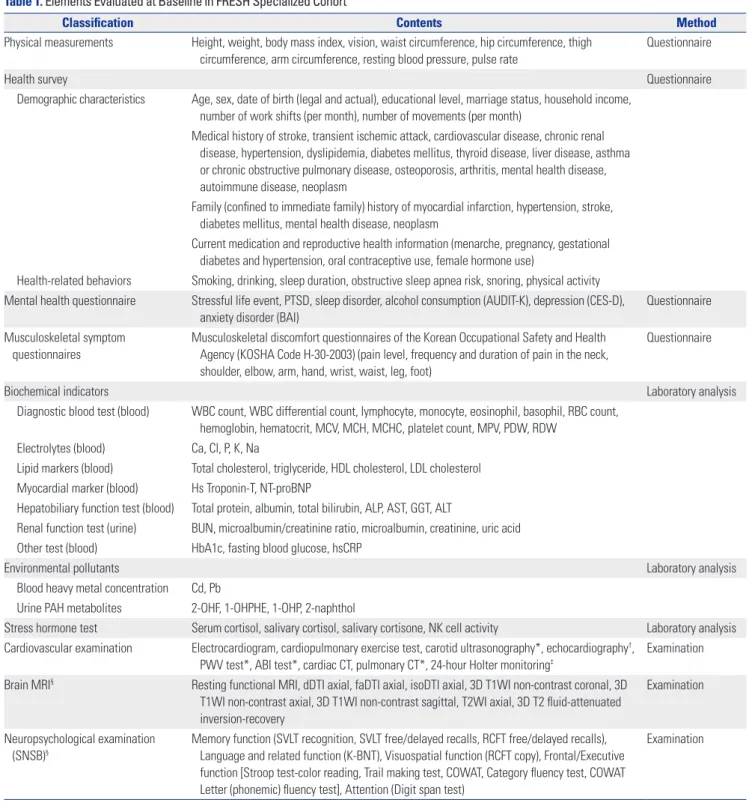
The topics and items in the questionnaires used in FRESH cohort are listed in Table 1. All participants were interviewed by trained nurses. Questionnaires at baseline covered infor- mation on anthropometric measures and medical history, and evaluated factors related to the participants’ occupational en- vironment, such as work shifts and experience of psychologi- cal trauma.
Musculoskeletal symptoms were surveyed using the Mus- culoskeletal Discomfort questionnaire of the Korean Occupa- tional Safety and Health Agency (KOSHA), which is based on the musculoskeletal symptom criteria established by the Na- tional Institute for Occupational Safety and Health in the Unit- ed States.21 Ocular surface disease index (OSDI) survey was used to assess dry eye symptoms.22 Currently, the regular health examination program performed by the NFA includes slit-lamp examination, fundus photography, ocular tonometry, and eye- sight test; therefore, considering the redundancy of the exami- nation, we only included xerophthalmia survey.23
To measure mental health status, we included question- naires on post-traumatic stress disorder (PTSD), sleep disor- der, depression, and anxiety disorder. PTSD was measured us- ing the PTSD Checklist-Specific (PCL-S).24,25 Sleep disorders were measured using the Pittsburgh Sleep Quality Index (PSQI), and depression was characterized by a shortened Center for Epidemiologic Studies Depression scale (CES-D).26,27 The Alco- hol Use Disorders Identification Test in Korea (AUDIT-K) was used to evaluate alcohol consumption; finally, the Beck Anxi- ety Inventory (BAI) was used to measure anxiety disorders as follows: severe anxiety (BAI score ≥32), moderate anxiety (27–
31), mild anxiety (22–26), and normal (0–21).28,29 The following blood indices were measured: biochemical indicators, diag- nostic blood test, electrolytes lipid markers, myocardial marker, hepatobiliary function test, renal function test, blood glucose- related test, and high-sensitivity C-reactive protein (hsCRP).
Firefighters are often exposed to various health hazards, es- pecially heavy metals and persistent organic pollutants. The concentrations of two heavy metals (lead, cadmium) and four polycyclic aromatic hydrocarbons (PAHs; 2-naphthol, 2-hy- droxyfluorene, 1-hydroxyphenanthrene, 1-hydroxypyrene) were measured in the blood and urine, respectively.
For stress-related hormone measurements, the level of se- rum cortisol, salivary cortisol, and cortisone were measured, and hair was collected to perform long-term stress hormone analysis. Natural killer (NK) cell activity was measured to ex- amine the relationship between immune function and stress.
Among the 1022 participants, 352 further underwent 3 Tesla (3T) brain magnetic resonance imaging (MRI), as firefighters are exposed to particulate matter and carbon monoxides and
Table 1. Elements Evaluated at Baseline in FRESH Specialized Cohort
Classification Contents Method
Physical measurements Height, weight, body mass index, vision, waist circumference, hip circumference, thigh circumference, arm circumference, resting blood pressure, pulse rate
Questionnaire
Health survey Questionnaire
Demographic characteristics Age, sex, date of birth (legal and actual), educational level, marriage status, household income, number of work shifts (per month), number of movements (per month)
Medical history of stroke, transient ischemic attack, cardiovascular disease, chronic renal disease, hypertension, dyslipidemia, diabetes mellitus, thyroid disease, liver disease, asthma or chronic obstructive pulmonary disease, osteoporosis, arthritis, mental health disease, autoimmune disease, neoplasm
Family (confined to immediate family) history of myocardial infarction, hypertension, stroke, diabetes mellitus, mental health disease, neoplasm
Current medication and reproductive health information (menarche, pregnancy, gestational diabetes and hypertension, oral contraceptive use, female hormone use)
Health-related behaviors Smoking, drinking, sleep duration, obstructive sleep apnea risk, snoring, physical activity Mental health questionnaire Stressful life event, PTSD, sleep disorder, alcohol consumption (AUDIT-K), depression (CES-D),
anxiety disorder (BAI)
Questionnaire Musculoskeletal symptom
questionnaires
Musculoskeletal discomfort questionnaires of the Korean Occupational Safety and Health Agency (KOSHA Code H-30-2003) (pain level, frequency and duration of pain in the neck, shoulder, elbow, arm, hand, wrist, waist, leg, foot)
Questionnaire
Biochemical indicators Laboratory analysis
Diagnostic blood test (blood) WBC count, WBC differential count, lymphocyte, monocyte, eosinophil, basophil, RBC count, hemoglobin, hematocrit, MCV, MCH, MCHC, platelet count, MPV, PDW, RDW
Electrolytes (blood) Ca, Cl, P, K, Na
Lipid markers (blood) Total cholesterol, triglyceride, HDL cholesterol, LDL cholesterol Myocardial marker (blood) Hs Troponin-T, NT-proBNP
Hepatobiliary function test (blood) Total protein, albumin, total bilirubin, ALP, AST, GGT, ALT
Renal function test (urine) BUN, microalbumin/creatinine ratio, microalbumin, creatinine, uric acid Other test (blood) HbA1c, fasting blood glucose, hsCRP
Environmental pollutants Laboratory analysis
Blood heavy metal concentration Cd, Pb
Urine PAH metabolites 2-OHF, 1-OHPHE, 1-OHP, 2-naphthol
Stress hormone test Serum cortisol, salivary cortisol, salivary cortisone, NK cell activity Laboratory analysis Cardiovascular examination Electrocardiogram, cardiopulmonary exercise test, carotid ultrasonography*, echocardiography†,
PWV test*, ABI test*, cardiac CT, pulmonary CT*, 24-hour Holter monitoring‡
Examination Brain MRI§ Resting functional MRI, dDTI axial, faDTI axial, isoDTI axial, 3D T1WI non-contrast coronal, 3D
T1WI non-contrast axial, 3D T1WI non-contrast sagittal, T2WI axial, 3D T2 fluid-attenuated inversion-recovery
Examination
Neuropsychological examination (SNSB)§
Memory function (SVLT recognition, SVLT free/delayed recalls, RCFT free/delayed recalls), Language and related function (K-BNT), Visuospatial function (RCFT copy), Frontal/Executive function [Stroop test-color reading, Trail making test, COWAT, Category fluency test, COWAT Letter (phonemic) fluency test], Attention (Digit span test)
Examination
FRESH, Firefighter Research on the Enhancement of Safety and Health; PTSD, post-traumatic stress disorder; AUDIT-K, Alcohol Use Disorders Identification Test in Korea; CES-D, Center for Epidemiologic Studies Depression scale; BAI, Beck Anxiety Inventory; WBC, white blood cell; RBC, red blood cell; MCV, mean corpuscu- lar volume; MCH, mean corpuscular hemoglobin; MCHC, mean corpuscular hemoglobin concentration; MPV, mean platelet volume; PDW, platelet distribution width, RDW, red cell distribution width; Ca, Calcium; Cl, chloride; P, phosphorus; K, potassium; Na, sodium; HDL, high-density lipoprotein; LDL, low-density lipo- protein; NT-proBNP, N-terminal-pro-brain natriuretic peptide; ALP, alkaline phosphatase; AST, aminotransferase; GGT, γ-glutamyl transferase; ALT, alanine ami- notransferase; BUN, blood urea nitrogen; hsCRP, high-sensitivity C-reactive protein; Cd, Cadmium; Pb, lead; PAH, polycyclic aromatic hydrocarbon; 2-OHF, 2-hydroxyfluorene;1-OHPHE, 1-hydroxyphenanthrene; 1-OHP, 1-hydroxypyrene; NK cell, natural killer cell; PWV, pulse wave velocity; ABI, ankle brachial index;
SNSB, Seoul Neuropsychological Screening Battery; SVLT, Seoul Verbal Leaning Test; RCFT, Ray Complex Figure Test; K-BNT, Korean-Boston Naming Test; COW- AT, Controlled Oral Word Association Test.
*Conducted at Severance Hospital and Gyeongsang National University Hospital; †Conducted at Severance Hospital; ‡Applicants Only; §Approximately 350 par- ticipants aged >40 years or fire service academy students, applicants only.
are at risk of mild traumatizing brain injury; these could result in structural and functional abnormalities in the brain. The brain MRI protocols included the following: dTI axial, faDTI axial, isoDTI axial, 3D T1WI non-contrast coronal, 3D T1WI non-contrast axial, 3D T1WI non-contrast sagittal, T2WI axial, resting functional MRI, and 3D T2 fluid-attenuated inversion- recovery. All three hospitals used the same brain MRI proto- cols. Brain volume and cortical thickness were estimated using Inbrain® software (https://www.inbrain.co.kr/).30-33 While brain MRI can identify structural changes, neuropsychological exam- inations are required to identify functional abnormalities. Neu- ropsychological examinations not only indicate abnormalities in the functional areas of the brain, but also compare them to the average level. Participants undergoing brain MRI underwent neuropsychological testing using the Seoul Neuropsychologi- cal Screening Battery (SNSB).34
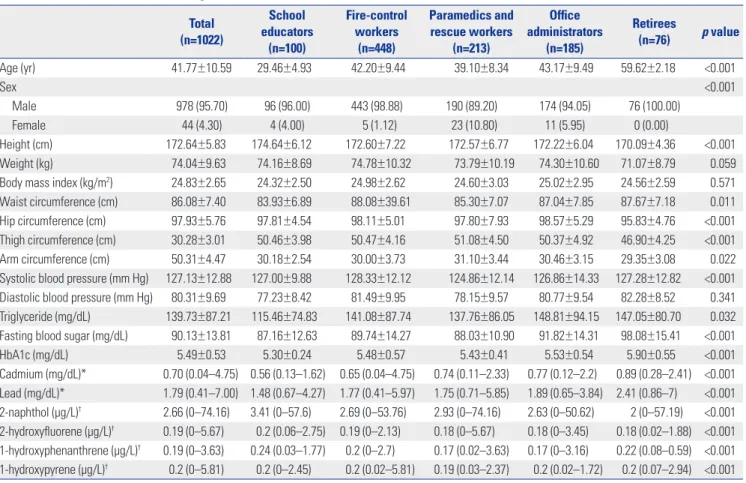
Baseline characteristics are shown in Tables 2 and 3. Distri- bution and statistical significance of the variables by duty were verified, while assuming that work environment could vary greatly depending on the duty, and that the duty would have a significant effect on cardiovascular and mental health.
Systolic blood pressure was the lowest in paramedics and res-
cue workers, and the highest in fire-control workers (p<0.001).
The proportion of participants with high-risk PTSD was 111 (10.86%). Among firefighters, the proportion of participants with high-risk PTSD (14.08%) was the highest among para- medics and rescue workers. The risk of severe depression, ac- cording to CES-D test, was the highest in retiree group. Severe anxiety was identified in eight participants (0.78%). PSQI tests showed that 486 out of 1022 participants had normal sleep quality (47.55%), whereas 536 had poor sleep quality (52.45%).
SNSB test was performed in 350 participants, which included 16 fire service academy students, 177 fire-control workers, 62 paramedics and rescue workers, 59 office administrators, and 36 retirees.
Of the 352 brain MRI tests, 255 showed negative findings in brain. Thirteen and 11 subjects showed old infarct lesions and small vessel disease, respectively, while no participant showed acute cerebral infarction or hemorrhagic lesions. Twelve par- ticipants with neoplastic lesions had benign tumors, and no malignant tumor was observed. In addition, 60, two, and four subjects showed nonspecific blight object, atrophic changes, and normal variants (mastoid effusion, cavum septum pellu- cidum, cavum vergae), respectively.
Table 2. General Characteristics of Firefighters in FRESH Cohort at Baseline Total
(n=1022)
School educators
(n=100)
Fire-control workers
(n=448)
Paramedics and rescue workers
(n=213)
Office administrators
(n=185)
Retirees
(n=76) p value
Age (yr) 41.77±10.59 29.46±4.93 42.20±9.44 39.10±8.34 43.17±9.49 59.62±2.18 <0.001
Sex <0.001
Male 978 (95.70) 96 (96.00) 443 (98.88) 190 (89.20) 174 (94.05) 76 (100.00)
Female 44 (4.30) 4 (4.00) 5 (1.12) 23 (10.80) 11 (5.95) 0 (0.00)��
Height (cm) 172.64±5.83 174.64±6.12 172.60±7.22 172.57±6.77 172.22±6.04 170.09±4.36 <0.001
Weight (kg) 74.04±9.63 74.16±8.69 74.78±10.32 73.79±10.19 74.30±10.60 71.07±8.79 0.059
Body mass index (kg/m2) 24.83±2.65 24.32±2.50 24.98±2.62 24.60±3.03 25.02±2.95 24.56±2.59 0.571
Waist circumference (cm) 86.08±7.40 83.93±6.89 88.08±39.61 85.30±7.07 87.04±7.85 87.67±7.18 0.011
Hip circumference (cm) 97.93±5.76 97.81±4.54 98.11±5.01 97.80±7.93 98.57±5.29 95.83±4.76 <0.001
Thigh circumference (cm) 30.28±3.01 50.46±3.98 50.47±4.16 51.08±4.50 50.37±4.92 46.90±4.25 <0.001
Arm circumference (cm) 50.31±4.47 30.18±2.54 30.00±3.73 31.10±3.44 30.46±3.15 29.35±3.08 0.022
Systolic blood pressure (mm Hg) 127.13±12.88 127.00±9.88 128.33±12.12 124.86±12.14 126.86±14.33 127.28±12.82 <0.001 Diastolic blood pressure (mm Hg) 80.31±9.69 77.23±8.42 81.49±9.95 78.15±9.57 80.77±9.54 82.28±8.52 0.341 Triglyceride (mg/dL) 139.73±87.21 115.46±74.83 141.08±87.74 137.76±86.05 148.81±94.15 147.05±80.70 0.032 Fasting blood sugar (mg/dL) 90.13±13.81 87.16±12.63 89.74±14.27 88.03±10.90 91.82±14.31 98.08±15.41 <0.001
HbA1c (mg/dL) 5.49±0.53 5.30±0.24 5.48±0.57 5.43±0.41 5.53±0.54 5.90±0.55 <0.001
Cadmium (mg/dL)* 0.70 (0.04–4.75) 0.56 (0.13–1.62) 0.65 (0.04–4.75) 0.74 (0.11–2.33) 0.77 (0.12–2.2) 0.89 (0.28–2.41) <0.001 Lead (mg/dL)* 1.79 (0.41–7.00) 1.48 (0.67–4.27) 1.77 (0.41–5.97) 1.75 (0.71–5.85) 1.89 (0.65–3.84) 2.41 (0.86–7) <0.001 2-naphthol (μg/L)† 2.66 (0–74.16) 3.41 (0–57.6) 2.69 (0–53.76) 2.93 (0–74.16) 2.63 (0–50.62) 2 (0–57.19) <0.001 2-hydroxyfluorene (μg/L)† 0.19 (0–5.67) 0.2 (0.06–2.75) 0.19 (0–2.13) 0.18 (0–5.67) 0.18 (0–3.45) 0.18 (0.02–1.88) <0.001 1-hydroxyphenanthrene (μg/L)† 0.19 (0–3.63) 0.24 (0.03–1.77) 0.2 (0–2.7) 0.17 (0.02–3.63) 0.17 (0–3.16) 0.22 (0.08–0.59) <0.001 1-hydroxypyrene (μg/L)† 0.2 (0–5.81) 0.2 (0–2.45) 0.2 (0.02–5.81) 0.19 (0.03–2.37) 0.2 (0.02–1.72) 0.2 (0.07–2.94) <0.001 FRESH, Firefighter Research on the Enhancement of Safety and Health.
Values are presented as mean±standard deviation or n (%) unless otherwise indicated.
*Kruskal-Wallis test was conducted; median (min-max) values are suggested instead of mean±standard deviation; †Measured as urinary concentration; median (min-max) values are suggested instead of mean±standard deviation.
FRESH cohort study was able to identify the risk and pro- tective factors for cardiovascular disease and mental disorders in more than 1000 Korean firefighters. In order to consider the exposure variations in occupational environments, we recruit- ed firefighters from three different regions in Korea. In addi- tion to different variables, exposure to heavy metals and PAHs can also be used to confirm the association of occupational ex- posure with cardiovascular and mental disorders. Although firefighters are part of an occupational group that is vulnerable to a wide variety of mental health hazards and toxic substances, previous studies have only examined the association between mental disorders, such as anxiety disorders and PTSD, and the results of questionnaire surveys.23,24 Since 3T brain MRI and neuropsychological tests were performed in this study, it was possible to identify both functional and structural changes in the brain.
FRESH cohort offered several advantages. This was the first study to investigate cardiovascular disease and cognitive func- tion of firefighters in Korea. While previous cohort studies on firefighters were mainly retrospective studies using secondary data, this study examined factors that affect cardiovascular dis- ease, mental disease, and cognitive dysfunction using various clinical tests as a prospective study. In addition, inspections were conducted for firefighters nationwide using standard- ized screening protocols. In the study design process, standard-
ization protocols were prepared and distributed to all research- ers, and standardization training was provided to the personnel who conducted the examinations to minimize measurement errors at different institutions.
Nevertheless, our research also had some limitations. First of all, selection bias may have resulted from only including subjects who applied for the study, rather than randomly se- lecting the participants. For example, people who are usually interested in health-related issues may have been more likely to participate in this study, which could lead to the healthy worker effect. In addition, some of the items that should be in- vestigated specifically for firefighters were not included in our questionnaire. For example, years of service and recent expo- sure to trauma can be important variables in analyzing the re- lationship between disease and work characteristics. To com- pensate for this, starting in 2018, when baseline participants began their first follow-up, we added questions about the date of entry, date of retirement (if leaving), and trauma experienced within the last 6 months.
FRESH study is available to those who are interested in col- laboration. FRESH research committee requests a short re- search proposal, including background information, research questions, methods, and authorship. FRESH research commit- tee is responsible for the distribution and control of data. Re- searchers who are interested in collaborative research can con- Table 3. Mental Health Status of Firefighters in FRESH Cohort at Baseline
Total (n=1022)
School educators
(n=100)
Fire-control workers
(n=448)
Paramedics and rescue workers
(n=213)
Office administrators
(n=185)
Retirees
(n=76) p value
PTSD <0.001
High risk (<11) 111 (10.86) 6 (6.00) 49 (10.94) 30 (14.08) 17 (9.19) 9 (11.84)
Low risk (≥11) 911 (89.14) 94 (94.00) 399 (89.06) 183 (85.92) 168 (90.81) 67 (88.16)
CES-D 0.188
Severe depression (≥23) 19 (1.86) 1 (1.00) 8 (1.79) 4 (1.88) 3 (1.62) 3 (3.95)
Moderate depression (19–22) 18 (1.76) 4 (4.00) 7 (1.56) 3 (1.41) 3 (1.62) 1 (1.32)
Mild depression (14–18) 35 (3.42) 2 (2.00) 17 (3.79) 7 (3.29) 8 (4.32) 1 (1.32)
Normal (0–13) 950 (92.96) 93 (93.00) 416 (92.86) 199 (93.42) 171 (92.44) 71 (93.41)
AUDIT-K <0.001
High alcohol dependence (≥26) 21 (2.05) 4 (4.00) 7 (1.56) 4 (1.88) 5 (2.70) 1 (1.32)
Probable alcohol dependence (15–25) 44 (4.31) 0 (0.00) 23 (5.13) 9 (4.23) 8 (4.32) 4 (5.26) Hazardous drinking (12–14) 257 (25.15) 26 (26.00) 118 (26.34) 42 (19.72) 52 (28.11) 19 (25.00)
Normal (0–11) 700 (68.49) 70 (70.00) 300 (66.97) 158 (74.17) 120 (64.87) 52 (68.42)
BAI 0.243
Severe anxiety disorder (≥32) 8 (0.78) 0 (0.00) 3 (0.67) 1 (0.47) 2 (1.08) 2 (2.63)
Moderate anxiety disorder (27–31) 11 (1.08) 1 (1.00) 4 (0.89) 1 (0.47) 3 (1.62) 2 (2.63)
Mild anxiety disorder (22–26) 20 (1.96) 4 (4.00) 7 (1.56) 3 (1.41) 4 (2.16) 2 (2.63)
Normal (0–21) 983 (96.18) 95 (95.00) 434 (96.88) 208 (97.65) 176 (95.14) 70 (92.11)
PSQI 0.002
Poor sleep quality (≥6) 536 (52.45) 50 (50.00) 241 (53.79) 113 (53.05) 104 (56.22) 28 (36.84)
Normal (<6) 486 (47.55) 50 (50.00) 207 (46.21) 100 (46.95) 81 (43.78) 48 (63.16)
FRESH, Firefighter Research on the Enhancement of Safety and Health; PTSD, post-traumatic stress disorder; CES-D, Center for Epidemiologic Studies Depres- sion scale; AUDIT-K, Alcohol Use Disorders Identification Test in Korea; BAI, Beck Anxiety Inventory; PSQI, Pittsburgh Sleep Quality Index.
tact the FRESH investigator at [email protected].
ACKNOWLEDGEMENTS
This research was supported by the Fire Fighting Safety & 119 Rescue Technology Research and Development Program fund- ed by the National Fire Agency (“MPSS-Fire Safety-2015-80”).
The funders had no role in the study design, data collection, analysis, decision to publish, or preparation of this manuscript.
AUTHOR CONTRIBUTIONS
Conceptualization: Yun Tae Kim, Woo Jin Kim, Jee Eun Choi, Mun-joo Bae, Heeseon Jang, Sungha Park, Chan Joo Lee, Seung Koo Lee, Hye- Jeong Lee, Dong Jin Im, Eun Seok Kang, Young-Chul Jung, Byoung Seok Ye, Sang Baek Koh, Sung Soo Oh, Ki Soo Park, Mi-Ji Kim, and Changsoo Kim. Data curation: Yun Tae Kim, Woo Jin Kim, Jee Eun Choi, Heeseon Jang, Sung Soo Oh, Mi-Ji Kim, Yeoju Jeong. Formal analysis: Yun Tae Kim and Woo Jin Kim. Funding acquisition: Ki Soo Park, Sang Baek Koh, and Changsoo Kim. Investigation: Woo Jin Kim, Sung Soo Oh, and Yeoju Jeong. Methodology: Yun Tae Kim and Woo Jin Kim. Project administration: Ki Soo Park, Sang Baek Koh, and Changsoo Kim. Resource: Ki Soo Park, Sang Baek Koh, and Changsoo Kim. Software: Yun Tae Kim. Supervision: Ki Soo Park, Sang Baek Koh, and Changsoo Kim. Validation: Woo Jin Kim. Visualization: Yun Tae Kim. Writing—original draft: Yun Tae Kim and Woo Jin Kim. Writ- ing—review & editing: Yun Tae Kim, Woo Jin Kim, and Changsoo Kim.
ORCID iDs
Yun Tae Kim https://orcid.org/0000-0001-5171-2962 Woo Jin Kim https://orcid.org/0000-0001-5520-4228 Jee Eun Choi https://orcid.org/0000-0001-8290-9522 Mun-joo Bae https://orcid.org/0000-0002-0242-9826 Heeseon Jang https://orcid.org/0000-0002-9737-7220 Chan Joo Lee https://orcid.org/0000-0002-8756-409X Hye-Jeong Lee https://orcid.org/0000-0003-4349-9174 Dong Jin Im https://orcid.org/0000-0001-8139-5646 Byoung Seok Ye https://orcid.org/0000-0003-0187-8440 Mi-Ji Kim https://orcid.org/0000-0002-8646-832X Yeoju Jeong https://orcid.org/0000-0002-6926-1124 Sung Soo Oh https://orcid.org/0000-0003-0801-3052 Young-Chul Jung https://orcid.org/0000-0002-0578-2510 Eun Seok Kang https://orcid.org/0000-0002-0364-4675 Sungha Park https://orcid.org/0000-0001-5362-478X Seung Koo Lee https://orcid.org/0000-0001-5646-4072 Ki Soo Park https://orcid.org/0000-0001-5571-3639 Sang Baek Koh https://orcid.org/0000-0001-5609-6521 Changsoo Kim https://orcid.org/0000-0002-5940-5649
REFERENCES
1. National Fire Agency (NFA). Statistical Yearbook (2018) [Internet].
Sejong: NFA; c2018 [accessed on 2019 August 22]. Avaliable at:
https://www.nfa.go.kr/nfa/releaseinformation/statisticalinfor- mation/main/?boardId=bbs_0000000000000019&mode=view&c ntId=16&category=&pageIdx=.
2. Brandt-Rauf PW, Fallon LF, Tarantini T, Idema C, Andrews L.
Health hazards of fire fighters: exposure assessment. J Occup En-
viron Med 1988;45:606-12.
3. Kim JM, Lee HJ. Hazards exposed to firefighters in fire-physical, chemical, and biologic factors. J Korean Med Assoc 2008;51:1072-7.
4. Kales SN, Soteriades ES, Christophi CA, Christiani DC. Emergen- cy duties and deaths from heart disease among firefighters in the United States. N Engl J Med 2007;356:1207-15.
5. Soteriades ES, Smith DL, Tsismenakis AJ, Baur DM, Kales SN. Car- diovascular disease in US firefighters: a systematic review. Cardiol Rev 2011;19:202-15.
6. Li K, Lipsey T, Leach HJ, Nelson TL. Cardiac health and fitness of Colorado male/female firefighters. Occup Med (Lond) 2017;67:
268-73.
7. Dobson M, Choi B, Schnall PL, Wigger E, Garcia-Rivas J, Israel L, et al. Exploring occupational and health behavioral causes of fire- fighter obesity: a qualitative study. Am J Ind Med 2013;56:776-90.
8. Daniels RD, Kubale TL, Yiin JH, Dahm MM, Hales TR, Baris D, et al. Mortality and cancer incidence in a pooled cohort of US fire- fighters from San Francisco, Chicago and Philadelphia (1950- 2009). Occup Environ Med 2014;71:388-97.
9. Pukkala E, Martinsen JI, Weiderpass E, Kjaerheim K, Lynge E, Tryg- gvadottir L, et al. Cancer incidence among firefighters: 45 years of follow-up in five Nordic countries. Occup Environ Med 2014;71:
398-404.
10. Airila A, Hakanen JJ, Luukkonen R, Lusa S, Punakallio A, Leino- Arjas P. Developmental trajectories of multisite musculoskeletal pain and depressive symptoms-the effects of job demands and re- sources and individual factors. Psychol Health 2014;29:1421-41 11. Lusa S, Miranda H, Luukkonen R, Punakallio A. Sleep disturbanc-
es predict long-term changes in low back pain among Finnish fire- fighters: 13-year follow-up study. Int Arch Occup Environ Health 2015;88:369-79.
12. Punakallio A, Lusa S, Luukkonen R, Airila A, Leino-Arjas P. Mus- culoskeletal pain and depressive symptoms as predictors of tra- jectories in work ability among finnish firefighters at 13-year fol- low-up. J Occup Environ Med 2014;56:367-75.
13. Lourel M, Abdellaoui S, Chevaleyre S, Paltrier M, Gana K. Relation- ships between psychological job demands, job control and burn- out among firefighters. N Am J Psychol 2008;10:489-96.
14. Ângelo RP, Chambel MJ. The reciprocal relationship between work characteristics and employee burnout and engagement: a longitudinal study of firefighters. Stress Health 2015;31:106-14.
15. Morren M, Yzermans CJ, van Nispen RM, Wevers SJ. The health of volunteer firefighters three years after a technological disaster. J Occup Health 2005;47:523-32.
16. Huynh JY, Xanthopoulou D, Winefield AH. Social support moder- ates the impact of demands on burnout and organizational con- nectedness: a two-wave study of volunteer firefighters. J Occup Health Psychol 2013;18:9-15.
17. Schermer TR, Malbon W, Adams R, Morgan M, Smith M, Crockett AJ. Change in lung function over time in male metropolitan fire- fighters and general population controls: a 3-year follow-up study.
J Occup Health 2013;55:267-75.
18. Ahn YS, Jeong KS, Kim KS. Cancer morbidity of professional emer- gency responders in Korea. Am J Ind Med 2012;55:768-78.
19. Kim HD, An YS, Kim DH, Jeong KS, Ahn YS. An overview of com- pensated work-related injuries among Korean firefighters from 2010 to 2015. Ann Occup Environ Med 2018;30:57.
20. Kim YK, Ahn YS, Kim K, Yoon JH, Roh J. Association between job stress and occupational injuries among Korean firefighters: a na- tionwide cross-sectional study. BMJ Open 2016;6:e012002.
21. Lee DK, Kim JH. A study on the prevention system of musculo- skeletal disorders in Korea and other countries. J Ergon Soc Korea 2010;29:423-33.
22. Schiffman RM, Christianson MD, Jacobsen G, Hirsch JD, Reis BL.
Reliability and validity of the ocular surface disease index. Arch Ophthalmol 2000;118:615-21.
23. National Fire Agency (NFA). Regulations for the health and safety management of fire officials national safety and control ordi- nance. No. 1 Annex 4 (2015) [Internet]. Sejong: NFA; c2015 [ac- cessed on 2019 August 22]. Avaliable at: http://law.go.kr/LSW/
admRulLsInfoP.do?admRulSeq=2100000013941.
24. Wilkins KC, Lang AJ, Norman SB. Synthesis of the psychometric properties of the PTSD checklist (PCL) military, civilian, and spe- cific versions. Depress Anxiety 2011;28:596-606.
25. Blanchard EB, Jones-Alexander J, Buckley TC, Forneris CA. Psy- chometric properties of the PTSD Checklist (PCL). Behav Res Ther 1996;34:669-73.
26. Buysse DJ, Reynolds CF 3rd, Monk TH, Berman SR, Kupfer DJ. The Pittsburgh Sleep Quality Index: a new instrument for psychiatric practice and research. Psychiatry Res 1989;28:193-213.
27. Radloff LS. The CES-D scale: a self-report depression scale for re- search in the general population. Appl Psychol Meas 1977;1:385- 401.
28. Beck AT, Epstein N, Brown G, Steer RA. An inventory for measur- ing clinical anxiety: psychometric properties. J Consult Clin Psy-
chol 1988;56:893-7.
29. Saunders JB, Aasland OG, Babor TF, de la Fuente JR, Grant M.
Development of the alcohol use disorders identification test (AU- DIT): WHO collaborative project on early detection of persons with harmful alcohol consumption--II. Addiction 1993;88:791-804.
30. Lee JS, Kim C, Shin JH, Cho H, Shin DS, Kim N, et al. Machine learning-based individual assessment of cortical atrophy pattern in Alzheimer’s disease spectrum: development of the classifier and longitudinal evaluation. Sci Rep 2018;8:4161.
31. Zhu J, Jin Y, Wang K, Zhou Y, Feng Y, Yu M, et al. Frequency-depen- dent changes in the regional amplitude and synchronization of resting-state functional MRI in stroke. PloS One 2015;10:e0123850.
32. Zou QH, Zhu CZ, Yang Y, Zuo XN, Long XY, Cao QJ, et al. An im- proved approach to detection of amplitude of low-frequency fluc- tuation (ALFF) for resting-state fMRI: fractional ALFF. J Neurosci Methods 2008;172:137-41.
33. Zuo XN, Di Martino A, Kelly C, Shehzad ZE, Gee DG, Klein DF, et al. The oscillating brain: complex and reliable. Neuroimage 2010;
49:1432-45.
34. Jahng SM, Na DL, Kang YW. Constructing a composite score for the Seoul neuropsychological screening battery-core. Dement Neuro- cogn Disord 2015;14:137-42.