1)
서 론
제왕절개(cesarean section)에 의한 분만이 천식 발생 의 증가에 기여한다는 연구들이 있어 왔다.1,2)그리고 분만 방법(mode of delivery)은 소아에서 천식 이외에 알레르 기비염 아토피피부염 그리고 알레르겐 감작 등 다른 알레르,
접수 :2011년12월20 ,일 승인:2011년12월22일 책임저자 : 김봉성 강원도 강릉시 사천면 방동길, 38-1 울산대학교 의과대학 강릉아산병원 소아청소년과 Tel : 033)610-3166, Fax: 033)641-8148 E-mail : [email protected]
기 질환의 발생에도 영향을 줄 수 있다는 보고가 있다.3,4) 천식을 비롯한 알레르기 질환의 유병률은 우리나라를 비롯 하여 대부분의 산업화된 나라들에서 지난 수십 년 동안 극 적으로 증가하여 왔다.5)이와 비슷한 추세로 제왕절개의 빈 도 역시 대부분의 산업화된 나라들과 일부 개발도상국에서 증가하는 추세를 보이고 있다 특히 남미의 일부 국가에서는.
를 상회하는 제왕절개 빈도를 보이고 있다
50% .6,7)하지만
년대만 하더라도 대부분의 국가에서는 세계보건기구 1970
가 권장하는 수준인 미 (World Health Organization) 15%
만이었다.8) 미국의 경우1996년20.7%였던 제왕절개의
분만 방법이 소아 천식의 발생에 영향을 미칠 수 있는가?
울산대학교 의과대학 강릉아산병원 소아청소년과
김 봉 성
Is Mode of Delivery Associated with an Increased Risk for Childhood Asthma?
Bong-Seong Kim, MD, PhD
Department of Pediatrics, Gangneung Asan Hospital, University of Ulsan College of Medicine, Gangneung, Korea
Under the hygiene hypothesis, children born by cesarean section (CS) may consequently have an increased risk of asthma and other allergic diseases. CS has been shown to have a delayed and altered development in establishment of gut flora and altered cytokine production. Concerns about the relations between CS and the risk of children's asthma are rising due to the growing number of CS performed in many countries. However, finding the concrete evidence to correlate CS with higher risk of asthma is still controversial. There were significant covariate imbalance between groups of children born by CS vs. vaginal delivery that include the number of maternal age, gestational age, birth weight, complication during pregnancy, complication during labor, socio- economic status, a parental history of atopy, and maternal smoking history. And there were consi- derable heterogeneity in methods and study subjects between the studies of delivery by CS and the offspring's risk of asthma and other allergic diseases. Therefore, as we proceed into the further study, researchers must refer to the literatures and look for the best way proving their hypothesis that are based on the methodological subject group. Of which should be accordance with the research purposes. Also, researchers have to search for identifying the core biological mechanism in order to know whether there is a causal relationship exists between the CS and asthma. [Pediatr Allergy Respir Dis(Korea) 2011;21:250-260]
Key Words : Mode of delivery, Cesarean section, Vaginal delivery, Asthma, Allergic disease,
Risk factors
비율이 큰 폭으로 증가하여2006년 전체 분만 중31.1%에 서 제왕절개로 분만이 이루어졌다.9)우리나라의 경우에도
년 제왕절개분만율이 였던 것이 년
1990 13.3% 2001 40.5
로 증가하였고 이후 소폭으로 감소하여 년
% 2010 36.0%
수준을 보이고 있다.10)
위생가설(hygiene hypothesis)은 신생아 시기의 면역 계가Th2림프구가 활성화된 방향으로 편위되어 있으나 출 생 이후 미생물과 접촉하면서Th1/Th2균형 상태로 회복 된다고 설명한다.11)질식분만(vaginal delivery)이 이루어 지는 동안 모체의 산도와 장관의 세균총이 신생아의 장내 균 집락 시작의 주요한 공급원이 되는 것으로 여겨지고 있 다 반면에 제왕절개분만에서는 모체의 세균총과 직접적인. 접촉이 이루어지지 않아 주변환경의 세균총이 신생아의 장 내 균 집락의 주요한 공급원이 된다.12)
알레르기 질환 유병률의 증가가 이루어진 기간과 비슷한 시기에 제왕절개분만의 비율이 증가하였고 분만 방법에 따 라 신생아 장관 내 균 집락 상태가 변화하면서 면역계 발달 과정에 영향을 줄 가능성이 있기에 그동안 여러 연구자들에 의해 역학적 관련성이 연구되어 왔고 일부 연구자들에 의해 구체적인 면역기전을 밝혀 인과관계를 증명하려는 시도가 있어 왔다.1-4,12-37)하지만 지금까지 이루어진 역학연구들에 서 제왕절개분만과 천식 혹은 다른 알레르기 질환과의 관련 성을 보인 경우도 있었지만 관련성을 보이지 않은 연구들도 있어 논란의 여지가 있다 천식을 비롯한 알레르기 질환은. 잘 알려진 대로 다인자성 질환으로 분만 방법이라는 하나의 가능성 있는 요인이 질환 발생에 얼마만큼 영향을 미칠 수 있는지 확인하기 어려운 측면이 있다 하지만 이전 연구들의. 대상군과 방법 그리고 결론에 도달하는 과정을 고찰하여 각 연구의 의미를 파악한다면 앞으로 연구방향을 설정하는 데 도움이 될 수 있을 것이다.
관련된 연구들의 결과
제왕절개분만과 천식 및 알레르기 질환 발생 위험도의 관련성에 대한 연구는 최근 수년 간 증가하는 추세이다.1,2,4,
13-21,23-45)
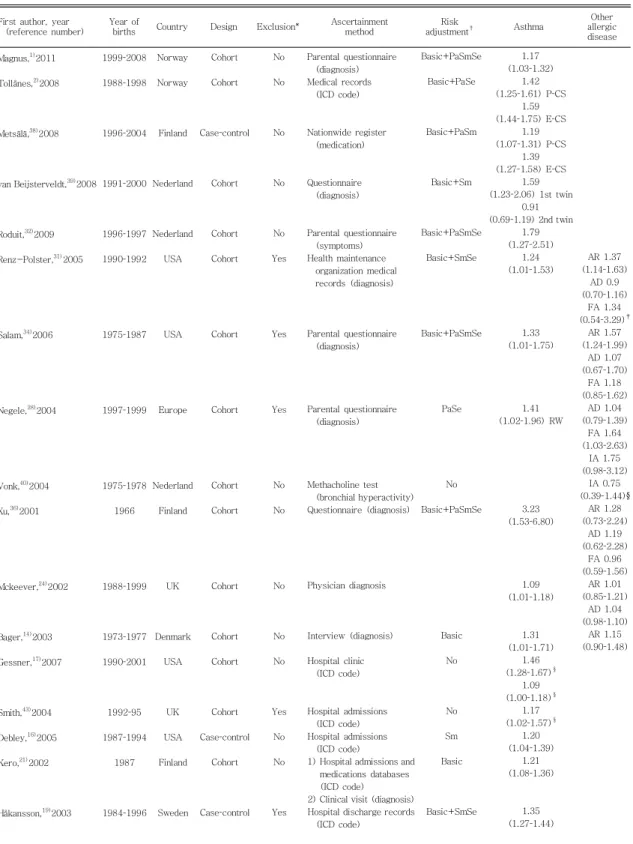
이제까지 많은 연구들에서 제왕절개분만과 천식 및 알레르기 질환 발생의 위험도가 관련이 있었다.(Table 하지만 적지 않은 수의 연구에서는 유의한 관련성이 없 1)
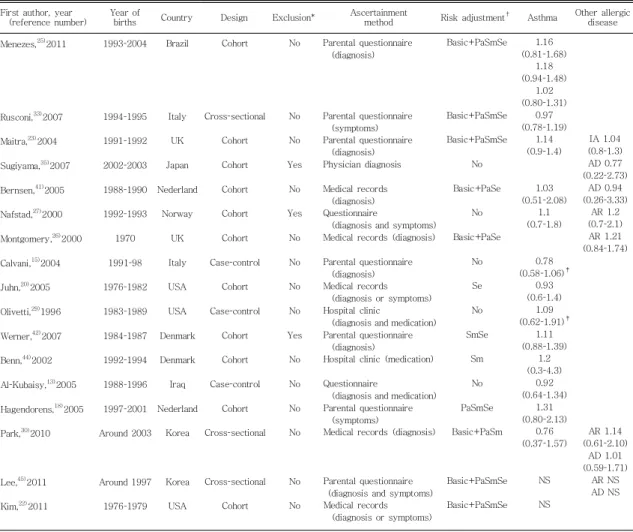
어 논란의 여지가 있다.(Table 2)
년 제왕절개분만과 천식 및 알레르기 질환 발생의 2008
위험도의 관련성에 관한 연구를 정리한 개의 메타분석이2
있었다.46,47)제왕절개와 천식의 관련성에 대한23개의 연
구들을 바탕으로 시행한 메타분석의 경우 분만 방법과 천식, 의 상관관계 분석에서 제왕절개분만군의 천식 발병 교차비 는 였다 하지만 이 메타분석에 포함 (odds ratio, OR) 1.22 .
된 각각의 연구들 간에는 통계적으로 의미 있는 수준의 이 질성(heterogeneity)을 보였다. 18세 미만의 소아를 대상 으로 시행한 연구로 범위를 축소하였을 때 이질성의 정도가 유의하게 줄었고 제왕절개분만군이 질식분만군과 비교하, 여 알레르기 질환 발병의 위험도가20%증가한다고 보고하 였다.46)또 다른 메타분석 연구에는26개의 연구가 포함되 었고 제왕절개에 의한 분만과 식품 알레르기 흡입 알레르기, 겐에 대한 감작 아토피피부염 알레르기비염 천식과 천식, , , 으로 인한 입원과의 관련성을 조사하였다.47)이 연구에 의 하면 제왕절개분만군에서 알레르기비염 발병은, 1.23,천식 은1.18,그리고 천식으로 인한 입원과의 교차비는1.21로 제왕절개분만군에서 알레르기 질환의 위험이 증가한다고 보고하였다 그러나 식품 알레르기나 아토피피부염 발생과. 는 상관관계를 보이지 않았고 흡입 알레르겐에 대한 감작도, 증가하지 않는다고 보고하였다 그리고 이 연구에서 관련성. 을 보인 알레르기 질환의 경우에도 제왕절개의 일반인구 기 여위험도(population attributable risk, PAR)가1-4%로 낮았다 즉 질환 발생의 증가에서. 1-4%정도에서만 제왕절 개분만의 영향을 받는 것으로 제왕절개분만율의 증가가 알 레르기 질환 발생의 증가에 큰 영향을 미치지는 않았을 것 으로 추정하여 두 메타분석이 조금은 다른 결론을 제시하였 다.
메타분석 이후에도 제왕절개분만과 알레르기 질환 위험 도의 관련성에 관한 여러 연구가 계속 발표되고 있다 최근. 발표된 노르웨이 모자코호트 연구(Norwegian Mother 에서는 제왕절개에 의한 and Child [MoBa] Cohort Study)
분만이 생후36개월경의 천명 천식 그리고 재발성 하부기, 도감염(recurrent lower respiratory tract infections)에 어떤 영향을 미치는지 연구하였다.1)이 연구에서는 제왕절 개분만군과 질식분만군간에 다양한 혼란변수(confounding 를 교정하였다 그 결과 제왕절개분만군의 현증 천
factor) .
식에 대한 교차비가1.17이었고, 특히 알레르기 질환이 없 는 산모의 경우 제왕절개분만군의 현증 천식에 대한 교차비 가1.33으로 보다 높은 관련성을 보였다 하지만 단순 천명. 이나 재발성 하부기도감염의 경우는 관련성이 없었다 그리. 고 이런 결과는 제왕절개를 응급으로 시행한 군(emergen-
과 선택적으로 시행한 군 사이에 유의
cy CS) (planned CS)
한 차이를 보이지 않았다 하지만 연구자들은 연구의 결과변. 수(outcome variable)들이 여러 혼란변수의 영향을 크게
Table 1. Characteristics and Relative Risks of Selected Studies which Showed Cesarean Section is Associated with an Increased Risk for Asthma and Other Allergic Diseases46,47)
First author, year (reference number)
Year of
births Country Design Exclusion* Ascertainment method
Risk
adjustment† Asthma Other
allergic disease Magnus,1)2011
Tollånes,2)2008
Metsälä,38)2008
van Beijsterveldt,39)2008
Roduit,32)2009 Renz-Polster,31)2005
Salam,34)2006
Negele,28)2004
Vonk,40)2004 Xu,36)2001
Mckeever,24)2002
Bager,14)2003 Gessner,17)2007
Smith,43)2004 Debley,16)2005 Kero,21)2002
Håkansson,19)2003
1999-2008 1988-1998
1996-2004
1991-2000
1996-1997 1990-1992
1975-1987
1997-1999
1975-1978 1966
1988-1999
1973-1977 1990-2001
1992-95 1987-1994
1987
1984-1996 Norway Norway
Finland
Nederland
Nederland USA
USA
Europe
Nederland Finland
UK
Denmark USA
UK USA Finland
Sweden Cohort Cohort
Case-control
Cohort
Cohort Cohort
Cohort
Cohort
Cohort Cohort
Cohort
Cohort Cohort
Cohort Case-control
Cohort
Case-control No No
No
No
No Yes
Yes
Yes
No No
No
No No
Yes No No
Yes
Parental questionnaire (diagnosis) Medical records
(ICD code)
Nationwide register (medication)
Questionnaire (diagnosis)
Parental questionnaire (symptoms) Health maintenance
organization medical records (diagnosis)
Parental questionnaire (diagnosis)
Parental questionnaire (diagnosis)
Methacholine test (bronchial hyperactivity) Questionnaire (diagnosis)
Physician diagnosis
Interview (diagnosis)
Hospital clinic (ICD code)
Hospital admissions (ICD code) Hospital admissions
(ICD code)
1) Hospital admissions and medications databases (ICD code) 2) Clinical visit (diagnosis) Hospital discharge records
(ICD code)
Basic+PaSmSe Basic+PaSe
Basic+PaSm
Basic+Sm
Basic+PaSmSe Basic+SmSe
Basic+PaSmSe
PaSe
No Basic+PaSmSe
Basic No
No Sm Basic
Basic+SmSe
1.17 (1.03-1.32)
1.42 (1.25-1.61) P-CS
1.59 (1.44-1.75) E-CS
1.19 (1.07-1.31) P-CS
1.39 (1.27-1.58) E-CS
1.59 (1.23-2.06) 1st twin
0.91 (0.69-1.19) 2nd twin
1.79 (1.27-2.51)
1.24 (1.01-1.53)
1.33 (1.01-1.75)
1.41 (1.02-1.96) RW
3.23 (1.53-6.80)
1.09 (1.01-1.18)
1.31 (1.01-1.71)
1.46 (1.28-1.67)§
1.09 (1.00-1.18)§
1.17 (1.02-1.57)§
1.20 (1.04-1.39)
1.21 (1.08-1.36)
1.35 (1.27-1.44)
AR 1.37 (1.14-1.63)
AD 0.9 (0.70-1.16)
FA 1.34 (0.54-3.29)‡
AR 1.57 (1.24-1.99)
AD 1.07 (0.67-1.70)
FA 1.18 (0.85-1.62)
AD 1.04 (0.79-1.39)
FA 1.64 (1.03-2.63)
IA 1.75 (0.98-3.12)
IA 0.75 (0.39-1.44)§
AR 1.28 (0.73-2.24)
AD 1.19 (0.62-2.28)
FA 0.96 (0.59-1.56)
AR 1.01 (0.85-1.21)
AD 1.04 (0.98-1.10)
AR 1.15 (0.90-1.48)
Table 1. Characteristics and Relative Risks of Selected Studies which Showed Cesarean Section is Associated with an Increased Risk for Asthma and Other Allergic Diseases46,47)(Continue)
First author, year (reference number)
Year of
births Country Design Exclusion* Ascertainment method
Risk
adjustment† Asthma
Other allergic disease Annesi-Maesano,4)2001
Xu,37)2000
1958 1985-1986
UK Finland
Cohort Cohort
No No
Questionnaire (symptoms) Parental questionnaire
(diagnosis)
Basic+PaSm Basic+Pa
1.46 (1.02-2.07)§E-CS
1.38 (1.00-1.92)
FA, food allergy; IA, inhalant allergen sensitization; AD, eczema/atopic dermatitis; AR, allergic rhinitis; NS, not significant; E-CS, emergency cesarean section;
P-CS, planned cesarean section.
*Exclusion of preterm delivery ( 37 weeks) or low birth weight ( 2,500 g).˂ ˂ †Basic: Maternal age, prematurity (gestational age or birth weight), parity and birth order. Pa, parental allergy; Sm, smoking in pregnancy or ETS perinatal period; Se, socioeconomic status (household income, parental education, or social class).‡Not adjusted.§Odds ratios or incidence rate ratios, and 95% confidence intervals were not presented in the article, but calculated for the previous study47)based on numbers of cases and controls extracted from the article.
Table 2. Characteristics and Relative Risks of Selected Studies which Showed Cesarean Section is Not Associated with an Increased Risk for Asthma and Other Allergic Diseases46,47)
First author, year
(reference number) Year of
births Country Design Exclusion* Ascertainment
method Risk adjustment† Asthma Other allergic disease Menezes,25)2011
Rusconi,33)2007 Maitra,23)2004 Sugiyama,35)2007 Bernsen,41)2005 Nafstad,27)2000 Montgomery,26)2000 Calvani,15)2004 Juhn,20)2005 Olivetti,29)1996 Werner,42)2007 Benn,44)2002 Al-Kubaisy,13)2005 Hagendorens,18)2005 Park,30)2010
Lee,45)2011 Kim,22)2011
1993-2004
1994-1995 1991-1992 2002-2003 1988-1990 1992-1993 1970 1991-98 1976-1982 1983-1989 1984-1987 1992-1994 1988-1996 1997-2001 Around 2003
Around 1997 1976-1979
Brazil
Italy UK Japan Nederland
Norway UK Italy USA USA Denmark Denmark Iraq Nederland
Korea
Korea USA
Cohort
Cross-sectional Cohort Cohort Cohort Cohort Cohort Case-control
Cohort Case-control
Cohort Cohort Case-control
Cohort Cross-sectional
Cross-sectional Cohort
No
No No Yes No Yes No No No No Yes No No No No
No No
Parental questionnaire (diagnosis)
Parental questionnaire (symptoms) Parental questionnaire
(diagnosis) Physician diagnosis
Medical records (diagnosis) Questionnaire
(diagnosis and symptoms) Medical records (diagnosis)
Parental questionnaire (diagnosis) Medical records
(diagnosis or symptoms) Hospital clinic
(diagnosis and medication) Parental questionnaire
(diagnosis)
Hospital clinic (medication)
Questionnaire
(diagnosis and medication) Parental questionnaire
(symptoms)
Medical records (diagnosis)
Parental questionnaire (diagnosis and symptoms) Medical records
(diagnosis or symptoms)
Basic+PaSmSe
Basic+PaSmSe Basic+PaSmSe
No Basic+PaSe
No Basic+PaSe
No Se No SmSe
Sm No PaSmSe Basic+PaSm
Basic+PaSmSe Basic+PaSmSe
1.16 (0.81-1.68)
1.18 (0.94-1.48)
1.02 (0.80-1.31)
0.97 (0.78-1.19)
1.14 (0.9-1.4)
1.03 (0.51-2.08)
1.1 (0.7-1.8)
0.78 (0.58-1.06)‡
0.93 (0.6-1.4)
1.09 (0.62-1.91)‡
1.11 (0.88-1.39)
1.2 (0.3-4.3)
0.92 (0.64-1.34)
1.31 (0.80-2.13)
0.76 (0.37-1.57)
NS NS
IA 1.04 (0.8-1.3) AD 0.77 (0.22-2.73)
AD 0.94 (0.26-3.33)
AR 1.2 (0.7-2.1)
AR 1.21 (0.84-1.74)
AR 1.14 (0.61-2.10)
AD 1.01 (0.59-1.71)
AR NS AD NS
FA, food allergy; IA, inhalant allergen sensitization; AD, eczema/atopic dermatitis; AR, allergic rhinitis; NS, not significant; E-CS, emergency cesarean section;
P-CS, planned cesarean section.
*Exclusion of preterm delivery ( 37 weeks) or low birth weight ( 2,500 g).˂ ˂ †Basic: Maternal age, prematurity (gestational age or birth weight), parity and birth order. Pa, parental allergy; Sm, smoking in pregnancy or ETS perinatal period; Se, socioeconomic status (household income, parental education, or social class).‡Odds ratios or incidence rate ratios, and 95% confidence intervals were not presented in the article, but calculated for the previous study47)based on numbers of cases and controls extracted from the article.
받고 있어서 태어난 신생아의 기저질환 유무 후성유전 기전, 혹은 산모의 사회 정신적 요인 (epigenetic mechanisms)
등 교정되지 않은 혼란변수가 존 (psychosocial factors)
재할 가능성을 제시하였다 브라질의 두 코호트 집단. (1993 년과 2004 )년 을 분석한 연구에서는 제왕절개분만군에서 소아기와 청소년기 현증 혹은 지속성 천명의 위험도가 증가 하는지 연구하였다.25)1993년 코호트 당시 제왕절개분만 율은30.5%였고2004년 코호트에서45.2%로 증가하였 다 하지만 제왕절개분만군에서 질환의 위험도는 증가하지. 않았다 이 연구에서 저자들은 제왕절개분만으로 인한 생물. 학적 개연성(biological plausibility)을 인정하더라도 다른 환경적인 요인이 알레르기 질환 발생에 중요하고 많은 연구 가 수행된 미국이나 유럽에 비해 낮은 소득 수준과 높은 제 왕절개 비율이 다른 결과를 보인 원인일 것으로 제시하였다.
브라질의 경우 소득 수준이 낮은 계층에서 천식의 발병률이 높은 반면 미국이나 유럽 등과는 달리 사회경제적 수준이 높은 계층에서 제왕절개분만이 많이 이루어지는 것이 두 군 간의 차이를 보이지 않는 원인이 될 수 있다고 하였다.25)실 제로 두 연구가 이루어진 나라의 제왕절개분만이 이루어지 는 상황은 매우 대조적이다 노르웨이의 경우 연구가 수행될. 당시 제왕절개분만율은13.5%였고 이 중에서 응급으로 시 행된 경우가57.1%, 선택적으로 시행된 경우가35.1%였 다 제왕절개를 한 산모는 상대적으로 나이가 많고 미혼인. , 경우가 많으며 첫 아이 분만인 경우가 많았고 제왕절개에, , 대한 선호도가 높았으며 비만도가 높고 교육 수준은 낮으, , 며 알레르기 질환을 보다 많이 갖고 있었다 그리고 임신과, . 관련된 합병증 양막파열의 기간이 긴 특성이 있었다, .1)반 면 브라질의 경우 전반적인 제왕절개의 비율이 높고 제왕절 개가 의학적인 적응증과 더불어 환자의 편의성에 의해서 시 행되는 의료 문화를 갖고 있어 대상군의 차이가 결과에 영 향을 미칠 가능성이 있다.25)
최근 국내에서 수행된 두 연구도 다소 차이가 있는 결과 를 보여주고 있다 초중등학교 학생들을 대상으로 시행한 역. 학조사에서 제왕절개분만과 천식 알레르기비염 아토피피, , 부염의 유병률의 관계를 조사하였다 이 연구에서 알레르기. 질환의 가족력이 있는 대상자들의 경우 제왕절개분만군이, 질식분만군과 비교하여 일생 동안 천식 진단의 유병률이 유 의하게 높았다.(11.3% vs. 9.2%,
P
=0.032)45)그러나 다 른 한 연구는 단일 병원을 방문한 환자를 대상으로 한 연구 로 분만 방법과 알레르기 질환의 유병률 사이에 유의한 상 관관계가 없었다.30)앞의 연구 역시 전체 대상군에서는 분 만 방법과 천식 알레르기비염 아토피피부염 발생과는 유의, ,한 관련성을 보이지 않았다.45)
분만 방법과 천식 및 알레르기 질환 발생 위험도의 관련 성에 대한 현재까지의 연구들은 다양한 정도의 이질성을 보 이고 있다.(Tables 1, 2)분만이 이루어진 연도가1958년 에서2008년까지로 다양하지만 지역에 있어서는 대부분의 연구가 미국과 유럽에서 수행되었다 연구방법도 대부분 코. 호트연구(cohort study)이나 일부 환자-대조군 연구(case -control study)와 단면 연구(cross-sectional study)가 포함되어 있다 결과에 영향을 줄 수 있는 주요한 혼란변수. 인 제태연령37주 미만의 미숙아와2,500 g미만의 저출생 체중아가 포함되어 있는 연구가 있는 반면에 이를 제외시킨 연구들도 있다 천식 및 알레르기 질환을 확인하는 방법도. 설문지 의무기록 의사의 진단 혹은 기도과민성 검사를 시, , 행한 경우도 있다 알레르기 질환을 확인하는 연령 역시 생. 후 년 이내의 대상군부터 성인에 이르기까지 연구에 따라3 다양하다 그리고 주요 혼란변수들을 조정하는 방법도 연구. 들 마다 차이가 있다 최근의 한 연구는 다변량분석 방법을. 사용하여 연구의 결과변수들이 여러 혼란변수에 어떻게 영 향을 받고 있는지 언급하였고,1)한 연구는 제왕절개분만군 과 질식분만군 사이의 공변량(covariate)불균형을 해소하 기 위한 통계적 방법의 하나인 propensity score matching 을 사용한 연구도 있었다.22)
제왕절개분만이 알레르기 질환 이외에 다른 질환의 발생에 미치는 영향
이전 세대에는 제왕절개에 의한 분만이 주로 산과적 합 병증이 예견되거나 모체의 상태가 위중한 경우 주로 시행되 어 왔다 하지만 마취와 산과술기가 발전하면서 이전에 제왕. 절개로 분만이 이루어진 기왕력이 있거나 둔위(breech 분만인 경우에 일반화 되었고 최근에는 많은 presentation)
나라에서 단순히 산모의 요구에 의해서 시행되는 경우가 많 아 제왕절개분만이 산모와 아기에 미치는 영향에 대한 면밀 한 검토가 요구되고 있다.48)
질식분만을 한 만삭 신생아의 경우 호흡기 질환의 이환 율이 적은 것으로 알려져 있다 분만 중 카테콜라민 분비가. 이루어지면서 태아의 폐 속 양수가 흡수되고surfactant가 분비된다 선택적 제왕절개의 경우 이런 일련의 과정들이 생. 략되면서 신생아의 폐 적응과정이 미흡하여 신생아 일과성 빈호흡(transient tachypnea of the newborn),지속성 폐 고혈압증(persistent pulmonary hypertension of the
그리고 기흉과 저산소증의 빈도가 높아진다
neonate) .49)
이러한 호흡기 질환의 이환율은 제왕절개 이외에 제태연령 의 영향을 많이 받아37주와40주 사이에도2- 배 가량 이4 환율에 차이를 보이는 것으로 알려져 있다.50)
제 형 당뇨병1 (type 1 diabetes) 역시 제왕절개분만과 연관이 있다는 보고들이 있다 한 메타분석에서 제태 연령. , 출생 체중 산모 연령 출생 순서 형제 수, , ( ),모유 수유와 산 모의 당뇨 병력 등 혼란변수들을 보정하고도 제왕절개분만 으로 출생한 경우20%정도 당뇨병의 위험도를 높이는 것 으로 보고되었다.51)그외에 신경모세포종(neuroblastoma) 혹은 급성 림프구성 혹은 골수성 백혈병과 같은 악성 종양 의 발생과 관련이 있다는 보고도 있다.52-54)
제왕절개분만이 알레르기 질환의 발병 위험도를 높이는 가능한 기전
제왕절개로 태어난 영아들이 질식분만으로 태어난 영아 들과는 다른 장내 세균 분포를 보이고 이는 이후의 면역학 적인 미숙함으로 이어져 향후 알레르기 질환의 발생 위험도 가 증가할 것으로 추정되고 있다.55)그리고 몇몇의 연구에 서 신생아의 대표적인 호흡기 질환인 신생아 일과성 빈호흡 과 호흡부전증후군(respiratory distress syndrome, 은 향후 기관지 천식과 연관이 있다고 발표된 바 있는 RDS)
데,43,56)제왕절개분만은 신생아 일과성 빈호흡과 호흡부전
증후군의 잘 알려진 원인 중 하나이다.57)
앞서의 연구들에 의하면 장내 세균이 출생 후 면역계의 발달에 중요한 역할을 한다는 증거들이 많이 있다.58)장 내 세균이 분만 방법에 따라 다르게 증식하고 그에 따라 면역 계의 발달도 다르게 이루어 질 수 있다 따라서 출생 초기. 수일간의 장 내 세균총의 구성이 향후 개체의 일생 동안의 건강에 중요한 결정 요소일 가능성이 있다 앞으로 신생아의. 장 내 생태계를 정확하게 연구하는 것이 중요할 것으로 여 겨지고 있는데 일부 이미 수행된 연구에 의하면 신생아시기, 의 장 내 세균총의 구성은 특히 모유를 수유하는 영아에서 오랜 기간 유지되는 것으로 보고되었다.59)제왕절개로 태어 난 영아들의 경우 차적인 장 내 세균총이 출생 후 개월까1 6 지도 안정되지 않는 것으로 알려져 있다 또한 다른 연구에. 서 분만 방법의 차이에 의해 출생 후 년 뒤의 장 내 세균7 구성에도 차이를 보였던 결과가 있다.60)하지만 이러한 변 화가 어떤 임상적인 차이를 만드는 지는 아직 알려진 바 없 고 비록 오랜 기간 추적 관찰을 했다고 할지라도 차적인1 장 내 세균총이 얼마나 길게 유지되는지는 확인이 필요하다.
장 내 세균총이 출생 후 면역계의 발달에 중요한 역할을
한다는 증거들이 많아지고 있지만 아직 정확한 기전은 알지 못하고 있다 한 연구에서 질식분만을 한 개체에서만 신생아. 의 면역계 발달에 필요한 여러 사이토카인 생산이 이루어질 수 있다는 보고가 있었다.12)또한 다른 한 연구에 의하면 미 숙아에서 제왕절개로 출생한 경우 장 내 세균 집락화에 실 패하여 괴사성 장염(necrotizing enterocolitis)의 빈도가 증가하는 것과 관련이 있다는 보고가 있었다.61)여러 역학 연구들이 분만 방법 특히 선택적 제왕절개가 알레르기 질환, 의 위험도를 증가시킨다고 보고하고 있지만 제왕절개와 관 련된 여러 혼란변수가 어느 정도 역할을 하고 있는 것이 사
실이다.62,63)제왕절개로 태어난 많은 영아들이 생리적인 장
내 세균총의 촉진제라고 여겨지는 모유 수유를 조기에 시작 하지 못하는 것이 대표적이다 생리적이지 못한 장 내 세균. 의 집락화 그리고 모유 수유가 늦어짐으로써 발생하는 식이 보조의 결핍 등이 효과를 지속시키는 역할을 하고 있는 것 같다.
가능성 있는 또 다른 기전으로 후성유전 기전이 있다 위. 생 가설을 비롯한 기존의 가설들이 제왕절개와 알레르기 질 환과의 관계를 충분히 설명하지 못하는 것과 관련하여 질식 분만과 분만과정의 스트레스의 차이에 주목하는 의견이다.
분만 시 저산소증 과정에 분비되는 카테콜라민은 생존에 필 요한 에너지를 발생시키는 데 필수적이고 후성유전 기전을 통해 주산기 스트레스가 출생아의 향후 행동과 성인기 스트 레스에 대한 반응을 조절하는 데 필수적이라는 것이다.64) 실제로 한 연구에서 제왕절개로 출생한 영아에서 질식분만 영아에 비해서 백혈구의 높은DNA methylation을 보고하 였다.65)이는 제왕절개 출생으로 변형된epigenome이 어 떤 특정 환경 조건에서 발현할 수 있음을 시사한다.
현재까지 연구들의 문제점
메타분석의 결과에도 불구하고 현재까지도 제왕절개분 만과 천식 및 알레르기 질환 발생의 위험도의 관련성에 대 해 확실한 결론을 내리기 어렵다 현재까지의 대부분의 연구. 들은 미국과 유럽에서 나온 것으로 한국을 포함한 제왕절개 의 빈도가 높은 나라에 바로 적용하기는 어려우며 더욱이 나라마다 혹은 지역마다 제왕절개의 기준이 다르다는 점도 고려의 대상이다 메타분석 역시 관찰연구. (observational 들로부터 나온 결과로 관찰연구가 갖고 있는 여러 제 study)
한점들을 극복하기 어렵다 관찰연구의 경우 인과관계. (cau- 를 확인할 수 없고 분만 방법은 무작위배 sal relationship)
정(randomization)이 불가능하며 제왕절개로 분만하는 산
모와 태아의 여러 조건들과 제왕절개에 수반되는 처치들이 질식분만 방법과 많은 차이를 보이게 된다 따라서 많은 혼. 란변수를 보정하고 분만 방법을 좀 더 세분화하여 연구할 필요가 있다 하지만 지금까지의 여러 연구들이 이러한 점을. 충분히 반영하지 못한 경우가 있었다.(Tables 1, 2)
저출생체중(low birth weight, preterm or
in utero
은 중요한 혼란변수 중 하나이다 저출growth retardation) .
생체중 단독으로도 면역기전 혹은 폐의 구조적 발달부전으 로 인해 천식의 위험 요소로 알려져 있다.16)대부분의 연구 가 저출생체중을 보정하였으나 일부 연구에서 이에 대한 보 정이 이루어지지 못하였다 모유는 면역을 조절하고 일부의. 항염증 요소가 있는 것으로 알려져 있어 출생 후 4- 개월6 동안의 모유 수유는 천식 이행을 막는 보호 인자로 알려져 있다.66)제왕절개분만으로 출생한 영아에서 모유 수유를 조 기에 시작하지 못하거나 기간이 짧은 경우가 많다.19)따라 서 모유 수유 여부가 제왕절개로 출생한 소아에서 혼란변수 의 하나로 작용할 가능성이 있다 이 역시 현재까지의 많은. 연구에서 이에 대한 보정이 이루어지지 않았다 주산기 혹은. 소아기의 간접 흡연(passive smoking)역시 천식 발생의 위험 인자이다 태아기에 간접 흡연에 노출되면 태아의 폐. 발달에 장애와 연관이 있으며 기도폐쇄와 기도과민성(air- way hyper-responsiveness)을 초래할 수 있다.67)산모의 흡연 역시 제왕절개분만과 양의 상관관계가 있어 혼란변수 로 작용할 가능성이 있고 일부 연구들에서 보정이 이루어지 지 못하였다.
혼란변수 이외에 우리가 주목해야 할 것은 노출변수(ex- 라 할 수 있는 제왕절개분만의 세부 범주 posure variable)
이다 우선 모든 제왕절개분만을 각각의 적응증 (category) .
으로 나누지 않고 포괄적인 하나의 범주에 포함시키는 것은 적절하지 않다 질식분만을 진행하면서 양수막이 터진 상태. 에서 오랜 시간을 끌다가 제왕절개로 전환하여 분만이 이루 어진 경우와 양수막이 온전한 상태로 선택적 제왕절개가 이 루어진 경우는 신생아가 접하는 세균 환경이 많이 다를 수 밖에 없다 양수막 조기파열의 경우 역시 신생아가 접할 수. 있는 미생물 환경 역시 간과되어서는 안된다 그리고 과거와. 현재의 태아감시의 방법이 차이가 있어 수십 년 전의 제왕 절개의 적응증과 최근 제왕절개의 적응증이 같지 않다 또한. 적게는5%에서 많게는50%에 이르는 각 나라별 제왕절개 의 비율 역시 상이한 의료 환경과 문화의 차이를 반영하는 것으로 일률적으로 비교하기에 어려움이 있다.68)향후 연구 에서는 이러한 점들에 대한 세심한 배려가 있어야 제왕절개 가 장 내 세균 집락화와 알레르기 질환에 어느 정도 영향을
미치는지 알 수 있을 것이다.
분만 전 혹은 분만 과정에서 사용되는 항생제 역시 향후 연구에서 고려하여야 할 점이다 이 시기의 항생제 사용이. 태아의 미생물 환경 혹은 이어서 발생하는 질병에 어떤 영 향을 미치는지 아직 알지 못한다 미국의 조사에서 임산부의.
에서 군 연쇄상구균 이 집락
20% B (group B streptococci) 화되어 있어 분만과정에서 항생제를 투여하고 있다. 또한 제왕절개 전 항생제 투여가 일상화되어 있고 미숙아 분만과 조기 양막 파열인 경우에도 항생제가 사용되고 있다 중남미. 에서 수행된 한 연구에 의하면 분만방식에 따라 태아 장 내 세균 집락화의 정도가 달랐지만 이 연구에서 질식분만으로 분만한 경우는 아무도 항생제를 투여받지 않았고 제왕절개 로 분만한 경우는 모두가 수술 몇 시간 전에 cephalosporin 계열의 항생제를 투여받은 것으로 조사되었다.69)이런 경우 항생제에 대한 노출이 장 내 세균 집락화에 영향을 주는지 혹은 다른 나라의 진료지침에서 제왕절개 시 항생제 투여의 적응증이 다른 경우에도 같은 결과를 보일 지는 향후 연구 에서 규명되어야 한다.
연구의 결과변수(outcome variable)인 알레르기 질환 의 확인 방법 역시 결과에 영향을 미칠 수 있는 요소이다.
메타분석 자료에 의하면 천식 혹은 천식으로 인한 입원 같 은 일부 알레르기 질환과 제왕절개분만과 상관관계를 다룬 연구들에서 연구간 이질성이 큰 것으로 나타났다.47)이질성 은 주로 대상 인구집단 특성의 차이와 연구 방법의 차이에 기인하였다 연구들은 연구설계에 있어서 대다수의 코호트. 연구와 소수의 환자-대조군연구 혹은 단면연구로 나눌 수 있었다 그리고 대상군의 연령군에 따라 잠재적인 분류 오류. 의 가능성이 있는데 이는 또 하나 (misclassification bias)
의 중요한 문제로 결과변수인 천식을 어떻게 정의할 것인가 하는 문제와 연결되어 있다 소아에서 비아토피 일과성 천명. 환자를 포함할 것인지 아니면 전형적인 아토피천식 환자만 다룰 것인지가 연구 결과에 영향을 미칠 수 있고 일과성 천 명 환자가 포함될 가능성이 적은 성인 연구에서의 결과와 소아에서의 결과가 차이가 있을 가능성이 있다 그리고 임상. 적 천식 환자를 모두 포함할 것인지 기도과민성 검사 혹은 알레르기검사 등 객관적인 자료가 충족된 경우로 한정할 것 인지 하는 문제도 연구 결과에 영향을 미칠 수 있다.
결 론
분만 방법 특히 제왕절개와 알레르기 질환과의 관계에, 대해 많은 역학 연구가 수행되었다 제왕절개분만은 신생아.
가 접하는 최초의 세균 환경을 변화시킨다 최근의 연구들은. 이와 같은 조기 세균 집락화에 대한 기초적인 지식들을 제 공하였고 세균 집락화는 모유 수유 같은 다른 인자에 영향 을 받을 수 있다 제왕절개분만과 장 내 세균총의 변화 그리. 고 알레르기 질환을 비롯한 소아청소년기 질환의 인과관계 에 대한 연구가 지속적으로 이루어 지고 있다 하지만 이러. 한 연구들은 몇 가지 문제점들을 갖고 있다.
분만 방법과 이후 소아청소년기 알레르기 질환의 발생과 의 연관성은 중요한 연구 과제이다 산모들에서 제왕절개의. 요구가 점차 많아지고 대부분의 국가에서 질식분만 비율이 저하하고 있는 시점에서 더욱 중요해지고 있다 분만 방법에. 따라 장 내 세균 집락화가 어떻게 달라지는지 규명하는 향 후의 연구는 위생가설이 어떻게 작동하는지 알려주는 열쇠 가 될 것이다 그리고 연구를 시작하면서 인과관계가 어디에. 서 오는지 인과관계에 영향을 미치는 요소들이 어떤 것들인, 지 미리 정리하는 것이 필요하다 이 과정을 통해 제왕절개. 를 어떻게 분류할 것인지 혼란변수가 인과관계에 어떤 영향 을 미치는지 혹은 혼란변수 상호간의 작용은 어떻게 이루어 지는지 예측할 수 있다 연구의 결과를 해석함에 있어서도. 다양한 독립변수와 혼란변수의 상호작용을 고찰함으로써 문제를 해결하는 데 도움을 받을 수 있을 것으로 사료된다.
참 고 문 헌
1. Magnus MC, Håberg SE, Stigum H, Nafstad P, London SJ, Vangen S, et al. Delivery by cesa- rean section and early childhood respiratory symptoms and disorders: the norwegian mother and child cohort study. Am J Epidemiol 2011;
174:1275-85.
2. Tollånes MC, Moster D, Daltveit AK, Irgens LM. Cesarean section and risk of severe child- hood asthma: a population-based cohort study.
J Pediatr 2008;153:112-6.
3. Eggesbø M, Botten G, Stigum H, Nafstad P, Magnus P. Is delivery by cesarean section a risk factor for food allergy? J Allergy Clin Im- munol 2003;112:420-6.
4. Annesi-Maesano I, Moreau D, Strachan D. In utero and perinatal complications preceding asthma. Allergy 2001;56:491-7.
5. Magnus P, Jaakkola JJ. Secular trend in the oc- currence of asthma among children and young adults: critical appraisal of repeated cross sec- tional surveys. BMJ 1997;314:1795-9.
6. Hamilton BE, Martin JA, Sutton PD; Centers for Disease Control and Prevention, National Cen- ter for Health Statistics. Births: preliminary data for 2003. Natl Vital Stat Rep 2004;53:1-17.
7. Arias E, MacDorman MF, Strobino DM, Guyer B. Annual summary of vital statistics--2002.
Pediatrics 2003;112(6 Pt 1):1215-30.
8. Porreco RP, Thorp JA. The cesarean birth epi- demic: trends, causes, and solutions. Am J Obstet Gynecol 1996;175:369-74.
9. Hamilton BE, Martin JC, Ventura SJ. Birth: pre- liminary data for 2006. Natl Vital Stat Rep 2007:56;1-18.
10. Health Insurance Review & Assessment Ser- vice. 2007 Annual report on the appropriacy of the caesarean section delivery. Seoul: Health Insurance Review & Assessment Service, 2008.
11. Strachan DP. Hay fever, hygiene, and house- hold size. BMJ 1989;299:1259-60.
12. Malamitsi-Puchner A, Protonotariou E, Boutsi- kou T, Makrakis E, Sarandakou A, Creatsas G.
The influence of the mode of delivery on circu- lating cytokine concentrations in the perinatal period. Early Hum Dev 2005;81:387-92.
13. Al-Kubaisy W, Ali SH, Al-Thamiri D. Risk fac- tors for asthma among primary school children in Baghdad, Iraq. Saudi Med J 2005;26:460-6.
14. Bager P, Melbye M, Rostgaard K, Benn CS, Westergaard T. Mode of delivery and risk of allergic rhinitis and asthma. J Allergy Clin Im- munol 2003;111:51-6.
15. Calvani M, Alessandri C, Sopo SM, Panetta V, Tripodi S, Torre A, et al. Infectious and uterus related complications during pregnancy and development of atopic and nonatopic asthma in children. Allergy 2004;59:99-106.
16. Debley JS, Smith JM, Redding GJ, Critchlow CW. Childhood asthma hospitalization risk after cesarean delivery in former term and prema- ture infants. Ann Allergy Asthma Immunol 2005;94:228-33.
17. Gessner BD, Chimonas MA. Asthma is associa- ted with preterm birth but not with small for gestational age status among a population-ba- sed cohort of Medicaid-enrolled children ˂10 years of age. Thorax 2007;62:231-6.
18. Hagendorens MM, Bridts CH, Lauwers K, van Nuijs S, Ebo DG, Vellinga A, et al. Perinatal
risk factors for sensitization, atopic dermatitis and wheezing during the first year of life (PIPO study). Clin Exp Allergy 2005;35:733-40.
19. Håkansson S, Källén K. Caesarean section in- creases the risk of hospital care in childhood for asthma and gastroenteritis. Clin Exp Aller- gy 2003;33:757-64.
20. Juhn YJ, Weaver A, Katusic S, Yunginger J.
Mode of delivery at birth and development of asthma: a population-based cohort study. J Al- lergy Clin Immunol 2005;116:510-6.
21. Kero J, Gissler M, Grönlund MM, Kero P, Kos- kinen P, Hemminki E, et al. Mode of delivery and asthma -- is there a connection? Pediatr Res 2002;52:6-11.
22. Kim BS, Qin R, Katusic S, Juhn YJ. The influence of cesarean section on the incidence of child- hood asthma: a propensity score approach [ab- stract]. J Allergy Clin Immunol 2011;127:AB80.
23. Maitra A, Sherriff A, Strachan D, Henderson J;
ALSPAC Study Team. Mode of delivery is not associated with asthma or atopy in childhood.
Clin Exp Allergy 2004;34:1349-55.
24. McKeever TM, Lewis SA, Smith C, Hubbard R.
Mode of delivery and risk of developing aller- gic disease. J Allergy Clin Immunol 2002;109:
800-2.
25. Menezes AM, Hallal PC, Matijasevich AM, Bar- ros AJ, Horta BL, Araujo CL, et al. Caesarean sections and risk of wheezing in childhood and adolescence: data from two birth cohort stu- dies in Brazil. Clin Exp Allergy 2011;41:218- 23.
26. Montgomery SM, Wakefield AJ, Morris DL, Pounder RE, Murch SH. The initial care of newborn infants and subsequent hay fever.
Allergy 2000;55:916-22.
27. Nafstad P, Magnus P, Jaakkola JJ. Risk of childhood asthma and allergic rhinitis in relation to pregnancy complications. J Allergy Clin Im- munol 2000;106:867-73.
28. Negele K, Heinrich J, Borte M, von Berg A, Schaaf B, Lehmann I, et al. Mode of delivery and development of atopic disease during the first 2 years of life. Pediatr Allergy Immunol 2004;15:48-54.
29. Oliveti JF, Kercsmar CM, Redline S. Pre- and perinatal risk factors for asthma in inner city African-American children. Am J Epidemiol
1996;143:570-7.
30. Park YH, Kim KW, Choi BS, Jee HM, Sohn MH, Kim KE. Relationship between mode of deli- very in childbirth and prevalence of allergic diseases in Korean children. Allergy Asthma Immunol Res 2010;2:28-33.
31. Renz-Polster H, David MR, Buist AS, Vollmer WM, O'Connor EA, Frazier EA, et al. Caesarean section delivery and the risk of allergic disor- ders in childhood. Clin Exp Allergy 2005;35:
1466-72.
32. Roduit C, Scholtens S, de Jongste JC, Wijga AH, Gerritsen J, Postma DS, et al. Asthma at 8 years of age in children born by caesarean section. Thorax 2009;64:107-13.
33. Rusconi F, Galassi C, Forastiere F, Bellasio M, De Sario M, Ciccone G, et al. Maternal compli- cations and procedures in pregnancy and at birth and wheezing phenotypes in children. Am J Respir Crit Care Med 2007;175:16-21.
34. Salam MT, Margolis HG, McConnell R, McGre- gor JA, Avol EL, Gilliland FD. Mode of delivery is associated with asthma and allergy occur- rences in children. Ann Epidemiol 2006;16:
341-6.
35. Sugiyama M, Arakawa H, Ozawa K, Mizuno T, Mochizuki H, Tokuyama K, et al. Early-life risk factors for occurrence of atopic dermatitis during the first year. Pediatrics 2007;119:
e716-23.
36. Xu B, Pekkanen J, Hartikainen AL, Järvelin MR.
Caesarean section and risk of asthma and allergy in adulthood. J Allergy Clin Immunol 2001;107:732-3.
37. Xu B, Pekkanen J, Järvelin MR. Obstetric com- plications and asthma in childhood. J Asthma 2000;37:589-94.
38. Metsälä J, Kilkkinen A, Kaila M, Tapanainen H, Klaukka T, Gissler M, et al. Perinatal factors and the risk of asthma in childhood--a popula- tion-based register study in Finland. Am J Epi- demiol 2008;168:170-8.
39. van Beijsterveldt TC, Boomsma DI. Asthma and mode of birth delivery: a study in 5-year- old Dutch twins. Twin Res Hum Genet 2008;
11:156-60.
40. Vonk JM, Boezen HM, Postma DS, Schouten JP, van Aalderen WM, Boersma ER. Perinatal risk factors for bronchial hyperresponsiveness
and atopy after a follow-up of 20 years. J Al- lergy Clin Immunol 2004;114:270-6.
41. Bernsen RM, de Jongste JC, Koes BW, Aar- doom HA, van der Wouden JC. Perinatal cha- racteristics and obstetric complications as risk factors for asthma, allergy and eczema at the age of 6 years. Clin Exp Allergy 2005;35:
1135-40.
42. Werner A, Ramlau-Hansen CH, Jeppesen SK, Thulstrup AM, Olsen J. Caesarean delivery and risk of developing asthma in the offspring. Acta Paediatr 2007;96:595-6.
43. Smith GC, Wood AM, White IR, Pell JP, Came- ron AD, Dobbie R. Neonatal respiratory morbi- dity at term and the risk of childhood asthma.
Arch Dis Child 2004;89:956-60.
44. Benn CS, Thorsen P, Jensen JS, Kjaer BB, Bisgaard H, Andersen M, et al. Maternal vagi- nal microflora during pregnancy and the risk of asthma hospitalization and use of antiasthma medication in early childhood. J Allergy Clin Immunol 2002;110:72-7.
45. Lee YJ, Jee HM, Kim BJ, Kim HB, Yu JH, Lee SY, et al. Prevalence of allergic diseases in children according to mode of delivery. Pediatr Allergy Respir Dis(Korea) 2011;21:197-206.
46. Thavagnanam S, Fleming J, Bromley A, Shields MD, Cardwell CR. A meta-analysis of the asso- ciation between Caesarean section and child- hood asthma. Clin Exp Allergy 2008;38:629- 33.
47. Bager P, Wohlfahrt J, Westergaard T. Caesa- rean delivery and risk of atopy and allergic disease: meta-analyses. Clin Exp Allergy 2008;
38:634-42.
48. Bergholt T, Østberg B, Legarth J, Weber T.
Danish obstetricians' personal preference and general attitude to elective cesarean section on maternal request: a nation-wide postal survey.
Acta Obstet Gynecol Scand 2004;83:262-6.
49. van den Berg A, van Elburg RM, van Geijn HP, Fetter WP. Neonatal respiratory morbidity fol- lowing elective caesarean section in term in- fants. A 5-year retrospective study and a review of the literature. Eur J Obstet Gynecol Reprod Biol 2001;98:9-13.
50. Tita AT, Landon MB, Spong CY, Lai Y, Leveno KJ, Varner MW, et al. Timing of elective repeat cesarean delivery at term and neonatal
outcomes. N Engl J Med 2009;360:111-20.
51. Cardwell CR, Stene LC, Joner G, Cinek O, Svensson J, Goldacre MJ, et al. Caesarean sec- tion is associated with an increased risk of childhood-onset type 1 diabetes mellitus: a meta-analysis of observational studies. Diabe- tologia 2008;51:726-35.
52. Bluhm E, McNeil DE, Cnattingius S, Gridley G, El Ghormli L, Fraumeni JF Jr. Prenatal and perinatal risk factors for neuroblastoma. Int J Cancer 2008;123:2885-90.
53. Kaye SA, Robison LL, Smithson WA, Gunder- son P, King FL, Neglia JP. Maternal reproduc- tive history and birth characteristics in child- hood acute lymphoblastic leukemia. Cancer 1991;68:1351-5.
54. Cnattingius S, Zack M, Ekbom A, Gunnarskog J, Linet M, Adami HO. Prenatal and neonatal risk factors for childhood myeloid leukemia.
Cancer Epidemiol Biomarkers Prev 1995;4:
441-5.
55. Neu J, Rushing J. Cesarean versus vaginal deli- very: long-term infant outcomes and the hygie- ne hypothesis. Clin Perinatol 2011;38:321-31.
56. Birnkrant DJ, Picone C, Markowitz W, El Kh- wad M, Shen WH, Tafari N. Association of transient tachypnea of the newborn and child- hood asthma. Pediatr Pulmonol 2006;41:978- 84.
57. Levine EM, Ghai V, Barton JJ, Strom CM. Mode of delivery and risk of respiratory diseases in newborns. Obstet Gynecol 2001;97:439-42.
58. Björkstén B. Effects of intestinal microflora and the environment on the development of asthma and allergy. Springer Semin Immuno- pathol 2004;25:257-70.
59. Grönlund MM, Lehtonen OP, Eerola E, Kero P.
Fecal microflora in healthy infants born by dif- ferent methods of delivery: permanent changes in intestinal flora after cesarean delivery. J Pediatr Gastroenterol Nutr 1999;28:19-25.
60. Salminen S, Gibson GR, McCartney AL, Isolauri E. Influence of mode of delivery on gut mic- robiota composition in seven year old children.
Gut 2004;53:1388-9.
61. Hällström M, Eerola E, Vuento R, Janas M, Tammela O. Effects of mode of delivery and necrotising enterocolitis on the intestinal mic- roflora in preterm infants. Eur J Clin Microbiol
Infect Dis 2004;23:463-70.
62. Dewey KG, Nommsen-Rivers LA, Heinig MJ, Cohen RJ. Risk factors for suboptimal infant breastfeeding behavior, delayed onset of lacta- tion, and excess neonatal weight loss. Pediat- rics 2003;112(3 Pt 1):607-19.
63. Evans KC, Evans RG, Royal R, Esterman AJ, James SL. Effect of caesarean section on breast milk transfer to the normal term newborn over the first week of life. Arch Dis Child Fetal Neo- natal Ed 2003;88:F380-2.
64. Welberg LA, Seckl JR. Prenatal stress, gluco- corticoids and the programming of the brain. J Neuroendocrinol 2001;13:113-28.
65. Schlinzig T, Johansson S, Gunnar A, Ekström TJ, Norman M. Epigenetic modulation at birth - altered DNA-methylation in white blood cells after Caesarean section. Acta Paediatr 2009;
98:1096-9.
66. Gdalevich M, Mimouni D, Mimouni M. Breast- feeding and the risk of bronchial asthma in childhood: a systematic review with meta-ana- lysis of prospective studies. J Pediatr 2001;
139:261-6.
67. Joad JP. Smoking and pediatric respiratory health. Clin Chest Med 2000;21:37-46, vii-viii.
68. Rebelo F, da Rocha CM, Cortes TR, Dutra CL, Kac G. High cesarean prevalence in a national population-based study in Brazil: the role of private practice. Acta Obstet Gynecol Scand 2010;89:903-8.
69. Dominguez-Bello MG, Costello EK, Contreras M, Magris M, Hidalgo G, Fierer N, et al. Deli- very mode shapes the acquisition and structure of the initial microbiota across multiple body habitats in newborns. Proc Natl Acad Sci U S A 2010;107:11971-5.