22(3) : 220-224 (2016)
http://dx.doi.org/10.20307/nps.2016.22.3.220
220
Anti-Helicobacter pylori Compounds from Polygonum cuspidatum
Atif Ali Khan Khalil, Woo Sung Park, Hye Jin Kim, Kazi Marjahan Akter, and Mi-Jeong Ahn*
College of Pharmacy and Research Institute of Pharmaceutical Sciences, Gyeongsang National University, Jinju 52828, Korea
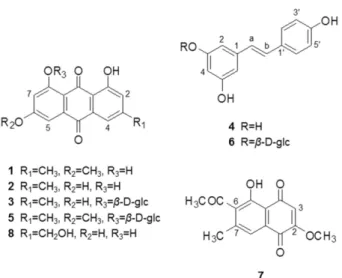
Abstract − Anti-Helicobacter pylori activity guided fractionation led to the isolation of five anthraquinones, two stilbenes and one naphthoquinone from the EtOAc fraction of Polygonum cuspidatum, using silica gel column chromatography, Sephadex-LH20, MPLC and recrystallization. The chemical structures were identified to be physcion (1), emodin (2), anthraglycoside B (3), trans-resveratrol (4), anthraglycoside A (5), polydatin (6), 2- methoxy-6-acetyl-7-methyljuglone (7) and citreorosein (8) by UV,
1H-NMR,
13C-NMR and mass spectrometry.
Anti-Helicobacter pylori activity including MIC values of each compound was evaluated. All of the isolates exhibited anti-H. pylori activity of which MIC values were lower than that of a positive control, quercetin. Compounds 2 and 7 showed potent growth inhibitory activity. Especially, a naphthoquinone, compound 7 displayed most potent antibacterial activity with MIC
50value of 0.30 µM and MIC
90value of 0.39 µM. Although anti-H. pylori activity of this plant was previously reported, this is the first report on that of compounds isolated from this species. From these findings, P. cuspidatum roots or its isolates may be useful for H. pylori infection and further study is needed to elucidate mechanism of action.
Keywords − Polygonum cuspidatum, Anti-Helicobacter pylori activity, Emodin, 2-Methoxy-6-acetyl-7-methyljuglone
Introduction
H. pylori is a gram-negative, spiral-shaped, microaero- philic, flagellated human pathogen bacterium that success- fully colonizes gastric mucosa.
1,2H. pylori produce urease which breaks down urea of stomach into ammonia and CO
2, and the ammonia neutralizes the acidic environment of stomach. This bacterium also generates vacuolating toxin (VacA) and the product of the cytotoxin-associated gene (CagA), which have been reported to be responsible in the virulence.
3Since Helicobactor pylori was identified in the pyloric region of chronic gastritis patients in 1983, by Marshall and Warren,
4H. pylori has been known to be involved in gastrointestinal disorders such as gastritis, duodenal ulcer and stomach cancer.
2,5In addition, recent studies have revealed relationships between this bacterium and other diseases such as Parkinson’s disease and chronic hepatitis C.
6,7Although the first-line triple therapy, which prescribes one proton pump inhibitor, amoxicillin and clarithromycin or metronidazole, sequential therapy and bismuth-based
quadruple therapies combined with triple therapy or sequential therapy have been tried for treatment of H.
pylori infection, clarithromycin resistance, relapse and other mild side effects such as vomiting and diarrhea are still emerging.
8,9Therefore, interest on natural products which can be used as adjuvant therapy with less adverse effect has been increasing.
10Polygonum cuspidatum Siebold & Zucc. (Reynoutria japonica Houtt.) belongs to the family Polygonaceae, and is a large, herbaceous perennial plant. This plant has hollow and erect stems with distinct raised nodes, with red or purple spots.
11This plant is widely distributed in Asia and North America.
12The root of this plant is known to have major secondary metabolites including emodin, polydatin, resveratrol, physcion and anthraglycoside B.
13Recently, over sixty seven compounds have been isolated and identified from this plant. They are quinones, stilbenes, flavonoids, coumarins, lignans and others. Over one hundred prescriptions containing this crude drug has been used to treat diseases such as inflammation, jaundice and skin burn.
14Modern investigations have revealed that P.
cuspidatum have many pharmacological effects including anti-shock, anti-inflammatory, antioxidant, anticancer, hepatoprotective, antibacterial, lipid regulating, antiviral, and antifungal activities.
15-19The present study was undertaken to isolate and identify bioactive constituents
*Author for correspondence
Mi-Jeong Ahn, College of Pharmacy and Research Institute of Phar- maceutical Sciences, Gyeongsang National University, Jinju 52828, Korea
Tel: +82-55-772-2420; E-mail: [email protected]
Both first authors contributed equally to this work.
from 70% ethanol extract of P. cuspidatum roots, which showed significant anti-H. pylori activity, and to evaluate the antibacterial activity of isolated compounds.
Experimental
General − The nuclear magnetic resonance (NMR) spectrometer used here was a Bruker DRX-300 and a Bruker DRX-500 spectrometer (Germany), and chemical shifts were recorded as δ values. FAB/MS and EI/MS were obtained on a JEOL JMS-700 (Akishima, Japan).
Medium pressure liquid chromatography (MPLC) was performed on YMC GEL ODS-A (12 nm, S-150 μM) (YMC Co. Ltd., Kyoto, Japan) and 25 g with Biotage Isolera One system (Charlotte, NC). TLC was done on Silica gel 60 F
254(Merck, Germany). Column chromatography was performed on silica gel 60 (0.063 - 0.43 mm; Merck KGaA, Damstadt, Germany) and Sephadex LH-20 (GE Healthcare, Uppsala, Sweden). A CO
2incubator, ASTEC SCA-80DS (Japan) was used for bacterial culture.
All chemicals used in bioassay were of biochemical reagent grade. Quercetin was purchased from Sigma (St.
Louis, MO) and used as a positive control. The other chemicals were extra grade.
Plant Material − The roots of Polygonum cuspidatum was purchased from Kyung-Dong oriental market (Jegi- dog, Seoul) in October 2013. The plant was identified by professor Mi-Jeong Ahn, College of Pharmacy, Gyeongsang National University. The voucher specimen (No. GSC- 104) was deposited in the Herbarium of the College of Pharmacy, Gyeongsang National University.
Extraction and Isolation − The dried roots of Polygonum cuspidatum (4 kg) were ground and extracted with 70% ethanol at room temperature. The ethanolic extract was concentrated through rotary evaporator to give a crude extract (1.12 kg). This extract was then suspended in H
2O and partitioned successively with n- hexane, ethyl acetate and n-butanol, respectively, to give n-hexane Fr. (14.6 g), EtOAc Fr. (407 g), n-BuOH Fr.
(174 g) and water Fr. (468 g) fractions, respectively. The ethyl acetate fraction was subjected to silica column chromatography (CC) with a gradient elution of Hexane, CH
2Cl
2and MeOH mixture (1:1:0 → 0:1:0 → MeOH) to give seven fractions (fr.1-fr.7). The fr.2 and fr.3 were applied on silica gel CC using a mixture of hexane and EtOAc (100:0 → 0:100) as an eluting solvent to give subfractions, fr.2a-fr.2c and fr.3a-fr.3b, respectively. Com- pounds 1 (894 mg) and 2 (18 g) were isolated from fr.2b and fr.3b, respectively, by recrystallization. Compound 7 (80 mg) was obtained from fr.3a through repeated silica
gel CC using a mixture of hexane and CH
2Cl
2mixture.
Compound 8 (7 mg) was isolated from the same sub- fraction by silica gel CC using a mixture of hexane and CH
2Cl
2mixture followed by Sephadex LH-20 CC using methanol as developing solvent. Other two fractions (fr.4 and fr.5) were divided into subfractions, fr.4a-fr.4e and fr.5a-fr.5c, respectively, by silica gel CC using a CH
2Cl
2and MeOH mixture (100:0 → 0:100) as an eluting solvent.
Compounds 3 (345 mg), 4 (42 mg) and 5 (120 mg) were given by recrystallization from fr.4c, fr.5a and fr.5b, respectively. A subfraction fr.5c gave compound 6 (11 g) by MPLC using water and methanol mixture (100:0 → 0:100) as eluting solvent.
Physcion (1) − Yellowish powder, C
16H
12O
5; EI-MS (m/z): 284 [M]
+;
1H-NMR (CDCl
3, 300 MHz): δ 12.34 (1H, s, 1-OH), 12.14 (1H, s, 8-OH), 7.64 (1H, d, J = 1.2 Hz, H-4), 7.38 (1H, d, J = 2.6 Hz, H-5), 7.10 (1H, d, J = 1.2 Hz, H-2), 6.70 (1H, d, J = 2.6 Hz, H-7), 3.96 (3H, s, 6-OCH
3), 2.47 (3H, s, 3-CH
3);
13C-NMR (CDCl
3, 125 MHz): see Table 2.
Emodin (2) − Orange needles, C
15H
10O
5; EI-MS (m/z):
270 [M]
+;
1H-NMR (DMSO-d
6, 300 MHz): δ 12.07 (1H, s, 1-OH), 12.01 (1H, s, 8-OH), 7.46 (1H, br d, H-4), 7.15 (1H, br d, H-2), 7.09 (1H, d, J = 2.4 Hz, H-5), 6.57 (1H, d, J = 2.4 Hz, H-7), 2.47 (3H, s, 3-CH
3);
13C-NMR (DMSO-d
6, 125 MHz): see Table 2.
Anthraglycoside B (3) − Yellowish powder, C
21H
20O
10; FAB-MS (m/z): 433.2 [M+H]
+;
1H-NMR (DMSO-d
6, 500 MHz): δ 13.23 (1H, br s, OH-1), 7.46 (1H, br s, H-4), 7.27 (1H, d, J = 2.4 Hz, H-5), 7.16 (1H, br s, H-2), 6.98 (1H, d, J = 2.4 Hz, H-7), 5.05 (1H, d, J = 7.6 Hz, H-1'), 3.72~3.24 (glc-H 2'~6'), 2.41 (3H, s, 3-CH
3);
13C-NMR (DMSO-d
6, 125 MHz): see Table 2.
trans-Resveratrol (4) − Pale white powder, C
14H
12O
3;EI-MS (m/z): 228 [M]
+;
1H-NMR (DMSO-d
6, 500 MHz):
δ 9.54 (4'-OH), 9.18 (3, 5-OH) 7.39 (2H, d, J = 8.6 Hz, H-2', 6'), 6.93 (1H, d, J = 16.5 Hz, H-b), 6.81 (1H, d, J = 16.5 Hz, H-a), 6.75 (2H, d, J = 8.6 Hz, H-3', 5'), 6.38 (2H, d, J = 2.0 Hz, H-2, 6), 6.12 (1H, t, J = 2.0 Hz, H-4);
13