Renal and perirenal abscesses are uncommon disease entities resulting from infections in or around the kidneys. Furthermore, it is a diagnostic challenge for physicians. A delay in diagnosis may lead to higher morbidity and mortality.1 With the availability of computed tomography (CT) scanning and magnetic resonance imaging (MRI) in the diagnosis of renal abscesses, mortality has been reduced to 12%.2The mainstay of treatment for renal or perinephric abscesses is adequate drainage and optimal antibiotic regimen.2Classical management for renal abscesses includes surgical exploration, incision and drainage, or nephrec- tomy.3However, minimally invasive treatment appeared in the early 1970s, and the trend toward conservative treatment was common due to the advances in imaging techniques and novel antibiotics. Several reports observed that small
Renal Abscesses Measuring 5 cm or Less: Outcome of Medical Treatment without Therapeutic Drainage
Seung Hwan Lee, Hyun Jin Jung, Sang Yol Mah, and Byung Ha Chung
Department of Urology, Yonsei University College of Medicine, Gangnam Severance Hospital, Seoul, Korea.
Purpose:Diagnosis and proper treatment of renal abscesses remains a challenge for physicians. We investigated the characteristics and comorbidity factors of renal abscesses measuring 5 cm or less and critically examined the effectiveness of conservative treatment.Materials and Methods:Between February 2001 and March 2009 the records of 63 patients initially diagnosed at our hospital with renal or perirenal abscesses were retrospectively reviewed. In 63 patients with renal and perirenal abscesses, 51 abscesses measured 5 cm or less, and 49 abscesses were treated with intravenous antibiotics alone. Results: Most patients were women (91.8%), and their mean age was 42.3 years. The mean size of renal abscesses was 3.6 cm. The most common predisposing condition was diabetes mellitus (DM) (46.9%). Common clinical features were fever (83.7%) and flank pain (53.1%).
On urinalysis, 31 (64.6%) cases had positive bacterial cultures with Escherichia coli (50.0%) being the most common pathogen. All 49 patients were treated with broad-spectrum intravenous antibiotics alone. All patients showed complete clinical regression and resolution of the renal lesions shown by CT between 3 and 14 weeks. The average hospital stay was 15.3 days (range, 5-31 days). Significant predictors of a long hospital stay were age, abscess size, and DM. Conclusion:
Medium-sized as well as small-sized renal abscesses were treated successfully with intravenous antibiotics alone. DM was a significant predictor of prolonged hospital stay. If therapeutic drainage is believed to involve considerable risk, then intravenous antimicrobial therapy may be a good alternative treatment.
Key Words: Abscess, kidney, antibiotics, infection
Received: August 24, 2009 Revised: October 27, 2009 Accepted: October 31, 2009
Corresponding author: Dr. Byung Ha Chung, Department of Urology, Yonsei University College of Medicine, Gangnam Severance Hospital, 712 Eonju-ro, Gangnam-gu, Seoul 135-720, Korea.
Tel: 82-2-2019-3474, Fax: 82-2-3462-8887 E-mail: [email protected]
∙The authors have no financial conflicts of interest.
© Copyright:
Yonsei University College of Medicine 2010 This is an Open Access article distributed under the terms of the Creative Commons Attribution Non- Commercial License (http://creativecommons.org/
licenses/by-nc/3.0) which permits unrestricted non- commercial use, distribution, and reproduction in any medium, provided the original work is properly cited.
INTRODUCTION
renal abscesses were effectively treated with a course of intravenous antibiotics.4,5The efficacy of conservative treat- ment in medium sized (3-5 cm) renal abscesses, however, has not been consistently observed across studies.2-5There- fore, we reviewed our experience with 49 renal abscesses to investigate the characteristics and comorbidity factors of renal abscesses measuring 5 cm or less and to critically examine the effectiveness of conservative treatment.
Between February 2001 and March 2009, the records of 63 patients initially diagnosed at our hospital with renal abscesses were retrospectively reviewed. In 63 patients with renal and perirenal abscesses, 51 abscesses measured 5 cm or less. Of the 51 patients, two patients with renal abscesses underwent percutaneous abscess drainage and 49 absces- ses were treated with intravenous antibiotics alone. We analyzed patient characteristics, abscess location and size, predisposing factors, clinical presentation, microbiology, laboratory data, treatment, outcome, and length of hospi- talization.
Renal abscesses were diagnosed with imaging studies such as abdominal CT or MRI and only included the renal capsule and perirenal abscesses within Gerota’s fascia.
Those confined in the cortex, central medulla, or internal calices were considered renal abscesses while those local- ized between the capsule of the kidney and Gerota’s fascia were identified as perirenal abscesses.6The size of renal or perirenal abscesses was measured as the largest diameter.
Abscesses with a size of 3 cm or less were defined as small, 3-5 cm as medium, and 5 cm or more as large. Patients were discharged when clinical and laboratory parameters normalized during the minimum 48 hours. Follow-up CT scans were performed in all patients to evaluate the resolu- tion of renal lesions (range 3 to 14 weeks).
Multivariate analysis was done to determine indepen- dent risk factors for the length of hospitalization in patients with renal or perirenal abscesses.
Patient characteristics (Table 1)
The average patient age was 42.3 years (range, 21-71 years).
There were 4 males (8.2%) and 45 females (91.8%).
Twenty-three (46.9%) patients had diabetes mellitus (DM), which was the most common predisposing condition, fol- lowed by hypertension (n = 7, 14.3%), renal stone (n = 5, 10.2%), prior pyelonephritis (n = 4, 8.2%), and malignancy (n = 2, 4.1%). The mean duration of symptoms prior to
diagnosis was 3.8 days (range, 1-13 days). The most common presenting symptom was fever (n = 41, 83.7%) and flank pain (n = 26, 53.1%).
Abscess characteristics and microbiological data (Table 2)
Of the 49 patients, renal abscesses were found in 26 (53.1%) patients, perirenal in 14 (28.6%), and renal/peri- renal in 9 (18.3%). The right side and mid portion were the predominant sites. Bilateral abscesses were observed in 3 cases. The mean size of renal or perirenal abscesses was 3.6 cm (range, 1.3-5.0 cm). Microbiological culture results from urine and blood were available for 48 and 46 patients, respectively. Urine cultures were positive in 31 patients and blood cultures in 6. These 6 patients with positive blood cultures had the same organism in urine cultures.
The most frequently isolated pathogen in urine cultures was E. coli (n = 24, 50.0%). Others included K. pneumoniae (n = 5, 10.4%) and S. aureus (n = 2, 4.2%). Of the 31 cases positive in urine cultures, 2 cases caused by E. coli and K.
pneumoniae were resistant to ampicillin, cephalothin, cefo- taxime, trimethoprim-sulfamethoxazole, and ciprofloxacin.
Another 1 case caused by S. aureus was resistant to peni-
MATERIALS AND METHODS
Table 1. Demographic and Clinical Features of Patients with Renal or Perirenal Abscesses Treated with Intravenous An- tibiotics Alone
No. of patients (%)
Mean age 42.3 (21 - 71)
Gender
Male 4 (8.2)
Female 45 (91.8)
Comorbidity factors
DM 23 (46.9)
Malignancy 2 (4.1)
Renal stone 5 (10.2)
Prior pyelonephritis 4 (8.2)
Hypertension 7 (14.3)
None 13 (26.5)
Other 4 (8.2)
Clinical presentation
Fever 41 (83.7)
Chills 21 (42.9)
Flank pain 26 (53.1)
Myalgia 8 (16.3)
Nausea & vomiting 5 (10.2)
Frequency 4 (8.2)
Dysuria 3 (6.1)
Gross hematuria 3 (6.1)
DM, diabetes mellitus.
RESULTS
cillin and methicillin.
Treatment
All 49 patients were treated with broad-spectrum intrave- nous antibiotics alone. All patients were treated with broad spectrum antibiotics, which typically included the combina- tion of an intravenous antipseudomonas penicillin or third generation cephalosporin in combination with an aminogly- coside. Five patients were treated with fluoroquinolone monotherapy or in combination with an aminoglycoside by the physician’s preference. 3 cases were treated with imipenem and vancomycin because of the antimicrobial insusceptibility to other antibiotics.
The average hospital stay was 15.3 days (range, 5-31 days). In one patient, the hospital stay was 62 days because of the transfer out to endocrinology for sugar control. In another 2 patients admitted with septic condition, multiple abscesses measured 3 cm or less were found in one patient and a 3.3 cm-sized intrarenal abscess was found in the other patient. Fortunately, 2 emergent cases were success- fully managed by only antibiotics treatment. Their hospital stay was 23 and 31 days, respectively.
All patients showed complete clinical regression and
resolution of the renal lesions shown by CT between 3 and 14 weeks. After the discharge from the hospital, all patients took the broad spectrum oral antibiotics for an average of 16 days. There were no complications except in one patient who had a recurrent infection (pyelonephritis 13 months later). Table 3 shows the clinical factors influencing hos- pital stay. Significant predictors of a long hospital stay were age, abscess size, and DM.
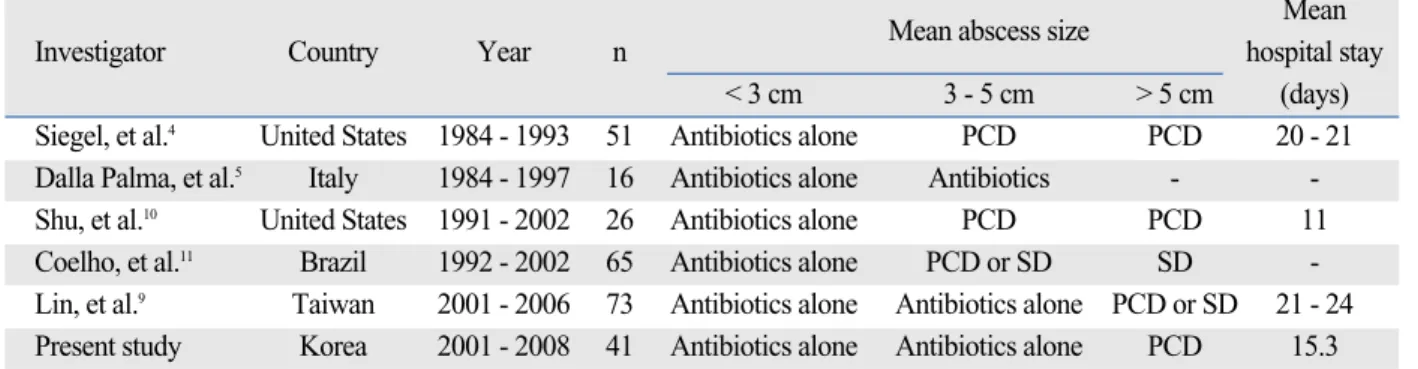
In 1996, Siegel, et al.4suggested an algorithmic approach to the management of renal abscesses. They reported that primary conservative management using antibiotics was recommended in small abscesses (< 3 cm) whereas drai- nage (percutaneous or surgical) was recommended in large abscesses (> 5 cm). Both observation protocols used were possible in medium-sized abscesses (3-5 cm). However, percutaneous abscess drainage has several complications, although uncommon, such as pyopneumothorax, bactere- mia, and fistula in the gastrointestinal tract.7Bamberger recommended avoidance of aggressive interventional or surgical treatment of renal and perinephric abscesses of 5 cm in diameter or less, which can have complete remission after antibiotic therapy.8However, another study showed that aggressive drainage was appropriate in abscesses > 3 cm.4The reported primary treatment of renal abscesses by size is summarized in Table 4.4,5,9-11As shown in Table 4, a common treatment modality for medium-sized abscesses has not been observed across studies. We reported a 100%
cure rate of small and medium renal abscesses (5 cm or less) using systemic antibiotics. In an era of improved antimicrobial treatment and support care, the rate of con-
DISCUSSION
Table 2. Abscess Characteristics and Microbiological Data No. of patients (%) Size
< 3 cm 30 (61.2)
3 - 5 cm 19 (38.8)
Renal 26 (53.1)
Perirenal 14 (28.6)
Renal + perirenal 9 (18.3)
Laterality
Right 35 (73.7)
Left 11 (18.4)
Both 3 (7.9)
Site
Upper 11 (22.4)
Mid 21 (42.6)
Lower 8 (16.3)
Multiple 9 (18.7)
Blood cultures 46
E. coli 3 (6.5)
K. pneumoniae 2 (4.3)
S. aureus 1 (2.2)
Urine cultures 48
E. coli 24 (50.0)
K. pneumoniae 5 (10.4)
S. aureus 2 (4.2)
Table 3. Significant Predictors of Hospital Stay in Patients with Intravenous Antibiotics Alone
Standardized
Variable regression p value*
coefficient (R)*
Sex (male) - 0.676 0.347
Age 0.911 0.013
DM (yes) 1.297 0.011
Hypertension (yes) 0.997 0.082
Urine analysis 0.815 0.076
Leukocytosis 0.773 0.083
Laterality (Rt) 0.943 0.266
Size 0.947 0.004
*From final multivariate model after multiple regression analyses with stepwise selection of the following covariates: age, sex, hypertension, DM, urine analysis, urinary stone, urine culture, leukocytosis, creatinine level, laterality, and size. DM, diabetes mellitus.
servative treatment to therapeutic intervention would inc- rease with time. However, it remains unclear under which circumstances medical management without drainage is a reasonable option. A disadvantage of medical therapy without at least diagnostic drainage is that empirical regi- mens could be utilized without knowledge of the offending organisms and their antimicrobial susceptibilities. Further studies are needed to distinguish the characteristics of abs- cesses that respond to medical management and determine the optimal duration and type of therapy.
In several studies, urinary obstruction and renal stones have been reported as common predisposing conditions with an incidence of 21-50%12,13and 24-54%,2,14respecti- vely. However, our study showed that systemic diseases such as DM (46.9%) was much more common than renal or urologic diseases such as malignancy (4.1%) or renal stones (10.2%).
In our study, patients with renal abscesses had a higher rate of E. coli infection in urine cultures, and a female predo- minance (91.8%) was observed. This may be a result of the development of renal abscesses via an ascending infection by organisms already isolated within the urinary tract,9and interestingly, in Korea, use of a bidet has become wides- pread in recent decades. This might cause the ascending infection, especially in the relatively short urethra in females.
Lin, et al.9reported that age over 65 years, thrombocy- topenia, and abscesses without drainage were indepen- dently related to a poor outcome. This study revealed some- what different results compared to their study. We observed that age, underlying comorbidity such as DM, and abscess size were independently related to hospital stay. This should alert physicians to the possibility of warning pati- ents of longer hospitalization and intervention in this setting. As far as we know, this is the first study to deter- mine the predictors of hospital stay in patients with renal or perirenal abscesses.
Limitations affecting our current findings must be consi- dered. First, our study is non-comparative. Only 2 patients underwent percutaneous drainage, and we could not com-
pare the outcome of antibiotics treatment alone to that of percutaneous drainage. Second, diagnostic tools such as CT or MRI scans were not performed in identical fashion.
Variations across scans likely impacted the reported values of our clinical parameters. Furthermore, radiology reports were not provided by the same radiologist, and different opinions among radiologists might be embedded. Based on these results, large-scale prospective studies are needed to establish more current and reasonable guidelines for the treatment of renal or perirenal abscesses.
In conclusion, medium-sized as well as small-sized renal abscesses were successfully treated with intravenous anti- biotics alone. If therapeutic drainage is believed to involve considerable risk, then intravenous antimicrobial therapy may be a good alternative treatment.
1. Yen DH, Hu SC, Tsai J, Kao WF, Chern CH, Wang LM, et al.
Renal abscess: early diagnosis and treatment. Am J Emerg Med 1999;17:192-7.
2. Meng MV, Mario LA, McAninch JW. Current treatment and outcomes of perinephric abscesses. J Urol 2002;168:1337-40.
3. Anderson KA, McAninch JW. Renal abscesses: classification and review of 40 cases. Urology 1980;16:333-8.
4. Siegel JF, Smith A, Moldwin R. Minimally invasive treatment of renal abscess. J Urol 1996;155:52-5.
5. Dalla Palma L, Pozzi-Mucelli F, Ene V. Medical treatment of renal and perirenal abscesses: CT evaluation. Clin Radiol 1999;
54:792-7.
6. Patterson JE, Andriole VT. Renal and perirenal abscesses. Infect Dis Clin North Am 1987;1:907-26.
7. Lang EK. Renal, perirenal, and pararenal abscesses: percutaneous drainage. Radiology 1990;174:109-13.
8. Bamberger DM. Outcome of medical treatment of bacterial abs- cesses without therapeutic drainage: review of cases reported in the literature. Clin Infect Dis 1996;23:592-603.
9. Lin HS, Ye JJ, Huang TY, Huang PY, Wu TS, Lee MH. Charac- teristics and factors influencing treatment outcome of renal and perinephric abscess--a 5-year experience at a tertiary teaching hospital in Taiwan. J Microbiol Immunol Infect 2008;41:342-50.
REFERENCES
Table 4. Reported Primary Treatment of Renal or Perinephric Abscesses by Size
Mean abscess size Mean
Investigator Country Year n hospital stay
< 3 cm 3 - 5 cm > 5 cm (days) Siegel, et al.4 United States 1984 - 1993 51 Antibiotics alone PCD PCD 20 - 21 Dalla Palma, et al.5 Italy 1984 - 1997 16 Antibiotics alone Antibiotics - - Shu, et al.10 United States 1991 - 2002 26 Antibiotics alone PCD PCD 11 Coelho, et al.11 Brazil 1992 - 2002 65 Antibiotics alone PCD or SD SD - Lin, et al.9 Taiwan 2001 - 2006 73 Antibiotics alone Antibiotics alone PCD or SD 21 - 24 Present study Korea 2001 - 2008 41 Antibiotics alone Antibiotics alone PCD 15.3 PCD, percutaneous drainage; SD, surgical drainage.
10. Shu T, Green JM, Orihuela E. Renal and perirenal abscesses in patients with otherwise anatomically normal urinary tracts. J Urol 2004;172:148-50.
11. Coelho RF, Schneider-Monteiro ED, Mesquita JL, Mazzucchi E, Marmo Lucon A, Srougi M. Renal and perinephric abscesses:
analysis of 65 consecutive cases. World J Surg 2007;31:431-36.
12. Thorley JD, Jones SR, Sanford JP. Perinephric abscess. Medicine
(Baltimore) 1974;53:441-51.
13. Fowler JE Jr, Perkins T. Presentation, diagnosis and treatment of renal abscesses: 1972-1988. J Urol 1994;151:847-51.
14. Angel C, Shu T, Green J, Orihuela E, Rodriquez G, Hendrick E.
Renal and peri-renal abscesses in children: proposed physio- pathologic mechanisms and treatment algorithm. Pediatr Surg Int 2003;19:35-9.