1. Introduction
The Defense Technology Security Act was enacted
on December 29, 2015, and 141 defense industrial technologies were designated in December 2016[1]. The defense industrial technology is protected and the
A Study on Establishment of Criteria to Identify the Defense Industrial Technology of Diesel Engine for Military Vehicle
Heung-Soo Yoon1, Yeon-Seung Ryu2*
1Ph.D. Student, Dept. of Security and Management Engineering, Graduate School, Myongji University
2Professor, Dept. of Security and Management Engineering, Graduate School, Myongji University
군용차량을 위한 디젤기관의 방산기술 식별기준 정립에 관한 연구
윤흥수1, 류연승2*
1명지대학교 대학원 보안경영공학과 박사과정, 2명지대학교 대학원 보안경영공학과 교수
Abstract The Defense Technology Security Act was enacted in 2015 to protect the defense industrial technology from being duplicated or interfering technologies being developed, which prevents its value and utility from deterioration and prevents inappropriate export. Defense industrial technology refers to technology that should be protected for national security among the national defense science and technology related to the defense industry.
However, technical identification criteria of identification and management system of protection technology are not regulated. Therefore, in this study, through the Delphi survey, diesel engine core technology identification criteria related to the high efficiency internal combustion engine propulsion technology among the 141 defense industrial technologies is established to improve the identification and management system of the technology to be protected among the defense industrial technology protection system. As a result of the study, operational operability, durability, safety, sequencing and modularization were established as diesel engine core technology identification criteria.
Key Words :Defense Industrial Technology, Defense Technology Security Act, Military Vehicle, Diesel engine
요 약 방산기술이 복제되거나 방해기술이 발달되어 그 가치와 효용이 낮아지는 것을 방지하고 부적절한 수출을 방지하기 위한 보호가 필요하여 2015년도에 방위산업기술보호법이 제정되었다. 방산기술이란 방위산업과 관련된 국방과학기술 중에 서 국가안보를 위하여 보호되어야 하는 기술을 의미한다. 그러나 현재 방산기술 보호체계 중에서 보호대상 기술의 식별 및 관리 체계의 기술식별 기준이 법규화 되어 있지 않다. 이에 본 연구에서는 델파이 설문을 통하여 141개 방산기술 중에서 고효율 내연기관 추진 기술과 관련 있는 디젤기관 요소기술 식별기준을 정립하고 방산기술 보호체계 중 보호대상 기술의 식별 및 관리 체계를 개선하였다. 연구결과로 디젤기관 요소기술 식별기준으로 작전 운용성, 내구성, 안전성, 계열화 및 모듈화 등을 정립하였다.
주제어 : 방산기술, 방위산업기술보호법, 군용차량, 디젤기관
*Corresponding Author : Yeon-Seung Ryu ([email protected]) Received December 12, 2018
Accepted March 20, 2019
Revised January 3, 2019 Published March 28, 2019
relevant organizations are supported to ensure national safety and to fulfill the obligations of international treaties[2]. The defense industrial technology protection system is classified into the identification and management system, personnel control and facility protection system, and information protection system to protect the technology[2,3]. However, technical identification criteria of identification and management system of protection technology are not regulated, and the dual technology like engine technology of the military vehicle, applied both to the private and military sector, is hard to distinguish between defense industrial technology and civil technology with current defense industrial technology scope and designated notification status.
Engine technology applied to commercial vehicles is said to be applied to military vehicles as engine of military vehicles uses the same engine mounted on commercial vehicles[4,5]. As can be seen from the case of technology leaks during the M&A process between Ssangyong Motors and Shanghai Motors, China, if companies with main engine technology of commercial vehicles leak technology during overseas M&A process, not only the engine information of commercial vehicles but also that of military vehicles can be leaked[6]. Also there is a big concern of leakage of engine information of military vehicles as engine information of commercial vehicles is widely disclosed through internet with the development of information technology[7]. The main technology of commercial vehicles is designated as industrial technology or national core technology, and is protected by the act on prevention and protection of industrial technology.
However, if the same technology is applied to military vehicles, there is no protection in reality. There would be a low awareness of technology protection since military vehicles are expected to not a weapon system but a transportation. But in general, if missiles or vulcan are loaded with the military vehicle developed in sequencing form, it becomes a very important weapon system in battle. Therefore, if a main engine
technology of a military vehicle is leaked, a technology with a large ripple effect should be designated as a core technology of defense industrial technology and protected by the Defense Technology Security Act so that the technology leaks can be punished[8].
In this study, through the Delphi survey, diesel engine core technology identification criteria related to the high efficiency internal combustion engine propulsion technology among the 141 defense industrial technologies is established to improve the identification and management system of the technology to be protected among the defense industrial technology protection system.
2. Related Works
The Defense Technology Security Act was enacted on December 29, 2015, and 141 defense industrial technologies were designated and notified in December 2016. It ensures national safety and fulfills the obligation of international treaties by protecting defense industrial technology and supporting relevant organizations, serving for the improvement of national credibility[3].
Defense industrial technology is a technology that should be protected for national security among the national defense science and technology related to the defense industry. It refers to the technology designated and notified by the head of defense business according to Article 7 of the Defense Technology Security Act. 8 major fields, 48 major fields and 141 technologies have been designated and notified by 2017[2]. However, there are not many prior studies on protection of defense industrial technology as the Defense Technology Security Act has been established relatively recently. This study in particular can be said to have great differentiation as there is no other research on the establishment of the core technology identification criteria of the defense industrial technology. The previous studies on protection of
defense industrial technology are as follows.
The Defense Agency for Technology and Quality(2015) suggested that the defense business law should be amended to clarify the definition of the national defense science and technology related to defense industrial technology[9]. The Sungkyunkwan University industry-Academy Collaboration Foundation(2016) suggested that the Defense Technology Security Act should be revised as it overlaps with the Industrial Technology Security Act, causing the double support and increased burden to the target organizations[10]. According to A. R. Hur(2018) firms are unwilling to disclose their technology due to the risk of the company's technology release and cost due to the construction of the protection system, and also the identification procedure of the defense industrial technology is not established. So she offers the need to establish a scope of protected assets and a method of grading importance[11]. H. S. Yoon & Y. S.
Ryu(2018) stressed the need to improve the test evaluation system and defense industrial technology protection system with consideration of the security of the weapon system as the military commercialization policy is actively implemented to modernize the weapon system[12].
3. Research Methodology
3.1 Investigation method and period
Through the review of literature such as articles, news, reports, and related laws, the evaluation items of the core technology identification criteria of defense industrial technology were drawn. The results of these documents were reviewed from May 8 to May 23, 2018.
The evaluation items were selected through consensus after collecting opinions from 3 experts interview. One doctor of defense acquisition, one automotive engineering professor, and one senior research engineer of the military vehicle development were selected as experts. Interviews were conducted via email,
telephone, and direct interviews.
In order to evaluate and verify the validity of selected evaluation items selected through literature reviews and expert interviews, standards were established from 2 times of Delphi survey, conducted for 8 experts from June 14 to August 2, 2018. The number of expert groups in the Delphi survey has no established rules[13], and Lynn(1986) suggested that the number of expert groups to verify the validity of the content should be preferably 3 to 10[14]. In order to increase the reliability of the survey results, 8 experts except the 3 experts who participated in the interview stage were selected again. 8 experts consisted of 4 automotive engineering professors, and 4 research engineers of the military vehicle development.
3.2 Verification of measurement tools
Y. J. Yoon & J. I. Lee(1998) suggested that reliability guarantee is the most important factor to Delphi method of which prediction relies on subjective evaluation of experts[15]. The results of the survey and the research model were then verified and the reliability was secured through the Content Validity Ratio(CVR) evaluation and the Kendall's W test on the Delphi survey results. Data analysis was processed statistically with SPSS for Windows(ver 25.0) and Excel 2010.
3.2.1 Content Validity Ratio(CVR)
The CVR evaluation was used to verify whether the contents of each item were valid about the Delphi survey results. The CVR value was calculated in the process of assigning the total number of expert groups who responded to the survey and the number of expert groups who responded the CVR survey to be valid into the CVR formula. The result was judged to be valid if the value was more than the CVR minimum value according to the number of experts, If the value is less than the minimum value, it is judged to be invalid and deleted[16]. The formula to obtain CVR value is as follows.
ne : Number of all expert groups responded to the survey(persons)
N : The number of experts who responded the question to be valid(persons)
In this study, the 5-point Likert scale was used for the evaluation of each item. Therefore, the number of experts who selected more than 3 points was judged to be the number of experts who answered that the question to be valid. In addition, since the total number of expert group responded to Delphi survey was 8, the CVR minimum value was 0.75. Therefore, it was judged to be a valid question if the CVR was over 0.75.
If the CVR was less than 0.75, it was judged to be an invalid question and was deleted.
3.2.2 Kendall's W
H. J. Noh(2015) found Kendall's W to be suitable for observing power consistency when there are more than 3 ranking data[17]. Therefore, Kendall's W was used to judge the consensus of experts on Delphi survey results. The formula for obtaining Kendall's W is as follows.
M : Number of evaluators(persons) n : Number of objects(units) i : evaluator
j : object
Rij : Rank that evaluator i judged on the object j
0≤W≤1 is satisfied, and the closer the W is to 1, the higher the match degree, and vice versa[18]. Also, in order to interpret Kendall's W obtained through the equation above, the criteria proposed by Schmidt(1997) was followed[19,20]. Table 1 shows the interpretation of Kendall's W.
Table 1. Construction of Kendall's W[19]
Ranges for Coefficient W Meaning
Up to 0.1 Very low
More than 0.1 and up to 0.3 Low
More than 0.3 and up to 0.5 Moderate More than 0.5 and up to 0.7 High More than 0.7 and up to 0.9 Very high
4. Research Result
4.1 Literature review results
As a result of review of the literature, the evaluation items of the core technology identification criteria related to the diesel engine technology were extracted to 11 items. Criteria #1 to #7 were constituted with criteria to be considered when developing the military vehicles, suggested by B. K. Lee & Y. K.
Cho(2010)[21]. Criteria #8 to #11 were constituted with technology cards(forms) to be protected by The Defense Agency for Technology and Quality(2015)[9].
Table 2 shows the literature review results on the identification criteria of core technology.
Table 2. Literature review results
No. Evaluation item
1 Operational operability
2 Performance
3 Maintainability
4 Convenience
5 Applying new technology
6 Sequencing and modularization
7 Economics
8 Importance of technology
9 Technical difficulty
10 National security
11 Utilization value(usability)
4.2 Expert interview results
Expert interviews were conducted by e-mail, telephone, and direct interview method and the opinions were collected and agreed upon to select evaluation items. All 3 experts selected operational operability,
applying new technology, sequencing and modularization, economics, national security, and utilization value(usability) as evaluation items unanimously. 2 experts suggested that maintainability and convenience are not appropriate as evaluation items as the demonstration of the combat power of the weapon system should be prioritized. This suggestion was then delivered to other experts and those two items were selected after the modification into durability and safety under feedback and consensus.
Performance and Importance of technology were removed with the common opinion from 3 experts that these have broad meaning and thus are not specific criteria. Technical difficulty was said that it has a possibility to be a constraint for an expert to apply various technologies, and that opinion was passed to the other experts, and then technical difficulty was deleted after times of consensus.
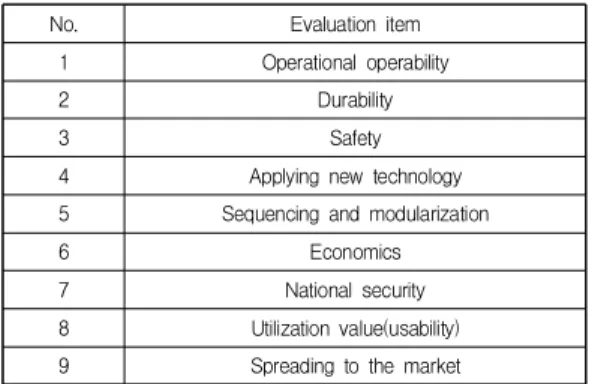
In addition, one of the experts suggested that spreading to the market should be added as an evaluation item. Spreading to the market was selected additionally with other experts' agree. Therefore, 9 evaluation items for core technology identification criteria related to diesel engine technology were selected as a result of interview with experts. Table 3 shows the results of expert interview on the core technology identification criteria.
Table 3. Expert interview results
No. Evaluation item
1 Operational operability
2 Durability
3 Safety
4 Applying new technology
5 Sequencing and modularization
6 Economics
7 National security
8 Utilization value(usability)
9 Spreading to the market
4.3 Delphi survey results 4.3.1 Delphi 1st survey results
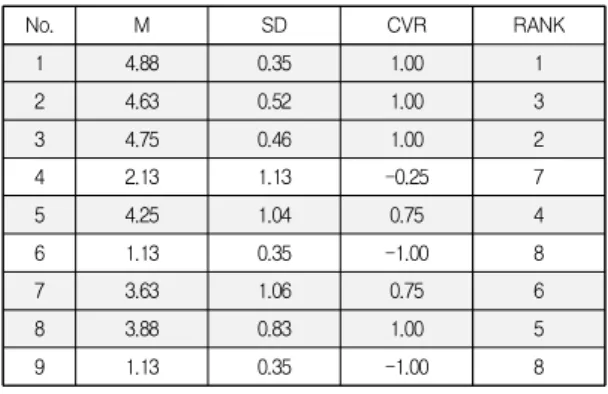
The results of the survey are summarized with M, SD, CVR, and W, .
Because the survey results are from 8 experts, the opinions of experts are said to be in consensus if CVR is over 0.75 and SD is less than 1.00 or close to 1.00 even if SD is over 1.00. In addition, M in relatively close range from is considered to be an appropriate data whether it is over or under the average. M is the mean, SD is the standard deviation, CVR is the content validity ratio, is the total average, and W is the Kendall matching coefficient.
Applying new technology was rejected without a reevaluation, judged to be invalid because consensus between experts was low as SD was 1.00 or more and the deviation from 1.00 was much higher than that of other items, and CVR was less than 0.75. Economics and Spreading to the market have SD less than 1.00, meaning consensus of experts are relatively high, and were thought to be invalid as they have CVR less than 0.75, thus been deleted. The opinions of the experts who checked 1 or 2 points on the above evaluation items are summarized as follows. defense industrial technology does not necessarily have to be a new technology. Even if it is a past technology, if it is a source technology or a key technology, it can be selected as an core technology of defense industrial technology with consideration of the value of technology. In addition, defense industrial technology is intended to contribute to national security, so economics and spreading to the market are closer to the criteria for identifying industrial technology and national core technologies.
SD of operational operability, durability, safety, sequencing and modularization, national security, and utilization value(usability) are mostly less than 1.00 or close to 1.00, even if the SD is 1.00 or more. Therefore, it was judged that the opinions of experts were in agreement that these were valid questions. In addition, these were considered to be an appropriate items as their Ms were above the (3.38).
The W in the Delphi first survey results on the core
technology identification criteria is interpreted as 'Moderate'. Therefore, it was verified that the opinions of the experts were in good agreement with the survey results. Table 4 shows the statistical processing of the results of the Delphi first survey.
Table 4. Statistical processing of Delphi 1st survey results
No. M SD CVR RANK
1 4.88 0.35 1.00 1
2 4.63 0.52 1.00 3
3 4.75 0.46 1.00 2
4 2.13 1.13 -0.25 7
5 4.25 1.04 0.75 4
6 1.13 0.35 -1.00 8
7 3.63 1.06 0.75 6
8 3.88 0.83 1.00 5
9 1.13 0.35 -1.00 8
· = 3.38, W = 0.308
In addition, the seven experts suggested economic value, security of technology, uniqueness of technology(special performance and function), contribution to improving engine performance, eco-friendly, associated with engine start-up as core technology identification criteria that were unlisted in the first survey.
Economic value means economic value added by technology and is an important criterion to evaluate the value of technology. Security of technology is necessary to assess the level of technical protection and security measures for the technology. Uniqueness of technology(special performance and function) is a criterion for evaluating the differentiation of technology considering the specific performance and function of technology. Contribution to improving engine performance is a necessary criterion for evaluating the contribution of engine output and torque to improve engine performance. Associated with engine start-up is a criterion for evaluating whether or not the technology is related to engine start-up because engine start-up is the most important factor that determines whether the
engine starts and runs. In addition, eco-friendly was double-presented by 2 experts. In order to operate a diesel vehicle, which is considered to be the main cause of air pollution in recent years, experts stressed that eco-friendly criteria should be included as environmentally friendly technology is necessary for harmful exhaust gas reduction. Table 5 shows the additional items from the Delphi first survey.
Table 5. Additional items derived from the Delphi 1st survey
No. Evaluation item
1 Economic value
2 Security of technology
3 Uniqueness of technology
(special performance and function)
4 Contribution to
improving engine performance
5 Eco-friendly
6 Associated with engine start-up
4.3.2 Delphi 2nd survey results
The results of the second survey were analyzed with the same method as the first survey.
Eco-friendly item was found to be invalid because the agreement of the experts was low as SD was far out of 1.00 compared to that of other items, and CVR was less than 0.75, so it was deleted without reevaluation. Experts who gave 1 or 2 points for eco-friendly suggested that environmental factors cannot be seen to be directly related to national security, taking that defense industrial technology is a technology contributing to national security into account.
Economic value, security of technology, uniqueness of technology(special performance and function), contribution to improving engine performance, associated with engine start-up all had SD less than 1.00, meaning that consensus of experts are high, and were judged that experts think these are valid as their CVRs are all more than 0.75. Also, security of technology was judged to be valid because it was less
than (3.79) but slightly different from , and the others items were judged to be valid because they are all higher than .
The W in the Delphi second survey results for core technology identification criteria was interpreted as 'Very high'. Therefore, it was verified that the consensus of the experts on the survey results is very high. Table 6 shows the statistical processing of the results of the second phase of the Delphi survey.
Table 6. Statistical processing of Delphi 2nd survey results
No. M SD CVR RANK
1 4.88 0.35 1.00 1
2 3.75 0.71 1.00 5
3 3.88 0.83 1.00 4
4 4.13 0.64 1.00 2
5 2.13 1.36 -0.50 6
6 4.00 0.76 1.00 3
· = 3.79, W = 0.719
In addition, the experts did not suggest additional evaluation items besides the evaluation items of the core technology identification criteria presented in the second survey.
4.3.3 Overall result
In the second survey, it was concluded that experts agreed on the establishment of the core technology identification criteria, so survey results of Delphi first and second were put together and established as diesel engine core technology identification criteria. However, since there are limitations to obtain various opinions with a relatively small number of Delphi survey subjects, it is necessary to increase the number of survey subjects to conduct research. It is expected to contribute to the development of the defense industry, which will improve the defense industrial technology protection system and affect the national security, as a basic research to establish the core technology identification criteria of all defense industrial technology henceforth. Table 7 shows the results of the
Delphi first and second survey on the identification criteria of diesel engine components.
Table 7. Delphi 1st, 2nd survey on diesel engine technology identification criteria
No. Evaluation item
1 Operational operability
2 Economic value
3 Safety
4 Durability
5 Sequencing and modularization
6 Contribution to improving
engine performance 7 Associated with engine start-up 8 Utilization value(usability)
9 Uniqueness of technology
(special performance and function)
10 Security of technology
11 National security
5. Conclusion
Through the Delphi survey, the identification criteria of diesel engine core technology related to high efficiency internal combustion engine propulsion technology among the 141 defense industrial technologies were established, and the identification and management system of technology to be protected among the defense industrial technology protection system was improved. Operational operability, durability, safety, sequencing and modularization, national security, utilization value(usability), uniqueness of technology(special performance and function), contribution to improving engine performance, associated with engine start-up were established as diesel engine core technology identification criteria. Since there are limitations in obtaining various opinions with relatively small number of Delphi survey subjects, it is necessary to conduct research with increased number of survey subjects.
This research is expected to contribute to the development of the defense industry, which will
improve the defense industrial technology protection system and affect the national security, as a basic research to establish the core technology identification criteria of all defense industrial technology in the future.
REFERENCES
[1] National Law Information Center. (2018).
http://www.law.go.kr/LSW/lsRvsRsnListP.do?lsId=0124 37&chrClsCd=010102.
[2] Defense Acquisition Program Administration. (2017).
Defense Technology Security Guide 11-1690000-001928-01, 6-7.
[3] National Law Information Center. (2018).
http://www.law.go.kr/법령/방위산업기술보호법.
[4] Korea Automotive Technology Institute. (2013). A Study on the Optimized of Military Vehicles According to Type of An Army, 8-15.
[5] B. K. Lee. (2010). A Selection Model of the Development Factors of Military Vehicles Using Analytic Hierarchy Process. Doctors dissertation.
Kwangwoon University, 8-10.
[6] J. B. Lee. (2009). A legal study on the protection of industrial technology in corporate mergers and acquisitions(M&A). Journal of Korean Branch of International Association of Constitutional Law, 297-298.
[7] B. C. Won. (2017). http://www.boannews.com/
media/view.asp?idx=55492&kind=1.
[8] Defense Acquisition Program Administration. (2017).
Defense Technology Security Act Q&A, 23.
[9] Defense Agency for Technology and Quality. (2015). A Study of identification of Defense Industrial Technology, 53-55.
[10] Sungkyunkwan University industry-Academy Collaboration Foundation. (2016). A Defense Development Plans of Defense Industrial Technology, viii-ix.
[11] A. R. Hur. (2018). A Study on Classification of Defense Industrial Technology Information. Masters dissertation. Myongji University, 1-3.
[12] H. S. Yoon & Y. S. Ryu. (2018). A Study on Improvement of Test & Evaluation of Vehicle Part in Mixed Equipment and Defense Industrial Technology, Journal of Korea Convergence Society, 9(7), 241-249.
[13] Rowe, G., & Wright, A. M. (2001). Judgment change during Delphi-like procedures: The role of majority
influence, expertise, and confidence. Technological Forecasting and Social Change, 72(4), 377-399.
[14] M. R. Lynn. (1986). Determination and quantification of content validity. Nursing Research, 35(6), 382-385.
[15] Y. J. Yoon & J. I. Lee. (1998). An Analysis of the Reliability of Technology Forecasting Outcomes, Journal of Korea Technology Innovation Society, 1(2), 276.
[16] Lawshe, C. H. (1975). A quantitative approach to content validity. Personnel Psychology, 28(4), 563-575.
[17] H. J. Noh. (2015). Nonparametric statistical analysis and correspondence analysis using SPSS. JiPhilmedia, 210.
[18] H. J. Noh & H. Y. Jung. (2008). Introduction to statistical analysis by SPSS. Hanol publisher, 201.
[19] Schmidt, R. C. (1997). Managing Delphi surveys using nonparametric statistical techniques. Decision Sciences Journal, 28(3), 763-774.
[20] Sidney Chaves, José Afonso Mazzon, and Cesar Alexandre de Souza. (2012). Proposition of A Method to Measure Rankings Using the Delphi Technique, Future Journal, 4(2), 52-75.
[21] B. K. Lee & Y. K. Cho. (2010). Priority Decision based on User's Requirements for the Development of Military Vehicles. Journal of The Korean Society of Automotive Engineers, 18(6), 122-129.
윤 흥 수(Yoon, Heung Soo) [정회원]
․2018년 3월 ∼ 현재 : 명지대학교 보안경영공학과 (박사과정)
․관심분야 : 무기체계 보안, 방산기 술 보호, 내연기관
․E-Mail : [email protected]
류 연 승(Ryu, Yeon Seung) [정회원]
․1990년 2월 : 서울대학교 계산통 계학과 (학사)
․1992년 2월 : 서울대학교 전산과 학과 (석사)
․1996년 8월 : 서울대학교 전산과 학과 (박사)
․2003년 3월 ∼ 현재 : 명지대학교 컴퓨터공학과 교수
․관심분야 : 시스템 보안, 무기체계 보안, 방산기술 보호
․E-Mail : [email protected]