• 검색 결과가 없습니다.

A study on combustion of blended straight vegetable oil in marine diesel engine cylinders

N/A
N/A
Protected

Academic year: 2021

Share "A study on combustion of blended straight vegetable oil in marine diesel engine cylinders"

Copied!
8
0
0

로드 중.... (전체 텍스트 보기)

전체 글

(1)

J. Korean Soc. of Marine Engineering (JKOSME) ISSN 2234-8352 (Online)

http://dx.doi.org/10.5916/jkosme.2015.39.8.813 Original Paper

A study on combustion of blended straight vegetable oil in marine diesel engine cylinders

Nguyen Dai An 1 . Tran The Nam 2 · Dang Van Uy +

(Received July 7, 2015; Revised September 12, 2015;Accepted October 27, 2015)

Abstract: Straight vegetable oil (SVO) is widely recommended as fuel for diesel engines in general and especially for marine diesel engines. However, SVOs used directly as fuel for diesel engines may cause problems for the engines; SVOs blended with diesel oil are a better choice. To widen understanding of the possibility of using blended SVOs as fuel alternatives, this paper presents results of experimental research on the combustion of blended straight vegetable oil in a marine diesel engine’s cylinders. Results show that the fuel combustion process have the same curves as in simulations and, in the case of using blended fuels with up to 20% palm oil, the test diesel engine technical parameters such as engine output, exhaust gas temperatures, and specific fuel consumption are very similar to those of diesel oil (DO). Based on these results, marine diesel engines are strong potential applications and particularly recommended for the use of SVO blends.

Keywords: Straight vegetable oil, Blended Fuel, Combustion process, Marine diesel engine

1. Introduction [1]

The tendency towards using renewable fuels such as gas fuel(LPG, NLG) and bio-fuel in the maritime sector is firmly established. Most well-known marine engine makers have focused attention on applied research and development relating to renewable fuels. However, using these fuels widely on a commercial scale is not yet feasible. This is because the cost of bio-diesel is still high and the safety required for gas fuel use onboard is very complex. Among renewable fuels, a fuel with more potential is straight vegetable oil (SVO). SVO has also been used as alternative fuel for on-shore operating diesel engines as well as for offshore engines owing to its reasonable fuel price, which is slightly higher than for conventional diesel oil (DO). Nevertheless, the practicality of using SVO as alternative fuel for marine diesel engines needs to be confirmed.

With this aim, we carried out an investigation on combustion of SVO and its blend with DO fuel inside cylinders of a medium- sized marine diesel engine.

2. Straight vegetable oil as alternative fuel for diesel engines [1][2]

The first diesel engine, which was invented by Rudolf Diesel, used straight vegetable oil (SVO) as fuel. Since their invention

in 1892, diesel engines have been improved and have become highly efficient. Almost all existing diesel engines are designed to be optimized for fossil fuel and they are not able to attain optimum combustion processes with other kinds of fuel such as SVO. However, due to a shortage of conventional fuel resources in the near future and environmental protection issues, SVO is again being recommended as an alternative fuel, especially for marine diesel engines. Hence, it is necessary to clarify the properties of straight vegetable oils and their differences in comparison with standard diesel fuel in order to bridge the gap between them.

Firstly, SVO refers to all kinds of vegetable oils produced for fuel purposes. Production of SVO is quite simple, involving mechanical extraction of oil from an oil-bearing biomass as feedstock. The quality of SVO for fuel use depends on the feedstock and processing conditions. SVOs have a chemical composition of triglycerides, mainly consisting of one glycerol combined with three molecules of fatty acids. The latter contain long chains of carbon atoms linked by single bonds and combined with hydrogen, ending with a carboxyl group.

Meanwhile, fossil fuel oils are complex mixtures of hydrocarbons which contain paraffins, naphthenes, olefins, and aromatics. SVOs have some advantages over other fuel oils for marine diesel engines, including renewability, local availability,

† Corresponding Author (ORCID: http://orcid.org/0000-0001-7628-938X): Department of International Relations, Vietnam Maritime

(2)

lower sulfur content (avoiding environmental issues caused by sulfuric acid), lower aromatic content, and high biodegradability [2]. However, SVOs also have several disadvantages, such as high viscosity, low cetan number, and high fatty content, influencing the fuel injection process and causing engine coking if misused.

3. Combustion of SVO blends with diesel oil

3.1 Theoretical investigation

The main aim of the theoretical part of our investigation is to calculate some important parameters of fuel combustion inside a cylinder on the basis of a mathematical model of a diesel engine. There are several different types of mathematical model of diesel engines such single-zone, two-zone, and multi- zone models with advantages and disadvantages. However, the single-zone model was selected to support this research.

The single-zone model was developed on the basis of the first law of thermodynamics, which states that “the change of internal energy inside a closed system is equal to total input energy minus the energy converted into work.” If a diesel engine is considered as a closed system and we investigate the energy change of the system over a very small crank angle, then energy conservation in accordance with the first thermodynamic law can be expressed as follows [3]-[5]:

(1)

where is the heat released when fuel is burned [kJ/ o CA], PdV

W =

∂ is work created [kW], and is the

speed of the internal energy change.

Then we can write equation (1) in a new form:

(2) equation (2) can then be applied for an ideal gas and converted into a differential equation depending on the engine crank angle and, using some related relations such as R = C P – C v and k = C P / C v , the conservation equation can be written as follows:

(3)

Or

Equation (3) is a general form for calculating pressure changes and heat released by burning fuel inside a diesel engine cylinder.

Then, based on the equation (3), the equations for estimation of pressure changes and heat release during fuel burning inside a cylinder are as follows:

• Pressure in cylinder

(4)

where Q in is the energy input [equation (5)] in [kJ/kg] and dV/dθ is the change of cylinder volume depending on crank angle calculated by equation (6):

(5)

(6)

• Heat release

If Q gross is real heat released then Q gross =Q net – Q loss

Here Q net is total energy input to a cylinder and Q loss is energy lost to the surroundings. Then a differential equation for the real heat release can be created as follows:

(7)

The lost energy can be expressed by equation (8):

(8)

The Reynolds number is defined as:

where a c =0.38 (for a two-stroke engine) and 0.49 (for a four- stroke engine), b=0.7, and c r = 1.6 × 10 -12 .

The net input energy is calculated by below equations:

(9) W

Q dU = ∂ − ∂

Q

dT mC dU = v

dT mC PdV

Q − = v

θ θ

θ d

P dV k

k d V dP k d dQ

1 1

1 + +

= −

θ θ

θ d

dV V k P d dQ V k d

dP − −

= 1

( )

θ π

ω θ

θ d

dV V k P T

hA T d Q df V k d dP

w g

in   −

  − −

= −

180 1

( )

( ) IVC f HV

IVC IVC s r HV

f f

in q

RT V p F A q x

m

Q η

η λ

/ 1

1 +

= −

=

( )

[ 1 cos 2 sin 2 1 / 2 ]

2 sin

− −

+

= θ θ θ

θ R

V d dV d

θ θ

θ d

dQ d dQ d

dQ gross net loss

=

( ) ( ) 

 

 − + −

= g 4 w 4

w r g b e c

loss R T T c T T

B a K d A

dQ θ

B R m

g

e πµ

= 4

θ θ θ

θ

θ d

P dV d dm m PV d V dP d P dV r C d dQ net

 +

 

 + −

=

(3)

Here, dm / d θ is burned gas lost through the piston rings

and

m is the mass of fuel injected into the cylinder. The relation between m and

m is expressed by equation (10):

, Hence: (10)

where C=0.8 [m/s] is a constant and Sp is the average speed of the piston.

Combustion temperature

Based on the first law of thermodynamics, equation (1) can be expressed as:

(11)

where m is the mass of the burned mixture supplied into the cylinder [kg],

θ d

du is the speed of internal energy increase,

θ d

dQ is the heat release speed of fuel burned [kJ/0CA]; and

θ d

dW is the speed of work creation.

However, in fact, the energy which is supplied into a diesel engine by burning fuel causes not only an increase of the internal energy but a part of this energy is also lost to the surroundings owing to heat transmission ( dQ loss / d θ ) . Therefore, equation (11) can be expressed as follows:

(12)

Then, a mathematical model to calculate the combustion temperatures inside a diesel engine cylinder can be equationted as:

(13)

where m can be canculated by using the relation PV=mRT, Cv is the specific heat at constant volume [KJ/(kg.K)], and for the gas in the model, Cv = 1,008 [KJ/(kg.K)].

• Ignition delay

ignition delay of fuel; the ignition delay then determines the entire combustion process in the cylinder. Therefore, identifying ignition delay of fuel inside an engine cylinder is very important because, if ignition delay of the fuel is known, the fuel injection time can be adjusted properly for a diesel engine. The ignition delay of a fuel can be calculated on basis of a mathematical model. According to experts’ research results, an ignition delay model is influenced by two factors:

the physical processes presented by pressures /p/ and temperatures /T/ of combustion mixtures inside the cylinder combustion chamber; and chemical process considerations such as the activation energy EA. Consequently, two scientists, Hardenberg and Hase, have proposed a model of ignition delay as follows [3]:

 

 

 

 

 −

 

 −

+

=

63 , 0

4 , 12 1 , 21 190 . 17

1 exp 1

22 , 0 36 , 0 ( ) (

cyl cyl

p A

id GQTK S E R T P

τ

(14)

Here τ id is the ignition delay time [s] or [ o CA], S p is the

average speed of the piston [m/s], E A is the activation energy [kJ/mol], T cyl is the temperature of the burned mixture inside the cylinder [ o K], P cyl is the pressure of the burned mixture inside a cylinder [Pa], and R=8.314 [J/mol. o K] is the real gas constant.

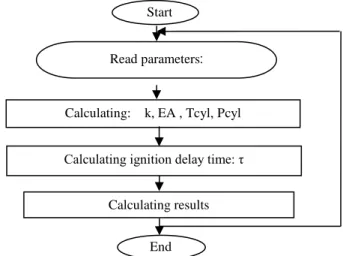
For identification of ignition delay time of a fuel, a calculation algorithm was developed as showed in Figure 1 [6][7].

Figure 1: Algorithm to calculate ignition delay

3.2 Experimental investigation

 

 

 − +

• =

S p

C

m ( )

exp θ π

S p

m C d dm

− •

θ =

θ θ

θ d

dW d dQ d

m du = −

θ θ θ

θ d

dW d dQ d dQ d

m du = − loss

( )

θ θ

θ d

dV V C

RT mC

T T hA d Q df mC d dT

v v

w g in

v

− −

= 1

Calculating: k, EA , Tcyl, Pcyl

Calculating ignition delay time: τ

Calculating results

End Start

Read parameters:

(4)

marine diesel engines. The experimental part of this study was carried out at the Research Center of Marine Diesel Engine (Vietnam Maritime University) [6].

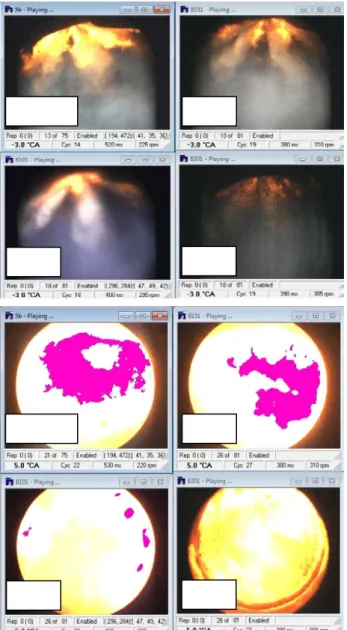
Palm oil was selected as a straight vegetable oil for research and blended palm oil was produced by a continuous fuel mixer which was designed and manufactured by our research team. A medium-sized marine diesel engine 6LU32 (Hanshin-Japan) used as the engine in this study is a four-stroke engine with a turbocharger. This diesel engine drives a hydrodynamic brake which acts as load consumption equipment. Objectives of this experimental research include identifying the actual combustion of blended palm oil (with different amounts by volume of palm oil in the fuel mixture) inside engine cylinders and determining the ignition delay time depending on the percentage of palm oil in fuel mixtures. Furthermore, through special observation equipment called a VisioScope, pictures of combustion occurring inside a cylinder chamber were taken. The real visual pictures of blended palm oil combustion can provide valuable conclusions and recommendations regarding the use of SVOs as fuel for marine diesel engines.

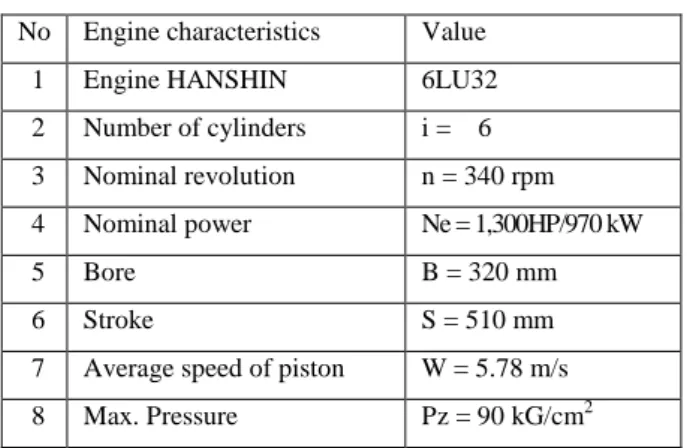
For the purpose of this study, the technical specifications of the 6LU32 diesel engine and the fuel features of blended palm oils are shown in Tables 1 and 2.

In order to avoid confusion with blended bio-diesel fuel, in this paper PO denotes blended palm oil. PO5 means that the fuel mixture contains 5% palm oil while the remaining amount is DO (95%). PO100 is pure palm oil (0% DO).

Table 1: Technical specifications of experimental diesel engine [6]

No Engine characteristics Value

1 Engine HANSHIN 6LU32

2 Number of cylinders i = 6 3 Nominal revolution n = 340 rpm 4 Nominal power Ne = 1,300HP/970 kW

5 Bore B = 320 mm

6 Stroke S = 510 mm

7 Average speed of piston W = 5.78 m/s 8 Max. Pressure Pz = 90 kG/cm 2

Table 2: Fuel features of blended palm oil [6]

No Fuel characteristic Blended fuels and DO DO PO10 PO20 PO30 PO100 1 Density at 15 o C,

[kg/dm 3 ] 0.8464 0.8538 0.8599 0.8668 0.9225 2 Viscosity at 40oC, [cSt] 2.6 3.42 5.31 6.45 40.24 3 Cetane number 42.89 50.13 50.91 52.11 52.92 4 Flash point, [ o C] 72 73 75 77 135 5 Freezing point, [ o C] -6 -1 1 2 16 6 Lower Heating

Value, [MJ/kg] 43.4 39.72 39.55 38.69 37.11

4. Results and discussions

4.1 Model investigation results

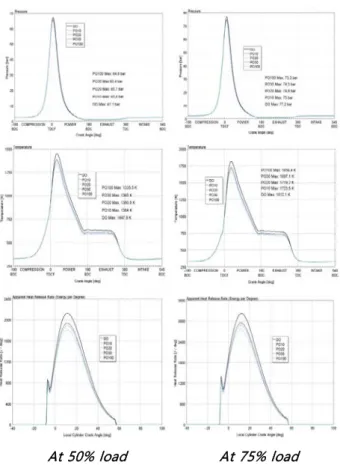
Based on the equations (4), (7), (13), our reasearch team simulated the combustion of blended palm oil at three different loads, namely 100%, 75%, and 50%. Results of the model calculations are presented in Figures 2, 3, and 4.

To analyze the simulation results in detail, we broke down the data into real values of combustion pressure, heat release, and temperature in accordance with different kinds of blended fuels. These are presented in Tables 3, 4, and 5.

Figure 2: Combustion pressure at 100% load

Figure 3: Heat release and combustion temperature

(5)

Figure 4: Combustion pressure, heat release and temperatu re at loads of 50% and 75%

Table 3: Combustion parameter and comparision with DO’s at 100% load

No Fuels

Combustion parameters

Pressure [bar] Heat release [kJ/ o K]

Temperature [ o K]

1 DO 89.2 - 4,300 - 2,170 -

2 PO10 86.2 -3.36% 4,020 -6.51% 2,064 -4.89%

3 PO20 85.8 -3.81% 4,000 -6.98% 2,058 -5.16%

4 PO30 85.1 -4.60% 3,950 -8.14% 2,030 -6.45%

5 PO100 83.9 -5.94% 3,850 -10.49% 1,980 -8.76%

Table 4: Combustion parameter and comparision with DO’s at 75% load

No Fuels

Combustion parameters Pressure

[bar]

Heat release [kJ/ o K]

Temperature [ o K]

1 DO 77.2 - 3,230 - 1,812.1 - 2 PO10 75.0 -2.85% 2,950 -8.67% 1,723.5 -4.89%

3 PO20 74.8 -3.11% 2,940 -8.98% 1,719.2 -5.13%

Table 5: Combustion parameter and comparision with DO’s at 50% load

No Fuels

Combustion parameters Pressure

[bar]

Heat release [kJ/ o K]

Temperature [ o K]

1 DO 67.1 - 2,150 - 1,447.9 - 2 PO10 65.8 -1.94% 1,920 -10.69% 1,384 -4.41%

3 PO20 65.7 -2.09% 1,910 -11.16% 1,380.9 -4.63%

4 PO30 65.4 -2.53% 1,870 -13.02% 1,365 -5.73%

5 PO100 64.8 -3.43% 1,800 -16.28% 1,335.5 -7.76%

In Table 5, results of ignition delay of blended fuels obtained by the model calculation (equation (14)) are shown. Additionally, a comparison is made between the ignition delay times in Table 6.

Table 6: Calculated ignition delay time of blended fuels

Ignition delay in [ o CA]

Blended fuels

DO PO10 PO20 PO30 PO100 2.1978 2.2127 2.2181 2.2279 2.3003 Increase in [ o CA] and

in [%] in comparison with DO

- -

0.0140 0.60

0.020 0.910

0,030 1,365

0.101 4.595

The calculation results for fuel combustion inside diesel engine cylinders show that:

- The combustion of blended fuels is very similar to that of DO fuel. Owing to presence of palm oil in the blends, combustion parameters such as pressure, temperature, and heat release rate are lower than those of DO.

- Differences can be seen most clearly between the combustion of PO100 and DO, but become less clear when engine load is reduced. The gap in peak pressures at 100% load is 5.94% and 3.43% at 50% load;

- The greater the percentage of palm oil in blends, the smaller the output of the engine owing to the lower specific heat of the blended fuel.

- PO100 has the highest ignition delay in comparison with that of DO, measured at a value of 0.101 o CA, equivalent to an increase of 4.595% relative to DO. The differences of ignition time for blends are not very large: 0.6% for PO10 and 1.365% for PO30.

At 50% load At 75% load

(6)

marine diesel engine with the support of high-accuracy measuring equipment. Measurements were taken for combustion pressure, temperature, heat release rate, and ignition delay time in two regimes: 50% load and 75% load.

• Peak pressure

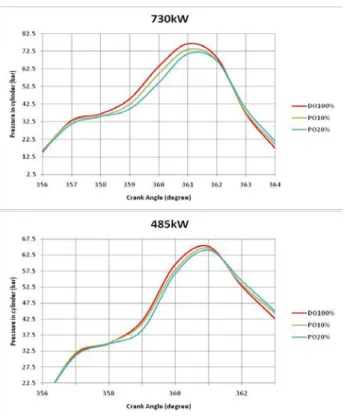
The characteristics of combustion pressure changes are shown in Figures 5 and 6 and details are presented in Table 7.

Figure 5: Pressure in cylinder at 50% load

Figure 6: Pressure in cylinder at 75% load

Table 7: Peak pressure at different engine loads Engine

load

Peak pressure [bar]

Difference [%]

DO PO10 PO20

50% 65.808 64.352 64.106 2.59 75% 76.321 73.555 72.068 5.58

Changes of pressure in cylinders for all blended fuels and DO were the same. The biggest difference of peak pressure is recognized for PO20 relative to DO, with a value of 5.58%.

• Ignition delay

The results of ignition delay of blended palm oil are shown in Figure 7. The research team enlarged pictures of the moment of starting ignition for all kinds of tested blended fuels, and real values measured are presented in Table 8.

Figure 7: Ignition delay of blended palm oils

Table 8: Ignition start of fuels before top dead center (TDC) No Engine

load [kW]

Ignition start of blended fuels before TDC [s]

DO PO10 PO20

1 485 0.0017 0.0017 0.0008

2 730 0.0021 0.0016 0.0012

It can be seen that the ignition start of PO10 before top dead center (TDC) was the same as that of DO at low load and was delayed by 1.31 times at higher load. Also, the delay increased approximately linearly with rising volume fraction of palm oil in the blended fuels.

To demonstrate this result, the VideoScope equipment was

used to observe the combustion process in the cylinder,

especially at the start of ignition, for different kinds of blended

fuels including DO, PO10, PO15, and PO20. The results are

shown in Figure 8.

(7)

Figure 8: Ignition start and burning of fuels

• Heat release

The heat release was recorded and is presented in Figure 9.

At the lower load (50%), the heat release of the fuels is more different than at the higher load (75%). The highest heat release was for DO and the lowest was for PO20. However, the variance was not large at the higher load.

• Emissions

Emissions in the exhaust gas of diesel engines such as CO, CO 2 , HC, and NOx were analyzed by a special AVL AMA i60 R1 measuring system. The results of the experiment are plotted in Figure 10.

Figure 10: Emissions depending on kind of fuels

Among emissions, for the marine field, IMO focuses seriously on NO x content control. The absolute values of NO x

in the experiment associated with different fuels are shown in Table 9.

Table 9: NO x emissions of diesel engine 6LU32 NOx emissions

DO PO10 PO20

ppm g/kWh ppm g/kWh ppm g/kWh

940.45 19.4 894.06 18.6 576.62 13.6

The results show that the greater volume fraction of palm oil in the blended fuels, the lower the NO x emissions in the exhaust gas of the diesel engine. In particular, the NO x

emissions of PO20 were only 13.6 [g/kW.h], which was lower than the allowable NO x emissions limit requested by IMO for the 6LU32 test diesel engine with nominal operation at 320 rpm (requested NO x emission for the test engine is 14.19 g/kW.h).

5. Conclusion

Use of straight vegetable oil is becoming more wide-spread

in the maritime field owing to important advantages of SVO as

(8)

as bad combustion, engine coking, significantly lower output, and so on. Therefore, to avoid the above mentioned problems, it is recommended that blended SVOs should be applied. In order to understand more clearly the possibility of using blended SVOs on basis of the above research results, the following conclusions were found:

- The combustion process of blended palm oil fuels is very similar to that of diesel fuel (DO), as presented in Figures 3 and 6. The study results achieved by model calculations and by experiment showed that the maximum pressure and the heat release of blended fuels are slightly lower than those of DO.

- The difference in ignition delay times of varied SVO blends greatly affect the burning process. Therefore, the volume of palm oil in blends should not exceed 20%.

- Impressive results associated with exhaust gas emissions were recorded for the blended fuels, as well. The content of CO, CO 2 , THC, and NO x decreased with the increasing fraction of palm oil in the blends.

Finally, blended SVOs (palm oil and others) can be used as alternative fuels not only for diesel engines in general, but also for marine diesel engines in the near future.

References

[1] K. Kołwzan, M. Narewski, and P. R. Statków, “Study on alternative fuels for marine applications,” Clean Shipping Currents, vol 1, no 3, 2012.

[2] J. Blin, C.Brunschwig, A.Chapuis, “Characteristics of vegetable oils for use as fuel in stationery diesel engines- towards specification for a standard in west Africa”, HAL archives-ouvertes, 2013.

[3] J. B. Heywood, Internal Combustion Engine Fundamentals, McGraw-Hill Book Company, 1988.

[4] B. Challen and R. Baranescu, Diesel Engine Reference Book, Butterworth-Heinemann, Oxford OX2 8DP, 1999.

[5] P. A. Lakshminarayanan, Y. V. Aghav, Modelling Diesel Combustion, Springer, 2009.

[6] D. V. Uy and research team, “Research and develop a technology solution in order to convert marine diesel engines of small and medium scale to use blended straight vegetable oils as alternative fuel”, No.04.11/NLSH, 2014.

[7] N. P. Quang, “MATLAB & SIMULINK for automatic

control application,” Scientific and technical Publishing,

2003.

수치

Figure 1: Algorithm to calculate ignition delay
Figure 2: Combustion pressure at 100% load
Figure 4:  Combustion pressure, heat release and temperatu re at loads of 50% and 75%
Figure 5: Pressure in cylinder at 50% load
+2

참조

관련 문서

24, The International Council on Clean Transportation, China V Gasoline and Diesel Fuel Quality

Using selected engine performance simulation results as input to the intake faces of the nozzles and ejector CFD simulation to determine pressure loss, temperature levels and

This study makes use of statistical method in estimating the spread of oil supply disruption, which will be the starting point of analysis on oil

¡ 작동 범위 내에서의 어떠한 점도 MCR이 될 수 있으나, MCR을 선정할 때는 마력과 회전수의 Derating 값(MCR, NMCR에서 마력과 회전수의 차이), 프로펠러 회전수,

This study attempts to quantify the economic effects of increases in international oil prices on Korea’s energy and biodiesel industry by using a small open computable

Secondly, in the results of the analysis as to the influence of the Taekowndo leader's leadership on the stress of a Taekowndo player, it appeared that in

This study was conducted to examine the satisfaction of blended learning classes using online videos with Korean elementary and middle school students and

It was found that the NO emission decreased significantly at various condition of operation with the 2-stage combustion type diesel engine, but CO and