Experimental and Numerical Study on Effects of Wall Impingement on Spray and Combustion Characteristics in a Diesel Engine
Yu Liu
*, S. S. Chung
*and J. Y. Ha
†Key Words : Diesel engines, Visualization system, Impinged spray, Free spray, CFD software
Abstract
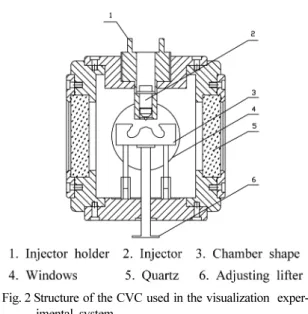
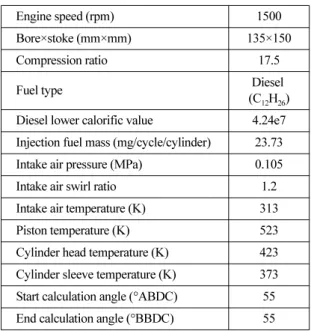
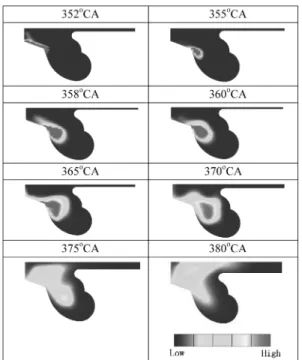
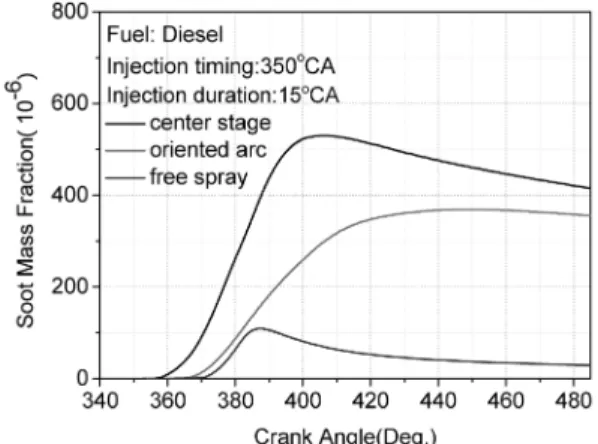
The spray-wall impingement in diesel engines is important to mixture preparation, engine performance and pollutant emissions. The purpose of this paper is to study the effects of spray-wall impingement on fuel distribution, combustion and emission characteristics by using both experimental and numerical methods. To investigate the spray-wall impinge- ment process, an impingement-chamber was designed and a visualization experiment system was also developed. The images of impinged spray and free spray were digitally recorded with an intensified CCD camera. To investigate the fuel distribution, combustion and emission characteristics of impinged spray in a real diesel engine, the fuel injection and com- bustion processes of an engine with impingement-chamber were simulated by CFD software. Equivalence ratio distribution results were obtained to understand the fuel distribution characteristics of the impinged spray. Some combustion and emis- sion characteristics were also acquired and the results showed that ignition delay of impinged spray was shorter than that of free spray; NO emission of the impinged spray was significantly less than that of free spray, but soot emission of impinged spray was more than that of the free spray. This study found that the diesel engine with spray-wall impingement has significant potential to reduce NO emission.
1. Introduction
The spray-wall impingement process, which is caused by the interaction between the spray, the wall and the air, is an important issue affecting mixture preparation and consequent combustion. Therefore it affects engine performance and pollutant emissions.
For example, in port fuel injection systems, it is a common practice to make the fuel spray impinges on the back of the inlet valves to enhance fuel evapora- tion. However, a significant proportion of fuel drop- lets deposit onto the impinged surface, and generates a liquid film which leads to the formation of unburned hydrocarbons. Especially in small bore direct injec- tion engines, the spray-wall impingement is unavoid-
able and the effects of spray-wall impingement can be quite evident. Increased emission of soot, nitric oxides and unburned hydrocarbons have been reported due to spray-wall impingement. Therefore it is neces- sary to study the spray-wall impingement process and its effects on the fuel distribution, combustion and emission characteristics.
Many researches on spray-wall impingement have been performed. For example, Hiroshi used the tur- boKIVA code to develop three-dimensional computa- tions and investigated the effects of wall impingement on combustion characteristics
(1). A modified version of wall-impingement model based on KIVA-3V code was proposed and proven to be adequate for different injection pressures and back pressure by Andreassi
(2). Shim studied the spray-wall impingement process in gasoline direct injection (GDI) engines, and some fundamental data about the effects of ambient tempera- ture and pressure on fuel film mass were obtained
(3). In spite of the previous reports, further study of spray-
(2010
년8
월12
일접수~2010
년9
월13
일심사완료, 2010
년9
월27
일게재확정)
*
Dept. of Mechanical Engineering, Dong-A University, Korea
†