• 검색 결과가 없습니다.

Relationship between Health-Related Quality of Life and Suicide Ideation in a Nationally Representative Sample of Elderly Koreans

N/A
N/A
Protected

Academic year: 2021

Share "Relationship between Health-Related Quality of Life and Suicide Ideation in a Nationally Representative Sample of Elderly Koreans"

Copied!
8
0
0

로드 중.... (전체 텍스트 보기)

전체 글

(1)

https://doi.org/10.15268/ksim.2019.7.1.057 ISSN 2383-9651(Online)

Relationship between Health-Related Quality of Life and Suicide Ideation in a Nationally Representative Sample of

Elderly Koreans

Park Dahye, RN, Ph.D

1

Kim Heejeong, RN, Ph.D

1

Dept. of Nursing, Semyung University, Professor

2ǂ

Dept. of Nursing, Namseoul University, Professor

Abstract

Purpose : This study was implemented to identify the risk conditions influencing suicidal ideation in a nationally representative sample of elderly South Koreans.

Methods : Data from 1,152 men and 1,581 women aged 65 years or older were gathered from the 2013 and 2014 Korea National Health and Nutrition Examination Survey VI. All analyses were performed using SPSS. To determine significant correlations between risk condition and suicidal ideation, a t-test was used.

Results : There were differences in suicidal ideation according to the following individual factors: age, educational background, marital status, economic activity, recognition of stress, experience of depression, and economic status. There were differences in suicidal ideation according to the following health-related factors: subjective health status, EQ-5D (EuroQoL-5 Dimensions), hours of sleep, and BMI. There were also differences in suicidal ideation according to the following disease-related factors: HTN, COPD, asthma, stroke, depression and osteoarthritis.

Conclusion : The findings indicate that broad intervention programs should be distributed to prevent suicidal ideation. It is also recommended that programs be developed in a way that can help manage the variables identified in this study. Furthermore, follow-up studies should be conducted to verify the program.

Key Words : elderly, EQ-5D, South Koreans, suicide ideation

1)

ǂ
Corresponding author : Kim Heejeong, [email protected]

Received : February 20, 2019 | Revised : March 18, 2019 | Accepted : March 22, 2019

※ This paper was supported by the Semyung University Research Grant of 2017.

(2)

Ⅰ. Introduction

In 2011, the death rate by suicide in Korea was 33.3 persons per 100,000; this is 2.6 times higher than the 12.6 persons per 100,000 average described by the Organization for Economic Cooperation and Development (OECD) (Organization for Economic Cooperation and Development, 2013). Moreover, suicide seems to be a particular concern among older adults; indeed, the suicide rate for people aged 80 years and older was 123.3 per 100,000 in 2011, which was four to five times higher than it was among people in their 20s (24.4 per 100,000) and 30s (29.6 per 100,000) (Korean Association for Suicide Prevention, 2011).

Moreover, Korea’s elderly population (aged 65 years and older) was estimated to be 12.2 % of the total population in 2013 and is expected to increase to 24.3 % in 2030 and to 37.4 % in 2050 (Korea National Statistical Office, 2013).

Along with the increase in the aging population, suicide among the elderly has become a serious issue worldwide(Shin et al., 2013).

Moreover, there is a link between suicide ideation and behaviors leading to suicide. Indeed, studies of suicide often focus on actual suicide attempts as well as suicide ideation(Harwood & Jacoby, 2000). Any individual expressing suicidal thoughts or intentions must be treated with caution(Dong et al., 2014; Park et al., 2014); therefore, it is important to obtain a better understanding of suicide ideation among the elderly and the factors that are related to suicide ideation in this population.

The primary objective of this study was to survey the relationship between health related QOL (quality of life) and suicide ideation among elderly Koreans. The specific purpose of this study were to recognize the differences in suicide ideation according to health behaviors, physical characteristics, and psychological health among Koreans aged 65 years and older.

Ⅱ. Methods

1. Ethics Statement

This study's protocol for performing a secondary analysis of data from the Sixth Korea National Health and Nutrition Examination Survey (KNHANES Ⅵ-1,2) carried out in 2013-14 was reviewed and approved by the Institution Review Board (Approval No. 2013-07CON-03-4C and 2013-12EXP-03-5C) of the Korea Centers for Disease Control and Prevention (KCDC). We requested permission from the KCDC to the use the KNHANES survey results for research purposes, and we proffered a data use plan and posted a written pledge on the KNHANES homepage (KCDC, 2011). Informed permission was obtained from all of the participants when the 2013 and 2014 KNHANES were organized.

2. Study Population

The data examined in this study were obtained during the 2013 and 2014 Korea National Health and Nutrition Examination Survey (KNHANES) (KCDC, 2014; KCDC, 2015), which collected statistical data regarding national health status and health-relation conditions that were reported to the World Health Organization (WHO) and OECD. The KNHANES consisted of a health interview survey, a health examination survey, and a nutrition survey.

The data were collected using the EuroQol 5-Dimension (EQ-5D) test, which is an international standardized instrument, and were subjected to χ

2

test and t-test analysis to provide a representative sample of South Korean men and women aged 65 years or older.

The rolling survey sampling method was applied to ensure that the two year samples became independent probability samples that were representative of the country;

in addition, this method was used to guarantee that the

selected samples had similar year-specific features. The

(3)

sample design was based on a stratified multistage probability sampling design that was determined according to the population rate per city, gender and age.

3. Measurement Tools and Methods

1) Suicide ideation

Suicide ideation was measured via the interview question,

“Did you ever think that you wanted to die during the past year?” The response options were “Yes” and “No.”

2) Variates

The following demographic variables were used as variates in this study: age, gender, residential area, educational status, marital status, and economic status.

Educational status was classified as “high” if the respondents indicated that they had completed middle school or higher (i.e. higher than the 7th grade). Marital status was determined by asking participants if they were living with a spouse or if they were not living with a spouse due to divorce or death. Household economic status was determined by the equivalent income (average monthly household income, adjusted according to the number of family members); this was used to identify participants in the bottom 25 % of the sample based on their household economic status.

In addition, smoking, drinking, and regular physical activity were used as health behavior-related variates in the study. Smoking status was determined by the participants’

self-reported smoking behavior (past and present). The amount of pure alcohol consumed in grams per day was used to compute the average number of alcoholic beverages consumed and the frequency of alcohol consumption.

Participants who consumed an average of 11.5 g/day of alcohol were considered to be mild-to-moderate drinkers;

those consuming more than 30 g/day were considered to be heavy drinkers (Choi et al., 2012).

The physical health variables measured in this study were

obesity and the presence of chronic disease (e.g. chronic obstructive pulmonary disease, diabetes, hypertension, osteoarthritis, stroke, and heart disease).

The psychological health variables measured in this study were stress, the experience of depression, depression diagnosed by a doctor, and the use of mental health counselling services, among others. Stress recognition was classified as “yes” if respondents answered that they “feel very strongly,” “feel strongly,” or “feel somewhat” that they have stress in their lives and as “no” if respondents answered that they “feel a little” stress in the lives.

Depression was defined as sadness or despair occurring consecutively for at least two weeks within the past year;

this sadness or despair was considered to be disruptive to one’s daily life. Depression diagnosed by a doctor was confirmed if participants responded “yes” to the following question: “Have you ever been diagnosed with depression by a doctor?” Mental health counselling was determined by examining participants’ references to any experiences receiving counselling for mental problems through a personal visit, telephone consultation, or via the Internet within the previous year.

3) Health-Related Quality of Life (HRQOL)

Data regarding health-related behaviors and variables were gathered use of two self-reporting questionnaires (the AUDIT and the EQ-5D) taken during the 2010 and 2011 KNHANES. The participants’ HRQOL was evaluated use of the EQ-5D (Brooks et al., 2003), a standardized instrument developed by the EuroQol Group (Rabin &

Charro, 2001) that measures five dimensions of HRQOL:

mobility, self-care, usual activity, pain/disability, and anxiety/depression. Participants respond to each item by selecting from the response choices of “0: none,” “1:

moderate,” or “2: severe”. The total score is calculated use

of a quality weight-scoring system specially developed for

the South Korean population that range from 0 to 1, with

a higher score indicating a better HRQOL (Choi et al.,

(4)

2012; Korea Centers for Disease Control and Prevention, 2014; Nam et al., 2007).

4. Data analysis

SPSS 22.0 (SPSS Inc., Chicago, IL, USA) was used for all statistical analyses by applying the sampling weights that had been determined from the analysis of the sampling and response rates in the original data from the survey. The results of the suicidal ideation and EQ-5D measures of continuous variables are presented as mean [standard error (SE)] values.

A comparison of participants according to the suicidal ideation, in terms of general characteristics, health-related

factors, disease-related factors was performed using the χ

2

test and F-test, followed by the Scheffe test as a post-hoc test.

Ⅲ. Results

1. Descriptive analysis of general characteristics

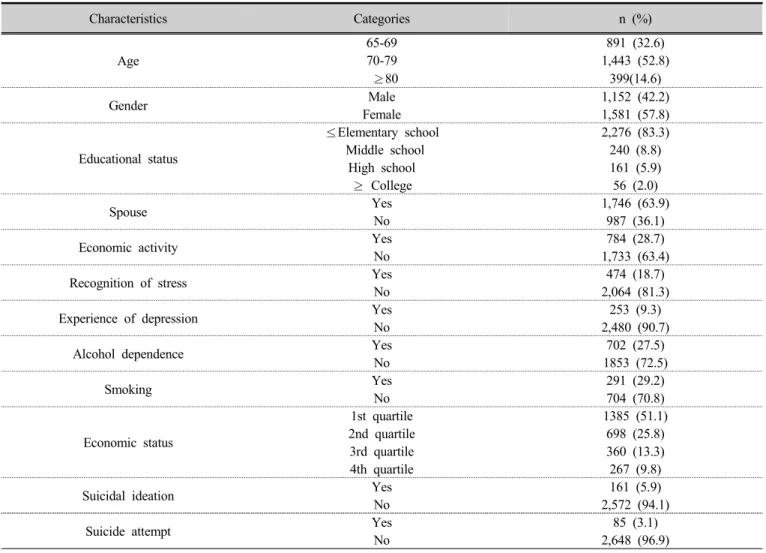
The general characteristics of the participants are shown in Table 1. The study participants included 1,152 males (42.2 %) and 1,581 females (57.8 %). The participants’ ages were as follows: 65-69years, 891 (32.6 %); 70-79years, 1,443 (52.8 %); and over 80years, 399 (14.6 %).

Characteristics Categories n (%)

Age

65-69 891 (32.6)

70-79 1,443 (52.8)

≥80 399(14.6)

Gender Male 1,152 (42.2)

Female 1,581 (57.8)

Educational status

≤Elementary school 2,276 (83.3)

Middle school 240 (8.8)

High school 161 (5.9)

≥ College 56 (2.0)

Spouse Yes 1,746 (63.9)

No 987 (36.1)

Economic activity Yes 784 (28.7)

No 1,733 (63.4)

Recognition of stress Yes 474 (18.7)

No 2,064 (81.3)

Experience of depression Yes 253 (9.3)

No 2,480 (90.7)

Alcohol dependence Yes 702 (27.5)

No 1853 (72.5)

Smoking Yes 291 (29.2)

No 704 (70.8)

Economic status

1st quartile 1385 (51.1)

2nd quartile 698 (25.8)

3rd quartile 360 (13.3)

4th quartile 267 (9.8)

Suicidal ideation Yes 161 (5.9)

No 2,572 (94.1)

Suicide attempt Yes 85 (3.1)

No 2,648 (96.9)

Table 1. Socio-demographic characteristics of subjects (n=2,733)

(5)

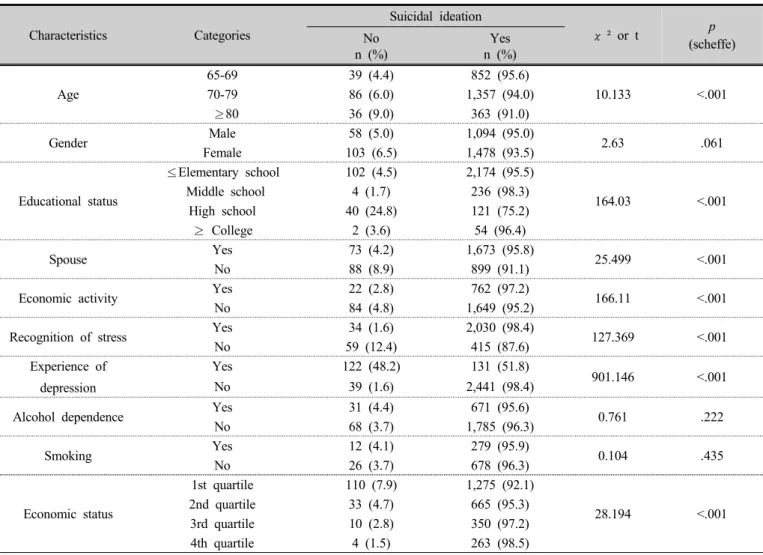
2. Suicide ideation according to demographics and psychological health characteristics

Table 2 shows the differences in suicide ideation according to the participants’ demographics and psychological health characteristics. In general, participants experiencing suicide

ideation were older (p<.001),had an educational background no higher than the 6th grade (p<.001), did not have a spouse (p<.001), and were in the bottom quartile of economic status for the sample (p<.001) when compared to those who did not report suicide ideation.

Characteristics Categories

Suicidal ideation

χ² or t p

(scheffe) No

n (%)

Yes n (%)

Age

65-69 39 (4.4) 852 (95.6)

10.133 <.001

70-79 86 (6.0) 1,357 (94.0)

≥80 36 (9.0) 363 (91.0)

Gender Male 58 (5.0) 1,094 (95.0)

2.63 .061

Female 103 (6.5) 1,478 (93.5)

Educational status

≤Elementary school 102 (4.5) 2,174 (95.5)

164.03 <.001

Middle school 4 (1.7) 236 (98.3)

High school 40 (24.8) 121 (75.2)

≥ College 2 (3.6) 54 (96.4)

Spouse Yes 73 (4.2) 1,673 (95.8)

25.499 <.001

No 88 (8.9) 899 (91.1)

Economic activity Yes 22 (2.8) 762 (97.2)

166.11 <.001

No 84 (4.8) 1,649 (95.2)

Recognition of stress Yes 34 (1.6) 2,030 (98.4)

127.369 <.001

No 59 (12.4) 415 (87.6)

Experience of depression

Yes 122 (48.2) 131 (51.8)

901.146 <.001

No 39 (1.6) 2,441 (98.4)

Alcohol dependence Yes 31 (4.4) 671 (95.6)

0.761 .222

No 68 (3.7) 1,785 (96.3)

Smoking Yes 12 (4.1) 279 (95.9)

0.104 .435

No 26 (3.7) 678 (96.3)

Economic status

1st quartile 110 (7.9) 1,275 (92.1)

28.194 <.001

2nd quartile 33 (4.7) 665 (95.3)

3rd quartile 10 (2.8) 350 (97.2)

4th quartile 4 (1.5) 263 (98.5)

Table 2. An analysis of differences in suicidal ideation according to individual factors (n=2,733)

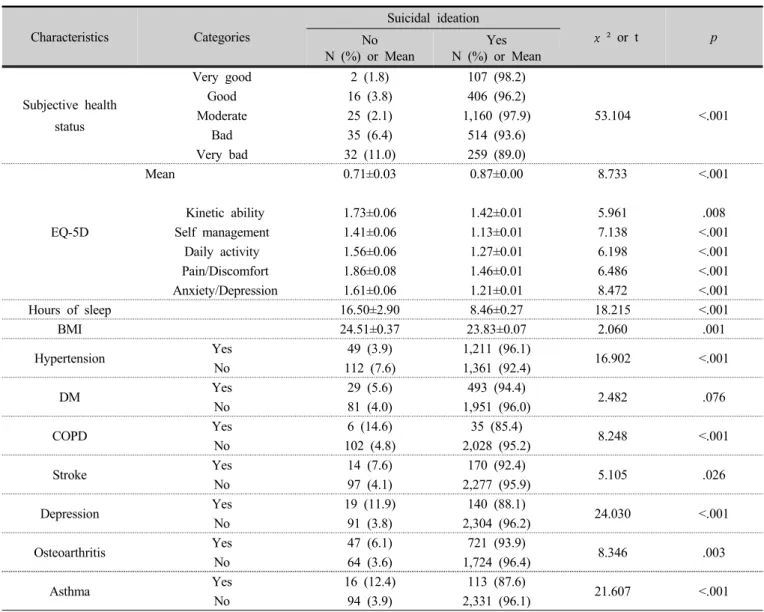
2. Suicide ideation according to health behaviors and physical health characteristics

Table 3 shows the differences in suicide ideation according to participants’ health behaviors and physical health characteristics. All respondents with chronic diseases, excluding DM, reported suicide ideation; however, only those with HTN (p<.001), COPD (p<.001), stroke (p<.026), depression (p<.001),

osteoarthritis (p<.003), and asthma (p<.001) were statistically

different from those without chronic diseases. With regard to

psychological health characteristics, participants who reported

stress (p<.001), reported experiencing depression (p<.001), were

diagnosed with depression by a doctor (p<.001), or were

undergoing mental health counselling (p<.001) reported higher

rates of suicide ideation.

(6)

Characteristics Categories

Suicidal ideation

χ² or t p

No N (%) or Mean

Yes N (%) or Mean

Subjective health status

Very good 2 (1.8) 107 (98.2)

53.104 <.001

Good 16 (3.8) 406 (96.2)

Moderate 25 (2.1) 1,160 (97.9)

Bad 35 (6.4) 514 (93.6)

Very bad 32 (11.0) 259 (89.0)

EQ-5D

Mean 0.71±0.03 0.87±0.00 8.733 <.001

Kinetic ability 1.73±0.06 1.42±0.01 5.961 .008

Self management 1.41±0.06 1.13±0.01 7.138 <.001

Daily activity 1.56±0.06 1.27±0.01 6.198 <.001

Pain/Discomfort 1.86±0.08 1.46±0.01 6.486 <.001

Anxiety/Depression 1.61±0.06 1.21±0.01 8.472 <.001

Hours of sleep 16.50±2.90 8.46±0.27 18.215 <.001

BMI 24.51±0.37 23.83±0.07 2.060 .001

Hypertension Yes 49 (3.9) 1,211 (96.1)

16.902 <.001

No 112 (7.6) 1,361 (92.4)

DM Yes 29 (5.6) 493 (94.4)

2.482 .076

No 81 (4.0) 1,951 (96.0)

COPD Yes 6 (14.6) 35 (85.4)

8.248 <.001

No 102 (4.8) 2,028 (95.2)

Stroke Yes 14 (7.6) 170 (92.4)

5.105 .026

No 97 (4.1) 2,277 (95.9)

Depression Yes 19 (11.9) 140 (88.1)

24.030 <.001

No 91 (3.8) 2,304 (96.2)

Osteoarthritis Yes 47 (6.1) 721 (93.9)

8.346 .003

No 64 (3.6) 1,724 (96.4)

Asthma Yes 16 (12.4) 113 (87.6)

21.607 <.001

No 94 (3.9) 2,331 (96.1)

Table 3. An analysis of differences in suicidal ideation according to health-related factors (n=2,733)

Ⅳ. Discussion

We found that certain demographic characteristics of the elderly participants affected suicide ideation; specifically, participant age, marital status, educational background, economic status, recognition of stress, and experience of depression had an effect on suicide ideation. These findings are consistent with previous work. Specifically, researchers have reported a positive association between age and suicide ideation (Dong et al., 2014) and a negative

association between suicide ideation, educational background, and economic status (Choi & Kim, 2008; Dong et al., 2014) Moreover, previous research has indicated that there is a higher likelihood of suicide ideation among females (Dong et al., 2014; Wang et al., 2013) and unmarried or cohabiting individuals (Choi & Kim, 2008;

Dong et al., 2014; Wang Z et al., 2013).

When chronic diseases were examined, only osteoarthritis

and heart disease were found to cause statistically

significant differences in suicide ideation. This may be

(7)

because osteoarthritis and heart disease decrease an individual’s quality of life due to significant disability and poor physical performance (Parker, 2014). Thus, this finding is consistent with research reporting a relationship between physical illness or poor health status and elderly suicide (Choi & Kim, 2008; Dong et al., 2014). Therefore, to help prevent suicide among the elderly, health status characteristics should be considered in future research.

These main findings propose that board intervention programmes should be distributed to prevent problems of suicidal ideation. It is also recommended that programs be developed that can help manage the variables identified in this study and that follow-up studies be carried out to verify the model.

Furthermore, researcher should extend the present findings by identifying additional mediating factors that affect suicide ideation among the elderly.

Ⅴ. Conclusion

This study was implemented to identify the risk conditions influencing suicidal ideation in a nationally representative sample of elderly South Koreans. Data collected from 1,152 men and 1,581 women aged 65 years and older were gained from the 2013 and 2014 Korea National Health and Nutrition Examination Survey VI.

There were differences in suicidal ideation according to the following individual factors: age, educational background, marital status, economic activity, recognition of stress, experience of depression, and economic status. There were differences in suicidal ideation according to the following health-related factors: subjective health status, EQ-5D (EuroQoL-5 Dimensions), hours of sleep, and BMI. There were also differences in suicidal ideation according to the following disease-related factors: HTN, COPD, stroke, depression, osteoarthritis, and asthma. These main findings propose that board intervention programs should be

distributed to prevent problems of suicidal ideation. It is also recommended that program be developed that can help manage the variables identified in this study and that follow-up studies be conducted to verify the model.

References

Brooks R, Rabin R, Charro F(2003). The measurement and valuation of health status using EQ-5D: A European perspective : evidence from the EuroQol BIOMED Research Programme. Dordrchet, Kluwer Academic Pub.

Choi JY, Ha HS, Kwon HS, et al(2012). Characteristics of metabolically obese, normal-weight women differ by menopause status: the Fourth Korea National Health and Nutrition Examination Survey. Menopause, 20(1), 85-93.

Choi YH, Kim SH(2008). Suicide ideation and related factors according to depression in order adults. J Korean Geriatr Soc, 28, 345-355.

Dong X, Chen R, Wong E, et al(2014). Suicidal ideation in an older US Chinese population. J Aging Health, Advanced Online Publication, 26(7), 1189-1208.

Harwood D, Jacoby R(2000). Suicidal behavior among the elderly. In A. Hawton & K. von Heeringen (Eds.), The international handbook of suicide and attempted suicide, West Sussex, John Wiley & Sons, pp.275-291.

Korean Association for Suicide Prevention(2011). Annual suicide report in Korea. Seoul.

Korea National Statistical Office(2013). 2013 Statistics on the aged. Daejon.

Nam HS, Kwon SS, Ko KO, et al(2007). EQ-5D Korean valuation study using time trade off method. Seoul, Korea Centers for Disease Control and Prevention.

Parker L, Moran GM, Roberts LM, et al(2014). The

burden of common chronic disease on health-related

quality of life in an elderly community-dwelling

population in the UK. Family Practice, 31(5), 557-563.

(8)

Park JI, Han MI, Kim MS, et al(2014). Predictors of suicidal ideation in older individuals receiving homecare services. Int J Geriatr Psychiatr, 29(4), 367-376.

Rabin R, Charro FD(2001). EQ-SD: a measure of health status from the EuroQol Group. Ann Med, 33(5), 337-343.

Shin KM, Cho SM, Hong CH, et al(2013). Suicide among the elderly and associated factors in South Korea. Aging

& Mental Health, 17(1), 109-114.

Wang Z, Qin Y, Zhang Y, et al(2013). Prevalence and correlated factors of lifetime suicidal ideation in adults in Ningxia, China. Shanghai Archives of Psychiatry, 25(5), 287-294.

Korea Centers for Disease Control and Prevention (KCDC).

Korea National Health and Nutrition Examination Survey (KNHANES V-1), 2011. Available at

http://knhanes.cdc.go.kr. Accessed 17 Sep 2013.

Korea Centers for Disease Control and Prevention (KCDC).

Korea National Health and Nutrition Examination Survey (KNHANES VI-1), 2014. Retrieved from https://knhanes.cdc.go.kr/knhanes/index.do. Accessed 27 June 2017.

Korea Centers for Disease Control and Prevention.

(KCDC). Korea National Health and Nutrition Examination Survey (KNHANES VI-2), 2015. Retrieved from https://knhanes.cdc.go.kr/knhanes/index.do.

Accessed 27 June 2017.

Organization for Economic Cooperation and Development (OECD). OECD indicators, 2013. Available at http://dx.doi.org/10.1787/health_glance-2013-en/

Accessed 17 Sep 2013.

수치

Table 1. Socio-demographic characteristics of subjects                      (n=2,733)
Table 2 shows the differences in suicide ideation according  to the participants’ demographics and psychological health  characteristics
Table 3. An analysis of differences in suicidal ideation according to health-related factors  (n=2,733)

참조

관련 문서