Investigation of the 7th Grade Science-gifted Students’ Understanding about the Lunar Phase through Their Own Observation and Interpretation
Eunsook Kim1,*, Hee-Won Yu2, and Seung-Urn Choe2
1SNU Gwanak Gifted Education Institute, Seoul National University, Seoul 151-748, Korea
2Department of Earth Sceince Education, Seoul National University, Seoul 151-748, Korea
Abstract: As homework, a total of 32 seventh grade science-gifted students were asked to observe the moon at daily intervals for one month duration. They were also asked to take the photos and to record relevant variables in a given format. The purpose of the task was to investigate what students thought, as they observed the moon. The results show that students paid attention mainly to the position of the moon relative to other variables such as the date in the lunar calendar, the observer’s position on the earth, and the position of the sun. Overall students’ response implied that students did not observe the lunar phase in relation with relevant variables. Some reponses from students show common misconceptions such as the cause of the lunar phase to reflect the shadow of the earth. However, some responses reveal students’ idea that has been rarely reported in the previous researches. For example, some students drew the moon to revolve in the opposite direction. Significant number of students drew the sun’s position to be due west before the full moon and due east after the full moon. Few students recognized the relation between the time of observation and observer’s position on the earth. The results of current research suggest that not only the education but also the research needs to be expanded to consider informal environment such as the actual field conditions.
Keywords: moon, lunar phase, observation in field, science-gifted student
Introduction
A scale of any phenomena in astronomy is huge in time and space. Every phenomenon takes place outside in the sky and it takes long time for an observer on the earth to find any pattern. A pattern in the lunar phases can be observed in a relatively short time and used as one of the first topics introduced in textbooks, making the lunar phases to be the foundation to other astronomical phenomena. Therefore, research on the lunar phases is quite active in science education.
Research on students’ understanding of the lunar phases is most active, revealing similar misconceptions for students with different ages and pre-service teachers (Chae, 1996; Kim and Lee, 1995; Kim and Park, 1997; Myeong, 2001; Philips, 1991; Stahly et al., 1999; Sung, 2008; Sung and Choe, 2008;
Trumper, 2001; Trundle et al., 2002, 2007). For example, the idea that earth’s shadow caused the lunar phases was found to be the most common misconception in various research results (Trundle et al., 2002; Kim, 2006). The earth’s rotation or weather, cloud for example, have also been frequently mentioned as the cause of phase change. Some researchers reported that understanding the basic optics was closely related to understanding the lunar phases (Kim and Lee 1995; Kim and Park 1997). Significant number of students did not understand relative position of sun-earth-moon, and had confusion between revolution and rotation (Kim, 2006; Lee et al., 2008; Sung and Choe 2008).
Analysis on textbooks showed that a view from the earth and a view from the universe were mixed and used inconsistently (Chae 2009; Lee and Choe, 2008).
The text, figures, and activities of textbooks were inconsistent (Chae 2009). It is also reported that the huge scale of the related objects, such as the relative size of the sun, the earth, and the moon or the long distance from the sun were not clearly explained
*Corresponding author: [email protected]
*Tel: +82-2-880-7611
*Fax: +82-2-886-5262
causing more confusion (Lee and Choe, 2008).
Various suggestions for textbooks or activities have been made to improve the understanding of the lunar phases. Some researchers tried to modify text, figures or activities (Chae 2008, 2009). Others suggested to add more accurate information about relative orientation of orbits of the moon and the earth to offer the basis to imagine relative position of the sun, the earth, and the moon in three dimensional space (Lee et al., 2008). Some developed a lunar phase drawing module for students (Kim, 2006). Because of the familarity and complexity, the lunar phase has also been used frequently to investigate the consistency in model construction, or explanation of a phenomena (Oh, 2006; Oh and Kim, 2006).
The main tools to study students’ understanding of the lunar phase in the previous researches have been an interview or written surveys. They were done inside the building using small models, text or figures printed on paper and guided by the researcher. On the other hand, it is well known that there is a gap between school science and students’ experience in the field (Orion, 1993). In this research, students were asked to observe and interpret the moon at the sky at daily intervals for one month duration. The research questions were then given as follows.
First, what are the important variables that students perceive when they watch the moon in the sky?
Second, how do students understand variables relevant to the lunar phase?
Research Method and Procedure
Research subjects
Research subjects were 32 science-gifted 7th grade students enrolled in the G Education Institute for Gifted (GEI) in Seoul. Students did not have any lessons related to the lunar phase at the center. Their learning about the lunar phase consists of the formal education based on the national curriculum and any information through informal channel. Table 1 shows the related contents in the national curriculum.
Instrument and data collection
Because GEI is not a regular school, the classes are given on every other Saturday. In autumn semester, there was about one month period without class due to Chuseok, Korean Thanksgiving Day (August 15th in the lunar calendar). During this period a homework was assigned to students to observe and interpret the lunar phases. The homework was explained during class just before the holiday period and the detailed instruction was posted on the GEI's homepage again.
Students handed in the assignment at the first class after the holiday period.
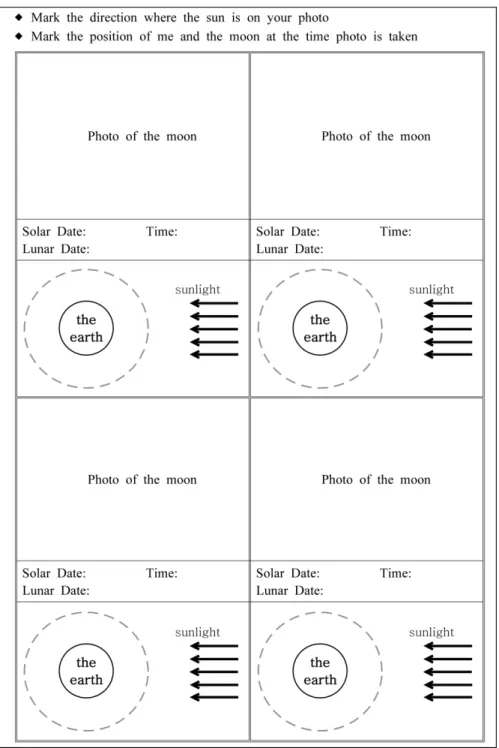
Students’ assignment was basically to take pictures and keep the record using observation note (Fig. 1) everyday. Observation note was developed by the authors and checked by three school teachers. The note has a picture to mark the position of the moon and the observer and spaces for the photo, date (solar
Table 1. Related contents in the national curriculum
Grade Related contents in the national curriculum (revised in 2007)
3rd
Light travels staight.
(a) Explain how shadow forms by the light traveling straight (b) Know the factors affecting the size of shadow
5th
The earth and the moon
(a) Compare the surface of the earth and the moon
(b) Explain the day and night in relation with the earth’s rotation (c) Explain the direction of the moon’s motion for one day
(d) Know the change in position and the shape of the moon at the same time of the day after the sunset for several days and explain the reason for change
6th
Light
(a) Understand light going straight, the reflection and refraction
(b) Explain the procedure of seeing an object in relation with motion of light
and lunar) and time. Using this note students kept the record of four variables, the lunar date, position of the moon around the earth, the position of the observer on the earth and the direction where the sun would be.
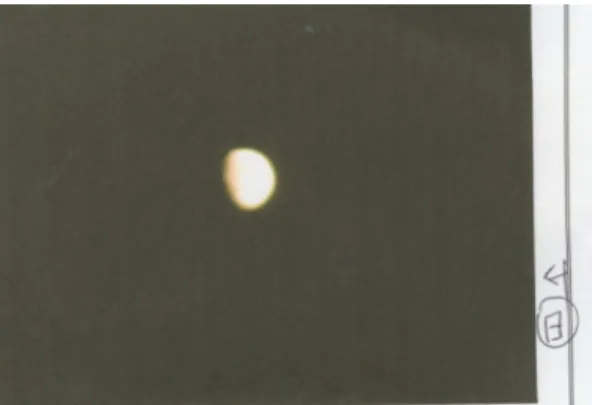
The sun’s direction was to be marked on the photo.
Figure 2 shows an example of drawings done by
students. Helpful tips to take photos including a list of proper time for each day were also posted on GEI’s homepage. The task was to be done for one month and there was no limits in consulting with others or searching information through internet and other materials.
Fig. 1. Observation note for moon.
Results
The assignment was announced on Sept. 11th in the class and on the homepage. It was due on Oct. 9th.
Twenty students out of 32 students enrolled in science classes turned in their assignments. The results were evaluated in two ways. First, the number of students, who kept the record for each of the four variables, was counted. Second, student’s idea was investigated using the patterns revealed in their records of four variables over several days.
Variables important to students
Considering all the related variables is not a simple task. Previous research shows that students of all ages have difficulties understanding the lunar phase.
However, in this research no-response is interpreted as low interest of a student. The reasons for this interpretation are the following.
First, this activity was an assignment and enough time (one month) was given to finish it. Students had no limits in searching information or consulting other people. They were encouraged to call GEI for any questions. Therefore no response means students’
interest to find proper answer was not very high.
Second, the teachers who reviewed the assignment agreed that the task would appear to be easy enough to the students so that they were willing to do the task.
Third, there was an activity report, which is done by participating students for every class or activity in GEI. Students said task was somewhat difficult, but covering an interesting subject that they were curious about and wanted to learn more. The difficulties reported were mostly about the taking pictures because it was night time and the moon was very far.
As mentioned before 20 students (62%) responded revealing relatively low interest in the lunar phase, although it is a familiar phenomenon. The number of days that photos were taken varies from 3 days to 20 days, and only 6 students (30%) recorded the required information for all four variables, the lunar date, the direction of the sun’s position, position of the moon and the position of the observer. Table 2 shows the number of students who made record of each variable.
The variable with the most responses was the position of moon. The lunar date and the observer’s position followed and the sun’s position had the least responses. It is interesting that sun, the source of the light of this phenomena, and the position of the observer, who is the student him/herself, received the low attention among the 4 variables. It shows that students tend to consider the moon only when they watch the moon, and ignore other objects such as sun.
This implies that many students do not consider the lunar phase as a phenomenon resulting from a combination of various variables, such as relative position of the earth, the moon, and the sun.
Student’s understanding of variables relevant to the lunar phase
Students’ drawings showed their ideas about the lunar phase. Some of them had been reported in the Fig. 2. An example the sun’s direction by a student on the
photo.
Table 2. Number of students who recorded the information for each variable
Lunar date Sun Moon Observer
Number of students with response 12 (60%) 8 (40%) 15 (75%) 10 (50%)
Number of students without response 6 (30%) 12 (60%) 5 (25%) 10 (50%)
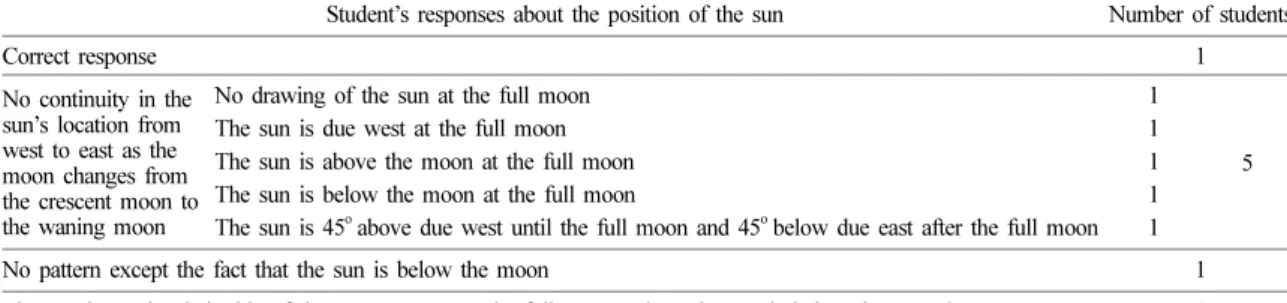
previous research articles. But there were significant number of ideas that were rarely reported, implying that student’s own observation and interpretation are an area worth investigating. The responses for each variables are shown in Tables 3, 4 and 5. In these Tables, ideas that had been reported in the previous research are marked by *. Student's ideas revealed from their drawings of the sun, the earth, and the moon are described below.
The sun’s position: Eight students marked the direction where the sun would be. The responses of students are described in Table 3. Among them only one response is qualitatively correct. There are five other students who drew the sun on the bright side of the moon. But they tend to draw the sun located due west of the moon before the full moon and due east of the moon after the full moon, and the sun stayed above the horizon at all time. At the full moon one drew the sun above the moon another drew below.
While most of the students think the sun is on the bright side of the moon, only two students have the sun at lower position than the moon.
The above result suggests a possibility that students see their photos as a collection of separate instances
and fail to see the continuity between instances, which is worthy of further investigation.
One student have the sun on the dark side of the moon revealing a similar idea that the earth’s shadow causes the lunar phases.
The observer’s position: As mentioned earlier only half the students marked the observer’s position on the earth. The observer’s position can be derived from the time the photo was taken. Table 4 shows the students’
responses. There are four students’ whose responses show consistently correct markings.
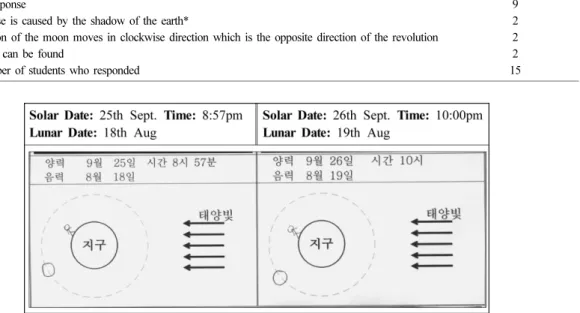
Although most of the students drew the observer on the opposite side of the sun, the positions were not consistent with the time. For example, one student drew the observer on the same spot on the earth at eight different times. Two pictures among them are shown in Fig. 3.
The moon’s position: Students had a high interest in the position of the moon, with 15 responses out of 20.
The number of correct responses, 9 was also the highest (Table 5). Students might find this part easier because the drawing used in the observation note was similar to the picture frequently used to explain the Table 3. Student’s responses about the position of the sun (* marks the idea that had been reported in the previous researches.)
Student’s responses about the position of the sun Number of students
Correct response 1
No continuity in the sun’s location from west to east as the moon changes from the crescent moon to the waning moon
No drawing of the sun at the full moon 1
5
The sun is due west at the full moon 1
The sun is above the moon at the full moon 1
The sun is below the moon at the full moon 1
The sun is 45o above due west until the full moon and 45o below due east after the full moon 1
No pattern except the fact that the sun is below the moon 1
The sun is on the dark side of the moon except at the full moon, where the sun is below the moon* 1
Total number of students who responded 8
Table 4. Student’s responses about the position of the observer
Student’s responses about the position of the observer Number of students
Correct response 4
Observer at fixed position 3
No relation between the observer position and time 2
A picture trying to show the moment when the moon is at the highest point 1
Total number of students who responded 10
lunar phase. This familiarity might explain the high ratio of correct answers also.
Two students drew the moon between the earth and the sun, which agrees with a well known misconception that the shadow of the earth causes the lunar phases.
Comparing this picture with other pictures of these students confirms this misconception. In two other students' responses the moon is revolving clockwise, which is the opposite to the moon’s revolution.
Conclusion and Suggestion
To investigate what students think when they watch the moon in the sky, a group of thirty two 7th grade science-gifted students were asked to observe and take photos of the lunar phases while recording relevant variables in a observation note for a month. Based on students responses, the authors conclude the following.
First, students did not pay much attention to the relevant variables influencing the lunar phase except the position of the moon. Students were asked to keep the record of four variables, the lunar date, the direction where the sun would be, the position of the moon, and the position of the observer on the surface
of the earth.
No response is interpreted as low interest in that particular variable. The number of students who handed in their assignment was 20 out of 32 students, showing that the interest in the lunar phase itself is not very high. Among variables, the position of the moon received 15 responses out of 20 with 9 correct answers. The moon is the variable with the highest response among four. The number of responses for other variables are 12 for the lunar date, 10 for observer’s position, and 8 for the sun implying lowest interest in the sun.
Second, students’ drawings for relevant variables showed some of their understanding or misunderstanding regrading the lunar phase. Although the investigation was limited because of the low response ratio, recording over a period of time revealed some interesting results rarely reported in the previous research.
Some of the new findings regarding student’s idea are the moon revolving in the wrong direction, the sun located either due west or due east of the moon, and no connection between the time of observation and the observer’s position on the surface of the earth.
Table 5. Student’s responses about the position of the moon (* marks the idea that had been reported in the previous researches.) Student’s responses about the position of the moon Number of students
Correct response 9
Lunar phase is caused by the shadow of the earth* 2
The position of the moon moves in clockwise direction which is the opposite direction of the revolution 2
No pattern can be found 2
Total number of students who responded 15
Fig. 3. The observer is on the same spot at different times.
These findings suggest that some of student’s ideas are revealed in a particular context such as field observation. A well known misconception that the shadow of the earth causes the lunar phase has been found in current investigation, too.
It has been well known that there is a gap between school science and the students’ experience in the field. The field trips and other informal education have been encouraged to help closing the gap. The result of this research reveals some of the students ideas about the lunar phase that have not been reported. This leads to the possibility of an area in students' understanding which cannot be probed by the interview or written survey only. Therefore, not only the education but also the research needs to expand its area to explore students’ understanding in the field and other informal educational environment.
References
Chae, D., 2009, An Analysis of ‘The Phases of the Moon’, Contents of 9th Grade Science Textbook, Journal of the Korean Association for Science Education, 29, 874-885.
Chae, D., 2008, The development and application of the new model of the moon phases. Elementary Science Education, 27, 385-398.
Chae, D., 1996, Students’ naive theories on the phases of the moon. Elementary Science Education, 15, 45-55.
Kim, C.J. and Lee, J., 1995, The Relationship among sec- ondary school students’ conceptions about the phase change of the Moon and Light. Journal of the Korean Earth Science Society, 17, 8-21.
Kim, C.J. and Park, H.J., 1997, The relation among ele- mentary students’ conception about the phase change of the moon and light; an approach based on conceptual ecology. Elementary Science Education, 16, 173-187.
Kim, J.H., 2006, High school students’ conceptual change of the lunar phases of instruction using the lunar phases drawing module. Journal of the Korean Earth Science Society, 27, 353-363.
Lee, M. and Choe, S.U., 2008, Complementary models for helping secondary school students to develop their understanding of the moon phases. Journal of the Korean Earth Science Society, 29, 60-77.
Myeong, J., 2001, Reasons for unsuccessful earth science problems solving of pre-service teachers: A study on the motion of the moon and the planets. Journal of the Korean Earth Science Society, 22, 339-349.
Oh, J.Y., 2006, An explanatory consistency of preservice secondary teachers’ explanations about the lunar phases.
Jouranl of the Korean Earth Science Society, 27, 606- 619.
Oh, J.Y. and Kim, Y.S., 2006, Preservice elementary teacher mental models about astronomical phenomena:
seasons and the moon phases. Journal of the Korean Association for Science Education, 26, 68-87.
Orion, N., 1993, A model for development and implemen- tation of field trips as an integral part of the science curriculum. School Science and Mathematics, 93, 325- 331.
Philips, W., 1991, Earth science misconceptions. The Sci- ence Teacher, 58, 21-23.
Stahly, L.L., Krockover, G.H., and Shepardson, D.P., 1999, Third grade students’ ideas about the lunar phases.
Journal of Research in Science Teaching, 36, 159-177.
Sung, N.H., 2008, Students’ mental models of the moon phases and science curriculum articulation. Master’s Thesis, Seoul National University, Seoul, Korea, 84 p.
Sung, N.H. and Choe, S.U., 2008, A comparative study of knowledge integration in the textbook and students mental model about the phases of the moon. Journal of the Korean Earth Science Society, 29, 163-174.
Trumper, R., 2001, A cross-age study of junior high school students’ conceptions of basic astronomy concepts.
International Journal of Science Education, 23, 1111- 1123.
Trundle, K.C., Atwood, R.K., and Christopher, J.E., 2007, A longitudinal study of conceptual change; Preservice elementary teachers’ conceptions of the moon phases.
Journal of Research in Science Teaching, 44, 303-326.
Trundke, K.C., Atwood, R.K., and Christopher, J.E., 2002, Preservice elementary teachers’ conceptions of the moon phases before and after instruction. Journal of Research in Science Teaching, 39, 633-658.
Manuscript received: July 19, 2011 Revised manuscript received: September 18, 2011 Manuscript accepted: September 19, 2011