INTRODUCTION
Many studies with respect to therapeutic or sub therapeutic use of antibiotic improved growth performance but decreased mortality and morbidity in production animals (Doyle, 2001).
However, critical anxiety raised about transmitting bacterial antibiotic resistance in humans and discharge of antimicrobial compounds (i.e., zinc, copper) to the environment (Ogawara, 1981; Russell, 1991; Han, 2007). In this regard, much interests in alternatives/replacements for dietary antimicrobial products are increasing in poultry production (Patterson and Burkholder, 2003; Niewold, 2007).
There are many different kind of plant extract (barley, whole grains, oak, etc.) which affects antioxidant capacity depending on the amounts of polychemicals (Duh et al., 2001;
Liu, 2007; Mateo et al., 2009; Num et al., 2017). However, many antioxidative phenolic compounds in plants are predomi- nantly present in a covalently bound form with an insoluble polymer (Gong et al., 2012). Therefore, it is necessary to find an effective processing method to release these compounds.
Several methods including heat treatment (steam explosion and torrefaction), far-infrared (FIR) radiation, and enzymatic treat- ment, have been studied in order to liberate and activate low-molecular-weight antioxidants from various plants (Ahajji
Determination of Growth Performance, Viscera Organ Weights and Ileal Intestinal Architecture of Broilers in Response to Drinking Water
Added Extractions from Wooden Chips for the Starter Period
Shemil Priyan Macelline
1,*, Samiru Sudharaka Wickramasuriya
1,*, Taeg Kyun Shin
1, Eunjoo Kim
1, Hyun Min Cho
1, Jun Seon Hong
1, Jeong Bin Nam
2, Seung Min Yang
3, Geun Hye Oh
3,
Seog Goo Kang
4and Jung Min Heo
5,†1
Student, Department of Animal Science and Biotechnology, Chungnam National University, Daejeon 34134, Republic of Korea
2
Research Professor, Department of Bio-Based Materials, Chungnam National University, Daejeon 34134, Republic of Korea
3
Student, Department of Bio-Based Materials, Chungnam National University, Daejeon 34134, Republic of Korea
4
Professor, Department of Bio-Based Materials, Chungnam National University, Daejeon 34134, Republic of Korea
5
Professor, Department of Animal Science and Biotechnology, Chungnam National University, Daejeon 34134, Republic of Korea
ABSTRACT A total of 90 one-day-old male broilers (Ross 308) were randomly assigned to one of the three dietary treatments, each consisting of six replicates (5 broilers/cage). The dietary treatments were 1) control (CON: fresh clean water with no supplement); 2) low dose [LD: CON + 1.56% extractions from the wooden chips (EWC)] and 3) high dose (HD:
CON + 12.5% EWC). Drinking water supplemented with EWC was provided using specifically designed individual nipple drinker units. Average daily water intake (ADWI), average daily gain (ADG), average daily feed intake (ADFI), and feed conversion ratio (FCR) were measured weekly for 21 days. One broiler from each cage was euthanized for measuring the visceral organ weights and collecting ileal tissue samples for ileal architecture analysis on day 21. Broilers assigned to the LD and HD watery groups showed higher ADWI than that in broilers consumed CON on day 7 (P<0.05). The broilers subjected to HD treatment showed a deeper crypt depth (P<0.05) than that in broilers subjected to LD and CON on day 21.
Therefore, broilers consumed HD showed a lower (P<0.05) villus height:crypt depth ratio than that broilers consumed CON on day 21. Broilers provided drinking water containing any of the tested concentrations of EWC showed no effect (P > 0.05) on growth performance, ileal villus height, and visceral organ weights as compared with those in the CON from hatch to 21 days. In conclusion, broilers fed HD showed reduction in villus height:crypt depth ratio without impairing growth performance and visceral organ weights for the experimental period.
(Key words: extractions from the wooden chips, growth performance, viscera organ weights, water intake)
*
These authors have contributed equally to this work.
†
To whom correspondence should be addressed : [email protected]
et al., 2009). Heat treatment of wood at moderate tempe- ratures (200∼250℃) under an inert atmosphere (to avoid oxidative degradation) leads to formation of torrefied or heat-treated wood (Ahajji et al., 2009). Antioxidative phenolic compounds can be present in raw materials or produced during the heat-treatment process (Avat, 1993; Ahajji et al., 2009).
The purpose of the present study was to determine the beneficial effect of organic acids and phenolic compounds present in the extracts from Oak wood chips on broiler (Ross 308) growth performance, ileal intestinal architecture and viscera organ weights from hatch to 21 days.
MATERIAL AND METHODS
Experiment procedures were investigated and approved by the Animal Ethics Committee of the Chungnam National University (CNU-00903).
1. Housing and Managements
This study was conducted in the research facility of the Chungnam National University of South Korea. Eighteen wire floor cages (0.85 × 0.55 × 0.35 m
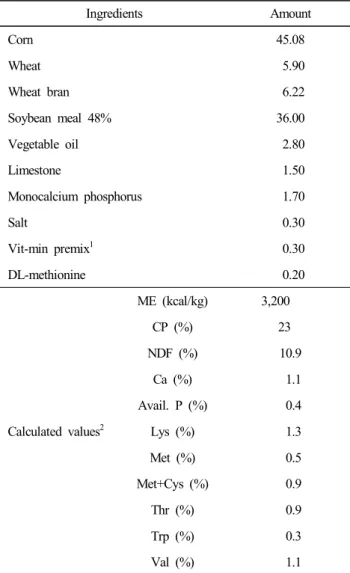
3) were used as experiment units. Each cage consisted with specifically design individual nipple drinker unit with two nipple drinkers and a metal through feeder. All the broilers were allowed to ad-libitum access of corn and soybean-meal diet (Table 1) formulated to meet the nutrition requirement of poultry (NRC, 1994) without incorporation of any antibiotic growth promoters. The ambient temperature was maintained at 30±
1 ℃ from days 1 to 3 and then gradually decreased to 25±1℃
and it was maintained until the end of the experiment.
2. Preparation of Extractions from Wooden Chips
Torrefaction of the oak wooden chips was achieved using a laboratory scale reactor as described by Nam et al. (2018).
A prescribed amount of oak wooden chips was weighed and placed in the center of the reactor. An external dryer was used to dry the chips to <15% moisture prior to torrefaction.
The wooden chips were torrefied at 240 ℃ temperatures for 24 h. After torrefaction, the material was ground and sieved to a maximum particle size of 60 mesh. The torrefied material
Table 1. Composition (% as-fed basis) of the experimental diet
Ingredients Amount
Corn 45.08
Wheat 5.90
Wheat bran 6.22
Soybean meal 48% 36.00
Vegetable oil 2.80
Limestone 1.50
Monocalcium phosphorus 1.70
Salt 0.30
Vit-min premix
10.30
DL-methionine 0.20
Calculated values
2ME (kcal/kg) 3,200
CP (%) 23
NDF (%) 10.9
Ca (%) 1.1
Avail. P (%) 0.4
Lys (%) 1.3
Met (%) 0.5
Met+Cys (%) 0.9
Thr (%) 0.9
Trp (%) 0.3
Val (%) 1.1
1
Supplied per kilogram of total diets: Fe (FeSO
4․H
2O), 80 mg;
Zn (ZnSO
4․H
2O), 80 mg; Mn (MnSO
4․H
2O) 80 mg; Co (CoSO
4․H
2O) 0.5 mg; Cu (CuSO
4․H
2O) 10 mg; Se (Na
2SeO
3) 0.2 mg; I, (Ca(IO
3) ․2H
2O) 0.9 mg; vitamin A, 24,000 IU;
vitamin D
3, 6,000 IU; vitamin E, 30 IU; vitamin K, 4 mg;
thiamin, 4 mg; riboflavin, 12 mg; pyridoxine, 4 mg; folacine, 2 mg; biotin, 0.03 mg; vitamin B
8, 0.06 mg; niacin, 90 mg;
pantothenic acid, 30 mg.
2
The values were calculated according to the values of feedstuffs in NRC (1994).
was stored in a desiccator at room temperature until chemical
analyses. Extractions of torrefied wood were performed in
bottles using water. Upon completion of extraction, the
extract was filtered through a filter paper. The concentration
of polyphenol and flavonoids in oak wooden chip extracts
were determined as 1.07 mg/g and 192.12 mg/g respectively
(Nam et al., 2018).
3. Experiment Design and Management
Ninety, day-old (Ross 308) male broilers with the initial body of 44.9±0.2 (mean±SEM) were allotted to one of three treatments having 6 replicate pens (five broilers per pen) in a completely randomized design. Similar initial body weight and weight distribution were maintained across the replicate cages. The treatments were 1) control (CON: fresh clean water without any supplementations), 2) low dose (LD: CON+1.56%
EWC), and 3) high dose (HD: CON+12.5% EWC). The study lasted for 21 days.
Pen basis daily water intake was measured using the calibrated water dispenser in the individual nipple drinker units. Body weights and feed intake were measured on each week for 3 weeks. Daily weight gain, daily feed intake and feed conversion ratio were calculated based on weekly body weights and feed intake on each pen.
4. Collection of the Samples
At the end of experiment (day 21), sample collection was conducted to collect viscera organs and ileal tissue samples.
One broiler that closer to the mean body weight was selected from each replicate pen and weighted. Broiler was euthanized via cervical dislocation and sacrificed prior to the collection of samples. Afterward, ileal from the gastrointestinal tract was separated at the points of Meckel’s diverticulum and ileocecal junction. A 3 cm segment of distal ileal was removed and cleaned with phosphate-buffered saline (PBS) solution.
Collected samples were immediately stored in the plastic containers that contained 10% of neutral buffered formaldehyde (Sigma Chemical Co., St. Louis, MO) for the fixation prior to the mucosa architecture analysis. Thereafter, liver, spleen and pancreas were removed and trimmed the excess fat depositions on each organ. Organ weights were recorded and calculated the percentage of organ weights relative to live body weight of the respective broiler.
5. Ileal Intestinal Architecture
Ileal tissue samples were processed following dehydration, embedding, staining and mounting on the glass according to the Pelicano et al. (2005). Thereafter, well positioned 10 villi
and associated 10 crypts were selected for take villus height, villus width, crypt depth and mucosa thickness measurements using NIS-Elements viewer software (Version: 4.20; NIS Elements, Nikon, USA) with the aid of calibrated eyepiece of inverted microscope (eclipse TE2000, Nikon Instrument Inc., Melville, NY 11747-3064, USA).
6. Statistical Analyses
Completely randomized design was used for analyzed the data in general linear model (GLM) procedure of one-way ANOVA of SPSS software (version 24, Armonk, NY: IBM Corp.). Pen was used as the experiment unit for growth performance and water intake data while individual selected broiler was used as the experiment units for the intestinal ileal architecture and viscera organ weights analysis. Statis- tical significance was accepted at P<0.05. Turkey multiple range test between means were made when a significant treatment effect was observed.
RESULTS
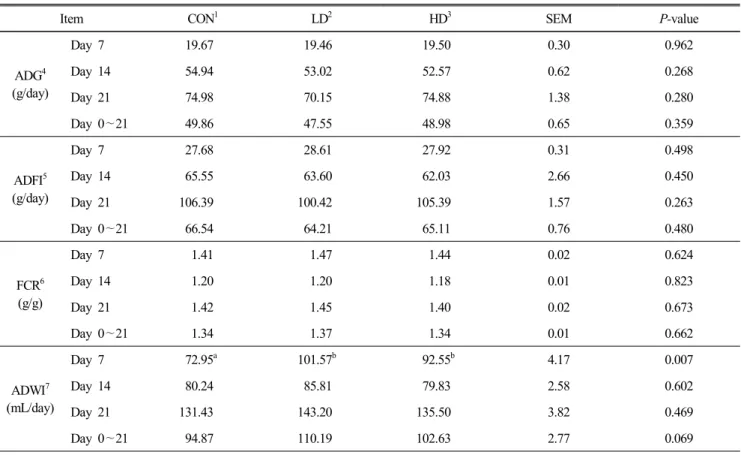
Growth performance and water intake of broilers fed with three different EWC are shown in the Table 2. Broilers in the LD and HD groups showed higher (P<0.05) ADWI compared to those in the CON group on day 7. Given broilers LD and HD showed similar (P>0.05) ADG, ADFI and FCR compared to those in the CON from hatch to 21 days.
Ileal intestinal architecture of broilers fed with different watery treatments are shown in the Table 3. Broilers consu- med HD showed higher (P<0.05) crypt depth presenting those drunk LD and CON on day 21. Therefore, broilers in HD had lower (P<0.05) villus height:crypt depth ratio com- pared to broilers received CON on day 21. No difference (P>0.05) was observed in ileal villus height, villus width and total mucosa thickness of broilers fed 3 different watery treatments on day 21.
Relative weights of the liver, spleen and pancreas did not affect (P>0.05) by the EWC treatments on day 21 (Table 4).
DISCUSSION
Previous studies demonstrated that broilers fed a diet su-
pplemented with EWC improved their growth and relevant intestinal functions including its morphology, digestibility and absorption in starter and grower phases (Zhu, 2013; Rattanawut
and Yamauchi, 2015). Abovementioned studies regarding EWC had mainly used it as an acidifying and antioxidant agents by reasons of present of organic acids and phenolic Table 2. Effect of extractions from wooden chips on growth performance of broiler for day 21
Item CON
1LD
2HD
3SEM P-value
ADG
4(g/day)
Day 7 19.67 19.46 19.50 0.30 0.962
Day 14 54.94 53.02 52.57 0.62 0.268
Day 21 74.98 70.15 74.88 1.38 0.280
Day 0 ∼21 49.86 47.55 48.98 0.65 0.359
ADFI
5(g/day)
Day 7 27.68 28.61 27.92 0.31 0.498
Day 14 65.55 63.60 62.03 2.66 0.450
Day 21 106.39 100.42 105.39 1.57 0.263
Day 0 ∼21 66.54 64.21 65.11 0.76 0.480
FCR
6(g/g)
Day 7 1.41 1.47 1.44 0.02 0.624
Day 14 1.20 1.20 1.18 0.01 0.823
Day 21 1.42 1.45 1.40 0.02 0.673
Day 0 ∼21 1.34 1.37 1.34 0.01 0.662
ADWI
7(mL/day)
Day 7 72.95
a101.57
b92.55
b4.17 0.007
Day 14 80.24 85.81 79.83 2.58 0.602
Day 21 131.43 143.20 135.50 3.82 0.469
Day 0 ∼21 94.87 110.19 102.63 2.77 0.069
1
Fresh clean water with no supplementation.
2
1.56% extractions of wooden chips incorporated water.
3
12.5% extractions of wooden chips incorporated water.
4
Average daily gain.
5
Average daily feed intake.
6
Feed conversion ratio.
7
Average daily water intake.
Table 3. Effect of extractions from wooden chips on ileal intestinal architecture of broiler on day 21
Item CON
1LD
2HD
3SEM P-value
Villus height (V) 668.62 646.75 626.02 18.05 0.656
Crypt depth (C) 54.74
a54.05
a77.30
b3.96 0.013
V:C ratio 14.09
b12.68
ab8.50
a0.89 0.018
Villus width 60.52 73.51 63.60 4.53 0.501
Total mucosa thickness 906.23 948.47 793.33 31.93 0.119
1
Fresh clean water with no supplementation.
2
1.56% extractions of wooden chips incorporated water.
3
12.5% extractions of wooden chips incorporated water.
compounds, respectively (Watarai and Tana, 2005; Rattanawut and Yamauchi, 2015). Organic acids maintain the low pH of gastric contents that helps to suppress pathogenic micro- organism and to increase protein digestion in broilers (Abdo, 2004; Wolfenden et al., 2007). Wang et al. (2008) mentioned that presence of phenolic compounds helps to reduce substrates that increase oxidative stress in Hubbard and Shiqizha broilers on day 21. However, there were few studies investigated that drinking water added EWC on growth performance and intestinal ileal architecture of broilers in starter phase (Yamauchi et al., 2014). Interestingly, drinking water acidification using organic acid is another imple- mentation in broiler industry used for improving growth performance (Aclkgoz et al., 2011). Therefore, current study was designed to investigate the effect of organic acids and phenolic compounds in EWC on broilers growth perfor- mance, ileal intestinal architecture and viscera organ weights.
Current study observed that broilers in in LD and HD increased water intake on day 7. Couple of studies of James and Wheeler (1949) and Smith et al. (2000) mentioned that the potassium in feed or drinking water increased the water intake in broilers. Although we were not in the position to analyze potassium content in EWC, the studies of Zulkarami et al. (2011) and Pari (2016) reported that EWC contained high concentration of potassium. Therefore, the results of our current study expressed that higher water intake could be due to reasonable amount of potassium in EWC.
In the current study, watery treatments did not significantly alter growth performance from hatch to day 21. Recent research outcome from Yamauchi et al. (2014) demonstrated that Sanuki Cochin fed 500 and 1,000 times diluted EWC had similar growth rate compared to those had clean fresh water. In addition, study of Aclkgoz et al. (2011) found no
difference between broilers had water added formic acid (pH 4.5) and those had water without formic acid (pH 7.4). In agreement to the findings, Watkins et al. (2004) concluded that water acidification using organic acids did not affect the growth performance of broilers in any stage. This could be due to high concentration of wooden chip extracts components (organic acids and phenols) may cause toxicity to broilers rather than acidifying water (Philipsen, 2006; Yamauchi et al., 2014).
In the aspect of ileal intestinal architecture of current study, there were higher crypt depth and low villus height to crypt depth ratio obtained by broilers accessed HD compared to those had CON. This result could be due to high turnover in enterocytes of broilers had HD (Savage et al., 1997; Demir et al., 2003). However, presumably broilers had HD in the current study was able to maintain their villus height without any adverse consequences compared to broilers had LD and CON. Similarly, Samanya and Yamauchi (2001) obtained that broilers (White Leghorn) fed a diet with EWC up to 5% did not alter the ileal villus heights on day 28. Further, Ross broilers fed a corn-soybean based diet supplemented with 0.1% of organic acid did not provide a significant difference on ileal architecture on day 21 (Gunal et al., 2006). In the current study, water supplementation with HD showed deeper crypt depth suggesting the high demand for new tissue in gut mucosa. Interestingly, Yason et al. (1987) mentioned that the deeper crypt have been associated with the availability of toxic compound in the intestine of broiler and turkey. The investigation would be suggesting that the presence of toxic compounds in EWC rather than organic acids and phenolic compounds. Many studies (Shamoto et al., 1999; Shamoto and Yamauchi, 2000) demonstrated that the incorporation of EWC in to broiler diets improved the gut morphology by Table 4. Effect of extractions from wooden chips on viscera organ weights of broiler on day 21
Item (%) CON
1LD
2HD
3SEM P-value
Liver 2.16 2.24 2.06 0.05 0.358
Spleen 0.08 0.07 0.08 0.01 0.686
Pancreas 0.26 0.24 0.26 0.01 0.280
1
Fresh clean water with no supplementation.
2
1.56% extractions of wooden chips incorporated water.
3