정식시기와 질소시비 수준에 따른 봄배추의 생육량 추정
이상규1*·서태철2·장윤아1·이준구1·남춘우1·최장선1·여경환1·엄영철1
1농촌진흥청 국립원예특작과학원 채소과, 2농촌진흥청 감사담당관실
Prediction of Chinese Cabbage Yield as Affected by Planting Date and Nitrogen Fertilization for Spring Production
Sang Gyu Lee1*, Tae Cheol Seo2, Yoon Ah Jang1, Jun Gu Lee1, Chun Woo Nam1, Chang Sun Choi1, Kyung-Hwan Yeo1, and Young Chul Um1
1Vegetable Research Division, National Institute of Horticultural and Herbal Sciences, RDA, Suwon 440-706, Korea
2Audit and Inspection Office, Research Policy Bureau, RDA, Suwon 441-707, Korea
Abstract. The average annual and winter ambient air temperatures in Korea have risen by 0.7oC and 1.4oC, respectively, during the last 30 years. The continuous rise in temperature presents a challenge in growing certain horticultural crops. Chinese cabbage, one most important cool season crop, may well be used as a model to study the influence of climate change on plant growth, because it is more adversely affected by elevated temperatures than warm season crops. This study examined the influence of transplant- ing time, nitrogen fertilizer level and climate parameters, including air temperature and growing degree days (GDD), on the performance of a Chinese cabbage cultivar (Chunkwang) during the spring growing season to estimate crop yield under the unfavorable environmental conditions. The chinese cabbage plants were trans- planted from Apr. 8 to May 13, 2011 when 3~4 leaves were occurred, at internals of 7 days and cultivated with 3 levels of nitrogen fertilization. The data from plants transplanted on Apr. 22 and 29, 2012 were used for the prediction of yield as affected by planting date and nitrogen fertilization for spring production. In our study, plant dry weight was higher when the seedlings were transplanted on 15th (168 g) than on 22nd (139 g) of April. There was no significant difference in the yield when plants were grown with different lev- els of nitrogen fertilizer. The values of correlation coefficient (R2) between GDD and number of leaves, and between GDD and dry weight of the above-ground plant parts were 0.9818 and 0.9584, respectively. Nitro- gen fertilizer did not provide a good correlation with the plant growth. Results of this study suggest that the GDD values can be used as a good indicator in predicting the top biomass yield of Chinese cabbage.
Key words : Growing degree day, light intensity, temperature
서 론
최근 지구온난화에 따른 이상기후 발생 빈도가 증가 하고 있는 바, 지속적인 강우에 의한 노지 고추의 병 피해, 이상저온에 의한 배추의 저온피해 및 무의 냉해 발생 등 우리나라 국민들이 즐겨 먹는 채소의 공급량 의 부족으로 인한 가격 폭등으로 국민경제에 큰 영향 을 미치고 있다. 2009년에 발생한 이상기후로 인하여
배추는 전년과 비교하여 가격이 354% 상승하였고, 무 는 320%가 상승하여 국가적인 대응책의 필요성이 제 기된 바 있다(NIHHS, 2009). 당시 재배면적이 감소 한 원인도 있지만 가장 큰 원인은 이상기상에 따른 생육 부진으로 생산량이 감소하였기 때문으로 추정된 다. 이러한 피해를 경감하기 위하여 농작물 생산량을 사전에 예측하기 위한 연구는 국외에서 많이 이루어지 고 있으나 우리나라에서는 초보적인 단계로 주요 농작 물에 대해서만 이루어지고 있는 실정이다.
기후변화가 원예작물 생산에 미치는 영향분석과 미 래 예측을 위해 기존의 작물 수량통계 모형을 넘어서
*Corresponding author: [email protected]
*Received June 11, 2012; Revised September 3, 2012;
*Accepted September 11, 2012
는 작물 생육모델 개발 연구가 활발히 진행되고 있는 데, 기 개발된 작물 생육모델로는 DSSAT-CSM(미국), SWAP(화란), 그리고 WOFOST(화란) 모델 등 (Eitzinger 등, 2004; Liu 등, 2010)이 활용되고 있으 며, 모델간의 비교연구와 새로운 작물에 대한 적용연구 가 이루어지고 있다. DSSAT-CSM(The Decision Support System for Agrotechnology Transfer-Cropping System Model)은 미국에서 개발한 DSSAT CROPGRO 와 CERES(Crop Environment Resource Synthesis) 의 16가지 작물모델을 포함하고, 작물생장과 발달, 토 양수분, 질소 균형을 시뮬레이션하는 Process-based model이다(Jones 등, 2003). 최근에 미국에서는 기후 변화에 대한 작물 수량 반응을 예측하기 위해 CERES-maize 모델을 이용하여 온도 +2oC, 강우량
−20%를 적용하여 나온 수량예측 값과 3가지의 통계적 모델 이용시 나온 수량예측 값을 비교하여 통계적 모 델이 광범위한 지역에서의 기후변화에 따른 수량 예측 에 중요한 역할을 할 수 있다고 보고하였다(Lobell과 Burke, 2010). 독일의 쾰른 대학에서는 2007년에 화 란의 와게닝겐 대학에서 개발한 GECROS(Genotype-by- Environment interaction on crop growth Simulator) 와 미국의 DSSAT-CERES를 결합한 새로운 작물 생 육 모델인 DANUBIA(Interactive Simulation System for Global Change Research in the Upper Danube Basin)를 이용하여 사탕수수, 봄보리, 옥수수, 겨울밀, 그리고 감자 등의 작물에 검증하는 연구결과를 보고하 였다(Lenz-Wiedemann 등, 2010).
우리나라에서는 벼의 경우, GIS나 X-벤드 레이더 산란계 등을 활용한 벼 생육 모니터링, 기상요인별 수 량 예측 등에 관한 연구가 수행된 바 있으나(Kim 등, 2010; Lee 등, 2010), 배추에 대해서는 수량 예측에 대한 연구가 수행된 바 없다.
따라서 본 실험은 봄배추를 대상으로 정식시기와 질 소시비량을 달리하여 생산량 예측 모델식을 개발하고 자 수행하였다.
재료 및 방법
실험재료로는 봄배추 품종인 ‘춘광’(cv. chungwang,
Sakada)을 사용하였다. 105공 플러그에 시판용 경량상
토인 흥농 바이오 상토를 채우고 1셀당 2립씩 파종하
여 발아 후 솎음작업을 통해 1셀당 1주씩 남겼다. 정 식은 파종 후 본엽이 3~4매 시점인 2011년 4월 8일 부터 5월 13일까지 일주일 간격으로 6회에 걸쳐 실시 하여 그 결과의 평균치를 배추의 생육량 모델 구축에 이용하였다. 질소시비량 처리는 밑거름을 주기전에 사 전 토양분석을 실시하였고, 분석결과를 토대로 봄배추 시비 추천량(12.8kg/10a)을 기준으로 0.5(6.4), 1.0(12.8), 2.0N(25.6kg/10a)를 각각 시비하였다. 총 시비 추천량 중 밑거름과 웃거름의 비율은 40 : 60%의 비율로 하였 고, 웃거름은 정식 후 15일과 30일에 시비하였다. 생 육조사는 정식후 일주일 간격으로 처리 및 반복별로 2 주씩 뽑아서 엽수, 엽면적(LI-3100, Area meter, LI- COR Inc., USA), 생체중 및 건물중을 조사하였다.
일사량, 온도 및 습도는 시험포장에서 약 2km 정도 떨어진 수원 기상대의 자료를 사용하였으며, 강우량과 일조시수는 기상청 홈페이지의 자료를 이용하였다. 기 후인자와 생육조사 결과와의 상관분석은 SAS프로그램 (SAS9.2, SAS Institute Inc., USA)을 이용하였으며, 생육도일(GDD)과 엽수, 생육도일과 지상부 건물중과 의 상관관계는 EXCEL 프로그램(MS Office 2007, Microsoft Co. Ltd., USA)을 이용하여 회귀식을 구해 본 결과, 가장 적합한 3차 다항회귀식을 구하였다. 배 추의 base temperature 를 5로 설정한 것과 배추 재 배관리는 표준영농교본 재배법에 근거(Kang 등, 2002) 하여 실시하였으며, 배추 좀나방 등 병충해 방제를 위 하여 2회 약제를 살포하였다.
* 생육도일(Growing Degree Days)
=Σ{(일최고온도 + 일최저온도/2) − 5oC}
결과 및 고찰
질소비료 시비 전후의 토양분석 결과는 Table 1과 같다. 밑거름을 투입한 후 토양분석한 결과를 보면, 질 산태 질소 함량이 처리간 약간의 차이를 보였는데 0.5N 처리구는 31.3mg · kg−1이었고, 1.0N처리구는 35.9mg · kg−1, 2.0N 처리구는 45.9mg · kg−1이었다. 이 와 같이 질소 함량이 낮은 이유는 기비투입 후의 빗 물 등에 의한 용탈과 탈질작용에 의한 것으로 생각된 다. 그 외에 유기물함량 4.9~5.1%, 유효인산 870~
903mg · kg−1, 암모늄태질소 24.1~45.9mg · kg−1, 치환
성칼륨 1.9~2.2, 치환성칼슘 12.2~12.4, 치환성마그네 슘 2.8~3.1mg · kg−1로 나타났다.
정식시기에 따른 생육조사 결과는 정식시기가 4월 22일 처리에서 엽수, 생체중이 높았고, 건물중은 4월 15일 처리에서 높은 결과를 보였다. 이와 같은 결과는 수원 지방에서의 배추 정식시기가 4월 하순경이라는 것을 의미하며 이보다 빠른 시기에 정식하면 온도가 낮아 생육이 좋지 않았고, 5월 이후에 정식하면 온도 가 높아져 상대적으로 생육이 부진하였기 때문으로 사 료된다.
질소 시비량에 따른 생육특성은 처리간 차이는 없는
Table 1. Soil chemical properties in the field as influenced by basal fertilization for production of Chinese cabbage in spring season.
Nitrogen fertilization
level (kg/10a) pH EC
(dS/m) OM (%)
P2O5
(mg · kg−1)
NO3-N (mg · kg−1)
K Ca Mg
mg · kg−1
Controlz 7.2 1.5 4.5 880 12.5 1.40 12.0 2.9
0.5 N (6.4)0 7.7 1.9 4.9 870 31.3 1.90 12.2 3.1
1.0 N (12.8) 7.6 2.0 5.0 876 35.9 2.10 12.4 2.8
2.0 N (25.6) 7.7 2.1 5.1 903 41.8 2.20 12.3 2.9
zBefore application of basal fertilization.
Table 2. Growth of Chinese cabbage as affected by trans- planting date in spring season.
Transplanting date (Days after
transplanting)
No. of leaves
Fresh weight (g/plant)
Dry weight (g/plant) 08. April (63) 093.7 cdz 2,476 c 124.7 bc 15. April (63) 096.8 bc 2,978 b 167.6 a 22. April (63) 105.0 a 3,671 a 139.0 b 29. April (63) 100.3 ab 3,300 ab 119.6 bc 06. May (63) 101.9 ab 2,958 b 112.5 c 13. May (56) 088.6 d 2,510 c 104.9 c
zDMRT.05.
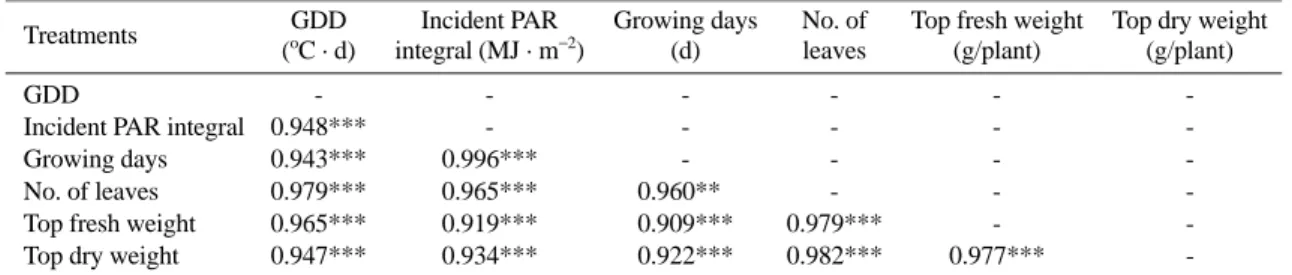
Table 3. Partial correlation between growth of Chinese cabbage and climatic variables.
Treatments GDD
(oC · d)
Incident PAR integral (MJ · m−2)
Growing days (d)
No. of leaves
Top fresh weight (g/plant)
Top dry weight (g/plant)
GDD - - - - - -
Incident PAR integral 0.948*** - - - - -
Growing days 0.943*** 0.996*** - - - -
No. of leaves 0.979*** 0.965*** 0.960*** - - -
Top fresh weight 0.965*** 0.919*** 0.909*** 0.979*** - -
Top dry weight 0.947*** 0.934*** 0.922*** 0.982*** 0.977*** -
*** Significant at p≤ 0.001.
zGDD: growing degree days, Σ[(daily maximum temperature + daily minimum temperature)/2] − 5oC.
것으로 나타났다. 이와 같은 결과는 질소시비량에 따른 토양내 질소 성분의 차이가 크지 않았으며(Table 1), 조사 주수가 많지 않아 반복간에 생육의 차이가 컸기 때문으로 생각된다.
기후인자와 생육인자와의 편상관 분석을 실시한 결 과(Table 3), 기후인자인 적산일사량과 생육도일(GDD) 은 생육인자인 엽수, 지상부 생체중, 지상부 건물중과 정의 상관관계가 높게 나타났으며, 적산일사량보다는 생육도일(GDD)이 생육인자들과 좀 더 높은 정의 상 관관계를 보였다. 기후인자인 적산일사량과 GDD(생육 도일)와의 편상관은 0.948이었고, 엽수와 지상부, 생체 중과 지상부, 건물중과 GDD간 편상관은 각각 0.979, 0.965, 그리고 0.947로 상관관계가 높은 것으로 나타 났다.
이러한 결과를 기초로 질소시비 수준별로 생육도일
(GDD)과 엽수, 생육도일(GDD)과 지상부 건물중의 분
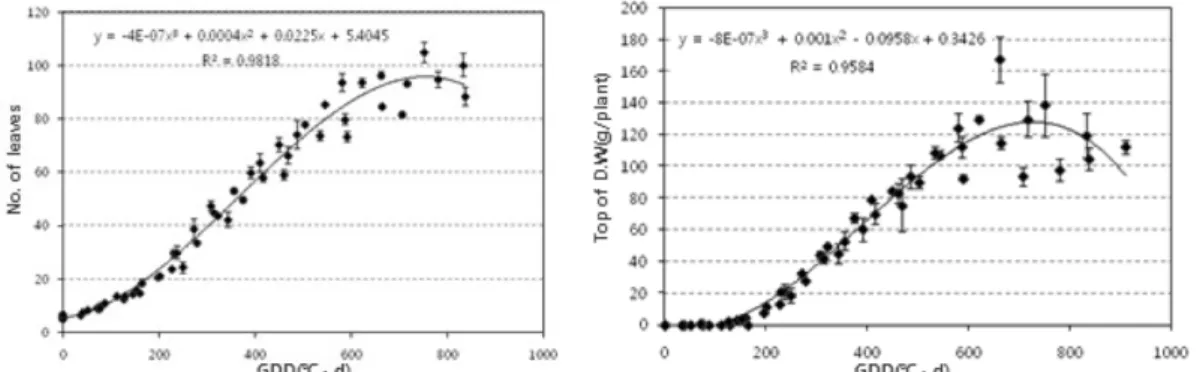
포를 그림으로 나타내본 결과(Fig. 1), 질소시비 수준 에 따른 차이는 없었다. 따라서 질소시비 수준의 영향 을 무시하고 질소시비수준별 엽수와 지상부건물의 평균값과 생육도일(GDD)과의 분포도를 그리고 3차 함수로 다항회귀식을 구한 결과(Fig. 2), 엽수(y) =
−0.0000004x3+ 0.0004x2+ 0.0225x + 5.4045(R2= 0.9818),
지상부건물중(y) = −0.0000008x3+ 0.001x2− 0.0958x + 0.3426(R2= 0.9584)로 각각 나타났다. 따라서 봄배추 생육기간중에 GDD 측정만으로도 봄배추의 지상부 생 산량을 추정할 수 있을 것으로 판단되었다. 한편, 실질
Fig. 1. Changes of number of leaves and top dry weight of spring chinese cabbage as affected by nitrogen fertilization levels with respect to growing degree days (GDD) after transplanting.
Fig. 2. Changes of number of leaves per plant and top dry weight with respect to growing degree days (GDD) after trans- planting for spring chinese cabbage. Lines represent fitted cubic function and vertical bars indicate the standard errors of the mean values.
Fig. 3. The ratio of top dry matter to fresh weight with respect to days after transplanting for spring chinese cabbages. Verti- cal bars indicate the standard errors of the mean values.
적으로 배추의 수량은 생체중으로 표현되기 때문에 생 육도일과 지상부건물중과의 관계를 통해 건물중을 예 측할 수 있다고 하더라도 생체중의 예측은 힘들다. 따 라서 현실적으로 건물중을 생체중으로 변환시키기 위
한 관계식을 설정할 필요가 있다(Nendel 등, 2009).
정식시기별 건물율 및 건물중과 생체중과의 관계를 조 사한 결과(Fig. 3), 건물율은 정식 7일 후에 8.0%로 값이 가장 높았고, 결구가 시작되는 시기인 정식 6주 후부터 점차 감소하는 경향을 보였으며, 이러한 결과는 생체중과 건물중의 관계가 직선적인 관계가 아닌 2차 식으로 예측 가능함이 확인되었다. 이러한 결과는 Cho 와 Son(2009)이 수경재배 청경채에서 구한 직선적인 1차 관계식과는 차이가 있었다. 이것은 배추는 청경채 보다 결구 이후 건물율이 더 크게 낮아지기 때문으로 판단되었다. 이와같이 생육량 추정에는 작물별로 시기 별로 다양한 결과를 초래하기 때문에 우리나라에서도 기후변화와 관련하여 작물별로 수량예측 모델 개발 연 구가 지속적으로 추진되어야 할 것으로 판단된다.
적 요
최근 지구온난화에 따른 이상기상 발생 빈도가 증가 하고 있으며 배추 등 일부 채소작물의 저온 및 고온 등으로 인하여 생산량에 문제가 발생하고 있다. 이러한 이상기상 조건 발생시 사전에 생산량을 예측하면 수급 을 조절하는데 효과적이라 판단된다. 따라서 본 실험은 기상이변에 따른 봄배추의 생육량을 추정하기 위하여 정식시기와 질소시비량을 달리하여 생육인자간 상관계 수를 도출하였다. 그 결과, 정식시기별 최종 생육은 4 월 15일과 4월 22일 정식 처리에서 건물중이 각각 168g과 139g으로 타 시기에 비해 높았으며, 질소처리 에 따른 차이는 없었다. 기후인자 온도, 일사량,
GDD, 그리고 생육인자 엽수, 지상부생체중, 지상부건
물중 등의 편상관분석 결과, 유의성이 높은 것으로 나타났다. GDD와 엽수, GDD와 지상부 건물중의 분 포를 측정한 결과, 질소시비 수준에 따른 차이는 없었 으며, 3차함수로 다항회귀식을 구한 결과, 엽수(y) =
−0.0000004x3+ 0.0004x2+ 0.0225x + 5.4045(R2= 0.9818), 지상부건물중(y) = −0.0000008x3+ 0.001x2− 0.0958x + 0.3426(R2= 0.9584)로 나타났다. 따라서 봄배추 생육기 간중에 GDD 측정만으로도 봄배추의 지상부 생산량을 추정할 수 있을 것으로 판단되었다.
주제어 : 광 강도, 생육도일, 온도
인 용 문 헌
1. Cho, Y.Y. and J.E. Son. 2009. Determination of suit- able parameters for developing adequate growth model of pak-choi plants. Hort. Environ. Biotechnol. 50:532- 535.
2. Eitzinger, J., M. Trnka, J. Hosch, Z. Zalud, and M.
Dubrovsky. 2004. Comparison of CERES, WOFOST and SWAP models in simulating soil water content during growing season under different soil conditions.
Ecological Modeling 171:223-246.
3. Jones, J.W., G. Hoogenboom, C.H. Porter, K.J. Boote, W.D. Batchelor, L.A. Hunt, P.W. Wilkens, U. Singh, A.J. Gijsman, and J.T. Ritchie. 2003. The DSSAT cropping system model. Europ. J. Agronomy 18:235- 265.
4. Kang, H.J., J.S. Lee, K.Y. Ryu, and J.T. Lee. 2002.
Technology of Chinese cabbage cultivation. Rural Development Administration. Korea. pp. 39-42.
5. Kim, Y.H., S.Y. Hong, and H.Y. Lee. 2010. Construc- tion of X-band automatic radar scatterometer measure- ment system and monitoring of rice growth. K. J. Soil Sci. Fert. 43:374-383.
6. Lee, B,W., Y.H. Lee, J.E. Lee, K.H. Moon, D.J. Kim, K.J. Lee, and D.H. Choi. 2010. Develop crop growth models for soybean, potato, and oilseed rape, evaluate the temperature response of major upland crop under the changed climate condition. Res. Rept. RDA. p. 89.
7. Lenz-Wiedemann, V.I.S., C.W. Klar, and K. Schneider.
2010. Development and test of a crop growth model for application within a global change decision sup- port system. Ecological Modeling 221:314-329.
8. Liu, H.L., J.Y. Yang, C.F. Drury, W.D. Reynolds, C.S.
Tan, Y.L. Bai, P. He, J. Jin, and G. Hoogenboom. 2011.
Using the DSSAT-CERES-Maize model to simulate crop yield and nitrogen cycling in fields under long- term continuos maize production. Nutr. Cycl. Agroec- osyst 89:313-328.
9. Lobell, D.B. and M.B. Burke. 2010. On the use of sta- tistical models to predict crop yield responses to cli- mate change. Agricultural and Forest Meteorology 150:1443-1452.
10. National Institution Horticultural and Herbal Science (NIHHS). 2009. Annual report. 2009.
11. Nendel, C., U. Schmutz, A. Venezia, F. Piro, and C.R.
Rahn. 2009. Converting simulated total dry matter to fresh marketable yield for field vegetables at a range of nitrogen supply levels. Plant & Soil 325:319-334.