<학술논문>
DOI:10.3795/KSME-A.2009.33.4.430
사체 아킬레스건을 이용한 경골관통터널방식의 후방십자인대 재건술
- 간섭나사 및 이중고정핀 방식에 따른 초기연신 및 활주율 평가 -
김철웅†․배지훈*․오동준**
(2008년 11월 3일 접수, 2009년 2월 18일 수정, 2009년 2월 18일 심사완료)
The Posterior Cruciate Ligament (PCL) Reconstruction by the Transtibial Tunnel Method using Cadaveric Achilles Tendon Grafts
- Evaluation of the Initial Lengthening and the Slippage Ratio due to the Interference Screw Fixation and Double Cross-Pin Fixation -
Cheol-Woong Kim, Ji-Hoon Bae and Dong-Joon Oh
Key Words: Posterior Cruciate Ligament(후방십자인대, PCL), Cadaveric Achilles Tendon (사체 아킬레 스건), Reconstruction(재건술), Transtibial Tunnel(경골관통터널), Interference Screw(간섭나 사), Double Cross-Pin(이중고정핀), Initial Lengthening(초기연신), Slippage Ratio(활주율)
Abstract
Posterior Cruciate Ligament (PCL) plays an important role in knee extension. Rotational instability due to injured PCL can be restored by various PCL reconstruction methods. In this study, the initial lengthening affected by fixation device and location was demonstrated, and furthermore, the slippage and the relationship between lengthening ratio and slippage ratio in the calcaneus and soft tissue fixation methods was newly suggested. Eight specimens of proximal tibia and Achilles tendon grafts were harvested from four cadavers and divided into four groups in regard to the four different types of transtibial fixation techniques. The cyclic load ranged from 50 N to 250 N applied to each graft fixed to proximal tibia in 55 degrees. The initial lengthening ratio to the total elongation has been approximately constant regardless of the fixation methods. The soft tissue fixation method with an interference screw showed about 56.4% slippage ratio to the total elongation and the same method with a double cross-pin presented about 45.4% slippage ratio. The soft tissue fixation method with an interference screw demonstrated approximately 2 mm less total elongation and about 13% more slippage than lengthening because of poor fixation compared to the same method with a double cross-pin.
1. 서 론
스포츠 인구 및 과체중 인구 증가로 인해 최근 슬관절 손상 환자가 급증하는 추세이다. 특히 스포츠 로 인한 사고 중 45%가 슬관절 손상이며 대표적인 병증은 전방십자인대(Anterior Cruciate Ligament(이하
†책임저자, 회원, 고려대 공학기술연구소/(주)트리플씨메디칼 E-mail : [email protected]
TEL : (02)944-6844, (02)929-9844 / FAX : (02)944-6842 * 고려대학교 의과대학 정형외과
** 안동대학교 기계교육과
ACL)) 및 후방십자인대(Posterior Cruciate Ligament (이하 PCL))의 손상이다. 특히 PCL은 단독손상의 경우, 슬관절 과굴곡상태에서 경골상단부 전면에 직접 외력이 가해지는 dashboard injury가 가장 흔 한 기전이고, PCL 동반인대손상은 후방손상, 내 전, 외전, 과신전, 그리고 심한 외반회전력(vagus torque)이 PCL의 임계치를 벗어날 때 발생한다.
1960년대 말부터 정형외과 전문의들은 십자인대 의 중요성을 인지하기 시작하였다. 1990년대 초반 까지는 PCL에 비해 상대적으로 관찰과 진단이 쉽 고 접근이 용이한 ACL 재건술 연구가 주류를 이
Fig. 1 Anatomical location of anterior cruciate
ligament (ACL) and posterior cruciate ligament (PCL) ; anatomical studies and taken picture by this research group루어왔다. 그러나 MRI, 관절경 등의 진단기기가 발전하면서 PCL 손상 발견은 급격히 확대되었고, 슬관절의 해부학적 거동에 대한 연구가 심화되면 서 그 중요성은 더욱 부각되었다.(1) 1986년부터 동종 이식건을 이용한 ACL 재건술의 성공적인 술례가 보고된 이후, 최고 10년 이상의 추시결과 들이 다수 보고된 바 있다. 현재 ACL 재건술은 과거의 많은 이견들이 정립되는 단계에 있으나 PCL 재건술의 경우에는 아직도 논란의 여지가 많다.(2) PCL은 Fig. 1과 같이 후방중심부에 위치 하기 때문에 경골의 후방전위를 막아주고, 슬관 절의 신전시 매우 중요한 역할을 한다. 따라서 PCL이 손상되었을 경우 회전 불안정성은 급격히 증가한다.(3) 또한, PCL이 제거된 슬관절에서는 슬 개대퇴 및 경대퇴 관절에 지속적인 압력이 가해 져 슬관절염이 진행될 수 있다.(4) 그러나 불행하 게 최근까지도 PCL 재건술은 이식건, 경골부고정 방법, 고정장치, 대퇴터널의 위치, 이식건 다발수 등에서 다양한 술기가 난립하며 정상 관절의 안 정성에 근접하기 위한 재건술은 계속되고 있다.(5) 이러한 다양한 술기에서 가장 중요한 공학적 접 근은 이식건을 이용한 PCL 재건 구조에서 이식 건, 고정장치, 근위경골이 각각 분담하게 되는 하 중의 크기와 반복하중 하에서의 응력전달(stress flow), 응력재분포(stress redistribution)에 따른 피로 거동 등을 정확히 이해하고 평가하는 것이다. 따 라서 본 연구에서는 상기 내용의 기초연구로서, 현재 수술실에서 적용되고 있는 다양한 PCL 재
Table 1 Proximal Tibia list by four male's fresh frozen
cadaverRegist. No. Notice of
death Year Gender Disease entity 07-26 1*
2007.05.12 56.3 male brain edema 2**
07-11 3**
2007.01.30 69.8 male gastric cancer 4*
07-29 5*
2007.06.02 40.9 male hepatoma 6**
07-10 7**#
2007.01.29 30.3 male intracranial hemarrhage 8*#
* transtibial one-tunnel with interference screw fixation
** transtibial one-tunnel with double cross-pin fixation
*# transtibial one-tunnel with interference screw fixation and
cancellous screw
**# transtibial one-tunnel with double cross-pin and cancellous
screw
건술 중 사체 아킬레스건을 이용한 경골관통터널 (transtibial tunnel) 수술법을 적용하였다. 그리고 반 복하중 하에서 아킬레스건의 고정장치 및 고정위치 에 따른 아킬레스건의 초기연신(initial lengthening)거 동을 파악하였다. 또한 아킬레스건의 종골부 고정방 식과 연부조직 고정방식에 따른 미끄럼(이하 활주, slippage)거동과 연신율(lengthening ratio)과 활주율 (slippage ratio)의 관계에 대해 규명해 보았다. 본 연 구는 아킬레스건을 이용한 경골터널방식 PCL 재건 술의 첫 번째 연구로서 향후 임상적 결과와 다양한 공학적 접근이 융합된 새로운 결과들이 다수 보고 될 예정이다. 본 연구는 향후 PCL 재건술의 합리적 수술기법에 일조하는 중요한 기초연구자료가 될 것 으로 기대한다.
2. 동결사체 아킬레스건을 이용한 PCL 재건술용 경골관통터널 시험편 제작
본 연구에서 수행한 경골관통터널방식의 PCL 재건 술은 경골후방 과간영역(tibial posterior intercondylar area)의 PCL 부착점에서 이식건의 급격한 각도변화로 끊어지거나 늘어나는 현상인 "killer turn"(6)이 발생한 다는 단점이 있다. 따라서 최근에는 tibial inlay법도 병행되고 있으나, tibial inlay의 경우 추가적 피부절개 와 수술중 환자의 자세변화가 필요하므로 여전히 경 골관통터널방식은 PCL 재건술에서 널리 수행되는 술
기이다.(7~9) Table 1에 제시된 신선동결사체 4구에서
경골시험편을 채취하였다. 경골터널 제작을 위해 측 와위(lateral decubitus)에서 슬와부(popliteal fossa)의 반
Fig. 2 Preparation of fresh frozen cadaver tibia specimen classed by (a) PCL reconstruction with
interference screw (Inion Hexalon, Poly Lactic Acid (PLA)); (b) PCL reconstruction with bio-absorbable double cross-pins (RIGIDFIX_2.7 mm BTB CROSS PIN KIT, Poly Lactic Acid (PLA))Fig. 3 Schematic drawing of four different fixation
device in the transtibial one-tunnel; (a) calcaneus fixation using interference screw, (b) calcaneus fixation using double cross-pin, (c) Achilles tendon soft tissue fixation using interference screw and cancellous screw, and(d) Achilles tendon soft tissue fixation using
double cross-pin and cancellous screw양막건(semimembranosus tendon)을 따라 절개하여 내외측의 비복근 중앙부를 박리하고 슬와부의 신 경 및 혈관을 제거한 후 관절막을 수직으로 절개 하였다. 이후 경골평탄부(tibial plateau)에서 경골
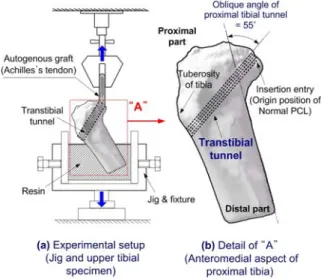
원위방향 200 mm 지점에서 경골을 절단하여 총 8개 의 근위경골 시험편을 채취하였다. 또한, 종골편이 부착된 아킬레스건(d = 10 mm)을 Fig. 2(a)와 같은 절차에 의해 준비하였다. PCL 경골 부착부(Fig. 4(b) insertion entry)에 경사각 55도로 경골의 전내측에서 PCL 부착부위까지 관통하는 직경 12 mm의 경골관 통터널을 제작하였다. 이후 Fig. 3과 같은 네 가지 결합방식으로 PCL 재건술용 시험편을 제작하였다.
즉 8개의 경골시험편을 4개 그룹으로 나누어 Fig.
3(a) 간섭나사(d = 10 mm, L = 30 mm)를 이용한 아 킬레스건 종골부 고정, Fig. 3(b) 2개의 횡고정핀(d = 2.7 mm, L = 42 mm, BTB Cross pin kit)을 이용한 아킬레스건 종골부 고정, Fig. 3(c) 간섭나사(d = 10 mm, L = 30 mm) 및 해면나사(cancellous screw, d = 6.5 mm, L = 40 mm, Depuy Mitek, J&J)를 이용한 아 킬레스건 연부조직 고정, 그리고 Fig. 3(d) 2개의 횡 고정핀(d = 2.7 mm, L = 42 mm) 및 해면나사(d = 6.5 mm, L = 40 mm)를 이용한 아킬레스건 연부조직 고정으로 구분하였다. 반복하중시험은 Instron 8511을 이용하였다. 본 연구에서는 경골관통터널 방식에서 발생될 수 있는 killer turn의 영향을 충분히 고려하 기 위해 Fig. 4에 제시된 바와 같이 레진을 이용하 여 근위경골의 경사각을 실제 수술과 동일한 55°로 고정하였고 반복하중시 발생할 수 있는 경사각의 변 화를 미연에 방지하였다. Zantop 등(10)은 PCL 재건술 후 실제로 환자가 일상에서 1주일간 활동한 경우의 슬관절 부하내력은 최대인장강도(Pmax) = 250 N, 최
Fig. 4 Experimental setup for the PCL reconstruction
by autogenous graft using Achilles tendon in proximal tibia of fresh frozen cadaver; (a) Jig setup with proximal tibial specimen, (b) determination of oblique angle at the transtibial tunnel소인장강도(Pmin) = 50 N의 조건에서 1,000 cycles로 부하한 조건과 유사하다고 보고하였다. 또한, Brand 등(11) 및 Kousa 등(12)은 본 연구에서 적용된 것과 동 일한 간섭나사와 Bone-Patellar Tendon Bone (BPTB) 이식건을 이용하여 재건술을 수행한 결과, Pmax = 850 N, Pmin = 215 N의 고정강도(fixation strength)가 측정되었다고 보고하였다. 본 연구에서는 세계적으 로 적용빈도가 높은 Zantop의 부하법을 이용하여 최대인장강도(Pmax) = 250 N, 최소인장강도(Pmin) = 50 N의 하중조건에서 1 Hz의 정현파로 1,000 cycles 까지 부하하여 아킬레스건의 고정장치(간섭나사 vs.
이중고정핀) 및 아킬레스건의 고정위치(종골 vs. 연 부조직)에 따른 초기연신 및 활주율에 대해 평가해 보았다.
3. 경골터널 내 아킬레스건의 초기연신율 : 간섭나사 및 이중고정핀의 경우
PCL 재건에 사용되는 이식건으로는 슬개건 (patellar tendon),(13) 슬괵건(hamstring tendon),(14~16) 아킬레스건 등 자가 혹은 동종 이식건이 사용된 다. 해부학적으로 PCL은 전외측(anterolateral, AL) 다발 및 후내측 (posteromedial, PM) 다발로 구성 되어있다. 전외측 다발은 굴곡시 대퇴부와 연결 된 경골의 후방전위를 막아주며 이는 내측대퇴과 (medial femoral condyle)의 외측벽 원위전방에서
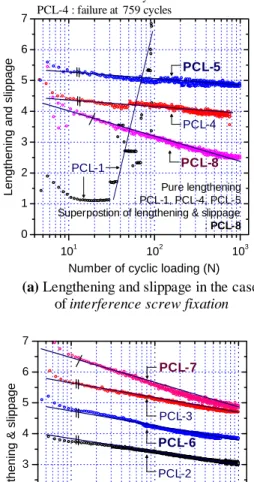
Fig. 5 Relationship between elongation and slippage
versus number of cyclic loading after posterior cruciate ligament reconstruction; (a) interference screw (PCL-1,-4,-5) and interference screw with cancellous screw (PCL-8), (b) double cross-pin (PCL-2,-3,-6) and double cross-pin with cancellous screw (PCL-7)관찰된다. 후내측 다발은 신전시 후방전위를 막아준 다.(5) 따라서 최근에는 이식건이 정상 PCL과 동일한 해부학적 기능을 수행하도록 전외측 다발 및 후내 측 다발을 분리하여 이중다발 구조로 재건하고 있 는 추세이다. 이중다발을 경골터널에 사용하는 경 우, 충분한 이식건의 길이가 요구되므로 동종 아킬 레스 건을 가장 많이 사용하고 있다.(8) 따라서 최 근 아킬레스건을 이용한 다양한 술기가 보고되고 있는데 임상적 연구보고 외에도 공학적 접근법의
연구결과도 점차로 증가하는 실정이다. 그러나, 기 존의 연구들은 PCL 재건술후의 아킬레스건의 강도 평가, 손상평가 등에 국한되어 있다.(17,18) 그러나 실 제 PCL 재건 구조에서 아킬레스건, 고정장치, 근위 경골이 각기 분담하는 하중과 반복하중 하에서의 응력전달, 응력재분포에 따른 피로거동을 평가하고 이해하는 것은 매우 중요한 연구이다. 따라서 본 연 구는 그에 대한 첫 번째 기초연구로 PCL 재건 시 간섭나사와 이중고정핀이 아킬레스건의 초기연신과 활주율에 미치는 영향에 대해 평가해보았다. Fig.
5(a)는 간섭나사를 이용한 아킬레스건 고정법이고, Fig. 5(b)는 이중고정핀을 이용한 아킬레스건 고정법 이다. Fig. 5(a)에서 PCL-1, PCL-4, PCL-5는 Fig. 3(a) 와 같이 아킬레스건 종골부에 간섭나사를 고정한 것이고, PCL-8은 Fig. 3(c)와 같이 아킬레스건 종골 부를 경골터널의 근위조면(tibial tuberosity)에서 원위 방향으로 노출시켜 해면나사(cancellous screw)를 고 정하고 간섭나사는 Fig. 3(a)와 동일하게 위치하되 아킬레스건의 연부조직(soft tissue)을 고정시킨 이중 고정방식이다(이하, 간섭나사의 연부조직 고정법).
또한 Fig. 5(b)에서 PCL-2, PCL-3, PCL-6은 Fig. 3(b) 와 같이 아킬레스건 종골부에 이중고정핀을 삽입한 것이고, PCL-7은 Fig. 3(d)와 같이 아킬레스건의 연 부조직에 이중고정핀을 삽입하고 근위조면 원위방 향에 해면나사를 고정한 이중고정방식이다(이하, 이 중고정핀의 연부조직 고정법). Fig. 5(a),(b)에서 PCL-1,-2 / PCL-3,-4 / PCL-5,-6 / PCL-7,-8은 각각 동일 사체의 좌우측 슬관절이다. 본 연구에서는 총 1,000 cycles 중에서 1/4에 해당하는 250 cycles를 초 기연신으로 결정하였고, 그 구간을 "Phase-I"이라고 정의하였다. Fig. 5(a)를 살펴보면, PCL-1, PCL-4, PCL-5 중에서 PCL-5 만이 1,000 cycles에 도달하였 음을 알 수 있다. PCL-1의 경우, 간섭나사의 갑작스 런 이탈에 의해 94 cycles에서 부하가 중단되었고, PCL-4의 경우, 서서히 진행된 활주에 의해 760 cycles에서 간섭나사의 이탈이 발생하였다. 이상 Fig.
5(a) 그래프를 정리하면, 1) 시험편 제작 상에서 큰 오차가 발생하지 않았다고 했을 때, 간섭나사의 이 탈은 연령에 따른 근위경골부의 골밀도와 특별한 관련성이 없음을 근위경골 사체의 연령분포를 통해 알 수 있었다(Table 1참조). 2) 더 많은 재현성이 요 구되지만, Pmin = 50 N, Pmax = 250 N의 부하조건에 서 경골터널 내 간섭나사의 이탈률은 60% 이상이었 다. 3) 간섭나사가 이탈된 PCL-1, PCL-4를 제외하고
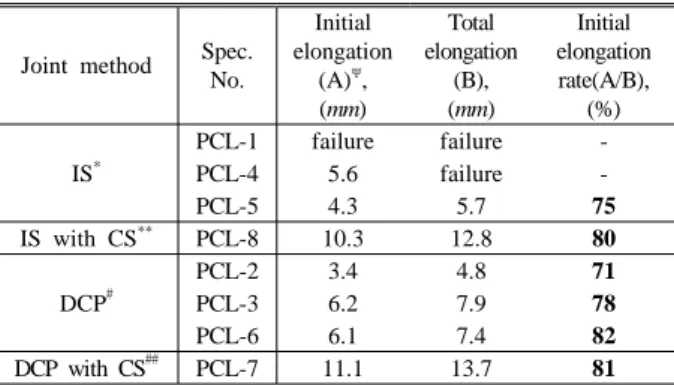
Table 2 Definition of initial elongation rate (δ
AB) using comparison between total elongation versus initial elongation (phase-I)Joint method Spec.
No.
Initial elongation
(A)ψ, (mm)
Total elongation
(B), (mm)
Initial elongation rate(A/B),
(%)
IS*
PCL-1 failure failure -
PCL-4 5.6 failure -
PCL-5 4.3 5.7 75
IS with CS** PCL-8 10.3 12.8 80
DCP#
PCL-2 3.4 4.8 71
PCL-3 6.2 7.9 78
PCL-6 6.1 7.4 82
DCP with CS## PCL-7 11.1 13.7 81
* Interference Screw fixation
** Interference Screw with Cancellous Screw
# Double Cross-Pin fixation
## Double Cross-Pin fixation with Cancellous Screw ψ Region of phase-I in Figure 5.
Fig. 6 Photographs of two different fracture mode
due to the elongation behavior in the case of interference screw versus the elongation with slippage in the case of interference screw and cancellous screwPCL-5만을 고려했을 때 아킬레스건의 총연신량(total elongation)은 5.7 mm이다. 4) 간섭나사와 해면나사를 이용한 이중고정방식(PCL-8)일 때, 간섭나사의 이탈은 발생하지 않은 반면 총연신량은 12.8 mm로 측정되었 다. 간섭나사만 고정한 경우(PCL-5)에 비해 무려 2.25 배 증가한 것이다. 5) 간섭나사의 이탈이 발생하지 않 은 PCL-5 및 PCL-8을 비교해 보았을 때, PCL-5는 초 기연신량(Fig. 5(a) Phase-I)이 총연신량의 75% (4.3 mm)를 차지하였다. 또한, PCL-8의 경우, 초기연신량이 총연신량의 80%(10.3 mm)를 차지하였다. 한편, Fig.
5(b) 그래프를 살펴보면, 1) Fig. 5(a)와 같이 연령에 따른 골밀도와의 관련성은 찾을 수 없었다. 2) 모든 시험편에서 이중고정핀의 이탈은 발생하지 않았다. 3) 이중고정핀의 연부조직 고정법(PCL-7)일 때, 연신량은 13.7 mm로 이중고정핀의 종골 고정법(PCL-6)에 비해 1.8배 증가하였다. 4) 이중고정핀 종골 고정법 중에서 도 PCL-3, PCL-6은 유사한 반면 PCL-2는 1.7배 정도 의 편차가 발생하였고, 이는 아킬레스건의 고유물성이 사체마다 편차가 있기 때문이라고 생각한다. 그럼에도 불구하고 총연신량에 대한 초기연신량(Phase-I)의 비율 은 Table 2에 제시한 바와 같이 상기 4가지 고정방식 에 큰 영향을 받지 않고, 71~82% 범위의 일정비율을 나타냈다. 따라서 고정방식이 아킬레스건의 초기연신 율을 좌우하지는 않는다고 판단된다.
4. 아킬레스건 연부조직 고정시 연신에 포함된 활주율(slippage ratio) 평가
앞 장에서는 간섭나사 및 이중고정핀을 이용한
0 2 4 6 8 10 12 14
50 100 150 200 250 300
Lengthening and Slippage (mm)
Load (N)
0 2 4 6 8 10 12 14
0 50 100 150 200 250 300
Load (N)
Lengthening and Slippage (mm)
0 2 4 6 8 10 12 14
50 100 150 200 250 300
Lengthening and Slippage (mm)
Load (N)
0 2 4 6 8 10 12 14
50 100 150 200 250 300
Lengthening and Slippage (mm)
Load (N)
0 2 4 6 8 10 12 14
50 100 150 200 250 300
Load (N)
Lengthening and Slippage (mm)
0 2 4 6 8 10 12 14
50 100 150 200 250 300
Lengthening and Slippage (mm)
Load (N)
0 2 4 6 8 10 12 14
50 100 150 200 250 300
Load (N)
Lengthening and Slippage (mm)
0 2 4 6 8 10 12 14
50 100 150 200 250 300
Lengthening and Slippage (mm)
Load (N)
(I) = 3.4 mm / (II) = 4.0 mm (III) = 4.5 mm / (IV) = 4.8 mm (I) = failure / (II) = failure (III) = failure / (IV) = failure
(I) = 5.6 mm / (II) = 7.8 mm (III) = 11.4 mm / (IV) = failure
(I) = 4.3 mm / (II) = 4.9 mm (III) = 5.3 mm / (IV) = 5.7 mm
(I) = 10.3 mm / (II) = 11.2 mm (III) = 11.9 mm / (IV) = 12.8 mm
(I) = 6.2 mm / (II) = 6.9 mm (III) = 7.5 mm / (IV) = 7.9 mm
(I) = 6.1 mm / (II) = 6.7 mm (III) = 7.1 mm / (IV) = 7.4 mm
(I) = 11.1 mm / (II) = 12.2 mm (III) = 13.0 mm / (IV) = 13.7 mm (a) interference screw (PCL-1) (b) interference screw (PCL-4) (c) interference screw (PCL-5) (d) interference screw with
cancellous screw (PCL-8)
(e) double cross-pin (PCL-2) (h) double cross-pin with
cancellous screw (PCL-7) (f) double cross-pin (PCL-3) (g) double cross-pin (PCL-6)
(I) (II) (III) (IV) (I) (II) (III) (IV) (I) (II) (III ) (IV) (I) (II) (III) (IV)
Phase-I Phase-I Phase-I Phase-I
(I) (II) (III) (IV) (I) (II) (III) (IV)
(I) (II) (III)
(IV) Failure region
Phase-I Phase-I Pmax Phase-I
Pmin
Pmax
Pmin
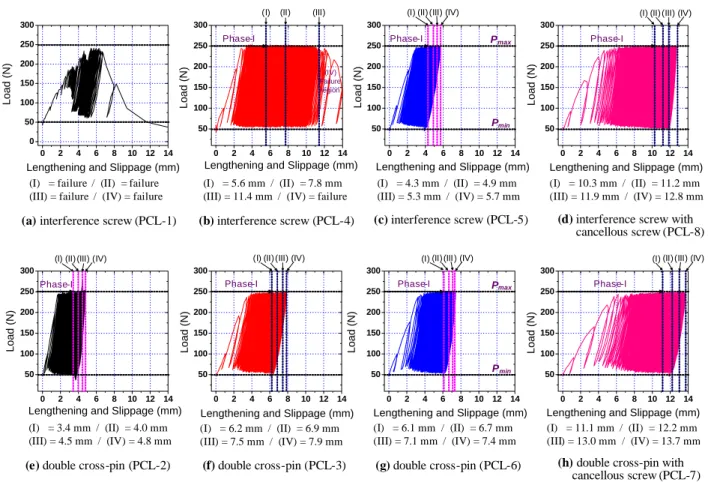
Fig. 7 Relationship between load and lengthening with slippage after posterior cruciate ligament reconstruction with
interference screw (Inion HEXALONTM) of calcaneus in (a) to (c), with interference screw and cancellous screw of soft tissue fixation in (d), with double cross-pin (2.7 mm BTB RigidFix, Depuy Mitek) of calcaneus in (e) to (g), and with double cross-pin and cancellous screw of soft tissue fixation in (h)아킬레스건 종골부 고정방식이나 연부조직 고정 방식에 상관없이 초기연신율(Phase-I)은 총연신율 의 약 7 7 %를 차지함을 알 수 있었다. 그러나 Phase-I부터 Phase-IV에 이를 때까지 아킬레스건의 연신과 동반하여 발생되는 활주가 고정방식에 따 라 단계적으로 어떻게 변화하는지 파악해야 한다.
Fig. 5(a)에서 PCL-1, PCL-4, PCL-5는 간섭나사가 아킬레스건의 종골부와 결합되어 활주가 동반되 지 않은 순수 연신이 발생했음을 Fig. 6(a)를 통하 여 판단할 수 있으나, PCL-8은 간섭나사가 아킬레 스건 연부조직과 결합되어 있어 활주가 크게 동 반되었음을 Fig. 6(b)를 통해 확인할 수 있었다.
또한 Fig. 5(b)의 경우에도 PCL-2, PCL-3, PCL-6은 이중고정핀이 아킬레스건의 종골부와 결합되어 활주가 발생하지 않았고 이중고정핀도 파손되지 않았다. 그러나 PCL-7은 고정핀이 아킬레스건의 연부조직과 결합되어 많은 활주가 발생하였다.
(사진생략) 따라서 본 장에서는 고정장치를 연부 조직에 결합한 PCL-7, PCL-8에서 총연신율에 포
Table 3 Definition of slippage ratio in the case of
interference screw fixation with cancellous screw at the soft tissue in Achilles tendon using PCL-5 and PCL-8Phase
Lengthening(A) (mm);
(PCL-5)
Lengthening with slippage(B) (mm); (PCL-8)
Lengthening ratio(c) (%)
; (A/B)
Slippage ratio (%)
; (100-C)
I 4.3 10.3 41.7 58.3
II 4.9 11.2 43.8 56.2
III 5.3 11.9 44.5 55.5
IV 5.7 12.8 44.5 55.5
Table 4 Definition of slippage ratio in the case of
double cross-pin fixation with cancellous screw at the soft tissue in Achilles tendon using PCL-6 and PCL-7Phase
Lengthening(A) (mm);
(PCL-6)
Lengthening with slippage(B) (mm); (PCL-7)
Lengthening ratio(c) (%)
; (A/B)
Slippage ratio (%)
; (100-C)
I 6.1 11.1 55.0 45.0
II 6.7 12.2 54.9 45.1
III 7.1 13.0 54.6 45.4
IV 7.4 13.7 54.0 46.0
함된 활주율을 단계적으로 평가해보고자 하였다. Fig.
7은 Pmin = 50 N ~ Pmax = 250 N, 1 Hz 정현파의 반 복하중 조건에서 간섭나사의 종골부 고정법(Fig.
7(a)~(c)), 간섭나사의 연부조직 고정법(Fig. 7(d)), 이 중고정핀의 종골부 고정법(Fig. 7(e)~(g)), 이중고정핀 의 연부조직 고정법(Fig. 7(h))에 대한 하중과 연신-활 주(총연신량) 거동을 나타낸 그래프이다. Fig. 7에서 (a)-(e), (b)-(f), (c)-(g), (d)-(h)는 동일사체의 좌우측 슬 관절이다. 간섭나사의 종골부 고정법인 Fig. 7(a),(b) 는 1,000 cycles에 도달하지 못하고 부하 중에 간섭나 사 이탈이 발생하였으므로 동일사체 (a)-(e), (b)-(f)는 평가대상에서 제외하였다. 본 연구에서 종골부 고정 법(Fig. 7(c),(g))인 경우에는 아킬레스건의 연신만 발 생하였고, 고정장치를 연부조직에 결합한 경우(Fig.
7(d),(h))에는 연신과 동반된 활주가 발생하였으므로 Fig. 7(c),(d)의 관계를 이용하면 간섭나사의 연부조직 고정법에서 총연신율에 포함된 활주율을 계산할 수 있다. Fig. 7(g),(h)의 관계를 이용하면 이중고정핀의 연부조직 고정법에서 총연신율에 포함된 활주율을 계산할 수 있다. 이상의 내용을 정리하면 Table 3 및 Table 4와 같다. Table 3은 간섭나사의 연부조직 고정 법에서의 활주율이고 Table 4는 이중고정핀의 연부조 직 고정법에서의 활주율이다. 간섭나사의 경우, 총연 신량 중 활주가 차지하는 비율은 초기연신(Phase-I)일
101 102 103
0 1 2 3 4 5 6 7
Lengthening & slippage
Number of cyclic loading (N) PCL-7
PCL-3 PCL-6 PCL-2
101 102 103
0 1 2 3 4 5 6 7
Number of cyclic loading (N)
Lengthening and slippage
PCL-1
PCL-4 PCL-5 PCL-1 : failure at 94 cycles
PCL-4 : failure at 759 cycles
PCL-8
(a) Lengthening and slippage in the case of interference screw fixation
(b) Lengthening and slippage in the case of double cross-pin fixation
Pure lengthening : PCL-2, PCL-3, PCL-6 Superpostion of lengthening & slippage : PCL-7 Pure lengthening : PCL-1, PCL-4, PCL-5 Superpostion of lengthening & slippage : PCL-8
Fig. 8 Relationship between lengthening and slippage
of Achilles tendon and number of cyclic loading under tension-tension at Pmax = 250 N and Pmin = 50 N ; (a) interference screw fixation, (b) double cross-pin fixation때 58.3%, 이후 감소하여 Phase-IV일 때 55.5%까지 감소하였고 총 2.8%의 감소율이 발생하였다. 이중고 정핀의 경우, 총연신량 중 활주가 차지하는 비율은 초기연신(Phase-I)일 때 45.0%, 이후 증가하여 Phase-IV일 때 46.0%까지 증가하였고, 총 1.0% 증가 율이 발생하였다. 이상의 결과를 분석하기위해 Fig. 8 과 같은 일차곡선으로 재구성하였다. Fig. 8(a)는 간 섭나사의 종골부 고정법(PCL-1, PCL-4, PCL-5)과 연 부조직 고정법(PCL-8)을 나타낸 것이다. Fig. 8(b)는 이중고정핀의 종골부 고정법(PCL-2, PCL-3, PCL-6)과
101 102 103 0
1 2 3 4 5 6 7
Lengthening and slippage
Number of cyclic loading (N) PCL-8 (soft tissue fixation
with interference screw )
PURE Slippage
PURE Lengthening Superposition of lengthening and slippage
(a) Lengthening and slippage in the case
of interference screw fixation101 102 103
0 1 2 3 4 5 6 7
Number of cyclic loading (N)
Lengthening and slippage
PCL-7 (soft tissue fixation with double cross -pin)
PURE Slippage PURE Lengthening Superposition of lengthening and slippage
(b) Lengthening and slippage in the case
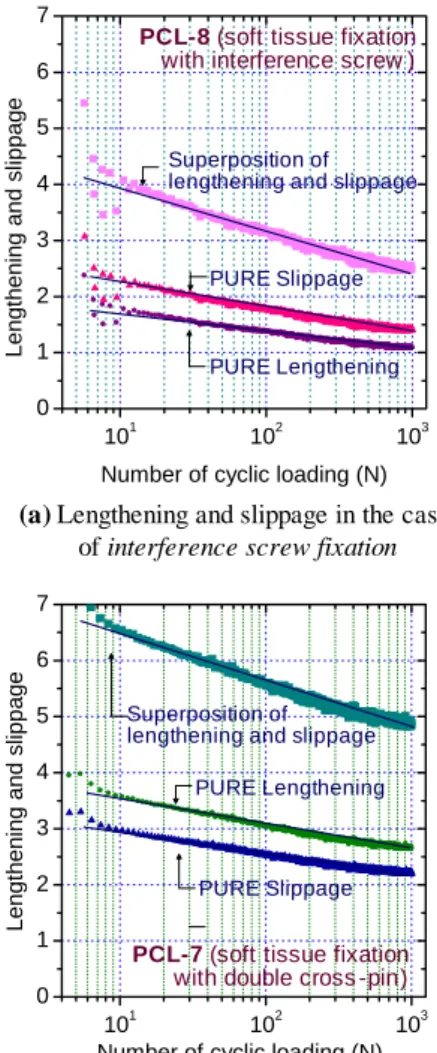
of double cross-pin fixationFig. 9 Superposition of lengthening and slippage of
Achilles tendon and number of cyclic loading under tension-tension at Pmax = 250 N and Pmin = 50 N ; (a) interference screw fixation, (b) double cross-pin fixation under 연부조직 고정법(PCL-7)을 나타낸 것이다. Fig.8(a),(b)를 종합적으로 분석해 보면, 1) 간섭나사의 종골부 고정법(Fig. 8(a))의 PCL-4, PCL-5는 동일한 기울기를 갖는다. 2) 이중고정핀의 종골부 고정법 (Fig. 8(b))인 PCL-2, PCL-3, PCL-6도 동일한 기울기 를 갖는다. 3) 간섭나사의 연부조직 고정법(PCL-8) 과 이중고정핀의 연부조직 고정법(PCL-7)은 고정장 치가 상이함에도 불구하고 동일한 기울기를 갖는다.
그러나 종골부 고정법보다 기울기가 증가하였다. 상 기 일차곡선의 기울기를 좌우하는 Fig. 8의 y축은 단위시간당 변화하는 아킬레스건의 변위(da/ds)를 1/10 sec. 단위로 측정하고 이를 정수로 표현한 것이 다. 따라서 Fig. 8에서 일차곡선의 기울기가 크다는
것은 아킬레스건의 초기연신과 후기연신의 차이가 크다는 의미이다. 그러나 PCL-8과 PCL-7은 활주가 동반되었기 때문에 과대평가되거나 과소평가된 결 과라고 생각된다. 왜냐하면 아킬레스건을 누적중첩 손상(cumulative superposition damage)의 관점으로 보 았을 때, 부하 중에 발생하는 활주가 아킬레스건의 순수연신을 저해하고 반복하중의 일부가 활주에 소 모되는 기전으로 발전되었기 때문이다. 결과적으로 연부조직 고정법을 종골부 고정법(Fig. 8(a) PCL-4,-5 및 Fig. 8(b) PCL-2,-3,-6)과 비교했을 때 부하후반으 로 갈수록 일차곡선의 기울기 차가 더 커졌다는 의 미는 연부조직 고정장치가 더욱 불안정해졌음을 의 미한다. 따라서 Fig. 8의 결과로 미루어보아 간섭나 사의 연부조직 고정법(PCL-8)이 이중고정핀의 연부 조직 고정법(PCL-7)보다 더 불안정한 고정장치라고 설명할 수 있다. 한편, Fig. 8에서는 간섭나사와 이 중고정핀의 연부조직 고정법(PCL-8, PCL-7)에서 발 생한 총연신량 중 활주율이 차지하는 비율을 평가 할 수는 없었다. 따라서 Table 3, 4에 제시된 연신율 과 활주율의 관계 및 Fig. 8의 관계를 종합하여 간 섭나사와 이중고정핀의 연부조직 고정법(PCL-8, PCL-7)에서 발생한 총연신량 중 활주가 차지하는 비율을 계산해 보았다. 그 결과는 Fig. 9와 같다.
Fig. 9(a)는 간섭나사의 연부조직 고정법(PCL-8)에 대한 결과이고, Fig. 9(b)는 이중고정핀의 연부조직 고정법(PCL-7)에 대한 결과이다. Fig. 9(a)의 간섭나 사 연부조직 고정법(PCL-8)에서 연신과 활주가 누적 중첩된 총연신율을 100%으로 보았을 때, 연신 (lengthening)이 43.6%를 차지하였고, 활주(slippage)가 56.4%를 차지하였다. 반대로 Fig. 9(b)의 이중고정핀 연부조직 고정법(PCL-7)에서는 연신이 54.6%를 차 지하고, 활주가 45.4%를 차지하였다. 이상을 총연신 량으로 환산하면, 간섭나사의 연부조직 고정법 (PCL-8)은 총연신량 12.8 mm 중에서 연신량이 5.6 mm, 활주량이 7.2 mm로 활주량이 연신량보다 오히 려 1.6 mm 많았다. 한편, 이중고정핀의 연부조직 고 정법(PCL-7)은 총연신량이 13.7 mm로 간섭나사일 때 보다 총연신량이 0.9 mm 증가하였고, 그 중 연 신량이 7.5 mm, 활주량이 6.2 mm를 차지하였다. 이 중고정핀의 연부조직 고정법에서는 연신량이 활주 량보다 1.3 mm 많았다. 따라서 간섭나사의 연부조 직 고정법(PCL-8) 및 이중고정핀의 연부조직 고정법 (PCL-7)은 동일사체의 좌우측하지에서 추출된 아킬 레스건 간의 비교결과이므로 아킬레스건의 물성에
큰 차이가 없다고 판단했을 때 다음과 같은 고찰을 할 수 있다. 1) 이중고정핀 연부조직 고정법의 경우 가 간섭나사 연부조직 고정법보다 아킬레스건의 연 신량이 약 2 mm 정도 더 증가하였다. 2) 간섭나사 연부조직 고정법의 경우, 연신보다 활주의 비율이 약 13% 더 증가하였다. 3) 그러므로 간섭나사 연부 조직 고정법(PCL-8)은 아킬레스건이 더 연신될 수 있는 여지가 있음에도 불구하고 이중고정핀에 비해 상대적으로 약한 고정에 의해 활주가 더 활발히 진 행되었고, 그로 인해 충분한 연신이 발생되지 못했 다고 판단된다. 따라서 간섭나사 연부조직 고정법에 서는 최대연신 시 발생하는 연신임계강도가 활주를 발생시키는 활주저항강도보다 약 13% 정도 낮다고 판단할 수 있고, 반대로 이중고정핀 연부조직 고정 법에서는 연신임계강도가 활주저항강도보다 약 9%
정도 높다고 판단할 수 있다.
4. 결 론
본 연구에서는 다양한 후방십자인대(PCL) 재건 술 중 사체 아킬레스건을 이용한 경골관통터널 수술법(transtibial tunnel surgery)을 이용하여 반복 하중 하에서 아킬레스건의 고정장치 및 고정위치 에 따른 초기연신거동, 총연신율과 활주율의 관계 등을 규명하였다. 그 자세한 내용은 다음과 같다.
(1) 총연신량에 대한 초기연신량의 비율은 고정 장치(간섭나사 vs. 이중고정핀) 및 고정위치(종골 부 vs. 연부조직)와 상관없이 71 ~ 82% 범위의 일정비율을 나타냈다. 따라서 아킬레스건의 고정 방식과 고정위치가 초기연신에는 큰 영향을 미치 지 못함을 알 수 있었다.
(2) 간섭나사의 아킬레스건 연부조직 고정법의 경우, 총연신량 중 활주가 차지하는 비율은 초기 연신일 때 58.3%, 이후 감소하여 부하후기일 때 55.5%까지 감소하였고, 총 2.8%의 감소율이 발생 하였다. 반면, 이중고정핀의 아킬레스건 연부조직 고정법의 경우, 총연신량 중 활주가 차지하는 비 율은 초기연신일 때 45.0%, 이후 증가하여 부하 후기일 때 46.0%까지 증가하였고, 총 1.0% 증가 율이 발생하였다.
(3) 반복하중 하에서 단위시간당 변화하는 아킬 레스건의 변위를 일차곡선으로 표현하면, 종골부 고정법 간에 동일한 기울기를 나타냈고, 연부조 직 고정법 간에도 동일한 기울기를 나타냈다. 그
러나 연부조직 고정법은 초기연신과 후기연신의 차가 크게 나타났다. 왜냐하면 누적중첩손상에 의해 부하 중에 발생하는 활주가 아킬레스건의 순수연신을 저해하고 반복하중의 일부가 활주에 소모되는 기전으로 발전되었기 때문이다.
(4) 간섭나사 연부조직 고정법에서 연신과 활주 가 누적중첩된 총연신율을 100%으로 보았을 때, 연신이 43.6%를 차지하였고, 활주가 56.4%를 차지 하였다. 반대로 이중고정핀 연부조직 고정법에서는 연신이 54.6%를 차지하고, 활주가 45.4%를 차지하 였다.
(5) 이중고정핀 연부조직 고정법은 간섭나사 연 부조직 고정법보다 아킬레스건의 총연신량이 약 2 mm 정도 더 증가하였고, 간섭나사 연부조직 고정 법은 연신보다 활주의 비율이 약 13% 더 큰 결과 가 나타났다. 따라서 간섭나사 연부조직 고정법은 아킬레스건이 더 연신될 수 있는 여지가 있음에도 불구하고 이중고정핀에 비해 상대적으로 약한 고 정에 의해 활주가 더 활발히 진행되었고, 그로 인 해 아킬레스건의 충분한 연신이 발생되지 못했다.
(6) 간섭나사 연부조직 고정법은 최대연신 시 발생하는 연신임계강도가 활주를 발생시키는 활 주저항강도보다 약 13% 정도 낮다고 판단되었고, 반대로 이중고정핀 연부조직 고정법은 연신임계 강도가 활주저항강도보다 약 9% 높다고 판단되 었다.
후 기
이 논문은 2008년도 정부재원(교육인적자원부 학술연구조성사업비)으로 한국학술진흥재단의 지 원을 받아 연구되었음 (KRF-2008-314-D00007)
참고문헌
(1) Beom Ku Lee, In Ho Seong, Young Hun Jang, and Seung Jeong Baek, 1999, "Clinical Study After Reconstruction of the Posterior Cruciate Ligament -Factors on Posterior Stability-," Journal of Korean Arthroscopy Society, Vol. 11, No. 6, pp. 62~68.
(2) Hong Chul Lim, Jae Chul Yoo, and Sang Hwan Han, 2002, "Anatomic Double-Bundle Posterior Cruciate Ligament Reconstruction Using Achilles Allograft -Preliminary Report-," Journal of Korean Arthroscopy Society, Vol. 6, No. 1, pp. 7~13.
(3) Claude T. Moorman, Siobhan Murphy Zane, Sanjiv Bansai, Stephen J. Cina, Thomas L.
Wickiewicz, Tussel F. Warren, and Maria Kyriaki Kaseta, 2008, "Tibial Insertion of the Posterior Cruciate Ligament: A Sagittal Plane Analysis Using Gross, Histologic, and Radiographic Methods,"
Arthroscopy: The Journal of Arthroscopic & Related Surgery, Vol. 24, Issue 3, pp. 269~275.
(4) Dong Chul Lee, Oog Jin Sohn, Woo Hyuk Jang, and Sang Keun Bae, 2006, "Evaluation of Posterior Cruciate Ligament Reconstruction Using the Femoral Double Tunnel and Tibial Inlay Techniques,"
Journal of Korean Orthopaedic Association, Vol.
41, No. 4, pp. 658~664.
(5) Christopher J. Wahl and Gregg Nicandri, 2008,
"Single-Achilles Allograft Posterior Cruciate Ligament and Medial Collateral Ligament Reconstruction: A Technique to Avoid Osseous Tunnel Intersection, Improve Construct Stiffness, and Save on Allograft Utilization," Arthroscopy: The Journal of Arthroscopic & Related Surgery, Vol.
24, Issue 4, pp. 486~489.
(6) Andre Weimann, Alexandra Wolfert, Thore Zantop, Anne-Kathleen Eggers, Michael Raschke, and Wolf Petersen, 2007, "Reducing the "Killer Turn" in Posterior Cruciate Ligament Reconstruction by Fixation Level and Smoothing the Tibial Aperture,"
The Journal of Arthroscopic and Related Surgery, Vol. 23, No.10, pp. 1104~1111.
(7) Yong Seuk Lee, Young Bok Jung, Jin Hwan Ahn, Bun Jung Kang, Yun Chang Shin, and Chae Gwan Kong, 2006, "Transtibial Double Bundle PCL Reconstruction Using TransFix Tibial Fixation -Technical Note-," Journal of Korean Arthroscopy Society, Vol. 10, No. 2, pp. 203~208.
(8) Jin Hwan Ahn, Jae Chul Yoo, and Joon Ho Wang, 2005, "The Clinical Results of Posterior Cruciate Ligament Reconstruction - Preservation of Remnant Posterior Cruciate Ligament-," Journal of Korean Orthopaedic Association, Vol. 40, No. 7, pp. 889~896.
(9) Eun Kyoo Song and Jong Kuen Sun, 2005,
"Comparative Study of Posterior Cruciate Ligament Reconstruction -Transtibial Tunnel Method Versus Tibial Inlay Method-," Journal of Korean Arthroscopy Society, Vol. 9, No. 1, pp. 13~15.
(10) Thore Zantop, Markus Ruemmler, Barbara Wlbers, Martin Langer, Andre Weimann, and Wolf Petersen, 2005, "Cyclic Loading Comparison Between Biodegradable Interference Screw Fixation
and Biodegradable Double Cross-Pin Fixation of Human Bone-Patellar Tendon-Bone Grafts,"
Arthroscopy: The Journal of Arthroscopic and Related Surgery, Vol. 21, No. 8, pp.934~941.
(11) Brand J., Weiler A., Caborn D.N.M., Brown C., and Johnson D., 2000, "Graft Fixation in Cruciate Ligament Reconstruction," American Journal of Sports Medicine, Vol. 28, pp. 761~773.
(12) Kousa P., Jarvinen T.L., Pohjonen T., Kannus P., and Jarvinen M, 2001, "Initial Fixation Strength of Biodegradable and Titanium Screws in Anterior Ligament Reconstruction. Biomechanical Evaluation by Single Cycle and Cyclic Loading," American Journal of Sports Medicine, Vol. 29, pp. 420~425.
(13) Kleipool, AE., Van Loon, T. and Morti, RK., 1994, "Pain After use of the Central Third of the Patellar Tendon for Cruciate Ligament Reconstruction: 33 Patients Followed for 2-3 Years,"
Acta Orthop Scand, Vol. 65, pp. 62~66.
(14) Patricia Niedzwietzki, Thore Zantop, Andre Weimann, Mirco Herbort, Michael J. Raschke, and Wolf Petersen, 2007, "Femoral Fixation of Hamstring Grafts in Posterior Cruciate Ligament Reconstruction:
Biomechanical Evaluation of Different Fixation Techniques," The American Journal of Sports Medicine, Vol. 35, No.5, pp. 780~786.
(15) Song, E.K., Yoon, T.R. and Jung, J.W., 2001,
"Widening of Bony Tunnel After ACL Reconstruction using Hamstring with Ligament Anchor (LA) Screw, Journal of Korean Arthroscopy Society, No. 5, pp. 69~73.
(16) In, Y., Bahk, W.J. and Kwon, O.S., 2004,
"Cross-Pin Femoral Fixation for Hamstring Posterior Cruciate Ligament Reconstruction," Arthroscopy Association of North America, Vol. 33, No.12, pp.
29~33.
(17) Thomas Nau, Yan Chevalier, Nicola Hagemeister, Jacques A. deGuise and Nicolas Duval, 2005,
"Comparison of 2 Surgical Techniques of Posterolateral Coner Reconstruction of the Knee,"
The American Journal of Sports Medicine, Vol. 33, No.12, pp. 1838~1845.
(18) Thore Zantop, Andre Weimann, Kerstin Wolle, Volker Musahl, Martin Langer, and Wolf Petersen, 2007, "Initial and 6 Weeks Postoperative Structural Properties of Soft Tissue Anterior Cruciate Ligament Reconstructions With Cross-Pin or Interference Screw Fixation: An In Vivo Study in Sheep,"
Arthroscopy Association of North America, Vol. 23, No.1, pp. 14~20.