• 검색 결과가 없습니다.

Isolation and characterization of Brucella abortus isolates from wildlife species in South Korea

N/A
N/A
Protected

Academic year: 2021

Share "Isolation and characterization of Brucella abortus isolates from wildlife species in South Korea"

Copied!
7
0
0

로드 중.... (전체 텍스트 보기)

전체 글

(1)

Korean J Vet Res(2016) 56(3) : 147~153 http://dx.doi.org/10.14405/kjvr.2016.56.3.147

147

<Original Article>

Isolation and characterization of Brucella abortus isolates from wildlife species in South Korea

Quang Lam Truong

1

, Kiju Kim

1

, Jong-Taek Kim

1

, Moon Her

2

, Suk-Chan Jung

2

, Tae-Wook Hahn

1,

*

1

College of Veterinary Medicine and Institute of Veterinary Science, Kangwon National University, Chuncheon 24341, Korea

2

OIE Reference Laboratory for Brucellosis, Animal and Plant Quarantine Agency, Anyang 14089, Korea (Received: May 7, 2016; Accepted: June 29, 2016)

Abstract: A total of 782 blood and 465 tissue samples from 1,039 wild animals and 127 dairy goats were collected from January 2011 to December 2013 in 10 provinces of South Korea and tested for the presence of brucellosis. The Rose Bengal test revealed that 8.0% (52/650) of the serum samples were seropositive, while 4.2% (33/782) of the serum samples were positive for Brucella antibodies by competitive enzyme-linked immunosorbent assay. Of the 650 sera examined, only 16 (2.5%) were positive by both serological tests. Direct polymerase chain reaction (PCR) assay using B4/B5 primers for Brucella abortus (BCSP31) revealed the prevalence of Brucella to be 26.5% (129/487) in blood samples and 21% (98/465) in tissue samples while, 16S rRNA PCR detected Brucella DNA in 6.8% (33/487) and 2.6%

(12/465) in blood and tissue samples, respectively. Of PCR-positive samples, only 6.2% (30/487) of blood samples and 2.4% (11/465) of tissue samples were found to be positive by both BCSP31 and 16S rRNA PCRs. However, Brucella strains were isolated by blood culture from only two out of 487 blood samples (0.4%). This characterization and identification of pathogenic Brucella isolates is the first to clearly indicate that the organisms were Brucella abortus biovar 1.

Keywords: Brucella abortus, isolation, polymerase chain reaction, serology, wildlife

Introduction

Over the years, Brucella species infections world-wide have been documented in a great variety of terrestrial wildlife and marine species [9, 13, 20, 27, 30, 36]. An important consid- eration with regard to brucellosis in wildlife is to distinguish between a spillover of infection from domestic animals and a sustainable infection within a susceptible wildlife population.

However, there is still limited understanding of the impact of mutual transmission of pathogens between livestock and wild- life [12]. Hence, only long-term surveillance of wildlife may help to identify the natural reservoir of diseases in sporadic areas, creating opportunities for helping nationwide eradication.

In South Korea, bovine brucellosis is currently sporadic among domestic cattle. The disease was first reported in live- stock in 1955. Although there have been national brucellosis eradication programs, a steady annual increase in the number of outbreaks was reported prior to the year 2000 [32]. Follow- ing the severe losses during the 2000–2006 period, intensive brucellosis eradication programs covering all dairy and beef cattle have largely eliminated brucellosis in domestic livestock [16]. Because the interactions between wildlife and livestock might influence the course of progressive brucellosis control,

monitoring for brucellosis in wildlife has been conducted from 2008 to 2010 in the Gangwon and Chungcheong provinces of South Korea. During that monitoring, a strain of Brucella (B.) abortus biovar (bv) 1 was isolated from Chinese water deer [31] in Gangwon province, and this isolate was classified as having the same genotype as isolates from domestic cattle farms in the same province [16]. This evidence suggests that the risk of direct or indirect transmission of brucellosis between cattle and wildlife may occur, and that infected wild- life must be considered a possible source of reinfection for domestic livestock in the final stages of a brucellosis eradica- tion campaign in South Korea. Because there have been no large-scale studies of brucellosis prevalence in wildlife in South Korea, efficient implementation of brucellosis control measures in wildlife, such as a nationwide program, are neces- sary. In this context, the aim of our investigation was to estab- lish nationwide screening for the prevalence of brucellosis in wildlife, and in dairy goats, in 10 provinces of South Korea.

Materials and Methods

Sample collection

All wild animals tested in this study were rescued by the

*Corresponding author

Tel: +82-33-250-8671, Fax: +82-33-259-5625

E-mail: [email protected]

(2)

Wildlife Reservation Centers located at 10 different provinces and cities. Specimens from 12 wildlife species and dairy goats were collected from different areas of Gangwon, Gyeonggi, Chungcheongbuk, Chungcheongnam, Gyeongsangbuk, Jeol- labuk, Jeollanam, Ulsan, Gyeongsangnam, and Busan during the period of January 2011 to December 2013. The blood, spleen, liver, kidney, and lymph node from each carcass were aseptically prepared at autopsy, while only blood samples were collected from live animals. These samples were used for the detection of brucellosis using the polymerase chain reac- tion (PCR), serological testing, and bacterial isolation.

Serological tests

The Rose Bengal test (RBT) was carried out with a com- mercial cell suspension of B. abortus standardized in accor- dance with the World Organisation for Animal Health (OIE Terrestrial Manual, 2009) [25]. The competitive enzyme-linked immunosorbent assay (C-ELISA), an OIE-recommended test for Brucella diagnosis, was conducted by using the Brucella- Ab C-ELISA kit (Svanova Biotech; Sweden), which is a multispecies assay allowing detection of Brucella-specific antibodies in various species. All steps of the RBT and C- ELISA were conducted in accordance with the manufactur- ers’ protocols. The C-ELISA results for control and test sera were expressed as percent inhibition (PI). The PI value for each sample was calculated with the formula PI = [100 – (OD of test sample/OD of conjugate control) × 100]. Based on C-ELISA cutoff value of ≤ 30 PI being negative, sera of wildlife with C-ELISA values of >30 PI were considered positive (Svanova Biotech).

Bacterial isolation

Blood, spleen, liver, kidney, and lymph node specimens were collected from each animal for isolation. These sam- ples were handled at biosafety level 2 plus and protocols were carried out in accordance with the OIE Terrestrial Man- ual 2009 [25]. Briefly, 0.5 to 2 mL of each blood sample was centrifuged, and the pellets were then inoculated into tryptic soy broth (TSB; Becton, Dickinson and Company, USA) con- taining 5% bovine serum. Tissue samples were homogenized in sterile phosphate-buffered saline (PBS, pH 7.0) using a Tis- sue Lyser system (Qiagen, USA). Tissue homogenates were inoculated directly onto tryptic soy agar (TSA) and into TSB supplemented with 5% bovine serum and antibiotic mixtures (25 U/mL bacitracin, 20 μg/mL vancomycin, 5 μg/mL nalidixic acid, 5 U/mL polymyxin B, 100 μg/mL cyclohexamide, and 100 U/mL nystatin). For blood and tissue culture, the culture tubes were incubated under air supplemented with 5% CO

2

at 37

o

C for 30 days. Each broth culture was inoculated onto TSA every 10 days and then incubated at the same condi- tions for 3 to 10 days for the presence of suspected colonies.

To confirm the Brucella species, the organisms were identi- fied by colony morphology, Gram staining, oxidase and cata- lase production, urease hydrolysis activity, H

2

S production, CO

2

requirement, and growth in the presence of basic fuch-

sine and thionine at 20 μg/mL. Agglutination with A and M monospecific sera (National Veterinary Services Laboratories, USA), as well as lysis by phages, were also performed to identify the isolates.

DNA extraction from clinical samples

Lymph node, liver, and spleen tissue samples from the ani- mals were combined and homogenized in 1 mL of PBS by a Tissue Lyser system. Three hundreds microliters of tissue homogenates were used for DNA extraction in accordance with the manufacturer’s protocol (DNeasy Blood and Tissue kit; Qiagen). Three hundreds microliters of blood samples were taken and centrifuged at 4,000 × g for 5 min. The genomic DNA of whole-blood pellet was isolated with a DNeasy Blood and Tissue DNA extraction kit (Qiagen) in accordance with the manufacturer’s instructions. For bacterial cells, the genomic DNA of isolated colonies was obtained using the HiYield Genomic DNA kit (RBC Bioscience, Taiwan). The DNA was stored at −20

o

C until it was used.

PCR amplification

For direct detection of Brucella organisms in blood and tis- sue samples, the amplifications were performed using previ- ously described primers: B4/B5 primers (BCSP31 PCR) amplified a 223 bp sequence of the gene encoding a 31 kDa B. abortus antigen [6] and 905 bp fragment was amplified with F4/R2 primers (16S rRNA PCR) derived from the 16S rRNA sequence on B. abortus [28]. Primers were synthe- sized by Bioneer (Korea). PCRs were performed in a 25 µL mixture containing PCR buffer (50 mM KCl, 10 mM Tris HCl, 0.1% Triton X-100; Promega, USA), 200 µM each of deoxynucleoside triphosphate, 1.5 mM MgCl

2

, 10 pmol of each primer, 1–2 units of GoTaq DNA polymerase (Promega) and 5 µL of template DNA in a total volume of 25 µL. The PCR conditions were used as previously described [6, 28]. For verification of the Brucella isolates, the advance Bruce-lad- der PCR was performed as described elsewhere [15, 18].

Negative controls containing all PCR reagents except tem- plate DNA were also used. The positive PCR control con- tained genomic DNA isolated from B. abortus bv 1–544, B.

canis RM6/66, B. suis bv 1 1330, B. ovis 63/290, B. neotomae 5K33, and B. melitensis bv 1 16M reference strains, respec- tively. Thermal cycling was performed with a C1000 Thermal Cycler (Bio-Rad Laboratories, USA). To check the reliabil- ity of the results and to detect any external contamination, all samples were processed in duplicate. The expected size of the amplied DNA was determined by electrophoresis in a 1.0%

agarose gel and comparison with DNA molecular-weight standards (Solgen, Korea). The presence of a well-defined band was considered as a positive result.

Results

Between 2011 and 2013, a total of 1,166 individuals (782

blood and 465 tissue samples) from 12 wildlife species (n =

(3)

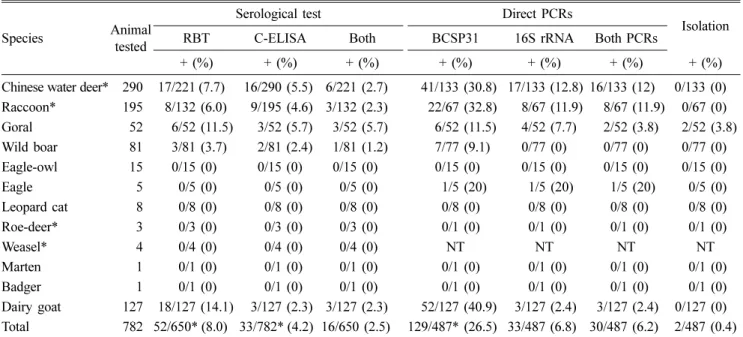
1,039) and dairy goats (n = 127) were tested for brucellosis using direct PCRs, serology, and bacterial isolation. As shown in Table 1, a total of 782 serum samples were examined for antibodies to Brucella using RBT and C-ELISA. Seropositiv- ity by RBT was found in 8.0% (52/650) of the samples, including 7.7% (17/221) of Chinese water deer, 6.0% (8/132) of raccoons, 11.5% (6/52) of gorals, 3.7% (3/81) of wild boars, and 14.1% (18/127) of dairy goats. In comparison, 33 out of 782 serum samples (4.2%) were found to be seropositive by C-ELISA including 5.5% (16/290) in Chinese water deer, 4.6% (9/195) of raccoons, 5.7% (3/52) of gorals, 2.4% (2/81) of wild boars, and 2.3% (3/127) of dairy goats. Although serum samples were examined using both RBT and C-ELISA assays, positive results were poorly correlated between these tests. Among positive serum samples, only 2.5% (16/650) of samples, including 5.7% (3/52) of gorals, 2.7% (6/221) of Chinese water deer, 2.3% (3/132) of raccoons, 1.2% (1/81) of wild boars, and 2.3% (3/127) of dairy goats, were positive on both serological tests.

Blood samples were also tested for the presence of Bru- cella DNA by PCRs. Of the 487 blood samples evaluated (Table 1), 129 samples were positive for Brucella spp. by BCSP31 PCR, yielding a prevalence of 26.5% including 30.8%

(41/133) in Chinese water deer, 32.8% (22/67) in raccoons, 11.5% (6/52) in gorals, 9.1% (7/77) in wild boars, 20% (1/5) in eagles, and 40.9% (52/127) in dairy goats. Meanwhile, 33 out of 487 blood samples (6.8%) were found positive for Brucella DNA by 16S rRNA PCR. However, among these, only 30 blood samples (6.2%) were found to be positive by both PCRs. There were inconsistent results among the tests;

some samples were found to be positive by PCRs but nega-

tive by serology, and vice versa, and only 1.3% (10/782) of blood samples were found to be positive with all four tests (RBT, C-ELISA, BCSP31 PCR and 16S rRNA PCR). By contrast, as seen in Table 1, Brucella species were isolated by blood culture from only two of 487 (0.4%) blood samples.

Interestingly, these two isolates were obtained from blood samples of gorals (2/52) which all were positive in serologi- cal tests, PCRs and blood culture.

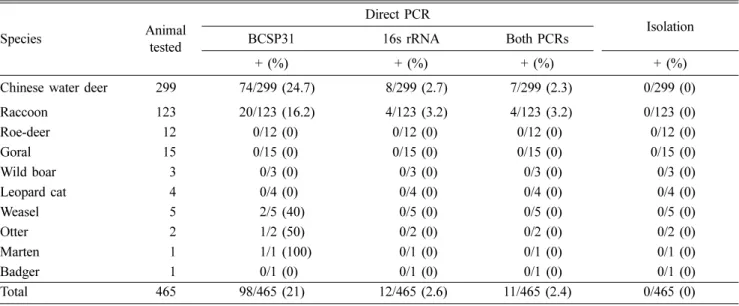
The overall results of PCRs and bacterial isolation in tis- sue samples are shown in Table 2. We demonstrated that 98 out of 465 tissue samples (21%) from wildlife were positive by direct BCSP31 PCR; 74/299 (24.7%) of Chinese water deer, 20/123 (16.2%) of raccoons, 2/5 (40%) of weasels, 1/2 (50%) of otters, and 1/1 (100%) of marten. Only 12 of all samples tested (2.6%) were found to be positive by direct 16S rRNA PCR, including 2.7% (8/299) of Chinese water deer, and 3.2% (4/123) of raccoons. Among PCR-positive samples, only 2.4% (11/465) of samples were found to be positive by both PCRs. All tissue samples yielded negative results in conventional bacterial culturing for Brucella.

The two isolates originating from blood samples of gorals were identified using the classical biotyping method. The characteristics of Brucella isolates clearly indicate that the etiological pathogen in gorals was B. abortus bv 1 (Table 3).

Using BCSP31 PCR, a fragment of expected size (223 bp) was amplified from total DNA of the two isolates, indicating these isolates belonged to the genus Brucella (data not shown).

In addition, the advanced Bruce-ladder PCR was used for the identification and differentiation of Brucella species, prov- ing that these isolates were B. abortus (Fig. 1).

Table 1. Prevalence of Brucella in blood samples of wildlife and dairy goats in 2011–2013

Species Animal

tested

Serological test Direct PCRs

Isolation

RBT C-ELISA Both BCSP31 16S rRNA Both PCRs

+ (%) + (%) + (%) + (%) + (%) + (%) + (%)

Chinese water deer* 290 17/221 (7.7) 16/290 (5.5) 6/221 (2.7) 41/133 (30.8) 17/133 (12.8) 16/133 (12) 0/133 (0) Raccoon* 195 28/132 (6.0) 29/195 (4.6) 3/132 (2.3) 222/67 (32.8) 228/67 (11.9) 228/67 (11.9) 20/67 (0) Goral 52 226/52 (11.5) 223/52 (5.7) 23/52 (5.7) 226/52 (11.5) 224/52 (7.7) 222/52 (3.8) 22/52 (3.8) Wild boar 81 223/81 (3.7) 222/81 (2.4) 21/81 (1.2) 227/77 (9.1) 220/77 (0) 220/77 (0) 20/77 (0) Eagle-owl 15 220/15 (0) 220/15 (0) 20/15 (0) 220/15 (0) 220/15 (0) 220/15 (0) 20/15 (0) Eagle 5 2220/5 (0) 2220/5 (0) 220/5 (0) 2221/5 (20) 2221/5 (20) 2221/5 (20) 220/5 (0) Leopard cat 8 2220/8 (0) 2220/8 (0) 220/8 (0) 2220/8 (0) 2220/8 (0) 2220/8 (0) 220/8 (0) Roe-deer* 3 2220/3 (0) 2220/3 (0) 220/3 (0) 2220/1 (0) 2220/1 (0) 2220/1 (0) 220/1 (0)

Weasel* 4 2220/4 (0) 2220/4 (0) 220/4 (0) NT NT NT NT

Marten 1 2220/1 (0) 2220/1 (0) 220/1 (0) 2220/1 (0) 2220/1 (0) 2220/1 (0) 220/1 (0) Badger 1 2220/1 (0) 2220/1 (0) 220/1 (0) 2220/1 (0) 2220/1 (0) 2220/1 (0) 220/1 (0) Dairy goat 127 18/127 (14.1) 23/127 (2.3) 3/127 (2.3) 52/127 (40.9) 23/127 (2.4) 23/127 (2.4) 0/127 (0) Total 782 52/650* (8.0)2 33/782* (4.2) 16/650 (2.5) 129/487* (26.5) 33/487 (6.8) 30/487 (6.2) 2/487 (0.4)

*The number of samples used for each method of testing differed because specimens were sometimes received with serum or hemolysis in

serum, so other tests could not be applied. PCR, polymerase chain reaction; RBT, Rose Bengal test; C-ELISA, complementary enzyme-

linked immunosorbent assay; NT, not tested.

(4)

Table 2. Prevalence of Brucella in tissue samples of wildlife in 2011–2013

Species Animal

tested

Direct PCR

Isolation

BCSP31 16s rRNA Both PCRs

+ (%) + (%) + (%) + (%)

Chinese water deer 299 74/299 (24.7) 28/299 (2.7) 27/299 (2.3) 0/299 (0)

Raccoon 123 20/123 (16.2) 24/123 (3.2) 24/123 (3.2) 0/123 (0)

Roe-deer 12 220/12 (0) 220/12 (0) 220/12 (0) 20/12 (0)

Goral 15 220/15 (0) 220/15 (0) 220/15 (0) 20/15 (0)

Wild boar 3 2220/3 (0) 2220/3 (0) 2220/3 (0) 220/3 (0)

Leopard cat 4 2220/4 (0) 2220/4 (0) 2220/4 (0) 220/4 (0)

Weasel 5 2222/5 (40) 2220/5 (0) 2220/5 (0) 220/5 (0)

Otter 2 2221/2 (50) 2220/2 (0) 2220/2 (0) 220/2 (0)

Marten 1 2221/1 (100) 2220/1 (0) 2220/1 (0) 220/1 (0)

Badger 1 2220/1 (0) 2220/1 (0) 2220/1 (0) 220/1 (0)

Total 465 98/465 (21) 12/465 (2.6) 11/465 (2.4) 0/465 (0)

Table 3. Classical bio-typing of Brucella isolates from gorals

Strains

Growth characteristics Growth on dyes*

Specific

Sera

Lysis by phages

Interpretation

CO

2

Oxidase H

2

S Urea TH BF A M Tb Wb R/C

RTD 10

4

RTD RTD RTD

Goral 1 + + + + - + + - + + + - B. abortus bv 1

Goral 2 + + + + - + + - + + + - B. abortus bv 1

References + + + + - + + - + + + - B. abortus bv 1, 544

*Thionine (TH), basic fuchsine (BF); dye concentration in serum dextrose medium, 20 µg/mL.

Mono-specific antisera against Brucella (B.) abortus (A) and B. melitensis (M). Tb, Tbilisi; Wb, Weybridge; R/C, rough/canis-specific; RTD, routine test dilution.

Fig. 1. Identification and differentiation of Brucella isolates by advanced Bruce-ladder PCR. Lane M, 100 bp ladder; lane 1, B. abor- tus; lane 2, B. canis; lane 3, B. suis; lane 4, B. ovis; lane 5, B. neotomae; lane 6, B. melintensis; lane 7, B. certi; lane 8, B. pinnipedialis;

lane 9, B. microti; lane 10, B. inopinata; lanes 11 and 12, goral isolates.

(5)

Discussion

From 2011 to 2013, the first large-scale nationwide surveil- lance program using serological, bacteriological, and molec- ular diagnostics of brucellosis has been applied to wildlife species. In the present study, the seroprevalence of brucello- sis in wild animals was found to be 8% (52/650) with RBT and 4.2% (33/782) with C-ELISA, with the PI value of the most positive samples in C-ELISA showing weak positive results (PI range, 31–60). Only 16 of 650 samples were pos- itive by both assays, giving an overall seroprevalence of 2.5%. These results demonstrate a poor correlation between RBT and C-ELISA assays. Hence, it is highly probable that a higher number of false-positive or cross-reactions occurred in RBT than in C-ELISA. The RBT is known to be a less spe- cific test than C-ELISA because of its poor ability to discrim- inate between antibodies from cross-reacting organisms [7, 26, 29]. Cross-reactions and false-positive test results are possible because it was unknown whether the wild animals were infected with other Gram-negative bacteria such as Vibrio cholera O1, Yersinia enterocolitica O:9, Escherichia coli O:157, and some strains of Escherichia hermanni and Stenotrophomonas maltophil in wild animals [22, 29]. The observation of fewer C-ELISA positives than RBT positives has also been noted in other studies that demonstrated higher specificity of C-ELISA than RBT in either cattle or wild ani- mals [14, 19, 26]. Additionally, because the validation of serological tests for brucellosis in wildlife species is still an issue, the positivity by both C-ELISA and RBT must be care- fully evaluated as it may represent a source of infection [11].

Based on the reliable discrimination between C-ELISA and RBT, in this study we can conclude that the overall seroprev- alence of brucellosis in wild animals in South Korea is 2.5%.

Previous studies have also demonstrated the successful application of BCSP31 and 16S rRNA PCRs for the detec- tion of Brucella species in clinical samples including blood, milk and many types of tissues [4, 17, 21, 28, 35]. In the present study, the PCR prevalence of brucellosis in wildlife was surprising; 26.5% of blood and 21% of tissue samples were found positive for Brucella DNA by BCSP31 PCR, while only 6.8% and 2.6% of blood and tissue samples were found positive by 16s rRNA PCR, respectively. In fact, the high number of BCSP31 PCR-positive results in blood and tissue samples did not permit us to consider the overall prev- alence of brucellosis in wildlife populations. Both BCSP31 and 16S rRNA PCRs could provide more accurate positive results. In fact, only 30/487 blood and 11/465 tissue samples of wild animals and dairy goats were found to be positive by both PCRs, giving overall prevalence by PCR of 6.2% and 2.4%, respectively.

The high rate of PCR-positive results raised many ques- tions about the specificity of BCSP31 and 16s rRNA PCR- based methods, particularly BCSP31 PCR. It has been previ- ously reported that the sensitivity of BCSP31 PCR in the detection of Brucella DNA in clinical samples is superior to

that of 16s rRNA and omp2 gene PCRs [2, 4, 21, 23]. The BCSP31 PCR can be used for large-scale field screening for brucellosis in clinical samples of wild and domestic animals [35]. However, in this investigation, the BCSP31 PCR results showed problems with specificity. The close phylogenetic relationship between Ochrobactrum (O.) anthropi and Bru- cella spp. is previously acknowledged, as is the observation of similar products amplified by using the 16S rRNA prim- ers [8, 24]. Baily et al. [6] did not test whether the BCSP31 (B4/B5) primers do amplify the DNA of O. anthropi or other closely related bacterial species. In our study, we also estab- lished that the false-positive reaction in BCSP31 PCR, result- ing from specimen contamination, such as the infection by other microorganisms including Acinetobacter iwoffii, Aero- monas salmonicida, Yersinia pseudotuberculosis, and particu- larly Oligella ureolytica also requires attention (data not shown).

In particular, our results showed that O. anthropi species also yielded PCR products of expected size for either the BCSP31 or 16S rRNA primers. Those bacteria were isolated from PCR- positive samples, and identified by the Vitek 2 system (data not shown). Because it is unknown whether such pathogens are prevalent in wild animals, false-positive results caused by those pathogens cannot be excluded. In order to avoid these problems, further development and validation of established or new PCR assays, including single or multiplex PCRs, are needed to improve their sensitivity, specificity, and technical ease as well as to lower costs. These efforts will be useful for brucellosis screening or diagnosis in clinical samples from either domestic or wild animals. Furthermore, the combina- tion or use of more than one specific PCR-based marker can increase the sensitivity and specificity of Brucella detection, and it appears to be a more reliable molecular diagnostic approach for screening field animals.

In this study, the conventional cultures are a gold standard method, but showed very low sensitivity when compared with either serological or PCR tests. By using conventional cultures, Brucella species were not isolated from any of the tissue cultures, whereas B. abortus isolates were recovered from blood samples of two gorals. The different detection rate of Brucella species in either the blood or tissue samples could be due to higher sensitivity in the serological tests and PCRs compared with traditional culture methods. On the other hand, PCR can yield positive results when only bacterial DNA is present and there are no live bacteria in blood or tis- sue sample [33]. Excessive delay in the transport of materi- als for culture or differences in isolation techniques, sample types and the viability of the organism in the sample may also have affected the Brucella isolation rates [3, 10, 36].

Additionally, previous reports demonstrated that negative results from clinical samples might be attributable to contamination, and these difficulties proved to be a major factor in the rate of B. abortus isolation [1, 10].

Brucellosis is considered as an important infectious dis-

ease that affects public health. Historically, brucellosis in

domestic cattle was spread throughout South Korea with a

(6)

relatively high incidence reported [32, 34]. The impact of mutual transmission of Brucella between livestock and wild- life is still unknown, however B. abortus infection has been reported in nonpreferred hosts such as domestic dogs [5], elks [13], and Chinese water deers [31]. In our present study, B.

abortus strains were isolated from blood samples of gorals for the first time in South Korea, to our knowledge. By using biotyping, the two B. abortus bv 1 isolates from gorals were classified and grouped with isolates of the most common genotype from domestic cattle in South Korea. Hence, it appears possible that B. abortus can be transferred to gorals from cat- tle either directly or indirectly, as B. abortus is the common Brucella species isolated from cattle in South Korea.

The control of brucellosis in wildlife populations in South Korea presents an even greater challenge than its control in domestic animal species. Our investigation confirms the existence of Brucella in wild animals. It highlights the fact that high rates of brucellosis was observed in Chinese water deer, raccoon and gorals, and the presence of B. abortus bv 1 was detected in gorals. Because direct or indirect transmis- sion of the disease may occur, and brucellosis in wildlife res- ervoirs may pose a threat to humans and domestic animals, the implementation of national surveillances and control pro- grams for brucellosis in wildlife is extremely important to avoid new cases of such infections. Therefore, ongoing wildlife brucellosis surveillance programs should be considered to eradicate brucellosis in livestock and to protect the public health in South Korea.

Acknowledgments

This study was supported from funding of the Veterinary Science Technical Development projects in Animal and Plant Quarantine Agency (QIA), Ministry for Agriculture, Food and Rural Affairs (MAFRA), Republic of Korea (grant No.

1545007777) and by 2014 Research Grant from Kangwon National University (No. 120141472).

References

1. Ahmed YF, Sokkar SM, Desouky HM, Ghazi YA, Amin AS, Madboly AA. Pathological and molecular studies on mammary glands and supramammary lymph nodes of naturally Brucella infected buffalo-cows. J Reprod Infertil 2010, 1, 33- 40.

2. Al-Ajlan HH, Ibrahim ASS, Al-Salamah AA. Comparison of different PCR methods for detection of Brucella spp. in human blood samples. Pol J Microbiol 2011, 60, 27-33.

3. Alton GG, Jones LM, Pietz DE. Laboratory techniques in brucellosis. Monogr Ser World Health Organ 1975, 1-163.

4. Baddour MM, Alkhalifa DH. Evaluation of three polymerase chain reaction techniques for detection of Brucella DNA in peripheral human blood. Can J Microbiol 2008, 54, 352-357.

5. Baek BK, Lim CW, Rahman MS, Kim CH, Oluoch A, Kakoma I. Brucella abortus infection in indigenous Korean dogs. Can J Vet Res 2003, 67, 312-314.

6. Baily GG, Krahn JB, Drasar BS, Stoker NG. Detection of

Brucella melitensis and Brucella abortus by DNA amplification.

J Trop Med Hyg 1992, 95, 271-275.

7. Biancifiori F, Garrido F, Nielsen K, Moscati L, Durán M, Gall D. Assessment of a monoclonal antibody-based competitive enzyme linked immunosorbent assay (cELISA) for diagnosis of brucellosis in infected and Rev. 1 vaccinated sheep and goats. New Microbiol 2000, 23, 399-406.

8. Da Costa M, Guillou JP, Garin-Bastuji B, Thiébaud M, Dubray G. Specificity of six gene sequences for the detection of the genus Brucella by DNA amplification. J Appl Bacteriol 1996, 81, 267-275.

9. Etter RP, Drew ML. Brucellosis in elk of eastern Idaho. J Wildl Dis 2006, 42, 271-278.

10. Ewalt DR. Comparison of three culture techniques for the isolation of Brucella abortus from bovine supramammary lymph nodes. J Vet Diagn Invest 1989, 1, 227-230.

11. Gardner IA, Hietala S, Boyce WM. Validity of using serological tests for diagnosis of diseases in wild animals.

Rev Sci Tech 1996, 15, 323-335.

12. Godfroid J. Brucellosis in wildlife. Rev Sci Tech 2002, 21, 277-286.

13. Her M, Cho DH, Kang SI, Lim JS, Kim HJ, Cho YS, Hwang IY, Lee T, Jung SC, Yoo HS. Outbreak of brucellosis in domestic elk in Korea. Zoonoses Public Health 2010, 57, 155-161.

14. Hini V, Brodard I, Thomann A, Holub M, Miserez R, Abril C. IS711-based real-time PCR assay as a tool for detection of Brucella spp. in wild boars and comparison with bacterial isolation and serology. BMC Vet Res 2009, 5, 22.

15. Kang SI, Her M, Kim JW, Kim JY, Ko KY, Ha YM, Jung SC. Advanced multiplex PCR assay for differentiation of Brucella species. Appl Environ Microbiol 2011, 77, 6726- 6728.

16. Kim JY, Her M, Kang SI, Lee K, Lee HK, Jung SC.

Epidemiologic relatedness between Brucella abortus isolates from livestock and wildlife in South Korea. J Wildl Dis 2013, 49, 451-454.

17. Leal-Klevezas DS, Martínez-Vázquez IO, López-Merino A, Martínez-Soriano JP. Single-step PCR for detection of Brucella spp. from blood and milk of infected animals. J Clin Microbiol 1995, 33, 3087-3090.

18. López-Goñi I, García-Yoldi D, Marín CM, de Miguel MJ, Muñoz PM, Blasco JM, Jacques I, Grayon M, Cloeckaert A, Ferreira AC, Cardoso R, Corrêa de Sá MI, Walravens K, Albert D, Garin-Bastuji B. Evaluation of a multiplex PCR assay (Bruce-ladder) for molecular typing of all Brucella species, including the vaccine strains. J Clin Microbiol 2008, 46, 3484-3487.

19. Mainar-Jaime RC, Muñoz PM, de Miguel MJ, Grilló MJ, Marín CM, Moriyón I, Blasco JM. Specificity dependence between serological tests for diagnosing bovine brucellosis in Brucella-free farms showing false positive serological reactions due to Yersinia enterocolitica O:9. Can Vet J 2005, 46, 913- 916.

20. Mathias LA, Girio RJS, Duarte JMB. Serosurvey for antibodies against Brucella abortus and Leptospira interrogans in pampas deer from Brazil. J Wildl Dis 1999, 35, 112-114.

21. Mukherjee F, Jain J, Patel V, Nair M. Multiple genus- specific markers in PCR assays improve the specificity and sensitivity of diagnosis of brucellosis in field animals. J Med

c í

(7)

Microbiol 2007, 56, 1309-1316.

22. Muñoz PM, Marín CM, Monreal D, González D, Garin- Bastuji B, Díaz R, Mainar-Jaime RC, Moriyón I, Blasco JM. Efficacy of several serological tests and antigens for diagnosis of bovine brucellosis in the presence of false-positive serological results due to Yersinia enterocolitica O:9. Clin Diagn Lab Immunol 2005, 12, 141-151.

23. Navarro E, Escribano J, Fernández J, Solera J. Comparison of three different PCR methods for detection of Brucella spp.

in human blood samples. FEMS Immunol Med Microbiol 2002, 34, 147-151.

24. Navarro E, Fernandez JA, Escribano J, Solera J. PCR assay for diagnosis of human brucellosis. J Clin Microbiol 1999, 37, 1654-1655.

25. OIE. Bovine brucellosis. In: Manual of Diagnostic Tests and Vaccines for Terrestrial Animals. Chap. 2.4.3. pp. 624-659, World Orgarnisation for Animal Health, Paris, 2009.

26. Perrett LL, McGiven JA, Brew SD, Stack JA. Evaluation of competitive ELISA for detection of antibodies to Brucella infection in domestic animals. Croat Med J 2010, 51, 314-319.

27. Qureshi T, Stittmatter J, Turner K, Davis DS. Experimental infection of white-tailed deer with rangiferine brucellosis. J Wildl Dis 1999, 35, 388-391.

28. Romero C, Gamazo C, Pardo M, López-Goñi I. Specific detection of Brucella DNA by PCR. J Clin Microbiol 1995, 33, 615-617.

29. Samartino L, Gall D, Gregoret R, Nielsen K. Validation of enzyme-linked immunosorbent assays for the diagnosis of bovine brucellosis. Vet Microbiol 1999, 70, 193-200.

30. Tiller RV, Gee JE, Frace MA, Taylor TK, Setubal JC, Hoffmaster AR, De BK. Characterization of novel Brucella strains originating from wild native rodent species in North Queensland, Australia. Appl Environ Microbiol 2010, 76, 5837- 5845.

31. Truong QL, Kim JT, Yoon BI, Her M, Jung SC, Hahn TW. Epidemiological survey for Brucella in wildlife and stray dogs, a cat and rodents captured on farms. J Vet Med Sci 2011, 73, 1597-1601.

32. Wee SH, Nam HM, Kim CH. Emergence of brucellosis in cattle in the Republic of Korea. Vet Rec 2008, 162, 556-557.

33. Weiner M, Iwaniak W, Szulowski K. Identification of Brucella DNA in lymph tissue from deer (Cervus elaphus) and wild boars (Sus scrofa) by the use of BCSP31 PCR and AMOS- PCR. Bull Vet Inst Pulawy 2009, 53, 609-612.

34. Yoon H, Moon OK, Lee SH, Lee WC, Her M, Jeong W, Jung SC, Kim DS. Epidemiology of brucellosis among cattle in Korea from 2001 to 2011. J Vet Sci 2014, 15, 537-543.

35. Yu WL, Nielsen K. Review of detection of Brucella spp. by polymerase chain reaction. Croat Med J 2010, 51, 306-313.

36. Zheludkov MM, Tsirelson LE. Reservoirs of Brucella

infection in nature. Biol Bull 2010, 37, 709-715.

수치

Table 1. Prevalence of  Brucella in blood samples of wildlife and dairy goats in 2011–2013
Table 2. Prevalence of  Brucella in tissue samples of wildlife in 2011–2013 Species Animal  tested Direct PCR IsolationBCSP3116s rRNABoth PCRs + (%) + (%) + (%) + (%)

참조

관련 문서

It considers the energy use of the different components that are involved in the distribution and viewing of video content: data centres and content delivery networks

After first field tests, we expect electric passenger drones or eVTOL aircraft (short for electric vertical take-off and landing) to start providing commercial mobility

1 John Owen, Justification by Faith Alone, in The Works of John Owen, ed. John Bolt, trans. Scott Clark, &#34;Do This and Live: Christ's Active Obedience as the

mRNA expression of osteonectin, Runx2 and BSP(bone sialoprotein) in MC3T3-E1 cells cultured for 24 hours on 4 different titanium surfaces.. The mRNA were analyzed

Comparison of the prevalence of Malnutrition and Overweight, Obesity between South Korean families and North Korean refugees families 15 Table 5.. Comparison of the

In this context, the present study found that the emphasis of art education was changing from expression-oriented practical classes to systematic

Comparison of genotypes using REP-PCR and Integron-IS26 PCR results among 78 IRAB strains isolated from 2 university hospitals.. The result of REP-PCR genotypes and

Sequencing results of groEL gene of Anaplasma phagocytophilum detected in blood, kidney and spleen of wild rodents captured in Jeollanam-do area using a