669
Copyright © 2017 The Korean Society of Fisheries and Aquatic Science pISSN:0374-8111, eISSN:2287-8815
서 론
마비성패류독소(Paralytic Shellfish Toxins, PSTs)는 Alexan- drium spp., Gymnodinium spp. 등특정플랑크톤에의해자연 적으로생산되는것으로여과섭식(filter feeding)의특성을가 진이매패류에주로축적되며인간이오염된패류를섭취하는 경우심각한중독증상이유발된다(Thomas et al., 2006). 매년 한국의남해안에서주로마비성패류독소가발생하는데, 근년에 는전국연안으로검출범위가확대되고있으며, 마비성패류독 소의분석물량은점점더증가하고있는실정이다(NIFS, 2016) (Fig. 1). 따라서, 마비성패류독소의독화패류에의한식중독을 예방하기위해서신속하고정확한분석이반드시필요하다. 지 금까지의마비성패류독소분석은전세계적으로 AOAC 959.08
official method (OM)에근거한동물시험법(mouse bioassay;
AOAC MBA)을표준법으로하고있는데(AOAC, 2005), 이 방법의검출한계는 40 µg/100 g STX equivalent (equiv.) 으로 비교적높은검출한계에도불구하고시료중총독소량분석에 는신뢰성있는방법으로지난 50여년간지속적으로이용되어 오고있다(Schantz et al., 1958). 그러나, 최근전세계적으로윤 리적인문제등으로인한시험동물의사용을억제하거나금지 하고자하는여론이확산되고있으며(Hess et al., 2006), 높은 검출한계및독성프로파일에대한정보를얻을수없는등의단 점이부각되고있다(Park et al., 1986). 따라서, 동물시험법의 사용범위축소나배제를위한대체법개발의필요성이설득력 을얻고있다. AOAC (Association of analytical communities)
에서는 HPLC로독소를분리하기전형광유도체를만들어분
마비성패류독소 검출을 위한 분석법 비교
이가정*·권순재·정연중·손광태·하광수1·목종수1·김지회2
국립수산과학원 남동해수산연구소, 1국립수산과학원 식품위생가공과, 2국립수산과학원 연구기획과
Comparison of Analytical Methods for the Detection of Paralytic Shellfish Toxins (PSTs)
Ka Jeong Lee*, Soon Jae Kwon, Yeoun Joong Jung, Kwang Tae Son, Kwang Soo Ha1, Jong Soo Mok1 and Ji Hoe Kim2
Southeast Sea Fisheries Research Institute, National Institute of Fisheries Science, Tongyeong 53085, Korea
1Food Safety and Processing Research Division, National Institute of Fisheries Science, Busan 46083, Korea
2Research and Development Planning Division, National Institute of Fisheries Science, Busan 46083, Korea
Paralytic shellfish toxins (PSTs) are produced by marine dinoflagellate phytoplankton Alexandrium spp. and Gym- nodinium spp. These toxins accumulate in filter feeding organisms such as bivalves and the ingestion of contami- nated shellfish can cause illness in humans. The mouse bioassay (MBA) has been the preferred PST testing method worldwide for more than 50 years. However, this assay has several disadvantages, such as detection limits, non-toxic- profiles, and the ethical issues of using animals. The aim of this study was to establish an alternative to the MBA method for testing for PSTs. We optimized the analysis conditions of a post-column oxidation-high performance liquid chromatography (PCOX-HPLC) method and the Scotia Rapid Test Kit, and then compared the accuracy of these methods to the MBA method. The results demonstrated a strong correlation between the PCOX-HPLC method and the MBA, although the PCOX-HPLC method required expensive equipment and standard material, and was time consuming. The Scotia Rapid Test Kit promises to be a useful tool, as it provided rapid and qualitative results, although the method sometimes gave a false positive result that could not be explained by toxin profiles.
Key words: Paralytic shellfish toxins (PSTs), Mouse bioassay (MBA), Scotia Rapid Test Kit, Post-column oxidation- HPLC (PCOX-HPLC)
This is an Open Access article distributed under the terms of the Creative Commons Attribution Non-Commercial Licens (http://creativecommons.org/licenses/by-nc/3.0/) which permits unrestricted non-commercial use, distribution, and reproduction in any medium, provided the original work is properly cited.
https://doi.org/10.5657/KFAS.2017.0669 Korean J Fish Aquat Sci 50(6) 669-674, December 2017
Received 31 October 2017; Revised 16 November 2017; Accepted 8 December 2017
*Corresponding author: Tel: +82. 55. 640. 4761 Fax: +82. 55. 641. 2036 E-mail address: [email protected]
이가정ㆍ권순재ㆍ정연중ㆍ손광태ㆍ하광수ㆍ목종수ㆍ김지회 670
석하는 pre-column oxidation-HPLC법을시작으로 형광화합 물을생성하는 산화처리를독소성분 분리후실시하는 post- column oxidation-HPLC (PCOX-HPLC)법을 등재(AOAC 2011.02 Official method)하였다(AOAC, 2011). 또한, 미국패 류위생계획(US National shellfish sanitation program, NSSP) 에는 마우스 시험법을 비롯하여 PCOX-HPLC법 및 Scotia rapid test법이포함되어있다(NSSP, 2005).
본연구에서는매년마비성패류독소가발생하고있는경남진 해만일원에서한지점을설정하고, 지중해담치(Mytilus gallo- provincialis), 굴(Crassostrea gigas), 바지락(Ruditapes philip- pinarum) 및미더덕(Styela clava) 등우리나라사람들이주로
섭취하는패종을대상으로마우스시험법, PCOX-HPLC법및
면역시험키트(Scotia Rapid Test Kit)법을사용한기기분석법 을비교하여마비성패류독소검출에대한분석법의적용가능 성을알아보았다.
재료 및 방법
시료 채취 및 운반
패류 시료는경남 진해만명동일원에 지중해담치(Mytilus galloprovincialis), 굴(Crassostrea gigas), 바지락(Ruditapes philippinarum) 및미더덕(Styela clava)을각각채롱에설치한 후, 2015년 3-5월마비성패류독소발생시기에정기적으로채취 하여실험에사용하였다. 또한, 시료채취기간동안의수온은 8.7-17.4℃ 범위였고, 염분은 31.2-33.7 psu범위였다. 시약 및 표준물질
마비성패류독소의추출은염산(analytical grade, Merck, Darm- stadt, Germany)을 0.1 N로희석하여사용하였으며, 추출액은각 각마우스시험법, 면역시험키트법및 PCOX-HPLC 법에사용 하였다. PCOX-HPLC법을위한추출액은 Song et al. (2013)에 따라 정제하여사용하였고, 기기분석을 위한 표준물질 NEO (neosaxitoxin), STX (saxitoxin), dcSTX (decarbamoylsaxitox- in), GTX1 (gonyautoxin-1), GTX2 (gonyautoxin-2), GTX3 (go- nyautoxin-3), GTX4 (gonyautoxin-4), GTX5 (gonyautoxin-5), dcGTX2 (decarbamoylgonyautoxin-2), dcGTX3 (decarbamoyl- gonyautoxin-3), C1 (N-sulfocarbamoylgonyautoxin-C1) 및 C2 (N-sulfocarbamoylgonyautoxin-C2) 은 NRC (Halifax, Canada) 에서구입하여사용하였다. 또한, 면역시험키트는 Scotia rapid testing Ltd. (Halifax, Canada)에서구입하여사용하였다. 마우스 시험
마우스시험은식품공전(KMFDS, 2015)에따라 1 mL 염산
추출액을체중19-21 g ICR계마우스의복강에주사하여치사
시간에따라 Sommer’s Table을이용하여시료중에존재하는 마비성패류독소농도를계산하였다.
PCOX-HPLC 시험
PCOX-HPLC 시험은 AOAC (2011) 및 Song et al. (2013) 에의해독소별로분석후, 총독소량을계산하였다. 즉, 독소의 분리를위한 HPLC와 fluorescence detector는 e2695와 2475 FLR Detector (Waters, MA, USA)를각각사용하였고, detec- tor의 excitation wavelength는 330 nm, emission wavelength 는 390 nm로설정하였다. Post-column reaction system은 post- column derivatizer (Waters, MA, USA)를사용하여반응온도 를 80℃로유지하였다. GTXs/STXs 그룹의분석을위하여 col- umn의오븐온도를 40℃로설정하고 100% 용액 A를 0.8 mL/
min 유속으로흘렸고, C1 및 C2의경우 column 오븐온도를 15℃로설정하고 100% 용액 C를 0.8 mL/min 유속으로흘려 독소의분리를유도하였다.
분석에사용된 column은 GTX 및 STX의분리에 ZorbaxBo- nus-RP (Agilent, CA, USA, 863668-901T, 4.6×150 mm, 3.5 µm), C1및 C2의분리에 Phenosphere-NEXT, (Phenomenex, CA, USA, 00G-4307-E0,4.6×250 mm, 5 µm)를사용하였다.
정량및독소의계산은 single point calibration을 사용하여 peak 면적을측정하였으며독소성분별 saxitoxin 상대독성을 고려하여개별독소성분의기여도를합하여시료중총독소농 도를계산하고 µg/100 g STX equiv.으로표시하였다. 면역시험키트 시험
면역시험키트시험은추출액에 Scotia에서제공하는 buffer 용액을혼합하여키트에주입하여 positive (양성) 및 negative ( 음성) 결과를확인하였다.
결과 및 고찰 마우스 시험법
경남진해만일원의패류 4종에대하여마우스시험법결과 Fig. 1. Number of analytes for paralytic shellfish toxins (2006- 2015).
0 500 1000 1500 2000
2006 2007 2008 2009 2010 2011 2012 2013 2014 2015
No. of analytes (n)
Year
700 600 500 400 300 200 100
00 100 200
y = 0.9454x + 4.4877 R2 = 0.9878
MBA HPLC
300 400 500 600 700
MBA (μg/100 g STX equiv.)
PCOX-HPLC (μg/100 g STX equiv.) (A)
(B)
마비성패류독소 분석법 비교 671
를토대로 PCOX-HPLC법및면역시험키트법을이용하여마
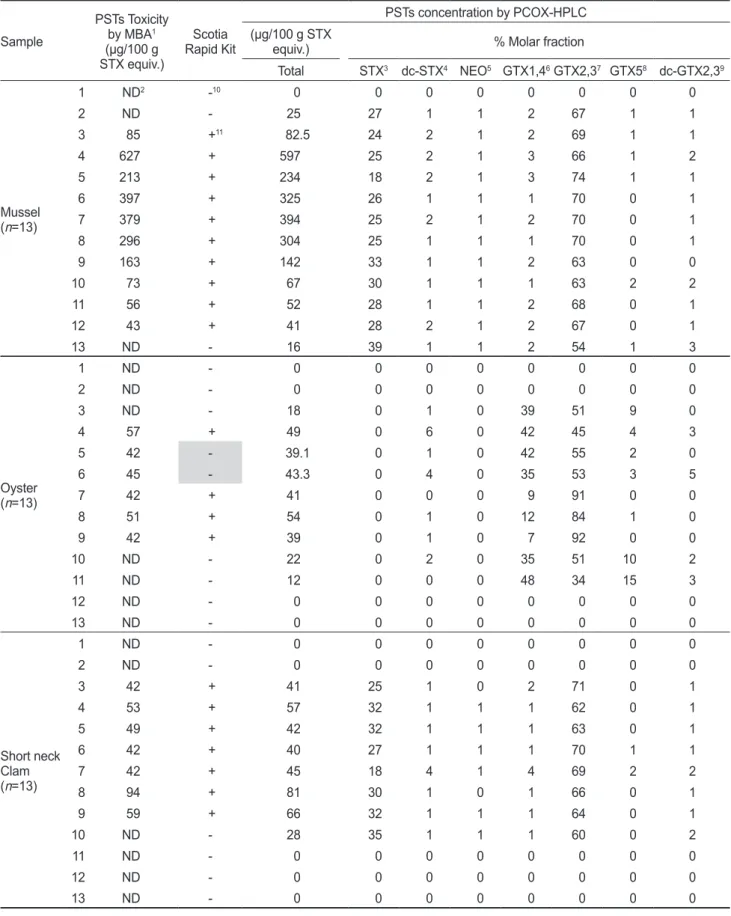
비성패류독소를분석하였다. 마우스시험에서는총 52개시료 중지중해담치 10개, 굴 6개및바지락 7개시료에서마비성 패류독소가 검출되었고, 미더덕에서는 모두 불검출 되었다. 특히지중해담치에서는 7개시료에서 85-627 µg/100 g STX
equiv.으로기준치를초과하여검출되었다. 우리나라에서는지
중해담치에서매년매년가장높은독성으로마비성패류독소 가검출되어마비성패류독소의지표종으로사용되고있으며, 산업적으로중요한굴에대한조사도강화하고있다(Lee et al., 2006). 굴에서는 6개시료에서 42-57 µg/100 g STX equiv.으로 검출되었고, 바지락에서는 7개시료에서 42-94 µg/100 g STX equiv.의농도로검출되었다. 같은시기및장소에서채취한패 류임에도불구하고패종에따라독의축적속도및독소의검출 농도에차이가있는이유는여과섭식(filter feeding)을하는생 물은해수를걸러주는여수율이다르며(Kim et al., 1998), 여수 속도에의해독의축적속도및축적농도가달라지기때문이다. PCOX-HPLC법
Post column oxidation HPLC (PCOX-HPLC)법을이용하여 마비성패류독소의독성프로파일을분석한후총독소량을계산 하고이결과를마우스시험법분석결과와비교하였다. 패류시 료 52개에대한개별독소의값을살펴보면, 마우스시험에서검 출된시료중가장높은농도를나타낸구성성분은지중해담치, 굴, 바지락모두 GTX2,3이 45-92%로가장높았고, GTX1,4는 1-48%, STX는 18-39%로검출되었으며, 패류의종류에따라 구성성분에는차이가있었다(Table 1). 또한, C1이나 C2 등의 독소는검출되지않았다. 마우스시험법과 PCOX-HPLC법사 이결과값의상관관계는상관계수(r2)가 0.9878로매우좋은상 관관계를나타내었다(Fig. 3).
이 결과를 살펴보면 특히 마우스시험에서 검출한계인 40 µg/100 g STX equiv. 이하로 불검출이었던시료가 PCOX-
HPLC 시험에서는검출되어보다정확한정량이가능하다는
것이확인되었다. PCOX-HPLC법은마우스시험법에비하여 전처리과정의단백질제거, 크로마토그래피를이용한독소성 분의분리, 독소성분의산화를통한형광성퓨린의형성과특 이적파장을이용한형광검출과같은단계를가지고있어특이 성이더높다(Rourke et al., 2008). 그러나, 시료의전처리시간 이길고고가의시험장비및지속적인표준물질의공급이필요 한실정이다.
면역시험키트법
마우스시험법의결과를토대로면역시험키트법을이용하여 마비성패류독소를분석하고, PCOX-HPLC법의 결과와도비 교하였다. 면역시험키트법은 제조회사의이름을 따서 Scotia rapid test 또는 Jellet rapid test라고도한다. 이시험법은 poly- clonal PSP toxin antibodies를사용하는면역크로마토그래피 (lateral flow immunochromatography)로임신키트와 유사한
스트립형식으로사용한다. 이시험은 35분내에 40 µg/100 g
STX equiv.의검출한계로패류조직의마비성패류독소를검
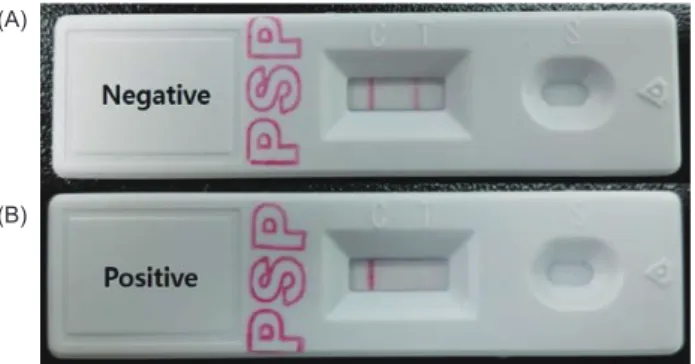
출한다. 면역시험키트법은패류의조직에서마비성패류독소의 스크리닝을위해상업적으로이용가능한신속테스트로개발 되었는데, 분석은키트에포함된 running buffer에패류추출액 을희석하여검출스트립에시료를로딩하고 35분간발색반응 을기다리는것을포함한다. 이때 test line (시험선또는 T line) 의색상강도를 control line (대조선또는 C 라인)의색상강 도와비교하여시료가검출(양성, positive)되었는지불검출(음 성, negative) 되었는지판독한다. Fig. 2는이시험법의결과를 보여주는데, test line이발색되면마비성패류독소가검출되지 않은것이고, 발색되지않으면검출된것으로구분한다(Cefas, 2007).
본연구에서마우스시험법과면역시험키트법을비교한결과 를 table 1에나타내었다. 불검출된시료는키트에서두줄로표 시되고, 검출된시료는한줄로표시되는데, 지중해담치추출액 을마우스시험한결과 false positive (위양성)및 false negative (위음성)은나타나지않았다. 그러나, 굴추출액의키트시험결 Fig. 2. Results of Scotia rapid test strips. C, control line; T, test line;
A, Negative (not detected); B, Positive(detected).
0 500 1000 1500 2000
2006 2007 2008 2009 2010 2011 2012 2013 2014 2015
No. of analytes (n)
Year
700 600 500 400 300 200 100
00 100 200
y = 0.9454x + 4.4877 R2 = 0.9878
MBA HPLC
300 400 500 600 700
MBA (μg/100 g STX equiv.)
PCOX-HPLC (μg/100 g STX equiv.) (A)
(B)
Fig. 3. Correlation between mouse bioassay and post-column oxi- dation-high performance liquid chromatography (HPLC) method.
0 500 1000
2006 2007 2008 2009 2010 2011 2012 2013 2014 2015
No. of analytes (n
Year
700 600 500 400 300 200 100
00 100 200
y = 0.9454x + 4.4877 R2 = 0.9878
MBAHPLC
300 400 500 600 700
MBA (μg/100 g STX equiv.)
PCOX-HPLC (μg/100 g STX equiv.) (A)
(B)
이가정ㆍ권순재ㆍ정연중ㆍ손광태ㆍ하광수ㆍ목종수ㆍ김지회 672
Table 1. Comparison of MBA, PCOX-HPLC methods and Scotia rapid kit for the detection of paralytic shellfish toxins
Sample
PSTs Toxicity by MBA1 (µg/100 g STX equiv.)
Scotia Rapid Kit
PSTs concentration by PCOX-HPLC (µg/100 g STX
equiv.) % Molar fraction
Total STX3 dc-STX4 NEO5 GTX1,46GTX2,37 GTX58 dc-GTX2,39
Mussel (n=13)
1 ND2 -10 0 0 0 0 0 0 0 0
2 ND - 25 27 1 1 2 67 1 1
3 85 +11 82.5 24 2 1 2 69 1 1
4 627 + 597 25 2 1 3 66 1 2
5 213 + 234 18 2 1 3 74 1 1
6 397 + 325 26 1 1 1 70 0 1
7 379 + 394 25 2 1 2 70 0 1
8 296 + 304 25 1 1 1 70 0 1
9 163 + 142 33 1 1 2 63 0 0
10 73 + 67 30 1 1 1 63 2 2
11 56 + 52 28 1 1 2 68 0 1
12 43 + 41 28 2 1 2 67 0 1
13 ND - 16 39 1 1 2 54 1 3
Oyster (n=13)
1 ND - 0 0 0 0 0 0 0 0
2 ND - 0 0 0 0 0 0 0 0
3 ND - 18 0 1 0 39 51 9 0
4 57 + 49 0 6 0 42 45 4 3
5 42 - 39.1 0 1 0 42 55 2 0
6 45 - 43.3 0 4 0 35 53 3 5
7 42 + 41 0 0 0 9 91 0 0
8 51 + 54 0 1 0 12 84 1 0
9 42 + 39 0 1 0 7 92 0 0
10 ND - 22 0 2 0 35 51 10 2
11 ND - 12 0 0 0 48 34 15 3
12 ND - 0 0 0 0 0 0 0 0
13 ND - 0 0 0 0 0 0 0 0
Short neck Clam(n=13)
1 ND - 0 0 0 0 0 0 0 0
2 ND - 0 0 0 0 0 0 0 0
3 42 + 41 25 1 0 2 71 0 1
4 53 + 57 32 1 1 1 62 0 1
5 49 + 42 32 1 1 1 63 0 1
6 42 + 40 27 1 1 1 70 1 1
7 42 + 45 18 4 1 4 69 2 2
8 94 + 81 30 1 0 1 66 0 1
9 59 + 66 32 1 1 1 64 0 1
10 ND - 28 35 1 1 1 60 0 2
11 ND - 0 0 0 0 0 0 0 0
12 ND - 0 0 0 0 0 0 0 0
13 ND - 0 0 0 0 0 0 0 0
과 false positive는없었으나, 마우스시험에서 42-45 µg/100 g STX equiv.로검출된 2개의시료에서 false negative가나타났 다. 또한, 바지락추출액에서도 false positive 및 false negative 는나타나지않았다. 마우스시험결과모든시료에서불검출되 었던미더덕시료에서는 false positive 및 false negative가나 타나지않고모두 negative로나타났다. 면역시험키트는 STX, GTX2,3, C1,2, GTX5 및 dcSTX에높은감도를가지고, NEO 및 GTX1,4에대해서는낮은감도를가지고있는데(Laycock et al., 2001), 독소별항체의교차반응도는 STX (100%), dcSTX (30%), GTX2,3 (60%), GTX5 (40%), C1,2 (33%), dcGTX2,3 (7%), NEO (20%) 및 GTX1,4 (2%)이다 (Jellet et al., 2002).
특히, GTX2, GTX3에 대해서는 검출한계가 23.3 µg/100 g STX equiv., STX는 19.9 µg/100 g STX equiv.로매우낮았 으며, GTX1,4는 345.2 µg/100 g STX equiv.의검출한계를나 타내었다(Cefas, 2007). 본연구에서 2개의굴시료중 false negative가나타난이유는 GTX2,3이독의구성성분 중가장 높게검출되었으나(53-55%) 면역시험키트에서의검출한계인 23.3 µg/100 g STX equiv. 이하였기때문인것으로사료된다. 면역시험키트법은분석시간이적게소요되고간편하다는장점 이있지만, positive와 negative 두가지의결과만을알수있기 때문에정성분석만가능하다는단점이있다.
분석방법의 비교
마비성패류독소의 검출에 사용되는 세가지 분석법을 비교
해본결과, 마우스시험법, PCOX-HPLC법및면역시험키트 법은서로좋은상관관계를가지고있었다. 마우스시험법및
PCOX-HPLC법은 패류독소의 정량이 가능하지만, PCOX-
HPLC법은분석에비용이많이들고, 분석시간이오래걸린다 는단점이있으며, 패류나플랑크톤의독성프로파일을알수 있다는장점이있다. 한편, 면역시험키트법은분석시간이적게 소요된다는장점이있고, 현재우리나라의마비성패류독소기 준치인 80 µg/100 g STX equiv. 보다낮은검출한계를가지 고있지만, positive와 negative 두가지결과만을알수있으므 로정성만가능하다. 또한, 본연구에서는 false positive가나타 나지않았지만, 검출한계인 40 µg/100 g STX equiv. 부근에서 는 false positive가많이나타나므로(Cost et al., 2009; Oshiro et al., 2009) 패류양식의현장에적용하기는어려울것으로사 료된다. 현재, 미국, 유럽및일본등의국가에서는마우스시험 법을일상적인분석에사용하면서 PCOX-HPLC를이용한기 기분석법을함께사용하고있는추세이다(FAO/WHO, 2016).
따라서, 식품안전정보확보와규제를위한모니터링환경에
서 PCOX-HPLC법은마우스시험법의보조시험법으로사용하
면서, 보다정확한마비성패류독소및원인플랑크톤등의독성 프로파일분석의수단으로활용하는등대체시험법으로도적 용이가능하다. 또한, 면역시험키트법은정성만이가능한특성 상동물시험법의보조시험법으로적합하므로마우스시험법을 기본으로사용하면서다른두가지방법을병행하는것이적합 한것으로사료된다.
Table 1. Continued
Sample
PSTs Toxicity by MBA1 (µg/100 g STX equiv.)
Scotia Rapid Kit
PSTs concentration by PCOX-HPLC (µg/100 g STX
equiv.) % Molar fraction
Total STX3 dc-STX4 NEO5 GTX1,46GTX2,37 GTX58 dc-GTX2,39
Warty SeaSquirt (n=13)
1 ND - 0 0 0 0 0 0 0 0
2 ND - 0 0 0 0 0 0 0 0
3 ND - 0 0 0 0 0 0 0 0
4 ND - 0 0 0 0 0 0 0 0
5 ND - 0 0 0 0 0 0 0 0
6 ND - 0 0 0 0 0 0 0 0
7 ND - 0 0 0 0 0 0 0 0
8 ND - 0 0 0 0 0 0 0 0
9 ND - 0 0 0 0 0 0 0 0
10 ND - 0 0 0 0 0 0 0 0
11 ND - 0 0 0 0 0 0 0 0
12 ND - 0 0 0 0 0 0 0 0
13 ND - 0 0 0 0 0 0 0 0
1MBA, Mouse Bioassay; 2ND, Not detected; 3STX, Saxitoxin; 4dc-STX, Decarbamoylsaxitoxin; 5NEO, Neosaxitoxin; 6GTX1,4, Gonyau- toxin 1,4; 7GTX2,3, Gonyautoxin 2,3; 8GTX5, Gonyautoxin 5; 9dc-GTX2,3, decarbamoylgonyautoxin 2,3;10-, negative (not detected); 11+, positive (detected).
이가정ㆍ권순재ㆍ정연중ㆍ손광태ㆍ하광수ㆍ목종수ㆍ김지회 674
사 사
이논문은 2017년도국립수산과학원수산과학연구사업수출
패류생산해역및수산물위생조사(R2017057)의지원으로수
행된연구이며연구비지원에감사드립니다.
References
AOAC (Association of Official Analytical Chemists). 2005.
AOAC Official Method 959.08. Paralytic Shellfish Poison.
Biological method. Final action . In: AOAC Official meth- ods for analysis, 18th Edition Chapter 49: Natural toxins (chapter ed. Truckses MW), AOAC International, Gaithers- burg, MD, U.S.A., 79-80.
AOAC (Association of Official Analytical Chemists). 2011.
AOAC Official Method 2011.02. Post column oxidation method(PCOX) AOAC International, Gaithersburg, MD, U.S.A., 12.
CEFAS (The Centre for Environment, Fisheries and Aquacul- ture Science). 2007. The use of the Jellett rapid testing kit for PSP toxins detection in the UK statutory monitoring pro- gramme for marine biotoxins. CEFAS, Lowestoft, UK, 7-8.
Costa PR, Baugh KA, Bruce W, Raymond R, Shelly LN, Natália T, Stacey ME and Kathi AL. 2009. Comparative determina- tion of paralytic shellfish toxins (PSTs) using five defferent toxin detection methods in shellfish species collected in the Aleutian Islands, Alaska. Toxicon 54, 313-320. https://doi.
org/10.1016/j.toxicon.2009.04.023.
FAO/WHO (Food and Agriculture Organization of the United Nations /World Health Organization). 2016. Technical re- port. Toxicity equivalency factors for marine biotoxin as- sociated with bivalve molluscs. FAO/WHO, Rome, Italy, 9-13, 27.
Hess P, Grune B, Anderson DB, Aune T, Botana LM, Caricato P, van Egmond HP, Halder M, Hall S. Lawrence JF, Moffat C, Poletti R, Richmond J, Rossini GP, Seamer C and Vilageliu JS. 2006. Three Rs approaches in marine biotoxin testing:
the report and recommendations of a Joint ECVAM/DG SANCO Workshop (ECVAM Workshop 54). Altem Lab Aanim 34, 193-224.
Jellet JF, Roberts RL, Laycock MV, Quilliam MA and Barrett RE. 2002. Detection of paralytic shellfish poisoning (PSP) toxins in shellfish tissue using MIST AlertTM, a new rapid test, in parallel with the regulatory AOAC mouse bioassay.
Toxicon 40, 1407-1425. https://doi.org/10.1016/S0041-0101 (02)00153-8.
Kim YS and Moon TS. 1998. Filtering rate with effect of water temperature and size of two farming ascidians Styela clava and S. plicata, and a farming mussel Mytilus edulis, J Ko- rean Fish Soc 31, 272-277.
KMFDS (Korea Ministry of Food and Drug Safety). 2015.
Korean Food Standard. Chapter 6.3. Shellfish toxins 6.3.1.
Paralytic shellfish toxins. KMFDS, Cheongju, Korea, 1185- 1189.
Laycock MV, Jellet JF, Belland ER, Bishop PC, Thérault BL, Russel-Tattrie AL, Quilliam MA, Cembella AD and Rich- ards RC. 2001. MIST AlertTM: a rapid assay for paralytic shellfish poisoning toxins . In: Hallegraff GM, Blackburn SI, Bolch CJ and Lewis RJ. (Eds.), Harmful Algal Blooms 2000. International Oceanographic Commission, Paris, France, 254-256.
Lee TS, Mok JS, Son KT, Oh EG, Kim PH, Lee KJ, Lee HJ and Kim JH. 2006. Paralytic shellfish poisoning in mussel from coastal area of Korea. National Institute of Fisheries Science, Busan, Korea 18-21.
NIFS (National Institute of Fisheries Science). 2016. Annual report of National Fisheries Research and Development In- stitute. NIFS, Busan, Korea, 63.
Oshiro M, Pham L, Csuti D, Dodd M, Inami GB and Brenden RA. 2006. Paralytic shellfish poisoning surveillance in Cali- fornia using the Jellet Rapid PSP test. Harmful Algae 5, 69- 73. http://dx.doi.org/10.1016/j.hal.2005.05.006.
Park DL, Adams WN, Graham SL and Jackson RC. 1986. Vari- ability of mouse bioassay for determination of paralytic shellfish poisoning toxins. J Assoc Off Anal Chem 69, 547- Rourke WA, Murphy CJ, Pitcher G, Van de Riet JM, Burns G, 550.
Thomas KM and Quilliam MA. 2008. Rapid postcolumn methodology for determination of paralytic shellfish toxins in shellfish tissue. J AOAC Int 91, 589-597.
Schantz EJ, McFarren EF, Schafer ML and Lewis KH. 1958.
Purified shellfish poison for bioassay standardization. J As- soc Off Anal Chem 41, 160-168.
Song KC, Lee KJ, Yu HS, Mok JS, Kim JH, Lim KS, Lee MA and Kim MH. 2013. Intra-laboratory validation of an HPLC Post-column oxidation method for the analysis of PSP tox- ins in oysters and mussels. Korean J Food Sci and Tech 45, 241-247. http://dx.doi.org/10.9721/KJFST.2013. 45.2.241.
Thomas K, Chung S, Ku J, Reeves K and Quilliam MA. 2006.
Analysis of PSP toxins by liquid chromatography with post column oxidation and fluorescence detection. In: Molluscan Shellfish Safety. Henshilwood K, Deegan B, McMahon T, Cusack C, Keaveney S, Silke J, O’ ´Cinneide M, Lyons D, Hess p (ed). Marine Institute, Galway, Ireland. 132-138.
NSSP (US National Shellfish Sanitation Program). 2005. NSSP Guidance Document. Proposal 05-110, Rapid Screening Method for PSP, NSSP, AL, U.S.A., 66-68.