- 1375 -
DNA Hybridization 센서의 제작과 전기화학적 검출 특성
이 동 윤1, 양 창 헌1, 최 원 석2, 박 상 현1, 권 영 수1,2,*
1동아대학교 전기공학과 & NTRC, 2동아대학교 나노공학과 & NTRC
Fabrication and Electrochemical Detection Property of Single Strand DNA Hybridization Sensor
Dong-Yun Lee1, Changheon Yang1, Won-Suk Choi2, Sang-Hyun Park1, Young-Soo Kwon1,2,*
1Department of Electrical Engineering & NTRC, Dong-A University
2Department of Nano Engineering & NTRC, Dong-A University
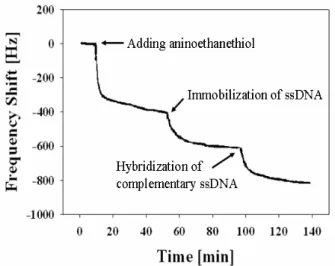
Abstract - A synthesized 21-mer single-stranded DNA(ss DNA) was covalently immobilized onto a self-assembled aminoethanethiol monolayer modified gold electrode onto QCM.
The covalently immobilized ssDNA was hybridized with complementary ssDNA. The interaction between surface im- mobilized ssDNA and complementary 21-mer DNA in solution was also examined. Each step was followed by monitoring changes in the QCM frequency with time. Also, PBS with pH 7.0 was selected as a supporting electrolyte in order to get maximum sensitivity and good bioactivity.
1. Introduction
The key issue in biosensor applications is more efficient by comparison to DNA hybridization investigations performed on membranes that are less sensitive and selective, time consuming and not time resolved [1]. Moreover it has been observed that surface hybridization is faster [2] and more selective [3] than hybridization in bulk solution. DNA biosensors are useful tools due to the high sensitivity and selectivity of biologically active materials. The applications include disease diagnostic devices, miniaturized biosensor arrays, and DNA driven assembly of nanostructures [5].
The quartz crystal microbalance (QCM) is a powerful tool for biosensor applications.It has become one of the most effective techniques of molecular biology and microchemistry because it enables the advantages of simple, rapid and real- time monitoring, as well as high sensitivity and specificity [4].
In this paper, we fabricated the DNA hybridization sensors by immobilization of 21-mer oligonucleotide using QCM Au- electrode. Firstly, aminoethanethiol as a hybridization indicator were evaluated electrochemically. A synthesized 21-mer oligo- nucleotide was covalently immobilized onto a self-assembled aminoethanethiol monolayer modified gold electrode onto QCM.
The single-stranded DNA formed a phosphoramidate bond with primary amino group of aminoethanethiol monolayer. And then, we also investigated the hybridization of oligonucleotide using the frequency dependent techniques of QCM. Probe immobilization was confirmed by cyclic voltammetry. Finally, we determined that the detection of the DNA sequence was carried out with a DNA sensor system consist of an immobilized and hybridized DNA gold electrode.
2. Experiment
Both oligonucleotide (5`-GAA AAA AAA TTG CGC AAT CCG-3`) and its complementary target DNA (3`-CGG ATT GCG CAA TTT TTT TTC-5`) with a length of 21-mer oligonucleotides were synthesized by Bioneer Corporation (Daejeon, Korea). Aminoethanethiol and 1-ethyl-3-(3-dime- thylaminopropyl) carbodiimide hydrochloride (EDC) were obtained from Sigma. Other reagents were commercially available with analytical grade.
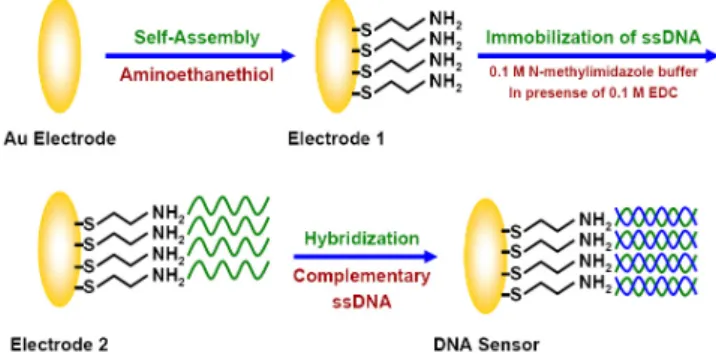
Fig. 1 shows the schematic process for the preparation of DNA sensor. At first, the gold electrode was cleaned by piranha solution (H
2
SO
4
:H
2
O
2
=3:1) subsequently cleaned by cycling between potential windows from 0 to + 1.5 V versus Ag/AgCl in 0.05 M H
2
SO
4
solution at scan rate of 100 mV/s for nearly 20 minutes until stable scans were observed. Then, the electrode was thoroughly rinsed with the ultra pure water.
After pretreatment, the gold electrode was immersed in 5 m M aminoethanethiol in ethanol solution for 24 h at room temperature with pure Ar gas. The surface of the electrode was washed with distilled water and ethanol and was purged with pure Ar gas. After these treatments, self-assembled monolayer with amino group was formed on the gold electrode surface as electrode 1.
Fig. 1 The process for the preparation of DNA hybridization sensor.
The electrode 1 was immersed in pH 6.0, 0.1 M N-methy- limidazole buffer containing 0.1 M EDC and 0.1 mg/ml single- strand DNA (ssDNA). The electrode was incubated for 2 h at room temperature. These conditions allow immobilization through the 5`-phosphate groups of ssDNA by the formation of a phosphoramidate bond with the amine groups of the electrode 1 surface. The electrode immobilized ssDNA mono- layer is denominated as electrode 2. Different concentrations of DNA, which was complementary to the immobilized ssDNA, were added. The electrode 2 was immersed into the hybridization buffer and incubated at 40 °C for 1 h with shaking [5].
The 9 MHz QCM (AT-cut, 0.5 mm diameter), which was provided with gold-coated electrode, were obtained from Seiko EG&G (Japan). The cyclic voltammetry response have been measured with QCA 922 (Seiko EG&G, Japan) and potentiostat 263A (PerkinElmer, USA). The immobilized and hybridized DNA-modified QCM gold-electrode was used as the working electrode. The Pt wire and KCl saturated Ag/AgCl electrodes were used as counter and reference electrodes, respectively. The stock solutions were made by phosphate buffer solution (PBS, pH 7.0)
2007년도 대한전기학회 하계학술대회 논문집 2007. 7. 18 - 20