Vol. 10, No. 2, p. 103−114, June 2006
Sorption properties of 152Eu and 241Am in geological materials: Eu as an analogue for monitoring the Am behaviour in heterogeneous geological environments
ABSTRACT: In order to confirm the similar behavior of Eu and Am in heterogeneous geological materials, we carried out the batch experiments for determining the sorption property of radi- onuclides, 152Eu and 241Am. We used four different types of core rocks including biotite banded gneiss, biotite gneiss, metabasite and andestic tuff, and selected two samples per each lithology, one of which is fracture-bearing and another is fracture-free. Except for metabasites, rock samples of each type are similar in their compo- sitions. We calculated sorption ratios of two radionuclides from the experimental results. Biotite gneiss and tuff had similar sorption trends for 152Eu and 241Am regardless of the existence of fractures, whereas two metabasite samples showed very different sorption properties. Such difference in the sorption trends revealed a close relationship with chemical compositions of the host rocks. Never- theless, 152Eu and 241Am showed similar adsorption trends for all the samples with variable contact times regardless of petrography and pH variations, and particularly, the sorption trends of 152Eu and
241Am in the metabasites were similar. This observation suggests that Eu and Am have similar sorption properties on geological materials. Therefore, Eu can be used as a useful analogue of Am in all kinds of geological environments regardless of variations in lithology and pH of groundwater. In addition, sorption ratios of
152Eu and 241Am are correlated with the contents of P2O5 and TiO2, suggesting that the chemical components such as P2O5 and TiO2 might be important for deciphering the interaction between the radionuclide and groundwater.
Key words: sorption properties, Europium and Americium, analogue, geological material
1. INTRODUCTION
Long-lived radionuclides derived from radioactive wastes, nuclear power related accidents or nuclear tests have been considered to be toxic pollutants and can be returned to human environment by hydrological cycle. Their migration with groundwater is strongly affected by their adsorption on geological materials (Krauskopf, 1986a, 1986b; Emrén, 1993;
Spasennykh, 1997; Xu and Wörman, 1999). Sorption is one of very important factors to understand the migration behav-
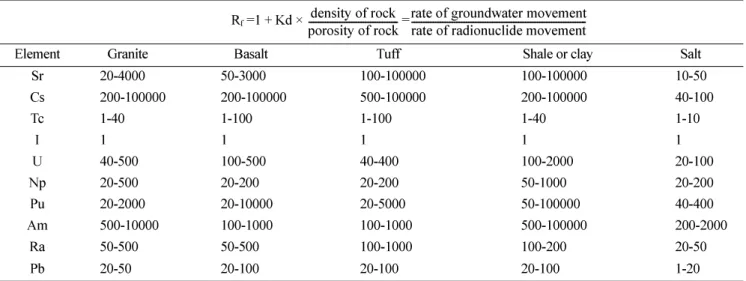
iors of radioactive elements in groundwater. The radionu- clides, particularly those carried by the groundwater, will interact in various ways with the rocks in aquifer such as sorption, substitution, precipitation, etc. Therefore, the adsorp- tion behavior of the radionuclide is affected by its surround- ing environments such as the physicochemical properties of groundwater and geologic materials as well as the radionu- clide itself (Hilton et al., 1997; Lee et al., 2001; Metz et al., 2003). As a result, many researchers have attempted to pre- dict how much the specific actinides will migrate over long period of time in subsurface environment (Krauskopf, 1986a, 1986b; Buddemeier et al., 1991; Guiterrez et al., 1991; Petit, 1991; Berry and Bond, 1992; Heath et al., 1992; Meece and Benninger, 1993; Curti, 1999). Krauskopf (1986a) summa- rized retardation factors for radionuclides in rock materials important for radioactive-waste repository (Table 1). Because the transuranic actinides do not occur naturally in appre- ciable quantities, their behaviors in the repository environ- ments, however, cannot be predicted from the field data of their movement in geologic environment (mainly in groundwa- ter) over geologic time. Therefore, predictions on the long- term future behaviors of transuranic actinides were made by extrapolation from short-term observations of their chemi- cal properties in laboratory experiments or in field tests, but such extrapolation is fraught with uncertainty (Curti, 1999).
For the past forty years, the unique and chemically coher- ent behaviors of the rare earth elements (REEs) in geolog- ical materials have been extensively used as a tool for solving various geological and geochemical problems (Tay- lor and McLennan, 1985; Lipin and McKay, 1989; Wood, 1990; Johannesson et al. 1996; Takahashi et al., 2002; Lee et al., 2003, 2004). Johannesson et al. (1996) suggested that a useful means for reducing the uncertainty was to observe both the past and present behaviors of natural analogues like the rare-earth metals for trivalent actinides, and Th for actinides in its tetravalent form. McCarthy et al. (1998) also used the lanthanide field tracers and found that natural organic matter facilitates the mobilization and rapid migra- Seung-Gu Lee*
Kil Yong Lee Soo Young Cho Yoon Yeol Yoon
Yongje Kim } Groundwater and Geothermal Resources Division, Korea Institute of Geoscience and Mineral Resources, Daejeon 305-350, Korea
*Corresponding author: [email protected]
tion of the transuranic radionuclides.
Johansson and Rosengren (1975) reported the cohesive energies of REEs and actinides (Fig. 1). The cohesive ener- gies of the divalent and trivalent REEs and actinides show a similar trend (Fig. 1). In particular, Eu-Am and Yb-No have strikingly low cohesive energy compared to other
REEs and actinides. Such a trend of Eu and Am can be also observed in the relative energy relationship between fns2 and fn-1d1s2 groundstate electronic configurations (Fred, 1967). The ionic radii of Eu2+, Eu3+, Am2+ and Am3+ in coordination numbers (CN) equal to 8 and 9 are summa- rized in Table 2. These two elements have similar ionic radii in the di- and trivalent ionic states. The similarity in physical and chemical properties of Eu and Am such as cohesive energy, relative energy relationship and ionic radii suggests that Eu and Am have similar geochemical behav- ior in the geological environment. Ionova et al. (1997) sug- gested that the covalency effects in the standard enthalpies of formation of trivalent lanthanide and actinide halides decrease from the beginning (La-Ac) to the middle of the series (Eu-Am) and then increase towards the end (Yb-No).
The Eu anomalies in geological samples play significant role for interpreting physical and chemical conditions in geological systems (Dymek and Klein, 1988; Derry and Jacobsen, 1990). Lee et al. (2003, 2004) suggested that pos- itive Eu anomalies in fractured granitic gneisses (Fig. 2) are primarily related to the calcite precipitation caused by paleo-groundwater environment change, and Eu is a useful analogue for understanding the behavior of Am in geolog- ical environment.
Sakuragi et al. (2004) suggested that the sorption behav- ior of Am3+ was similar to that of Eu3+ based on the batch
Fig. 1. Cohesive energy for the REEs (full curves) and actinides (dashed curves). The smooth curves denote the cohesive energy where these elements remain divalent in their metallic modifica- tion, and the jagged curves the cohesive energy of their trivalent metallic state (after Johansson and Rosengren, 1975).
Table 1. Retardation factors (Rf) for radionuclides in rock materials considered for repository siting (Krauskopf, 1986a).
Rf =1 + Kd × =
Element Granite Basalt Tuff Shale or clay Salt
Sr 20-4000 50-3000 100-100000 100-100000 10-50
Cs 200-100000 200-100000 500-100000 200-100000 40-100
Tc 1-40 1-100 1-100 1-40 1-10
I 1 1 1 1 1
U 40-500 100-500 40-400 100-2000 20-100
Np 20-500 20-200 20-200 50-1000 20-200
Pu 20-2000 20-10000 20-5000 50-100000 40-400
Am 500-10000 100-1000 100-1000 500-100000 200-2000
Ra 50-500 50-500 100-1000 100-200 20-50
Pb 20-50 20-100 20-100 20-100 1-20
density of rock porosity of rock
--- rate of groundwater movementrate of radionuclide movement---
Table 2. Ionic radii (Å) of Eu and Am in different coordination numbers (CN) and at oxidation states (Shannon, 1976; Henderson, 1990).
Eu Am
2+ 3+ 2+ 3+ 4+
CN=6 1.17 0.947 − 0.975 0.85
CN=8 1.25 1.066 1.26 1.109 0.95
CN=9 1.30 1.120 1.31 − −
experiment of Am3+ and Eu3+ sorption onto hematite. Thus, if we understand the behavior of Eu and other REEs during changes in the geological environment, we could predict the behavior of Am and other actinides in similar environ- ments. However, there has been little work on the study of sorption behaviors of Eu3+ and Am3+ on the geological material composed of multiple interactions among hetero- geneous materials.
To survey the sorption capacity of geological materials for the radionuclides and to clarify the similar sorption prop- erties of Eu and Am in geological materials, we performed batch experiments using the four kinds of rock materials from different lithologies (metabasite, biotite gneiss, and tuff) with 152Eu and 241Am as radionuclides. We found that metabasites had strong sorption capacity for 152Eu and 241Am, and that Eu is a useful analogue of Am in a variety of geo- logical environments. Our results will help in estimating the
retardation effect of geological materials on transuranic radionuclides.
2. EXPERIMENTAL PROCEDURES 2.1. Core Sample Preparation Procedure
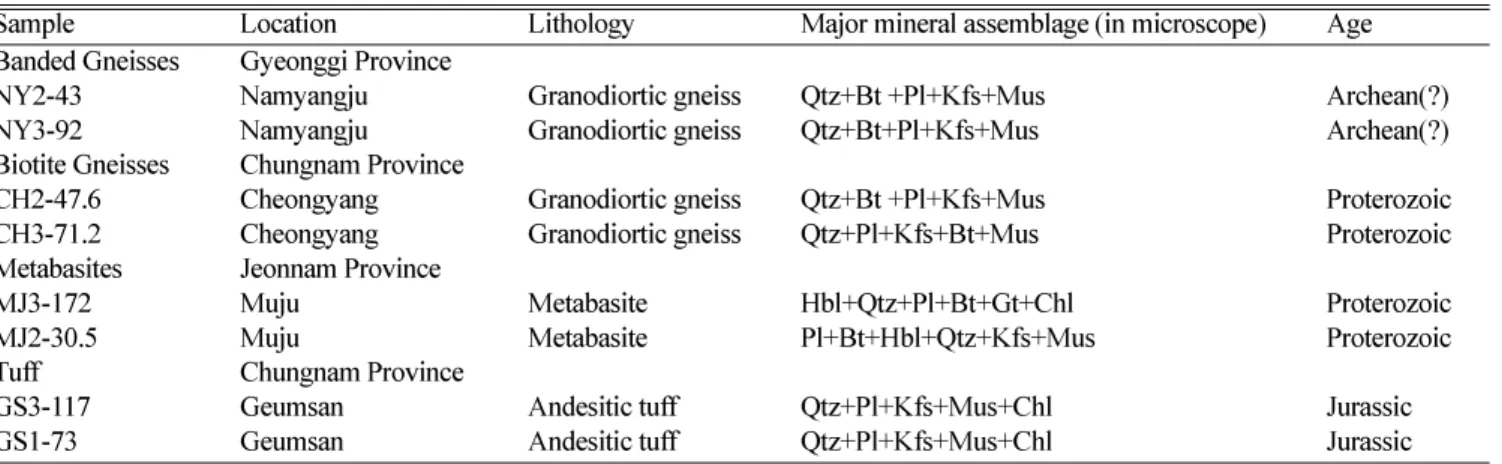
To carry out a sorption test for 152Eu and 241Am in various types of geological materials, we selected eight core sam- ples from three kinds of rocks: volcanic tuff and Precam- brian gneisses, namely biotite-banded gneiss, biotite gneiss, and metabasite. The samples were also divided into two groups: one was fresh with no fracture (NY2-43, CH2-47.6, MJ3-172 and GS3-117) and another with fractured surface (NY4-92, CH3-71.2, MJ2-30.5 and GS1-73). The petrog- raphy of the samples is described in Table 3. We also mea- sured the mineral contents of the powdered sample powders
Fig. 2. Chondrite-normalized REE diagram of (a) fractured rock powders and (b) dissolved calcites and their residues (after Lee et al., 2003).
Table 3. Location and description of core samples selected for the sorption experiment. In the sample number such as NY2-43, 2 is hole number and 43 is the depth of core in meter.
Sample Location Lithology Major mineral assemblage (in microscope) Age
Banded Gneisses NY2-43 NY3-92 Biotite Gneisses CH2-47.6 CH3-71.2 Metabasites MJ3-172 MJ2-30.5 TuffGS3-117 GS1-73
Gyeonggi Province Namyangju Namyangju Chungnam Province Cheongyang Cheongyang Jeonnam Province Muju
Muju
Chungnam Province Geumsan
Geumsan
Granodiortic gneiss Granodiortic gneiss Granodiortic gneiss Granodiortic gneiss Metabasite Metabasite Andesitic tuff Andesitic tuff
Qtz+Bt +Pl+Kfs+Mus Qtz+Bt+Pl+Kfs+Mus Qtz+Bt +Pl+Kfs+Mus Qtz+Pl+Kfs+Bt+Mus Hbl+Qtz+Pl+Bt+Gt+Chl Pl+Bt+Hbl+Qtz+Kfs+Mus Qtz+Pl+Kfs+Mus+Chl Qtz+Pl+Kfs+Mus+Chl
Archean(?) Archean(?) Proterozoic Proterozoic Proterozoic Proterozoic Jurassic Jurassic Qtz: quartz, Pl: plagioclase, Kfs: K-feldspar, Bt: Biotite, Mus: Muscovite, Hbl: Hornblende, Gt: garnet, and Chl: chlorite
with X-Ray diffractometer (XRD: Phillips XPERT-MPD).
These results are summarized in Table 4. Before sorption experiment, we measured the chemical compositions of the core samples. For chemical analysis and sorption experi- ment, we crushed about 2 kg of each core sample into grains of a few mm in diameter with a jaw crusher and then 30-50 g of the grains were pulverized in an agate mortar.
For the sorption experiment, some samples were pulverized to 150µm-300µm from the residue grains.
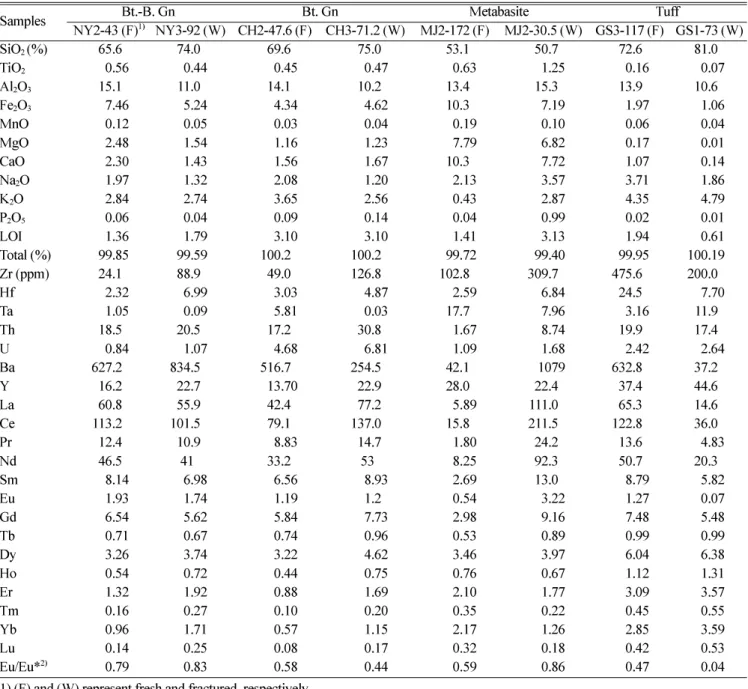
The chemical compositions of core samples were mea- sured using X-Ray fluorescence spectrometer (XRF: Shimadzu MXF-2300), and the abundance of REEs was determined using an inductive-coupled plasma mass spectrometer (ICP- MS: Perkin Elmer, Elan DRC II) at Korea Institute of Geo- science and Mineral Resources (KIGAM). Analytical pre- cision for light REEs (LREEs) was within 10%, whereas it was greater than 10-20% for heavy REEs (HREEs). Slight overlapping of Ln3+ by LREE-oxides is responsible for the poor precision of HREEs analyses.
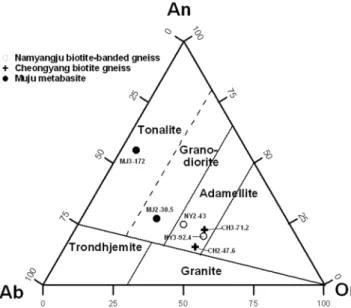
The chemical compositions of the core samples used for sorption experiment are presented in Table 5. The tuff shows high SiO2 and K2O content, and low total iron as Fe2O3 and MgO contents compared with gneisses. The nor- mative compositions were plotted on the An-Ab-Or projec- tion (Fig. 3) for gneisses and metabasites (O’Connor, 1965).
The gneiss samples are adamellitic, but metabasites are plotted in the area of tonalite to granodiorite.
2.2. Preconditioning of Groundwater
The groundwater for preconditioning was obtained from the borehole at Geumsan, Korea, which is located in the tuff area. This water sample was characterized by 7.6 in pH and 76µS/cm in electric conductivity. The groundwater volume to rock powder mass ratio was 20 ml/g, and the shaking speed was 50 strokes per minute, and a moderate shaking was performed for six weeks at 20±2 °C. The solutions fil-
tered with a 0.45µm Nucleopore filter after centrifuging at 20,000 g for 30 minutes.
The chemical compositions of the groundwater before and after preconditioning were measured by inductive-cou- pled plasma atomic emission spectroscope (ICP-AES) and are summarized in Table 6. The pHs of the filtrates after the preconditioning with the rock powders are about 8. In Table 6, the concentrations of K, Na, Cl, Al, SO4 and NO3 in fil- trates after preconditioning indicate striking variations com- pared to original groundwater (blank) whereas those of Fe, Mn, Si, PO4 reveal little variations. The pHs of the filtrates after adding 152Eu and 241Am were not controlled during the batch experiment. We also measured the pH of one of the filtrates (MJ2-30.5) with two radionuclides, which was 2.39 mainly due to the added nitric acid. The pH of filtrates after batch experiments for 110 days ranges from 1.5 to 4.2, indi- cating a slight variation compared to pH 2.39 after precon- ditioning (Table 6). The pH of the blank solution containing two radionuclides is 1.36.
2.3. Radionuclide and Tracer Solutions
The radionuclides of 152Eu and 241Am were used in sorp- tion experiments as tracers for Eu and Am. These tracers, purchased from Isotope Products Laboratory, U.S.A., were of above 99% radiochemical purity and had a chloride com- pound in a 1N nitric acid solution. The concentration of the radionuclides used in the sorption experiments were about 7.9×10⁻⁸ mol/L 152Eu and 1.8×10⁻⁶ mol/L 241Am. All of the sorption experiments were performed in 50 mL polypropy- lene centrifugal tube. 20 mL of the groundwater sample after preconditioning was put into the tube, and 0.2 mL of each tracer solution was added.
2.4. Sorption Experiments
For the calculation of sorption ratio as a function of con-
Table 4. Mineralogical compositions of the biotite banded gneiss, biotite gneiss, metabasite and tuff estimated from the XRD measurements.
Samples Bt.-B. Gn Bt. Gn Metabasite Tuff
NY2-43 (F)1)NY3-92 (W) CH2-47.6 (F) CH3-71.2 (W) MJ3-172 (F) MJ2-30.5 (W) GS3-117 (F) GS1-73 (W)
Quartz 23.6 22.3 46.8 60.4 -2) 3.8 30.9 59.0
Plagioclase 6.9 - 9.4 8.4 30.1 33.4 35.6 14.9
K-feldspar - 6.6 - - - - 20.2 17.9
Biotite 52.5 57.0 20.7 5.6 1.7 17.8 - -
Chlorite 2.0 1.3 1.2 16.0 9.6 13.5 5.3 2.4
Muscovite 15.0 11.9 17.0 7.7 - - 3.6 5.8
Hornblende - - - - 58.5 27.9 - -
Calcite - 1.0 1.2 1.9 0.1 3.6 4.0 -
Montmorillonite - - - - - - 0.5 -
Total 100 99.8 99.9 100 100 100 100 100
1) (F) and (W) represent fresh and fractured, respectively 2) “-” represents “not detected in XRD”.
tact time, the initial specific activity of radiotracer solution was measured with a high-purity Germanium (HPGe) detec- tor (EG&G ORTEC USA, fwhm of 1.9 keV for 60Co) coupled with the multi-channel analyzer (MCA) system. Pretreated geologic materials were then added in the radiotracer solu- tion. The solution to solid ratio was adjusted to 20 ml/g.
The mixture tube was shaken gently at a speed of 50 strokes per minute for a given time. At the end of each contact period, the aqueous phase was separated from the solid phase by centrifuging at 20,000 g for 30 minutes. Five mil- limeter of the supernatant was then taken into a measuring
vial and the specific activity was determined with a gamma- ray measuring system. The specific activities of 152Eu and
241Am in supernatant were measured 12 times (0.08, 0.33, 1, 2, 3, 6, 11, 15, 30, 45, 79, 110 day) for 110 days.
The sorption of tracer on tube surface was investigated using a control tube containing only radiotracer solution.
The activity in empty tube was measured with corrected geometric efficiency using a synthetic solution of 60Co and
152Eu. The effects of sorption on tube wall during batch experiments are negligible (Lee et al., 2001). The temper- ature and pressure in all procedures were controlled at
Table 5. Major element compositions (%), trace element and REE abundances (ppm) for Biotite banded gneiss, biotite gneiss, metabasite and tuff.
Samples Bt.-B. Gn Bt. Gn Metabasite Tuff
NY2-43 (F)1) NY3-92 (W) CH2-47.6 (F) CH3-71.2 (W) MJ2-172 (F) MJ2-30.5 (W) GS3-117 (F) GS1-73 (W)
SiO2 (%) 65.60 74.00 69.60 75.00 53.10 50.70 72.60 81.00
TiO2 0.56 0.44 0.45 0.47 0.63 1.25 0.16 0.07
Al2O3 15.10 11.00 14.10 10.20 13.40 15.30 13.90 10.60
Fe2O3 7.46 5.24 4.34 4.62 10.30 7.19 1.97 1.06
MnO 0.12 0.05 0.03 0.04 0.19 0.10 0.06 0.04
MgO 2.48 1.54 1.16 1.23 7.79 6.82 0.17 0.01
CaO 2.30 1.43 1.56 1.67 10.30 7.72 1.07 0.14
Na2O 1.97 1.32 2.08 1.20 2.13 3.57 3.71 1.86
K2O 2.84 2.74 3.65 2.56 0.43 2.87 4.35 4.79
P2O5 0.06 0.04 0.09 0.14 0.04 0.99 0.02 0.01
LOI 1.36 1.79 3.10 3.10 1.41 3.13 1.94 0.61
Total (%) 99.85 99.59 100.20 100.20 99.72 99.40 99.95 100.19
Zr (ppm) 24.10 88.90 49.00 126.80 102.80 309.70 475.60 200.00
Hf 2.32 6.99 3.03 4.87 2.59 6.84 24.50 7.70
Ta 1.05 0.09 5.81 0.03 17.70 7.96 3.16 11.90
Th 18.50 20.50 17.20 30.80 1.67 8.74 19.90 17.40
U 0.84 1.07 4.68 6.81 1.09 1.68 2.42 2.64
Ba 627.20 834.50 516.70 254.50 42.10 1079 632.80 37.20
Y 16.20 22.70 13.70 22.90 28.00 22.40 37.40 44.60
La 60.80 55.90 42.40 77.20 5.89 111.00 65.30 14.60
Ce 113.20 101.50 79.10 137.00 15.80 211.50 122.80 36.00
Pr 12.40 10.90 8.83 14.70 1.80 24.20 13.60 4.83
Nd 46.50 410.. 33.20 5300 8.25 92.30 50.70 20.30
Sm 8.14 6.98 6.56 8.93 2.69 13.00 8.79 5.82
Eu 1.93 1.74 1.19 1.20 0.54 3.22 1.27 0.07
Gd 6.54 5.62 5.84 7.73 2.98 9.16 7.48 5.48
Tb 0.71 0.67 0.74 0.96 0.53 0.89 0.99 0.99
Dy 3.26 3.74 3.22 4.62 3.46 3.97 6.04 6.38
Ho 0.54 0.72 0.44 0.75 0.76 0.67 1.12 1.31
Er 1.32 1.92 0.88 1.69 2.10 1.77 3.09 3.57
Tm 0.16 0.27 0.10 0.20 0.35 0.22 0.45 0.55
Yb 0.96 1.71 0.57 1.15 2.17 1.26 2.85 3.59
Lu 0.14 0.25 0.08 0.17 0.32 0.18 0.42 0.53
Eu/Eu*2) 0.79 0.83 0.58 0.44 0.59 0.86 0.47 0.04
1) (F) and (W) represent fresh and fractured, respectively.
2) Eu/Eu* is defined as the ratio of observed Eu abundance to that which would fall on the Sm-Gd join in chondrite-normalized REE patterns.
20±2°C and 1 atm., respectively.
2.5. Calculation of Adsorption Ratio
The distribution coefficient, kd, has been defined as the partition of a component between the solid and aqueous phase at an equilibrium state. However, it is uncertain
whether the equilibrium was reached for the sorption exper- iment. Therefore, the measured value in our experiment is called the sorption ratio, Rd, which is otherwise identical to kd but does not imply equilibrium. The sorption ratio of a radiotracer, Rd, can be calculated by the following equation:
Rd = Atj/Aij
where Aij is the initial specific activity of the radionuclide j, and Atj is the activity of the radionuclide j in the supernatant solution after the phase separation at the end of the given contact period.
The specific activity (Bq/mL) of each radionuclide in cen- trifugal tubes was corrected with its decay time by
Atj =Atc·e−λt
where Atj is the corrected the activity of radionuclide j, Atc is the activity of nuclide j at each interval, λ is the decay constant (ln2/T1/2), andT1/2 is the half-life of the radionuclide.
3. RESULTS
The basic concept of our experiment was that the dis- solved fraction of two radionuclides, 152Eu and 241Am, might show similar sorption properties regardless of petrography and physical properties of groundwater such as pH and EC.
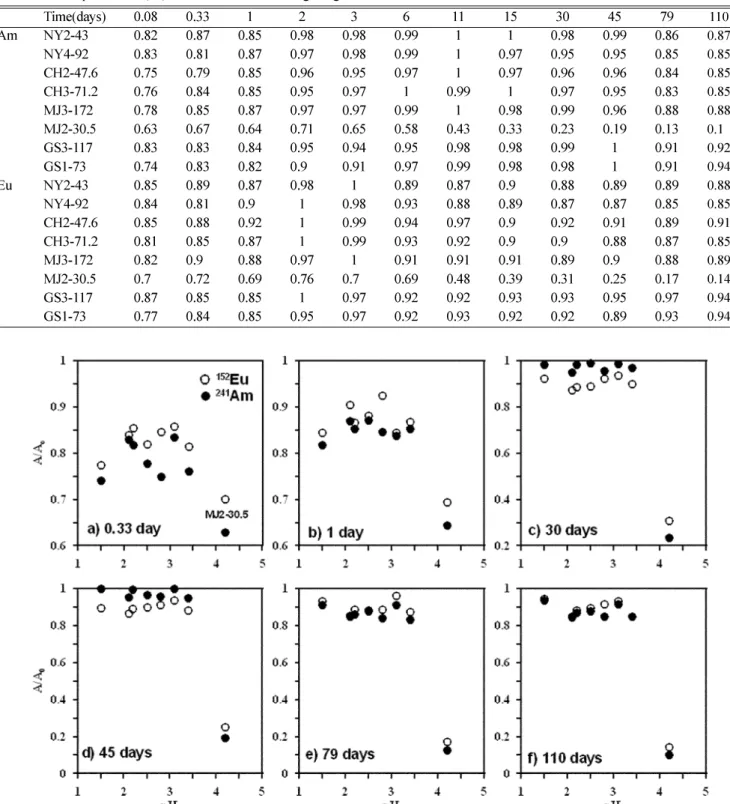
The results for adsorption ratios of 152Eu and 241Am are
Fig. 3. Or-Ab-An (O’Cornor. 1965) diagram of core samples from each bore hole. Or: orthoclase, Ab: albite, An: anorthite.
Table 6. Chemical composition of groundwater before and after preconditioning (in ppm). GW is original groundwater sample, and the others are groundwater after preconditioning.
Element GW NY2-43 NY3-92 CH2-47.6 CH3-71.2 MJ3-172 MJ2-30.5 GS3-117 GS1-73
K 0.61 8.59 6.62 6.10 4.29 9.61 11.5 2.00 2.67
Na 5.41 6.73 6.95 6.10 5.98 13.8 8.13 7.00 5.97
Fe 0.01 0.03 - - 0.01 13.8 - - -
Mn - - - - - 0.01 - - -
Si 7.31 7.23 5.76 6.32 6.29 7.41 7.27 8.11 8.20
Al 0.04 0.13 0.11 0.10 0.14 0.13 0.07 0.12 0.16
Ca 9.06 7.71 12.2 15.8 14.8 22.9 7.81 13.4 10.3
Mg 0.41 1.40 2.25 1.79 2.07 1.22 1.74 0.37 0.37
F 0.36 0.47 - 0.40 0.41 3.08 0.59 - 0.38
Cl 2.52 2.71 0.53 2.82 2.65 21.0 3.60 0.45 2.59
NO3 1.48 1.74 2.68 3.95 1.82 59.1 1.66 2.57 1.50
SO4 5.85 14.3 2.07 8.29 7.24 16.3 9.66 5.91 5.80
HCO3 35.5 − − − − − − − −
pH1) 7.6 7.9 8.1 8.0 8.0 7.9 8.1 7.9 8.0
pH2) 3.95 − − − − − 2.39 − −
pH3) 1.4 2.2 3.1 2.8 3.4 2.5 4.2 2.1 1.5
1) pH values of solutions after shaking with a ratio of 20 ml/g of groundwater volume to rock powder for 6 weeks and original groundwa- ter (GW).
2) pH values after mixing 152Eu and 241Am into the preconditioned solutions. In order to avoid the contamination, we estimated the pH of only two solutions (GW and MJ2-30.5).
3) pH values of solutions after 110 days of batch experiment.
summarized in Table 7 and Figures 4 and 5. In Table 7 and Figure 5, we can observe that the sorption ratio of 152Eu and
241Am in solutions increase to 1 and decrease again during the batch experiment. However, such changes are not hap- pened in new batch experiments using another sample.
Therefore, we supposed that such changes might be due to the sampling procedures or a temporary change of experi- mental conditions in room. In Table 7, most of the rock samples show 0.05-0.15 of sorption ability for 152Eu and
241Am except the sample MJ2-30.5 (metabasite), in which
Table 7. Adsorption ratio (Rd) of 152Eu and 241Am for geological materials.
Time(days) 0.08 0.33 1 2 3 6 11 15 30 45 79 110
Am NY2-43 0.82 0.87 0.85 0.98 0.98 0.99 1 1 0.98 0.99 0.86 0.87
NY4-92 0.83 0.81 0.87 0.97 0.98 0.99 1 0.97 0.95 0.95 0.85 0.85
CH2-47.6 0.75 0.79 0.85 0.96 0.95 0.97 1 0.97 0.96 0.96 0.84 0.85
CH3-71.2 0.76 0.84 0.85 0.95 0.97 1 0.99 1 0.97 0.95 0.83 0.85
MJ3-172 0.78 0.85 0.87 0.97 0.97 0.99 1 0.98 0.99 0.96 0.88 0.88
MJ2-30.5 0.63 0.67 0.64 0.71 0.65 0.58 0.43 0.33 0.23 0.19 0.13 0.10
GS3-117 0.83 0.83 0.84 0.95 0.94 0.95 0.98 0.98 0.99 1 0.91 0.92
GS1-73 0.74 0.83 0.82 0.90 0.91 0.97 0.99 0.98 0.98 1 0.91 0.94
Eu NY2-43 0.85 0.89 0.87 0.98 1 0.89 0.87 0.90 0.88 0.89 0.89 0.88
NY4-92 0.84 0.81 0.90 1 0.98 0.93 0.88 0.89 0.87 0.87 0.85 0.85
CH2-47.6 0.85 0.88 0.92 1 0.99 0.94 0.97 0.90 0.92 0.91 0.89 0.91
CH3-71.2 0.81 0.85 0.87 1 0.99 0.93 0.92 0.90 0.90 0.88 0.87 0.85
MJ3-172 0.82 0.90 0.88 0.97 1 0.91 0.91 0.91 0.89 0.90 0.88 0.89
MJ2-30.5 0.70 0.72 0.69 0.76 0.70 0.69 0.48 0.39 0.31 0.25 0.17 0.14
GS3-117 0.87 0.85 0.85 1 0.97 0.92 0.92 0.93 0.93 0.95 0.97 0.94
GS1-73 0.77 0.84 0.85 0.95 0.97 0.92 0.93 0.92 0.92 0.89 0.93 0.94
Fig. 4. Sorption properties of radionuclides 152Eu (open circles) and 241Am (solid circles) for each sample at different contact times. The pH values were measured at the completion of the batch experiment.
the sorption ability represents the inverse of sorption ratio of a nuclide. The sample MJ2-30.5 has very high sorption ability, 0.86 in 152Eu and 0.9 in 241Am, suggesting that both
152Eu and 241Am were sorbed onto the sample MJ2-30.5.
The lanthanides/actinides form many kinds of complex ions in groundwater at different pH conditions, and aquatic colloids can be important for the radionuclide migration in a variety of aquifer systems (Degueldre and Wernli, 1993;
Nagasaki and Suzuki, 1997; Kim et al., 2003). Figure 4 is a diagram between pH of solution and the sorption ratios (Rd), of 152Eu and 241Am. Because of possible contamination by pH electrodes, we did not measure the pH of solutions during the batch experiments. Therefore, Figure 4 shows the values in the solutions after 110 days of batch experi- ments. Figure 4 also showes that sorption properties of
152Eu and 241Am have very similar trends regardless of pH variation of solution. Though their sorption properties vary slightly during the first stage for 6 days, 152Eu and 241Am have very similar trends, particularly, since 30 days after batching experiments. This result indicates that sorption properties of two radionuclides are similar.
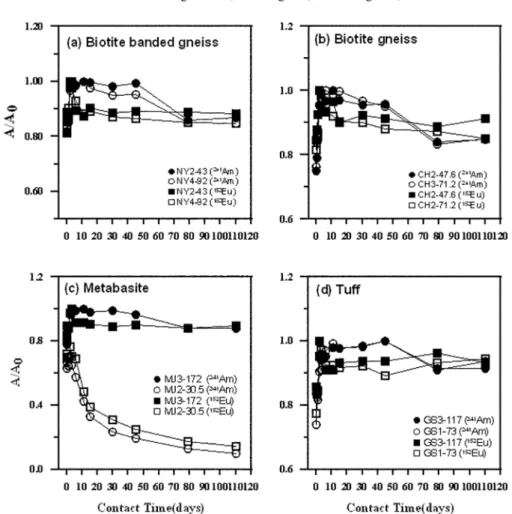
Figure 5 shows the sorption properties of 152Eu and
241Am, respectively, with contact interval, onto geological rock samples. In Figure 5, sorption properties can be sum- marized as follows: (1) each radionuclide has very similar
sorption trend for the same lithology regardless of the pres- ence of fractures except for the metabasite. (2) Two metab- asites have very different sorption ability in spite of the similar petrography. (3) Except for tuff, two radionuclides,
152Eu and 241Am, show very similar sorption trend in gneiss and metabasite. (4) In addition, solution of MJ2-30.5 shows a striking decrease of two radionuclide concentrations. Two radionuclides in the solution of MJ2-30.5 begin to decrease from the early stage, suggesting that sample MJ2-30.5 has strong sorption ability for two radionuclides.
4. DISCUSSION
4.1. Sorption Properties of 152Eu and 241Am in Geological Materials
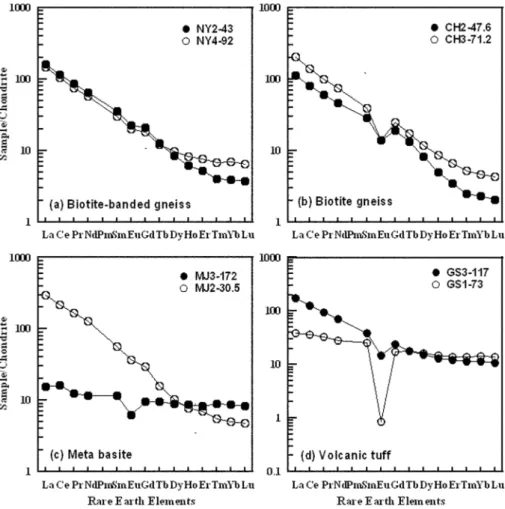
Emrén (1993) showed that the sorption property of radi- onuclides on fracture surfaces in aquifer was strongly dependent upon the chemical properties of both the surface and groundwater. This suggests that the chemical compo- sition of aquifer-bearing rock is an important factor in the sorption of radionulcides. Figure 6 is chondrite-normalized REE diagram of two biotite gneisses, metabasites and vol- canic tuff. All the biotite gneisses show LREE-enriched and HREE-depleted patterns with negative Eu anomaly. How-
Fig. 5. Sorption properties of radionu- clides 152Eu (rectangles) and 241Am (circles) against each sample as a func- tion of the contact time. Closed sym- bol is for fracture-free sample, whereas open is for fractured sample.
ever, metabasite and tuff show different REE patterns. In two metabasites, An-Ab-Or compositions (Fig. 3) also were different, suggesting that the chemical composition of source material was different. It has been known that the REE pattern in metamorphic rocks inherits an original pat- tern of protolith. However, Lee et al. (2003, 2004) reported that Eu abundances of the fractured rocks covered with fracture-filling calcite vary owing to geochemical environ- mental changes in paleo-groundwater, and the precipitation of the fracture-filling calcite resulted in positive Eu anom- aly. Thus, Eu is affected by the geochemical change of aqui- fer. Recently, Stipp et al. (2003) reported the Eu3+ uptake by calcite, and proposed that, in case of calcite precipitation, trivalent actinides and fission products, whose behavior resemble Eu3+, would be incorporated into calcite. Conse- quently, the Eu behavior of fractured aquifer might be important for understanding the geochemical changes between groundwater and its surrounding rock. Moreover, the sorp- tion properties of 152Eu and 241Am are closely related with chemical compositions of the core samples. For example, for the sample such as biotite gneisses with relatively homogeneous chemical composition, 152Eu and 241Am have similar sorption properties. However, for metabasites with different compositions, 152Eu and 241Am have different sorp- tion properties for different rock samples. Such trends sug-
gest that chemical compositions of fracture-bearing rock are important factor affecting sorption ability of the radionu- clides.
We mentioned that the fractured surfaces of the core sam- ples were covered with fracture filling-calcite due to water- rock interaction. Thus, concentration of Eu and Am might have decereased in the past-groundwater. Therefore, we can suppose that, based on the results by Lee et al. (2003, 2004), concentrations of Eu and Am in the specific geological environment such as sample MJ2-30.5 may be easily reduced due to water-rock interaction such as sorption and precipitation in the aquifer compared to those in another common geological environments.
Therefore, we conclude that sorption properties of 152Eu and 241Am in the geological environments are nearly the same regardless of petrography, physical and chemical state of geological materials and pH condition of groundwater.
4.2. Factors Controlling Sorption Properties of 152Eu and
241Am
Figures 4 and 5 show two interesting trends of adsorption ratio of two radionuclides. Firstly, the sorption properties of two radionulclides, 152Eu and 241Am, indicate very similar trends regardless of lithologies, and physical conditions of
Fig. 6. Chondrite-normalized REE dia- gram (Masuda et al., 1973) of core samples used in sorption experiments.
Closed symbol is for fracture-free sample, whereas open is for fractured sample.
solutions. Secondly, sample MJ2-30.5 has a strong sorption property for 152Eu and 241Am compared to others. In sample MJ2-30.5 (Figs. 4 and 5), the dissolved fractions of 152Eu and
241Am were removed at the early stage, and their adsorption ratios decreased continuously and rapidly with increasing contact time, indicating that most of 152Eu and 241Am was sorbed onto the sample MJ2-30.5 with very similar sorption trend.
Clay minerals are noted for their specific adsorption properties. Radioactive alkaline metals are most effectively
sorbed by mica-like clay minerals, while chlorite is suitable for divalent radionuclide (Konta, 1995). Our samples used in this study do not contain clay minerals except for chlorite (Table 4). Therefore, it is unlikely that strong sorption prop- erty of sample MJ2-30.5 is attributable to clay minerals.
It is known that Eu3+ precipitates may begin to form above pH 6.2, assuming the formation of EuOHCO3 (solid), or above pH 7.0 assuming Eu(OH)3 (solid) (Runde et al., 1992; Rizkalla and Choppon, 1993; Takahashi et al., 1998).
Thus, pH is an important factor in the sorption experiment.
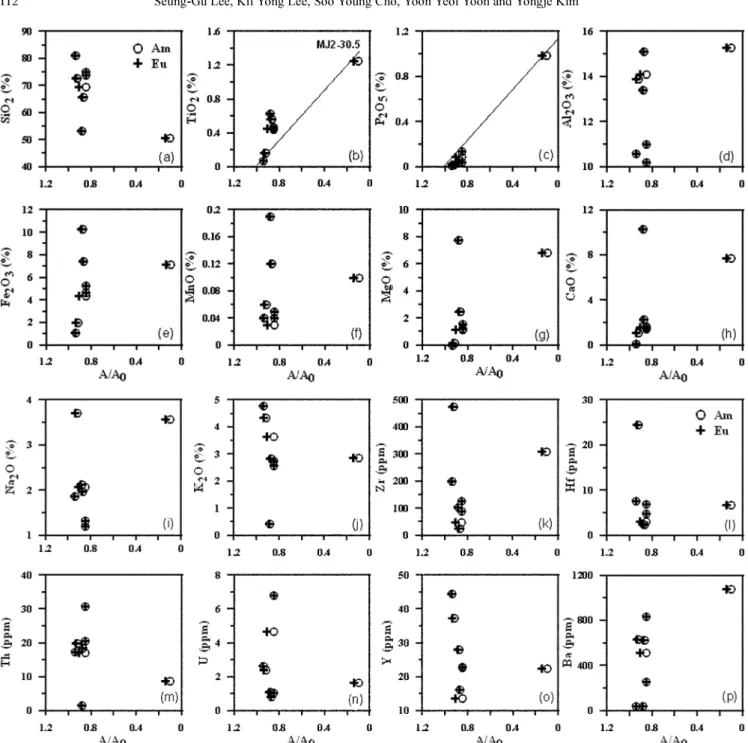
Fig. 7. Sorption ratio (A/A0) at 110 days vs. major oxides and trace elements. The lines of (b) and (c) suggest that there may exist some correlation between sorption ratio and TiO2 or P2O5.
Table 6 shows pH variations of sample solutions after the end of the batch experiments. Particularly, the solution MJ2-30.5 has pH 4.2, which is higher than other solutions.
However, the pH of solution MJ2-30.5 before batch exper- iment is less than 2.9 (Table 6), suggesting that the precip- itation of 152Eu and 241Am during batch experiment would not occur. Rai et al. (1981) showed that the Am concen- tration in solution contacting sediments decreased with an increase in pH. However, they also reported that, in the range of pH 4-5, the precipitation of Am did not occur.
Thus, it is difficult for Am to lead to sorption onto geolog- ical materials at this condition. In addition, the sorption trend of sample MJ2-30.5 is compatible with the results by Rai et al, (1981), suggesting that strong sorption of 152Eu and 241Am in our experiments may not be related with the pH condition.
Other factors affecting sorption properties of 152Eu and
241Am are mineralogical and chemical compositions of the geological samples. However, it is warranted to suggest any relationship between mineralogical compositions and sorp- tion properties. Figure 7 is a correlation diagram showing the relationship between chemical compositions and sorp- tion properties of 152Eu and 241Am based on our experimen- tal data. No correlation is apparent except for TiO2 and P2O5. In fact, we note high TiO2 (1.25 wt. %) and P2O5 (0.99%) of sample MJ2-30.5 (Table 5). Thus, TiO2 and P2O5 compo- sitions may be important for the sorption ability of the rocks against two radionuclides.
Admittedly, further systematic study is needed to clarify the reason of high sorption property of a metabasite (MJ2-30.5).
Nevertheless, our experimental results indicate that Eu and Am have similar sorption behavior in various geological environments.
5. SUMMARY
We carried out the sorption experiments to clarify the similarity in sorption behaviors between 152Eu and 241Am with geological materials such as biotite gneisses, metaba- site and andesitic tuff. Both 152Eu and 241Am have very sim- ilar properties on sorbing onto various rocks regardless of petrography and the pH variation of solutions. Moreover, the sorption properties of 152Eu and 241Am are closely related with chemical compositions of rock rather than the presence of fractures. Particularly, the concentrations of two radio- nuclides in groundwater strikingly decreased with the con- tact time with metabasite, suggesting that 152Eu and 241Am must be adsorbed onto the metabasite. In addition, sorption properties of 152Eu and 241Am onto metabasite revealed a correlation with the TiO2 and P2O5 contents, suggesting that these oxides might be important for sorption ability of the rocks against two radionuclides. Our results strongly indi- cate that 152Eu and 241Am have very similar sorption prop- erties regardless of petrography, chemical composition, and
the physical state of geological material like fracturing.
ACKNOWLEDGEMENTS: This work was supported by Principal Research Fund of Korea Institute of Geoscience and Mineral Resources (KIGAM 06-3211). The authors thank anonymous reviewers for thor- ough and constructive comments as well as Prof. Moonsup Cho of Seoul National University for editorial handling.
REFERENCES
Berry, J.A. and Bond, K.A., 1992, Studies of the Extent of Surface Diffusion in the Migration of Radionuclides through Geological Materials. Radiochimica Acta, 58/59, 329−335.
Buddemeier, R.W., Finkel, R.C., Marsh, K.V., Ruggieri, M.R., Rego, J.H. and Silva, R.J., 1991, Hydrology and Radionuclide at the Nevada Test Site. Radiochimica Acta, 52/53, 275−282.
Coppin, G.R., 1983, Comparison of the solution chemistry of the actinides and the lanthanides. Journal of Less-Common Metals, 93, 232−230.
Curti, E., 1999, Coprecipitation of radionuclides with calcite: esti- mation of partition coefficients based on a review of laboratory investigations and geochemical data. Applied Geochemistry, 14, 433−445.
Degueldre, C. and Wernli, B., 1993, Association Behavior of 241Am(III) on SiO2(amorphous) and SiO2(quartz) Colloids. Journal of Envi- ronmental Radioactivity, 20, 151−167.
Derry, L.A. and Jacobsen, S.B., 1990, The chemical evolution of Pre- cambrian seawater: Evidence from REEs in banded iron forma- tions. Geochimica Cosmochimica Acta, 49, 1955−1963.
Dymek, R.F. and Klein, C., 1988, Chemistry, petrography and origin of banded iron-formation lithologies from the 3800 Ma Isua supracrustal rocks, West Greenland, Precambrian Research, 39, 247−302.
Emrén, A.T., 1993, The influence of heterogeneous rock chemistry on the sorption of radionuclides in flowing groundwater. Journal of Contaminant Hydrology, 13, 131−141.
Fred, M., 1967, in Lanthanide/Acitinide Chemistry, vol. 71, Advances in Chemistry Series, American Chemical Society, Washington, pp.
200−201.
Guiterrez, M.G., Bidoglio, G., Avogadro, A., Mingarro, E. and D’Alessandro, M., 1991, Experimental Investigations of radio- nuclide transport through cored granite samples. Radiochimica Acta, 52/53, 213−217.
Heath, M.J., Montoto, M., Rodriguez Rey, A., Ruiz de Argandoña, V.G. and Menendez, B., 1992, Rock Matrix Diffusion as a Mech- anism of Radionuclide Retardation: A Natural Analogue Study of El Berrocal Granite, Spain. Radiochimica Acta, 58/59, 379−384.
Henderson, P., 1990, Inorganic Geochemistry. Pergamon Press, Oxford- New York, 353p.
Hilton, J., Nolan, L. and Jarvis, K.E., 1997, Concentrations of stable isotopes of cesium and strontium in freshwaters in northern England and their efforts on estimates of sorption coefficients (Kd).
Geochimica Cosmochimica Acta, 61, 1115−1124.
Ionova, G., Madic, C. and Guillaumont, R., 1997, Covalency Effects in the Standard Enthalpies of Formation of Trivalent Lanthanide and Actinide Halides. Radiochimica Acta, 78, 83−90.
Johannesson, K., Stetzenbach, K.J., Hodge, V.H. and Lyons, W.B., 1996, Rare earth element complexation behaviour in circumneu- tral pH groundwaters: Assessing the role of carbonate and phos- phate ions. Earth and Planetary Science Letters, 139, 305−319.
Johansson, B. and Rosengren, A., 1975, Interpolation scheme for the
cohesive energies for the lanthanides and actinides. Physical Review, B11, 1367−1373.
Kim, M.A., Panak, P.J., Yun, J.I., Kim, J.I., Klenze, R. and Köhler, K., 2003, Interaction of actinides with aluminosilicate colloids in statunasscendi. Part I; generation and characterization on actinide (III)-pseudocolloids. Colloidal Surface, A 216, 97−108.
Konta, J., 1995, Clay and man: Clay raw materials in the service of man. Applied Clay Science, 10, 275−335.
Krauskopf, K.B., 1986a, Aqueous geochemistry of radioactive waste disposal. Applied Geochemistry, 1, 15−23.
Krauskopf, K.B., 1986b, Thorium and rare earth metals as analogs for actinide elements. Chemical Geology, 55, 323−335.
Lee, K.Y., Yoon, Y.Y., Lee, S.G., Lee, D.H., Kim, Y. and Woo, N.C., 2001, Sorption of radionuclides on the container wall during batch migration studies. Journal of Radioanalytical Nuclear Chem- istry, 249, 271−278.
Lee, S.G., Lee, D.H., Kim, Y., Chae, B.G., Kim, W.Y. and Woo, N.C., 2003, Rare earth elements as an indicator of groundwater envi- ronment changes in a fractured rock system: Evidence from frac- ture-filling calcite. Applied Geochemistry, 18, 135−143.
Lee, S.G., Kim, Y., Chae, B.G., Koh, D.C. and Kim, K.H., 2004, The geochemical implication of a variable Eu anomaly in a fractured gneiss core: application for understanding Am behavior in the geological environment. Applied Geochemistry, 19, 1711−1725.
Lipin, B.R. and McKay, G.A., 1989, Geochemistry and Mineralogy of Rare Earth Elements. Reviews in Mineralogy, vol. 21, Min- eralogical Society of America, 348pp.
Masuda, A. Nakamura, N. and Tanaka, T., 1973, Fine Structure of mutually normalized rare-earth patterns of chondrites. Geochim- ica Cosmochimica Acta, 37, 239−248.
McCarthy, J.F., Sanford, W.E. and Stafford, P.L., 1998, Lanthanide Field Tracers Demonstrate Enhanced Transport of Transuranic Radionuclides by Natural Organic Matter. Environmental Sci- ence and Technology, 32, 3901−3906.
Meece, D.E. and Benninger, L.K., 1993, The coprecipitation of Pu and other radionuclide with CaCO3. Geochimica Cosmochimica Acta, 57, 1447−1458.
Metz, V., Kienzler, B. and Schûßler, W., 2003, Geochemical evalu- ation of different groundwater-host rock systems for radioactive waste disposal. Journal of Contaminant Hydrology, 61, 265−279.
Moeller, T., 1976, The Lanthanides. In: Comprehensive Inorganic Chemistry (J.C. Bailar et al. ed), 1−101, Pergamon Press, Oxford- New York-Toronto-Sydney-Braunschweig.
Nagasaki, S. Tanaka, S. and Suzuki, A., 1997, Interfacial behavior of actinides with colloids in the geosphere. Journal of Nuclear Materi- als, 248, 323−327.
O'Connor, J. T., 1965, A classification for quartz-rich igneous rocks
based on feldspar ratio. United States Geological Survey Profes- sional Paper, 525B, 79−84.
Petit, J-C., 1991, Natural Analogue Aspects of Radionuclide Trans- port in the Geosphere. Radiochimica Acta, 52/53, 337−340.
Rai, D., Strickert, R.G., Moore, D.A. and Serne, R.J., 1981, Influence of an americium solid phase on americium concentrations in solutions. Geochimica Cosmochimica Acta, 45, 2257−2265.
Rizkalla, E.N. and Choppin, G.R., 1991, Chap. 103 in Handbook on the Physics and chemistry of Rare Earths, Vol. 15, Gshneidner, K. A. Jr. and Eyring, L. Eds., Elsevier, New York.
Runde, W., Meinrath, G. and Kim, J.I., 1992, A Study of Solid-Liq- uid Phase Equilibria of Trivalent Lanthanide and Actnide Ions in Carbonate Systems. Radiochimica Acta, 58/59, 93−100.
Sakuragi, T., Sato, S., Kozaki, T., Mitsugashira, T., Hara, M. and Suzuki, Y., 2004, Am(III) and Eu(III) uptake on hematite in the presence of humic acid. Radiochimica Acta, 92, 697−702.
Shannon, R.D., 1976, Revised Effective Ionic Radii and Systematic Studies of Interatomic Distances in Halides and Chalkogenides.
Acta Crystallogrography, A32, 751−767.
Spasennykh, M.Yu. (1997) Radionuclide Migration in Aquifer Rocks:
Effect of Water-Rock Interaction. Geochemistry International, 35, 181−187.
Stipp, S. L. S., Lakstanov, L. Z., Jensen, J. T. and Baker, J. A., 2003, Preliminary results from coprecipitation experiments and obser- vations with surface-sensitive techniques. Journal of Contami- nant Hydrology, 61, 33−43.
Takahashi, Y., Kimura, T., Kato, Y., Minai, Y. and Tominaga, T., 1998, Characterization of Eu(III) Species Sorbed on Silica and Montmorillonite by Laser-Induced Fluorescence Spectroscopy.
Radiochimica Acta, 82, 227−232.
Takahashi, Y., Yoshida, H., Sato, N., Hama, K., Yusa, Y. and Shimizu, H., 2002, W- and M-type tetrad effects in REE patterns for water- rock systems in the Tono uranium deposits, central Japan. Chem- ical Geology, 184, 311−335.
Taylor, S.R. and McLennan, S.M., 1985, The continental Crust: Its Composition and Evolution. Blackwell. 312p.
Wood, S. A., 1990, The aqueous geochemistry of the rare earth ele- ments and Yttrium. 1. Review of the available low-temperature data for inorganic complexes and inorganic REE speciation in natural waters. Chemical Geology, 82, 159−186.
Xu, S. and Wörman, A., 1999, Implications of sorption kinetics to radionuclide migration in fractured rock. Water Resource Research, 35, 3429−3440.
Manuscript received January 2, 2006 Manuscript accepted May 18, 2006