저속 카메라 통신용 자동 디스플레이 검출을 위한 Lambertian 색상 분할 및 Canny Edge Detection 알고리즘 연구
한정도*, 누그마노브 사이드*, 이바딤*, 차재상**
A Study on Lambertian Color Segmentation and Canny Edge Detection Algorithms for Automatic Display Detection in CamCom
Jungdo Han*, Ngumanov Said*, Li Vadim*, Jaesang Cha**
요 약 최근 가시광원을 사용하는 카메라 통신 기술의 발전과 더불어 디스플레이를 통해 가시광 데이터를 표출하고 이를 인식 하는 기술에 대한 수요가 증가하고 있다. 기존의 디스플레이 기반 CamCom 기법은 사용자가 설정한 RoI 영역 기반의 2차원 컬러코드를 인식하는 방식을 사용하였으나, 이는 보행 상황 등 수신위치가 변동되는 상황에 적합하지 않은 단점이 존재한다. 이 에 본 논문에서는 카메라 통신에서 자동 RoI 설정을 위해 적용될 수 있는 Lambertian 색상 분할과 Canny 엣지 검출이 결합된 알고리즘 기반의 자동 디스플레이 검출 기법에 대하여 제안하였다. 기존 디스플레이 검출 기법은 디스플레이에서 표출되고 있는 콘텐츠의 변화가 발생하면 검출율이 현저히 감소하는 문제점이 존재하며, 본 논문에서는 이를 해결하기 위하여 lambertian 색 상 분할 및 canny 엣지 검출을 결합한 알고리즘 적용을 통헤 자동으로 디스플레이를 검출 할 수 있는 기법을 제안하였다. 본 연구에서는 디스플레이 엣지 인식을 위해 사용되는 다양한 알고리즘을 분석하고 변화하는 컬러코드 콘텐츠 인식시 성능을 측정 하였으며, 제안한 저속 카메라 통신용 자동 디스플레이 검출을 위한 lambertian 색상 분할 및 Canny Edge Detection 알고리 즘을 적용한 실험 결과 약 96%의 검출율을 달성함을 확인하였다.
Abstract Recent advancements in camera communication (CamCom) technology using visible light exploited to use display as an luminance source to modulate the data for visible light data communication. The existing display-CamCom techniques uses the selected region of interest based camera capturing approach to detect and decode the 2D color coded data on display screen. This is not effective way to do communicate when the user on mobility. This paper propose the automatic display detection using Lambertian color segmentation combined with canny edge detection algorithms for CamCom in order to avoid manual region of interest selection to establish communication link between display and camera. The automatic display detection methods fails using conventional edge detection algorithms when content changes dynamically in displays. In order to solve this problem lambertian color segmentation combined with canny edge detection algorithms are proposed to detect display automatically. This research analysed different algorithms on display edge recognition and measured the performance on rendering dynamically changing content with color code on display. The display detection rate is achieved around 96% using this proposed solutions.
Key Words : Display-Camera Communication, CamCom, Automatic Display Detection, Block Level Canny Edge Detection, Camera Communication, Edge Detection, Lambertian Color Segmentation
This work was supported by Institute for Information & communication Technology Promotion(IITP) grant funded by the Korea Government(MSIT) (No. 2017-0-00218-002, International Standardization Research of VLC application technology based LiFi and CamCom)
* Dept. of Integrated IT Engg, Seoul National Univ. of Science and Tech.
** Corresponding Author : Dept. of Electronics and IT Media Engg, Seoul National Univ. of Science and Tech.
Recieved October 10, 2018 Revised October 13, 2018 Accepted October 17, 2018
1. Introduction
Within huge spread of camera in everyday life, use of smartphones optical camera for receiving da ta could be a good less cost alternative for RF uses in personal area network access. The possibility to use OCC (Optical Camera Communication) is discl osed in [1] and [2].
Typically, OCC system uses smartphone camera to decode data bits, which are embedded into LEDs optical illumination. The camera captures images in realtime and only the portions of the captured imag es associated with the LEDs are extracted using i mage processing techniques since only those parts convey useful information for visible light communi cation.
Transmission of data in the visible spectrum allo ws user to encode up-to-date information on exis ting video images and rendered on display. In our research, we use data transmission in the form of 2D color code. The 2D color coded data is superim posed on visual frame and then rendered on displa y. The visual data transmission occurs at a frequen cy of 30 fps. The receiver is a smartphone camera.
The application developed by us to recognizes data encoded using 2D color code, according to the simil ar principle with the recognition of the QR-code.
However, before recognizing the color of the code, it is necessary to find in the display region to dete ct the picture of the area with the 2D colored code.
There are many computer techniques available f or object recognition but the available methods pro vides only fair result on display detection when dy namically content changes on the display [3]. In th is research, we analysed different edge and object detection methods performances and proposed to u se are discussed detection methods are lambertian color segmentation combined with canny edge dete ction algorithms. The proposed method is emulated
to use built-in smartphone camera as CamCom rec eiver to decode the display based visual light trans mitter. The following sections described the differ ent object detection methods considered for displa y detection, realtime implementation and performa nce measures.
2. Related Work
Object recognition is one of the areas of comput er vision that is maturing very rapidly. It is applied in many areas of computer vision, including image retrieval, security, surveillance, automated vehicle parking systems and machine inspection. Significan t challenges stay on the field of object recognition.
One main concern is about robustness with respect to variation in scale, viewpoint, illumination, non-r igid deformations and imaging conditions.
There are various methods which described in [4, 5, 6, 7, 10, 11]. The main purpose of these me thods is to recognize objects based on various assu mptions about the model of image formation, chang es in the brightness of the image which indicate: ch anges in depth, change the orientation of surfaces, changes in the properties of the material.
The various edge detection algorithms such as P rewitt, Robert, Sobel etc. are failed to meet the lo w area and reduced delay. Block level Canny opera tor (the Canny boundary detector, the Canny algori thm) gives simple edge detection operation which reduces the time and memory consumption. The Bl ock Level Canny edge detection algorithm is the sp ecial algorithm to carry out the edge detection of an image. Ideally, the result of the selection of bou ndaries is a set of related curves that denote the boundaries of objects, facets and overprints on the surface, as well as curves that display changes in the position of the surfaces. Thus, applying the bor derline filter to the image can significantly reduce
the amount of data processed because the filtered part of the image is considered less important, and the most important structural properties of the ima ge are preserved. Nevertheless, it is not always po ssible to single out boundaries in medium complex image of real world. The boundaries selected from such images often have such drawbacks as fragmen tation (the boundaries' curves are not connected to each other), the absence of boundaries or the pres ence of false boundaries that do not correspond to the processing object in image [8].
However edges detection of whole image in our case will be excesses. Found edges will contain ed ges of objects in whole Image ares. this mean that scene object will also be detected. What will lead to delays and low performance of algorithm. Using of the combined approach: on first-stage - detecti on of the object, in our case the color code, and the n the recognition of boundaries on second-stage, c an significantly increase the productivity
In recent publication regarding hair detection in f acial images, Yacoob and Davis have discussed the utility of the Lambertian color model in a color seg mentation context [9]. Instead of having a set of N training images and one test image, they only use one image. In that image, representing a human fac e, some pixels are known to represent hair. These pixels are used to train the model, and the model is applied on this same image to detect all the pixels representing hair. The Lambertian color segmentati on is to detect regions of interest in an image. This can be done using color intensity, contrast, or any other metric that allows an acceptable detection[3].
3. Proposed Display Detection Algorithm
The display detection scheme can be knowledge based detection or repetition sequence based detec
tion. The repetition based detection method needs to rely on the video stream sequence repeat in a certain period of time. So repetition sequence base d detection method is not suitable to use real-time application scenario where dynamic video playing o n the display screen. The knowledge based display detection scheme works based on the knowledge of display intrinsic and extrinsic characteristics. In practice, these methods tend to use simultaneously both intrinsic and extrinsic characteristics.
This paper proposed the knowledge based meth od to detect display based on Lambertian color mo del and Canny edge detection methods to precisel y detect the display screen in realtime when dyna mic visual sequences played on screen.
The Lambertian color model is quite simple and N background images are used to train the model.
These images have same size and same resolution, and are views of the same area in space, taken wit hout changing the orientation, position or zooming of the camera. The subject of the picture should be only background in all images, and only the illumina tion conditions are allowed to change. The model is computed for every pixel position across all N ima ges. For each pixel, brightness and chromaticity ar e evaluated, and a statistical model for that particul ar pixel is computed. Using a detection rate, we ca n then tell which values of brightness and chromati city can be used as threshold to select or reject no vel pixel intensities, just like when performing stat istical tests.
The Canny operator use Gaussian filter to smoot h the image in order to remove the noise. Smoothin g. Blur the image to remove noise. The Canny oper ator uses a filter that can be well approximated to the first Gaussian derivative. σ = 1.4 as shown in equation 1 [8]:
(1) To search for gradients, the borders are marked where the image gradient acquires the maximum va lue. They can have a different direction, so the Can ny algorithm uses four filters to detect horizontal, vertical and diagonal edges in a blurred image as sh own in equation 2 [8].
, arc
(2) Then we apply non-maximum suppression to ge t rid of spurious response to edge detection. The last step is applying double threshold to determine potential edges.
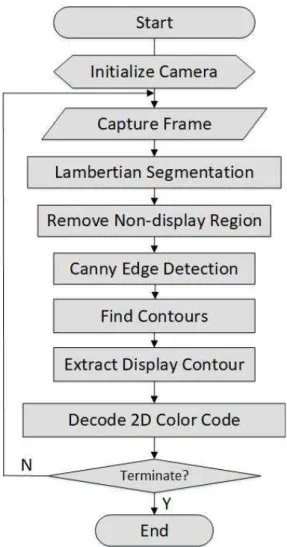
The proposed algorithm block diagram is illustra ted on the Fig. 1. The algorithm processing starts with image capturing from the frame of playing vid eo on the screen and then the captured image send to statistical Lambertian color model. In the next s tep detected display object region from Lambertian color model segmented image is sent send to Cann y edge detector to extract exact display object regi on of interest. We need to identify inner and outer contours of the detected display region to remove display frame region. So the received edges are co mpared by positioning and separated in to internal and external display frame regions.
Fig. 1. Display Detection Algorithm Block Diagram
The 2D color code region extracted from detect ed inter frame region of display. In our display bas ed 2D color code CamCom implementation, the colo r code is a rectangular surface and it has only 4 out er edges and MxN inner edges based on 2D color code mode selection. In other cases on non-rectan gular surface algorithm should be modified by appl ying other number of outer edges. As far as our col or code size concerns, color code block size stay c onstant from frame to frame we need find outer ed ges only once. For the next iteration saved contour
s can be used. Resulting contours devide 2D color code into the frames (usually square or rectangular shape) which contains only one color on each color block cell.
In some cases, the inner edges can not be found by Canny detector. However we know that each 2D color coded block cell should contain only one colo r, so we can compare the number of color with colo rs used in 2D color coding scheme. In our impleme ntation, we use four colors: red, green, blue, mage nta. The 2D color decode find more than one color found repeat contours search until one color in a bl ock will remain. The extracted color segments bloc k region than send to embedded symbol extraction process. If last frame of video received, terminate algorithm start capturing frame from the beginning of algorithm.
4. Implementation Results
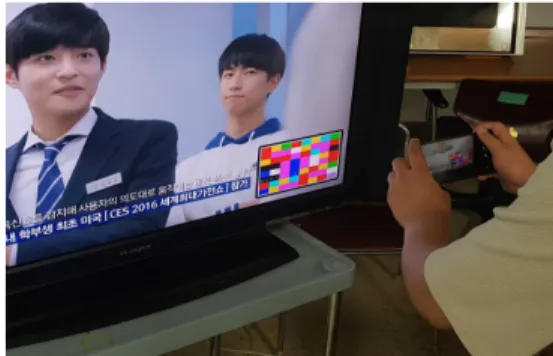
In this implementation, the display with FULL H D resolution used to evaluate the result and media content video was used with 1920 x 1080 resolutio n, about 3.05 minutes length, 30 fps. The media co ntent is blended with color code in full and partial screen then rendered on display as shown in Fig.
2. The display is used as CamCom Transmitter. Th e Android based smart phone with 16 mega pixels with f/1.8 aperture backside camera used as a rec eiver in this real-time emulation.
Fig. 2. Emulation setup
In this proposed method evaluation, We used to play the advertisement media content several time s and tried the detection of the display screen auto matically to decode 2D color code using CamCom techniques with different distance, capturing partial and whole TV screen from 85-90 degrees angle a s shown in Fig. 2.
The smartphone application developed using th e proposed knowledge based method to detect disp lay based on Lambertian color model and Canny ed ge The detected visual frame using real-time sm artphone application for proposed algorithm is sho wn in Fig. 3.
Fig. 3. Extracted frame from screen
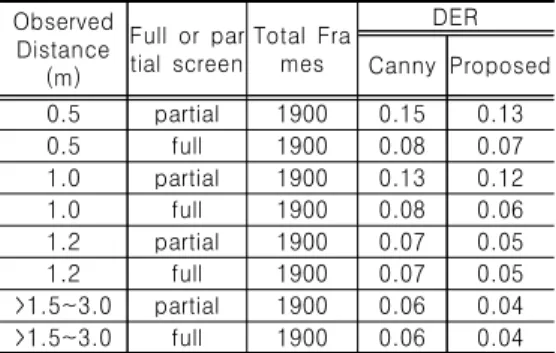
The detection error rate (DER) calculated using the ratio of total number of exact display detection frame and total number of frames used in processin g.
The display detection performance results of ex periment is shown in Table 1.
Observed Distance
(m)
Full or par tial screen
Total Fra mes
DER Canny Proposed
0.5 partial 1900 0.15 0.13
0.5 full 1900 0.08 0.07
1.0 partial 1900 0.13 0.12
1.0 full 1900 0.08 0.06
1.2 partial 1900 0.07 0.05
1.2 full 1900 0.07 0.05
>1.5~3.0 partial 1900 0.06 0.04
>1.5~3.0 full 1900 0.06 0.04
Table 1. Display Detection Error Rate
From Table 1 , the display detection error result shows that the automatic display detection and rec ognition works effectively from the distance 0.5 m eter till 3 meters and this will be useful for effecti ve 2D color code based CamCom using display lumi nance source. The emulation result in Table 1 conf irms that the proposed statistical model of Lambert ian color model segmentation fusion with Canny ed ge detection works very well for full and partial sc reen mode compare with traditional canny edge bas ed display detection. The proposed display detecti on technique gives 33.33% performance improvem ent compared with canny edge detection based disp lay detection techniques.
The DER has higher accuracy for full screen mo de than partial screen mode due to color noise inte rference in our implementation. In the case of full screen mode even changing distant to transmitter d oesn't affect much on error rate. In overall, the dis play detection rate is achieved around 96% using o ur proposed solutions and useful for free hand displ ay-CamCom user optical wireless network access on smart devices.
5. Conclusion
The proposed automatic display detection metho d for display-CamCom technology is an innovative technology because applying the Lambertian segme ntation model to the image can significantly reduce the amount of amount of unwanted background data to detect the display screen region, and the most important structural properties of the image are pr eserved to detect the exact display region of intere st using Canny edge detection technique. This rese arch experiment results confirms that detection err or rate still acceptable from 0.5 meter to 3 meters distance from transceiver and useful for display ba sed CamCom using visible light communication prin ciples. The Lambertian segmentation model fusion Canny edge detection technique improves the displ ay detection rate 33.33% compared to canny edge detection based display detection. The evaluation r esult on this paper shows how automatic display de tection can be implemented via Lambertian segmen tation model fusion Canny edge detection algorithm for effective CamCom using display for free hand optical wireless network access using smart devic e.
Acknowledge
This work was supported by Institute for Inform ation & Communication Technology Promotion (II TP) grant funded by the Korea government (MSI P), (No.2017-0-00218, International Standardizat ion Research of VLC Application Technology based LiFi and CamCom).
REFERENCES
[1] S. R. Ahuja, K. D. Hong, K. S. Hong, "The Ra pport Multimedia Conferencing System: A Soft ware Overviews", Proc. of 2nd IEEE Conferenc e on Computer Workstations, pp. 52-58, Marc
h, 1988.
[1] N. Saha, M. S. Ifthekhar, et al., “Survey on op tical camera communications: challenges and op portunities”, IET Optoelectronics, pp. 172-183, October, 2015.
[2] R. Boubezari, H. L. Minh, et al., “Smartphone Camera Based Visible Light Communication”, Jo urnal of lightwave technology, pp. 4120-4126, September, 2016
[3] T. Horprasert, D. Harwood, and L.S. Davis. "A statistical approach for real-time robust backgr ound subtraction and shadow detection“. IEEE I CCV, 1999.
[4] J. Blackledge. “Digital Image Processing: Math ematical and Computational Methods,” Dulbin In stitute of Technology, pp. 492-497, 2005.
[5] Y. Luo and R. Duraiswami, "Digital Image Proc essing Mathematical and Computational Method s", James Clerk Maxwell, 1868.
[6] B. Kaur , A. Garg, "Mathematical Morphologica l Edge Detection For Remote Sensing Images", IEEE, pp. 324-327, 2011.
[7] R .Gonzalez and R. Woods, "Digital Image Proc essing", pp.414-428, Addison Wesley, 1992.
[8] Kabade A. L, “Canny edge detection algorith m,” International Journal of Advanced Research in Electronics and Communication Engineering (IJARECE), Vol 5, Issue 5, pp.1292-1295, 20 16.
[9] Yacoob and Davis, “Detection and Analysis of Hair”, IEEE Transactions on Pattern Analysis
& Machine Intelligence, vol. 28 No. 07, 2006 [10] Bajcsy, et al., “Detection of Diffuse and Spec ular Interface Reflection and Inter-Reffections by Color Image Segmentation”, International Jo urnal of Computer Vision, Vol. 17, No. 3, pp. 2 41–272, 1996.
[11] A. Hurlbert and T. Poggio, “A Network for i mage segmentation using color”, Advances in n eural information processing systems, pp.297- 304 ,1989
저자약력
Jungdo Han [학생회원]
•Mar., 2012 – Feb., 2018 : BS, Electronics and IT Media Engg, Seoul Nat’l Univ. of Science & Tech., Korea
• Mar., 2018 ~ : MS Student, Dept. of Integrated IT Engg, Seoul Nat’l Univ.
of Science & Tech., Korea
<Research Interest>
Wireless Communication, VLC, OCC, IoT/IoL, Machine Learning
Ngumanov Said [정회원]
• Sep., 2008 – Dec., 2010 : The Republican Telecomm.
Management Centre of Uzbekistan, Engineer
•Jan., 2011 – Aug., 2013 : The Tashkent Radio, TV Broadcasting Center, Engineer
•Sep., 2011 – Jun., 2013 : MS, Dept. of Radio Engn, Radio and TV Broadcasting, Tashkent Univ. of Information Tech.
•Apr., 2015 – Dec., 2017 : Huawei Tech. Investment Tashkent-Wireless engineer
•Mar., 2018 ~ : Ph.D Candidate, Dept. of Integrated IT Engg, Seoul Nat’l Univ. of Science & Tech., Korea
<Research Interest> OWC, OCC, LiFI, Wireless
Comm. Technologies
Li Vadim [학생회원]
•Mar., 2014 – Feb., 2018 : BS, Electronics and IT Media Engg, Seoul Nat’l Univ. of Science & Tech., Korea
• Mar., 2018 ~ : MS
Student, Dept. of Integrated IT Engg, Seoul Nat’l Univ.
of Science & Tech., Korea
<Research Interest> IoT/IoL, Application Development, Block Chain
Jaesang Cha [정회원]