• 검색 결과가 없습니다.

Shear Performance of Wood-Concrete Composite II - Shear Performance with Different Anchorage Length of Steel Rebar in Concrete -

N/A
N/A
Protected

Academic year: 2021

Share "Shear Performance of Wood-Concrete Composite II - Shear Performance with Different Anchorage Length of Steel Rebar in Concrete -"

Copied!
8
0
0

로드 중.... (전체 텍스트 보기)

전체 글

(1)

*1 Received on September 6, 2012; accepted on September 18, 2012

*2 Division of Wood Engineering, Department of Forest Resources Utilization, Korea Forest Research Institute, Seoul 130-712, Korea

Corresponding author : Kwang-Mo Kim (e-mail: [email protected])

Shear Performance of Wood-Concrete Composite II*

1

- Shear Performance with Different Anchorage Length of Steel Rebar in Concrete -

Sang-Joon Lee, Chang-Deuk Eom, and Kwang-Mo Kim *

2†

ABSTRACT

Wood and concrete show significantly different physical properties, and it need to be firstly understood for using wood-concrete composite. This study is performed for compensating this and effective hybrid- ization of wood and concrete. This research in planned for wood-concrete composite after previous re- search which deals the shear performance with different anchorage length of steel rebar in wood. Yield mode and reference design value (Z) were derived using EYM (European Yield Model). And the yield mode changed before and after anchorage length of 10∼15 mm - I

s

mode to IV mode. There was not increasing tendency of shear performance with increased anchorage length for over 20 mm of anchorage in concrete. And wood composite shows 65% and 93% on initial stiffness and yield load respectively com- pared with the wood-concrete composite. Wood-concrete composite showed brittle failure after yield point while wood-to-wood composite showed ductile failure.

Keywords : wood-concrete composite, shear performance, EYM, steel rebar, anchorage

1. INTRODUCTION

High composite action between members is one of the most important concern to design the wood-concrete hybrid system including the tim- ber bridge (Yeah et al., 2011; Lee et al., 2012).

Researches on the timber bridge have been widely conducted in European countries and Northern America. After 1930’s, timber bridges started to be studied and to be constructed.

Several experimental approaches which deal with the composite action between wood and concrete member have been performed. Ritter

(1990) and Jutila and Salokangas (2010) pointed out that wood-concrete hybrid system can be ef- fectively applied for the timber bridge even the fully-composite action is difficult to be achieved.

Additional researches for concerning high composite action have been tried after 1960’s.

They can be devided into three approaches -

making notches at wooden part, inserting steel

rebar or plate in wood and concrete and using

the glue (An et al., 2008; Gutkowski et al.,

2008; Balogh et al., 2010; Bathon and Bletz-

Muhldorfer, 2010). The durability as well as the

structural safety also have been studied (Nunes

(2)

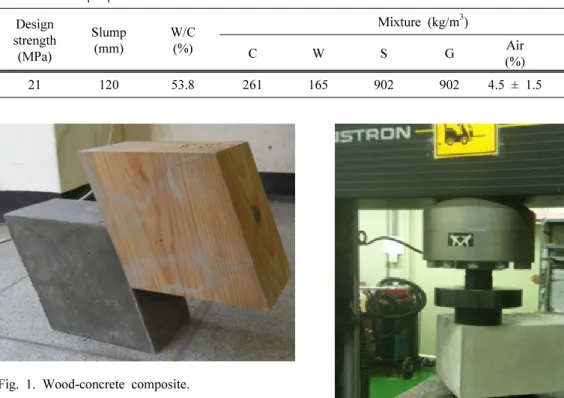
Table 1. Mix properties of concrete

Design strength

(MPa)

Slump (mm)

W/C (%)

Mixture (kg/m

3

)

C W S G Air

(%) Admix.

21 120 53.8 261 165 902 902 4.5 ± 1.5 2.92

Fig. 1. Wood-concrete composite.

and Carlito, 2008). It was found out from these researches that the wood-concrete hybrid system can be effectively applied for the timber super- structure however the concept of the fully-com- posite action still remains main concern for us- ing wood-concrete composites.

There is little approach for using wood-con- crete composite system in Korea, moreover there is no wooden bridge for vehicle and writ- ten specifications and/or standard for construct- ing the wooden bridge. This makes it difficult to concern recent rising concern about structural usage of wood and wooden culture in Korea.

Therefore, this study was planned for concern- ing the structural performance of wood-concrete composite. The shear performance with different anchorage length in wood (Lee et al., 2012) was firstly studied and the shear performance with different anchorage length in concrete was tried to be studied in this paper. After the pre

Fig. 2. Compression test of concrete.

diction with EYM (European Yield Model), comparison study was conducted between wood and concrete members.

2. MATERIALS and METHODS 2.1. Materials

The species of wood for manufacturing the

wood-concrete composite was pinus koraiensis

Sieb. and moisture content and oven-dried den-

sity were 13.5 ± 2.04% and 0.43 ± 0.04 g/cm

3

respectively. The shape and size of the wood-

concrete composite (Fig. 1) were referred to

previous research (Jurita and Salokangas, 2010;

(3)

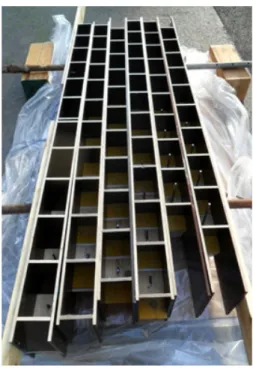
Fig. 3. Specimens after form work.

Fig. 4. Specimens after concrete pouring.

Fig. 5. Specimens on curing.

Lee et al., 2012). While anchorage length of steel rebar in wood fixed to 180 mm, anchorage length in concrete differed with eight steps (20, 40, …, 160 mm). Eight wood-concrete compo- sites were used for this study.

2 m

3

of ready-mixed concrete which was made by Korean standard (KSF 4009) was used for concrete material. Table 1 shows the mix properties of concrete which’s design strength targeted to 21 MPa. The concrete was cured in shady place about 28 days and the compressive strength after the curing shows 20.1 MPa (Fig. 2).

2.2. Manufacture of the Wood-concrete Composites

After anchoring of steel rebar in wood with

eight different length, form work for making

concrete part was performed (Fig. 3). FIS V

360S chemical anchor (Fischer co., ltd., Germany)

(4)

Fig. 6. EYM of wood-concrete composite.

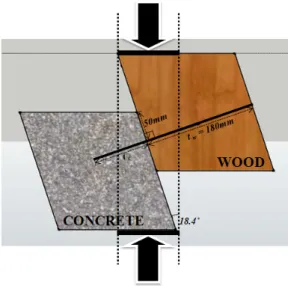
Fig. 7. Schematic View of Specimen on Shear Test.

was used for anchoring steel rebar in wood and form work was done after two days of curing the chemical anchor. Fig. 4 shows the speci- mens after pouring ready-mixed concrete and concrete part was cured in shady place about three days. After removing the form, each speci- mens were additionally cured about twenty five days.

Fig. 8. Shear Test.

2.3. Evaluation of the Shear Performance

2.3.1. Prediction of Shear Performance with EYM

EYM was applied for prediction of shear per-

formance of wood-concrete composite. Refer-

ence design value(Z)s were derived from each

(5)

Anchorage Length in Concrete (mm)

Yield Mode Determined

Yield Mode

Reference Design Value (Z)

I

s

II III

s

IV

5 2,100 38,477 11,708 5,945 I

s

2,100

10 4,200 39,544 16,246 5,945 I

s

4,200

15 6,300 40,685 19,630 5,945 IV 5,945

20 8,400 41,897 22,429 5,945 IV 5,945

40 16,800 47,402 30,841 5,945 IV 5,945

60 25,200 53,838 37,145 5,945 IV 5,945

80 33,600 61,053 42,425 5,945 IV 5,945

Fig. 9. Load-displacement curves.

determined yield mode.

As the material properties, the embedding strength of wood and concrete materials (Few, Fec) was determined to 31.6 MPa and 42 MPa (KBC Wood Design Manual, 2008) and the yield strength of steel rebar (F

yb

) was de- termined to 294 MPa as the property of SD30A steel rebar. Wooden part was assumed as the main member and concrete part was assumed as the side member. While the anchorage length of steel rebar in wood (t

w

) was fixed to 180 mm, EYM results were derived with seven steps of anchorage length (t

c

) in concrete.

2.3.2. Shear Test

Universal Testing Machine (UTM) (Instron, co., ltd, USA) was used for shear test (Figs. 7, 8). The testing procedure was referred to pre- vious research (Lee et. al., 2012).

3. RESULTS and DISCUSSIONS

3.1. Prediction of Yield Mode and

Reference Design Value(Z)

Table 2 shows results of EYM due to anchor-

age length of steel rebar in concrete member.

(6)

Table 3. Shear performance of wood-concrete composites due to anchorage length in concrete Anchorage Length in

Concrete (mm)

Initial Stiffness (kN/mm)

Yield Load (N)

Maximum Load (N)

20 2.5 7,527 10,602

40 2.7 7,956 26,985

60 3.2 9,652 27,403

80 2.9 11,728 32,055

100 2.6 10,558 27,869

120 2.0 9,808 29,148

140 2.0 10,144 29,802

160 2.4 11,956 25,807

Below 10 mm of anchorage, minimum yield loads were calculated at I

s

mode which makes bearing failure at concrete. And the reference design values at anchorage length of 5 mm and 10 mm derived 2,100 N and 4,200 N respec- tively. IV mode which makes plastic hinge at shear plane was derived over 15 mm of anchorage. And the reference design value was calculated to 5,945 N.

Results show similar tendency with previous research (Lee et. al., 2012) which applies the wood-to-wood composite. Yield mode was changed from I

s

mode to IV mode at 15∼20 mm and 10∼15 mm of anchorage length for wood and concrete side member respectively.

At IV yield mode, reference design values show 5,565 N and 5,945 N respectively for wood-to- wood and wood-to-concrete composites. Refer- ence design value at IV mode of wood-to-wood composite shows about 94% of wood-to-con- crete composite even the embedding strength of wood (31.6 MPa) is about 75% of concrete (42 MPa).

3.2. Shear Performance

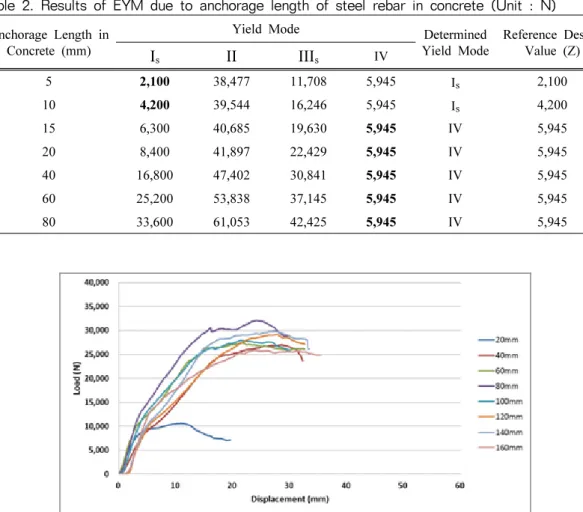
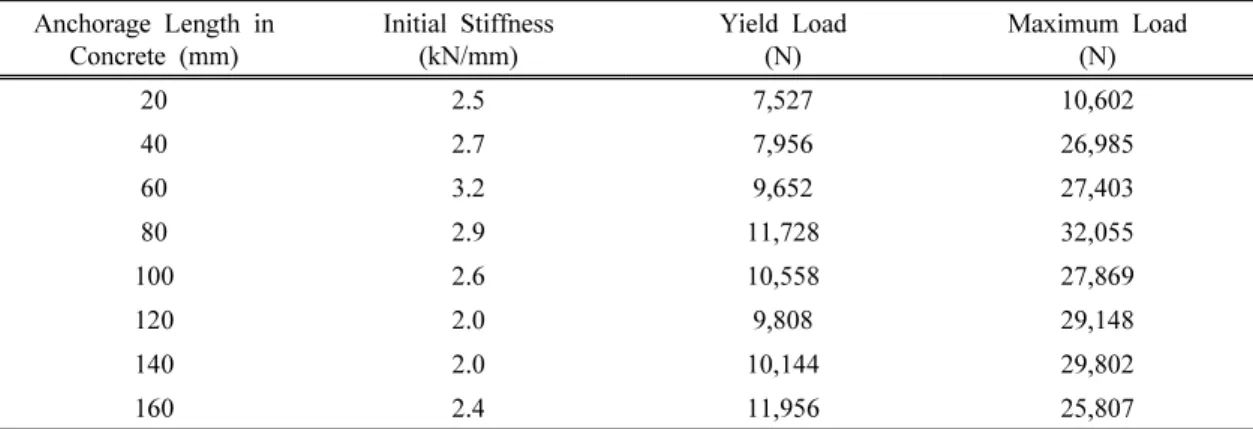
Fig. 9 shows the load-displacement curves for tested wood-concrete composite and table 3 shows derived shear performance with initial stiffness,

Table 4. Comparison of shear performance between wood-to-wood and wood-to-concrete composites

Initial Stiffness (kN/mm)

Yield Load (N) Wood-to-wood

composite

(Lee et. al., 2012) 1.63 ± 0.19 7,527 ± 778 Wood-to-concrete

composite 2.54 ± 0.42 7,956 ± 1,266

yield load and maximum load. Initial stiffness and yield load show 2.54 ± 0.42 kN/mm and 7,932 ± 1,266 N respectively for the eight test- ed wood-concrete composites. Results at 20 mm and 40 mm of anchorage show a little bit small- er values, however there was not increasing ten- dency with increment of the anchorage length.

It is considered that all specimens yield samely in IV mode as predicted with EYM. In the case of maximum load, there was no increasing ten- dency with increment of the anchorage length except composite with anchorage of 20 mm which shows pullout failure of inserted steel rebar.

Table 4 shows comparison of shear perform-

ance with initial stiffness and yield load be-

tween wood-to-wood and wood-to-concrete com-

posites. Results of wood-to-wood composite re

(7)

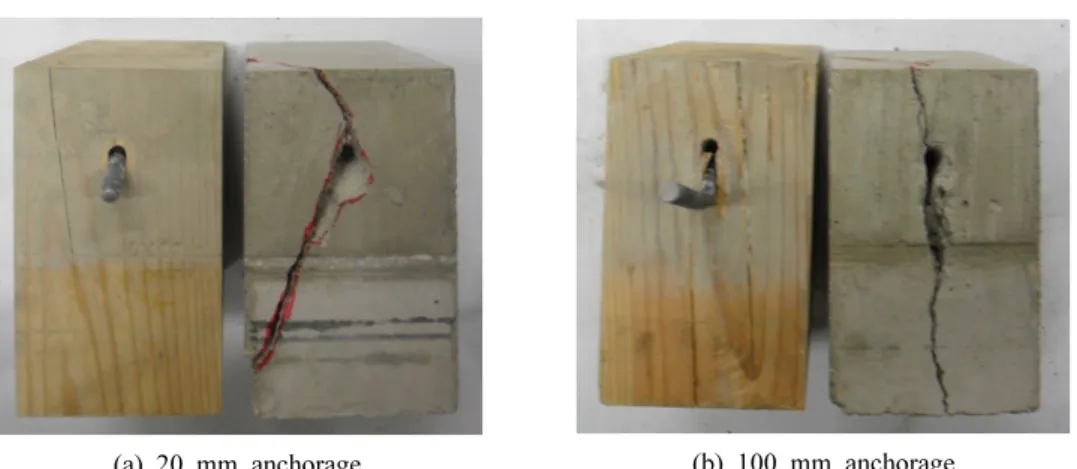
(a) 20 mm anchorage (b) 100 mm anchorage Fig. 10. Photographs after shear failure of wood-concrete composites.

fers to previous work (Lee et. al., 2012). Same with the result of wood-concrete composite, there was no increasing tendency of initial stiff- ness and yield load with increment of anchor- age length of steel rebar in wood-to-wood composite. Average initial stiffness and yield load of wood-to-wood composite shows about 65% and 93% than those of wood-concrete composite. Reference design values of wood- to-wood and wood-to-concrete composites cal- culated to 5,565 N and 5,945 N respectively, and actual yield loads showed about 130% of there values.

3.3. Shear Failure

Fig. 10 shows photographs after failure of tested wood-concrete composites at 20 mm and 100 mm of anchorage. After the yield load, lo- cal part around steel rebar at concrete part pulled out with steel rebar in the case of 20 mm of anchorage (Fig. 10(a)). However, there was not pull out failure over 40 mm of anchorage and brittle failure of concrete occurred different from the wood-to-wood composite (Lee et. al., 2012). Concrete cracked along the loading di- rection as confirmed from Fig. 10(b). And bend- ing of steel rebar also can be confirmed which

indicates the plastic hinge at the shear plane.

4. CONCLUSIONS

This study was performed for evaluation of wood-concrete composite with different anchor- age length of inserted steel rebar. Results were compared with previous work (Lee et. al., 2012) which dealt with the wood-to-wood composite.

EYM was applied as the preliminary prediction and mode conversion from I

s

mode to IV mode occurred before and after anchorage length of 10∼15 mm which is about 5 mm shorter an- chorage length then the wood-to-wood composite.

There was not increasing tendency of shear performance with increment of anchorage length from 20 to 160 mm in concrete. Initial stiffness and yield load show 2.54 ± 0.42 kN/mm and 7,932 ± 1,266 N respectively and those of wood-to-composite were about 65% and 93%.

Actual yield loads derived from shear test

showed around 130% of reference design val-

ue(Z)s from EYM for wood-to-wood and wood-

to-concrete composites. Wood-concrete compo-

site showed brittle failure after the yield point

while wood-to-wood composite showed ductile

failure.

(8)

REFERENCES

1. 국토해양부. 2008. 도로설계편람 제5편 교량.

2. 대한건축학회. 2008. 목조건축구조설계매뉴얼 (KBC Wood Design Manual).

3. 대한토목학회 교량설계핵심기술연구단. 2008.

도로교 설계기준 해설.

4. 한국표준협회. 2007. 레디믹스트 콘크리트. KS F 4009.

5. An, H. J., S. C. Kim, Y. J. Moon, and I. S.

Yang. 2008. Experimental study of composite beams consisting structural laminated timber beam with concrete slab. 2008 Proceedings of the Korea Concrete Institute Annual Meeting, Vol 20(1): 233∼236.

6. Balogh, J., M. Fragiacomo, N. Miller, R. Gut- kowski, and R. Atadero. 2010. Testing of Wood- Concrete Composite Beams with Shear Key Detail. Proceedings of International Conference on Timber Bridges, Lillehammer, Norway pp.

393∼398.

7. Bathon, L. and O. Bletz-Muhldorfer. 2010. Per- formance of single span wood-concrete-compo- site bridges under dynamic loading. Proceedings of International Conference on Timber Bridges, Lillehammer, Norway pp. 399∼402.

8. Construction and Maintenance Branch. Ministry of Transportation and Infrastructure. 2009. Stand- ard Specification for Highway Construction.

9. Customary U.S. Units 4th Edition. 2007. AASHTO

LRFD Bridge Design Specifications.

10. Gutkowski, R., K. Brown, A. Shigidi, and J.

Natterer. 2008. Laboratory tests of composite wood-concrete beams. Construction and Building Materials 22: 1059∼1066.

11. Nunes, J. L. and C. J. Carlito. 2008. Field Load Test Behavior of Composite Log-Concrete Bridge - P01. Proceedings of the 51st International Con- vention of Society of Wood Science and Techno- logy, Chile WS-36.

12. Julita, A. and L. Salokangas. 2010. Wood- Concrete Composite Beams - Finnish Speciality in the Nordic Countries. Proceedings of Interna- tional Conference on Timber Bridges, Lilleham- mer, Norway pp. 383 ∼392.

13. Ritter M. A. 1990. Timber Bridge: Design, Con- struction, Inspection, and Maintenance. U. S. Depart- ment of Agriculture, U. S. Forest Service, EM 7700-8.

14. Lee, S.-J., C.-D. Eom, and K.-M. Kim. 2012.

Shear Performance of Wood-Concrete Composite I - Shear Performance with Different Anchorage Length of Steel Rebar in Wood. J. Korean Wood Sci. & Tech. 40(3): 186∼193.

15. Yeah, D., M. Fragiacomo, M. De Franceschi, and K. H. Boon. 2011. State of the Art on Timber- Concrete Composite Structures: Literature Review.

Journal of Structural Engineering 137(10): 1085

∼1095.

수치

Fig. 2. Compression  test of concrete.
Fig. 3. Specimens after form work.
Fig. 8. Shear Test.
Fig. 9. Load-displacement curves.
+3

참조

관련 문서

Strength and Deformation of Structural Concrete by Kaufmann... Understanding of Concepts in

Most of the plastic strain is localized in narrow shear bands, which form approximately on the planes of maximum resolved shear stress.. The inhomogeneous flow in

The virtues of ordinary steel such as those listed in the below (which assure ductile behavior at member or structural level) tend to disappear in high strength

“ᄃ” shaped member due to brittle fracture with transverse shear and laminar bending. Members with 90 degree stacking is collapsed in crush mode due to

Most of the plastic strain is localized in narrow shear bands, which form approximately on the planes of maximum resolved shear stress. The inhomogeneous flow in

Segment Construction: form setting (2 days), rebar and formwork (3 days), concrete placement (1 day), Curing and tensioning (4 days), Form Traveler detachment (2 days)

▶ See lecture note P99-104 and P108 for the flexural and shear strengths of composite slab-on- stringer deck.... ▶ Transverse Stiffeners and Shear-Dominant Failure

• Useful for investigating the shear forces and bending moments throughout the entire length of a beam. • Helpful when constructing shear-force and