건축용 외장재와 접착제 연소가스의 독성분석에 관한 연구
김원종․박영주 † ․ 이해평․임석환 * ․김정인 * 강원대학교 소방방재학부․*서울소방학교 소방과학연구센터
(2013. 1. 21. 접수 / 2013. 7. 18. 채택)
A Study on the Toxicity Analysis of Combustion Gases of Architectural Surface Materials and Architectural Adhesives
Won-Jong Kim․Young-Ju Park † ․Hae-Pyeong Lee․Suk-Hwan Lim * ․Jung-In Kim * Department of Fire and Emergency Management, Kangwon National University
*Fire Science Research Center, Seoul Metropolitan Fire Service Academy (Received January 21, 2013 / Accepted July 18, 2013)
Abstract : This study was carried out, using toxicity test apparatus, to analyze toxic gases of heat insulation material and adhesives of composite panels used for the architectural surface material when a fire occurs. The findings of this study show that CO, CO
2, HCOH, CH
2CHCN and NO
xwere detected from styrofoam, reinforced styrofoam, polyurethane foam and glass fiber, but in the case of the polyu- rethane foam, HCl and HCN were detected as well. All the architectural adhesives released CO, CO
2and NO
x, but HCHO was only detected from the adhesives for styrofoam, wood, tile, windows and doors; CH
2CHCN was only from those for wood and stone; C
6H
5OH was only from those for wood. The toxicity index was also measured for architectural surface material and adhesives. Polyurethane foam showed the highest index, 11.7, and glass fiber was followed as 6.8. Reinforced styrofoam showed 5.7 and styrofoam revealed the least 4.9. In the case of archi- tectural adhesives, the highest ranking was those for stone 7.4, windows and doors 6.1, wood 5.3, tile 3.8, and styrofoam 3.7 were followed, respectively.
Key Words : toxicity analysis, combustion gases, architectural surface materials, architectural adhesives, exterior fire
†
Corresponding Author: Young-Ju Park, Tel : +82-33-540-3147, E-mail: [email protected]
1. 서 론
최근 건축물은 초고층화의 경향을 보이고 있으며 이에 따라 하중 감소 및 에너지 절약을 고려한 외장재를 사용하 고 있으나, 화재 안정성은 고려되지 않아 화재 위험성이 증 가되고 있다1-3). 또한 건물의 층수가 높아짐에 따라 바람의 영향이 증가하여 화재 발생 시 중요한 변수로 작용될 가 능성이 큰 것으로 판단된다.
소방방재청이 발표한 2011년도 전국 화재 통계분석 결 과에 따르면 국내 화재 건수 43,875건이고, 전체 대비 건 축에서 61.6% 화재가 발생하였으며, 피해 내역을 살펴보 면 사망이 총 263명 중 건축물에서 232명으로 88.2% 정도이 다4). 건축물 화재 시 3건 중 1건은 외벽에서 발생함을 알 수 있다. 또한 현재 많이 사용되고 있는 가연성 외장재는 화 재가 발생하면 외벽면의 외장재를 통해 순식간에 확산되어 초기 진화가 어렵다. 이에 따른 재산 및 인명피해가 나날이 증가하고 있어 이를 예방하기 위해서는 화재에 대한 정확 한 위험도 평가가 필수적이기 때문에 건축화재에 대한 화재 위험성에 관한 연구는 지속적으로 진행 중이다5-7). 그러나 이와 관련된 규정이나 규제가 마련되어 있지 않은 상황에 서 초고층 빌딩들이 도심지를 비롯하여 많이 건설되고 있
지 때문에 화재 발생 시 자칫 대형 인명피해와 재산피해로 이어질 수 있다. 초고층 건축물의 경우, 굵은 골재의 사용 과 더불어 에너지 효율의 최적화를 위하여 경량 및 단열 효 과에 적합한 외장재를 사용하고 있는 실정이다. 그러나 이 러한 외장재는 화재 시 열을 차단하여 단열 효과에 따른 온도 상승과 화재 하중의 위험성이 높아서 이에 적합한 규 정이 필요한 실정이다.
고층 건물용 외장재는 주로 알루미늄 복합 패널 등이 사용되지만 주로 화재에 취약한 알루미늄 복합 패널이 사
용 된다8-12). 이 복합 패널은 기본 두께가 4 mm로서 알루미
늄 판과 판 사이에 접합시킨 심재에 따라 내화성이 크게 달라지는데 폴리에틸렌이 사용될 경우는 불에 타기 쉽고, 무기질 심재가 사용될 경우는 난연성을 보인다. 그러나 이 러한 장점에도 불구하고 화재가 발생할 경우, 심재로 사용 되는 유기물질들이 화재에 매우 취약하고 유독가스를 발생 시키며 화염전파가 용이하여 위험하다는 단점이 있다.
이처럼 화재로 인한 연기독성의 피해는 화염에 의한 직 접적인 피해보다 광범위하고 치명적이다13). 또한 건축 외 장용 접착제로 사용되는 것은 대부분 고분자 물질로서 용 도가 다양하지만 열분해에 의해 유독성 물질의 생성이 가장 큰 단점이다. 산업현장 뿐만 아니라 일상생활에서 화재 등
Table 2. Materials for experiments(architectural surface materials).
Classification Characteristics
General styrofoam
Styrofoam refers to foam star styrene resin which has a lot of small air bubbles and is so light-weighted and heatproof that it is widely used as packing, inhalation material, decoration materials.
Reinforced styrofoam
Reinforced styrofoam is also called iso-pink and has higher density than normal stryfoam. In order words, it has hard surface.
Poly urethanefoam
Polyurethane foam consists of polyurethane which is made by a response of isocyanate and glycol. It refers to foam star product which is mixed with a volatile solvent such as carbon dioxide and freon created isocyanate and water used as crosslinked polymer.
Glass fiber
Glass fiber is mineral fiber which is shaped by melted glasses with fiber shape. It has the following characteristics : ① It is thermal-resistant and fireproof. ② It is water-resistant. ③ It has chemical durability, so it is not eroded.
④ It has high tensile strength. ⑤ It has low elongation. ⑥ It has high insulation. ⑦ It has low wear resistance and it is easily cracked. ⑧ It has 2.2 times of specific gravity of nylon and 1.1 times of cloth sewing.
에 의한 고분자물질이 열분해 시 발생하는 유독성 물질은 심한 연기 등과 함께 인체에 건강에 심각한 영향을 미치며, 대기환경오염에도 악영향을 초래한다. 고분자 물질의 열적 안정성에 대한 연구는 안전보건 뿐만 아니라 환경적으로 도 필요하다14-15). 이러한 고분자 물질의 단점을 보완하기 위 해서는 기본적으로 그 중합단계에서부터 열적 안정성을 고 려해야 하며, 또한 열분해 시 생성되는 물질들의 조사가 필요하다.
따라서 본 연구에서는 현재 건축물 외장재로 널리 쓰 이는 복합 패널의 단열용 심재를 종류별로 구분하여 이 재 료들 가운데 일반스티로폼, 강화스티로폼, 우레탄폼, 유리 섬유 등 4가지를 선정하였으며, 건축 외장용 접착제 중 일 반적으로 많이 사용되는 스티로폼용, 목공용, 석재용, 타 일용, 창호전용 등 5가지를 선정하여 NES 713방법에 따른 독성가스 분석을 수행함으로써 건축물의 화재 위험성을 분석하는데 주안점을 두었다.
2. 실 험
2.1.
실험대상본 연구에서는 건축물 외장재로 널리 쓰이는 복합 패널 의 단열용 심재를 종류별로 구분하여 이 재료들 가운데 일 반스티로폼, 강화스티로폼, 우레탄폼, 유리섬유 4가지와 스 티로폼용, 목공용, 석재용, 타일용, 창호전용 등 5가지의 건축 외장용 접착제를 선정하여 실험을 수행하였으며, Table 2과 Table 3에는 대상 시료들에 대한 간단한 특징을 제시하였다.
2.2.
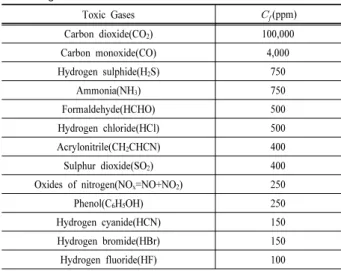
실험방법화재발생 시 인명피해의 주된 원인 가운데 하나인 연 소가스의 독성을 규명하기 위하여 Fig. 1과 같이 NES 713 (Naval Engineering Standard 713) 규격을 만족하는 영국 FTT사의 Toxicity Test Apparatus를 사용하여 외장재별 연
Fig. 1. Toxicity test apparatus.
Table 1. Lethal concentration(LC
50) for halt-hour exposure of toxic gases
Toxic Gases
(ppm)
Carbon dioxide(CO
2) 100,000
Carbon monoxide(CO) 4,000
Hydrogen sulphide(H
2S) 750
Ammonia(NH
3) 750
Formaldehyde(HCHO) 500
Hydrogen chloride(HCl) 500
Acrylonitrile(CH
2CHCN) 400
Sulphur dioxide(SO
2) 400
Oxides of nitrogen(NO
x=NO+NO
2) 250
Phenol(C
6H
5OH) 250
Hydrogen cyanide(HCN) 150
Hydrogen bromide(HBr) 150
Hydrogen fluoride(HF) 100
Table 3. Materials for experiments(architectural adhesives).
Classification Main component Usage
Use for wood polyvinylacetate resin 42±2%, water 52±2% wood, veneer, floor board, paper, wall paper, woven goods etc.
Use for stone polyamide resin + epoxy resin earthenware tile, ceramic tile, stoneware tile, polishing tile etc.
Use for tile cement, inorganic filler, powder resin etc. tile, gypsum board, CRC board, concrete, plastering side, PC side, etc.
Use for window and door Non-nitric acid silicon PVC, windows and doors, concrete, stone, marble etc.
Use for styrofoam acetate(vinylacetate) adhesive such as ; styrofoam, gypsum board, wood, veneer, iso-pinks etc.
소가스의 종류와 방출량 측정을 통해서 독성지수를 측정 하였다. 이 시험 규격은 물질의 완전연소 후 각각의 독성가 스를 측정할 수 있는 검지관을 이용하여 13가지의 개별 독성가스를 측정해서 최종적으로 독성지수 값을 계산한다.
독성지수는 일정한 부피(0.7~1 m3)의 챔버에 주어진 조건 즉, 화염길이 100~125 mm의 버너를 사용하여 화염온도1,150±
25oC의 화염에 노출시켜 1 g의 시험편을 완전연소 시킨 후, 1 g 시편의 연소를 통해 검출된 가스농도를 식 (1)에 의 해 100 g의 물질이 연소했을 때의 경우로 환산하여 NES 713 규격에서 제시하고 있는 Table 1에 제시된 각각의 가스에 대한 치사농도(
, 인간이 30분간 노출 되었을 경우 사망할 수 있는 가스농도)를 식 (2)에 의해 최종 독성지수(Toxicity Index)를 계산하였다.
(ppm)=
× ×
(1)
여기서,
: 시편의 연소생성가스 중 각각의 가스농도(ppm)
: 시편의 중량(g)
: 챔버의 부피(m3)각각의
값과 치사농도를 독성지수는 식 (2)에 의해 계산된다.
⋯
(2)
여기서,
: 식 (1)에 의해 계산된 가스의 평균값(ppm)
: 30분간 노출 됐을 경우의 치사 농도(ppm)
에 대한 값은 Table 1에 제시하였으며, 결과 값은 3 회 실험하여 측정된 값의 평균값을 사용하였다.3. 결과 및 고찰 결과
3.1.
검출된 물질3.1.1. 건축용 외장재
NES 713 방법에 의하여 1 g의 시편을 밀폐공간에서 연 소시킨 경우, 생성되는 유독가스에 대한 결과를 Table 4와 Fig. 2에 나타내었다. 건축용 외장재에서 총 4종의 대상물 질 가운데 H2S, NH3, SO2, C6H5OH, HBr, HF 등 6가지 물질 은 검출되지 않았지만, CO2, CO, HCHO, NOx등 4가지 물
Table 4. Results of measurement(architectural surface materials).
Classification Styrofoam Poly urethane foam Glass
fiber General Reinforced
CO
2(ppm) 5,000 5,000 5,500 5,000
CO(ppm) 5 10 100 10
H
2S(ppm) 0 0 0 0
NH
3(ppm) 0 0 0 0
HCHO(ppm) 0.2 0.2 5 0.5
HCl(ppm) 0 0 1 0
CH
2CHCN(ppm) 0 0.5 6 1
SO
2(ppm) 0 0 0 0
NO
x=NO+NO
2(ppm) 5 5 10 10
C
6H
5OH(ppm) 0 0 0 0
HCN(ppm) 0 0 5 1
HBr(ppm) 0 0 0 0
HF(ppm) 0 0 0 0
Toxicity Index 4.9 5.3 11.7 6.8
Fig. 2. Toxicity index(architectural surface material).
질은 모든 대상물질에서 검출되었다. 그리고 HCl은 우 레탄폼에서 검출되었고, HCN은 우레탄폼과 유리섬유에서
만 검출되었는데 CH2CHCN의 경우는 일반스티로폼에서만 검출되지 않았다. 총 4개의 시료를 대상으로 독성지수를 산출해 본 결과, 일반스티로폼이 가장 낮은 4.9를 나타냈 으며, 우레탄폼은 11.7의 가장 높은 독성지수를 나타내었다.
아직까지 건축용 외장재에 대한 독성지수의 기준은 설 정되어 있지 않기 때문에 독성지수를 이용한 건축용 외장 재의 독성평가를 결론 내릴 수 없는 상황이지만 미국의 MIL 기준을 참고한다면 일반스티로폼을 제외한 3개의 시료 가 MIL의 독성지수시험법에서 요구하는 기준인 5를 초과 하는 것으로 확인되었다.
3.1.2. 건축 외장용 접착제
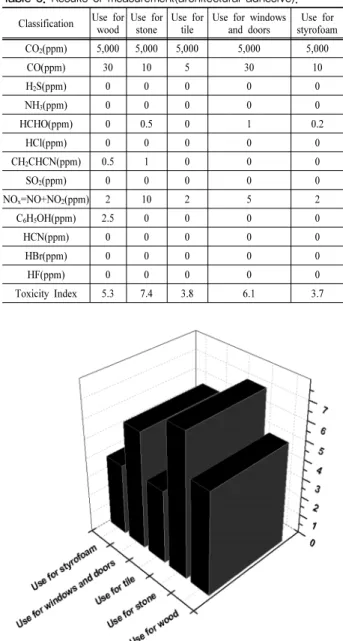
NES 713 방법에 의해 시편 1 g을 연소시킨 결과를 살펴 보면, 13가지 종류의 독성가스 항목 중 CO, CO2, NOx가
Table 5. Results of measurement(architectural adhesive).
Classification Use for wood Use for
stone Use for
tile Use for windows and doors Use for
styrofoam
CO
2(ppm) 5,000 5,000 5,000 5,000 5,000
CO(ppm) 30 10 5 30 10
H
2S(ppm) 0 0 0 0 0
NH
3(ppm) 0 0 0 0 0
HCHO(ppm) 0 0.5 0 1 0.2
HCl(ppm) 0 0 0 0 0
CH
2CHCN(ppm) 0.5 1 0 0 0
SO
2(ppm) 0 0 0 0 0
NO
x=NO+NO
2(ppm) 2 10 2 5 2
C
6H
5OH(ppm) 2.5 0 0 0 0
HCN(ppm) 0 0 0 0 0
HBr(ppm) 0 0 0 0 0
HF(ppm) 0 0 0 0 0
Toxicity Index 5.3 7.4 3.8 6.1 3.7
Fig. 3. Toxicity index(architectural adhesive).
공통적으로 모든 접착제에서 검출되었으며, HCHO는 스 티로폼용, 석재용, 창호용 접착제, CH2CHCN은 목공용과 석 재용 접착제에서만 검출이 되었고, C6H5OH는 목공용 접착 제에서만 검출이 되었다. 독성지수의 값을 알아보기 위해 시험 챔버의 부피, 시편의 무게, 측정된 각각의 가스농도를 정해진 공식에 적용하여 100 g의 시편이 연소됐을 경우로 환산하였다.
그 결과는 Table 5와 Fig. 3에 나타내었다. 석재용 접착제 는 7.4로 가장 높은 독성지수를 나타냈으며, 창호용 6.1, 목 공용 5.3, 타일용 3.8, 스티로폼용 3.7의 순으로 나타났다.
건축자재에 대한 독성지수는 기준이 없는 상황이라 어느 정도의 위험성인지는 판단할 수 없으나, 각각의 시편에 대해 서 어떠한 가스가 얼마만큼 검출 되었는지를 확인할 수 있었다.
4. 결 론
본 연구에서는 건축물 화재 시 발생할 수 있는 독성가 스의 위험성을 고찰하고자 외장재(일반스티로폼, 강화스티 로폼, 우레탄폼, 유리섬유) 4가지와 접착제(스티로폼용, 목 공용, 석재용, 타일용, 창호전용) 5가지에 대한 연소생성물 가스의 독성을 분석하여 다음과 같은 결론들을 얻을 수 있었다.
1) 건축물 외장재인 일반스티로폼, 강화스티로폼, 우레탄 폼, 유리섬유의 독성분석 결과 대부분 시료들은 CO, CO2, HCHO, CH2CHCN, NOx 등이 검출되었으며, 우레탄폼의 경우는 HCl과 HCN이 추가적으로 검출됨을 확인할 수 있 었다. 또한, 독성지수는 일반스티로폼이 상대적으로 가장 낮 은 값인 4.9로 나타났으며, 우레탄폼은 11.7로서 독성지수가 가장 높은 것을 확인할 수 있었다. 따라서 대부분의 시료 들로부터 검출된 독성가스들은 치사농도에는 훨씬 못 미 치는 것을 알 수 있었으며, 독성지수는 일반스티로폼<강화스 트로폼<유리섬유<우레탄 순임을 알 수 있었다.
2) 접착제의 독성가스 분석결과로는 CO, CO2, NOx가 공 통적으로 모든 접착제에서 검출이 되었으며, HCHO는 스 티로폼용, 석재용, 창호용 접착제, CH2CHCN은 목공용과 석 재용 접착제에서 검출되었다. C6H5OH는 목공용 접착제에 서만 검출이 됨을 확인할 수 있었다. 독성지수는 스티로폼 용이 3.7로 상대적으로 낮은 것을 알 수 있었으며, 석재용 접 착제는 7.4로 독성지수가 가장 높은 것을 확인할 수 있었다.
3) 건축용 외장재 및 접착제에 대한 독성지수의 기준은 규정되어 있지 않기 때문에 독성지수를 이용한 건축용 외 장재의 독성평가를 결론 내릴 수 없는 실정이지만 미국의 MIL 기준을 참고한다면 일반스티로폼을 제외한 3개의 시료 가 MIL의 독성지수시험법에서 요구하는 기준인 5를 초과 하는 것으로 확인되었고, 건축자재에 대한 독성지수는 기준 이 없는 상황이라 어느 정도의 위험성인지는 판단할 수 없 으나 각각의 시편에 대해서 어떠한 가스가 얼마만큼 검출 되었는지를 확인할 수 있었다.
감사의 글: 이 논문은 “2013년도 정부(교육부)의 재원
으로 한국연구재단의 지원을 받아 수행된 기초연구사업임 (No. 2013R1A1A3013320)”
References
1) S. H. Min and J. E. Yun, “A study on the Modeling Vertical Spread Fire of Exterior Panel by Fire Dynamic Simulation (FDS)”, Journal of the Korea Safety Management & Science, Vol. 11, No. 2, pp. 77~85, 2009.
2) S. H. Min and J. M. Lee, “A Study on Concurrent Fire Ap- pearance though Openings”, Journal of Korea Institute of Fire Science & Engineering, Vol. 26, No. 2, pp. 90~96, 2012.
3) J. B. Kwon, N. W. Lee and S. D. Seul, “A Consideration on Thermal Stability of the PVAc Latex Adhesive”, Journal of the Korean Society of Safety, Vol. 18, No. 3, pp. 81~87, 2003.
4) National Emergency Management, “statistical data 2011, pp.
1~3, 2012.
5) S. H. Min, Y. J. Jang, J. C. Sa, J. M. Lee, J. E. Yun, M. S. Kim and Y. H. Kim, “A survey about Installation Trend for Exterior In Domestic”, Proceedings of the Korea Institute of Fire Science and Engineering Conference, pp. 11~14, 2012.
6) NFPA 285, “Standard Fire Test Method for Evaluation of Fire Propagation Characteristics of Exterior Non-Load-Bearing Wall Assemblies Containing Combustible Componests 2006 Edition”, pp. 5~8, 2006.
7) S. H. Min, M. S. Kim, Y. J. Jang, J. C. Sa, Y. J. Bae and J. M.
Lee, “A Study on the Development of a Head for Prevent the Fire Spread of Exterior”, Journal of Korea Institute of Fire Science & Engineering, Vol. 26, No. 1, pp. 113~119, 2010.
8) C. K. Choi and S. H. Min, “A Study on the Large Experi- ments(ISO 13785-2) for Vertical Fire Behavior Analysis of Aluminum Composite Panels in General and Flame-retardant Material”, Journal of Korea Institute of Fire Science & Engi- neering, Vol. 26, No. 6, pp. 92~98, 2012.
9) J. Batchelor, “Use of Fiber Reinforced Composites in Modern Railway Vehicles“, Materials in Engineering, Vol. 2, No. 4, pp. 172~182, 1981.
10) Korea Fire-rating Building Material Association, “Exterior Wall Finishing Material Survey Research”, pp. 1~3, 2011.
11) Korea Fire-rating Building Material Association, “A Study on the Fire safety and Reformation of Sandwich Panel”, pp.
44~45, 2011.
12) D. H. Kim and S. Y. Park, “A Basic Study on Required Perfor- mance and Development Direction of Fire Resistance Wall on High-rise Building”, Journal of Korea Institute of Fire Science
& Engineering, Vol. 25, No. 4, pp. 1~7, 2011.
13) N. W. Cho, J. C. Lee and D. H. Rie, “A Comparative Study on To- xic Gas Index and Stop Time of Mouse Activity”, Journal of Korea Institute of Fire Science & Engineering, Vol. 25, No. 4, pp. 35~40, 2011.
14) O. S. Kweon, Y. H. Yoo, H. Y. Kim, J. H. Kim and S. H. Min,
“The Real Scale Fire Tests for Vertical Fire Spread Study of External Finishing Material”, Journal of Korea of Fire Science
& Engineering, Vol. 26, No. 6, pp. 85~91, 2012.
15) O. S. Kweon, Y. H. Yoo, H. Y. Kim and S. H. Min, “An Expe- rimental Study on fire Safety Performance of Glass Wool Sandwich Panel”, Journal of Korea of Fire Science & Engi- neering, Vol. 26, No. 5, pp. 21~27, 2012.