Article
http://dx.doi.org/10.4217/OPR.2020.42.1.001
제주 북동부 연안 조하대에 서식하는 중형저서동물 군집 변동 특성
강태욱
1
· 김동성
2*
1국립공원공단 국립공원연구원 해양연구센터
(59723) 전라남도 여수시 박람회길 1
2한국해양과학기술원 해양생태연구센터
(49111) 부산광역시 영도구 해양로 385
Meiobenthic Community Structure on the Northeast Coastal Area of Jeju Island, Korea
Teawook Kang
1
and Dongsung Kim
2*
1Marine Research Center, National Park Research Institute, Korea National Park Service
Yeosu 59723, Korea
2Marine Ecosystem Research Center, Korea Institute of Ocean Science & Technology
Busan 49111, Korea
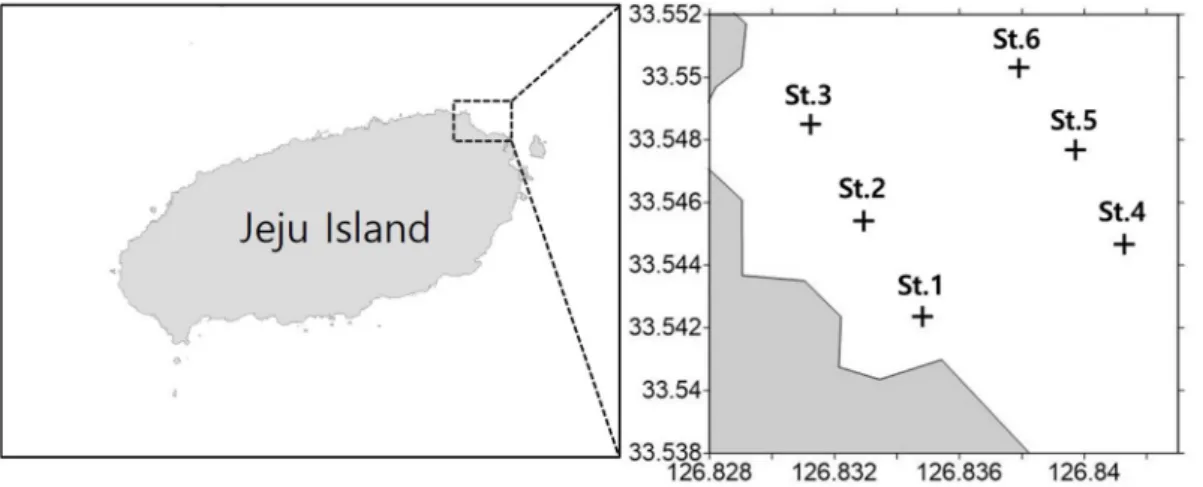
Abstract : We analyzed the characteristics of meiofaunal communities in the northern part of Jeju Island and the environmental factors affecting the meiofaunal communities. For the analysis of the communities, subtidal sediments containing meiofauna were collected from 6 sites (3 shallow sites and 3 deeper sites) on the northern coast of Jeju Island in April, June, August, and October 2017. The sediment samples were collected by SCUBA using a syringe. After isolating and counting meiofauna from the sediment using a series of sieves and centrifugation, the density of the meiofauna was expressed as individuals/10 cm
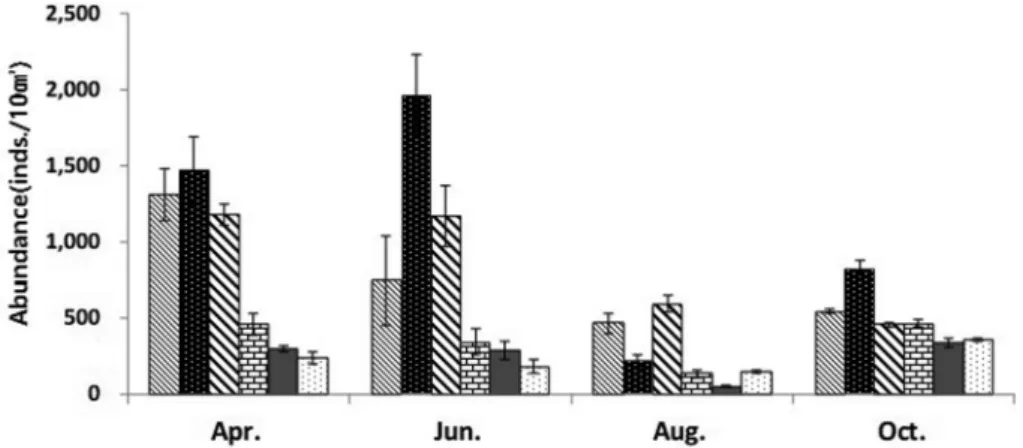
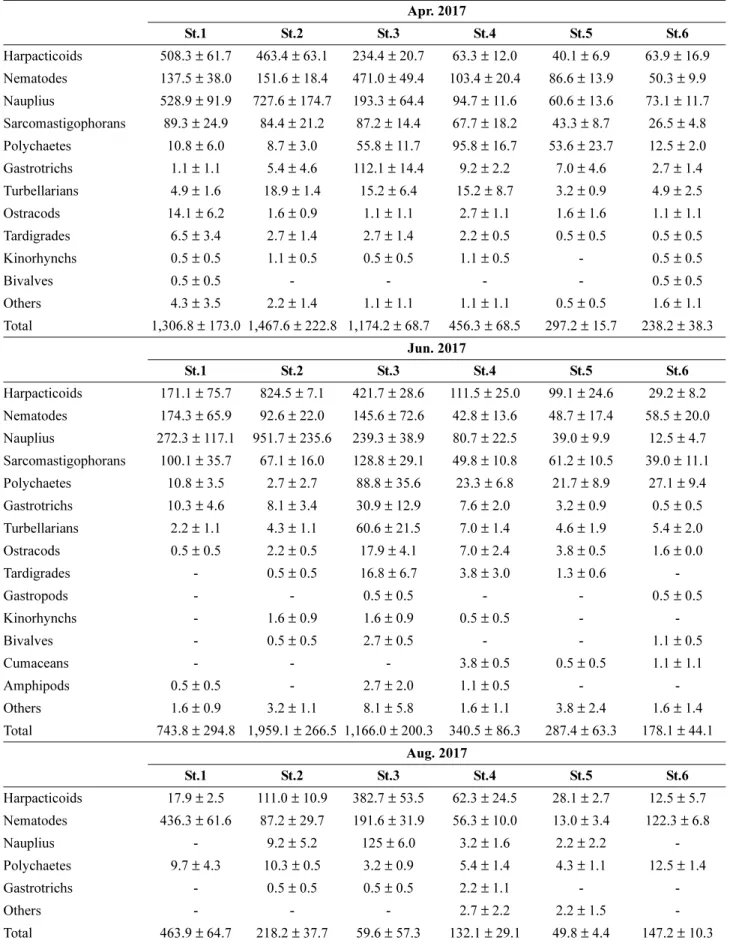
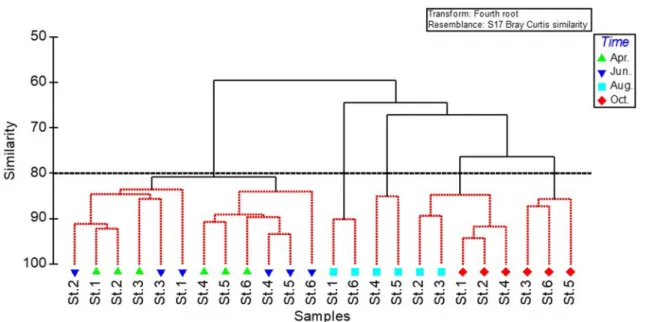
2. Density of meiofauna was lower in August compared to April and June, and the density determined in October was higher than August. During April and June, the meiofaunal communities at the shallow sites (i.e., ST 1, 2, and 3) were significantly different from the meiofaunal communities at deeper sites (ST 4, 5, and 6, p < 0.01). However, such spatial variation in the meiofaunal communities was not obvious in August and October. The most dominant meiofaunal taxa were harpacticoids, followed by nematodes and nauplius larvae. These three taxa accounted for 90% of the total meiofauna density. Abundance of harpacticoids and nematodes showed a significantly negative correlation with the water depth. BIO-ENV analysis indicated that the total organic nitrogen (TON) and the water temperature exerted a significant influence over the meiofaunal communities at the sampling sites.
Key words : meiofauna, nematodes, harpacticoids, density, sand
1. 서 론
제주도는 우리나라에서 가장 규모가 큰 섬으로 이를 둘 러싸고 있는 해역은 계절별로 한국남해연안수, 대마난류
수, 황해저층냉수, 중국대륙연안수 등이 흐르고 있다. 이 러한 수괴들은 서로 복잡한 관계를 갖으며, 제주도 연안 및 천해역에 다양한 영향을 미치고 있다. 특히, 난류권 해 양 환경에서 살아가는 해양생물들이 제주 주변 해양환경 으로 유입되어 살아가는 등 매우 독특한 해양생태계를 갖 고 있는 지역이기도 하다(좌와 이 2000; 이 등 2000). 제