11
남해도 주변 조하대 해역의 대형저서동물 분포
임현식* · 최진우1 · 최상덕2
*목포대학교 해양수산자원학과
1
한국해양과학기술원 남해특성연구부
2
전남대학교 양식생물학과
The Community Structure of Macrozoobenthos and Its Spatial Distribution in the Subtidal Region off the Namhaedo Island, South Coast of Korea
H YUN -S IG L IM *, J IN -W OO C HOI
1AND S ANG -D UK C HOI
2*Department of Marine and Fisheries Resources, Mokpo National University, Muan, Jeonnam 534-729, Korea
1
South Sea Research Institute, Korea Institute of Ocean Science Technology(KIOST), 41, Jangmok 1-gil, Geoje 656-830, Korea
2
Department of Aquaculture, Chonnam National University, Yeosu, Jeonnam 550-749, Korea
남해도 남측 해역의 연성기질 조하대 대형저서동물 군집구조 파악을 위해 2012년 7월부터 2013년 4월까지의 4 계절 동안 정점당 2회씩의 grab(표면적 0.1 m
2) 채집이 수행되었다. 조사결과 총 247종의 대형저서동물이 출현하였 으며, 평균 밀도는 1,027개체/m
2, 평균 생체량은 148.7 g/m
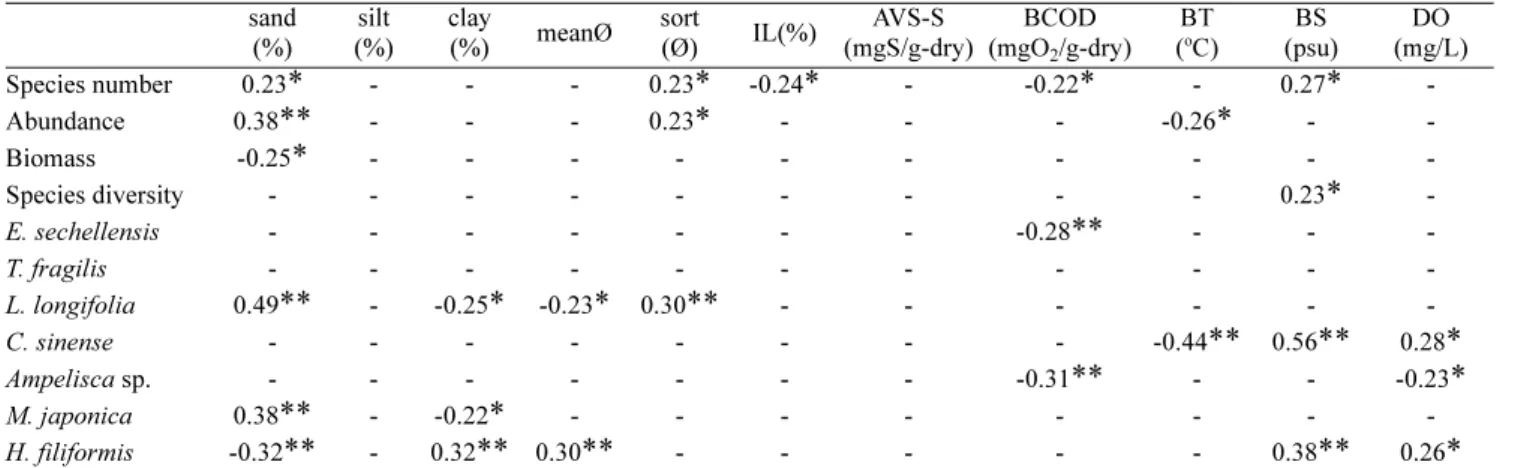
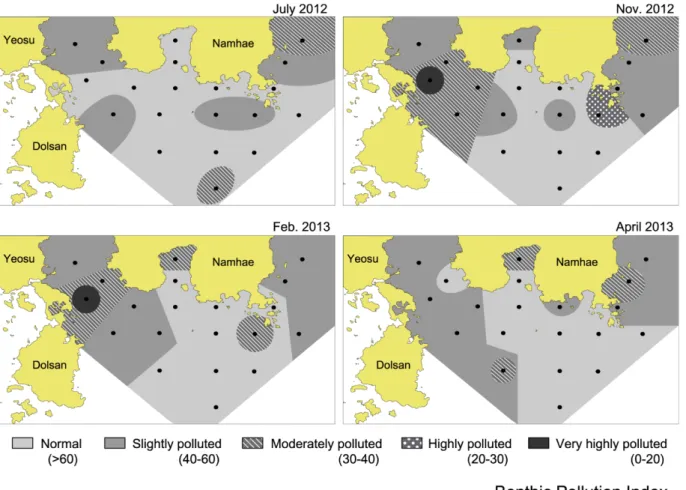
2이었다. 다모류가 출현종수 및 서식밀도에서 우점한 분 류군이었으며, 각각 37%를 점유하였다. 반면 생체량 우점 분류군은 극피동물로서 전체 생물량의 44%를 점유하였 다. 출현종수는 봄철에 가장 적었으며 겨울철에 가장 많았다. 서식밀도는 가을철이 가장 낮았으나 봄철에 가장 높았 다. 육지에 인접한 정점들에서 상대적으로 높은 밀도를 보였으며 외해역으로 나가면서 밀도가 감소하는 양상을 보 였다. 최우점종은 소형 옆새우류인 Eriopisella sechellensis였으며, 봄철에 네 번째 우점종으로 출현한 것을 제외하 고 가장 밀도가 높았다. 이 종은 주로 남해도 앞 외해역에 높은 밀도로 출현하였으나 광양만 입구역이나 사량만 입 구역에서는 출현하지 않았다. 이들 내만 해역의 입구에서는 이매패류인 Theora fragilis와 다모류인 Lumbrineris longifolia 가 높은 밀도로 출현하여 우점종의 차이를 보였다. 반면에 시프린스호 유류사고 이후 광양만 입구부터 외 측까지 높은 밀도로 출현한 Tharyx sp.는 이번 조사에서는 4계절 중 어느 계절에서도 해당 정점 주변에서 출현하지 않았다. Bio-Env 분석결과 저서동물의 분포에 영향을 미치는 환경요소는 퇴적물의 분급과 저층수온의 조합이었으며, 집 괴분석 결과 내만해역, 외해역, 중간해역 등의 5개 정점군으로 구분되었다. SIMPER 분석 결과 각 정점군에는 유기오염 지 표종인 T. fragilis가 공통적으로 기여하였으며, Magelona japonica, E. sechellensis, L. longifolia, Paraprionospio cordifolia 등의 기여도가 높게 나타났다. 저서오염지수(BPI) 값에 의한 저서군집 건강도 평가 결과 광양만 입구 및 사량만 인접 정점에서는 약간오염 상태였으나 남해도 외해역의 정점에서는 정상상태였다. 따라서 남해도 남측 해역 은 유기물 오염영향을 다소 받는 연안역과 상대적으로 양호한 외해역으로 구분되며 지속적인 저서생태계 감시가 요구된다.
An ecological study on subtidal macrobenthic fauna was conducted off the Namhaedo Island, south coast of Korea from July 2012 to April 2013. A total of 247 species of macrobenthos occurred with a mean density of 1,027 ind./m
2and a mean biomass of 148.7 g/m
2. Polychaetes was the richest and most abundant faunal group that comprised 37% in both total species number and density whereas echinoderms were biomass-dominant fau- nal group that accounted for 44% of the mean biomass. There was a seasonal variation in the species richness and abundance of macrobenthos with more species in winter and higher density in spring. Mean faunal density was relatively high at the stations near Namhaedo Island, but gradually decreased toward offshore stations. The most dominant species in terms of density was an amphipod species, Eriopisella sechellensis which occurred as a top ranker during three seasons except spring recorded the fourth rank. E. sechellensis showed its high density at the near shore stations of Namhaedo Island, but this species did not occur around the entrance of Gwangyang
Received June 13, 2015; Revised November 9, 2015; Accepted January 6, 2016