Print ISSN: 2288-4637 / Online ISSN 2288-4645 doi:10.13106/jafeb.2021.vol8.no2.0523
Social Media Marketing and Business Performance of MSMEs During the COVID-19 Pandemic
Jahid SYAIFULLAH1, Makmun SYAIFUDIN2, Markus Utomo SUKENDAR3, Junaedi JUNAEDI4
Received: November 05, 2020 Revised: December 30, 2020 Accepted: January 08, 2021
Abstract
This study aims to examine the role of social media marketing on the performance of micro-, small and medium-sized enterprises (MSMEs) during the COVID-19 pandemic. This research method uses a quantitative approach and the analytical tool used is Structural Equation Modeling (SEM) based on Partial Least Square. The sampling technique used purposive sampling and the sample in this study was MSMEs who use social media for marketing. The social media used are Facebook, Instagram, and Whatsapp. The number of samples in this study was 254 MSMEs. Data collection used online questionnaires. The research findings show that the use of social media marketing is influenced by compatibility, perceived usefulness, and perceived ease-of-use. The results of this study indicate that the use of social media for marketing has a positive effect on the performance of MSMEs, especially in increasing sales, customer relationships, productivity, and creativity. This means that the better the management of social media for marketing, the better the performance of MSMEs will be.
The theoretical contribution to this research is built on the TAM and UTAUT theories and their impact on social media marketing on MSMEs in developing countries that are living through the COVID-19 pandemic.
Keyword: Social Media Marketing, MSME Performance, COVID-19 JEL Classification Code: L25, M31, M51
and medium-sized enterprises (MSMEs). As a result, 70%
of MSMEs stated that they had stopped production due to COVID-19. The survey was conducted between 6 and 24 April 2020 of MSMEs spread across Indonesia. Related to this, the ILO also found that around 63% of MSMEs stopped and asked their employees to take paid or unpaid leave.
Also, there are MSME employees who have been affected by the termination of employment. Then, as many as 90% of respondents said they were facing cash flow problems due to the COVID-19 pandemic (ILO report, 2020).
Due to business disruption and movement restrictions, 64% of companies experienced a shortage of raw material supplies. Meanwhile, nearly two thirds or about 66% face problems with the delivery of finished products. The survey also shows that employers are working to cope with the impact of the outbreak. As many as 35% of respondents seek to diversify their sales or marketing channels, sales, and delivery online. Then, one in five companies or as many as 21% of respondents diversified their products in response to new requests, such as masks and sanitation. However, the survey shows that only 1 in 5 companies have managed to diversify their products. On the other hand, many companies reduce their output. A quarter of companies said they could not have sufficient workers to run their business operations
1 Firs Author and Corresponding Author. Lecture, Mass Communi- cation Study Program, Politeknik Indonusa Surakarta, Indonesia [Postal Address: Jl. K.H Samanhudi No.31, Bumi, Kec. Laweyan, Kota Surakarta, Jawa Tengah 57149, Indonesia]
Email: [email protected]
2 Lecture, Hospitality Study Program, Politeknik Indonusa Surakarta, Indonesia. Email: [email protected]
3 Lecture, Mass Communication Study Program, Politeknik Indonusa Surakarta, Indonesia. Email: [email protected]
4 Lecture, System Information Study Program, Politeknik Indonusa Surakarta, Indonesia. Email: [email protected]
© Copyright: The Author(s)
This is an Open Access article distributed under the terms of the Creative Commons Attribution Non-Commercial License (https://creativecommons.org/licenses/by-nc/4.0/) which permits unrestricted non-commercial use, distribution, and reproduction in any medium, provided the original work is properly cited.
1. Introduction
The spread of COVID-19 has led many governments to take drastic action. Lockdowns and restrictions on most community activities and economic life have been a big surprise for many economic actors, including MSME and startup players (Kuckertz et al., 2020). A survey conducted by the International Labor Organization (ILO) examined the impact of the COVID-19 pandemic on 571 micro-, small
for various reasons, including restrictions resulting from movement. Another problem is that consumer demand has fallen in all types of businesses. Even so, several products and services are experiencing increased demand.
To overcome the problem of MSMEs facing the crisis caused by COVID-19, the government should not only provide short-term assistance such as emergency capital, which is very small in value, but must take long-term policies such as utilizing available resources to be managed more effectively so that the existing potential can develop and give birth to product innovations and develop a strong entrepreneurial ecosystem (Kuckertz et al., 2000).
Based on the above problems, currently, many MSMEs are diversifying their sales or marketing channels using social media. The survey conducted by the ILO shows that only 1 in 5 companies are successful in diversifying their products. This means that the ability of MSMEs to diversify their products is still very low, especially in their marketing capabilities on social media. It is very interesting to examine the impact of using social media as a marketing tool on the performance of MSME businesses in Indonesia during the COVID-19 pandemic. To the best of our knowledge, no one has researched the ability of MSMEs in marketing their products on social media, especially during the COVID-19 pandemic. The implementation of physical or social distancing during COVID-19 has an implication on the shifting from conventional to online business activities (Patma, Wardana, Wibowo, & Narmaditya, 2020).
There have been many types of research on the use of social media as a marketing tool, but during this pandemic, no one has done so. Chatterjee and Kumar Kar (2020) researched the use of social media by MSMEs for marketing in India, and the results showed that perceptions of use, perceived convenience, and compatibility had a significant effect on social media marketing. Cheung, Pires, Rosenberger, Leung, & Ting (2020) investigated the role of social media marketing in value co-creation and engagement among smartphone users in China and Hong Kong. The results of his research show that social media marketing is very effective in building value co-creation, engagement, repurchase intention, and future behavior.
Tajvidi and Karami (2017) examined the effects of social media on company performance. The survey was conducted on MSEs in the hospitality industry in the UK.
The research found the influence of social media on the performance of MSEs in the UK and the ability of marketing to mediate the relationship between social media and company performance. Wang and Kim (2017) examined the influence of social media marketing in increasing customer relationship capability and firm performance. The results of his research indicate that the use of social media moderates the relationship between customer relationship capability and form performance.
Crick and Crick (2020) conducted a business-to-business marketing strategy study during a pandemic. The results of his research indicate that, although cooperation and competition have an effect on performance, it is necessary to clarify how the implementation of cooperation and competition can improve the performance of a company.
De Pelsmacker, van Tilburgh, and Holthof (2018) found that digital marketing strategies have a direct effect on online reviews and indirectly affect hotel performance.
Based on the results of a study conducted by Chatterjee and Kumar Kar (2020), Cheung et al. (2020) and Tajvidi and Karami (2017) found that the role of social media for marketing is very important for improving performance, therefore in this study the impact will be reviewed. This study is very important to understand the ability of MSMEs in using digital marketing and dealing with market changes due to COVID-19.
2. Literature Review and Hypothesis Development 2.1. Perceived Usefulness (PEU)
Research explains the relationship between perceptions of use and the use of social media marketing (SMM). Research on the relationship between perceived usefulness (PEU) and the use of technology was carried out by Kim and Chiu (2019) who found that PEU has a positive relationship with the use of new technology. PEU has a positive relationship with the use of smartphone technology (Park, Kim, & Kwon, 2016; Kim & Chiu, 2019).
Perceived usefulness (PEU) is a belief in performance, effectiveness, risk and trust in a technology (Turner et al., 2010). Risk factors, privacy and security are also part of perceived usefulness (Chatterjee & Kumar Kar, 2020). If these factors can be overcome, then the use of SMM for MSMEs will get many benefits (Turner et al., 2010). Based on the results of this study, the following hypothesis can be proposed:
H1: Perceived usefulness has a positive effect on the use of SMM for MSMEs
2.2. Perceived Ease-of-Use (PEO)
The belief in the ease-of-use of technology is associated with the conception of exerting one’s efforts to use a system or technology (Duffett, 2015; Henderson & Divett, 2003;
Park, 2009). This belief includes self-efficacy or simplicity (Yi, Liao, Huang, & Hwang, 2009). These factors are also thought to influence SMEs to adopt the use of social media (Kuo & Yen, 2009). This shows that, if there is an innovation that is easier to use, then users are motivated to use the
technology (Ware, 2018). This confirms that PEOU has a positive relationship with the use of new technology. The results of the study by Chatterjee and Kumar Kar (2020) prove a positive relationship between PEOU and SMM adoption. Based on these results, the following hypothesis is proposed:
H2: Perceived ease-of-use (PEO) has a positive impact on the use of SMM for MSMEs
2.3. Compatibility (COM)
Compatibility is the extent to which an innovative technology can be used according to the conditions of a company (Chatterjee & Kumar Kar, 2020). The level of compatibility of new technology products is an effective evaluation material from users of these services (Yoon &
Cho, 2016). Compatibility is considered an important part of the adoption of innovative technologies such as social media marketing (Wang, Wang, & Yang, 2010). Technology adoption must be compatible with work application systems, so that SMEs will consider adopting this technology (Brown & Rocha, 2020; Chatterjee & Kumar Kar, 2020).
The use of social media marketing (SMM) for SMEs is the most appropriate concept, because it can reach potential consumers according to the target and help improve MSME business performance (Derham et al., 2011). The results of research conducted by Chatterjee and Kumar Kar (2020) show that compatibility has a positive effect on the use of SMM for MSMEs. Based on this description, the following hypothesis can be proposed:
H3: Compatibility has a positive impact on the use of SMM for MSMEs.
2.4. Facilitating conditions (FCO)
Facility conditions are defined as the extent to which a person has confidence that this is the right technical infrastructure and that there is support from top management to use the new system (Venkatesh, 2012). In previous studies, it was revealed that facilitation conditions have a significant effect on innovative technology adoption behavior (Chatterjee & Kumar Kar, 2020). SMEs will not hesitate to adopt SMM if employees are properly trained to use social media if the company has low-cost Internet facilities, if not resistant to the use of social media. SMEs will not hesitate to adopt SMM if the environment is considered conducive (Chatterjee & Kumar Kar, 2020). Based on the results of this study, the following hypothesis can be formulated:
H4. Facilitating condition (FCO) has a positive impact on the use of SMM for MSMEs.
2.5. Cost (COST)
The use of technology requires a lot of money, therefore, MSME actors consider its use based on the benefits it will get ( Wang, Hong, Li, & Gao, 2020). Several studies highlighted that there is a relationship between cost and technology adoption (Chatterjee & Kumar Kar, 2020; Kim & Shin, 2015). Another study found that the cost factor plays an important role in the adoption of technology by a company (Chong & Chan, 2012). Other reasons for the use of SMM by MSMEs are because of low barriers, low costs, and low levels of IT skills requirements that motivate SMEs to use SMM (Derham, Cragg, & Morrish, 2011). This means that MSME actors will not use SMM if the costs are high. Social media is a cost-effective technology. This provides space for SMEs to communicate with their consumers at a low cost (Zhang, Fan, Yao, Hu, & Mostafavi, 2019). Based on these reasons, the hypotheses proposed in this study are as follows.
H5. Costs have a negative impact on the use of SMM by MSMEs.
2.6. Social Media Marketing (SMM)
Social media is a communication facility, a source of information sharing, a medium for self-actualization and collaboration in cyberspace (Elbanna, Bunker, Levine,
& Giring, 2019). In Indonesia, the use of social media reaches 160 million people and the average daily use of social media is 3 hours 26 minutes (We are social, 2020).
This shows that the market potential in social media is very high and this platform has become an easy instrument to communicate online between consumers and companies, or between consumers and consumers around the world at any time. The use of this platform is very appropriate for SMEs because they have limited resources such as funds, technical knowledge and so on (Rana, Barnard, Baabdullah, Rees, &
Roderick, 2019).
Social media marketing increases the trust and brand loyalty of a company, besides social media marketing makes it easier for consumers to obtain information about a company’s products (Puspaningrum, 2020). Social media marketing also shows a positive relationship with trust, intimacy, and customer loyalty (Khoa, 2020). The use of social media by a company makes it easy for companies to build their brands and increase their business activities (Sullivan & Koh, 2019; Fatima & Bilal, 2019; and Charttejee
& Kumar Kar, 2020). SMM can help MSMEs to improve their performance. Based on these findings, the following hypothesis can be formulated.
H6. Social media marketing has a positive effect on the performance of MSMEs.
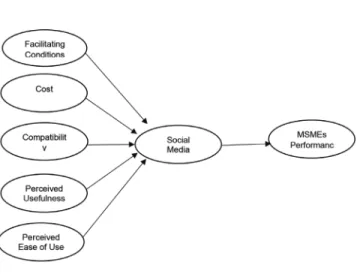
The results of a study on social media marketing or digital marketing, there are differences in results among researchers. Therefore this study will re-examine the influence of social media marketing on the performance of MSMEs, especially during the COVID-19 pandemic using a combination of models in research conducted by Chatterjee and Kumar Kar (2020), Cheung et al., (2020), and Tajvidi and Karami (2017). The conceptual model proposed in this study is described in Figure 1.
3. Research Method
This research method uses a quantitative approach and the analytical tool is Structural Equation Modeling (SEM) based on Partial Least Square. The sample in this research is the actors of micro-, small and medium-sized enterprises (MSMEs) in the Surakarta residency area. The sampling technique used purposive sampling. The data collection method uses an online questionnaire that is distributed through social media Facebook, Instagram, and Whatsapp. The number of samples in this study was 254 MSME actors who are active on social media Facebook, Instagram, and WhatsApp.
The independent variables in this study include facility conditions, cost, compatibility, perceived usefulness, and perceived ease of use. The mediation variable is social media marketing and the dependent variable is the performance of MSMEs. The source of the instruments used in this study was:
Based on these sources, the number of instruments used in this study amounted to 32 instruments.
4. Research Results
4.1. Evaluation of Constructs 4.1.1. Convergent Validity
Convergent validity test is used to test the relationship between the indicator and its latent variables or constructs.
This test is assessed based on the correlation between the item scores and the latent variable scores estimated by the PLS program. A construct is said to be valid if it has a loading factor greater than 0.70 (Ghozali, 2014). However, according to Latan and Ghozali (2012) a loading value of 0.5 to 0.6 is considered sufficient. After processing the data using WarpPLS, the results of the outer loading value can be seen in Table 2.
The results of data processing with PLS are shown in Table 2. It can be seen that most indicators in each variable in this study have a loading value greater than 0.70, except for the COM4 indicator, which has a loading value of less than 0.70, but still above 0.5. This shows that the variable indicator, which has a loading value greater than 0.70 has a high level of validity and a loading factor value of 0.5–0.7 has moderate validity so that it meets the convergent validity.
Table 1: Sources of Research Instruments
No Variable Source Number
of items
1 Facilitating condition
Hung and Lai, 2015;
Ng et al., 2019; Alhakimi dan Mahmoud, 2020;
Venkatesh, 2012; Aral et al., 2013; Zhang et al., 2019; and Charetejee et al., 2020.
6
2 Cost
Dwivedi et al, 2015; Zhang et al., 2019; Kim and Shin, 2015; Charetejee et al., 2020.
4
3 Compatibility
Yoon and Cho, 2016;
Dwivedi et al., 2015;
Misirlis and Vlachopoulou, 2018; Derham et al., 2011;
Charetejee et al., 2020.
4
4 Perceived usefulness
Abed et al., 2016; Alalwan et al., 2017; Chung et al., 2017; Elbanna et al., 2019;
Charetejee et al., 2020.
5
5 Perceived ease of use
Ware, 2018; Venkatesh et al., 2012; Hung and Lai, 2015; Rana et al., 2019; Chung et al., 2017;
Charetejee et al., 2020.
5
6 Social Media Marketing
Dwivedi et al., 2015;
Shareef et al., 2019; Abed et al., 2016, Charetejee et al., 2020.
3
7 SMEs
Performance
Sullivan and Koh, 2019;
Chung et al., 2017;
Elbanna et al., 2019;
Dwivedi et al., 2015;
Shareef et al., 2019;
Charetejee et al., 2020.
5 Figure 1: Conceptual Model
4.1.2. Discriminant Validity
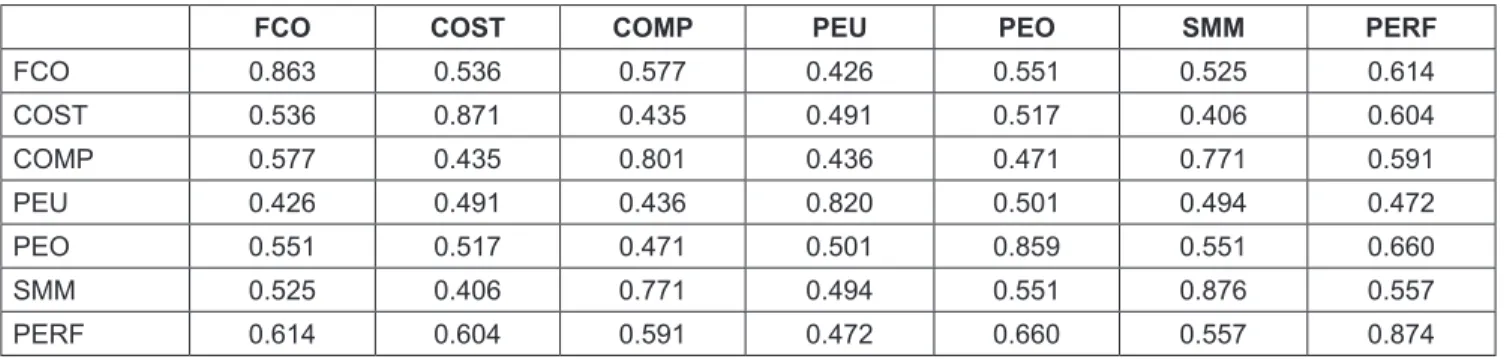
Discriminant validity test was used to test no correlation between latent variable constructs and other variables. The results of the discriminant validity test are in Table 3.
In Table 3, it is known that the square root value of AVE for each construct is greater than the correlation value so that the constructs in this research model can still be said to have good discriminant validity.
4.1.3. Reliability
Outer model can be measured by construct reliability, which is measured in two ways, which is seen from the composite reliability value and Cronbach’s alpha. The construct is declared reliable if the composite reliability value and Cronbach’s alpha value are greater than 0.70 (Latan &
Ghozali, 2012). Reliability test results can be seen in Table 4.
As the composite reliability and Cronbach’s alpha values of all constructs are above 0.70, it can be concluded that all constructs have good reliability in accordance with the required minimum value limits. The AVE value is also above the minimum threshold of 0.5 and ranges from 0.641 to 0.767 so that the model is well accepted and supports the validity results.
4.2. The Goodness of Fit Model
The structural model evaluation is done by looking at the goodness of fit model. The fit model is used to test the suitability of the overall research model. The results of the fit model are Average path coefficient (p < 0,05) Average R-squared (p < 0,05), Average adjusted R-squared (p < 0,05), Average block VIF (1,723), Average full collinearity VIF (2,265), Tenenhaus GoF (0,602), Sympson’s paradox ratio (1,000), R-squared contribution ratio (1,000), Statistical suppression ratio (1,000), and Nonlinear bivariate causality direction ratio (1,000). Based on the results of testing the goodness of fit model, it can be concluded that all tests are acceptable, which means that the model in this study is appropriate or the suitability of the model is very good.
Table 2: Outer Loading (Measurement Model) Indicators Variable Latin Kode Outer Loading
Facilitating condition
FCO1FCO2 FCO3FCO4 FCO5FCO6
0.794 0.879 0.900 0.864 0.876 0.860
Cost
COST1 COST2 COST3 COST4
0.705 0.935 0.906 0.918
Compatibility
COM1COM2 COM3COM4
0.805 0.883 0.807 0.697
Perceived of Use
PEU1PEU2 PEU3PEU4 PEU5
0.739 0.863 0.885 0.858 0.745
Perceived Ease of Use
PEO1PEO2 PEO3PEO4 PEO5
0.841 0.872 0.874 0.854 0.853 Social Media
Marketing
SMM1SMM2 SMM3
0.915 0.904 0.804
SMEs Performance
PERF1 PERF2 PERF3 PERF4 PERF5
0.898 0.921 0.761 0.897 0.885
Table 3: Discriminant Validity
FCO COST COMP PEU PEO SMM PERF
FCO 0.863 0.536 0.577 0.426 0.551 0.525 0.614
COST 0.536 0.871 0.435 0.491 0.517 0.406 0.604
COMP 0.577 0.435 0.801 0.436 0.471 0.771 0.591
PEU 0.426 0.491 0.436 0.820 0.501 0.494 0.472
PEO 0.551 0.517 0.471 0.501 0.859 0.551 0.660
SMM 0.525 0.406 0.771 0.494 0.551 0.876 0.557
PERF 0.614 0.604 0.591 0.472 0.660 0.557 0.874
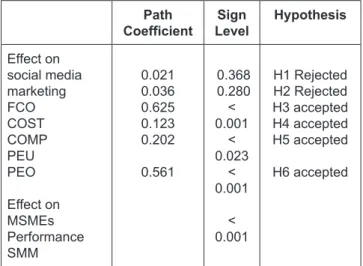
Table 5: Structural Equation Modeling Results Path
Coefficient Sign
Level Hypothesis Effect on
social media marketing FCOCOST COMPPEU PEO Effect on MSMEs Performance SMM
0.021 0.036 0.625 0.123 0.202 0.561
0.368 0.280
<
0.001
<
0.023
<
0.001
<
0.001
H1 Rejected H2 Rejected H3 accepted H4 accepted H5 accepted H6 accepted Table 4: Reliability Test
Variable Composite
Reliability Cronbach’s
Alpha AVE
FCOCOST COMPPEU PEOSMM PERF
0.946 0.926 0.876 0.911 0.933 0.908 0.942
0.931 0.890 0.810 0.877 0.911 0.846 0.922
0.744 0.759 0.641 0.673 0.737 0.767 0.764
4.3. Structural model results 4.3.1. The coefficient of determination
The coefficient of determination with the social media marketing variable as the dependent variable is 68.1 percent and the coefficient of determination with the dependent variable on the performance of MSMEs is 31.5 percent because the value of the coefficient of determination on the main dependent variable (MSME performance) is more than 10 percent indicating a good value and predictive on the strength of the PLS model (Falk and Miller, 1992).
4.3.2. Structural path coefficient
The results of the structural analysis of equation modeling with PLS can be seen in Table 5.
SEM analysis results show that the effect of facility conditions (FCO), cost (COST) has no significant effect on social media marketing, while for compatibility (COMP), perceived use (PEU) and perceived ease-of- use (PEO) have a positive and significant effect on social media marketing. The results of the analysis also show that social media marketing has a positive and significant effect on the performance of MSMEs.
5. Discussion
The existence of the COVID-19 pandemic has a huge impact on the performance of MSMEs in Indonesia. This is due to social and physical restrictions, so that community activities are very limited, this causes many businesses or companies to physically close down. One alternative for running business activities is to use online media, one of which is by using social media in marketing. The use of social media marketing for MSMEs is new, so many things need to be considered. Several factors that influence the use of social media marketing include conditions of facilities, costs, compatibility, technology related to using, and ease-of-use (Chatterjee & Kumar Kar, 2020).
The use of social media for marketing UMKM products requires supporting facilities and infrastructure, so it requires good investment and expertise so that the use of social media can be maximized for marketing. The results of this study indicate that the condition of the facility does not have a significant effect on social media marketing. This is because MSMEs do not have adequate infrastructure, lack of maximum means for promotion on social media, lack of investment in social media, do not have expert resources in social media, employees are not given training on social media, and lack of in house facilities training owned by MSMEs to study social media. These results support research conducted by Venkatesh (2012) and Chatterjee and Kumar Kar (2020).
The use of social media for marketing costs a lot, especially for paid advertisements. Costs are also used to improve the human resource capabilities of the company through training and infrastructure development. The results of this study indicate that costs do not have a significant effect on social media marketing. This is because SMEs have not fully used paid advertising media to promote their products. Most of the UMKM players still use unpaid media in promoting their products, so their target and target consumers are also very limited. Also, during the COVID-19 pandemic, the ability of MSMEs to spend the budget for advertising is still low.
These results do not support research conducted by Kim and Shin (2015), Charttejee and Kumar Kar (2020), Chong and Chan (2012), and Zhang et al. (2019).
Company compatibility greatly affects the use of social media as a marketing tool because not all products or types of companies, especially MSMEs, need social media as a means of promotion. The use of social media for promotion for MSMEs is adjusted to the type of product.
sales turnover. The results of this study indicate that the use of social media has a positive and significant effect on the performance of MSMEs. The positive influence shows that the better the use of social media for MSME business activities, the more MSME performance will improve such as sales, customer relationships, productivity, and creativity.
Social media for business activities are used by MSME players to advertise their products, connect with customers, compete with competitors, and other marketing techniques.
The results of this study support research conducted by Rana et al. (2019), Elbanna et al. (2019), Sullivan and Koh (2019), Fatima and Bilal (2019), and Chatterjee and Kumar Kar (2020).
6. Conclusions and Recommendations
In this time of COVID-19 pandemic, the ability to use social media for business is necessary, because all physical and social activities are limited. To have the ability to use social media for business requires supporting facilities such as infrastructure, costs, compatibility, knowledge of information technology, and the convenience of information technology for business. The results of this study found that the use of social media was significantly influenced by compatibility, perceptions of the use of information technology, and ease-of-use of information technology.
Compatibility shows the suitability of a product or business with social media users, meaning that the more compatible the product or business is with the use of social media to promote its product or business, the more social media use will be for MSME business needs. The use of information technology requires good knowledge and understanding to be useful, meaning that if the use of information technology is perceived as increasing added value and productivity, it will further increase the use of social media for its promotional media. Information technology also requires ease of operation, so that it does not make it difficult for users. The easier information technology is perceived to operate, the more it will encourage users to take advantage of this information technology, in this case, the use of social media as a promotional and sales tool. The results of this study indicate that the use of social media for marketing has a positive effect on the performance of MSMEs, especially in increasing sales, customer relationships, productivity, and creativity. This means that the better at managing social media for marketing, the better the performance of MSMEs will be.
Based on the results of this study, it can be recommended that the use of social media is a very effective way of improving the performance of MSMEs during the COVID-19 pandemic in Indonesia. Therefore it is necessary to increase knowledge in the use of social media as a medium for business. This study does not include demographic and The results of this study indicate that compatibility has a
positive and significant effect on social media marketing.
The positive influence shows that the more compatible the type of business or product will increase the use of social media marketing for MSMEs during the COVID-19 pandemic. This also shows that most MSME products are compatible with social media, MSME players have regularly used social media, MSME owners provide full support for the use of social media and businesses, and MSMEs are very compatible using social media as their marketing media. The results of this study support research conducted by Brown and Russell (2007), Wang and Kim (2017), Yoon and Cho (2016), and Chatterjee and Kumar Kar (2020).
The variety of social media with the various facilities offered and its limitations make MSME players able to choose the social media needed according to their ability to use social media, especially as a medium to market their products during this COVID-19 pandemic. The results of the analysis in this study indicate that the perception of use has a positive effect on the use of social media for marketing. The positive influence shows that the greater the benefits of using social media for business, the greater the use of social media.
Respondents also considered that the use of social media has added value as a marketing tool and is considered capable of increasing productivity. Social media is also perceived to help better manage the company, and help increase customer satisfaction. The results of this study support research conducted by Park, Kim, and Kwon (2016), Kim and Chiu (2019), and Chatterjee and Kumar Kar (2020).
The effectiveness of using social media as a marketing tool is determined by the level of ease-of-use. MSME actors who have limited knowledge of information technology must be able to master this technology to optimize technology or its features, especially on social media. The results of the analysis in this study indicate that the perceived ease-of-use has a positive effect on the use of social media marketing.
This shows that the easier social media technology is to use, the more MSMEs use social media as a marketing tool. Some indicators of ease-of-use of social media include easy to learn, easy to identify new consumers, and easy to identify consumer demand. Also, the information presented about customers is easy to know and easy to advertise on the social media platform. The results of this study support research conducted by Henderson and Divett (2003), Park (2009), Kuo and Yen (2009), Ware (2018), and Chatterjee and Kumar Kar (2020).
During this time of COVID-19, social and physical activities are limited to prevent more widespread transmission.
This has an impact on the decline in the sales turnover of MSME players in Indonesia. One way to maintain sales is to sell online, one of which is by using social media. The use of social media as a marketing tool is expected to increase
cultural variables as moderating the use of social media to improve its performance, therefore for future research, it is advisable to include demographic and cultural variables to improve the results of this study.
References
Abed, S. S., Dwivedi, Y. K., & Williams, M. D. (2016). Social commerce as a business tool in Saudi Arabia’s SMEs.
International Journal of Indian Culture and Business Management, 13(1), 1–19. https://doi.org/10.1504/
IJICBM.2016.077634
Alalwan, A. A., Rana, N. P., Dwivedi, Y. K., & Algharabat, R. S.
(2017). Social media in marketing: A review and analysis of the existing literature. Telematics and Informatics, 34(7), 1177–
1190. https://doi.org/10.1016/j.tele.2017.05.008
Alhakimi, W., & Mahmoud, M. (2020). The impact of market orientation on innovativeness: Evidence from Yemeni SMEs.
Asia Pacific Journal of Innovation and Entrepreneurship.
https://doi.org/10.1108/APJIE-08-2019-0060.
Aral, S., Dellarocas, C., & Godes, D. (2013). Introduction to the special issue —Social media and business transformation: A framework for research. Information Systems Research, 24(1), 3–13. https://doi.org/10.1287/isre.1120.0470.
Brown, R., & Rocha, A. (2020). Entrepreneurial uncertainty during the Covid-19 crisis: Mapping the temporal dynamics of entrepreneurial finance. Journal of Business Venturing Insights, 14(May), e00174. https://doi.org/10.1016/j.jbvi.2020.e00174 Chatterjee, S., & Kumar Kar, A. (2020). Why do small and
medium enterprises use social media marketing and what is the impact: Empirical insights from India. International Journal of Information Management, 53(December 2019), 102103.
https://doi.org/10.1016/j.ijinfomgt.2020.102103
Cheung, M. L., Pires, G. D., Rosenberger, P. J., Leung, W.
K. S., & Ting, H. (2020). Investigating the role of social media marketing on value co-creation and engagement:
An empirical study in China and Hong Kong. Australasian Marketing Journal, (xxxx). https://doi.org/10.1016/j.
ausmj.2020.03.006
Chung, A. Q. H., Andreev, P., Benyoucef, M., Duane, A., & O’Reilly, P. (2017). Managing an organization’s social media presence:
An empirical stages of growth model. International Journal of Information Management, 37(1), 1405–1417. https://doi.org/
10.1016/j.ijinfomgt.2016.10.003.
Crick, J. M., & Crick, D. (2020). Coopetition and COVID-19:
Collaborative business-to-business marketing strategies in a pandemic crisis. Industrial Marketing Management, 88(May), 206–213. https://doi.org/10.1016/j.indmarman.2020.05.016 De Pelsmacker, P., van Tilburg, S., & Holthof, C. (2018). Digital
marketing strategies, online reviews and hotel performance.
International Journal of Hospitality Management, 72(January), 47–55. https://doi.org/10.1016/j.ijhm.2018.01.003
Derham, R., Cragg, P., & Morrish, S. (2011). Creating value:
An SME and social media. PACIS 2011 - 15th Pacific Asia Conference on Information Systems: Quality Research in Pacific.
Duffett, R. G. (2015). Facebook advertising’s influence on intention-to-purchase and purchase amongst millennials.
Internet Research, 25(4), 498–526. https://doi.org/10.1108/
IntR-01-2014-0020
Dwivedi, Y. K., Kapoor, K. K., & Chen, H. (2015). Social media marketing and advertising. The Marketing Review, 15(3), 289–
309 https://doi.org/ 10.1362146934715X14441363377999 Elbanna, A., Bunker, D., Levine, L., & Sleigh, A. (2019).
Emergency management in the changing world of social media:
Framing the research agenda with the stakeholders through engaged scholarship. International Journal of Information Management, 47(January), 112–120. https://doi.org/10.1016/j.
ijinfomgt.2019.01.011
Fatima, T., & Bilal, A. (2019). Achieving SME performance through individual entrepreneurial orientation: An active social networking perspective. Journal of Entrepreneurship in Emerging Economies. https://doi.org/10.1108/JEEE-03-2019- 0037 In Press.
Hung, Y. H., & Lai, H. Y. (2015). Effects of facebook like and conflicting aggregate rating and customer comment on purchase intentions. International Conference on Universal Access in Human-Computer Interaction, 193–200. Los Angeles, CA: Springer International. Information Dimensions, Communications of the Association for Information Systems, 1–23. https://doi.org/10.1007/978-3-319-20678-3_19 31(5) Khoa, B. T. (2020). The antecedents of relationship marketing
and customer loyalty: A case of the designed fashion product.
Journal of Asian Finance, Economics and Business, 7(2), 195–
204. https://doi.org/10.13106/jafeb.2020.vol7.no2.195
Kim, K. J., & Shin, D. H. (2015). An acceptance model for smart watches: implications for the adoption of future wearable technology. Internet Research, 25(4), 527–541. https://doi.
org/10.1108/IntR-05-2014-0126.
Kuckertz, A., Brändle, L., Gaudig, A., Hinderer, S., Morales Reyes, C. A., Prochotta, A., … Berger, E. S. C. (2020). Startups in times of crisis – A rapid response to the COVID-19 pandemic.
Journal of Business Venturing Insights, 13(April). https://doi.
org/10.1016/j.jbvi.2020.e00169
Misirlis, N., & Vlachopoulou, M. (2018). Social media metrics and analytics in marketing – S3M: A mapping literature review.
International Journal of Information Management, 38, 270–
276. https://doi.org/10.1016/j.ijinfomgt.2017.10.005.
Ng, H., Kee, D., & Ramayah, T. (2019). Examining the mediating role of innovativeness in the link between core competencies and SME performance. Journal of Small Business and Enterprise Development, 27(1), 103–129. https://doi.org/
10.1108/JSBED-12-2018-0379
Patma, T. S., Wardana, L. W., Wibowo, A., & Narmaditya, B.
S. (2020). The Shifting of Business Activities during the COVID-19 Pandemic: Does Social Media Marketing Matter?
The Journal of Asian Finance, Economics and Business, 7(12), 283–292. https://doi.org/10.13106/jafeb.2020.vol7.no12.283 Puspaningrum, A. (2020). Social Media Marketing and Brand
Loyalty: The Role of Brand Trust. Journal of Asian Finance, Economics and Business, 7(12), 951–958. https://doi.
org/10.13106/jafeb.2020.vol7.no12.951
Rana, N. P., Barnard, D. J., Baabdullah, A. M. A., Rees, D., &
Roderick, S. (2019). Exploring barriers of m-commerce adoption in SMEs in the UK: Developing a framework using ISM. International Journal of Information Management, 44(October 2018), 141–153. https://doi.org/10.1016/j.
ijinfomgt.2018.10.009
Shareef, M. A., Mukerji, B., Dwivedi, Y. K., Rana, N. P., &
Islam, R. (2019). Social media marketing: Comparative effect of advertisement sources. Journal of Retailing and Consumer Services, 46, 58–69. https://doi.org/10.1016/j.
jretconser.2017.11.001.
Sullivan, Y. W., & Koh, C. E. (2019). Social media enablers and inhibitors: Understanding their relationships in a social networking site context. International Journal of Information Management, 49(October 2017), 170–189. https://doi.
org/10.1016/j.ijinfomgt.2019.03.014
Tajvidi, R., & Karami, A. (2017). The effect of social media on firm performance. Computers in Human Behavior, 1–10. https://doi.
org/10.1016/j.chb.2017.09.026
Venkatesh, V., Thong, J. Y., & Xu, X. (2012). Consumer acceptance and use of information technology: Extending the unified theory of acceptance and use of technology. MIS Quarterly, 36(1), 157–178. https://doi.org/10.2307/41410412.
Wang, Y., Hong, A., Li, X., & Gao, J. (2020). Marketing innovations during a global crisis: A study of China firms’ response to COVID-19. Journal of Business Research, 116(May), 214–
220. https://doi.org/10.1016/j.jbusres.2020.05.029
Wang, Z., & Kim, H. G. (2017). Can Social Media Marketing Improve Customer Relationship Capabilities and Firm Performance? Dynamic Capability Perspective. Journal of Interactive Marketing, 39, 15–26. https://doi.org/10.1016/j.
intmar.2017.02.004
Ware, J. (2018). Wearable Technologies and Journalism Ethics:
Students’ Perceptions of Google Glass. Teaching Journalism
& Mass Communication, 8(1), 17–24. Retrieved from http://
www.aejmc.us/spig/journal%0Ahttps://search.proquest.com/
docview/2150381639?accountid=142908
Yoon, S. Bin, & Cho, E. (2016). Convergence adoption model (CAM) in the context of a smart car service. Computers in Human Behavior, 60, 500–507. https://doi.org/10.1016/j.
chb.2016.02.082
Zhang, C., Fan, C., Yao, W., Hu, X., & Mostafavi, A. (2019).
Social media for intelligent public information and warning in disasters: An interdisciplinary review. International Journal of Information Management, 49, 190–207. https://doi.
org/10.1016/j. ijinfomgt.2019.04.004.