Vol. 23, No. 3, pp. 287-293, May 31, 2017, ISSN 1229-3431(Print) / ISSN 2287-3341(Online) https://doi.org/10.7837/kosomes.2017.23.3.287
1
1. Introduction
Since 1990, prior to initiating diplomatic relations between Korea and China, the Korea-China car ferry routes were installed and have contributed significantly to human and material exchanges between the two nations. Since the official establishment of diplomatic in 1992, the two governments have consistently managed the Korean and Chinese car ferry routes since 1993, following the ratification of maritime executed every year in accordance with the principles of reciprocity and promotion of friendly relations between the two nations. In recent years, however, competition has intensified due to the declining cargo traffic growth and the oversupply of vessels, thereby operating costs and profitability. Furthermore, considerable influence on the market environment of the Korea-China car ferry routes is expected to in the future as the construction of super large ports and container ships in the main arteries of Northeast Asia is in place, and as the medium and large sized container ships will be entering offshore routes.
Since 1990, the Korean and Chinese car ferry routes have largely operating in a very small scale, despite tremendous changes in the
First Author : [email protected], 051-410-5085 Corresponding Author : [email protected], 051-410-5089
conditions of the ports, economic conditions, and vessel safety standards. The two governments intend to apply stronger vessel safety management standards against Korean and Chinese vessels than global standards prevailing in most other countries, including developed countries, since the Sewol accident of April 2014.
To this end, the Korean and Chinese car ferry lines been required to be registered with the Korean Register of Shipping (KR) or the Chinese Classification Society (CCS).For more than 20 years, the vessels must jointly enter the shipyards of both countries, and a vessel safety management organization was established within the vessel companies to ensure that corporate management and vessel management are in unison. However, analytical researches such as the comparison of the causes of global marine accidents with those of the Korean and Chinese car ferry accidents are not yet available, and there are no guidelines on alternative safety management and crew. A review of previous studies on car ferry safety management suggests that the study and search for rescue capacity (Chang, 2009) and the analysis of changes in safety awareness after ferry accidents (Hwang, 2014) are available in Korea.
The purpose of this paper is to secure the safety of car ferry passengers and the safety of car ferry vessels by investigating and the safety management system of vessels in Korea and China. this
A Study on the Analysis of the Safety Management System of Korea-China Car Ferries
Young-Soo Park
*Hea-Dong Jeon
**Yong-Sik Oh
***Sang-Won Park
***** Division of Maritime Transportation Science, Korea Maritime and Ocean University, Busan 49112, Korea
** Department of Ship Operation, Korea Maritime and Ocean University, Busan 49112, Korea
*** Division of International Trade and Economics, Korea Maritime and Ocean University, Busan 49112, Korea
**** Graduate School of Korea Maritime and Ocean University, Busan 49112, Korea
Abstract : The purpose of this study is to keep the safety of the car ferry passengers and vessels by investigating and analyzing vessel safety management systems in Korea and China. To this end, we investigated Korea-China car ferries and the current status and causes of global marine accidents corresponding to the sizes of the vessels from Korea and China. Furthermore, we investigated car ferries’ crew management and safety management. As a result of the analysis of the ferry accident, the causes of human error and ship’s age were the greatest, but the ship’s companies showed a negative stance regarding the age restriction. It seems that it is necessary to utilize the near-miss accident reporting system and differentiate the management of ship’s aging. Also, it was analyzed that both the ship company and the crew of the ship need to strengthen their awareness of safety management.
Key Words : Korea-China car ferries, Vessel safety management, Marine accident, Crew management, Safety management
study investigates and car ferries operating between Korea and China and the current status and causes of global marine accidents corresponding to the sizes of the vessels from Korea and China.
Furthermore, we intend to investigate and car crew management and safety management and discover problems.
2. Analysis of the Status of Car Ferries in Korea and China
2.1 Analysis of the Size of Korean and Chinese Car Ferries Table 1 illustrates the status of car ferry lines, operating between Korea and China. 15 companies are currently operating 16 vessels, travelling between Korea and China. There are 10 vessels operated by 9 companies, docking in Incheon, whereas 5 vessels docking in Pyeongtaek are operated by 5 companies, and in Gunsan, 1 vessel is operated by 1 company.
* Replaced by HUADONG PEARL VIII in 2016.
** Replaced by ORIENTAL PEARL VIII in 2016.
The size and age of the vessels in Korea and China were compared with those of Japanese and British, operating mid to
long distances, which are similar in size and sailing time. Fig. 1 represents the lengths of the Korean, Japanese, and the British car ferries, with most ranging 150-200 meters in length. Fig. 2 indicates the age of the Korean, Japanese, and the British car ferries. The age of the British car ferries is higher than that of the Korean, and the Japanese mid to long distance car ferries are lower than the Korean.
Fig. 1. The length of car ferries of Korea, Japan and UK.
Fig. 2. The age of car ferries of Korea, Japan and UK.
2.2 Analysis of the Crew Status of Korean and Chinese Car Ferries
Fig. 3 shows the status of nationality of vessel crews in the Korean and Chinese car ferries. Observing the crew onboard the Korean and Chinese car ferries, it was discovered that the Chinese crew accounted for 81.77 % of the total of 834 crew members.
The ratio of Korean crew is different for each of the Korean and Chinese car ferries, and there are 3 vessels with only 1 or 2
(As of 2014)
Ship’s name Management Route
1 ARAFURA LILY YINGKOU FERRY Inchon-Yingkou 2 XIN YU JIN
XIANG QININ FERRY Inchon-
Qinhuangdao
3 XIANG XUE LAN HANJOONG
FERRY Inchon-Yantai
4 BI RYONG DAIN FERRY Inchon-Dalian
5 HUADONG
PEARL Ⅵ* HUADONG FERRY Inchon-Shidao
6 ORIENTAL
PEARL Ⅵ DANGDONG
FERRY Inchon-Dandong
7 NEW GOLDEN
BRIDGE Ⅱ WEIDONG FERRY Inchon-Weihai
8 NEW GOLDEN
BRIDGE Ⅴ WEIDONG FERRY Inchon-Qingdao
9 TIAN REN JINCHON FERRY Inchon-Tianjin
10 ZIYULAN LYGFERRY Inchon-
Lianyungang 11 YONG XIA DALONG FERRY Pyungtaek-Longyan
12 CK-STAR** LYGFERRY Pyungtaek-
Lianyungang 13 GRAND PEACE JIAODONG FERRY Pyungtaek-Weihai 14 RI ZHAO ORIENT RIZHAO FERRY Pyungtaek-Rizhao 15 STENA EGERIA YANTAI FERRY Pyungtaek-Yantai
16 SHIDAO SHIDAO FERRY Gunsan-Shidao
Table 1. Present condition of car ferries between Korea and China
Korean crew members on-board, and a total of 4 vessels have all Chinese crew members onboard. As a whole, there are 11 vessels in which the ratio of Korean crews is 1/3 of the total, accounting for 68.75 % of the total vessels. This analysis indicated that the ratio of Korean crew members is far much smaller than that of the Chinese crew.
Fig. 3. Nationality of crews in car ferries.
2.3 Investigation of Marine Accidents of the Korean and Chinese Car Ferries
(1) Analysis of the Status of Marine Accidents in Korean and Chinese Car Ferries
Table 2 illustrates the marine accidents of Korean and Chinese car ferriess during the last 10 years (KMST, 2015). Out of the total of 8 marine accidents, there were 5 collisions (62.5 %) and one case of fire, grounding, and operational obstruction. Analyzing of marine accidents by age demonstrated also that 4 vessels were older than 25 years (50 %), 2 vessels were 20-25 years old, 2 vessels were 15-20 years old, and none under 15 years.
Date Name Type Age
(year) G/T Length
(m) 2005.01 Morning Glory Collision 25 16,340 150.5
2006.06 Sewon Collision 34 5,688 119.91
2007.10 Dalong Impediment
of sailing 25 8,091 138.46 2008.05 New Golden
Bridge Collision 19 25,151 178.14
2010.01 HUADONG
PEARL Aground 22 19,534 160.58
2011.01 Oriental Pearl II Collision 25 10,624 126.23
2012.06 CK Star Fire 24 8,577 150.1
2012.01 Grand Peace Collision 22 24,112 177.71 Table 2. Accident of Korea-China car ferries for recent 10 years
Fig. 4 illustrates the causes of marine accidents of the Korean and Chinese car ferries during the past decade (KMST, 2015).
Having Analysed the causes of the marine accidents, we established that four cases were due to violation of the navigation law, while two cases of navigational negligence and two cases of vessel facility, and equipment defects accounted for such a high percentage of accidents primarily caused by human error and aging vessel.
Fig. 4. Cause of car ferries (Korea-China) accident.
(2) Analysis of Marine Accidents of the Overseas Passenger Vessels
Table 3 illustrates the number of accidents or passenger vessel sinking accidents occurred by large-scale cruise ships that have suffered a large number of casualties during car ferry accidents and passenger vessel accidents since 1990 (Yahoo Japan, 2015). There were 9 cases of capsizing (39.1 %), 5 cases of collision, and 2 cases of fire and sinking. A high number of capsizing happened because the accident vessels ultimately sank and capsized following collisions and fires, among others.
Among the marine accident vessels, those aged 20-25 years were 6, accounting for the largest number of vessels (27.2 %), followed by 4 vessels with the age of 40 years or older, and 3 vessels between 35 and 40 years of age. The analysis yielded that 15 vessels were relatively old (more than 20 years old), accounting for 68.1 % of all marine accidents.
Study of the marine accidents in each event with a vessel is depicted in Fig. 5, the most frequent causes were passenger and cargo loading failures, mainly caused by overloading passengers or cargoes. Nine of them were caused as such, 8 cases due to inclement weather, and 6 cases were caused by vessel facility and equipment defects, with human errors contributing to the accidents.
Of these, “Scandinavian Star” is the case in which many passengers died of language problems. Portuguese crews at the
time did not understand English and Norwegian when messages were broadcasted to abandon ship, nor were they able to communicate with passengers (WIKIPEDIA, 2017).
Date Name Type Year GRT Length(m) No. of
Death 1990.04 MS Scandinavian
Star Fire 19 10,513 144.24 158
1993.10 Seohae Ferry Capsizing 3 110 33.9 292 1994.09 MS Estonia Sinking 14 15,566 157.2 852 1985.10 MS Achille Lauro Hijacking 38 23,629 196 1 1998.09 MV Princess of the Orient Collision 24 13,935 195.1 150
1999.05 Sun Vista Fire 38 27,888 213.65 -
2000.09 MS Express Samina Collision 34 4,455 115 82
2001.02 Ehime Maru Collision - 499 58 9
2002.09 MV Le Joola Capsizing 12 2,087 79.5 1,863 2006.02 MS Al-Salam
Boccaccio 98 Flooding 37 11,799 130.99 1,020 2006.09 Stella Polaris Flooding 79 5,105 127 - 2008.06 MS Sea Diamond Capsizing 24 23,824 193 2 2007.04 MV Princess of
the Stars Grounding 22 22,412 142.95 773
2009.11 Ariake Capsizing 14 7,910 - -
2011.07 Bulgaria Sinking 56 1,003 80.2 122
2011.09 Spice Islander I Capsizing 44 836 60 1,573 2012.01 Costa Concordia Grounding 7 111,147 290.2 32 2012.02 Raboul Queen Capsizing 29 259 47 321 2012.03 MV Shariatpur I Capsizing 21 - - 147
2012.04 Unknown Capsizing - - - more
100
2012.07 MV Skagit - 23 - 34.1 more
100
2012.10 Sea Smooth Collision 9 274 27 92
2013.08 MV St. Thomas
Aquinas Collision 41 11,405 138.6 55 2014.04 MV Sewol Capsizing 20 6,835 145 295 Table 3. Serious accidents of world ferries after 1990 years
Fig. 5. Cause of accidents of ferries throughout the world.
The major causes of marine accidents were human errors (poor loading, neglected duties, improper manoeuvrability), and heavy weather, equipment defects, and human errors to some degrees combined to cause accidents. However, it would be possible to reduce large-scale accidents, if measures were taken against human errors and aging vessels, which gave rises to equipment defects.
3. Analysis of Safety Management System of the Korean and Chinese Car Ferries
3.1 Analysis of Safety Management System of the Korean and Chinese Car Ferries
In order to analyze the safety management system of the Korean and Chinese car ferries, we investigated 13 Korean and Chinese car ferry companies on the safety management items.
(1) Analysis of Safety Management System of the Korean and Chinese Car Ferries
Table 4 illustrates the results of the surveys performed on the companies’ vessel safety management.
Type of Ship Safety
Management Item No.
of Company
Management of Safe Route
Using original route 6 Re-setting by weather
forecast 3
Periodic update 8
Check of Ship Stability after loading
Check draft 9
Loading computer 9
Experience, by eye 1
ETC. 1
Safety of Hull, Engine and Safety Appliance
Periodic inspection 13 Special inspection 3
by ship crew 1
Ship maintenance problems
Lack of time 4
Lack of supporting 1
ETC 1
ISM Captain’s priorities and
responsibilities under ISM 13
Contingency plan YES 13
Near miss accident NO 9
YES 3
Emergency procedure Em’cy contact list 9
Company manual 10
How to use accident/near-miss report
Circulation 10
Training for crews 4
Additional event 2
Table 4. Survey result of safety management system
The results of the survey indicated that many companies modified settings for safety routes regularly, but the safety route resetting by weather was not high. A number of vessels were proceeding through the vessel's draft or loading computer to secure the safety of the vessel after cargoes are loaded, but there seemed to be companies that did not practice the same.
Companies inspected regularly the vessels for hull and safety equipments, and there were even some companies that executed special inspections. However, there were apparently some companies that lacked substantial management and repair time. In the ISM, all companies had captains’ priority rights and responsibilities defined, further to emergency response procedures.
Accidents and near-miss accidents took place in 3 companies, and most companies were responsive via their emergency contacts or self-guided manuals. It was also discovered that the accidents and near-miss accidents were reported via circulation, training, or special events.
(2) Analysis of Age Management of the Korean and Chinese Car Ferries
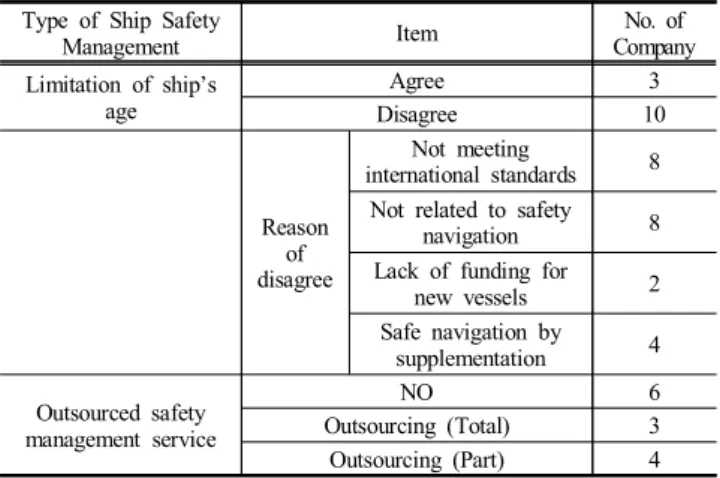
Many companies were against the restrictions on the operating age of vessels, contesting that there was no direct relationship between the vessel’s age and navigational safety. They were followed by the willingness to improve and the lack of funds. In this regard, they responded that problems might be resolved by strengthening PMS or via practical regulations and interest holding.
As for the vessels’ safety management, 6 companies undertake the management on their own, while 3 companies fully outsourced and 4 partially outsourcing management. These responses indicated that more than half of the safety management business are consigned, and Table 5 illustrates the results of surveying the company’s vessel age management.
Type of Ship Safety
Management Item No. of
Company Limitation of ship’s
age
Agree 3
Disagree 10
Reason of disagree
Not meeting
international standards 8 Not related to safety
navigation 8
Lack of funding for
new vessels 2
Safe navigation by supplementation 4 Outsourced safety
management service
NO 6
Outsourcing (Total) 3
Outsourcing (Part) 4
Table 5. Survey result of ship’s age management system
3.2 Analysis of crew Management of the Korean and Chinese Car Ferry
To analyze the crew management of the Korean and Chinese car ferries, we researched 13 safety management items of the Korean and Chinese car ferry companies. Table 6 illustrates the results of surveying the companies’ vessel safety management
Arrangement and operation of the crew were conducted relatively well by each company (76.9 % of the responding companies). In the case of Korean crew, there were 2 self-sourced companies and 8 outsourced companies. However, it was discovered that almost all 12 companies outsourced Chinese crews through outside foreign agencies. As for the problems related to the crew management, 11 of the respondent companies noted that the problem of supplying and receiving the crew is most difficult, 1 company noted training problem, and 2 companies noted crew management system. As for legal training, trained crews are hired or managed through consignment companies. In the case of certificates of various kinds of legal education, it is often the case that crews manage directly their own education. Self-training was conducted by most companies, but as for welfare support, most were not satisfied.
Type of Crew
Management Item No. of
Company Crew arrangement
and management
proper 10
improper 1
difficult 2
Crew manning Company-self 2
Outsourcing 8
Crew management issues
Crew supply 11
Education 1
Crew management
system 2
Compulsory training
Crew 1
Company 5
Trained crew
recruitment 3
Agency
management 8
Cert. management Company 6
Crew 9
Self-education training
YES 8
NO 3
Emergency drill difficult 1
follow the plan 12 Satisfaction of the
welfare support
Very satisfied 1
Satisfied 2
So so 9
Table 6. Survey result of crew management system
3.3 Proposal for the Safety of Korean and Chinese Car Ferries
(1) Emergency evacuation capability on-board
Emergency response training on vessels should be conducted regularly and practically for passengers. It is necessary to improve the emergency response capability of the crew and cabin crew.
Furthermore, for the different nationalities of the crew members, it seems necessary to tackle the problem of language barriers between crew and cabin crew, crew and passengers, and cabin crew and passengers.
It is also necessary to thoroughly install and maintain the safety related equipments on the vessel, and to evacuate the passengers quickly. To this end, we recommend that a passenger evacuation facility shall be installed for new vessels as well.
(2) Need for Safety Management and Training of Crew on Vessels
Most Korean and Chinese car ferries have Korean and Chinese crew on-board, but some vessels have crew members entirely comprised of the Chinese. This may cause a lack of emergency response by Korean passengers, and it seems that the emergency response capability is insufficient due to the ratio of crew members.
Such a crew management problem may be overcome by thoroughly training crew members. However, the recruitment of crew members under the concept of crew management does not warrant crew training, and implementation of systematic crew training may be difficult.
(3) Need for the Strengthened Safety Management Awareness of companies
Currently, the system for reporting on near-miss accidents of car ferries in Korea and China is poor. Therefore, there is a need to improve the identification of underlying risk factors in the Korean and Chinese routes and vessels.
It is necessary to strengthen the safety awareness through on-site visits and inspections by the managers including chief executive officers, and undertake preventive activities through identification of the risk factors.
Furthermore, such events as emergency escape routes for passengers to participate in safety training should be considered, along with authentication of the identities of crews on-board.
(4) Safety Management Problems Caused by Aging Vessels
The structural safety of passenger vessels has increasingly become a serious problem due to aging. Aging vessels are not necessarily unsafe, but they will be subjected to additional management concerns. As the vessels are operated for a long time, they may face corrosion in each part of the hull, thereby resulting in the declining thickness of the steel sheet, further resulting in structural safety problems (RIOMSE, 2006). This is caused due to the cyclical loading history of the vessels, which increases the cumulative fatigue damage on each part of the hull, ultimately yielding fatigue cracks and structural safety problems. Moreover, the final strength and buckling strength of the vessels’ steel plate may decline, affecting the structural safety of the vessels.
The problem of structural safety of passenger vessels caused by aging requires close attention, and the additional manpower of the companies to undertake safety management for strengthening inspection is needed. If needed, vessels would require differentiated management as per their aging process. In some cases, the companies will need to plan and execute measures to manage and replace vessels older than 20 years.
4. Conclusion
Since the Sewol accident of April 2014, the Korean and Chinese car ferry lines have established a vessel safety management organization within the companies, for corporate management and vessel management to be in unison. However, analytical researches such as the comparison of the causes of marine accidents of the Korean and Chinese car ferries with those of countries that are demonstrating similar causes, are not yet available, and there are no guidelines on alternative safety management systems and composition of crew members within companies.
The purpose of this study was to investigate and analyze the safety management system in the Korean and Chinese car ferries, and to ensure the safety of passengers and vessels alike. This study investigated and analyzed the current status and causes of marine accidents in the car ferries, as well those of the crew management on the vessels. The results of this study are as follows.
(1) Analyzing the marine accidents in Korea and China during the last 10 years, a total of 8 marine accidents took place, and human errors and aging vessels accounted for such a high percentage of the causes. Having analysed 24 accidents, involving large-scale cruise ships or sinking of passenger vessels, we
discovered that they were mostly caused by human errors, alongside the aging vessel problem. We believe that if measures are taken to tackle the human errors and equipment defects, arising out of the aging vessels, large-scale accidents may be prevented or reduced.
(2) The Korean and Chinese car ferry companies use systems of reporting accidents and near-miss accidents, but these systems are not fully activated and require active utilization. Furthermore, surveys indicated that there were many negative responses to the vessel’s age restriction system, however, differentiated management for aging vessels is needed.
(3) For the safety management of the Korean and Chinese car ferry companies, the crew’s safety management and training are necessary, further to the ability to respond to emergency evacuation. The companies must accordingly strengthen the awareness of safety management, and countermeasures against safety management problems caused by aging vessels are needed.
In this study, we investigated and analyzed the safety management status of the Korean and Chinese car ferry companies, without proposing detailed guidelines. In the future, based on the analyzed results, the companies should manage the vessels more safely through developing quantitative safety index, enabling the confirmation of the safety level of the Korean and Chinese car ferries, and passengers should be allowed to board with greater safety.
Acknowledgement
This research was a part of the project titled ‘A study on safety management and middle and long-term development strategy of Korea-China Car Ferries’, funded by the Yanghyun foundation, Korea.
References
[1] Chang, I. S.(2009), A Study on the Effective Safety Management Measures for the Prevention of Marine Accidents, Journal of the Korean Society of Marine Environment & Safety, Vol. 15, No. 1, pp. 33-39.
[2] Hwang, K. I.(2014), Change of safety consciousness of passengers on board ship after the Sewol ferry incident,
Journal of the korean Society of Marine Engineering, Vol.
38, No. 9, pp. 1156-1162.
[3] KMST(2015), Korean Maritime Safety Tribunal, Statistics of accidents near Korea port, http://www. kmst.go.kr/statistics/
(Accessed : Mar. 2015).
[4] RIOMSE(2006) A Study on the Appropriateness of Restrictions on Current Passenger Vessel Restriction and Improvement Plan, p. 36.
[5] WIKIPEDIA(2017), MS Scandinavian Star, https://en.wikipedia.
org/wiki/MS_Scandinavian_Star (Accessed : May. 2017).
Received : 2017. 05. 12.
Revised : 2017. 05. 26.
Accepted : 2017. 05. 29.