Print ISSN: 2288-4637 / Online ISSN 2288-4645 doi:10.13106/jafeb.2021.vol8.no5.1079
The Effect of Cultural Dimensions on Knowledge-Sharing Intentions:
Evidence from Higher Education Institutions in Jordan
Nayel AL HAWAMDEH
1, Ali AL QATAMIN
2Received: February 10, 2021 Revised: April 05, 2021 Accepted: April 15, 2021
Abstract
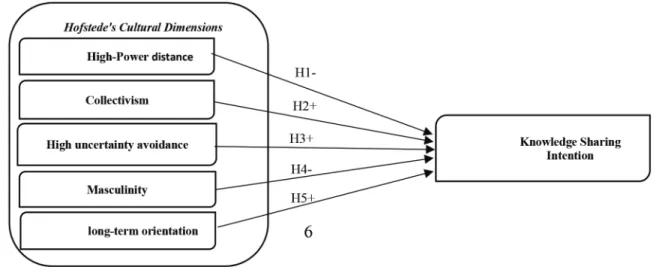
The current study aims to examine the effect of Hofstede’s dimensions of culture on the intention of sharing knowledge in higher education institutions (HEIs) in Jordan. In the literature, researchers have given limited attention to such an effect. Therefore, by adopting Hofstede’s framework, the current study attempts to investigate how Jordan’s cultural context impacts on the intentions to share knowledge in HEIs.
This study applied quantitative research methods to investigate the effect of Hofstede’s cultural dimensions on knowledge-sharing intentions.
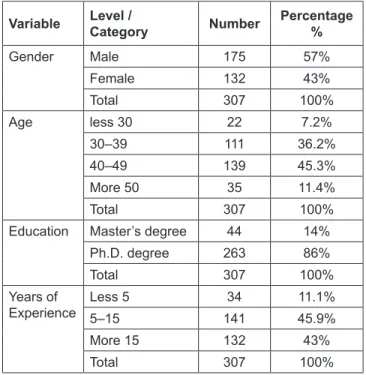
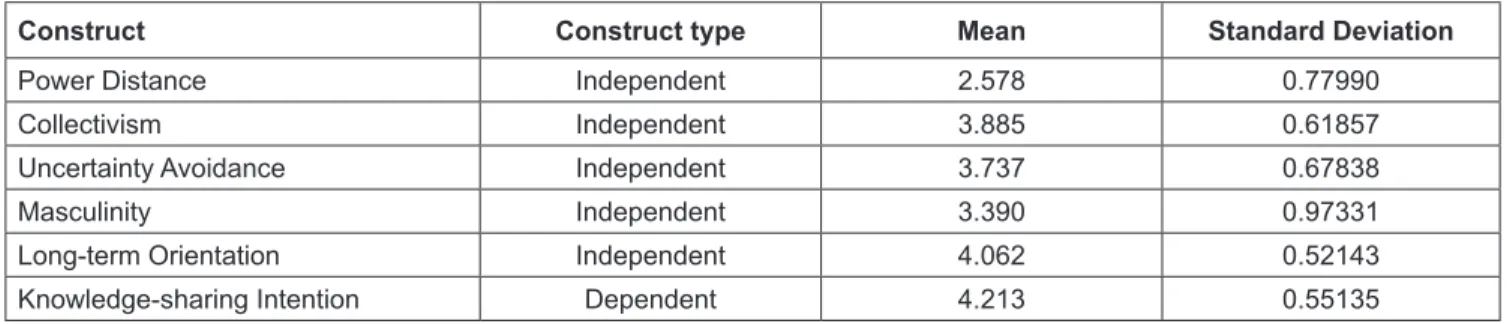
In total, 307 questionnaires were collected from employees in Jordanian universities and, then, tested using descriptive and regression analytical methods. The study results show that culture dimensions influence knowledge-sharing intention and that each dimension plays a different role in enhancing this knowledge-sharing intention. More specifically, it was found that long-term orientation, collectivism and high uncertainty avoidance had a positive effect on knowledge-sharing intention, while cultural masculinity and power distance had no negative effect. Based on these results, the study makes several recommendations, the most important of which is the promotion of cultural values that encourage intention to share knowledge. Also, more qualitative research is needed to explore in depth the effective means that encourage intentions to share different types of knowledge.
Keywords: Cultural Dimensions, Knowledge-Sharing Intentions, Higher Education Institutes, Jordan JEL Classification Code: D80, D83, M10, M19
research associated knowledge sharing with positive outcomes for organizations, such as innovative work behavior and competitive advantage (Almulhim, 2020; Hoa, Thanh, Mai, Le, & Quyen, 2020). Moreover, it serves as the key to explaining unprecedented transformation in our social life in general and the operations of socially-based companies and institutions in particular (Drucker, 1995).
The sharing of knowledge is a fundamental component of knowledge management since it creates new knowledge (Zhang, De Pablos, & Xu, 2014). According to Lee (2001), knowledge sharing is an activity that transfers or disseminates knowledge from one person, group, or organization to another that can be executed by various methods. It is expected that sharing knowledge shows how likely someone will share knowledge because desire is a key aspect that is related to the behavior (Ajzen, 1991). Moreover, Jolaee, Nor, Khani, and Yusoff (2014) assert that the organization must realize what makes employees share their knowledge.
In knowledge-intensive organizations such as HEIs, knowledge sharing is considered as the backbone for the permanence and development of these organizations (Bibi
& Ali, 2017). Therefore, many recent studies point out
1
First Author and Corresponding Author. Assistant Professor of Management Information Systems, Business Administration Department, College of Business, Tafila Technical University, Jordan [Postal Address: P.O. Box: 179, Tafila, 66110, Jordan]
Email: [email protected]
2
Assistant Manager, Admission and Registration Department, Tafila Technical University, Jordan. Email: [email protected]
© Copyright: The Author(s)
This is an Open Access article distributed under the terms of the Creative Commons Attribution Non-Commercial License (https://creativecommons.org/licenses/by-nc/4.0/) which permits unrestricted non-commercial use, distribution, and reproduction in any medium, provided the original work is properly cited.