제주도에서 흑로 Egretta sacra의 식이물과 취식 영역
1김완병2*․오홍식3
The Food Resources and Foraging Sites of Pacific Reef Herons(Egretta sacra) in Jeju Island, Korea1
Wan-Byung Kim2*, Hong-Shik Oh3 요 약
본 연구는 2005년 2월부터 8월까지 제주특별자치도 애월읍 신엄리에서 흑로의 식이물과 취식 영역을 조사하였다.
수거한 식이물은 모두 5종 21개체였으며. 이중 검정망둑(Tridentoger obscurus)이 38.1%(n=8)로 가장 많았고, 다음이 가막베도라치(Ennedpterygius etheostomus)가 19.0%(n=4), 멸치(Engraulis japonica)가 14.3%(n=3) 순이었다. 식이물 의 크기는 평균 58.29±5.17㎜(n=19)였으며, 검정망둑 67.49±4.91㎜(n=8), 가막베도라치 43.98±3.50㎜(n=4), 멸치 22.77±1.17㎜(n=3), 반쯤 소화된 상태의 넙치(Paralichthys olivaceus)와 볼락(Sebastes inermis)도 확인되었다. 먹이활 동이 이루어지는 취식 영역은 번식지를 기점으로 동쪽으로는 7.4km 지점의 외도천 하류까지, 서쪽으로는 6.6km 지점의 애월읍 금성천까지로 나타났다.
주요어: 애월읍, 검정망둑, 번식지
1 접수 2009년 9월 15일, 수정(1차: 2009년 12월 8일, 2차: 2009년 12월 14일), 게재확정 2009년 12월 15일
Received 4 September 2009; Revised(1st: 8 December 2009, 2nd: 14 December 2009); Accepted 15 December 2009 2 제주특별자치도민속자연사박물관 Folklore and Natural History Museum, Jeju Special Self-Governing Province, 996-1 Ildo 2
dong. Jeju City(690-834), Korea([email protected])
3 제주대학교 과학교육과 Dept. of Science education, Jeju National University, 66 Jejudaehakno, Jeju-Si, Jeju Special Self-Governing Province, 690-756, Korea([email protected])
* 교신저자 Corresponding author([email protected])
ABSTRACT
The principal objective of this study was to determine and characterize the food resources and foraging sites of Pacific Reef Herons bred in Aewol-eup, Jeju Island, during Feb. 2005 ~ Aug. 2005. The food resources of Pacific Reef Herons were identified as comprising 21 individuals of 5 species, and these identifications were verified as follows: 38.1% of Tridentoger obscurus(n=8), 19.0% of Ennedpterygius etheostomus(n=4), and 14.3% of Engraulis japonica(n=3). The sizes of the food resources were measured as follows: total 58.29±5.17㎜(n=19), T. obscurus was 67.49±4.91㎜㎜(n=8), E. etheostomus was 43.98±3.50㎜(n=4), and E. japonica was 22.77±1.17㎜. The semi-digested foods were confirmed as Paralichthys olivaceus and Sebastes inermis. The primary foraging sites were 7.4km(Oedocheon) east, to 6.6km(Geumseongcheon) west of the Aewol breeding area.
KEY WORDS : AEWOL-UP, TRIDENTOGER OBSCURUS, BREEDING AREA
Figure 1. Breeding location of Pacific Reef Herons at Sin-eom-ri, Aewol-eup, Jeju City in Jeju Island, Korea(● Survey area)
서 론
흑로(Egretta sacra Pacific Reef Herons)는 황새목 (Ciconiiformes) 백로과(Ardeidae)에 속하며, 한국, 일본, 중 국, 동남아시아와 오세아니아주의 해안가에 서식한다 (Hancock and Elliott, 1978; del Hoyo et al., 1992; Kushlan and Hancock, 2005). 우리나라에서는 제주도를 포함하여 우리나라의 남해안 도서 지방에서 번식하는 텃새이다 (Kushlan and Hafner, 2000; Kim et al., 2007).
백로과의 조류는 생태학적으로 먹이자원이 비슷하기 때 문에 각 종들은 먹이종류와 크기, 먹이습성이나 취식방법, 취식시간 등을 달리하여 같은 서식지내에서 먹이자원에 대 해 독립된 생태적 지위를 형성한다(Smith, 1977). 또한 백로 류는 번식지내에서 다양한 먹이공간을 이용하면서 다른 종 들과 혼성하는 경향이 있으며(Erwin, 1983), 집단번식지에 서의 공동생활은 좋은 취식지 정보를 확보하기 위한 행동이 다(Bayer, 1982; Kersten et al., 1991).
백로류의 번식지는 인근의 먹이자원의 분포에 결정된다 (Kelly et al., 1993). 쇠백로(Egretta garzetta)는 취식 공간 이 번식둥지로부터 7~13km 범위에 있으며(Haneda and Iwasaki, 1982), 황로(Bubulcus ibis) 25.6km, 쇠백로 27km, 해오라기( Nycticorax nycticorax) 13km 범위 내에서 각각 취식한다(Yamagishi et al., 1980; Demachi et al., 1991).
그리고 흑로는 번식지와 취식지 사이의 거리가 최소 8km에 이른다(Erwin, 1983). 취식지의 수심은 백로류의 먹이활동 을 제한하는 요인이 되며(Frederich and McGehee, 1994), 가뭄이나 홍수에 의한 습지의 수심 증감은 먹이자원의 감소 를 초래하여 번식 성공에 치명적인 영향을 미친다(Grull and Ranner, 1998; Custer et al., 1996). 흑로는 조석에 따라 취식 시간이 다르며, 만조시에는 먹이 활동에 제한을 받는 다(Mckilligan, 2002). 그리고 쇠백로는 용존산소량이 적어 서 물고기들이 표면으로 올라오는 경우가 많은 오전 시간대 에 먹이 활동을 집중하는 경향이 있다(Kersten et al., 1991).
본 연구는 제주도 애월읍 신엄리 일대의 번식지를 대상으 로 흑로의 식이물과 취식 영역을 알아보고자 수행되었다.
조사기간 및 조사방법
1. 조사기간 및 방법
조사는 2005년 2월부터 8월까지 제주시 애월읍 신엄리 번식지 주변을 대상으로 이루어졌다. 집단번식지에서의 조 사자의 출입은 번식성공률과 직결되기 때문에(Tremblay and Ellison, 1979), 조사자의 접근성과 안전성 그리고 흑로 의 번식에 미치는 장애를 최소화하였다. 식이물은 조사자가
둥지를 출입하면서 새끼가 토해낸 것과 어미가 새끼에게 급이하기 위하여 둥지 안과 밖에 토해낸 것을 모두 모아 측정하였다. 흑로의 취식 영역은 조사기간 동안에 번식지를 포함하여 이동하여 먹이 활동을 하는 지점을 표시하였다.
취식지 지점은 휴대용 GPS(GARMIN 60CSx)를 이용하여 좌표값을 측정하고, 지도와 거리 산출은 인터넷 다음지도 (http://local.daum.net/map/index.jsp)를 인용하였다.
2. 조사지 현황
조사지는 행정구역상 제주특별자치도 애월읍 신엄리에 속하며 속칭 ‘남또리개’라는 곳으로 북위 33°27′30″, 동경 126°20′00″에 위치한다(Figure 1). 현무암 해식단애가 급경 사로 형성되어 있으며 용암선반이 잘 발달되어 있다. 흑로 의 둥지방향이 바다를 향해 북쪽 또는 서쪽으로 노출되어 있으나, 용암선반과 암석틈새들이 많아서 직접적인 해풍과 파도로부터 번식장애를 극복할 조건을 갖추고 있다.
주요 식생으로는 절벽 위 육상에는 곰솔(Pinus thunbergii), 갯까치수영(Lysimachia mauritana), 띠 (Imperata cylindrica), 참억새(Miscanthus sinensis), 밀사 초(Carex boottiana), 갯기름나물(Peucedanum japonicum) 등이 분포한다. 절벽 아래는 사람들의 출입이 어렵지만 최 대 간조시에는 낚시꾼과 해초류를 채취하는 사람들의 출입 이 많고 절벽 위는 해안도로가 형성되어 있으며, 민박형 건 물들이 들어서 있다.
애월읍 신엄리에서 번식하는 조류는 흑로와 바다직박구 리(Monticola solitarius) 2종 이었다. 흑로와 공동생활을 하 는 종은 둥지터인 경우 가마우지(Phalacrocorax capillatus), 바다직박구리(Monticola solitarius), 재갈매기 (Larus argentatus), 괭이갈매기(Larus crassirostris) 그리
Species Name Number of individuals Size(㎜, Mean±SE)
Tridentoger obscurus 8 67.49±4.91
Ennedpterygius etheostomus 4 43.98±3.50
Engraulis japonica 3 22.77±1.17
Other(Hexagrammidae) 4 80.79±5.35
Subtotal 19 58.29±5.17
Paralichthys olivaceus 1 ND(semi-digested)
Sebastes intermis 1 ND(semi-digested)
ND: No data
Table 1. Food size of Pacific Reef Herons in Jeju Island 고 먹이터에서는 쇠백로, 중백로(Egretta intermedia), 중대 백로(Ardea alba), 왜가리( Ardea cinerea), 물총새(Alcedo atthis), 중부리도요(Numenium phaeopus), 노랑발도요 (Heteroscelus brevipes) 등이었다. 그리고 이 일대에서 확 인한 흑로의 번식 둥지는 13개소였으며, 최소 9쌍이 번식하 는 것이 조사된 바 있다(Kim et al., 2005)
결과 및 고찰
1. 식이물
수거한 식이물은 모두 5종 21개체였으며, 이중 검정망둑 (Tridentoger obscurus)이38.1%(n=8)로 가장 많았고, 다음 이 가막베도라치(Ennedpterygius etheostomus)가 19.0%
(n=4), 멸치(Engraulis japonica)가 14.3%(n=3) 순이었으 며, 쥐노래미과(Hexagra㎜idae)의 어류도 확인되었다 (Table 1).
반쯤 소화된 먹이를 제외한 식이물의 크기는 평균 58.29±5.17㎜(n=19)였으며, 검정망둑 67.49±4.91㎜(n=8), 가막베도라치 43.98±3.50㎜(n=4), 멸치 22.77±1.17㎜
(n=3), 반쯤 소화된 상태의 넙치(Paralichthys olivaceus)와 볼락(Sebastes intermis)도 확인되었다.
식이물은 새끼가 둥지 안에 토해내거나 어미가 새끼에게 먹여주기 위해 둥지 또는 둥지 앞 바위에 놓여 있었다. 또한 식이물 중에는 넙치 1개체와 볼락은 반쯤 소화한 상태였으 며, 넙치는 머리와 몸통을 먹은 상태였고, 볼락은 머리부분 이 잘려 나간 상태였다. 식이물 크기가 어느 정도 크면 어미 가 머리 부위를 잘라내고 먹이는 것으로 나타났다.
백로속의 주 먹이는 어류, 양서류, 파충류, 갑각류, 곤충 류 등이다(Siegfried, 1972; del Hoyo et al., 1992). 해오라 기는 붕어(Carassius auratus), 미꾸라지(Misgurnus mizolepis), 치리(Hemiculter eigenmanni), 가물치(Channa argus) 등의 어류와 황소개구리(Rana catesbeiana), 참개구
리(Rana nigromaculata), 땅강아지(Gryllotalpa orientalis) 도 선택하였으며(Kim et al., 1998), 쇠백로는 붕어, 미꾸리 (Misgurnus anguillicaudatus), 미꾸라지, 치리, 메기 (Silurus asotus) 등을 잡아먹는다(Han et al., 2001). 흑로의 먹이가 담수성보다 해수성이 많은 것은 흑로를 제외한 다른 백로류는 강, 저수지, 논습지 등이 가까운 내륙에서 번식하 지만 흑로는 바다와 접해있는 무인도서나 해안절벽에서 번식하기 때문에, 번식지 선택에 따라 먹이선호도가 다르게 나타난 결과라 할 수 있다.
흑로가 가장 선호하는 검정망둑은 기수역의 자갈이 많은 곳에서 그리고 가막베도라치, 멸치, 볼락은 바위와 해조류 가 많은 연안에서 각각 서식하며, 특히 검정망둑은 제주도 내 기수역에 비교적 우점적으로 분포한다(Jo, 1980). 결과 적으로 흑로가 먹이를 찾는 공간이 수심이 깊지 않은 해안 조간대로 그 곳에 서식하는 물고기는 수심이 깊은 곳에 서 식하는 물고기보다는 상대적으로 몸 크기가 작고 종류도 제한적일 수밖에 없다. Recher and Recher(1972)은 흑로의 주 먹이가 25㎜ 미만의 작은 물고기라 보고한 바 있는데, 본 연구에서는 58.29±5.17㎜로 2배 이상 차이를 보였으며, 주 먹이는 검정망둑으로 나타났다. 하지만, 비번식기에는 숭어(Mugil cephalus), 어렝놀래기(Duymaeria flagellifera) 와 같은 비교적 몸집이 큰 어류도 포식하는 것이 확인되었 다.
2. 취식 영역
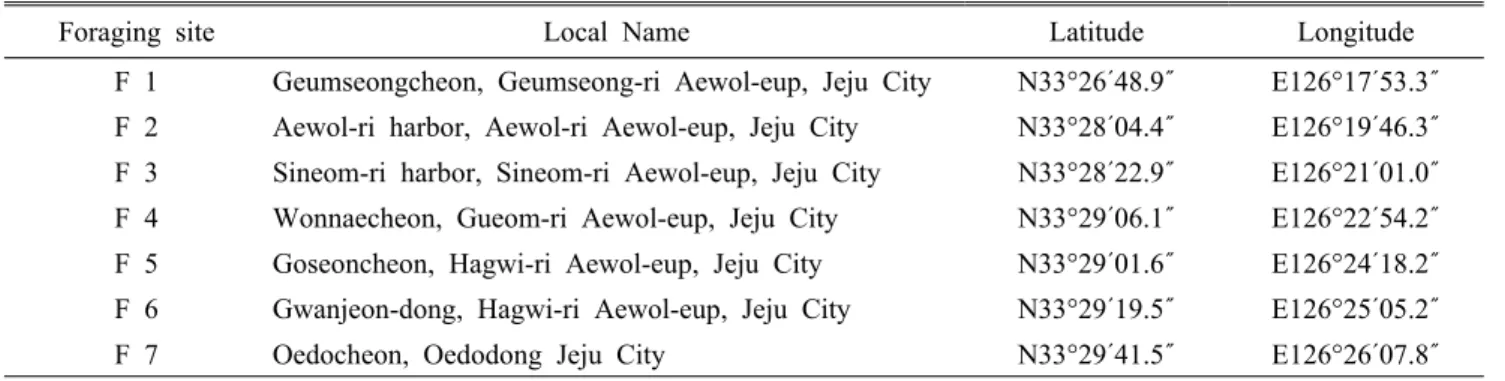
먹이를 취식하는 장소는 둥지 바로 아래의 조간대를 비롯 하여 인근 해안조간대까지 이동하였으며, 주로 용천수가 용 출하는 해수와 담수가 혼합되는 지역을 선호하는 것으로 나타났다. 주요 취식 위치는 Table 2에 제시한 바와 같다.
흑로는 단독 또는 집단을 이루어 번식을 하며, 둥지는 사람의 접근이 어려운 무인도의 암초나 나무 위 또는 암벽 선반 위에 틀며 알은 2~4개 정도 낳는다(Kikkawa, 1970;
Foraging site Local Name Latitude Longitude F 1 Geumseongcheon, Geumseong-ri Aewol-eup, Jeju City N33°26′48.9″ E126°17′53.3″
F 2 Aewol-ri harbor, Aewol-ri Aewol-eup, Jeju City N33°28′04.4″ E126°19′46.3″
F 3 Sineom-ri harbor, Sineom-ri Aewol-eup, Jeju City N33°28′22.9″ E126°21′01.0″
F 4 Wonnaecheon, Gueom-ri Aewol-eup, Jeju City N33°29′06.1″ E126°22′54.2″
F 5 Goseoncheon, Hagwi-ri Aewol-eup, Jeju City N33°29′01.6″ E126°24′18.2″
F 6 Gwanjeon-dong, Hagwi-ri Aewol-eup, Jeju City N33°29′19.5″ E126°25′05.2″
F 7 Oedocheon, Oedodong Jeju City N33°29′41.5″ E126°26′07.8″
Table 2. The major foraging sites around the Sineom-ri breeding area
Figure 2. Distance of the major foraging sites(F1~F7) from the Aewol-up breeding site(B).
B-F1: 6.6㎞, B-F2: 2.7㎞, B-F3: 0.8㎞, B-F4: 2.3㎞, B-F5: 3.9㎞, B-F6: 5.9㎞, B-F7: 7.4㎞
McKilligan, 2002; Kim et al., 2005; Kim et al., 2007).
번식지를 기점으로 동쪽으로는 2.3km 지점에 바다로 이어 지는 원내천을 비롯하여 3.9km 지점의 고성천 하류 지점의 조간대 그리고 5.9km 지점의 하귀리 관전동 해안 조간대, 7.4km 지점의 외도천 하류, 그리고 서쪽으로는 0.8km 지점 인 애월읍 신엄리 용천포구, 2.7km 지점의 애월항 주변 조 간대, 6.6km정도 떨어진 애월읍 금성천 하류에서 각각 흑로 의 먹이활동이 확인되었다(Figure 2).
먹이포획은 다리가 반쯤 잠기는 조간대와 바닷물과 경계 를 이루는 갯바위를 걸으면서 부리를 앞으로 빠르게 내밀어 낚아채었다. 기수역이 형성되어 있는 자갈밭에서는 비교적 느린 동작으로 먹이를 포획하였다. 백로과의 조류는 얕은 물가에서 천천히 걸어 다니면서 먹이를 낚아채는데, 그 속
도와 취식 유형은 종에 따라 조금씩 다르다(del Hoyo et al., 1992; Kushlan and Hancock, 2005; Choi, 2008). 흑로 를 비롯하여 Green-backed Heron, Yellow-crowned Night Heron은 담수 습지보다는 조석과 파도의 영향을 받는 해안 가에서 먹이자원을 획득하는데 어려움이 있으며(Kushlan and Hafner, 2000), 특히 흑로는 다른 백로류에 비해 암초지 에서만 먹이를 구하는 경향이 있다(McKilligan, 2002).
조사 결과, 흑로의 취식지는 번식 둥지로부터 서쪽으로 6.6km, 동쪽으로 7.4km 까지 이동하는 것으로 확인된 바, 집중적인 취식지가 많지 않은 점을 감안한다면, 먹이분포의 풍부도에 따라 취식지를 더 넓힐 것으로 판단된다.
한편, 이동성이 강한 백로류는 번식기 이후에는 번식지를 떠나는 경향이 있고, 그 차이는 종간 또는 이용 가능한 서식
지의 질에 따라 다르며(Erwin et al., 1996), 이동거리는 연 령에 따라서도 차이가 있다(McKilligan, 2002). 흑로는 한 지역에 머물러 생활하는 텃새이기 때문에 이동거리는 크지 않을 것으로 예측되지만, 향후 흑로의 취식 영역을 밝히기 위해서는 번식지를 기준으로 그 이동 범위와 흑로의 연령, 먹이 풍부도에 대한 연구가 진행되어야 할 것이다.
인용문헌
Bayer, R. D.(1982) How Important are Bird Colonies as Information Centers? Auk 99: 31-40.
Choi, Y. S.(2008) Foraging Ecology and Habitat Preference of Nest-nesting Ardeidae in Korea. Ph.D. dissertation.
Kyung-Hee University., 164pp.
Custer, T. W., R. K Randy and C. M. Custer(1996) Nest Initiation and Clutch Size of Great Blue Herons on the Mississippi River in Relation to the 1993 Flood. Condor 98(2): 181-188.
del Hoyo, J., A. Elliott and J. Sargatal(1992) Handbook of the world Vol. 1. Ostrich to Ducks. Lynx Edicions, Barcelona.
Demachi, G., M. Sakuyama and Y. Sawara(1991) Report on the Foraging Ecology of the Night Heron, Nycticorax nycticorax, in its Reproductive Season. Sci. Rep. Hirosaki Univ. 38:
129-135(In Japanese).
Erwin, R. M.(1983) Feeding Habitats of Nesting Wading Birds:
Spatial Use and Social Influences. Auk 100: 960-970.
Erwin, R. M., J. G. Haig, D. B. Stotts and J. S. Hatfield(1996) Dispersal and Habitat use by Post-fledgling Juvenile Snowy Egrets and Black-crowned Night-herons. Wilson Bull. 108(2):
342-356.
Frederick, P. C. and McGehee(1994) Wading Bird Use of Wastewater Treatment Wetlands in Central Florida, USA.
Colonial Waterbirds 17(1): 50-59.
Grull, A and A. Ranner(1998) Population of the Great Egret and Purple Heron in Relation to Ecological Factors in the Reed Belt of the Neusiedler See. Colonial Waterbirds 21(3): 328-334.
Han, S. H., D. H. Nam and T. H. Koo(2001) Comparison of the Breeding Ecology of Little Egreta Egretta garzetta and Black-crowned Night Heron Nycticorax nycticorax. Kor. J.
Orni. 8(1): 35-45(in Korean).
Hancock, J. and H. Elliot(1978) The Herons of the World: Eastern Reef Heron. Harper and Row, Publishers. New York, USA, pp.208-211.
Jo, J. Y.(1980). On the Freshwater Fish Fauna an Jeju Island. Bull.
Mar. Resour. Res. Inst. Jeju Nat. Univ. 4: 7-14(in Korean).
Kelly, J. P., H. M. Pratt and P. L. Greene(1993) The Distribution, Reproductive Success, and Habitat Characteristics of Heron and Egret Breeding Colonies in the San Francisco Bay Area.
Colonial Waterbirds 16(10): 18-27.
Kersten, M., R. H. Britton, O. J. Dugan and O. H. Hafner(1991) Flock Feeding and Food intake in Little Egrets: The Effects of Prey Distribution and Behaviour. Journal of Animal Ecology 60: 241-252.
Kikkawa, J.(1970) Birds recorded on Heron Island. Sunbird 1:
34-48.
Kim, J. S., D. P. Lee and T. H. Koo(1998) Breeding Ecology of Black-crowned Night Heron Nycticorax nycticorax. Kor. J.
Orni. 5(1): 35-46(in Korean).
Kim, W. B., H. S. Oh and W. T. Kim(2007) Clutch, Egg Size and Breeding Cycle of The Pacific reef Heron(Egretta sacra) on Jeju Island, Korea. Kor. J. Eco. 21(1): 93-100(in Korean).
Kim, W. B., H. S. Oh, E. M. Kim, B. S. Kim and W. T. Kim(2005) The Breeding Sites and the Nidification Habits of Pacific Reef Heron(Egretta sacra) on Jeju Island, Korea. Kor. J. Orni. 12(2):
49-59(in Korean).
Kushlan J. A. and J. A. Hancock(2005) The Herons. Oxford, 433pp.
Kushlan, J. A. and H. Hafner(2000) Heron Conservation. Academic Press, 480pp.
Mckilligan, N.(2002) Aspects of the Breeding Biology of the Reef Egret Egretta sacra. Corella 26(1): 13-18.
Recher, H. F. and J. A. Recher(1972) The foraging behaviour of Reef Heron. Emu 72(3): 85-90.
Siegfried, W. R.(1972) Aspects of the Feeding Ecology of Cattle Egrets(Ardeola Ibis) in South Africa. J. of Anim. Ecol. 41:
71-78.
Smith, J. P.(1997) Nesting Season Food habits of 4 Species of Herons and Egret at Lake Okeechobee, Florida. Colonial Waterbirds 20(2): 198-220.
Tremblay, J. and L. N. Ellison(1979) Effects of Human Distribution on Breeding of Black-Crowned Night Herons. Auk 96:
364-369.
Yamagish, S., I. Yoshikazy and K. Shigemoto(1980) Distribution of Colonies and Roosts and Feeding Disoersal of the Little and Cattle Egrets(Egretta gazetta and Bulbulcus ibis) in Nara Basin, Japan. Tori 29: 69-85(In Japanese).