Print ISSN: 2288-4637 / Online ISSN 2288-4645 doi:10.13106/jafeb.2021.vol8.no10.0385
The Effect of Perceived Risk and Technology Self-Efficacy on Online Learning Intention: An Empirical Study in Vietnam
Thuy Thanh Thi DOAN
1Received: June 30, 2021 Revised: September 09, 2021 Accepted: September 17, 2021
Abstract
In an effort to find ways to increase the effectiveness of online education, literature and empirical study based on the Technology Acceptance Model (TAM) have addressed a variety of questions, including perceived ease of use (PEU) and perceived usefulness (PU). After TAM, extensive studies have focused on the impact of extrinsic factors on PEU and PU, including Self-efficacy and Perceived Risk. This study aims to analyze the direct, indirect, and moderating effects of Self-efficacy and Perceived Risk on Online Learning Intention (OLI). Data was collected through a survey method from 472 students studying at universities in Vietnam. The collected data was analyzed using the PLS-SEM technique to test the hypotheses. The findings reveal that Technology Self-Efficacy influences the intention to take online courses both directly and indirectly through Perceived Ease of Use and Perceived Usefulness. Besides, Perceived Risk COVID-19 also has a positive effect on online learning intention, and plays a role as a moderating variable on the impact of PU on OLI. These findings suggest that students will have a stronger intention to study online when they are confident in their ability to use technology. When they believe in their ability to use technology, their online learning intention will also increase.
Keywords: Technology Self-Efficacy, Perceived Risk COVID-19, Perceived Usefulness, Perceived Ease of Use, Online Learning Intention JEL Classification Code: I20, I23, I24, M10, M19
In an effort to find ways to increase the effectiveness of online education, literature and empirical study based on the Technology Acceptance Model (TAM) have addressed a variety of questions, including perceived ease of use (PEU) (Kim et al., 2008) and perceived usefulness (PU) (Maheshwari, 2021). After TAM, extensive studies have focused on the impact of extrinsic factors on PEU and PU, including Self-efficacy (Lee et al., 2006) and Perceived Risk.
Bandura (1986) defined self-efficacy as the belief in one’s capabilities to organize and execute the courses of action required to manage prospective situations. Technology Self-Efficacy (TSE) is defined as the level of confidence students have in using technology for learning (Cai et al., 2019). People with higher Technology Self-Efficacy (TSE) are less likely to worry about technology usability and tend to perform better on technology-related tasks (Downey &
Kher 2015).
In the process of studying Online Learning Intention (OLI), especially during the COVID-19 pandemic, Perceived Risk (PR) is also a factor that deserves attention.
Most previous studies suggest that the impact of PR on behavior is negative (Marafon et al., 2018). However, because COVID-19 can be transmitted through close contact
1
First Author and Corresponding Author. Lecturer, Faculty of Business Administration, Ho Chi Minh City Open University, Vietnam [Postal Address: Room 403 – 35-37 Ho Hao Hon Street, Co Giang Ward, District 1, Ho Chi Minh City, 700000, Vietnam]
Email: [email protected]
© Copyright: The Author(s)
This is an Open Access article distributed under the terms of the Creative Commons Attribution Non-Commercial License (https://creativecommons.org/licenses/by-nc/4.0/) which permits unrestricted non-commercial use, distribution, and reproduction in any medium, provided the original work is properly cited.
1. Introduction
The impact of information technology on human life is enormous and its role in education is also extremely important, especially in the context of the global COVID-19 pandemic. Around the world, many educational institutions have temporarily closed. Some universities have also postponed or canceled all campus activities to minimize gatherings thereby reducing the spread of COVID-19.
During this quarantine due to the COVID-19 pandemic, it is essential to change the educational service, convert the teaching mode to online mode (Ambarwati et al., 2020; Park
& Lee, 2021).
with infected individuals, the perceived risk associated with its transmission is expected to have a positive impact on university students’ intention to study online. The COVID-19 transmission can appear through close contact with infected individuals (Guan et al., 2020). As university students become more aware of the usefulness of online learning during the COVID-19 period, the more they intend to study online. However, during the continuing global COVID-19 outbreak, the more these students realize that the risk of COVID-19 transmission through direct person-to- person contact is extremely high, the higher their intention to study online. With that argument, in this study, we use Perceived Risk COVID-19 both as an independent variable affecting OLI and as a moderator between PU and OLI.
In the face of the COVID-19 outbreak, educational institutions in general and universities, in particular, may need to start paying attention to online teaching methods and include them in the curricula for the future. Therefore, it is necessary to understand the opinions of learners and explore learners’ tendencies towards online teaching methods (Bali & Liu, 2018). For students to adopt and succeed in online learning, besides the skills and knowledge required, it is essential to identify other factors that influence their intention to study online (Brahmasrene & Lee, 2012).
In that context, this paper aims to study the online learning intention of university students in the future, through factors such as Perceived Risk, specifically the risk associated with the transmission of PR COVID-19, PEU, TSE, and the relationship between these factors.
2. Literature Review
2.1. Technology Acceptance Model – TAM
Based on the theory of reasonable action (TRA), Davis (1986) developed the Technology Acceptance Model (TAM) which is more specifically related to predicting the acceptability of an information technology system. TAM is an information systems theory that models how users come to accept and use technology. This model is deter- mined by two main factors: PU and PEU. The final version of TAM hypothesized that PEU not only affects directly but also indirectly through PU, the intention to use (Davis et al., 1989).
2.2. Online Learning Intention (OLI)
The intention is a representation of the willingness to perform a behavior. The Theory of Reasoned Action (Ajzen & Fishbein, 1975) and the Theory of Planned Behavior (Ajzen, 1991) are two very widely used theories in explaining human behavior through their intentions.
Face-to-face learning, e-learning, distance learning, and
online learning are different types of learning environments available. Online learning is a form of learning that is
“completely online” in which learners do not go to class but learn completely outside the classroom (Oblinger &
Oblinger, 2005). In this study, online learning intention is the willingness to participate in online courses.
2.3. Perceived Ease of Use (PEU), Perceived Usefulness (PU), and Online Learning Intention (OLI)
PU is defined as the degree to which a person believes that using a certain system will increase his or her job performance. According to TAM, PEU not only affects directly but also indirectly through PU online learning intention (Davis et al., 1989). The intention to use techno- logy, such as online money transfer services (Noreen et al., 2021) or E-learning (Park, 2009) was found to be positively correlated with PEU and PU. According to Huang et al.
(2020), PEU is responsible for 64% of the difference in college students’ behavioral intentions. Based on TAM and together with the above arguments, the following hypotheses are proposed:
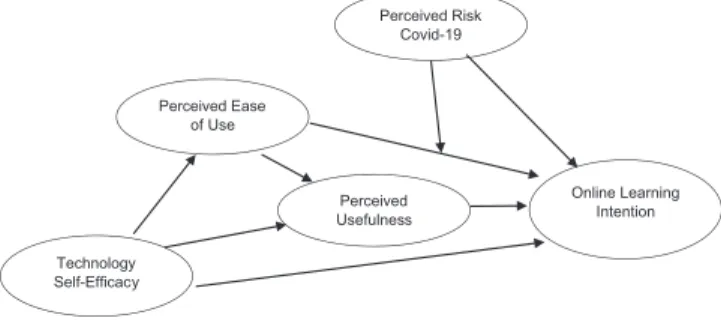
H1: Perceived Ease of Use has a positive effect on Online Learning Intention.
H2: Perceived Ease of Use has a positive effect on Perceived Usefulness.
H3: Perceived Usefulness has a positive impact on Online Learning Intention.
2.4. Technology Self-Efficacy (TSE) and Online Learning Intention (OLI)
Self-efficacy refers to an individual’s belief in his or her capacity to execute behaviors necessary to produce specific performance attainments. The self-efficacy of technology is derived from the concept of self-efficacy defined by Bandura (1986), according to which self- efficacy is defined as a belief in one’s ability to take the necessary actions in controlling situations. In the context of online learning, TSE refers to a factor that reflects students’
views and levels of confidence in using technology for learning (Cai et al., 2019), i.e. the ability to use technology without worrying about any problems. It also estimates the user’s ability to use technological inputs to achieve desired outcomes (Bailey et al., 2017; Cebeci et al., 2020).
In the online learning environment, TSE is linked to learners’ belief in the ability to use technology in learning.
Some students believe that using technology in learning is
easily achievable, however, there are also students who think
that it is difficult to learn how to use technology to serve
their learning process (Bailey et al., 2017). Many previous
studies have demonstrated an association between self- efficacy and PEU (Davis, 1989; Mathieson, 1991; Venkatesh
& Davis, 2000; Lee, 2006; Al-Gahtani, 2016). Thanks to self-efficacy, individuals can assess how easy or difficult it is to use technology to perform a particular task (Purnomo
& Lee, 2013). A meta-analysis by Abdullah and Ward (2016) on TAM theory through a review of 107 studies showed that self-efficacy is the best explanatory factor for PEU and has a strong impact on PU. This is also tested in the study of Rezaei et al. (2020). With those analyses, the following hypotheses are formed:
H4: Technology Self-Efficacy has a positive effect on Perceived Ease of Use.
H5: Technology Self-Efficacy has a positive effect on Perceived Usefulness.
H6: Technology Self-Efficacy has a positive impact on Online Learning Intention.
2.5. Perceived Risk (PR) and Online Learning Intention (OLI)
The concept of PR was first introduced by Bauer (1960), who defined perceived risk as the risk that consumers actively perceive because they do not understand product information. PR is a multidimensional structure, including many types of risks depending on the type of product or service (Kassim & Ramayah, 2015), or many risk aspects such as financial risk, physical risk, social risk, time loss risk, and psychological risk (Forsythe & Shi, 2003). The research of Maser and Weiermair (1998) mentioned another type of risk that of disease risk, and this is the type of risk that is of interest in the context of this study. In this study, the perceived risk of disease risk refers to students’ concerns about COVID-19 when interacting with classmates or teachers in a face-to-face learning setting, and their fear of contracting COVID-19 through face-to-face communication.
In many of the consumer behavior studies, the negative effects of PR are often highlighted, such as in the context of travel (Rittichainuwat & Chakraborty, 2009), mobile money services (Noreen et al., 2021), or online banking (Kassim
& Ramayah, 2015; Marafon et al., 201). Having direct contact with a large number of people when going to school increases the likelihood of COVID-19 infection. Therefore, the students’ intention to learn online will be stronger if they perceive a higher risk of COVID-19 infection. Furthermore, the more these students are aware of the significant risk of COVID-19 transmission through direct person-to-person contact, the more likely they are to study online. With that argument, in this study, in addition to the direct effect on OLI, PR COVID-19 was used as a moderator variable between PU and OLI. Therefore, the following research hypotheses are stated:
H7: Perceived Risk COVID-19 positively impacts Online Learning Intention.
H8: Perceived Risk COVID-19 moderates the effect of Perceived Usefulness on Online Learning Intention.
The proposed research model is shown in Figure 1.
3. Research Method 3.1. Measures
The proposed research model includes five elements:
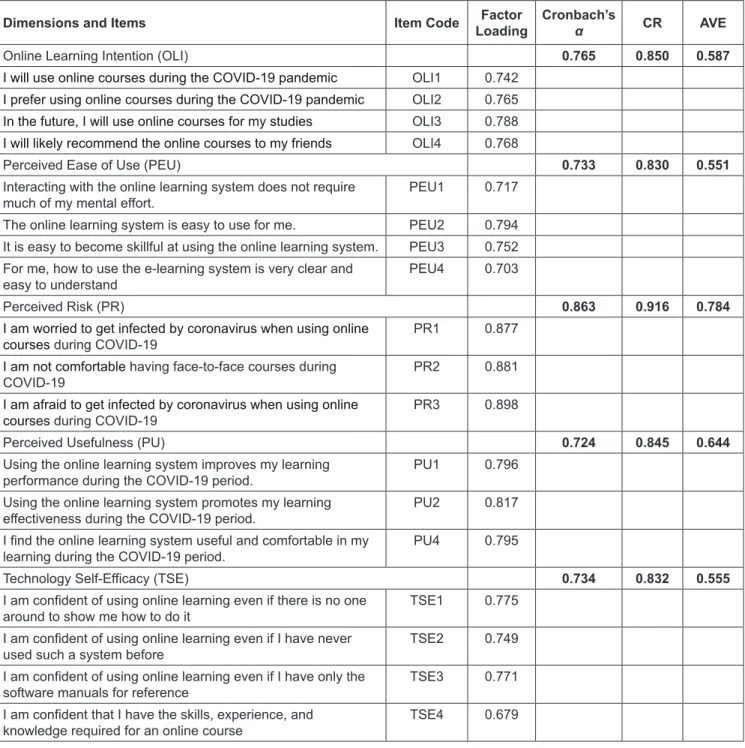
PEU, PU, PR COVID-19, TSE, and OLI. The PEU and PU scales were inherited from the TAM of Davis et al.
(1989). COVID-19 PR was measured using three observed variables from Olya and Al-Ansi (2018) and adjusted for the COVID-19 context. TSE is measured by four observed variables inherited from related studies (Bandura, 1986;
Ozturk et al., 2016; Nikou & Economides, 2017; Chao, 2019;
Ukpabi et al., 2021). OLI was measured using four observed variables adapted from Aji et al. (2020). All observed variables were designed to measure respondents’ opinions with a 5-point Likert scale, a type of psychometric response scale in which responders specify their level of agreement to a statement typically in five points: (1) Strongly disagree;
(2) Disagree; (3) Neither agree nor disagree; (4) Agree;
(5) Strongly agree. PLS-SEM (Partial Least Squares Structural Equation Modeling) technique is used to test the hypotheses in the proposed research model.
3.2. Data Collection
This is a study on students’ intention to study online, so the data is collected from students of universities in Vietnam. Due to the ongoing COVID-19 situation, the survey questionnaires were delivered to respondents via an online form. A total of 550 survey questionnaires were sent to students studying at universities that have implemented online teaching programs in Ho Chi Minh City. After completing data collection, the questionnaire was manually checked and those that did not meet the requirements were
Figure 1: Research Model
Perceived Risk Covid-19
Technology Self-Efficacy
Perceived Usefulness Perceived Ease
of Use
Online Learning Intention