Otolaryngology & Dermatology 2013;26(2):58-67 pISSN 1738-6640 eISSN 2234-4020
http://www.ood.or.kr http://dx.doi.org/10.6114/jkood.2013.26.2.058
Original Article / 원저
의이인 추출물이 알레르기 비염 동물의 cytokine에 미치는 영향
이승주·김윤범
경희대학교 한의과대학 안이비인후피부과교실
The Effects of Coisis semen extract on blood serum cytokine of Allergic Rhinitis Mice model
Seung Joo Lee·Yoon-Bum Kim
Kyunghee University College of Korean Medicine Dept. of Korean Ophthal - Otorhinolaryngology & Dermatology
Abstract
Objective : Allergic rhinitis(AR) is an inflammation or irritaion of nasal mucosa. Usually, serum cytokine is regarded as one of the most important factors in AR. Coisis semen have been used for the diseases in digestive organs in traditional chinese medicine. Nowaday, there were some studies reported about the effects of coisis semens on serum cytokine. However the results of theses studies were varies, and moreover there was no study which have used AR animal model. Therefore this study is aimed to determine therapeutic effects of coisis semen extract by observing changes of serum cytokine(IgE, TNF-α, IL-1β, IFN-γ and IL-13) with AR animal model.
Methods : Thirty BALB/c mice were divided into six groups : Normal group, Control group, sample Ⅰ, sample
Ⅱ, sample Ⅲ, sample Ⅳ. Except for Normal group, all the mice in other 5 groups were sensitized intraperionealy by 0.1% ovalbumin solution three times at intervals of one week. Then intranasal sensitization was performed by diffusing 0.1% ovalbumin solution three times at intervals of two days. Normal group were used Normal Saline instead of ovalbumin solution.
After the first day of study, sample Ⅰ, sample Ⅱ, sample Ⅲ, and sample Ⅳ were orally administrated coisis semen extract by 100㎎/㎏, 200㎎/㎏, 500㎎/㎏, and 1g/㎏ respectively for 28days. Then, the changes of serum IgE, TNF-α, IL-1β, IFN-γ and IL-13 were observed in 6 groups.
We used the statistical methods of ANOVA , post hoc by duncun, and Kruskal-Wallis test(p<0.05)
Results : There were statistical changes in IgE and TNF-α. But, there were no statistical changes in IL-1β, IL-13 and IFN-γ.
ⓒ 2013 the Society of Korean Medical Ophthalmology & Otolaryngology & Dermatology
This is an Open Access journal distributed under the terms of the Creative Commons Attribution Non-Commercial License (http://creativecommons.org/license/by-nc/3.0/) which permits unrestricted non-commercial use, distribution, and reproduction in any medium, provided the original work is properly cited.
교신저자 : 김윤범, 서울시 동대문구 회기동
경희대학교 부속한방병원 안이비인후피부과교실 (Tel : 02-958-9181, E-mail : [email protected])
∙
접수 2013/4/4∙
수정 2013/4/29∙
채택 2013/5/6Conclusions : According to above results, it is supposed that coisis semen extract has not some significant effects on cytokine of AR animal model. There was no evidence for using coisis semen in relieving symptoms of allergic rhinitis.
Key words : Allergic rhinitis; Coisis semen; Lachryma-jobi; BALB/c mouse; cytokine
Ⅰ. 서 론
알레르기 비염은 특정 알레르기 항원에 대한 IgE 매개 면역반응으로 유도된 염증으로 발생한 재채기, 가려움증, 수양성 비루 및 비폐색 중 하나 또는 여러 개의 증상으로 규정되는 복합질환이다1).
한의학에서 알레르기 비염은 鼻鼽, 噴嚔, 鼻涕 등 의 범주에 속하는데, 脾, 肺, 腎의 허약이나 風寒邪氣 등의 병인으로 발생한다고 보아, 溫補肺臟, 祛風散寒, 健脾益氣, 補腎納氣의 방법으로 치료하는 것을 대강으 로 하여 질병에 대한 저항력을 증강시키는데 중점을 두는 扶正祛邪를 원칙으로 하고 있다.
최근 Kim 등2)의 알레르기 비염환자를 대상으로 한 임상연구에서 太陰調胃湯, 調理肺元湯 등을 사용하여 噴嚔, 淸涕, 鼻塞 등의 증상이 호전된 결과가 있었다.
상기 복합처방에 사용된 약재 중 처방용량이 가장 많 은 의이인의 健脾除濕, 淸熱排膿의 작용이 알레르기 반응에 의한 점막 부종, 분비물 증가 및 염증성변화에 일정한 효과가 있을 것으로 기대되나, 아직까지 의이 인 단일약재를 알레르기 비염 모델에 실험적으로 연 구한 결과는 없었다.
의이인(Coicis semen)은 율무 Coix lachryma-jobi 의 성숙한 種仁을 건조한 것으로, 性은 微寒(凉)하며, 味는 甘淡하여 利水滲濕 除痺 健脾止瀉 淸熱排膿의 효능이 있다3). 최근 의이인의 cytokine 조절 효과에 대한 연구가 발표되고 있는데 그 결과는 연구마다 차 이를 보이고 있다. Hsu 등4)은 IgE를 유의성 있게 감
소시켰고, Ryu 등5)은 투여 농도에 따라 TNF-α, IL-1β를 유의성 있게 증가시키거나 감소시켰고, Yun 등6)은 TNF-α, IL-1β를 유의성 있게 억제한다고 발 표하였다. 이밖에 의이인과 관련된 실험적 연구로는 Lim7)의 암세포주 증식억제, Lim8)의 지질강하, Cho 등9)의 당뇨병성 신증, Lee 등10)의 고지혈증에 대한 연 구 등이 있다.
이에 본 연구는 의이인의 cytokine 조절 효과를 확 인하여 의이인의 항알레르기 치료제로서의 가능성을 확인하고자 알레르기 비염 동물 모델을 이용, 4종류의 다른 농도의 의이인 추출물을 경구 투여 후 혈중 Immunoglobulin E(IgE), Tumor Necrosis Factor- alpha(TNF-α), Interferon-gamma(IFN-γ), Interleukin- 1beta(IL-1β), Interleukin-13(IL-13)을 확인하여 다 음과 같은 결과를 얻었기에 보고하는 바이다.
Ⅱ. 재료 및 방법
1. 동물
동물은 중앙동물실험에서 분양받은 6주령의 BALB/c 수컷 마우스를 사용하였다. 고형사료와 물은 제한 없 이 공급하면서 12시간 주야의 생활리듬을 주었으며, 항온항습상태에서 2주간 적응시킨 후 사용하였다. 동 물실험계획서는 경희의료원 동물실험 윤리위원회의 승인(KHMC-IACUC 12-005)을 받았다.
2. 시약
실험에 사용한 한약재 의이인은 경희의료원에서 구 입하였다. Mouse tumor necrosis factor-alpha(TNF-
α), mouse interferon-gamma(IFN-γ) 및 mouse interleukin-1beta(IL-1β) enzyme linked immuno- sorbent assay(ELISA) kit들은 R&D Systems (Minneapolis, MN, USA)에서 구입하였다. Mouse interleukin-13(IL-13) ELISA kit는 RayBiotech, Inc.(Norcross, Ga, USA)에서 구입하였으며 mouse immunoglobulin E(IgE) ELISA kit는 ICL, Inc.(Portland, OR, USA)에서 구입하였다.
3. 검액 조제
의이인 500g 을 유리로 된 추출 병에 넣고 증류수 3,000㏄ 를 시료가 잠기도록 충분히 넣어 2시간 동안 수침한 다음 환류냉각장치를 이용하여 100℃에서 1시 간 전탕하여 1차 전탕액을 얻고, 재차 증류수 2,000㏄
를 넣어 1차 전탕할 때와 같은 방법으로 반복 시행하 여 2차 전탕액을 얻은 후 1, 2차 전탕액을 혼합하고 이 용액을 filter paper로 여과한 다음 rotary vacuum evaporator(EYELA, Japan)에서 감압 농축 후 동결건 조 하여 37g의 건조분말을 획득하였다(yield 7.4 %).
4. 검액 투여
마우스 30마리를 각각 5마리씩 Normal군, Control 군, 실험Ⅰ군, 실험Ⅱ군, 실험Ⅲ군, 실험Ⅳ군으로 나누 어 사용하였다. Normal군은 Ovalbumin 대신 Normal Saline을 복강 투여 및 비강 점적하였다.
Control군 및 모든 실험군에서는 복강 감작 및 비강 점적으로 알레르기 비염을 유발한 후, 의이인 추출물 은 각각 실험Ⅰ군은 100㎎/㎏, 실험Ⅱ군은 200㎎/㎏, 실험Ⅲ군은 500㎎/㎏, 실험Ⅳ군은 1g/㎏의 농도로 하 여 1㏄/㎏의 비율로 20㎖씩 28일간 매일 1회씩 경구
0.1% OVA 복강투여(sensitization) 0.1% OVA 비강점적(challenge)
↓ ↓ ↓ ↓ ↓ ↓
① ② ③ ④ ⑤ ⑥ ⑦ ⑧ ⑨
↑ ↑ ↑ ↑ ↑ ↑ ↑ ↑ ↑ ↑ ↑ ↑ ↑ ↑ ↑ ↑ ↑ ↑ ↑ ↑ ↑ ↑ ↑ ↑ ↑ ↑ ↑ ↑ ↑
각 실험 군별 농도로 의이인전탕액 20㎖/day 투여
투여 되었다.
5. 알레르기 반응 유발
Levine & Vaz11)의 방법을 응용하여 Ovalbumin (OVA: chicken egg albumin, grade V, Sigma, U.
S. A)을 항원으로 사용하였다. 인산완충용액(PBS:
phosphate buffered saline)과 수산화알루미늄겔 (Al(OH)3 gel, Sigma, U. S. A)을 1:1로 하여 OVA 10㎍을 PBS 와 수산화알루미늄겔 용액에 혼합하여 1
㎖를 만들어 0.1% OVA용액이 되도록 하였다.
Normal군을 제외한 모든 군에 실험시작 0일, 7일, 14 일째에 0.1% OVA 용액을 복강 투여하여 감작시켰다
12). 항원유발을 위해 마지막 복강 투여 1주일 후 7일 간 격일로 3회씩 Control군과 실험Ⅰ군, 실험Ⅱ군, 실 험Ⅲ군, 실험Ⅳ군 마우스의 비강에 0.1% OVA용액을 점적하여 알레르기 비염을 유발하였다13).
6. 혈청 분리
마우스를 에테르 마취시킨 후 심장천자로 채혈하여 약 1㏄의 혈액을 얻은 후 응고시켰다. 이것을 원심분 리기에 넣고(R. P. M 3000, 15분간) 혈청을 분리한 후 –70℃의 냉장고에 보관하였다.
7. 혈중 IgE 농도 측정
Mouse monoclonal IgE antibody가 코팅된 96 well microplate에 mouse IgE 표준액 100㎕ 또는 완 충액에 50배 희석된 serum 100㎕ 을 각 well에 넣고 실온에서 30분 간 반응시킨 뒤, 각 well을 4회 세척하 였다. HRP에 conjugate된 IgE Enzyme-Antibody Conjugate를 100㎕ 처리하고 실온에 30분 간 방치한
후 다시 4회 세척하였다. Hydrogen peroxide와 TMB 혼합 기질을 각 well에 100㎕ 처리 한 후 암소 에서 10분간 방치하고, stop solution을 100㎕씩 처리 한 후 sepectrophotometer 450㎚에서 흡광도를 측정 하였다. 결과 값은 표준액(0-400ng/㎖)의 흡광도 값을 4-parameter algorithm로 계산하였다.
8. 혈중 TNF-α 농도 측정
Mouse monoclonal TNF-α antibody가 코팅된 96 well microplate에 희석용액 50㎕씩 넣은 후, mouse TNF-α표준액 50㎕ 또는 완충액에 5배 희석된 serum 50㎕ 을 각 well에 넣고 실온에서 2시간 반응 시킨 뒤, 각 well을 5회 세척하였다. Horseradish peroxidase(HRP)에 conjugate된 TNF-α Conjugate 를 100㎕ 처리하고 실온에 2시간 방치한 후 다시 5회 세척하였다. Hydrogen peroxide와 chromogen (tetramethylbnzidine: TMB) 혼합 기질을 각 well에 100㎕ 처리 한 후 암소에서 30분간 방치하고, stop solution을 100㎕씩 처리한 후 sepectrophotometer (Versamax microplatereader; Molecular Device, Sunnyvale, CA, USA) 450㎚에서 흡광도를 측정하였 다. 결과 값은 표준액(0-700 pg/㎖)의 흡광도 값을 4-parameter algorithm로 계산하였다.
9. 혈중 IFN-γ 농도 측정
Mouse monoclonal IFN-γ antibody가 코팅된 96 well microplate에 희석용액 50㎕씩 넣은 후, mouse IFN-γ 표준액 50㎕ 또는 완충액에 2배 희석된 serum 50㎕ 을 각 well에 넣고 실온에서 2시간 반응 시킨 뒤, 각 well을 5회 세척하였다. HRP에 conjugate된 IFN-γ Conjugate를 100㎕ 처리하고 실 온에 2시간 방치한 후 다시 5회 세척하였다.
Hydrogen peroxide와 chromogen(TMB) 혼합 기질 을 각 well에 100㎕ 처리 한 후 암소에서 30분간 방 치하고, stop solution을 100㎕씩 처리한 후 sepectrophotometer 450 ㎚에서 흡광도를 측정하였
다. 결과값은 표준액(9.375-600pg/㎖)의 흡광도 값을 4-parameter algorithm로 계산하였다.
10. 혈중 IL-1β농도 측정
Mouse monoclonal IL-1β antibody가 코팅된 96 well microplate에 희석용액 50㎕씩 넣은 후, mouse IL-1β표준액 50㎕ 또는 완충액에 2배 희석된 serum 50㎕ 을 각 well에 넣고 실온에서 2시간 반응시킨 뒤, 각 well을 5회 세척하였다. HRP에 conjugate된 IL-1 β Conjugate를 100㎕ 처리하고 실온에 2시간 방치 한 후 다시 5회 세척하였다. Hydrogen peroxide와 chromogen(TMB) 혼합 기질을 각 well에 100㎕ 처 리 한 후 암소에서 30분간 방치하고, stop solution을 100㎕씩 처리한 후 sepectrophotometer 450㎚에서 흡광도를 측정하였다. 결과값은 표준액(0-400pg/㎖)의 흡광도 값을 4-parameter algorithm로 계산하였다.
11. 혈중 IL-13 농도 측정
Mouse monoclonal IL-13 antibody가 코팅된 96 well microplate에 mouse IL-13 표준액 100㎕ 또는 완충액에 2배 희석된 serum 100㎕ 을 각 well에 넣 고 실온에서 2.5시간 반응시킨 뒤, 각 well을 4회 세 척하였다. Biotinylated anti-mouse IL-13 antibody 를 100㎕ 처리하고 실온에 1시간 방치한 후 다시 4회 세척하였다. HRP-conjugated streptavidin을 각 well 에 100㎕ 처리 후 실온에서 45분간 반응 종료 후, 4 회 세척하였다. TMB 기질을 각 well에 100㎕ 처리 한 후 암소에서 30분간 방치하고, stop solution을 50
㎕씩 처리한 후 sepectrophotometer 450㎚에서 흡광 도를 측정하였다. 결과 값은 표준액(0-2000pg/㎖)의 흡광도 값을 4-parameter algorithm로 계산하였다.
12. 통계 처리
모든 측정값은 평균값±표준편차(Mean±S.D.)로 나 타내었으며, data 분석은 Kruskal-Wallis test로 하였
고, 사후검정은 Duncan을 이용하였다. P<0.05 이하 인 경우 유의하다고 판단하였다.
Ⅲ. 결 과
1. IgE, TNF-α 농도 변화
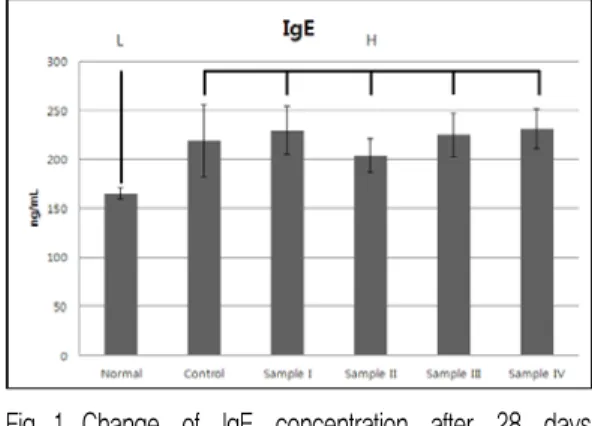
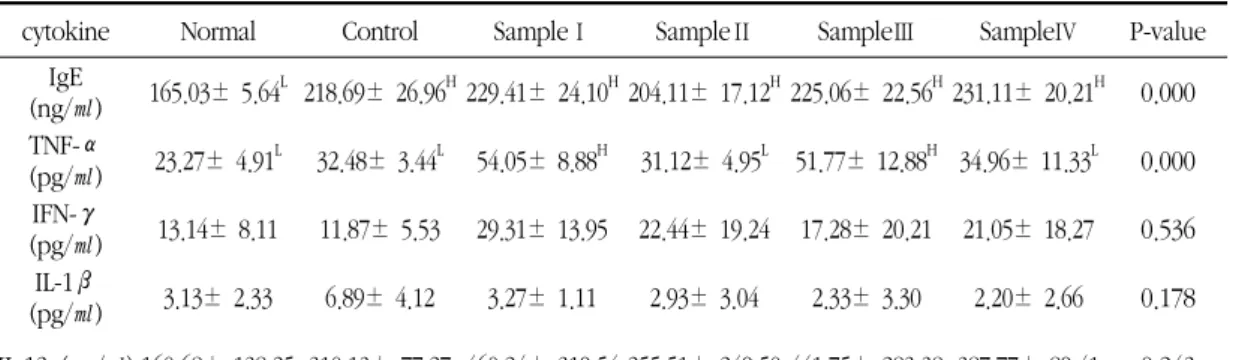
IgE, TNF-α 농도 변화는 그룹 간에 유의한 차이 가 있었다.
IgE는 Normal군 165.03±5.64ng/㎖, Control군 218.69±26.96ng/㎖, SampleⅠ군 229.41±24.10ng/
㎖, SampleⅡ군 204.11±17.12ng/㎖, SampleⅢ군 225.06±22.56ng/㎖, SampleⅣ군 231.11±20.21ng/㎖
로 나타났다.
TNF-α는 Normal군 23.27±4.9pg/㎖, Control군 32.48±3.44pg/㎖, SampleⅠ군 54.05±8.88pg/㎖, SampleⅡ군 31.12±4.95pg/㎖, SampleⅢ군 51.77±
12.88pg/㎖, SampleⅣ군 34.96±11.33pg/㎖으로 나타 났다.
2. IFN-γ , IL-1β , IL-13 농도 변화
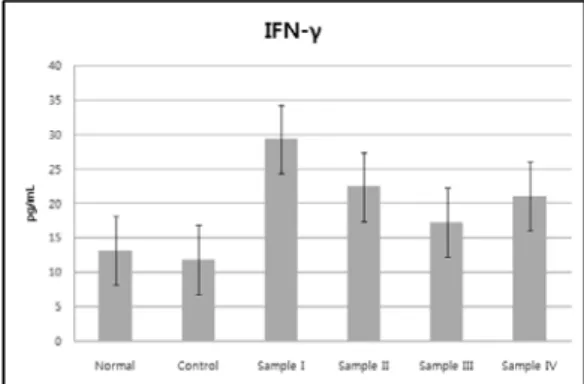
IFN-γ, IL-1β, IL-13 농도 변화는 그룹 간 차이 는 있었으나, 통계적으로 유의하지는 않았다.
IFN-γ는 Normal군 13.14±8.11pg/㎖, Control군 11.87±5.53pg/㎖, SampleⅠ군 29.31±13.95pg/㎖, SampleⅡ군 22.44±19.24pg/㎖, SampleⅢ군 17.28±
20.21pg/㎖, SampleⅣ군 21.05±18.27pg/㎖으로 나타 났다.
IL-1β는 Normal군 3.13±2.33pg/㎖, Control군 6.89±4.12pg/㎖, SampleⅠ군 3.27±1.11pg/㎖, Sample
Ⅱ군 2.93±3.04pg/㎖, SampleⅢ군 2.33± 3.30pg/㎖, SampleⅣ군 2.20±2.66pg/㎖으로 나타났다.
IL-13은 Normal군 160.68±138.25 pg/㎖, Control 군 310.13±77.27pg/㎖, SampleⅠ군 460.24± 319.54pg/
㎖, SampleⅡ군 255.51±249.50pg/㎖, SampleⅢ군 441.75±283.38pg/㎖, SampleⅣ군 387.77± 89.41pg/㎖
으로 나타났다.
Fig. 1. Change of IgE concentration after 28 days (P=0.000)
Control : The group induced OVA allergic rhinitis and which did not take medication
SampleⅠ: Coisis semen extract by 100㎎/㎏ administraion for 28days group
SampleⅡ: Coisis semen extract by 200㎎/㎏ administraion for 28days group
SampleⅢ: Coisis semen extract by 500㎎/㎏ administraion for 28days group
SampleⅣ: Coisis semen extract by 1g/㎏ administraion for 28days group
Fig. 2. Change of TNF-α concentration after 28 days (P=0.000)
Control : The group induced OVA allergic rhinitis and which did not take medication
SampleⅠ: Coisis semen extract by 100㎎/㎏ administraion for 28days group
SampleⅡ: Coisis semen extract by 200㎎/㎏ administraion for 28days group
SampleⅢ: Coisis semen extract by 500㎎/㎏ administraion for 28days group
SampleⅣ: Coisis semen extract by 1g/㎏ administraion for
28days group
Fig. 3. Change of IFN-γ concentration after 28 days (P=0.536)
Control : The group induced OVA allergic rhinitis and which did not take medication
SampleⅠ: Coisis semen extract by 100㎎/㎏ administraion for 28days group
SampleⅡ: Coisis semen extract by 200㎎/㎏ administraion for 28days group
SampleⅢ: Coisis semen extract by 500㎎/㎏ administraion for 28days group
SampleⅣ: Coisis semen extract by 1g/㎏ administraion for 28days group
Fig. 4. Change of IL-1β concentration after 28 days (P=0.178)
Control : The group induced OVA allergic rhinitis and which did not take medication
SampleⅠ: Coisis semen extract by 100㎎/㎏ administraion for 28days group
SampleⅡ: Coisis semen extract by 200㎎/㎏ administraion for 28days group
SampleⅢ: Coisis semen extract by 500㎎/㎏ administraion for 28days group
SampleⅣ: Coisis semen extract by 1g/㎏ administraion for 28days group
Fig. 5. Change of IL-13 concentration after 28 days (P=0.243)
Control : The group induced OVA allergic rhinitis and which did not take medication
SampleⅠ: Coisis semen extract by 100㎎/㎏ administraion for 28days group
SampleⅡ: Coisis semen extract by 200㎎/㎏ administraion for 28days group
SampleⅢ: Coisis semen extract by 500㎎/㎏ administraion for 28days group
SampleⅣ: Coisis semen extract by 1g/㎏ administraion for 28days group
Ⅳ. 고 찰
알레르기 비염은 비만세포 표면의 IgE와 항원의 결 합으로 인해 화학적 매개물질들과 cytokine들이 분비 되면서 일어나는 즉시형 알레르기 반응과 세포성면역 에 해당하여 T림프구에 의하여 매개되는 지연형 알레 르기 반응을 모두 포함한다14). 즉시형 알레르기 반응 에서 상기도점막이 항원에 감작되면, Th2 림프구는 IL-4, IL-13 등을 분비하여 이들이 항원에 특별한 IgE 의 생산을 촉진하고, 자극된 비만세포에서 히스타민 과 같은 염증매개물질이 방출되어 재채기, 가려움증 및 수양성비루 등 증상을 나타내며, 이때 IFN-γ 등 은 IgE 생산을 방해한다15). 지연형 알레르기 반응에 서 호산구는 활성산소를 생산하여 점막을 손상시키고 감염을 심화시키며, Th2 림프구는 IL-4, IL-13 등을 분비하여 증상을 지속시키고, 대식세포에서 생산되 는 염증성 cytokine인 IL-1β, TNF-α 등이 염증반응 을 유지하는데 기여한다. 이러한 과정을 통해 cytokine
들과 부착단백질들이 알레르기 비염과 기도과민성, 천식 및 비폐색을 유발한다16).
알레르기 비염을 치료하는 약물은 주로 항히스타 민, 국소스테로이드, 항충혈제 및 cytokine저해제17) 등이 사용되고 있는데, 조직에서 국소매개물질유리를 감소시키거나, 활성화된 비만세포나 호산구, 호염구에 서 화학적 매개물질의 방출을 저해하는 작용이 있다
18). 그렇지만, 알레르기 비염의 발병율과 유병율은 줄 어들지 않고 있고, 개별 약물의 부작용 등으로 장기사 용에 적합하지 않은 경우가 많아서, 더 좋은 치료약을 찾고자 하는 노력이 지속되어 왔다19).
의이인(Coicis semen)은 神農本草經 上品에 味甘微 寒無毒 主筋急拘攣 不可屈伸 風濕痺 下氣 라고 최초 기록이 있었다. 국내에서 사용되는 의약품 의이인은 禾本科(벼과 ; Poaceae)에 속한 율무(Coix lachryma- jobi Linne var. mayeun Staph.)를 표준약재로 정하 고 있으며20), 種皮를 제거한 種仁만을 약재로 사용하 고 있는데, 性은 微寒(凉)하고, 味는 甘淡하며, leucine, lysine, coixol, coixenolide, phytin, triterpenoid, vitamin B1, vitamin E(four tocopherols and three tocotrienols), phytosterols (campesterol, stigmasterol and β-sitosterol), squalene, fatty acids(palmitic, oleic and linoleic acids) 등의 성분을 함유하고 있다21).
의이인의 cytokine에 대한 반응성에 있어서 농도 의존성이 있다는 보고와 농도 의존성이 없다는 보고
Table 1. Change of Cytokine Concentration after 28days
cytokine Normal Control SampleⅠ SampleⅡ SampleⅢ SampleⅣ P-value
IgE
(ng/㎖) 165.03± 5.64
L218.69± 26.96
H229.41± 24.10
H204.11± 17.12
H225.06± 22.56
H231.11± 20.21
H0.000 TNF-α
(pg/㎖) 23.27± 4.91
L32.48± 3.44
L54.05± 8.88
H31.12± 4.95
L51.77± 12.88
H34.96± 11.33
L0.000 IFN-γ
(pg/㎖) 13.14± 8.11 11.87± 5.53 29.31± 13.95 22.44± 19.24 17.28± 20.21 21.05± 18.27 0.536 IL-1β
(pg/㎖) 3.13± 2.33 6.89± 4.12 3.27± 1.11 2.93± 3.04 2.33± 3.30 2.20± 2.66 0.178 IL-13 (pg/㎖) 160.68± 138.25 310.13± 77.27 460.24± 319.54 255.51± 249.50 441.75± 283.38 387.77± 89.41 0.243
가 있었다. 전자의 경우 Ryu22)는 IL-1β, TNF-α가 저농도 투여군에서는 유의한 증가, 고농도 투여군에 서는 유의한 감소를 보인다고 보고하였으며, 후자의 경우 Chen 등23,24)은 농도에 관계없이 IL-6, TNF-α 를 억제하여 항염증효과가 있다고 하였고, IL-4, IL-6, TNF-α를 억제하여 지연형 알레르기 반응에서의 cytokine 분비를 억제했다고 하였다. 그러나 본 연구 에서는 의이인 추출물이 농도 의존성과는 무관하게 알레르기와 관련된 cytokine 합성을 억제시키지 못하 였고, IgE의 경우 오히려 증가하였다. 따라서 이전과 본 연구의 결과를 종합하면 의이인 추출물의 cytokine 조절능력에 대한 결과에 있어 서로 다른 차 이를 보이고 있다. 이러한 차이에 관하여는 실험방법 과 실험에 사용된 의이인의 품종과 재배시기 및 재배 산지가 다르고, 의이인의 치료지표물질이 확립되어있 지 않은 것에서 비롯된 것으로 추측되며, 추가적인 연 구가 필요할 것으로 생각한다.
최근 국내에서는 한약 단미제를 이용하여 알레르기 비염 동물모델에서 치료효과를 살펴본 논문이 다수 있었는데, Chou 등25)의 白疾藜, Park 등26)의 羌活, Kim 등27)의 竹鹽(Bamboo salt) 및 Oh 등28)의 蘇葉 은 효과가 있었으며, Kim 등29)의 蔓荊子, 柴胡와 Jung 등30)의 石昌蒲는 효과가 없었다. Woo 등31)은 의이인이 마우스의 세포성 및 체액성 면역을 증강시 키는 역할을 하여 감염성 질환이나 종양 및 기타 면 역기능의 이상으로 인한 질환의 치료에 활용할 수 있
을 가능성을 제시하였고, Park 등32)은 의이인이 활성 산소의 생성을 유의성 있게 억제하였다고 보고하였던 바, 한약재 의이인에서도 알레르기 비염 치료제의 개 발 가능성은 있다고 생각되었다.
그러나 본 연구에서 의이인의 cytokine 조절 효과 를 확인하여 의이인의 항알레르기 치료제로서의 가능 성을 확인하고자 알레르기 비염 동물모델 중 BALB/c mice에 의이인 열수 추출물을 농도별로 투여하여 IgE, TNF-α, IFN-γ, IL-1β 및 IL-13 cytokine의 농도 변화를 측정하였지만, 그룹간 의미 있는 결과를 얻지 못했다. 비록 제한된 실험방법에서 유의미한 결 과를 얻지 못했지만, 추후 의이인의 품종을 달리하거 나 알레르기 비염의 다른 실험모델을 이용한 후속 연 구가 추가적으로 진행되어야할 것으로 생각된다.
Ⅴ. 결 론
본 연구에서 의이인이 알레르기 비염 동물의 cytokine에 미치는 영향을 알아보기 위하여, 의이인 추출물을 농도별로 투여한 후, 혈중 IgE, TNF-α, IFN-γ, IL-1β 및 IL-13 농도 변화를 관찰한바 의미 있는 결과를 얻지 못하였다.
참고문헌
1. David PS. Allergic rhinitis: definition, epidemiology, pathophysiology, detection, and diagnosis. Journal of Allergy and Clinical Immunology. 2001;108:s2-8.
2. Kim HG, Lee SK, Song IB, Ko BH. A Clinical Study on Sasang Constitutional Medical Treatment Effectiveness of Allergic Rhinitis Patients in Taeumin. J of Sasang Constitutional Medicine. 2006;18(1):138-46.
3. Nationwide College of Korean Medicine Joint
Instruction Compilation Committee. Bonchohak.
3rd ed. Seoul:Yeongrimsa. 2011:349-51.
4. Hsu HY, Lin BF, Kuo CC, Chiang W.
Suppression of Allergic Reactions by Dehulled Adlay in Association with the Balance of Th1/Th2 Cell Responses. J. Agric. Food Chem. 2003;51:3763-9.
5. Ryu HS, Kim HS. Effect of Job`s Tear (Yul-Moo) Extracts on Mouse Spleen and IL-1 β, IL-6, and TNF-α Cytokine Production by Peritoneal Macrophages. Korea J. Food and Nutr. 2006;19(2):201-6.
6. Yun HJ, Lee YJ, Kang MS, Baek JH.
Inhibitory Effect of Coicis Semen Extract(CSE) on Pro-inflammatory Mediatory. J. Korean Oriental Pediatrics. 2009;23(1):159-71.
7. Lim SY. Inhibitory Effects of Methanol Extracts from Korean Orysa sartiva and Coix lachryma-jobi var. ma-yuen on Mutagenicity and Growth of Human Cancer Cells. Journal of life science. 2008;18(10):1415-9.
8. Lim SC. Effects of Yullmoo (Coix lachryma- jobi var. mayuen stapf.) ext. on Lipidlowering and Serum Glucose in Hyperlipidemic Rat.
Korea J. Plant Res. 2006;19(1):126-9.
9. Cho SI, Kim HW, Kim JS. Effect of Coicis Semen Extract on Streptozotocin-Induced Diabetic Nephropathy Rats. Kor. J.
Herbology. 2006;21(3):75-81.
10. Lee YJ, Sohn YJ, Lim DB, Lee ES, Park JS, Kim SK. Effects of Coicis Semen on the Hyperlipidemia Induced by Fructose-rich Chow in Rat. Kor. J. Herbology. 2005;
20(1):85-92.
11. Levin BB, Vaz NM. Effect of combination of inbred stain, antigen and antigen dose on
immune responsiveness and reagin production in the mouse. Int. Arch. Allergy. 1970;
39:156-71.
12. Yayoi H, Tsunao K, Hiroshi N, Takemitsu H, Jiro I, Yasuo H, et al. IL-21 Administration into the Nostril Alleviates Murine Allergic Rhinitis. J Immunol. 2007;179:7157-65.
13. Yoshijki I, Atsushi K, Masahiro Y, Atsushi I, Hiroshi S. Possible Involvement of Suppression of Th2 Differentiation in the Anti-allergic Effect of Sho-seiryu-to in Mice. J Pharmacol. 2002;90:328-36.
14. Alexander NG, Peter WH, Guiseppina R, Glenis KS. Allergic rhinitis. Lancet. 2011;
378(9809):2112-22.
15. Sanjay NM, Jigar HS, Rajamannar T. Allergic rhinitis: an update on disease, present treatments and future prospects. International Immunopharmacology. 2011;11:1646-62.
16. Erwin WG. Inflammatory mediators in allergic rhinitis. J Allergy Clin Immunol.
2004;s135-8.
17. Mo JM, Kang EK, Quan SH, Rhee CS, Lee CH, Kim DY. Anti-tumor necrosis factor- alpha treatment reduces allergic responses in an allergic rhinitis mouse model. Allergy.
2011;66:279-86.
18. D Passali, M Lauriello, C Mezzedimi, GC Passali, L Bellussi. Natural history of allergic rhinitis A review. Clinical and Applied Immunology Reviews 1. 2001;207-16.
19. Yousurf MAS, Michael JAW. Allergic rhinitis and its pharmacology. Pharmacology &
Therapeutics. 2007;114:233-60.
20. Lee MY, Im SH, Kim HK, Han KS, Choi YH, Ju YS, et al. The Discrimination of
Coisis Semen and Coisis lacrima - jobi Semen by the Random Amplified Polymorphic DNAs and Anatomical Characteristics. Korean J.
Medicinal Crop Sci. 2002;10(1):17-23.
21. Shiva RB, Park SK, Cho YC, Lee YS.
Evaluation of phytonutrients in Adlay(Coix lacryma jobi L.) seed. African Journal of Biotechnology. 2012;11(8):1872-8.
22. Ryu HS. Effect of Job`s Tear(Yul-Moo) Extracts on Mouse Oral Administration IL-1 β, IL-6, TNF-α, IL-10 Cytokine Production by Peritoneal Macrophage for Two Weeks.
Korea J. Food and Nutr. 2008;21(2):204-9.
23. Hong-Jhang C, Cheng-Pei C, Wenchang C, Yun-Lian L. Anti-inflammatory effects and chemical study of a flavonoid-enriched fraction from adlay bran. Food Chemistry.
2011;126(4):1741-8.
24. Hong-Jhang C, Yi-Chen L, Wenchang C.
Inhibitory effects of adlay bran(Coix lachryma-jobi L. var. ma-yuen Stapf) on chemical mediator release and cytokine production in rat basophilic leukemia cells. J Ethnopharmcol. 2012;141(1):119-27.
25. Chou CY, Kim YB. The effects of Tribulus terrestris on Model of Allergic Rhinitis. The Journal of Korean Oriental Medical Ophthalmology & Otolaryngology &
Dermatology. 2011;24(2):28-34.
26. Jung HW, Jung JK, Park YK. Antiallergic effect of Ostericum koreanum root extract on ovalbumin-induced allergic rhinitis mouse model and mast cells. Asian Pacific Journal of Allergy and Immunology. 2011;29:338-48.
27. Kim KY, Nam SY, Shin TY, Park KY, Jeong HJ, Kim HM. Bamboo salt reduces allergic
responses by modulating the caspase-1 activation in an OVA-induced allergic rhinitis mouse model. Food and Chemical Toxicology.
2012;50:3480-8.
28. Oh HA, Park CS, Ahn HJ, Park YS, Kim HM. Effect of Perilla frutescens var. acuta Kudo and rosmarinic acid on allergic inflammatory reactions. Experimental Biology and Medicine. 2001;236:99-106.
29. Kim YB, Nam HJ, Park OS, Kim HJ, Kim KS, Cha JH. The Effects of Victicis Fructus &
Bupleuri Radix on the Allergic rhinitis. The Journal of Korean Oriental Medical Ophthalmology & Otolaryngology &
Dermatology. 2006;19(2):40-9.
30. Jung ER, Kim YB. The Effects of Acorus gramineus on Changes of Nasal Tissue in Allergic Rhinitis Model. The Journal of Korean Oriental Medical Ophthalmology &
Otolaryngology & Dermatology. 2008;21(1):
16-25.
31. Woo YE, Kim HK, Song BK, Lee EJ. Effects of Coisis Semen on the Immune Responses in the Mouse. The Journal of Korean Oriental Medical Society. 1996:269-88.
32. Park YK, Kang BS. Studies on the Effects of Coicis Semen and Sophorae Radix on the Antioxidation. Kor. J. Herbology. 2000;
15:57-67.