• 검색 결과가 없습니다.

Effect of Target Angle and Thickness on the Heel Effect and X-ray Intensity Characteristics for 70 kV X-ray Tube Target

N/A
N/A
Protected

Academic year: 2021

Share "Effect of Target Angle and Thickness on the Heel Effect and X-ray Intensity Characteristics for 70 kV X-ray Tube Target"

Copied!
5
0
0

로드 중.... (전체 텍스트 보기)

전체 글

(1)

https://doi.org/10.14316/pmp.2016.27.4.272 pISSN 2508-4445, eISSN 2508-4453

This work was supported by the Radiation Safety Research Programs (1305033) through the Nuclear Safety and Security Commission.

Received 10 November 2016, Revised 0 000 2016, Accepted 0 000 2016

Correspondence: Rena Lee ([email protected])

Tel: 82-2-2650-5337, Fax: 82-2-2654-0363

cc This is an Open-Access article distributed under the terms of the Creative Commons Attribution Non-Commercial License (http://creativecommons.org/licenses/by-nc/4.0) which permits unrestricted non-commercial use, distribution, and reproduction in any medium, provided the original work is properly cited.

Effect of Target Angle and Thickness on the Heel Effect and X-ray Intensity Characteristics for 70 kV X-ray Tube Target

Gyehong Kim*, Rena Lee

*Medical Research Institute, Ewha Womans University,

Department of Biomedical Engineering, School of Medicine, Ewha Womans University, Seoul, Korea

To investigate the optimum x-ray tube design for the dental radiology, factors affecting x-ray beam characteristics such as tungsten target thickness and anode angle were evaluated. Another goal of the study was to addresses the anode heel effect and off-axis spectra for different target angles. MCNPX has been utilized to simulate the diagnostic x-ray tube with the aim of predicting optimum target angle and angular distribution of x-ray intensity around the x-ray target. For simulation of x-ray spectra, MCNPX was run in photon and electron using default values for PHYS:P and PHYS:E cards to enable full electron and photon transport. The x-ray tube consists of an evacuated 1 mm alumina envelope containing a tungsten anode embedded in a copper part. The envelope is encased in lead shield with an opening window. MCNPX simulations were run for x-ray tube potentials of 70 kV. A monoenergetic electron source at the distance of 2 cm from the anode surface was considered. The electron beam diameter was 0.3 mm striking on the focal spot. In this work, the optimum thickness of tungsten target was 3 μm for the 70 kV electron potential. To determine the angle with the highest photon intensity per initial electron striking on the target, the x-ray intensity per initial electron was calculated for different tungsten target angles. The optimum anode angle based only on x-ray beam flatness was 35 degree. It should be mentioned that there is a considerable trade-off between anode angle which determines the focal spot size and geometric penumbra. The optimized thickness of a target material was calculated to maximize the x-ray intensity produced from a tungsten target materials for a 70 keV electron energy. Our results also showed that the anode angle has an influencing effect on heel effect and beam intensity across the beam.

󰠏󰠏󰠏󰠏󰠏󰠏󰠏󰠏󰠏󰠏󰠏󰠏󰠏󰠏󰠏󰠏󰠏󰠏󰠏󰠏

Key Words: Anode angle, Target thickness, MCNPX

Introduction

X-ray tubes are used in a wide of applications including the medical imaging, radiotherapy, and industrial inspection. A conventional x-ray tube is based on the thermionic emission which emits electrons from a filament in a vacuum tube. The electrons are accelerated toward a positively charged target (anode). Because of its properties such as high atomic number

and high melting point, tungsten is used as the target material in x-ray tubes.

1)

In x-ray tubes, a heated filament is used to emit electrons and posteriorly produce x-rays. As always, the x-rays are produced by a mechanism called the “bremsstrah- lung phenomenon” and using characteristic x-rays (i.e., x-rays with specific energies).

2)

The use of the Monte Carlo method to simulate radiation

transport has become the most accurate means of predicting

the x-ray spectra even in complex geometries.

3)

Using the

Monte Carlo method, it is possible to transport electrons and

photons inside the target and filter to obtain detailed in-

formation about the factors contributing to the production of

the x-ray spectrum.

4)

MCNPX is a general-purpose Monte

Carlo radiation transport code for modeling the interaction of

neutrons, protons, gamma rays and other particles with matter

at nearly all energies.

5)

(2)

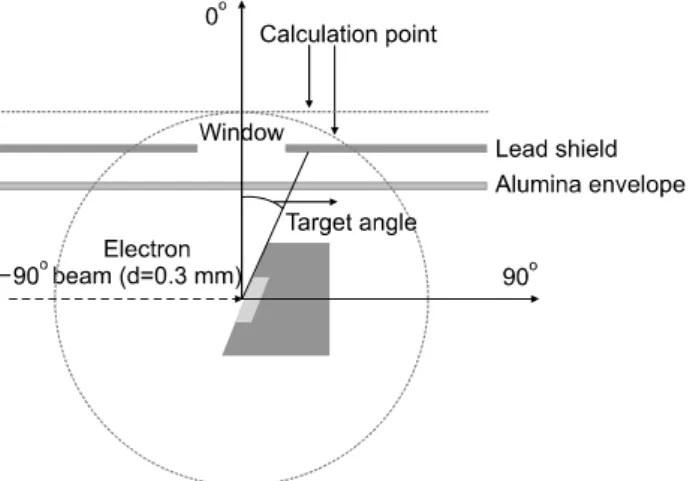
Fig. 1. Geometry for Monte Carlo simulation of x-ray intensity and assessment of anode heel effect. The position of detectors for calculation of x-ray beam intensity is also shown.

Here, we investigate the effect of a target thickness and anode angle of the x-ray target on the x-ray intensity and uniformity. This paper also addresses the anode heel effect and off-axis spectra for different target angles.

Materials and Methods

In this study, the x-ray tube consists of an evacuated 1 mm alumina envelope, which provides vacuum, support and elec- trical insulation, containing a filament cathode and a tungsten anode. The alumina envelopes are particularly strong mechani- cally. The envelope is encased in lead shield with an opening window. MCNPX simulations were run for x-ray tube poten- tials of 70 kV. In this work, we used MCNPX to simulate the diagnostic x-ray tube with the aim of predicting the x-ray in- tensity with different target thicknesses and different anode an- gles (between 12

o

and 35

o

).

The procedure of x-ray production consists of tracking a large number of electrons incident on the target until they are absorbed or emerge from it, and calculating the number of bremsstrahlung and characteristic photons produced by them during their travel within the target.

6)

For simulation of x-ray spectra, MCNPX was run in photon and electron mode (mode:

P, E) using default values for PHYS:P and PHYS:E cards to enable full electron and photon transport. The simplified geom- etry configuration of the x-ray target is shown in Fig. 1 which

has been used as input for the MCNP code.

Spatial and energy distributions of the bremsstrahlung and characteristic photons exiting the x-ray target and alumina en- velope were determined using a point detector (F5) tally of the MCNPX code. In this method, the transport of particles to- wards the detector is replaced by a deterministic estimate of potential contribution to the detector.

7)

The point detector tally measures photon flux at a point (unit is photons cm

−2

), which is normalized to be per starting particle. The point detectors were arranged in the calculation points in Fig. 1 to calculate the x-ray intensity around the target. According to the MCNP user manual,

7)

an uncertainty of less than 5% is required for point detector tally to produce a generally reliable confidence interval. The maximum uncertainty regarding the number of produced photons within each energy bin of widths 1 keV is less than 0.2%.

When the electrons strike the target, the code transports the electrons inside the target material until they are stopped after losing its kinetic energy. During the electron transport, all bremsstrahlung and characteristic x-ray production is con- sidered. The calculated spectrum is then normalized to the to- tal number of photons in the spectrum.

A mono-energy electron beam incident to the target with different target angles and thickness. In a target, the amount of x-rays produced will increase with increasing thickness of the targets until electrons are stopped after losing their kinetic energy. It is obvious that, by increasing the thickness, the amount of self-absorption will also increase. Therefore, there is an optimum thickness that can produce the maximum amount of a usable x-ray. The optimum thickness of a tungsten target is obtained in this work.

Results and Discussion

Fig. 2 shows the x-ray intensity as a function of tungsten target thickness at the calculation angle of 0 degree. Using a greater thickness for tungsten target will not change the x-ray amount produced. Therefore, for a specific electron energy, one cannot increase the x-ray intensity by increasing the thick- ness of the tungsten target. In this work, the optimum thick- ness of W target was 3 μm for the 70 kV electron potential.

At less than optimum thickness of tungsten target, the x-ray

(3)

Fig. 2. X-ray intensity for different thicknesses of tungsten

target material. Fig. 4. The angular distribution of the x-ray intensity emitted by the tungsten target for 3 μm target thickness.

Fig. 5. The x-ray intensity variation with anode angle for 3 μm target thickness.

Fig. 3. The x-ray spectrum without Alumina envelope for target angle 12 degree at 10 cm distance from the target position.

production was significantly reduced. As the thickness of tung- sten is increased beyond the optimum, there was no intensity difference.

The x-ray spectrum simulated by MCNPX without the alu- mina envelope for 12 degree target angle at calculation angle 0 degree was shown in Fig. 3. In the energy spectrum charac- teristic x-ray can be seen with energies around 9.5 keV. The low energy x-ray should normally be avoided since they can- not penetrate thick objects. Therefore, the low energy x-ray does not contribute to the image quality but only to the energy deposition in the patient.

The angular distributions of x-ray intensity were obtained for different target angles from 12 to 35 degrees as shown in

Fig. 4. The length of the path taken to emerge from the target depends on the angle of emission. As seen in Fig. 4, path 2 is longer than path 1 in the tungsten. With increasing the anode angle, more photons can reach the useful x-ray because the self-absorption of the anode decreases with the anode angle being increased. However, it should be mentioned that there is a considerable trade-off between anode angle which determines the focal spot size and the geometric penumbra.

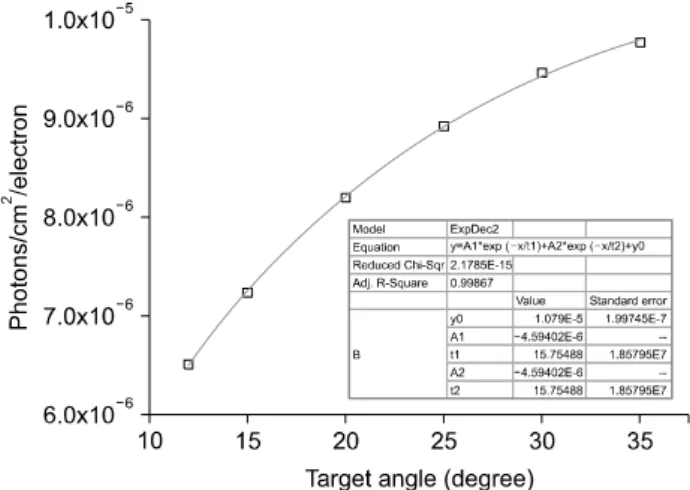
In Fig. 5, the x-ray intensity per initial electron was calcu-

lated for different tungsten target angles at calculation point 0

degree. The objective was to determine the angle with the

highest photon intensity per initial electron striking on the

target. It can be seen that photon intensity is raised with anode

(4)

Fig. 6. Illustration of anode heel effect for different anode angles and target thicknesses.

Fig. 7. The x-ray spectra with 1 mm alumina envelope for the target angle 12 and 35 degree at 10 cm distance from the target position.

Fig. 8. Off-Axis x-ray intensity for target angle 12 (a) and 35 degree (b).

angle from 12 to 35 degrees. In this study, the optimum anode angle based only on x-ray intensity information was 35 degree.

However, other considerations, including heel effect and pe- numbra, should be taken into account for a better anode angle choice.

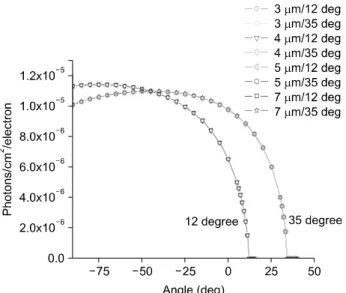
Fig. 6 shows the anode heel effect for different target angles and thicknesses. Beyond the optimum target thickness, which is 3 μm, target thicknesses cannot affect x-ray beam angular distributions. More photons can reach the useful x-ray for tar- get angle 35 degree than 12 degree because the self-absorption

of the anode decreases with the anode angle being increased.

In the useful x-ray beam (10 degree anode side until −10 de- gree cathode side), the x-ray intensity for the target angle 35 degree is 61% higher than 12 degree.

One of the most important parameters influencing the qual- ity of the x-ray spectrum is filtration. The produced x-ray beam after attenuation in the target passes through the tube’s alumina ceramic envelope for the attenuation of soft x-rays.

Fig. 7 shows simulated x-ray spectra for the target angle 12

and 35 degreees, respectively. In the energy spectrum charac-

teristic x-ray cannot be seen with energies around 9.5 keV.

(5)

The effect of alumina envelope in attenuation of low-energy x-ray is also obvious by comparing Fig. 3 with Fig. 7.

Another problem in x-ray imaging is nonuniformity of x-ray intensity in the direction perpendicular to the anode–cathode axis. Fig. 8 shows the variation of x-ray intensity on this axis for target angle 12 and 35 degree as a function of window diameter. The off-axis x-ray intensity is identical on both sides of the central axis for target angle 35 degree and the absorp- tion at small target angles, 12 degree, is higher than that at large target angles on anode side of central axis.

Conclusion

To design a x-ray tube, it is necessary to determine the thickness of the target material. This work studied tungsten as target material. The simulation results reveal that the thickness of a tungsten target is parameter that affects the intensity of generated x-rays. The optimized thickness of a target material was calculated to maximize the x-ray intensity produced from a tungsten target materials for a 70 keV electron energy. Our results also showed that the anode angle has an influencing ef- fect on heel effect and beam intensity across the beam. This

information is useful for x-ray tube design to improve image quality in diagnostic radiology. Additionally, the calculated MC model can be used either for further studies on its dosim- etry or for the application of animal x-ray imaging.

References

1. Cheng Y, Zhang J, Lee YZ, Gao B, Dike S, Lin W et al:

Dynamic radiography using a carbon-nanotube-based field- emission x-ray source. Review of scientific instruments 75(10):

3264-3267 (2004)

2. Knoll GF: Radiation detection and measurement. John Wiley &

Sons (2010)

3. Ay MR, Shahriari M, Sarkar S, Adib M, Zaidi H: Monte Carlo simulation of x-ray spectra in diagnostic radiology and mammography using MCNP4C. Physics in medicine and biology, 49(21):4897-4917 (2004)

4. Acosta E, Llovet X, Coleoni E, Riveros J, Salvat F:

Monte Carlo simulation of x-ray emission by kilovolt electron bombardment. Journal of applied physics 83(11):6038-6049 (1998) 5. Pelowitz DB: MCNPX user’s manual version 2.5. 0. Los Alamos

National Laboratory (2005)

6. Kulkarni R: Supe S. Monte Carlo calculations of mammographic

x-ray spectra. Physics in medicine and biology 29(2):185 (1984)

7. Briesmeister J: A General Monte Carlo N-Particle Transport

Code, MCNP. Los Alamos National Laboratory, ORNL-13221,

Oak Ridge, TN, USA (2000)

수치

Fig.  1.  Geometry  for  Monte  Carlo  simulation  of  x-ray  intensity  and  assessment  of  anode  heel  effect
Fig.  3.  The  x-ray  spectrum  without  Alumina  envelope  for  target  angle  12  degree  at  10  cm  distance  from  the  target  position.
Fig.  6.  Illustration  of  anode  heel  effect  for  different  anode  angles  and  target  thicknesses.

참조

관련 문서

Excitation Detection X-ray photoelectron spectroscopy (XPS) Photons(X-ray) Electrons UV photoelectron spectroscopy (UPS) Photons (UV) Electrons

- The effect of the motif (one wide slit) is to alter the intensity of each main peak, but the position of the main peaks are unchangedD. - intensity envolope →

Most line searches used in practice are inexact: the step length is chosen to approximately minimize f along the ray {x + t∆x |t ≥ 0}, or to reduce f enough...

A is the number of photons per nuclear transformation – L x-rays for transuranium elements, and gamma rays for fission and

This research is to conduct comparative analysis on the rain intensity of expected rainfall depth of the research-use X-band dual-polarimetric radar with that of actually

The structure and film optical properties were investigated by X-ray diffraction(XRD), the particle size and thickness were investigated by scanning

Single crystal X-ray structure determination clearly revealed structural authenticity of each compound and alluded electronic alteration via investigation on the

Postoperative X-ray (A : ankle lateral view, B : calcaneal axial view), Böhler angle and Gissane angle have recovered (Böhler angle is 32.2°, Gissne angle is 105.5°,