• 검색 결과가 없습니다.

Complexity in Regulation of MicroRNA Machinery Components in Cervical Cancer

N/A
N/A
Protected

Academic year: 2021

Share "Complexity in Regulation of MicroRNA Machinery Components in Cervical Cancer"

Copied!
7
0
0

로드 중.... (전체 텍스트 보기)

전체 글

(1)

Corresponding Author: Shin Kim, M.D., Department of Immunology, Keimyung University School of Medicine 1095 Dalgubeol-daero, Dalseo-gu, Daegu 704-701, Korea

Tel : +82-53-580-3884 E-mail : [email protected]

Introduction

Cervical cancer is the third most common malignancy among women worldwide according to the most recent estimates of the global cancer incidence [1]. It has been reported that seven

leading primary cancer sites in female during 2009 in Korea were lung, stomach, colon and rectum, liver, breast, and cervix uteri [2]. In Korea, changes of annual percentage in age-standardized incidence rates for cervical cancer were-4.4% in women between 1999 and 2009 based on world

Abstract

Altered expression of microRNA (miRNA) machinery components may play an important role in cervical cancer progression. The objective of current study was to evaluate Drosha, the DiGeorge syndrome critical region gene 8 (DGCR8), Dicer, and Argonaute 2 (AGO2) mRNA expression in cervical cancer. By using quantitative real-time PCR, mRNA expression levels of the four miRNA machinery components were examined in 31 cervical cancer tissues and adjacent histologically non-neoplastic tissues. In the present study, mRNA expression levels of major miRNA machinery components were variable among cervical cancer tissues. The altered mRNA expression levels of AGO2 and DGCR8 were positively correlated with each other. For the first time, this study revealed that the positive correlation between altered mRNA expression levels of each miRNA machinery components in cervical cancer tissues.

Key Words : AGO2, Biogenesis, Cervical cancer, DGCR8, Dicer, Drosha, MicroRNA

Department of Immunology & Institute for Cancer Research, Keimyung University School of Medicine, Daegu, Korea

Shin Kim, M.D.

Complexity in Regulation of MicroRNA Machinery Components

in Cervical Cancer

(2)

standard population as a standard population [2].

Although the incidence of cervical cancer has been shown to decrease, the definite pathogenesis of cervical cancer is still unclear. So it would be n e c e s s a r y t o a s s e s s t h e m e c h a n i s m s o f pathogenesis by approaching strategy through diverse methods.

MicroRNA (MiRNA) is a recently described class of highly conserved, small non-protein coding RNA molecules which regulates gene expression on the post-transcriptional level by translational repression or cleavage of the target mRNA [3].

miRNAs have sequences of approximately 17~21 nucleotides and have been shown to involve in various important biological processes including cellular development, differentiation, proliferation, cell death, metabolism, and carcinogenesis [4-6].

The biogenesis of miRNA is accomplished by a set of enzymes, collectively referred to as the “miRNA machinery” [7]. MiRNA biogenesis is regulated by several miRNA machinery components including Drosha, Dicer, the DiGeorge syndrome critical region gene 8 (DGCR8), and Argonaute (AGO).

Drosha, a nuclear ribonuclease, is a part of a multiprotein complex, the microprocessor, which cleaves primary miRNAs (pri-miRNAs; consisting of a hairpin stem, a terminal loop, and 5’ and 3’

single-stranded RNA extensions) into precursor miRNAs (pre-miRNAs; approximately 60-70 nucleotide stem-loop structure) in nucleus [8]. In addition to Drosha, DGCR8 is also a part of the microprocessor complex and has been shown to be essential for miRNAs maturation [9]. Within cytoplasm, the pre-miRNAs are further processed by a multidomain Dicer, which also belongs to the class of RNAse III endonucleases, into short double-stranded molecules, mature miRNAs [10].

The gene expression regulating effects of miRNAs are accomplished by the RNA-induced silencing complex (RISC), multiprotein effector complex

with endonuclease activity, which integrates mature miRNA strands [3]. The RISC is the main element of the RNA silencing process and consist of several different proteins that comprise a multiprotein complex, including AGO1, AGO2, and the dsRNA-binding protein PACT [11]. A number of interesting reports have provided that human disorders, including malignant tumors, are frequently associated with global alterations in the miRNA machinery components, comprising irregular expression and function of the key factors such as Drosha, DGCR8, Dicer, and AGO [12].

Therefore, the mRNA expression levels of miRNA machinery components were compared and analyzed in cervical cancer tissues and corresponding adjacent non-neoplastic tissues from same patients. Moreover, the mRNA expression levels of AGO2 and DGCR8 were correlated with each other.

Materials and Methods

Patients and tissues

Altogether, thirty-one patients diagnosed with cervical cancer (24 squamous cell carcinoma, 5 adenocarcinoma, 1 glassy cell carcinoma, 1 adenosquamous carcinoma) were included in the study. Cervical carcinomas and adjacent non- neoplastic tissues were obtained from the patients who received surgery in Dongsan Medical Center (Daegu, Korea) from May 2008 to June 2010.

Tissue samples were immediately frozen in liquid nitrogen and stored at-80℃ until RNA isolation.

Tissue samples were provided from Keimyung

Human Bio-resource Bank, Korea. The purpose of

this study was explained to all patients and

informed consent was obtained from each study

participant. The protocols were approved by the

(3)

Institutional Review Board of Keimyung University Dongsan Medical Center (approval #11-199-1).

Isolation of RNA and quantitative real-time PCR

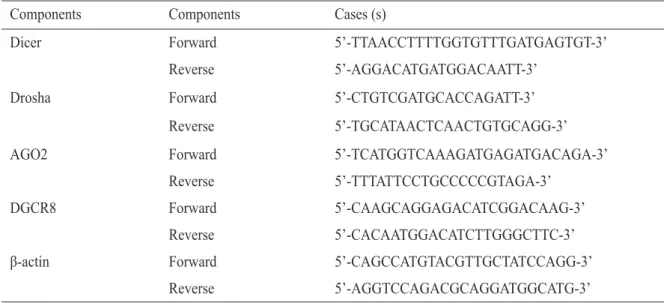
Total cellular RNA was extracted from tissues using the TRIzol reagent (Molecular Research Center, Inc., Cincinnati, OH, USA). RNA was quantified using Nanodrop 1000 (Thermo Scientific, Wilmington, Denmark). Each cDNA was synthesized from 2 μg of total RNA using M-MLV reverse transcriptase (Promega, Madison, WI, USA) according to the manufacturer’s protocol. By using the specific primer pairs described in Table 1 and S Y B R G R E E N P r e m i x (T O Y O B O, J a p a n), quantitative real-time PCR (qPCR) was performed on the LightCycler

480 real-time PCR system (Roche Diagnostics, Mannheim, Germany). β-actin was used as a housekeeping gene for normal- ization, and no template sample was used as a negative control.

Statistical analysis

Statistical analysis was performed with SPSS 18.0 (SPSS Inc., Chicago, IL, USA). Statistical comparisons for significance were made with Wilcoxon signed-rank test for paired samples.

Correlations between relative mRNA expressions of inter-individual miRNA machinery components were analyzed by the Pearson’s correlation coefficient analysis. Generally, p value of less than 0.05 was established to denote significance in all statistical analyses performed in the study.

Results

Expression levels of miRNAs machinery components in cervical cancer

The mRNA expression levels of miRNAs machinery components were quantified by qPCR in paired samples of cancer tissues and adjacent non-cancer tissues from 31 patients with cervical

Table 1. Primer sequences of miRNA machinery components used in quantitative PCR

Components Components Cases (s)

Dicer Forward 5’-TTAACCTTTTGGTGTTTGATGAGTGT-3’

Reverse 5’-AGGACATGATGGACAATT-3’

Drosha Forward 5’-CTGTCGATGCACCAGATT-3’

Reverse 5’-TGCATAACTCAACTGTGCAGG-3’

AGO2 Forward 5’-TCATGGTCAAAGATGAGATGACAGA-3’

Reverse 5’-TTTATTCCTGCCCCCGTAGA-3’

DGCR8 Forward 5’-CAAGCAGGAGACATCGGACAAG-3’

Reverse 5’-CACAATGGACATCTTGGGCTTC-3’

β-actin Forward 5’-CAGCCATGTACGTTGCTATCCAGG-3’

Reverse 5’-AGGTCCAGACGCAGGATGGCATG-3’

(4)

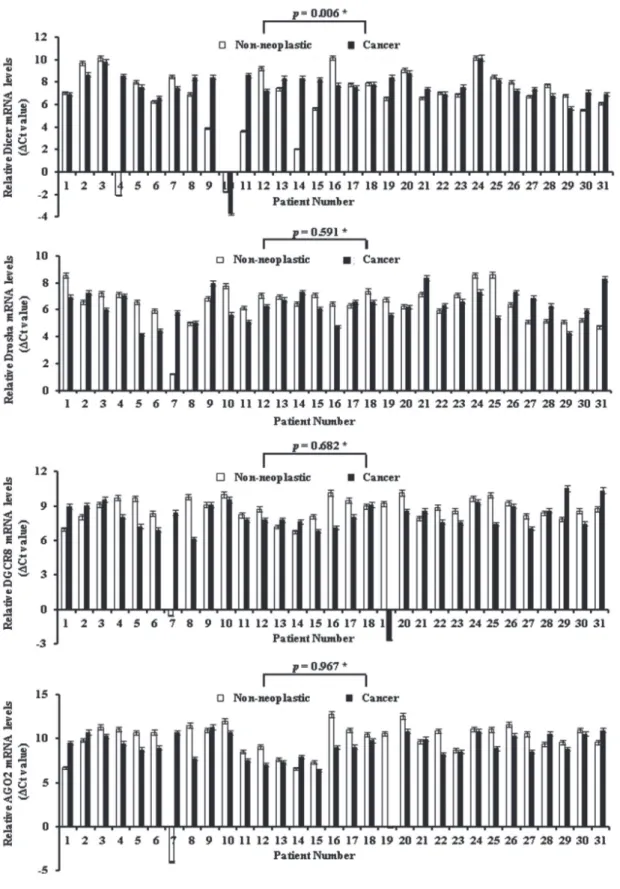
Fig. 1. The relative Dicer, Drosha, DGCR8, and AGO2 mRNA levels (normalized to the corresponding β-actin

mRNAs) in cervical cancer tissues compared to adjacent non-neoplastic tissues. *Wilcoxon signed rank Test.

(5)

cancer. Each mRNA level of components was normalized to the level of β-actin mRNA. Among four components only Dicer mRNA expression was significantly different between cervical cancer tissues and the corresponding non-neoplastic

tissues ( p =0.006, Fig. 1). However, the mean value of Dicer mRNA expression level in cervical tissues was not different between cancerous and non- neoplastic cervical tissues (Fig. 2).

Relationship between mRNA expression levels o f i n t e r-i n d i v i d u a l m i R N A m a c h i n e r y components in patients with cervical cancer

Prior to statistical analysis, raw qPCR data of Dicer, Drosha, DGCR8, and AGO2 mRNA expression were normalized to reference gene, β-actin. Then, qPCR data were analyzed by the 2

-ΔΔct

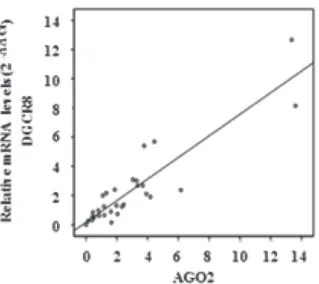
method [13]. To investigate significant correlation between mRNA levels of inter- individual miRNA machinery components in cervical cancer, correlations of the four selected miRNA machinery components were evaluated. As shown in Fig. 3, there were significant associations between AGO2 and DGCR8 with Pearson correlation coefficient value of 0.903 in cervical cancer ( p < 0.001).

Fig. 2. The relative Dicer, Drosha, DGCR8, and AGO2 mRNA expression in cervical cancer group and in the non- neoplastic group.

Fig. 3. Correlation between mRNA expressions of

AGO2 and DGCR8 in cervical cancer. * p < 0.001.

(6)

Discussion

Dysregulations of the miRNA machinery components have previously been linked to a variety of different cancers [14]. Although various papers have revealed alterations of microRNAs (miRNAs) expression profiles and their functional roles in cervical cancer [15-17], there have been few studies on the miRNA machinery itself.

In this study, the expression of the miRNA machinery components, which consists of extra- and intranuclear miRNA maturation components (Dicer, Drosha and DGCR8) and the extracellular m i R N A e f f e c t o r R I S C (A G O2) h a v e b e e n systematically investigated in cervical cancer. It has been reported that Drosha is up-regulated but DGCR8 is unchanged in cervical cancer [18]. In the present study, Dicer, Drosha, DGCR8, and AGO2 mRNA expressions are variable among cervical cancer specimens. Although there was a significance in statistical comparisons with Wilcoxon signed-rank test for paired samples of Dicer mRNA expression level, up-regulated Dicer mRNA level was shown more in malignant tissues than compared to the corresponding non- neoplastic tissues in 17 of the 31 patients with PTC (54.8%). Furthermore, only 4 cases were more than doubled in Dicer mRNA expression levels.

Drosha, DGCR8, and AGO2 mRNA expression levels were not significantly different between cervical cancer tissues and the corresponding non- neoplastic tissues (Fig. 1). Although it would be necessary to evaluate the regulations of miRNA machinery components in more cases of cervical cancer, these results suggested that the mRNA expression levels of Dicer, Drosha, DGCR8, and AGO2 are not remarkably changed in cervical cancer tissues compared to corresponding non- neoplastic tissues.

Although mRNA expression levels of Dicer,

Drosha, and AGO2 were strongly and positively correlated to each other in colorectal carcinoma [7], there were few studies to compare inter-individual miRNA machinery components in strictly pair- matched samples of cervical cancerous tissues and adjacent non-neoplastic tissues. Thus, in present study, the correlation between expression levels of inter-individual miRNA machinery components in cervical cancer was evaluated by using the Pearson’s correlation coefficient analysis. It appeared that mRNA expression levels of AGO2 and DGCR8 are positively correlated with one another (Fig. 3).

For the first time, I investigated the expression patterns of four selected miRNA machinery components and their inter-relation in cervical cancer. The mRNA expression levels of major miRNA machinery components were variable in cervical cancer tissues. However, the mRNA expression levels of AGO2 and DGCR8 were positively correlated with one another. These results suggested that altered mRNA expression levels of miRNA machinery components may not be related with cervical carcinogenesis and AGO2 and DGCR8 may share partially common regulating mechanisms in cervical cancer.

Acknowledgements

This work was supported by Dong-Il Culture and Scholarship Foundation of Korea, 2012. The biospecimens for this study were provided by the Keimyung Human Bio-Resource Bank, a member of the National Biobank of Korea, which is supported by the Ministry of Health and Welfare.

All samples derived from the National Biobank of Korea were obtained with informed consent under institutional review board-approved protocols.

Especially, I thank Chi-Heum Cho, M.D. for

(7)

providing specimens and Sun Young Kwon, M.D., Ph.D. for professional advisement about cervical cancer histopathologically.

References

1. Siegel R, Naishadham D, Jemal A. Cancer statistics, 2012. CA Cancer J Clin 2012;62:10-29.

2. Jung KW, Park S, Kong HJ, Won YJ, Lee JY, Seo HG, et al. Cancer statistics in Korea: incidence, mortality, survival, and prevalence in 2009. Cancer Res Treat 2012;44:11-24.

3. Bartel DP. MicroRNAs: genomics, biogenesis, mechanism, and function. Cell 2004;116:281-97.

4. Li PY, He FC, Zhou GQ. [Association of human microRNA related genetic variations with cancer]. Yi Chuan 2011;33:870-8.

5. Schmittgen TD. Regulation of microRNA processing in development, differentiation and cancer. J Cell Mol Med 2008;12:1811-9.

6. Shen J, Stass SA, Jiang F. MicroRNAs as potential biomarkers in human solid tumors. Cancer Lett 2013;329:125-36.

7. Papachristou DJ, Korpetinou A, Giannopoulou E, Antonacopoulou AG, Papadaki H, Grivas P, et al.

Expression of the ribonucleases Drosha, Dicer, and Ago2 in colorectal carcinomas. Virchows Arch 2011;459:431-40.

8. Lee Y, Han J, Yeom KH, Jin H, Kim VN. Drosha in primary microRNA processing. Cold Spring Harb Symp Quant Biol 2006;71:51-7.

9. Gregory RI, Yan KP, Amuthan G, Chendrimada T, Doratotaj B, Cooch N, et al. The Microprocessor complex mediates the genesis of microRNAs. Nature 2004;432:235-40.

10. Tijsterman M, Plasterk RH. Dicers at RISC; the

mechanism of RNAi. Cell 2004;117:1-3.

11. Sand M, Skrygan M, Georgas D, Arenz C, Gambichler T, Sand D, et al. Expression levels of the microRNA maturing microprocessor complex component DGCR8 and the RNA-induced silencing complex (RISC) components argonaute-1, argonaute-2, PACT, TARBP1, and TARBP2 in epithelial skin cancer. Mol Carcinog 2012;51:916-22.

12. Mockenhaupt S, Schurmann N, Grimm D. When cellular networks run out of control: global dysregulation of the RNAi machinery in human pathology and therapy. Prog Mol Biol Transl Sci 2011;102:165-242.

13. Schmittgen TD, Livak KJ. Analyzing real-time PCR data by the comparative C (T) method. Nat Protoc 2008;3:1101-8.

14. Gartel AL, Kandel ES. RNA interference in cancer.

Biomol Eng 2006;23:17-34.

15. Luo M, Shen D, Zhou X, Chen X, Wang W.

MicroRNA-497 is a potential prognostic marker in human cervical cancer and functions as a tumor suppressor by targeting the insulin-like growth factor 1 receptor. Surgery 2013.

16. Shen SN, Wang LF, Jia YF, Hao YQ, Zhang L, Wang H. Upregulation of microRNA-224 is associated with aggressive progression and poor prognosis in human cervical cancer. Diagn Pathol 2013;8:69.

17. Yamamoto N, Kinoshita T, Nohata N, Itesako T, Yoshino H, Enokida H, et al. Tumor suppressive microRNA-218 inhibits cancer cell migration and invasion by targeting focal adhesion pathways in cervical squamous cell carcinoma. Int J Oncol 2013;42:1523-32.

18. Cheloufi S, Dos Santos CO, Chong MM, Hannon GJ.

A dicer-independent miRNA biogenesis pathway that

requires Ago catalysis. Nature 2010;465:584-9.

수치

Table 1.  Primer sequences of miRNA machinery components used in quantitative PCR
Fig. 1. The relative Dicer, Drosha, DGCR8, and AGO2 mRNA levels (normalized to the corresponding β-actin  mRNAs) in cervical cancer tissues compared to adjacent non-neoplastic tissues
Fig. 3. Correlation between mRNA expressions of  AGO2 and DGCR8 in cervical cancer. * p &lt; 0.001.

참조

관련 문서

Multivariable Cox proportional regression by diagnosis year of mental disorders according to diagnosis of cervical cancer ···

* Often the configuration of atoms that has the minimum free energy after mixing does not have the same crystal structure as either of the pure components. In such cases

The stain field associated with a dislocation can in certain cases provide a favorable interaction with the strain field of the martensite nucleus, such that one of the

In order to make it possible for the flow control of the vane pump to be applied in an automatic transmission, it is very necessary to analyze the variation in

Percutaneous endoscopic cervical discectomy (PECD) is an effective minimally invasivesurgery for soft cervical disc herniation in properly selected cases..

In conclusion, it is suggested that: (a) there be educational programs for developing personality on the part of juveniles in order to prevent and

purpose of introducing the representative lawsuits in such a trend, it is necessary to review the status of representative cases and judicial issues in

Conclusion : The results reveal that it is not unusual that pedestrians are injured by automobiles in daily life. Awareness of risk factors would be useful in