• 검색 결과가 없습니다.

Study on Characteristics of Displacement and Stress of Piers under Adjacent load

N/A
N/A
Protected

Academic year: 2021

Share "Study on Characteristics of Displacement and Stress of Piers under Adjacent load"

Copied!
7
0
0

로드 중.... (전체 텍스트 보기)

전체 글

(1)

Study on Characteristics of Displacement and Stress of Piers under Adjacent load

Bo Song

a,b,*

,Jingxing Zhang

a,b

,Zunke Zhang

a,b

,Yanxuc Wang

c

, Taehwan Kim

d

a

University of Science and Technology Beijing, 100083, China

b

Beijing international cooperation for science and technology-Aseismic research of the rail transit engineering in the strong motion area, Beijing, 100083, China

c

Road Administration of Beijing Municipal Commission of Transport, 101300, China

d

Department of Security Service, University of Yongin, 470 Samga Dong, Gyeonggido 449-714, Republic of Korea

A B S T R A C T KEYWORDS

Nowdays, adjacent loading bringing enormous harm to the existing bridge in engineering construction. In this paper, the influencing mechanism of adjacent loading to pier and Law of displacement of pier is researched through living examples, and the safe influence area has been defined. Research shows that: the main damages to piers is caused by the side loading; lateral displacement index of pier top surface is more conservative than the pier additional stress index; it is secure when the distance of adjacent load is 0.5 times of the height of accumulation or 6m, otherwise it would be very scary, and the monitoring measure is necessary.

Evaluation of adjacent load Mechanical characteristics Safety threshold of adjacent load Lateral displacement of pier

ⓒ 2016 Korea Society of Disaster Information All rights reserved

* Corresponding author. Tel. 0086 10 13366236292. Email.

[email protected]

ARTICLE HISTORY Recieved Feb. 28, 2016 Revised Mar. 10, 2016 Accepted Mar. 30, 2016

1976-2208 ⓒ 2016 Korea Society of Disaster Information All rights reserved.

http://dx.doi.org/10.15683/kosdi.2016.3.31.40

(2)

1. Introduction

In recent years, the accidents due to approaching construction occur more frequently. For structures such as bridges which are extremely sensitive to the external environment, wrongful construction brings danger to bridge structures, and leads to collapse even, thus engineering accidents emerge endlessly: On June 27, 2009, a 13 story building under construction in Shanghai Lianhua Road Lotus Riverside overall capsized as a result of unreasonable bulldozer and excavation(Fig.1(a)); At November 2009 a wall near Changzhou Palace of Culture collapsed because of unreasonable bulldozer surrounding during the construction process; On May 9, 2013, a road embankment at the Zhoushi exit of Shenzhen Expressway collapsed by adjacent accumulation when heavy rain continuous. A large number of engineering accidents show that it is incidental the lateral movement, deflection and overall capsize under unreasonable heaped load.

Especially to bridges, etc, which are extremely sensitive to deformation, large amount of sediment near the existing buildings leading to lateral displacement, slope, then influencing the normal operation of buildings and even overall collapse. It is common that bulldozer accumulated near bridges (Fig.1(b)). It is extremely strict to displacement of piers, even a small displacement may cause unsmoothness and the danger of vehicle bump at bridge head and even fall beam.

(a) Overall collapse for accumulated impertinently (b) Bulldozer near bridge piers Fig. 1. Adverse effect of adjacent load to existing buildings

This study or paper focuses on the pier structure of the existing bridges and combines with practical engineering examples, to study the mechanical and deformation characteristics of existing bridge foundation under conditions of complicated adjacent load and to study the computational method of safety distance between existing bridge piers and accumulation under different height.

2. The finite element modelling of bridge with different loading

Pile foundation was selected in this study . The bridge pier model is established with the entity unit, and the soil constitutive

model is established with Mohr-Coulomb model, which obeys the Mohr-Coulomb failure criterion, and the effect of tension

is attached. The pile is simulated with beam element, which can be simplified into linear, the element material is reinvest to

line elements, frictional contact element is adopted between pile and soil, what’s more the braced structure also simulated with

beam element, the beam and bracing is reinvest to line elements together, the model characteristics are attached according to

the section shape and the material. The concrete material of bridge piers and underground continuous wall is C30, the modulus

of elasticity Ec=30Gpa, density is ρc=25KN/m3, adopting elasticity constitutive model. The layers of the model is divided into

layer-3, which including plain fill, clay and weathering layers, the engineering codes of every soil layer as shown in Tab.1.

(3)

Ceteris paribus ,the distance of the adjacent load(D) in this article is supposed D0=0m, 4 m, 8 m, 12 m, 16 m, 20 m, 24 m, 28 m, 32 m, 36 m, the modeling of adjacent load is established respectively (Fig.2- Fig. 4). Assuming the original displacement is 0m, the adjacent load model was establish with the Midas-GTS finite element software, to study the influence to the existing bridges of different distance of the adjacent load and different height of bulldozer. The generation of mesh and construction procedure as follows: the mesh was generated as hexahedral geotechnical unit of regulated the size of 2×1×2m, which based on mapping approach. To make sure the result more accurate, the meshing of bridge pier and the pile caps should be local refinement. The process of embankment loading is divided into five steps, the height of the first embankment loading is 4m, and the highest of embankment loading is 20m.

To observe the deformation diagram (Fig.5) of the model after extracting calculation conveniently, enlarger the deformation 3 times. As is known: the maximum distortion of the model occur in the mound model and the soil which is under the accumulation ,the maximum distortion is 70cm;The main effect on the existing bridges of adjacent load is the lateral shift along the opposite direction of adjacent load, with more earthwork is piled, the lateral shift of the existing bridges enlarger, the maximum lateral shift is 7.12cm.

(a) Deformation pattern after

excavation (b) Deformation vector diagram (c) Lateral deformation figure of piers

Fig. 5. Deformation pattern after excavation

Name soil

thickness H(m)

Specific weight γ (kN/m3)

elasticity modulus E(kN/m2)

poisson's

ratio μ Cohesion

c (Kpa) internal friction angle ψ(°)

bulldozer 3 18 5000 0.29 16 20

plain fill 3 18 5000 0.29 16 20

clay 8 19 12000 0.33 33 28

windblown soil 19 21.3 24000 0.3 45 30

existing pier - 25 30 0.2 - -

Tab.1 Soil parameter

Fig.2. Schematic diagram with different distance

Fig.3. model sketches with

different distance Fig.4. Calculation model figure

(4)

3. The finite element modelling of bridge with different loading

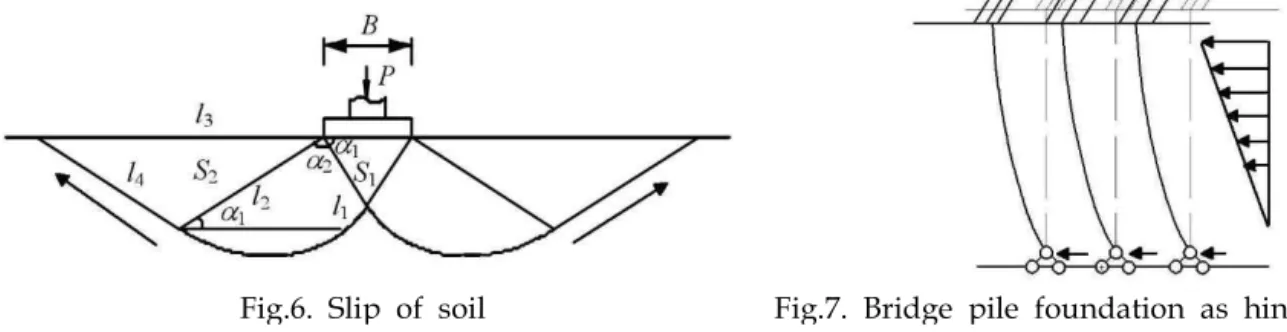
The influence of dead loads can be seen as the process of destruction of shear panels which occur at the unlimited-range soil with half-freedom. According to the failure model (Fig.6) of foundation which was raised by Prandl, the plastic zone only developed to a range of foundation at the initial stage of load, the sliding surface of soil have not extended to the ground, while the ground on both sides of the foundation was upheaved slightly without obvious cracks. The ground movements on both sides of the foundation lead to the lateral displacements of bridge, however, as a result of the restrained action of the bridge pile tip the bottom of the bridge foundation has hinged shoe with initial displacement, which restricts the bottom displacements of the pile, leading to the increase of bending shear deformation and internal stress bending moment(Fig. 7).

Fig.6. Slip of soil Fig.7. Bridge pile foundation as hinged shoe

According to the static computation method in the Railway Bridge And Culvert Design Codes (TB10002·1—99) in our country, the lateral displacement of bridge piers and abutments along direction vertical the bridges is limited toΔ≤5L(mm).

It is regarded as the limiting value of lateral displacement of bridge piers and abutments the horizontal angle of axis between adjacent structures caused by lateral displacement in the Japanese Codes and the Eurocode. In the Japanese Codes the live loads of trains is considered only in the calculation of horizontal angle, When the bridge span L≥30m, the limiting value of horizontal angle is 4‰, when the bridge span L<30m, the limiting value of horizontal angle is 4‰. According to the Eurocode the limiting value of horizontal angle is 2‰, meanwhile the limiting value of minimum radius of horizontal curve is R≥9500m. Considered in conjunction with the bridge span, it is regulated in Chinese applicable that the limiting value of lateral displacement of bridge piers and abutments is l‰~2.04‰, which is same to the horizontal angle. So that according to the most unfavorable factors, it is regulated in the Railway Bridge Design Basic code (TB10002·1—99) about the lateral displacement of bridge piers and abutments along direction vertical the bridges: Δ≤5L(mm). The bridge span is 30m in this example, then the limiting value of lateral displacement minΔ=2.7cm by calculating when Δ≤2.7cm. The maximum additional stress of the bridge piers, which is much less than the stress criterion. It is more conservative than the limit value evaluation of additional stress that the limit value evaluation of the horizontal displacement on the top of abutment and pier along direction vertical the bridges, therefore, the limit value evaluation of the horizontal displacement should be used to guideposts to evaluate the influence of adjacent load of accumulation on piers.

Fig. 8. Horizontal angle of axis Fig .9. Stress of pile foundation limited

(5)

4. The stress analysis method under complicated condition

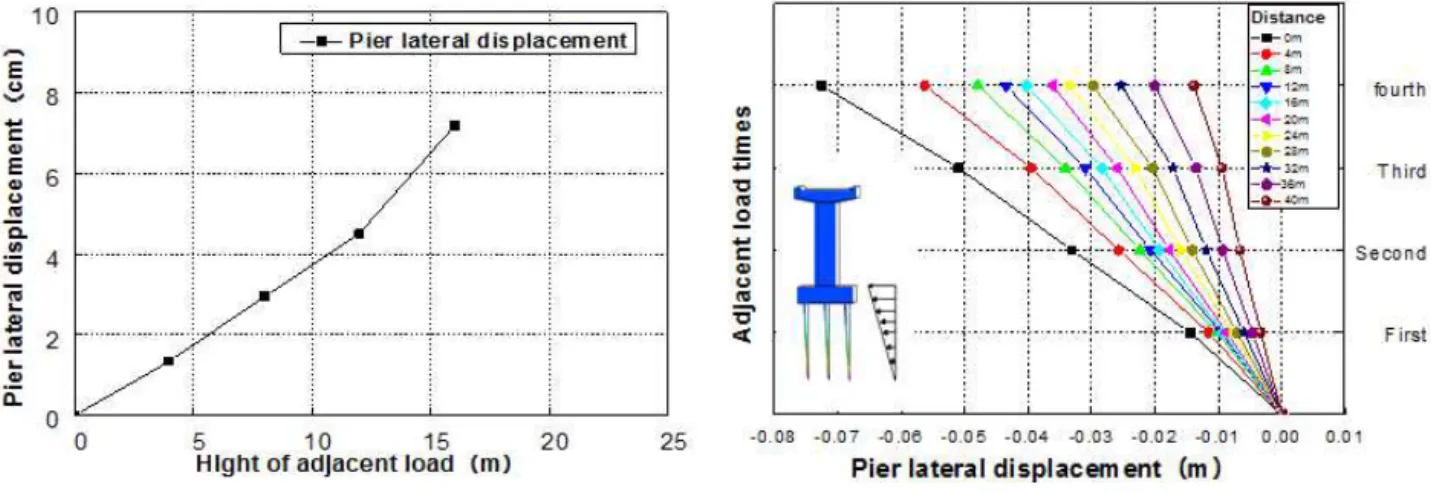
According to literature, the main influence factors to existing buildings of adjacent load is related to the distance of adjacent load(D), the height of adjacent load(H) and the sites condition, etc, which mainly leading to the soil rebound deformation for excavation unloading and causing deformation and displacement to the structure surrounding at the elastic range. Study the mechanism and law of different distances between accumulation and bridge pier while supposing the initial displacement is 0, and extracting data of lateral migration on the top of bridge pier increasing with height(Fig .10). Obviously, the lateral displacement of bridge piers increases with the accumulation enlarging, while the height of adjacent load H2=16m, the maximum lateral migration δmax=7.18cm. Based on the study of the relation on the height of adjacent load and the maximum lateral migration, the lateral migration of bridge pier increases linearly with the height of adjacent load, which within the range of elasticity.

Fig .10. Pier lateral displacement D=0 Fig .11. Curve relationship charts between distance and lateral displacement

When the distance between adjacent load of accumulation and bridge piers, the relationship of the height of adjacent load and the maximum lateral migration as follows:

Where . H2 : the height of temporary adjacent load δ : the lateral migration of bridge pier k : The linear effect rate

In the range of strength, the influence of adjacent load to bridge piers is linear, which determines the linear relationship

of range of adjacent load and the positive correlation relationship between exposure distance and adjacent load. While

extracting the lateral displacements of existing bridge of different adjacent distance, to drawn entity relationship diagram

(Fig.11) between adjacent distances and initial displacement. Obviously, the comparison between the maximum lateral

migration and the height of adjacent load declines with the adjacent distance increasing, it is the same with the linear

effect rate (k). While according to the limiting value of lateral displacement minΔ=2.7cm, the most dangerous condition

is that adjacent distance is 0. Meanwhile the linear effect rate (k) is maximum while the limiting value of height of adjacent

(6)

load is 6m. When the adjacent distance is 4m, according the formula the safety distance B0=H/2, the limiting value of height of adjacent load is 8m. The linear effect rate (k) of adjacent load declining with the adjacent distance increasing.

It is enough to ensure the safety while the adjacent distance exceeds 4m, on the contrary, it is necessary to ensure the height of adjacent load no more than 6m.

Therefore, the limiting value of safety distance of the adjacent load in this bridge shown as Fig. 12. While the safety range of adjacent load between B0>H/2 and 6m. The work should be tested when the distance of the adjacent load less than this range.

Fig .12. Safety distance of adjacent load

5. Conclusion

Considering the complexity of construction sites , the influence characteristic of adjacent load to bridge piers are different. Based on the computational model of simple supported girder bridge in this article, concluded as follows:

(1) The main damage of adjacent load to the existing bridge piers is the lateral deformation caused by adjacent load lateral, which transform linearly with the height of adjacent load within limits.

(2) The comparison between the maximum lateral migration and the height of adjacent load declines with the adjacent distance increasing, while the influence of lateral migration decreasing non-linearely.

(3) As to the key evaluation indicators influenced by adjacent load of accumulation, the limit value evaluation of the horizontal displacement on the top of pier is more conservative than the limit value evaluation of additional stress, which is more suitable to evaluate the influence of adjacent load of accumulation on piers.

(4) Compared to the Japanese code and the Europ code, the value of horizontal displacement constraint in Chinese code is more conservative.

(5) It is safety when the adjacent distance exceeds 0.5 times of the height of adjacent load or 6m. Work should be tested when the distance of the adjacent load less than this range.

Acknowledgements

This work was supported by Road Administration of Beijing Municipal Commission of Transport supported progrem—

Key Anti-collision Technology research on bridge under earthquake action and Oversea Famous Teachers Project of

Education Department(MS2011BJKJ005).

(7)

References

Li Zhong-cheng,Liang Zhi-rong(2010).” Calculation model and numerical analysis of passive piles subjected to adjacent surcharge loads.” Chinese Journal of Geotechnical Engineering, Vol.32, NO.S1, pp.128—134.

Guo W D. (2006). “On limiting force profile,slip depth and response of lateral piles”. Computers and Geotechnics, Vol.33, NO.1 pp.47–67.

Nie Ru-song, Leng Wu-ming, Yang Qi, Yue Jian, Yang Xiao-li (2009). “Field test and 3D FEM studies of bridge abutment on piled foundation subjected to embankment load.” Rock and Soil Mechanics, Vol.30, NO.9, pp.2862—2868.

Lu M M, Xie K H, Wang S Y (2011). “Consolidation of vertical drain with depth-varying stress induced by multi-stage loading.” Computers and Geotechnics, Vol.38, NO.8, pp.1096-1101.

LI Zhi-wei (2013). “Study of influence of surcharge load on lateral displacement of bridge piled foundation in soft ground”.

Rock and Soil Mechanics, Vol.34, NO.12, pp.3595—3600.

LIU Ziyou (2013). “Analysis of effect of group piles under situation of loading on surrounding soil.” Journal of Central South University (Science and Technology), Vol.44, NO.11, pp.4707—4711.

Dai Heng-jun, Liang Zhi-rong, Zhao Jun, Wei Xiang(2010). “Hong Chang-di. 3D numerical analysis of pile influenced by

lateral soil movement due to surcharge loads.” Chinese Journal of Geotechnical Engineering. Vol.32, NO,S2, pp.220—223.

수치

Fig. 5. Deformation pattern after excavation
Fig. 8. Horizontal angle of axis Fig .9. Stress of pile foundation limited
Fig .10. Pier lateral displacement D=0 Fig .11. Curve relationship charts between distance and lateral displacement
Fig .12. Safety distance of adjacent load

참조

관련 문서

In this regard, this study analyzes the effect of the job characteristics and work environment of workers with physical disabilities on job satisfaction

Objectives: This study aimed to investigate the relationship between job stress and turnover intention of employed opticians and to investigate the mediating effect of burnout

This study the changes in structure and mechanical characteristics by the analysis on mechanical characteristics of the welding part and the post weld

Therefore, the aim of this study was to investigate the morphologic characteristics of the interalveolar foramen and to analyze according to sex and age using cone

Objectives : The purpose of this study was to investigate the effects of general characteristics, health characteristics, mental health characteristics, suicidal

The purpose and necessity of this study was to investigate the effect of the 8-week GX complex exercise program on the stress index, blood lipid and APG

This study focuses on the energy-related legal system of Australia and examines (1) the general regulatory framework of energy industries, (2) the management and oversight

In this paper, we study characteristics of chromatic number which is the minimum number of colors when coloring adjacent vertices in different colors in graph coloring