47(2) : 110∼ 116 (2016)
110
미국가막사리 지상부의 항산화 성분
안달래1·김대근2*
1농촌진흥청 국립축산과학원 축산물이용과, 2우석대학교 약학대학
Antioxidant Components of the Aerial Parts of Bidens frondosa L.
Dalrae Ahn1 and Dae Keun Kim2*
1Animal Products Utilization Division, National Institute of Animal Science, Rural Development Administration, Iseo 55365, Korea
2College of Pharmacy, Woosuk University, Jeonju 55338, Korea
Abstract − As a part of an ongoing search for natural plants with antioxidant compounds by measuring the radical scavenging effect on 1,1-diphenyl-2-picrylhydrazyl (DPPH), a total extract of the aerial parts of Bidens frondosa L. (Compositae) was found to show potent antioxidant activity. Subsequent activity-guided fractionation of the methanolic extract led to the isolation of five compounds, quercetin-3-O-β-D-glucopyranoside (1), luteolin-7-O-β-D-glucopyranoside (2), 7,8,3',4'-tertrahydroxy- flavanone (3), okanin-4-O-β-D-glucopyranoside (4), and okanin (5). Their structures were elucidated by spectroscopic studies.
Compounds 3-5 were isolated for the first time from this plant. Among them, compounds 3 and 5 showed the significant radical scavenging effects on DPPH, and compounds 3 and 5 also showed the potent riboflavin and xanthine originated superoxide quenching activities.
Key words − Bidens frondosa L., Compositae, Antioxidant activity, DPPH radical, Superoxide quenching activity
Reactive oxygen species (ROS) include superoxide radical, hydrogen peroxide, and hydroxyl free radical (ROS; ·O2-,
·OH, H2O2), all of which have one or more unpaired electrons that potentially cause damage to cells. All these ROS are potently toxic and mutagenic.1,2) They are occurred by environmental and biochemical factors caused by the reduction of metabolism, pollutants, chemicals, and photochemistry reaction.3,4) An imbalance between production of ROS and their elimination in the organisms causes oxidative stress.5) Oxidative stress has been implicated as a possible factor in the etiology of several human diseases, including cancer, cardiovascular disease, Alzheimer's disease and aging.6) Antioxidant compounds are the important defense factors against oxidative stress caused by ROS. The synthetic antioxidants, such as butylated hydroxyanisole and butylated hydroxytoluene, have shown toxic and carcinogenicity. Thus, there is a growing interest in finding natural herbal plants that
advantage of low in toxicity and high in radical scavenging activity.7,8)
In the course of screening for antioxidants from Korean natural plants by measuring the radical scavenging effect on 1,1-diphenyl-2-picrylhydrazyl (DPPH), a methanolic extract of the Bidens frondosa L. (Compositae) was found to show a potent antioxidant activity. This genus commonly contains chalcones based on okanin,9) and there are a few reports of B- ring methylated chalcones in the genus.10) B. bipinnata has been used as a folk medicine with beneficial effects for diarrhea, acute nephritis, stomachache, carcinoma of esophagus and appendicitis.11,12) It has been reported that several constituents isolated from this plant have anti-inflammatory effects.13) In this paper, the isolation and structural characterization of isolated compounds, as well as their scavenging activity of the stable DPPH free radicals and superoxide quenching activity were described.
*교신저자(E-mail):[email protected] (Tel): +82-63-290-1574
Materials and Methods
General Experimental Procedures− NMR spectra were determined on a JEOL JMN-EX 400 spectrometer. Sephadex LH-20 was used for column chromatography (25-100μm; GE Healthcare, Uppsala, Sweden). Prep-HPLC was carried out on a Jaigel GS310 column (Tokyo, Japan). TLC was carried out on Merck (Darmstadt, Germany) precoated silica gel F254 plates, and silica gel for column chromatography was Kiesel gel 60 (230-400 mesh, Merck). Spots were detected under UV and by spraying with 10% H2SO4 in ethanol followed by heating at 100-120oC for 3 min. All other chemicals and solvents were of analytical grade and used without further purification. Ascorbic acid, butylated hydroxyanisole (BHA) and 1,1-diphenyl-2-picrylhydrazyl (DPPH) were obtained from Sigma Chemical Co. (St. Louis, USA). Absorbance of the resultin solution was measured on a microplate reader (GENios, Tecan, Grödig, Austria).
Plant Materials− The aerial parts of Bidens frondosa were collected and air-dried in October 2010 at Wanju, Jeonbuk, Korea. A voucher specimen was deposited in the herbarium of College of Pharmacy, Woosuk University (WSU-10-007).
Extraction and Isolation− The shade dried plant material (1.1 kg) was extracted three times with MeOH at 50oC and filtered. The extracts were combined and evaporated in vacuo at 50oC. The resultant methanolic extract (570 g) was subjected to successive solvent partitioning to give n-hexane (19.8 g), methylene chloride (3.4 g), ethyl acetate (6.8 g), n- BuOH (19.4 g) and H2O soluble fractions. Each fraction was tested for the radical scavenging effect on DPPH. Among these fractions, the ethyl acetate fraction showed the most significant free radical scavenging effect on DPPH (Fig. 1).
The ethyl acetate soluble extract was subjected to chromato- graphy on a Sephadex LH-20 column and give eight fractions (E1-E6). Fraction E2 (92 mg) was chromatographed on silica gel column chromatography (CHCl3-MeOH-H2O, 40:10:1) to give eight subfractions (E21-E28). Subfraction E27 (30 mg) was purified on a JAI-GS310 cloumn (MeOH) to give compound 1 (7 mg). Compound 2 was obtained by recry- stallization of fraction E8 (30 mg) from methanol. Fraction E3 (580 mg) was chromatographed on silica gel column chromatography (CHCl3-MeOH-H2O, 40:10:1) to give eight subfractions (E31-E38). Subfraction E34 (35 mg) was purified on a JAI-GS310 cloumn (MeOH) to give compound 3 (10 mg). Fraction E4 (210 mg) was chromatographed on silica gel column chromatography (CHCl3-MeOH-H2O,
80:15:1) to give five subfractions (E41-E45). Subfraction E43 (35 mg) was further chromatographed on a JAI-GS310 cloumn (MeOH) and purified by Sephadex LH-20 (MeOH) to give compound 4 (25 mg). Fraction E5 (580 mg) was chromatographed on silica gel column chromatography (CHCl3-MeOH-H2O, 40:10:1) to give six subfractions (E51- E56). Subfraction E53 (31 mg) was further chromatographed on a JAI-GS310 cloumn (MeOH) to give compound 5 (9 mg).
Compound 1 (Quercetin-3-O-β-D-glucopyranoside, iso- quercitrin): Amorphous powder, 1H-NMR (400 MHz, CD3OD) δ: 7.70 (1H, d, J=2.4 Hz, H-2'), 7.56 (1H, dd, J=8.8, 2.4 Hz, H-6'), 6.71 (1H, d, J=8.8 Hz, H-5'), 6.38 (1H, d, J=2.0 Hz, H-8), 6.19 (1H, d, J=2.0 Hz, H-6), 5.25 (1H, d, J=7.2 Hz, H-1"). 13C-NMR (100 MHz, CD3OD): Table I.
Compound 2 (Luteolin-7-O-β-D-glucopyranoside): Yello- wish amorphous solid, 1H-NMR (400 MHz, DMSO-d6) δ:
7.46 (1H, dd, J=8.4, 2.4 Hz, H-6'), 7.42 (1H, brs, H-2'), 6.90 (1H, d, J=8.4 Hz, H-5'), 6.79 (1H, d, J=2.4 Hz, H-8), 6.76 (1H, s, H-3), 6.45 (1H, d, J=2.0 Hz, H-6), 5.09 (1H, d, J=7.4 Hz, H-1"). 13C-NMR (100 MHz, DMSO-d6) (Table I).
Compound 3 (7,8,3'4'-tetrahydroxyflavanone3): Amor- phous yellow powder, 1H-NMR (400 MHz, CD3OD) δ: 7.29 (1H, d, J=8.8 Hz, H-5), 6.98 (1H, d, J=2.0 Hz, H-2'), 6.86 (1H, dd, J=8.0, 2.0 Hz, H-6'), 6.78 (1H, d, J=8.0, H-5'), 6.52 (1H, d, J=8.8 Hz, H-6), 5.37 (1H, dd, J=12.8, 2.8 Hz, H-2), 3.08 (1H, dd, J=16.8, 12.8 Hz, H-3α), 2.74 (1H, dd, J=16.8, Fig. 1. Scavenging effects of methanol extract and its subse- quent fractions from the aerial parts of Bidens frondosa on 1,1-diphenyl-2-picrylhydrazyl (DPPH) radical.
2.8 Hz, H-3β). 13C-NMR (100 MHz, CD3OD) (Table I).
Compound 4 (Okanin-4'-O-β-D-glucopyranoside): Yello- wish powder, 1H-NMR (400 MHz, CD3OD) δ: 7.52 (1H, d, J=15.6 Hz, H-β), 7.58 (1H, d, J=9.2 Hz, H-6'), 7.24 (1H, d, J=5.6 Hz, H-α), 7.18 (1H, d, J=2.0 Hz, H-2), 7.10 (1H, dd, J=8.0, 2.0 Hz, H-6), 6.82 (1H, d, J = 9.2 Hz, H-5') 6.81 (1H, d, J=7.6 Hz, H-5), 4.98 (1H, d, J=7.2 Hz, H-1"). 13C-NMR (100 MHz, CD3OD) (Table I).
Compound 5 (Okanin): Amorphous orange powder, 1H- NMR (400 MHz, CD3OD) δ: 7.75 (1H, d, J=15.6 Hz, H-β), 7.52 (1H, d, J=8.2 Hz, H-6'), 7.53 (1H, d, J=14.8 Hz, H-α), 7.17 (1H, d, J=2.0 Hz, H-2), 7.11 (1H, dd, J=8.0, 2.0 Hz, H- 6), 6.81 (1H, d, J=8.0, H-5), 6.46 (1H, d, J=8.8 Hz, H-5'). 13C- NMR (100 MHz, CD3OD) (Table I).
DPPH Radical Scavenging Effect− Ethanol solutions of test samples at various concentrations (0.1-100μg/mL) were added to a solution of DPPH in ethanol (1.5×10⁻⁴ M) in 96-well plates. After storing these mixtures for 30 min at room temperature, the remaining amounts of DPPH were determined by colorimetry at 520 nm on a microplate
reader.14) The radical scavenging activity of each compound was expressed by the ratio of the lowering of the DPPH solution in the absence of compounds. The mean values were obtained from triplicate experiments.
Riboflavin-originated Superoxide Quenching Activity− Superoxide quenching activities of test samples were measured photochemically, using an assay system consisting of methionine, riboflavin, and nitrobluetetrazolium (NBT).15,16) The reaction mixture was composed of 2.6 μM riboflavin, 13 mM methionine, 75μM NBT, 0.1 mM EDTA, 0.05 M sodium phosphate (pH 7.8), and various concentrations of test samples. The sample was randomly placed in a lighted storage box, and the sample was randomly replaced every 5 min for 15 min. During the light illumination, the temperature of the lighted storage box was 20±1oC. The light intensity at the sample level was 5,500 lux. During the light illumination, NBT was reduced to blue formazan formation that was measured by the absorbance at 560 nm. The inhibition of blue formazan formation was taken as a superoxide quenching activity.
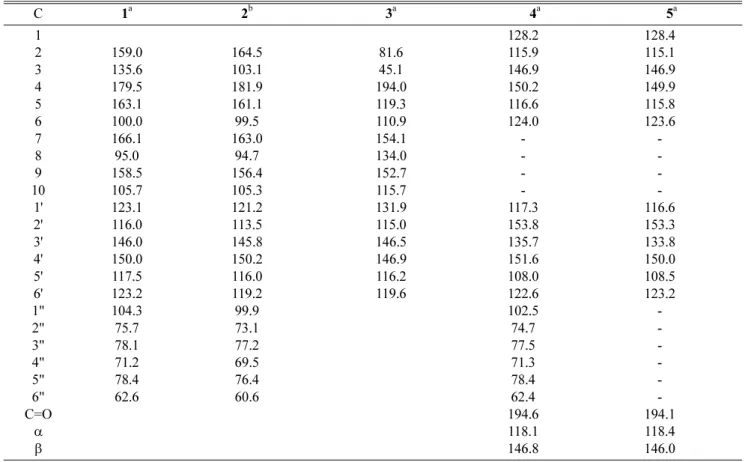
Table I. 13C-NMR spectral data of compounds 1-5
C 1a 2b 3a 4a 5a
1 2 3 4 5 6 7 8 9 10
1' 2' 3' 4' 5' 6' 1"
2"
3"
4"
5"
6"
C=O αβ
159.0 135.6 179.5 163.1 100.0 166.1 95.0 158.5 105.7 123.1 116.0 146.0 150.0 117.5 123.2 104.3 75.7 78.1 71.2 78.4 62.6
164.5 103.1 181.9 161.1 99.5 163.0
94.7 156.4 105.3 121.2 113.5 145.8 150.2 116.0 119.2 99.9 73.1 77.2 69.5 76.4 60.6
81.6 45.1 194.0 119.3 110.9 154.1 134.0 152.7 115.7 131.9 115.0 146.5 146.9 116.2 119.6
128.2 115.9 146.9 150.2 116.6 124.0
- - - - 117.3 153.8 135.7 151.6 108.0 122.6 102.5 74.7 77.5 71.3 78.4 62.4 194.6 118.1 146.8
128.4 115.1 146.9 149.9 115.8 123.6
- - - - 116.6 153.3 133.8 150.0 108.5 123.2
- - - - - - 194.1 118.4 146.0
a
Recorded at 100 MHz in CD
3OD
b
Recorded at 100 MHz in DMSO-d
6Xanthine-originated Superoxide Scavenging Activity− Superoxide radicals were generated by xanthine/xanthine oxidase and measured by previously reported method.17) In brief, test samples were mixed with 20 mM phosphate buffer (pH 7.8) containing 0.48 mM NBT and 1.6 mM xanthine.
After 5 min, xanthine oxidase (0.05 U/mL) 100μL was added.
The absorbance of reaction mixture was read at 570 nm after 30 min incubation at 37oC. Superoxide radical scavenging activity was expressed by the degree of NBT reduction of a test group in comparison to that of control.
Results and Discussion
In the course of our ongoing search for antioxidants from Korean natural plants, the ethyl acetate soluble fraction of methanolic extract of the aerial parts of B. frondosa was found to show scavenging activity on DPPH radical (Fig. 1).
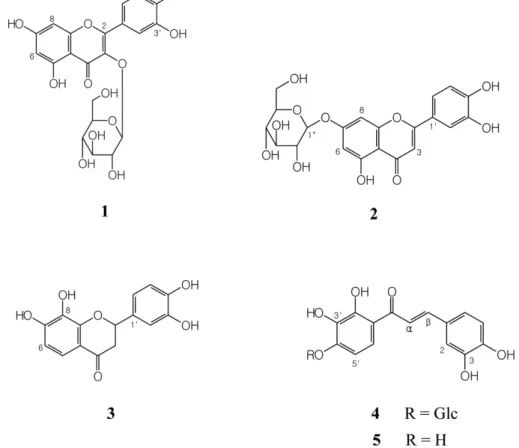
Subsequent activity-guided fractionation of the ethyl acetate soluble fraction led to the isolation of five phenolic compounds (Fig. 2).
In the 1H-NMR spectrum of compound 1, the typical
flavonoid signals were observed. Singlet signals at δ 6.38 (1H, d, J=2.0 Hz, H-8) and 6.19 (1H, d, J=2.0 Hz, H-6) revealed 5,7-dihydoxyl groups of A-ring in the flavonoid skeleton. A double doublet signal at δ 7.56 (1H, dd, J=8.8, 2.4 Hz, H-6´) and two doublets at 6.71 (1H, d, J=8.8 Hz, H-5´) and 7.70 (1H, d, J=2.4 Hz, H-2´) showed 3',4'-dihydroxy functional structure corresponding to aromatic B-ring. Therefore, the aglycone of the compound 1 was assignable to quercetin. The glucose proton signals were also detected with an anomeric proton signal at δ 5.25 (1H, d, J=7.2 Hz, H-1"). The relative large coupling constant of anomeric proton signal indicated the β configuration of glycoside linkages.18) The 13C-NMR spectrum showed 21 carbon signals including 15 carbon signals of aglycone and 6 peaks of monosaccharide. On the basis of these observations and the comparison of the data with those previously published, the structure of compound 1 was identified as quercetin-3-O-β-D-glucopyranoside (isoquercitrin).19-21)
In the 1H-NMR of compound 2, two meta-coupled aromatic signals were detected at δ 6.79 (1H, d, J=2.0 Hz, H-8) and 6.45 (1H, d, J=2.0 Hz, H-6). Furthermore, typical 1,3,4-
Fig. 2. Structures of compounds 1-5 isolated from Bidens frondosa.
trisubstituted benzene signals appeared at δ 7.46 (1H, dd, J=8.4, 2.4 Hz, H-6'), 7.42 (1H, d, brs, H-2'), and 6.90 (1H, d, J=8.4 Hz, H-5'). The signal at δ 6.76 (1H, s, H-3) was characteristic to the C-3 position found in a flavone skeleton.
An anomeric proton of the sugar was detected at δ 5.09 (1H, d, J=7.4 Hz, H-1"). In the 13C-NMR spectrum of compound 2, chemical shift of the ketone (C-4) was at δ 181.9, indicating a characteristic of flavone flavonoid. The structure of 2 was determined to be luteolin-7-O-β-D-glucopyranoside on the basis of the above evidences, together with a comparison of the above data with those published in the literature.22) Compound 3 showed positive results toward FeCl3 reagent. In
¹H-NMR, compound 3 displayed two doublets at δ 6.98 (1H, d, J=2.0 Hz, H-2') and 6.78 (1H, d, J=8.0 Hz, H-5'), and one double doublet at δ 6.86 (1H, dd, J=8.0, 2.0 Hz, H-6') characteristic of a 1,2,4-trisubstituted benzene ring, and two doublets at δ 7.29 (1H, d, J=8.8, H-5) and 6.52 (1H, d, J=8.8 Hz, H-6) of A-ring. Further, the ¹H-NMR spectrum of 3 displayed three double doublets at δ 5.37 (1H, dd, J=12.8, 2.8 Hz, H-2), 3.08 (1H, dd, J=16.8, 12.8 Hz, H-3α), and 2.74 (1H, dd, J=16.8, 2.8 Hz, H-3β) characteristic of C-ring of flavanone.
The combination of the substitution patterns of the A, B and C rings suggested that the compound 3 could be 7,8,3',4'- tetrahydroxy flavonoid. In the ¹³C-NMR spectrum, compound 3 showed 15 carbon signals including a carbonyl signal at δ 194.0. On the basis of these observation and the comparision of the data with those previously published, the structure of compound 3 was identified as 7,8,3',4'-tetrahydroxyflavanone.23)
Compound 4 showed positive results toward FeCl3 reagent.
¹H-NMR spectrum of compound 4 displayed two doublets at δ 7.18 (1H, d, J=2.0 Hz, H-2) and 6.81 (1H, d, J=8.0 Hz, H-5), and one double doublet at δ 7.10 (1H, dd, J=8.0, 2.0 Hz, H-6) characteristic of a 1,2,4-trisubstituted benzene ring, and two doublets at δ 7.58 (1H, d, J=9.2, H-6') and 6.82 (1H, d, J=9.2 Hz, H-5') of A-ring. The ¹H-NMR spectrum of 4 displayed two olefinic protons having trans-configuration were observed at δ 7.24 (1H, d, J=15.6 Hz, H-α) and 7.52 (1H, d, J=15.6 Hz, H-β). Further, the 1H-NMR spectrum of 4 displayed a doublet at δ 4.98 (1H, d, J=7.2 Hz, H-1") for the anomeric proton which suggest that there should be a glycoside group. In the
¹³C-NMR spectrum, compound 4 showed 21 carbon signals including a carbonyl signal at δ 194.6. On the basis of these observation and the comparison of the data with those previously published, the structure of compound 4 was identified as okanin-4'-O-β-D-glucopyranoside.24)
Compound 5 showed positive results toward FeCl3 reagent.
NMR spectra of compound 5 showed very similar of compound 4 except glycoside group. ¹H-NMR spectrum of compound 5 displayed two doublets at δ 7.18 (1H, d, J=2.0 Hz, H-2) and 6.81 (1H, d, J=8.0 Hz, H-5) and one double doublet at δ 7.10 (1H, dd, J=8.0, 2.0 Hz, H-6) characteristic of a 1,2,4-trisubstituted benzene ring, and two doublets at δ 7.58 (1H, d, J=9.2, H-6') and 6.46 (1H, d, J=9.2 Hz, H-5') of A- ring. The ¹H-NMR spectrum of 5 displayed two olefinic protons having trans-configuration were observed at δ 7.52 (1H, d, J=15.6 Hz, H-α) and 7.72 (1H, d, J=15.6 Hz, H-β). In the ¹³C-NMR spectrum, compound 5 showed 15 carbon signals including a carbonyl signal at δ 194.1. On the basis of these observations and the comparison of the data with those previously published, the structure of compound 5 was identified as okanin.24)
The DPPH radical scavenging effects of each solvent fraction from B. frondosa are shown in Fig. 1. The radical scavenging effects of the five compounds isolated from the EtOAc soluble fraction of B. frondosa are shown in Fig. 3.
Among these compounds, two compounds 3 (IC50 value, 3.75 μg/mL) and 5 (IC50 value, 3.90μg/mL) exhibited stronger scavenging effects on DPPH free radical than did vitamin C (IC50 value, 3.32 μg/mL).
To verify additional antioxidant activities of the isolated compounds 1-5, superoxide quenching activities were measured. In the present study, superoxide was found to originated from riboflavin and xanthine. Inhibition of blue
Fig. 3. Scavenging effects of compounds 1-5 from Bidens frondosa on 1,1-diphenyl-2-picrylhydrazyl (DPPH) radical.
formazane formation was taken as a riboflavin-originated superoxide quenching activity. The superoxide quenching activities of five compounds isolated from the EtOAc soluble fraction of B. frondosa are shown in Fig. 4. Among five isolated compounds, compounds 3, 4 and 5 exhibited more potent activities (IC50 value, each 3.34, 5.62 and 3.71 μg/mL, respectively) than vitamin C (positive control, IC50 value, 9.71 μg/mL). Compounds 1 and 2 exhibited weaker quenching activities on riboflavin-originated superoxide than that of the
positive control, vitamin C.
The superoxide anion derived from oxidation of xanthine causes the oxidation of NBT into water soluble formazan. The decrease of absorbance at 570 nm with antioxidants represents the quenching of the superoxide anion reaction mixture. The xanthine-originated superoxide quenching activities of five compounds isolated from the EtOAc soluble fraction of B.
frondosa are shown in Fig. 5. Compounds 1-5 exhibited higher activities with IC50 values of 2.42 (1), 2.89 (2), 0.46 (3), 1.86 (4), and 1.13 (5) μg/mL, respectively than that of vitamin C, which was used as a positive control (IC50 value, 5.74 μg/mL).
Conclusions
To the best of our knowledge, compounds 3-5 were isolated for the first time from this plant in the present study. Among these compounds, compounds 3 and 5 exhibited stronger scavenging effects on the DPPH free radicals than other isolated compounds, and also compounds 3 and 5 showed the most potent quenching activities against both the riboflavin- originated superoxide and the xanthine-originated superoxide.
Results of the present study indicate that the isolated compounds 1-5 from the EtOAc soluble fraction of B.
frondosa may be useful to treat the various oxidative damages.
References
1. Akinboro, A., Mohamed, K. B., Asmawi, M. Z., Sulaiman, S.
F. and Ofiman, O. A. (2011) Antioxidants in aqueous extract of Myristica fragrans (Houtt.) suppress mitosis and cyclo- phosphamide-induced chromosomal aberrations in Allium cepa L. cells. J Zhejiang Univ. Sci. B 12: 915-922.
2. Morales, N. P., Sirijaroonwong, S., Yamanont, P. and Phisalaphong, C. (2015) Electron paramagnetic resonance study of the free radical scavenging capacity of curcumin and its demethoxy and hydrogenated derivatives. Biol. Pharm.
Bull. 38: 1478-1483.
3. Adelman, R., Saul, R. L. and Ames, B. N. (1988) Oxidative damage to DNA: Relation to species metabolic rate and life span. Proc. Natl. Acad. Sci. 85: 2706-2708.
4. Martínez-Cayuela, M. (1995) Oxygen free radicals and human diseae. Biochimie 77: 147-161.
5. Monika, L. L., Zbigniew, S. and Halina, B. P. (2010) Influ- encn of vitamin C on markers of oxidative stress in the ear- liest period of ischemic stroke. Pharmacol. Rep. 62: 751-756.
6. Suganya, T., Siriporn, O. and Sombat, C. (2007) Studies on antioxidative activity of certain plants in Thailand: Mech- Fig. 4. Riboflavin-originated superoxide quenching activities of
compounds 1-5 from Bidens frondosa.
Fig. 5. Xanthine-originated superoxide scavenging activities of compounds 1-5 from Bidens frondosa.
anism of antioxidant action of guava leaf extract. Food.
Chem. 103: 381-388.
7. Branen, A. L. (1975) Toxicology and biochemistry of butyl- ated hydroxyanisole and butylated hydroxytoluene. J. Am.
Oil Chem. Soc. 52: 59-63.
8. Kubola, J. and Siriamornpun, S. (2008) Phenolic contents and antioxidant activities of bitter gourd (Momordica charantia L.) leaf, stem and fruit fraction extracts in vitro. Food Chem.
110: 881-890.
9. Hoffmann, B. and Hölzl, J. (1988) A methylated chalcone glucoside from Bidens pilosa. Phytochemistry 27: 3700-3701.
10. McCormick. S. P., Bohm, B. A. and Ganders, F. R. (1984) Methylated chalcones from Bidens torta. Phytochemistry 23:
2400-2401.
11. Ahn, D. K. (2006), Illustrated Book of Korean Medicinal Herbs, 104. Kyohak publishing Co., Seoul.
12. Kwon, J. W., Byun, E., Lee, E. J., Kim, Y. C., Jeong, G. S., An, R. B. and Kwon, T. O. (2009) Antioxidative and hepa- toprotective effect of compounds from the flowers of Bidens bipinnata L. Kor. J. Pharmacogn. 40: 345-350.
13. Le, J., Lu, W., Xiong, X., Wu, Z. and Chen, W. (2015) Anti- Inflammatory constituents from Bidens frondosa. Molecules 20: 18496-18510.
14. Yoshida, T., Mori, K., Hatano, T., Okumura, T., Uehara, L., Komagoe, K., Fujita, Y. and Okuda, T. (1989) Studies on inhibition mechanism of autooxidation by tannins and fla- vonoids. V. Radical scavenging effects of tannins and related polyphenols on 1,1-diphenyl-2-picrylhydrazyl radical. Chem.
Pharm. Bull. 37: 1919-1921.
15. Ginnopolitis, C. N. and Ries, S. K. (1977) Superoxide dis- mutase. I. Occurrence in higher plants. Plant Physiol. 59:
309-314.
16. Choi. D. S., Kim, S. J. and Jung, M. Y. (2001) Inhibitory
activity of berberine on DNA strand cleavage induced by hydrogen peroxide and cytochrome c. Biosci. Biotechnol.
Biochem. 65: 452-455.
17. Thuong, P. T., Kang, H. J., Na, M. K., Jin, W. Y., Youn, U.
J. and Seong, Y. H. (2007) Anti-oxidant constituents from Sedum takesimense. Phytochemistry 68: 2432-2438.
18. Markhanm, K. P., Ternai, B., Stanley, R., Geiger, K. and Mabry, T. J. (1978) Carbon-13 NMR studies of flavonoides- III: naturally occurring flavonoid glycosides and their acy- lated derivatives. Tetrahedron 34: 1389-1397.
19. Seo, S., Tomita, Y., Tori, K. and Yoshimura, Y. (1978) Deter- mination of the absolute configuration of a secondary hydroxy group in a chiral secondary alcohol using glyco- sidation shifts in carbon-13 nuclear magnetic resonance spec- troscopy. J. Am. Chem. Soc. 100: 3331-3339.
20. Lee, D. Y., Lyu, H. N., Kwak, H. Y., Jung, L., Lee, Y. H., Kim, D. K., Chung, I. S., Kim, S. H. and Baek, N. I. (2007) Isolation of flavonoids from the fruits of Cornus kousa Burg.
J. Appl. Biol. Chem. 50: 144-147.
21. Aishan, H., Baba, M., Iwasaki, N., Kuang, H. and Okuyama, T. (2010) The constituents of Urtica cannabina used in Uighur medicine. Pharm. Biol. 48: 577-583.
22. Na, M. K., Huong, H. T., An, R. B., Lee, S. M., Kim, Y. H., Lee, J. P., Seong, R. S., Lee, K. S. and Bae, K. H. (2000) Quality evaluation of Lonicerae Flos. Kor. J. Pharmacogn.
31: 340-344.
23. Wu, Z. J., Ouyang, M. A. and Yang, C. R. (1999) Poly- phenolic constituents of Salvia onchifolia. Acta Bot. Yunnan 21: 393-398.
24. Hoffmann, B. and Hölzl, J. (1989) Chalcone glucosides from Bidens pilosa. Phytochemistry 28: 247-249.
(2016. 4. 18 접수; 2016. 5. 13 심사; 2016. 6. 2 게재확정)