설악산 상록침엽수림의 고도별 종조성 및 치수 밀도 변화
김지동1⋅변성엽2⋅송주현3⋅채승범4⋅김호진3⋅이정은3⋅윤이슬3⋅윤충원 3*
1국립백두대간수목원 생물자원조사팀, 2국립백두대간수목원 연구전략팀,
3공주대학교 산림자원학과, 4국립산림과학원 산림생명정보연구과
Species Composition Dynamics and Seedling Density Along Altitudinal Gradients in Coniferous Forests of Seorak Mountain
Ji-Dong Kim
1, Seong Yeob Byeon
2, Ju Hyeon Song
3, Seung Beom Chae
4, Ho Jin Kim
3, Jeong Eun Lee
3, I Seul Yun
3and Chung Weon Yun
3*1Forest Bioresources Survey Team, Baekdudaegan National Arboretum, Bonghwa 36209, Korea
2Research Planning and Coordination Team, Baekdudaegan National Arboretum, Bonghwa 36209, Korea
3Department of Forest Resources, Kongju National University, Kongju 32588, Korea
4Division of Forest Bioinformation, National Institute of Forest Science, Suwon 16631, Korea
요 약: 식생의 수직적 분포는 고도구배에 따라 구분할 수 있으며, 수종의 분포패턴이 다르게 나타날 수 있다. 본 연구는 상록침엽수림의 고도별 분포 변화에 대한 기초자료를 제시하기 위해, 식생구조, 고도에 따른 종조성, 치수 밀도와 고도에 따른 변화에 대해 분석하였다. 중요치 분석 결과, 식생구조는 분비나무(12.2), 잣나무(10.86), 시닥나무(8.11) 등의 혼효림
구조로 나타났다. 고도에 따른 종조성 결과로, 분비나무와 두루미꽃은 해발고도가 증가함에 따라 중요치가 함께 증가하였다.
1,400 m에서 1,600 m 구간 사이에서 미역줄나무의 출현은 숲 틈의 발생이 빈번함을 알 수 있었다. 종다양성지수는 1,400-1,500 m 구간에서 가장 높게 나타나 위에 숲 틈 발생의 당위성을 반영해주는 결과로 적절하였다. 상록침엽수의 치수밀도 변화는 2년 동안 분비나무가 402 ± 5.4 ha-1에서 528 ± 11.6 ha-1으로 유의한 수준에서 증가하였고, 잣나무는 57 ± 1.3 ha-1에서 56
± 1.6 ha-1으로 감소하였다. 해발고도별 치수밀도 변화는 1,500-1,600 m에서 분비나무와 잣나무 모두 대폭 증가하였다. 본 연구결과는 치수의 증가나 감소 경향이 mast seeding 해를 파악해야 하기 위한 기초자료로써 활용될 수 있다. 따라서 설악산의 상록침엽수종 개체군뿐만 아니라 치수의 생존 및 사망에 대한 지속적인 모니터링에 본 연구결과가 활용되길 기대해본다.
Abstract: The vertical distribution of vegetation can be classified according to the altitudinal gradient and the distribution of species along this gradient. The purpose of this study was to analyze the vegetation structure, species composition, dimensional density, and change according to altitude. These data illustrate the distribution of coni- ferous forest by altitude. By order of importance, the vegetation structure of this mixed forest consisted of Abies nephrolepis (12.2), Pinus koraiensis (10.86), and Acer komarovii (8.11). As a result of species composition accord- ing to the altitude, A. nephrolepis and Maianthemum bifolium increased in importance with increasing altitude.
Tripterygium regelii emerged between 1,400 m and 1,600 m, which indicates that forest gaps were frequent at that elevation. The species diversity index was the highest from 1,400–1,500 m and coincided with the presence of forest gaps. The changes in A. nephrolepis of evergreen conifers increased significantly from 402 ± 5.4 ha.-1 to 528 ± 11.6 ha.-1 for two years, and decreased from 57 ± 1.3 ha.-1 to 56 ± 1.6 ha.-1 for P. koraiensis. The density of A.
nephrolepis and P. koraiensis seedlings significantly increased at 1,500–1,600 m. The results of this study can be used as a basis to identify the mast seeding year with the increase or decrease of seedlings. In addition to documenting the evergreen conifer population of the Seorak Mountain, these results can be built upon for future monitoring of seedlings mortality.
Key words: altitudinal gradient, ecological monitoring, seedling dynamics, subalpine zone
1)
* Corresponding author E-mail: [email protected] ORCID
Chung Weon Yun https://orcid.org/0000-0001-7048-6980
JOURNAL OFKOREANSOCIETY OFFORESTSCIENCE ISSN 2586-6613(Print), ISSN 2586-6621(Online) http://e-journal.kfs21.or.kr https://doi.org/10.14578/jkfs.2020.109.2.115
115
서 론
식생의 수직적 분포는 고도구배에 따라 구분할 수 있으 며, 또한 범지구적인 기후변화에 따라 식생 경계의 변화 (수목한계선, 고산대)에 대한 지속적인 연구의 필요성이 요구되고 있다(Brigitta et al., 2009; Lenoir et al., 2009;
Zhang et al., 2010; Kim et al., 2019). 기후변화에 대응한 다양한 연구 접근과 결과 도출이 필요하며, 민감한 반응 을 보일 수 있는 식생은 주요 연구 재료로 활용되고 있다.
최근 저지대에서 고지대로의 광범위한 분포를 보이는 식 물의 이주는 북방계 식물 또는 고산대 식물을 자극하여 더 높은 곳의 서식지로 이동하게끔 유발하는 것으로 밝혀지 고 있다(Grabherr et al., 1995; Guisan and Theurillat, 2000;
Theurillat and Guisan, 2001; Brigitta et al., 2009).
최근 선행연구들은 기후변화에 따라 수목한계선이 상승 하는 경향이 있으며(Kullman, 2002; Lloyd and Fastie, 2003;
Danby and Hik, 2007; Zhang et al., 2010), 그 경향은 유의 하지 않았으나 임분 밀도는 증가한 것으로 관찰되고 있다 (MacDonald et al., 1998; Danby and Hik, 2007; Klasner and Fagre, 2002). 그러나 일부 연구자들은 기후 온난화로 인하여 겨울에 눈의 양이 줄어들어 토양 건조 및 토양 표 면의 매우 낮은 온도로 인해 치수 밀도가 감소하여 수목 한계선의 안정성을 유지하지 못하거나 심지어 하강으로 이어질 것으로 추측하고 있다(Grace et al., 2002; Danby and Hik, 2007; Kullman, 2007).
나무의 생활사에서 치수는 높은 사망률이 발생하는 단 계 중 하나이다(Sun and Chen, 2000). 치수는 성목과 비교 하여 환경적 요인의 변화에 더 민감하게 반응하며(Kullman, 1993; Germino et al., 2002; Brigitta et al., 2009; Kim et al., 2019), 식생의 수직적 분포의 상승 또는 하강 여부는 주로 치수의 생존 및 생장 상황에 달려있다(Smith et al., 2003; Lenoir et al., 2009; Brigitta et al., 2009; Zhang et al., 2010). 만약 몇 개의 치수만 생존해 있다면 성목의 고 사 후에 수목한계선이 하강하게 된다. 그러나 치수가 생 장한다면 수목한계선의 위치를 유지하거나 심지어 상승 시킬 수 있다(Klasner and Fagre 2002; Smith et al., 2003;
Lenoir et al., 2009; Brigitta et al., 2009; Zhang et al., 2010).
따라서 치수의 고도 변동과 구조에 대한 조사는 지역 또는 경관 규모에서 식생의 수직적 변화 과정을 이해하는 데 도 움이 될 것이다. 또한, 범지구적인 기후변화에 대한 고산 생 태계의 반응을 예측하는 데 생태적 지표가 될 것이다.
지금까지 우리나라에서는 수목의 치수 밀도 변화나 환 경인자와 관계성 등에 대한 연구결과는 상대적으로 부족 하며, 고도구배에 따라 관찰된 치수 발생 패턴을 구명해 낸 연구가 부족한 실정이다. 본 연구는 설악산 일대의
1,300 m부터 1,700 m까지 분포하는 분비나무와 잣나무 를 대상으로 하였다. 분비나무와 잣나무를 대상으로 한 이유는 현재 기후변화에 가장 민감한 고산대 상록침엽수 종이며, 등산객의 방문이 빈번하며, 이에 따라 자연적·인 위적 교란을 동시에 받는 곳 중 하나이기 때문이다. 또한, 이 지역의 동반 출현 수종인 눈잣나무, 구슬댕댕이, 홍월 귤 등 희귀·특산식물의 분포가 가장 다양한 지역이기도 하다(Kong, 2000; Kong and Lim, 2008; Lee et al., 2014;
Kim et al., 2017).
본 연구는 분비나무와 잣나무 치수가 발생하는 식생구 조, 종다양성 변화, 치수 밀도, 고도별 치수 변화량 등 식 생의 수직적 분포 변화에 대한 생태학적 기초자료를 제 시하기 위해 실시하였다.
재료 및 방법
1. 연구 대상지 및 모니터링 조사구 설정 방법
본 연구는 분비나무(Least Concern, LC) 및 잣나무가 서 식하는 설악산 대청봉일대를 대상으로 하였다. 모니터링 조사구는 2016년 5월부터 6월까지 분비나무와 잣나무가 상관에 우점하고 있는 군락을 선정하였다. 모니터링 조사 구의 형태는 최대 20 m × 20 m (0.04 ha)의 정방형구로 향후 지속적인 모니터링을 위해 clinometer, 줄자, 측량폴 대 등을 활용하여 각 끝 측량 지점에 표식말뚝을 설치하 였다. 모니터링은 2년 간격으로 수행하였으며, 멸종위기 침엽수종의 개체, 치수 발생률 및 고사율을 조사하였다.
2. 조사 및 분석 방법
2016년도와 2018년도 5월부터 10월까지 오색과 대청봉 사이 1,300 m에서 1,700 m까지 총 31개소의 모니터링 조 사구에서 식생의 상관우점과 지형 요인에 따라 최대 400
㎡를 구획하였다. 흉고직경 2 cm 이상의 모든 침엽수 및 활엽수에 대하여 흉고직경과 수고를 측정하였다. 초본층 은 식생조사법(Ellenberg, 1956; Braun-Blanquet, 1964)에 따라 종 목록과 군도(sociability) 및 우점도(dominance)를 판정하여 조사하였다. 상록침엽수 치수는 방형구 내에 나 타나는 흉고직경 2 cm 미만의 치수를 대상으로 개체수를 조사하였다. 입지환경은 Garmin Montana 650GPS 장비를 사용하여 경위도 좌표, 사면방향, 고도 등을 기록하였다.
구성종의 식물분류와 동정은 원색식물도감(Lee, 2003)을 이용하였다. 종명의 학명과 국명은 국가생물종지식정보 시스템(Korea Forest Service, 2010a)과 국가표준식물목록 (Korea Forest Service, 2010b)을 참고하였다.
자료의 분석은 2018년에 조사한 매목조사자료와 식생 조사자료를 기준으로 층위별 중요치(Importance value,
IV)를 산출하였으며, 층위는 교목층(≥ 5.0 m), 관목층(≤
3.0 m), 초본층(≤ 1.0 m)으로 구분하였다. 최종적으로 중 요치는 평균상대우점치(Mean impotance value, MIV)로 층위별 가중치인 교목층 3, 관목층 1, 초본층 0.5를 부여 하여 식생구조를 구분하였다.
2016년과 2018년의 조사한 상록침엽수 치수의 개체수 는 ha당 본수로 환산하였고, 고도별 개체수 변화 및 연간 비교를 위해 분석하였다. 검정은 Chi-squared test를 적용 하였으며, 통계 프로그램은 R 3.5.1을 사용하였다.
산림식생의 안정성을 유추할 수 있는 종 다양성 및 경 쟁 등을 분석하기 위해 층위별 종다양도 지수(H’), 최대 종다양도(H’max), 균재도(J’), 우점도(1-J’)를 분석하였다 (Shannon and Weaver, 1949; Brower and Zar, 1977).
결과 및 고찰
1. 설악산 아고산대 상록침엽수림의 식생구조
식생구조 분석 결과 평균상대우점치는 분비나무가 가 장 높게 나타났으며, 잣나무, 시닥나무 순서로 나타났다 (Table 1). 층위별로 보면 교목층은 잣나무가 가장 높은 중요치를 보이고, 분비나무, 사스래나무의 중요치가 비교 적 높게 구성되어 있다. 설악산 아고산대 상록침엽수림에 서 상층을 구성하는 수종과 유사한 결과로 나타났다(Park et al., 2009; Yun et al., 2011; Han et al., 2016; Kim et
al., 2017).
관목층은 시닥나무와 분비나무의 중요치가 가장 높게 나타났다. 일반적으로 아고산대 침엽수군락에서 관목층 은 진달래과가 우세하다(Do et al., 2012; Cho et al., 2016;
Kim et al., 2018). 그러나 본 연구에서는 분비나무가 관목 층에서 우세하였고, 해당 지역의 선행연구들과 비슷한 결 과로 나타났다(Kwon et al., 2010; Kim et al., 2011). 또한, 미역줄나무가 진달래과보다 상대적으로 중요치가 높았는 데, 덩굴성식물은 산림을 구조적으로 단순화시키고 빛과 영양 경쟁에서 우위를 차지하여, 치수가 갱신하는 데 있 어 부정적 환경을 조성할 수 있다. 이와 같이 설악산과 비교할 수 있는 지리산일대의 상록침엽수림에서 미역줄 나무 중요치가 높을수록 구상나무 치수갱신에 저해를 초 래할 수 있는 연구결과와 비슷한 것으로 나타났다(Kim et al., 2018). 따라서 분비나무 치수의 지속적 갱신을 유도하 기 위해서는 덩굴성식물에 대한 인위적 관리가 필요할 것 으로 판단된다.
초본층은 두루미꽃, 박새, 실새풀, 자주솜대 등이 중요 치가 높은 것으로 나타났다. 이는 우리나라 아고산대에 출현하는 다년생 초본식물 구성과 비슷한 경향이었다 (Hong et al., 2010; Yun et al., 2011; Yun et al., 2012;
Lee and Kim, 2017). 박새의 높은 중요치로 미루어 보아 박새가 출현하는 서식지는 비교적 수분이 충분한 것으로 판단된다(Lee, 2003; Korea Forest Service, 2010a). 또한,
Species Layer
Tree Shrub Herb MIV
Abies nephrolepis 분비나무 21.53 12.55 2.52 12.20
Pinus koraiensis 잣나무 29.63 1.76 1.19 10.86
Acer komarovii 시닥나무 6.90 15.39 2.03 8.11
Betula ermanii 사스래나무 11.18 3.30 0.17 4.88
Sorbus commixta 마가목 6.93 6.39 0.51 4.61
Maianthemum bifolium 두루미꽃 - - 11.37 3.79
Acer pseudosieboldianum 당단풍나무 5.44 4.38 0.08 3.30
Quercus mongolica 신갈나무 8.88 - 0.08 2.99
Prunus padus 귀룽나무 0.84 6.82 0.93 2.87
Tripterygium regelii 미역줄나무 - 8.12 0.17 2.76
Veratrum oxysepalum 박새 - - 7.95 2.65
Rhododendron mucronulatum var. ciliatum 털진달래 - 7.57 0.34 2.64
Rhododendron schlippenbachii 철쭉 - 7.35 0.25 2.54
Calamagrostis arundinacea 실새풀 - - 6.66 2.22
Euonymus macropterus 나래회나무 0.23 3.86 2.27 2.12
Smilacina bicolor 자주솜대 - - 6.01 2.00
102 species omitted (MIV < 2.0)
Table 1. Importance value of major species within vertical layers in investigation plots.
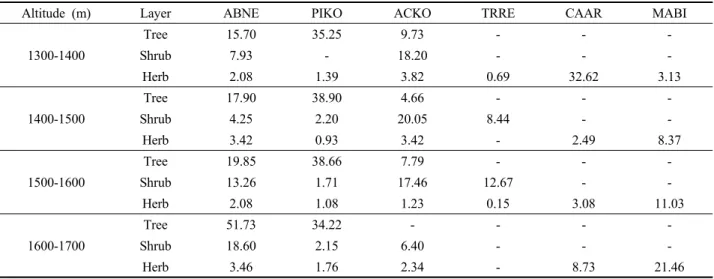
Altitude (m) Layer ABNE PIKO ACKO TRRE CAAR MABI 1300-1400
Tree 15.70 35.25 9.73 - - -
Shrub 7.93 - 18.20 - - -
Herb 2.08 1.39 3.82 0.69 32.62 3.13
1400-1500
Tree 17.90 38.90 4.66 - - -
Shrub 4.25 2.20 20.05 8.44 - -
Herb 3.42 0.93 3.42 - 2.49 8.37
1500-1600
Tree 19.85 38.66 7.79 - - -
Shrub 13.26 1.71 17.46 12.67 - -
Herb 2.08 1.08 1.23 0.15 3.08 11.03
1600-1700
Tree 51.73 34.22 - - - -
Shrub 18.60 2.15 6.40 - - -
Herb 3.46 1.76 2.34 - 8.73 21.46
Abies nephrolepis (ABNE), Pinus koraiensis (PIKO), Acer komarovii (ACKO), Tripterygium regelii (TRRE), Calamagrostis arundinacea (CAAR), Maianthemum bifolium (MABI).
Table 2. Importance value of major species within vertical layers along the altitudinal gradients.
분비나무는 관목층과 초본층에서 잣나무에 비해 피도와 빈도가 높게 나타나 해당 지역의 경우 분비나무의 치수 는 지속적으로 발아 및 생장이 이루어지고 있어 향후 분 비나무에 의한 군락이 형성될 것으로 판단되었다.
2. 고도에 따른 종조성
설악산 아고산대 상록침엽수림의 교목층, 관목층, 그리 고 초본층에서 높은 중요치를 나타내는 종을 고도에 따 라 살펴보면, 1,600 m 이하에서 잣나무가 교목층은 우세 하나 관목층, 초본층 등에서 시닥나무와 분비나무 등의 중요치가 높게 나타났다(Table 2). 주요 상록침엽수 중에 서 분비나무는 고도가 증가함에 따라 중요치 또한 증가 하는 것으로 나타났고, 1,600-1,700 m에서 중요치가 가장 높게 나타났다. 미역줄나무의 경우 1,600 m 이하에서 나 타나고 있는 반면 1,600 m 이상의 고도에서 출현하지 않 는 것으로 나타났다. 실새풀은 미역줄나무의 중요치가 높은 고도별 생육지를 제외하고 다른 고도 구간에서 높 은 중요치를 나타내고 있다. 미역줄나무의 중요치 변화 는 서식지에서 동반 출현하는 종조성에 영향을 끼치며, 초본부터 관목층까지 상대적으로 영양 경쟁을 심화시킬 수 있다. 미역줄나무와 같은 덩굴성식물의 출현은 조사 지 내 숲 틈의 유무를 파악할 수 있으며, 숲의 구조를 단 순화시킬 수 있는 우려가 있기에 지속적인 모니터링 및 물리적 관리가 필요하다. 고산성 식물인 두루미꽃은 고 도가 증가함에 따라 중요치가 증가하였다. 실새풀은 건 조한 침엽수림에서 수분 증발 감소, 토양 수분의 증가, 열 보존과 같은 치수의 생장을 촉진시키는 역할을 하며 (Hogg and Victor, 1991), 실새풀의 피도에 따라 치수 발
생과 생장에 영향을 미치는 것으로 보고되었다(Matthew et al., 2002). 1,600-1,700 m에서 미역줄나무의 비출현은 해당 고도가 비교적 낮은 평균온도, 바람받이 등 극한 환 경이 조성되어 있으며, 저지대 식물이 자라기에 적합하지 않고, 해당 서식지에서 적응한 눈잣나무, 홍월귤 등 고산 성 식물이 개체군을 이루고 있기 때문이다(Lee et al., 2014;
Kim et al., 2019).
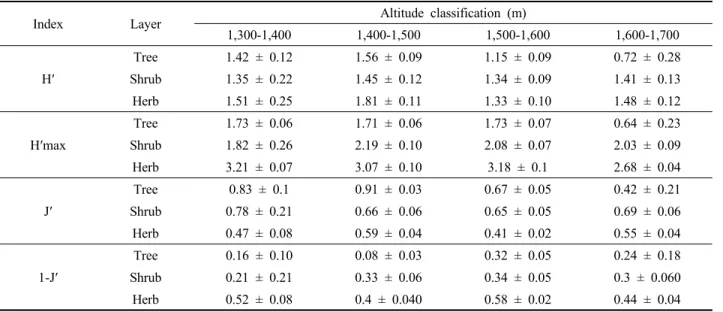
층위별 종다양성지수 등을 분석 결과 교목층은 고도가 증가할수록 다양성지수 및 균등도는 낮아졌으며, 관목층 과 초본층은 1,400-1,500 m 구간에서 비교적 다양성지수 (H’), 균등도(J’)가 높게 나타났다. 위에 해발고도별 층위 구조 분석 결과와 같이 1,400-1,500 m 구간에서 숲 틈의 발생과 종의 분포역에 있어서 전이지대인 것으로 판단된 다. 숲 틈은 개체목 또는 개체군이 수관을 이루는 동안 교란에 의해 고사되거나 쓰러져 수관층이 열리고 광온성 식물(eurythermal plant)에 의해 다시 채워진다(Brokaw and Busing, 2000). 이러한 과정에서 종다양성은 수관층 유형, 경관 그리고 교란의 종류에 의해 결정된다(Ellum et al., 2010; Duguid et al., 2013). 종다양성은 기존 우점 종에 대한 다양성보다 교란 발생 후 이입되는 종에 의한 종다양성 증가가 나타난다(Kumar and Ram, 2005; Bolton and D’Amato, 2011).
한편, 미역줄나무 중요치가 가장 높게 나타난 1,500- 1,600 m 고도 구간은 초본층의 균등도가 가장 낮게 나타 나고 있다. 균등도는 군집 내 바이오매스가 생태적 지위 공간에 분포되어 있어 이용 가능한 자원의 전체 범위를 나타내는 정도로 해석된다. 조사구 내 다양한 종들이 특 정 지역에서 고르게 분포될 때 증가하고 반대의 경우에
Index Layer Altitude classification (m)
1,300-1,400 1,400-1,500 1,500-1,600 1,600-1,700
H′
Tree 1.42 ± 0.12 1.56 ± 0.09 1.15 ± 0.09 0.72 ± 0.28
Shrub 1.35 ± 0.22 1.45 ± 0.12 1.34 ± 0.09 1.41 ± 0.13
Herb 1.51 ± 0.25 1.81 ± 0.11 1.33 ± 0.10 1.48 ± 0.12
H′max
Tree 1.73 ± 0.06 1.71 ± 0.06 1.73 ± 0.07 0.64 ± 0.23
Shrub 1.82 ± 0.26 2.19 ± 0.10 2.08 ± 0.07 2.03 ± 0.09
Herb 3.21 ± 0.07 3.07 ± 0.10 3.18 ± 0.1 2.68 ± 0.04
J′
Tree 0.83 ± 0.1 0.91 ± 0.03 0.67 ± 0.05 0.42 ± 0.21
Shrub 0.78 ± 0.21 0.66 ± 0.06 0.65 ± 0.05 0.69 ± 0.06
Herb 0.47 ± 0.08 0.59 ± 0.04 0.41 ± 0.02 0.55 ± 0.04
1-J′
Tree 0.16 ± 0.10 0.08 ± 0.03 0.32 ± 0.05 0.24 ± 0.18
Shrub 0.21 ± 0.21 0.33 ± 0.06 0.34 ± 0.05 0.3 ± 0.060
Herb 0.52 ± 0.08 0.4 ± 0.040 0.58 ± 0.02 0.44 ± 0.04
※ H′ : Diversity index; H′max : Max diversity index; J′ : Evenness, 1-J′ : Dominance.
Table 3. Species diversity index along the altitudinal gradients.
는 감소한다(DeJong, 1975; Norman et al., 2005).
또한, 균등도가 낮을수록 어떤 특정 종들이 생태적 지 위를 차지하는 동안 그 공간 내 존재하는 자원의 가용성 이 많지 않은 것을 의미한다. 고도별 중요치 분석 결과와 함께 미루어 보아 미역줄나무의 출현은 임분 내 생산성 을 감소시키며, 외부 유입종의 정착기회를 증가시키는 것으로 해석된다(Norman et al., 2005; Kim et al., 2018).
종다양성지수가 낮다는 것은 군집 내 잠재적으로 사용할 수 있는 양분 자원의 일부가 사용되지 않은 것으로, 특정 환경조건에서 임분 내 자원을 이용하는 종들이 사라지는 것이며 환경 변동에 대한 완충효과가 감소하는 것을 의 미한다(Tilman, 1982). 이는 곧 외부 유입종의 생태적 지 위 공간이 마련되는 것으로 이어지며 특정 임분의 외부 유입종을 방어할 수 있는 침입저항력이 낮아짐을 의미한 다(Dukes, 2001). 본 연구는 해발고도에 따라 교목층의 균등도는 낮아져 특정 종들이 생육을 위한 생태적 지위 공간이 국소적으로 변화하는 것으로 볼 수 있다. 이에 외 부 유입종이 사용 가능한 자원 및 서식공간이 축소되어 종다양성지수가 감소한 것으로 판단된다.
3. 상록침엽수 치수의 밀도와 고도에 따른 변화
설악산 아고산대 상록침엽수 중에서 주요종인 분비나무 의 치수 밀도 변화는 2016년 402 ± 5.4 ha-1에서 2018년에 528 ± 11.6 ha-1로 2년간 유의한 수준에서 증가하였고 (p < 0.01), 잣나무의 치수 밀도 변화는 2016년에 57 ± 1.3 ha-1에서 2018년에 56 ± 1.6 ha-1로 감소하였다(Figure 1).
잣나무 치수는 분비나무 치수와 비교하여 총 개체수에서
Figure 1. Dynamics of Abies nephrolepis seedling density into the two years.
많은 차이가 나타나는 것으로 관찰되었다. 잣나무의 경 우 치수 밀도의 큰 변화가 없는데, 이는 치수 발생단계 (ontogenetic stages)에서 대량으로 발생하지 않기 때문인 것으로 판단된다(Omelko et al., 2016; Kim et al., 2019).
본 연구에서 분비나무와 잣나무 치수의 연도별, 개체군 별 차이로 보면, 분비나무 치수는 10 cm 이하에서 대량 으로 발생하나 50 cm 이상에서 진계생장하지 못하고 대 부분 고사되는 것으로 보고되는 것과 비슷한 경향으로 나타났다(Kim et al., 2019). 저지대 산림에서 잣나무 치 수는 주변 조림지에서 천연림으로 종자가 유입되어 새로 운 개체들이 정착하는 현상이 발견되었으며, 비교적 많 은 치수가 발생하고 있는 것으로 나타났다(Kang et al., 2007). 이것으로 미루어 보아, 본 연구에서 분비나무 치수 의 발생은 활발히 일어나고 있는 반면에 잣나무 치수는
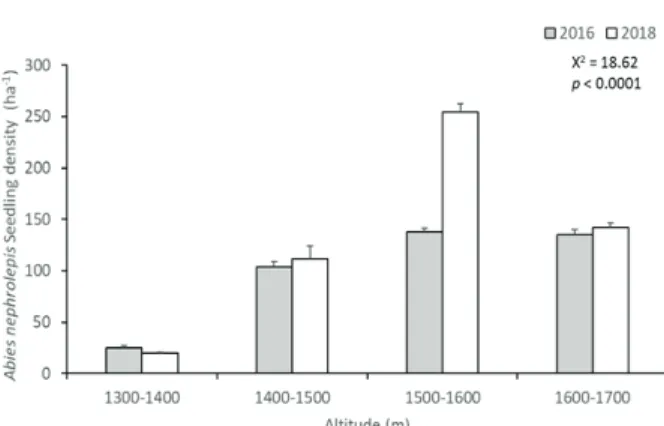
Figure 2. Dynamics of Abies nephrolepis seedling density according to the altitudinal gradients.
Figure 3. Dynamics of Pinus koraiensis seedling density according to the altitudinal gradients.
소폭 감소하였는데 저지대 산림에서 갱신되는 연구 양상 과 상이했다. 서식지에 따라 치수갱신 양상이 다를 것으 로 판단되므로 고도별 치수갱신 변화를 제시하였다.
고도별 상록침엽수 치수의 변화량은 분비나무 치수가 1,300-1400 m 구간에서 2016년 25 ± 2.0 ha-1에서 2018년 20 ± 0.6 ha-1로 감소하였고, 1,400-1,500 m 구간에서 2016 년 104 ± 4.5 ha-1에서 2018년 112 ± 12.0 ha-1로, 1,500- 1,600 m 구간에서 2016년 138 ± 3.8 ha-1에서 2018년 254
± 8.3 ha-1로, 1,600-1,700 m 구간에서 2016년 135 ± 4.9 ha-1에서 2018년 142 ± 4.5 ha-1로 증가하였다. 잣나무 치수 는 1,300-1,400 m 구간에서 2016년 2 ± 0.2 ha-1에서 2018 년 4 ± 0.4 ha-1로, 1,500-1,600 m 구간에서 2016년 23 ± 0.8 ha-1에서 2018년 30 ± 1.8 ha-1으로 증가하였고, 1,400- 1,500 m 구간에서 2016년 17 ± 1.5 ha-1에서 2018년 6 ± 0.4 ha-1로 감소하였으며, 1,600-1,700 m 구간에서 2016년 16 ± 0.8 ha-1에서 2018년 16 ± 0.8 ha-1로 변화가 없었다.
치수의 밀도는 2018년에 1,500-1,600 m 고도 구간에서 대 폭 증가하였는데, 이는 고도별 층위구조 및 종다양성지수 등을 살펴보았을 때 1,500-1,600 m 구간에 숲 틈이 발생함 으로 인해 광량의 증가로 분비나무 치수 발아 및 생장에
영향을 미쳐 치수 밀도가 다른 구간에 비해 대폭 증가한 것으로 판단되었다(Hunziker and Brang, 2005; Kim et al., 2019).
1,500-1,600 m 구간에서는 잣나무 치수뿐 아니라 분비 나무 치수 또한 증가하여 잣나무와 분비나무의 치수 생 장을 유도하기 위해서는 덩굴성식물의 인위적 관리를 고 려해보아야 한다. 또한, 숲 틈 발생으로 인한 여러종의 유입으로 인해 종다양도 지수가 높게 나타나고 있어 잣 나무 및 분비나무 치수의 생육에 악영향을 미칠 것으로 판단되는 바, 본 구간에서의 치수 생존에 대한 지속적인 모니터링이 필요할 것으로 판단된다.
결 론
본 연구의 결과와 함께 지리산 상록침엽수림의 고도별 미역줄나무의 확장에 따른 숲 구조, 치수갱신의 부정적 영향이 관찰되고 있으므로(Kim et al., 2018), 설악산 숲 구조 및 치수갱신에 대한 지속적인 관찰연구가 진행되어 야 한다. 최근 수종 분포 예측에 대해 GIS를 기반으로 한 연구는 항공사진, 지형도, 임상도 등을 활용하여 모델분 석을 실시하여 아고산대 수종의 분포 축소가 지속적으로 이루어지고 있는 것으로 보고하였다(Kim and Lee, 2013;
Park et al., 2014; Koo et al., 2016). 이 중 임상도는 일반 적으로 상층 수관에 해당하는 수종의 분포도를 기반으로 한다. 따라서 상층 수종의 분포 예측은 가능하나 하층 수 종의 동태까지 파악하기는 어려운 실정이다. 그러므로 하층의 지속적인 모니터링을 통해 아고산대 산림의 지표 를 파악하는 것이 중요할 것으로 사료되었다.
본 연구에서 제시된 해발고도별 결과를 미루어 보아 1,400-1,500 m와 1,500-1,600 m 구간에서 치수갱신 양상 의 차이가 나타났다. 미역줄나무의 중요치가 1,500-1,600 m 구간에서 높았던 반면 분비나무와 잣나무의 치수발생 이 가장 많이 나타났다. 이러한 차이는 다른 해발고도에 비해 종 다양성 지수와 균등도가 비교적 낮기 때문인 것 으로 판단된다. 따라서 지속적인 모니터링을 통해 갱신 되고 있는 분비나무와 잣나무의 공존 및 경쟁양상을 파 악할 수 있을 것이다.
또한, 상록침엽수 치수의 발아 및 생장의 경우 종자 충 실율, 해걸이, 병해충, 수명 등 해당 산지의 종자 연구를 통해 다양한 접근의 해석이 필요하다. 종자 연구는 건강 한 종자를 채취할 수 있는 기초자료, 보존 대상 수종의 현지 내 보존을 위한 종자의 영구저장 방법을 마련하기 위하여 중요하다. 이미 국외에서는 상록침엽수 종자에 대한 다양한 연구결과가 도출되고 있어 우리나라 또한 연구 협업을 통해 서식지 보전 및 복원 기술개발이 필요
로 할 것으로 판단되었다.
상록침엽수의 치수갱신에 있어 총 개체 수는 분비나무 치수가 많이 발생하고 있는 단계에 있다. 기후변화, 물리 적 환경, 그리고 mast seeding 이론 등 개체 발생의 급격 한 변화에 대한 검증을 위해 최소 2년 이상의 기초 데이 터가 필요하다. 아직까지 대한민국 아고산대에서 발생하 고 있는 상록침엽수의 집단 고사, 치수 대량 발생 또는 고사 등 다양한 이론과 가설에 입각한 결과가 부족하므 로 장기적인 관점에서 모니터링이 지속적으로 이루어져 야 할 것이다.
감사의 글
본 연구는 국립산림과학원 임업·산림분야 기후변화 영 향·취약성 평가 및 적응 연구 과제(위탁연구과제 ‘설악산 일대 아고산 상록침엽수림 변화 조사, 분석’)의 장기생태 모니터링 일환으로 작성되었습니다.
References
Bolton, N.W. and D’Amato, A.W. 2011. Regeneration re- sponses to gap size and coarse woody debris within natural disturbance-based silvicultural systems in northeastern Minnesota. Forest Ecology and Management 262(7): 1215- 1222.
Braun-Blanquet, J. 1964. Pflanzensoziologie Grundzüge der Vegetationkunde (3rd Ed.). Springer-Verlag, New York, pp. 865. (in German)
Brigitta, E., Thomas, K., Martin, M. and Peter, U. 2009. Short- term signals of climate change along an altitudinal gradient in the South Alps. Plant Ecology 202(1): 79-89.
Brokaw, N. amd Busing, R.T. 2000. Niche versus chance and tree diversity in forest gaps. Trends in Ecology & Evolution 15(5): 183-188.
Brower, J.E. and Zar, J.H. 1977. Field and laboratory methods for general ecology. Wm. C. Brown Company Publishers.
Iowa, U.S.A. pp. 596.
Cho, M.G., Chung, J.M., Im, H.I., Noh, I., Kim., T.W., Kim, C.Y. and Moon, H.S. 2016. Ecological characteristics of sub-alpine coniferous forest on Banyabong in Mt. Jiri.
Journal of Climate Change Research 7(4): 465-476. (in Korean with English abstract)
Danby, R.K. and Hik, D.S. 2007. Variability, contingency and rapid change in recent subarctic alpine tree line dynamics.
Journal of Ecology 95(2): 352-363.
DeJong, T.M. 1975. Comparison of three diversity indices based on their components of richness and evenness. Oikos
26(2): 222-227.
Do, M.S., Lee, J.H., Gwon, J.H. and Song, H.K. 2012.
Vegetation structure and ecological properties of Picea jezoensis community. CNU Journal of Agricultural Science 39(4): 525-534. (in Korean with English abstract) Duguid, M.C., Frey, B.R., Ellum, D.S., Kelty, M. and Ashton,
M.S. 2013. The influence of ground disturbance and gap position on understory plant diversity in upland forests of southern new England. Forest Ecology and Management 303: 148-159.
Dukes, J.S. 2001. Biodiversity and invasibility in grassland microcosms. Oecologia 126: 563-568.
Ellenberg, H. 1956. Aufgaben und Methoden der Vegetation- skunde. Ulmer, Stuttgart, Germany, pp. 136.(in German) Ellum, D.S., Ashton, M.S. and Siccama, T.G. 2010. Spatial
pattern in herb diversity and abundance of second growth mixed deciduous-evergreen forest of southern new England.
Forest Ecology and Management 259(8): 1416-1426.
Germino, M.J., Smith, W.K. and Resor, A.C. 2002. Conifer seedling distribution and survival in an alpine-treeline ecotone. Plant Ecology 162(2): 157-168.
Grabherr, G,, Gottfried, M,, Gruber, A. and Pauli, H. 1995.
Patterns and current changes in alpine plant diversity. In:
Chapin FS Ⅲ, Körner, C. (eds) Arctic and alpine bio- diversity: patterns, causes and ecosystem consequences.
Ecological Studies 113. Springer, Berlin, pp. 166-81.
Grace, J., Berninger, F. and Nagy, L. 2002. Impacts of climate change on the tree line. Annals of Botany 90(4): 537-544.
Guisan, A. and Theurillat, J.P. 2000. Assessing alpine plant vulnerability to climate change: a modelling perspective.
Integrated Assess 1(4): 307-320.
Han, S.H., Han, S.H. and Yun, C.W. 2016. Classification and stand characteristics of subalpine forest vegetation at Hyangjeukbong and Jungbong in Mt. Deogyusan. Journal of Korean Forest Society 105(1): 48-62.(in Korean with English abstract)
Hogg, E.H. and Victor, J.L. 1991. The impact of Calamagrostis canadensis on soil thermal regimes after logging in northern Alberta. Canadian Journal of Forest Research 21(3): 387-394.
Hong, M.P., Lee, H.J., Chun, Y.M. and Hong, B.R. 2010. Flora of Mt. Seorak, Gangwon-do. Korean Journal of Environ- ment and Ecology 24(4): 436-486. (in Korean with English abstract)
Hunziker, U. and Brang, P. 2005. Microsite patterns of conifer seedling establishment and growth in a mixed stand in the southern Alps. Forest Ecology and Management 210(1-3): 67-79.
Kang, H.S., Lim, J.H., Chun, J.H., Lee, I.K., Kim, Y.K. and
Lee, J.H. 2007. Invasion of Korean Pine seedlings originated from neighbour plantations into the natural mature deciduous broad-leaved forest in Gwangneung, Korea. Journal of Korean Forest Society 96(1): 107-114.
(in Korean with English abstract)
Kim, H.S., Bae, S.W., Jang, S.C. and Jeong, J.M. 2011. Stand structure and growth characteristics at different elevations of the Korean Pine(Pinus koraiensis) natural forest on Mt.
Seorak. Journal of Forest Science 27(3): 157-167. (in Korean with abstract English)
Kim, J.D., Lim, J.H. and Yun, C.W. 2019. Dynamics of Abies nephrolepis Seedlings in relation to environmental factor in Seorak Mountain, South Korea. Forests 10(8): 702.
Kim, J.D., Park, G.E., Lim, J.H. and Yun, C.W. 2017. Phyto- sociological community type classification and flora of vascular plants for the forest vegetation of Daecheongbong Area in Mt. Seorak. Journal of Korean Forest Society 106(2): 130-149. (in Korean with English abstract) Kim, J.D., Park, G.E., Lim, J.H. and Yun, C.W. 2018. The
Change of seedling emergence of Abies koreana and altitudinal species composition in the subalpine area of Mt. Jiri over short-term (2015-2017). Korean Journal Environment and Ecology 32(3): 313-322. (in Korean with English abstract)
Kim, N.S. and Lee, H.C. 2013. A study on change and distri- butions of Korean fir in sub-alpine zone, Journal of the Korea Society of Environmental Restoration Technology 16(5): 49-57. (in Korean with English abstract) Klasner, F.L. and Fagre, D.B. 2002. A half century of change
in alpine treeline patterns at Glacier National Park, Montana, USA. Arctic Antarctic and Alpine Research 34(1): 49-56.
Kong, W.S. 2000. Geoecology on the subalpine vegetation and landscape of Mt. Sorak. Journal of the Korean Geographical Society 35(2): 177-187. (in Korean with abstract English) Kong, W.S. and Lim, J.H. 2008. Disjunctive distribution of
Vaccinium vitis-idaea and thermal condition. Journal of the Korean Geographical Society 43(4): 495-150. (in Korean with abstract English)
Koo, K.A., Kim, J., Kong, W.S., Jung, H.C. and Kim, G.H.
2016. Projecting the potential distribution of Abies koreana in Korea under the climate change based on RCP scenarios.
Journal of the Korea Society of Environmental Restoration Technology 19(6): 19-30. (in Korean with English abstract) Korea Forest Service. 2010a. Korea Biodiversity Information
System. http://www.nature.go.kr/
Korea Forest Service. 2010b. Korea Plant Names Index Committee. http://www.nature.go.kr/kpni/
Kullman, L. 1993. Tree limit dynamics of Betula pubescens
ssp. tortuosa in relation to climate change variability:
evidence from central Sweden. Journal of Vegetation Science 4(6): 765-772.
Kullman, L. 2002. Rapid recent range-margin rise of tree and shrub species in the Swedish Scandes. Journal of Ecology 90(1): 68-77.
Kullman, L. 2007. Tree line population monitoring of Pinus sylvestris in the Swedish Scandes, 1973–2005: implications for tree line theory and climate change ecology. Journal of Ecology 95(1): 41-52.
Kumar, A. and Ram, J. 2005. Anthropogenic disturbances and plant biodiversity in forests of Uttaranchal, central Himalaya. Biodiversity and Conservation 14(2): 309-331.
Kwon, H.J., Gwon, J.H, Han, K.S., Kim, M.Y. and Song, H.K.
2010. Subalpine forest vegetation of Daecheongbong Area, Mt. Seoraksan. Korean Journal of Environment and Ecology 24(2): 194-201. (in Korean with English abstract) Lee, C.B. and Kim, H.H. 2017. Elevational patterns of plant
species richness and relative importance of climatic and topographic factors on the Mt. Seorak, South Korea.
Journal of Agriculture & Life Science 52(3): 1-11. (in Korean with English abstract)
Lee, J.H., Shin, H.S., Cho, H.J. and Yun, C.W. 2014. Subalpine Conifer Forest Communities. National Institute of Ecology.
GeoBook, Korea, pp. 136. (in Korean)
Lee, T.B. 2003. Coloured Flora of Korea. Hyangmunsa. Korea.
pp. 999. (in Korean)
Lenoir, J., Gégout, J.C., Pierrat, J.C., Bontemps, J.D. and Dhôte, J.F. 2009. Differences between tree species seedling and adult altitudinal distribution in mountain forests during the recent warm period (1986-2006). Ecography 32(5): 765- 777.
Lloyd, A.H. and Fastie, C.L. 2003. Recent changes in treeline forest distribution and structure in interior Alaska.
Ecoscience 10(2): 176-185.
MacDonald, G.M., Szeicz, J.M., Claricoates, J. and Dale, K.A.
1998. Response of the central Canadian treeline to recent climatic changes. Annals of the Association of American Geographers 80(2): 183-208.
Matthew, J.G., William, K.S. and Resor, A.C. 2002. Conifer seedling distribution and survival in an alpine-treeline ecotone. Plant Ecology 162(2): 157-168.
Norman, W.H.M., David, M., William, G.L. and Wilson, J.B.
2005. Functional richness, functional evenness and func- tional divergence: the primary components of functional diversity. Oikos 111(1): 112-118.
Omelko, A., Ukhvatkina, O. and Zhmerenetsky, A. 2016.
Disturbance history and natural regeneration of an old- growth Korean pine-broadleaved forest in the Sikhote-Alin
mountain range, Southeastern Russia. Forest Ecology and Management 360: 221-234.
Park, H.C., Lee, J.H. and Lee, G.G. 2014. Predicting the suitable habitat of the Pinus pumila under climate change. Journal of Environmental Impact Assessment 23(5): 379-392. (in Korean with English abstract)
Park, S.G., Cho, H.J. and Lee, C.B. 2009. Vegetation types
& floristic composition of native conifer forests in the ridge of the Baekdudaegan, South Korea. Journal of Korean Forestry Society 98(4): 464-471. (in Korean with English abstract)
Shannon, C.E. and Weaver, W. 1949. The Mathematical Theory of Communication. University of Illinois Press, Urbana, USA. pp. 108.
Smith, W.K., Germino, M.J., Hancock, T.E. and Johnson, D.M.
2003. Another perspective on altitudinal limits of alpine timberlines. Tree Physiology 23(16): 1101–1112.
Sun, S.C. and Chen, L.Z. 2000. A preliminary study on the ecological responses of seedlings to drought and simulated defoliation in Quercus liaotungensis. Acta Ecologica Sinica 20(5): 893-897.
Theurillat, J.P. and Guisan, A. 2001. Potential impact of climate change on vegetation in the European Alps: a review.
Climatic Change 50(1-2): 77-109.
Tilman D. 1982. Resource competition and community struc- ture. Princeton University Press, pp. 296.
Yun, C.W., Kim, H.J., Lee, B.C., Shin, J.H., Yang, H.M. and Lim, J.H. 2011. Characteristic community type classi- fication of forest vegetation in South Korea. Journal of Korean Forest Society 100(3): 504-521. (in Korean with English abstract)
Yun, J.H., Kim, J.H., Kim, S.Y., Park, C.H. and Lee, B.Y.
2012. Vertical distribution of vascular Plants in Osaek valley, Seoraksan national park by temperature gradient1a.
Korean Journal Environment and Ecology 26(2): 156-185.
(in Korean with English abstract)
Zhang, L., Luo, T., Liu, X. and Kong, G. 2010. Altitudinal variations in seedling and sapling density and age structure of timberline tree species in the Sergyemla Mountains, southeast Tibet. Acta Ecologica Sinica 30(2): 76-80.
Manuscript Received : December 24, 2019 First Revision : February 27, 2020 Second Revision : March 10, 2020 Third Revision : March 19, 2020 Accepted : March 19, 2020