한강수계 주요 댐호의 식물플랑크톤 군집 세포내 화학양론
박혜경†
국립환경과학원 낙동강물환경연구소
Elemental Stoichiometry of Natural Phytoplankton Communities in Reservoirs of the Han River Systems
Hae-Kyung Park†
Nakdong River Environment Research Center, National Institute of Environmental Research (Received 20 August 2014, Revised 17 November 2014, Accepted 17 November 2014)
Abstract
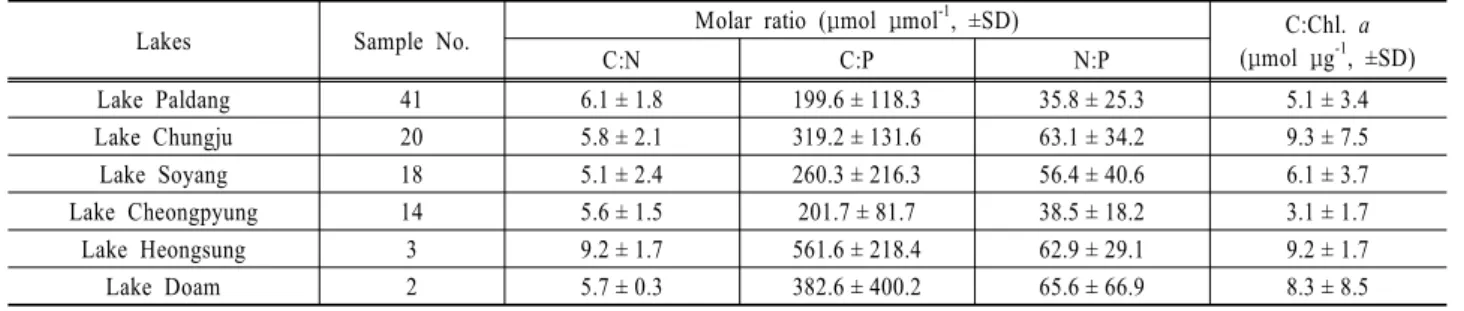
Elemental cellular stoichiometry of natural phytoplankton communities was examined in six large dam reservoirs in the Han River system. Carbon (C) and nitrogen (N) contents of the phytoplankton-dominated seston from Lake Soyang was higher than that from other lakes. Phosphorus (P) content showed slight variations among six lakes in the range of 0.04~0.18 μmol P mg DW
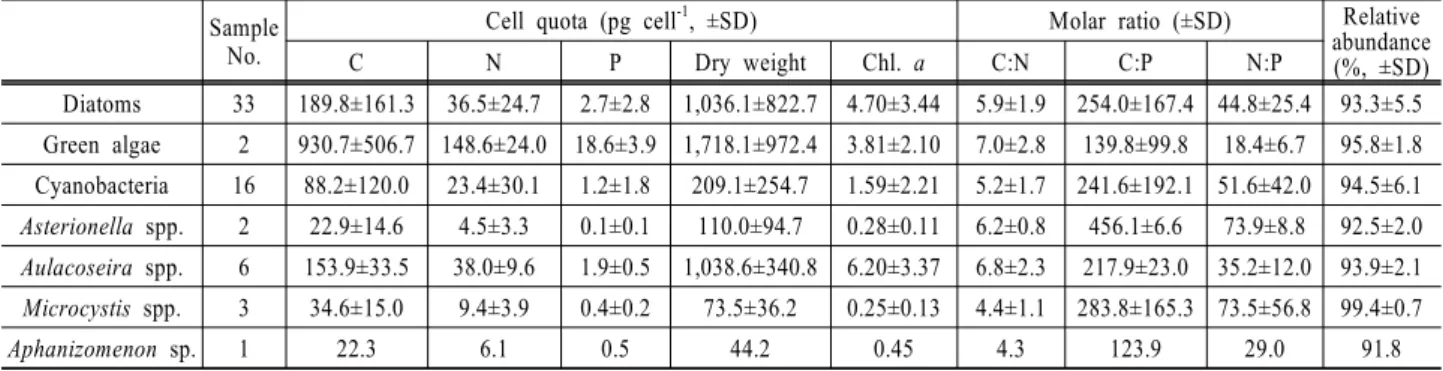
-1. The phosphorus concentrations of lake water showed obvious positive relationship with P and C contents of the phytoplankton-dominated seston. In all six lakes, N:P ratios and C:P ratios in the phytoplankton-dominated seston were more than 23 and 133 respectively, indicating the phytoplankton communities in six lakes have been exposed in phosphorus limited condition. The relative abundance of diatoms showed significant negative correlation with C, N, P contents of the phytoplankton-dominated seston and that of cyanobacteria showed significant positive correlation. Elemental stoichiometry of diatoms-dominated seston showed distinctive less content than that of cyanobacteria-dominated seston. The cellular N:P ratios of diatoms- and cyanobacteria-dominated seston indicate that both main classes of phytoplankton in six lakes are in phosphorus deficiency. Elemental stoichiometry of the phytoplankton-dominated seston in this study could be used for the further ecological stoichiometric studies in six lakes.
Key words : cyanobacteria, diatoms, elemental stoichiometry, Lake Paldang, Lake Soyang, phytoplankton community
1. Introduction 1)
생태적 화학양론은 생태계 상호작용에서 에너지와 탄소 (C), 질소(N), 인(P)과 같은 원소들의 밸런스를 연구하여 생 태계 내에서 어떻게 열역학법칙이 먹이망 거동과 영양물질 순환에 영향을 미치는지 규명한다. 즉 원소 수준의 화학양 론적 접근을 통해 생물의 특성과 활동이 생태계에 어떻게 영향을 미치고 또한 생태계에 의해 어떻게 영향을 받는지 를 분석하는데 있어 물질의 양 뿐만 아니라 질 또한 생태 학적 상호작용의 복잡성을 이해하는데 중요하다는 것을 알 수 있다(Elser, 2000).
식물플랑크톤은 수생태계 1차생산자로서 작게는 특정 호 수, 하천 또는 해양 생태계 먹이망의 에너지 흐름과 물질 순환에서 크게는 지구 규모의 물질 순환에 까지 반드시 고 려해야할 생물군이다. 뿐만 아니라 식물플랑크톤은 녹조, 적조와 같이 일부 부영양 수역에서 대량 증식하여 수환경 에 악영향을 끼치는 주요 관리대상 생물이기도 하다. 식물 플랑크톤 자연 군집의 원소수준 화학양론은 증식속도나 생
†