• 검색 결과가 없습니다.

Effects of Hydrogen Reduction in Microstructure, Mechanical and Thermoelectric Properties of Gas Atomized n-type Bi<sub>2</sub>Te<sub>2.7</sub> Se<sub>0.3</sub> Material

N/A
N/A
Protected

Academic year: 2021

Share "Effects of Hydrogen Reduction in Microstructure, Mechanical and Thermoelectric Properties of Gas Atomized n-type Bi<sub>2</sub>Te<sub>2.7</sub> Se<sub>0.3</sub> Material"

Copied!
6
0
0

로드 중.... (전체 텍스트 보기)

전체 글

(1)

Effects of Hydrogen Reduction in Microstructure, Mechanical and Thermoelectric Properties of Gas Atomized n-type

Bi 2 Te 2.7 Se 0.3 Material

Pradip Rimal, Sang-Min Yoon, Eun-Bin Kim, Chul-Hee Lee, and Soon-Jik Hong *

Division of Advanced Materials Engineering, Kongju National University 32588, Korea (Received April 4, 2016; Revised April 15, 2016; Accepted April 20, 2016)

···

Abstract The recent rise in applications of thermoelectric materials has attracted interest in studies toward the fab- rication of thermoelectric materials using mass production techniques. In this study, we successfully fabricate n-type Bi

2

Te

2.7

Se

0.3

material by a combination of mass production powder metallurgy techniques, gas atomization, and spark plasma sintering. In addition, to examine the effects of hydrogen reduction in the microstructure, the thermoelectric and mechanical properties are measured and analyzed. Here, almost 60% of the oxygen content of the powder are eliminated after hydrogen reduction for 4 h at 360 °C. Micrographs of the powder show that the reduced powder had a compara- tively clean surface and larger grain sizes than unreduced powder. The density of the consolidated bulk using as-atom- ized powder and reduced atomized powder exceeds 99%. The thermoelectric power factor of the sample prepared by reduction of powder is 20% better than that of the sample prepared using unreduced powder.

Keywords: n-type Bi

2

Te

3

, Gas atomization, Hydrogen reduction, Thermoelectric properties

···

1. Introduction

Thermoelectric (TE) materials directly convert heat energy to electricity i.e. when a temperature gradient is provided on thermoelectric junction a voltage gradient is produced through the Seebeck effect [1]. Waste heat from the automotive exhaust, home heating, and industrial pro- cesses are significant and recovery of these wasted heat with thermoelectric generators optimizes sustainability of energy resources [2]. Salient features like high reliabil- ity, absence of moving parts, soundless operation and low environmental impact have attracted researchers to develop efficient material for more than six decades [3].

Efficiency of TE materials can be estimated by unit less figure of merit [4,5],

(1) where, σ is conductivity; S is seebeck coefficient; T is temperature expressed in Kelvin and κ is thermal con- ductivity; of the material. Though significant increment

in individual properties of S, σ and κ are reported, their interrelated factors and coupling between them have lim- ited ZT value around 1. Solid state system exhibiting ZT

≥ 3 is expected to supersede conventional mechanical energy conversion devices [6].

Rhombohedral crystal structure of Bi

2

(Te,Se)

3

has a five layered units of Bi and (Te,Se) hexagonal planes stacked along the base plane, c-axis with atomic order (Te,Se)-Bi-(Te,Se)-Bi-(Te,Se) or Te-Bi-Se-Bi-Te [7, 8]. The n-type Bi

2

Te

3

-Bi

2

Se

3

compound has exhibited outstand- ing TE properties near room temperature. However, full functionality of n-type materials is limited by oxidation on powder surface, which acts as donor thereby degrad- ing the thermoelectric performance of these materials.

Appropriate selection of hydrogen reduction treatment condition can reduce oxidation amount to near solubility level of oxygen in Bi

2

(Te,Se)

3

based materials [9].

TE materials prepared by directional solidification method like zone melting possess outstanding electrical proper- ties, but their applications are limited by poor mechani-

ZT σ S= × 2×T κ⁄

*Corresponding Author: Soon-Jik Hong, TEL: +82-41-521-9387, FAX: +82-41-568-5776, E-mail: [email protected]

<PM리뷰>
(2)

cal properties since their basal plane is a cleavage plane [10,11]. At present, gas atomization process is well- adapted powder fabrication technique for mass produc- tion and high performance spherical shaped powders [12]. Powder as produced by gas atomization are more homogeneous and has finer grained structures and also reduces the complications required in melting and solidi- fication processing [13]. Spark Plasma Sintering (SPS) is a fascinating technology to fabricate fine grains and high- density TE materials. Controlled grain growth, less waste and shorter time of sintering make it most promising con- solidation technique for mass production [14].

In this study, the effects of hydrogen reduction in microstructure, mechanical and thermoelectric properties of n-type Bi

2

Te

2.7

Se

0.3

material fabricated by gas atomiza- tion and spark plasma sintering are studied.

2. Experimental Procedure

2.1. Powder fabrication and consolidation

Pellets of elemental Bi, Te, and Se ingots of high purity

> 99.99% were mixed and heated inside graphite cruci- ble to obtain the melt of Bi

2

Te

2.7

Se

0.3

alloy by using high- frequency induction furnace. The as formed alloy melt was then introduced through a boron nitride melt deliv- ery nozzle into a gas atomizer operating under argon atmosphere. The pressure of inert atomization gas was fixed at 1.2 MPa until atomization of all melt was assured.

Thus, Bi

2

Te

2.7

Se

0.3

alloy powder of wide size distribu- tion was obtained and subsequently sieved so that pow- der and satellites of size above 200 µm were excluded from further analysis. Some portion of Gas atomized (GA) powder was followed by hydrogen reduction treatment in Electric Tube Furnace to eliminate the oxygen present in the powder. The heating rate of the furnace was 10°C/min for 36 min and stabilized at reduction temperature 360°C for 4 hours before cool- ing to room temperature. The reduced gas atomized (R- GA) powder was kept in a protective environment of Glove Box avoiding any chances of oxidation. In this study, both types of powder GA and R-GA were con- solidated by Spark plasma sintering technique. Graph- ite mold filled with 15 g of powder was sintered in vacuum at 400°C temperature for 10 min under a uniax- ial pressure of 50 MPa.

2.2. Microstructure and phase analysis

Powder surface morphology of both GA and R-GA powder was analyzed by field emission scanning elec- tron microscopy (FESEM). The specimen for powder microstructure observation was mounted using epoxy resin and the surface was polished using suitable grades of sand papers and alumina paste. The microstructures of both GA and R-GA powder were observed through an optical microscope. Phase identifications of powder and bulks were investigated by X-Ray Diffraction (Mini- Flex-600; Rigaku, Japan) using CuK-beta( α2) radiation.

To investigate the bulk microstructures of samples con- solidated by SPS, both GA and R-GA samples were frac- tured in the direction perpendicular to the press direction and FESEM images of the fractured surfaces were stud- ied.

2.3. Physical and mechanical properties

Oxygen contents of GA and R-GA powder were mea- sured by Eltra ONH-2000 Oxygen/Nitrogen/Hydrogen determinator. The relative density of the bulk samples were measured for ten times at ambient temperature using Archimedes Principle, and average results are reported. A polished sample mounted in epoxy resin was used to measure the hardness of both GA and R- GA sample. Vickers hardness of samples was measured at different locations of mounted sample piece by hard- ness tester (MMT-X3; Japan) for 20 times under the load of 98.07 ×10

−3

kgf and averaged; the average val- ues were reported as hardness result and used for fur- ther analysis.

2.4. Thermoelectric properties

TE properties of both GA and R-GA bulk samples were measured in a direction normal to the sintering pressure direction. Samples of size 3 mm × 3 mm × 10 mm were cut from disc bulk and the cut samples were polished and cleaned to measure TE transport properties.

Temperature dependence of seebeck coefficient, electri-

cal conductivity and power factors of the samples were

measured by Thermoelectric Power measurement system

(TEP 1000; South Korea) near room temperature. Car-

rier concentration ( η) and Hall mobility (µ) were mea-

sured on samples of size 5 mm × 5 mm × 0.5 mm at

room temperature.

(3)

3. Results and Discussions

3.1. Microstructure and Phase identification

Powder fabrication method has a direct influence on shape, size, and surface of prepared powder. Powder morphology and powder microstructure dictate mechani- cal and TE properties of Bi

2

Te

3

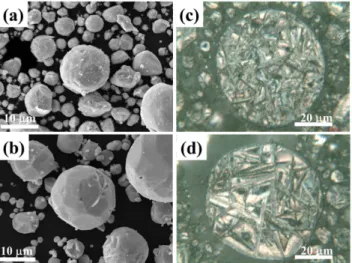
based materials. In this study, morphology and microstructure of powder used for sintering were investigated using field emission scanning electron microscope and optical microscope. Fig. 1 shows the SEM and OM images of the GA and R-GA powder.

Most of the powder had near spherical shapes and fine surface. Fig. 1(a) shows the powder morphology of gas atomized Bi

2

Te

2.7

Se

0.3

material. Most of the GA powder had near spherical shape, which is very attractive for mold filling during sample fabrication as spherical pow- ders exhibit better flowability and higher tap density compared to other shapes. Typical to the GA process, we can notice that GA powder shows a broad range of size distribution. Generally GA powder size ranges from sub- micron to 200 µm. Further, high gas jet pressure and rapid solidification during atomization convert small amount of melt into dust particles. Fig. 1(b) shows the powder morphology of R-GA powder. Also, it is neces- sary to mention that hydrogen reduction in this study does not show any notable effect in powder shape and size distribution, but the process significantly influenced

powder microstructure. Fig. 1(c) shows the microstruc- ture of the GA powder. Needle-shaped grains of differ- ent sizes are clearly visible on the microstructure of GA powder. To study the effect of reduction in the micro- structure, reduced powder of similar size was selected and compared, as grain sizes are dependent on powder sizes in the atomized powder. The difference in powder microstructure can be easily noticed in Fig 1(d). As expected after reduction, grain sizes of the powder increased which suggests that R-GA powder had larger grain sizes and less number of grains.

Fig. 2 shows the XRD patterns of the powder and SPS bulks. All powder and bulks followed Standard powder diffraction JCPDS index Bi

2

Te

3

(PDF# 015-0863) peaks suggesting powder and bulks consisted single phase rhombohedral structure. Although reduction was carried out at a higher temperature for a long time, reduced pow- der also followed the same diffraction pattern, which indicates that powder phase and structure were intact without any compositional change. N-type Bi

2

Te

3

based materials are anisotropic in nature and orientation of c- axis of grains along < 00l> plane is useful to yield high TE properties [8]. However, cleavage plane lies parallel to c-axis in Bi

2

Te

3

based material so strong orientations deteriorates mechanical properties and makes it less desirable for practical applications [11,15]. As seen in Fig. 2, the XRD intensities along basal planes (006) and

Fig. 1. Morphology and microstructure of gas atomized powder: (a) Secondary electron images showing morphology of GA powder (b) Optical microscopy image of microstructure of GA powder (c) Secondary electron images of R-GA powder (d) Optical microscopy image of microstructure of R-GA powder.

Fig. 2. XRD patterns of the GA and R-GA powder and

corresponding SPS consolidated bulk samples. Both powder

and bulk samples can be indexed to JCPDS (PDF # 015-

0863).

(4)

(0015) were weak for both GA and R-GA powder and corresponding consolidated samples. This signifies that SPS consolidation does not stimulate any preferential ori- entation in consolidated samples and in this study both GA and R-GA bulk samples had isotropic mechanical and TE properties.

Microstructures of bulk samples provide useful infor- mation regarding the behavior of TE material and their performance. Fig. 3 shows the fracture surfaces of the consolidated bulk samples. Grains of different sizes are visible in the SEM images. Also, no voids or pores could be located. Smaller grain sizes and a large number of grain boundaries are mostly desirable in TE materials for the reduction of thermal conductivity. Grain sizes in Fig.

3(b) are larger in comparison to those in Fig. 3(a) which could be attributed to the larger grain sizes of the reduced powder. Also, no special grain orientations were seen in the fractographs which support the result obtained from XRD analysis that samples were isotropic in nature.

3.2. Physical parameters and mechanical properties Gas atomization though acclaimed for minor oxidation

of fabricated powder than existing other powder fabrica- tion techniques, nullifying the oxidation of powder is out of hand. The oxygen content of the GA powder, 402.2 ppm, was significantly reduced to 180.6 ppm in R-GA powder through hydrogen reduction. Despite the drastic elimination of oxygen from powder after reduction, con- siderable amount of residual oxygen present in powder was inherited as the solubility of oxygen in Bi

2

(Te,Se)

3

[9]

.

The density of bulk samples also has a decisive role in the performance of TE material. Higher densities are required to ensure less material loss during sample fabri- cation and to yield optimum TE properties. Density of bulk samples is dependent on the powder morphology, size distribution and consolidation process. In this study, use of wide size distribution spherical powder and opti- mized condition of SPS consolidation of Bi

2

Te

3

based materials resulted in densities above 99% for both GA and R-GA samples. Both GA and R-GA bulk samples possessed enough strength for a practical application, which was practically realized during sample prepara- tion. Vickers hardness was around 60 for both GA and R- GA bulk samples. Though slight grain growth was observed after reduction, it is interesting that mechanical property of as-fabricated samples was not influenced by the hydrogen reduction treatment.

3.3. Thermoelectric properties

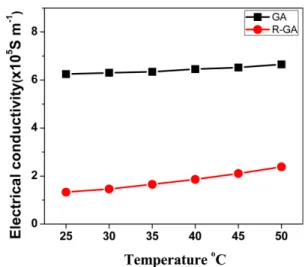
Fig. 4 shows the temperature dependence of electrical conductivity of the samples consolidated by SPS mea- sured at room temperature range of 25-50°C. Electrical Fig. 3. Fractographs of SPS consolidated bulk samples: (a)

GA sample (b) R-GA sample.

Fig. 4. Temperature dependence of electrical conductivity σ

of GA and R-GA sample.

(5)

conductivity can be expressed by following equation [16]:

σ = η e µ

c

(2)

Where, η is the carrier concentration, e is charge car- ried by an electron and µ

c

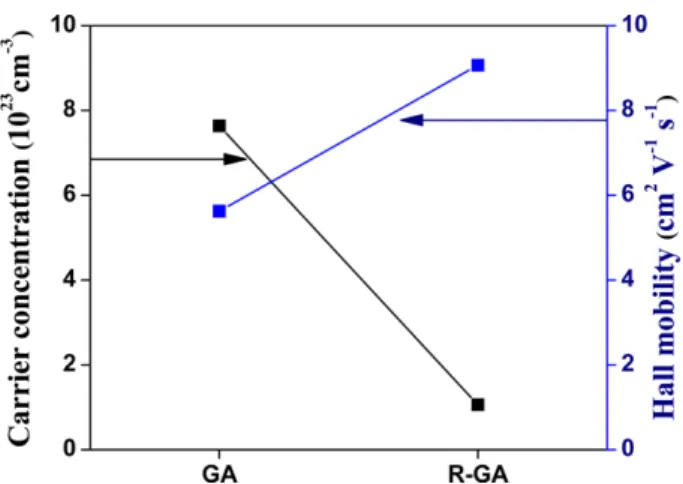
is carrier mobility in the low carrier concentration limit [1]. From Eq. (2), it can be seen that electrical conductivity depends on the product of carrier concentration and carrier mobility. High electri- cal conductivity was measured in GA bulk sample, but after reduction electrical conductivity of the R-GA bulk sample plummeted. In this study, a decrease in electrical conductivity after reduction was mostly influenced by an enormous loss in carrier concentration although there was a slight increment in carrier mobility as shown in Fig. 5.

Seebeck coefficient of all the samples measured at a temperature range of 25-50°C is plotted in Fig. 6. See- beck coefficient determines the difference in voltage gen-

erated for temperature difference created at two ends of thermoelectric material. Seebeck coefficient is simply expressed as [1]:

S = − ∆V / ∆T (3)

Where, ∆V is difference in thermoelectric voltage mea- sured at terminals of samples and ∆T is temperature dif- ference created at the terminals. In our study, negative values obtained for both samples confirmed that they were n-type thermoelectric materials. Seebeck coeffi- cient increased noticeably more than twice for R-GA sample than GA sample. Dissolved oxygen in Bi

2

Te

3

- Bi

2

Se

3

solid solutions takes in place of Te

(2)

which has the smallest electronegativity. This leads to the forma- tion of Bi

2

Te

3-x

O

x

, a solid solution of Bi

2

Te

3

and Bi

2

O

3

, in which the dissolved oxygen acts as a donor [9,17].

This explains the higher carrier concentration of GA sample and the significant decrease in carrier concentra- tion after reduction. Also, Seebeck coefficient can be related to career concentration and scattering by follow- ing relation [18]:

S α r – ln η (4)

Where r is the scattering factor and η is the carrier concentration. Although the presence of oxides could add to scattering of electrons, Seebeck coefficient in this study was mostly influenced by changes in carrier con- centration after reduction. In addition, removal of dis- solved oxygen can lead to the creation of vacancies at Bi and Te/Se sites, and the created vacancy defects have potential to increase scattering of electrons.

Worthiness of a material to be classified as TE mate- rial relies mostly on the amount of power factor gener- ated by the material, but it is not the only feature to influence performance of TE material. Power Factor of TE materials is defined as [19]:

PF = σ × S

2

(5)

Where, σ is the electrical conductivity and S is See- beck coefficient of the material. Temperature depen- dence of thermoelectric power factor is shown in Fig. 7.

Very low Seebeck coefficient of GA bulk yielded low power factor compared to R-GA bulk sample. For both GA and R-GA bulks, power factor first increased with increase in temperature and peaked at 30

o

C and then Fig. 5. Carrier concentration η and carrier mobility µ

c

of the

samples measured at the room temperature.

Fig. 6. Temperature dependence of Seebeck coefficient S of

GA and R-GA samples.

(6)

decreased with further increase of temperature. Also, compared to R-GA bulk, power factor of GA bulk sharply declined above 30

o

C. Almost 20% increment in peak Power Factor and more stability in higher tempera- ture were obtained for R-GA suggesting that hydrogen reduction process can successfully enhance TE proper- ties of n-type Bi

2

Te

3

based materials fabricated by gas atomization process.

4. Conclusions

We have presented hydrogen reduction method as an appropriate technique to improve the TE performance of Bi

2

Te

3

based materials fabricated by gas atomization without any effect on mechanical properties. After reduc- tion, we obtained smooth dust free powder surface and almost 60% of oxygen content in the powder was elimi- nated. Powder microstructure and bulk fracture surface morphology confirmed enlargement in grain size after reduction, but reduction had no effect on Bi

2

Te

3

phase and mechanical properties of SPS consolidated bulk sam- ples. In thermoelectric properties, hydrogen reduction sharply decreased electrical conductivity whereas See- beck coefficient increased more than twice than that of the sample prepared from unreduced powder. Reduction method had positive effects in improving the thermoelec- tric power factor by 20%.

Acknowledgements

This work was supported by ‘Energy Efficiency &

Resources Core Technology Program’ of the Korea Insti- tute of Energy Technology Evaluation and Planning (KETEP) granted financial resource from the Ministry of Trade, Industry & Energy, Republic of Korea (20152020001210).

References

[1] D. M. Rowe: CRC Handbook of Thermoelectrics, CRC Press LLC, Boca Raton, 1995.

[2] G. J. Snyder and E. S. Toberer: Nat. Mater., 7 (2008) 105.

[3] Y. Lan, A. J. Minnich, G. Chen and Z. Ren: Adv. Funct.

Mater., 20 (2010) 357.

[4] L. D. Zhao, B.-P. Zhang, W. S. Liu, H. L. Zhang and J.-F.

Li: J. Alloys Compd., 467 (2009) 91.

[5] K. T. Kim, I. Son and G. H. Ha: J. Korean Powder Metall.

Inst., 20 (2013) 345.

[6] C. J. Vineis, A. Shakouri, A. Majumdar and M. G. Kanatzidis:

Adv. Mater., 22 (2010) 3970.

[7] A. Hruban, A. Materna, W. Dalecki, G. Strzelecka, M. Piersa, E. J.-Wegner, R. Diduszko, M. Romaniec and W. Or owski:

Acta Phys. Pol. A, 120 (2011) 950.

[8] J. Jiang, L. Chen, S. Bai, Q. Yao and Q. Wang: Mater. Sci.

Eng. B, 117 (2005) 334.

[9] C. H. Lim, D. C. Cho, Y. S. Lee and C. H. Lee: J. Korean Phys. Soc., 46 (2005) 995.

[10] H. P. Ha, Y. J. Oh, D. B. Hyun and E. P. Yoon: Int. J. Soc.

Mater. Eng. Resour., 10 (2002) 130.

[11] C.-H. Kuo, C.-S. Hwang, M.-S. Jeng, W.-S. Su, Y.-W.

Chou and J.-R. Ku: J. Alloys Compd., 496 (2010) 687.

[12] H.-S. Kim and S.-J. Hong: J. Alloys Compd., 586 (2014) S428.

[13] S.-J. Hong and B.-S. Chun: Mater. Res. Bull., 38 (2003) 599.

[14] L. D. Zhao, B.-P. Zhang, J.-F. Li, M. Zhou and W. S. Liu:

Physica B Condens. Matter, 400 (2007) 11.

[15] D. H. Kim, C. Kim, S. H. Heo and H. Kim: Acta Mater., 59 (2011) 405.

[16] S.-J. Hong, Y.-S. Lee, J.-W. Byeon and B.-S. Chun: J. Alloys Compd., 414 (2006) 146.

[17] F. Li, X. Huang, Z. Sun, J. Ding, J. Jiang, W. Jiang and L.

Chen: J. Alloys Compd., 509 (2011) 4769.

[18] C.-H. Lee, M. F. Kilicaslan, B. Madavali and S.-J. Hong:

Res. Chem. Intermed., 40 (2014) 2543.

[19] S.-J. Hong and B.-S. Chun: Mater. Sci. Eng. A, 356 (2003) 345.

l Fig. 7. Temperature dependence of Power Factor PF of GA

and R-GA samples measured in temperature range of 25-

50°C.

수치

Fig. 1. Morphology and microstructure of gas atomized powder: (a) Secondary electron images showing morphology of GA powder (b) Optical microscopy image of microstructure of GA powder (c) Secondary electron images of R-GA powder (d) Optical microscopy imag
Fig. 4. Temperature dependence of electrical conductivity  σ of GA and R-GA sample.
Fig. 6. Temperature dependence of Seebeck coefficient S of GA and R-GA samples.

참조

관련 문서

Third, looking at the sub-factors in terms of textbooks and software by priority, they were in the order of development of textbooks and learning tools

For the gender, while training and direction, democratic direction, positive regard, and autocratic direction of leadership type sub-factors were perceived as high in

Fourth, for the sub-factors of personality traits according to weight lifters’ education, while there was a high difference in neuroticism and agreeableness

: Development of Microstructure and Alteration of Mechanical Properties.. 4.6 The homogeneous nucleation rate as a function of undercooling ∆T. ∆T N is the critical

Second, there was no statistically significant difference in the sub-factors of participation satisfaction according to age, career, occupation,

Among the sub-factors of self-esteem, positive, male was higher than female, and on the contrary, negative In this study, females were higher than males,

In other words, the higher level of social support and positive reward in leadership type, the higher level of social approval among the sub-variables

§ Null-path-length balancing: comparing the null-path-length of each of the two sub-trees (the length to the closest null sub- tree/empty node). § Weight balancing: