http://dx.doi.org/10.12925/jkocs.2016.33.3.498
대장균 β-Galactosidse를 이용한 1, 2-Hexanediol galactoside의 합성과 Ethyl Acetate 추출 및 Silica Gel Chromatography를
이용한 정제
김이옥․정경환✝
한국교통대학교 생명공학과
(2016년 7월 13일 접수; 2016년 9월 2일 수정; 2016년 9월 22일 채택)
β-Galactosidase-catalyzed Synthesis of 1, 2-Hexanediol Galactoside and its Purification using Ethyl Acetate Extraction
followed by Silica Gel Chromatography
Yi-Ok Kim․Kyung-Hwan Jung✝
Department of Biotechnology, Korea National University of Transportation, Jeungpyung, Chungbuk 368-701, Republic of Korea
(Received July 13, 2016; Revised September 2, 2016; Accepted September 22, 2016)
요 약 : 선행연구에서 화장품 소재로서 보습력과 방부력을 가지고 있는 1, 2-hexanediol (HD)의 transgalactosylation 반응을 통하여 galactose한 분자가 HD에 결합한 1, 2-hexanediol galactoside (HD-gal)의 합성을 확인하였다. 본 연구에서 재조합 β-galactosidase (β-gal)가 발현된 Escherichia coli (E. coli) 세포를 이용하여 약 94%의 수율로 HD-gal가 합성되는 것을 관찰하였고, HD-gal을 합 성한 후, 보다 효과적인 HD-gal의 정제 방법에 대하여서도 연구하였다. 먼저 고농도의 lactose (300 g/l) 존재 하에서 β-gal을 함유한 E. coli 세포를 이용하여, 48 시간 동안 75 mM의 HD로 부터 HD-gal이 합성되는 것을 TLC 분석으로 확인하였고, 반응액에서 E. coli β-gal의 존재를 Western blotting으로 확인할 수 있었다. HD-gal을 효과적으로 순수 정제하기 위하여, 용매를 사용하여 transgalactosylation 반응이 끝난 후 잔여 HD를 우선 제거하고, 이어서 silica gel chromatography를 수 행하는 방법을 실시하였다. 물에 녹지 않는 용매로는 methylene chloride와 ethyl acetate를 선택하여 비 교 실험하였는데, ethyl acetate를 사용하여 4회 물층을 분획하여, 잔여 HD를 효과적으로 제거할 수 있 었다. 그 후, 이어서 silica gel chromatography 수행하여, 순수한 HD-gal을 효과적으로 정제하였다. 반 응에 첨가된 75 mM의 HD를 기준으로 최종 정제된 HD-gal의 생산 수율은 mole 기준으로는 약 8.9±0.6% (n=3), weight 기준으로 약 21.1±1.4% (n=3) 정도였다. 앞으로 이러한 정제 방법을 이용하 여 얻은 HD-gal의 항균력 변화를 HD와 비교하여 평가할 예정이고, 피부세포에 대한 독성 변화를 역시 HD와 비교하여 분석할 예정이다.
✝Corresponding author (E-mail: [email protected])
주제어 : 1, 2-헥산디올 갈락토사이드, 에틸아세테이트 추출, 실리카젤 크로마토그래피, 베타-갈락토시 데이즈, 화장품 방부제
Abstract : 1, 2-Hexanediol galactoside (HD-gal) has been previously synthesized from 1, 2-hexanediol (HD), in which recombinant β-galactosidase (β-gal) of Escherichia coli (E. coli) was used for transgalactosylation reaction. In this study, a method for HD-gal purification from the reaction mixture was particularly investigated. Using β-gal-containing E. coli, HD-gal was synthesized from 75 mM HD for 48 hr under 300 g/l lactose concentration. Then, HD-gal synthesis from HD was confirmed by TLC analysis, and the existence of E. coli β-gal during 48 hr-reaction was also confirmed by Western blotting, in which the conversion yield of HD to HD-gal reached about 94% during 48 hr. To establish an efficient method for HD-gal purification, we carried out the solvent extraction of the reaction mixture, followed by silica gel chromatography, particularly in order to remove the residual HD. Two water-immiscible solvents, such as methylene chloride and ethyl acetate, were investigated comparatively to find out appropriate solvent. Then, it was found that residual HD was almost removed when ethyl acetate extraction of water phase of reaction mixture was carried out four times. Subsequently, silica gel chromatography was carried out, and purified HD-gal could be finally obtained. The production yield for HD-gal from 75 mM HD was 8.9±0.6% (n=3) (mole basis) or 21.1±1.4% (n=3) (weight basis). For further study, using purified HD-gal, we will investigate the minimum inhibitory concentrations (MICs) of HD-gal against bacteria. In addition, cytotoxicity to human skin cells of HD-gal will be examined.
Keywords : 1, 2-Hexanediol Galactoside, Ethyl Acetate Extraction, Silica Gel Chromatography, β -Galactosidase, Cosmetic preservative
1. 서 론
본 연구팀은 그 동안 화장품에 주로 사용하는 방부제(살균/보존제)인 chlorphenesin (CPN)과 phenoxyethanol (PE) 대한 transgalactosylation 반응을 연구하여 왔다. CPN과 PE 분자에 galactose 한 분자를 효소반응을 이용하여 첨가 결합시킴으로 방부력에는 큰 영향이 없고, 합성된 방부제 galactoside 분자의 피부세포에 대한 세포 독성이 감소되는 긍정적인 결과를 얻었다[1-4].
CPN과 PE에 대한 transgalactosylation 반응에 대한 연구는 몇 연구 팀에서 진행하였으나, 합성 된 CPN과 PE의 galatoside 분자를 확인 하는 수 준이었으며, 이 분자의 기능변화와 피부세포에 대 한 독성평가 등에 대하여서는 구체적인 연구가 진행되지 않았다[5-7].
한편, 이러한 transgalactosylation 반응에 의해 합성된 galactoside 유도체 의약품의 경우에는 이 러한 반응으로 합성된 유도체 의약품이 보다 좋
은 방향으로 약물의 특성을 변화/개선 (독성감소, 물에 대한 용해도 증가, 표적으로의 전달능력 증 가) 시킬 수 있다는 연구 결과도 보고되고 있다 [8-10].
이러한 연구를 확장 발전 시키기 위하여, 본 연구팀에서는 화장품 소재로서 보습력과 방부력 을 가지고 있는 1, 2-hexanediol (HD)의 transgalactosylation 반응에 대하여서 이미 선행 연구를 실시하여 1, 2-hexanediol galactoside (HD-gal)의 합성을 처음으로 확인하였다[11, 12]. HD는 현재 화장품의 방부제로 1-2%의 농 도로 사용되고 있는데, 1, 2-alkanediol의 alkyl chain의 길이가 길어질수록 독성이 높아지는 것 으로 알려져 있으며, 몇 가지 1, 2-alkanediol을 혼합하여 사용하면, 피부에 대한 독성이 있는 것 으로 알려져 있다[13-15].
본 연구에서도 선행연구에서와 같이 HD-gal을 재조합 β-galactosidase (β-gal)가 발현된 Escherichia coli (E. coli) 세포를 이용하여
HD-gal을 합성하였다[1-4]. 재조합 E. coli 세포 안에 β-gal이 이미 발현속도 조절을 통하여 합 성된 상태이며, β-gal의 활성이 E. coli 세포 파 쇄물의 insoluble fraction에서 발견된다는 사실도 이미 본 연구팀에 의하여 밝혀졌다[16-18]. 본 연구에서는 선행연구에서 HD-gal 합성을 확인하 였기 때문에[11, 12], HD-gal 합성 후, 보다 효 과적인 HD-gal을 정제하는 방법에 대하여 연구 하였다. 이러한 정제연구는 transgalactosylation 반응에 의하여 합성된 HD-gal 분자의 항균력 실 험과 세포독성 실험에 많은 양의 HD-gal이 요구 되기 때문에 반드시 필요한 연구로 판단되었다.
이 때, HD-gal 합성반응이 종료된 후, 반응액에 잔존하는 HD를 효과적으로 용매를 이용하여 제 거하는 방법을 사용하여, silica gel chromatography를 이용한 HD-gal 정제 작업의 효율성을 증대 시켰다. 이러한 정제 방법으로 보 다 순수한 HD-gal을 정제하여, HD-gal의 항균 력과 피부세포에 대한 독성실험 수행을 보다 원 활히 할 수 있을 것으로 기대하고 있다.
2. 실 험
2.1. 시 약
1, 2-Hexanediol은 Sigma-Aldrich (St Louis, MO, USA)에서 구입하였고, TLC (thin-layer chromatography) plate는 Macherey–Nagel (Düren, Germany)의 DC-Fertigplatten SIL G-25 UV254를 사용하였다. Western blotting을 위한 1st antibody인 anti-β-gal (rabbit IgG fraction)은 Molecular probes (Eugene, Oregon, USA)에서, 2nd antibody인 goat anti-rabbit IgG-HRP (horseradish preoxidase conjugate)는 Abcam (Cambridge, UK)에서 구입하였다. 그리 고 ECL (enhanced chemiluminescent) substrate 과 X-ray film은 Thermo Fischer Scientific Co.
(Waltham, MA, USA)와 GE Healthcare Life Sciences (Chicago, IL, USA)에서 구입하여 사용 하였다. 이때, marker로서 β-gal은 Sigma- Aldrich (St. Louis, MO, USA)에서 구입하였다.
HD-gal 정제를 위한 Silica gel은 Zeochem (Uetikon am See, Switzerland)의 ZEOprep 60 (60-200 μm)을 사용하였고, 기타 본 연구에 사 용한 시약들은 reagent-grade를 사용하였다.
2.2. β-Gal을 생산하는 재조합 대장균
대장균의 araBAD 프로모터 시스템에 의하여 발현이 조절되는 pBAD/Myc-His/lacZ vector (7.2 kb) (Invitrogen, Carlsbad, CA, USA)를 사 용하여 E. coil MC1061를 발현 숙주로 하여 β -gal을 발현하였다. β-gal 유전자는 pBAD/
Myc-His expression kit 의 유전자를 사용하였 다. 재조합 E. coil 제작과 재조합 β-gal을 함유 한 E. coil의 배양방법 및 E. coil 세포의 효소로 서 보관 방법 등에 대하여서도 선행연구에서 자 세히 기록하였다[1-4, 16, 17].
2.3. β-Gal 함유 대장균을 이용한 HD-G 합성 15 ml conical tube에 300 g/l lactose, 4.8 U/ml β-gal, 75 mM HD를 50 mM phosphate buffer (pH 7.0)로 녹인 후, 전체 부피를 10 ml 되게 한다. 그리고 shaking incubator (37℃, 100 rpm) 에서 48 시간 동안 반응시켰다[11].
2.4. TLC 분석
20 × 10 cm TLC plate에 시료를 loading하 고 acetonitrile : water = 85 : 15 (v/v)을 이동 상으로 하여 15 분 전개하였다. 그리고 staining solution #1 (1.25 g KMnO4, 10 g K2CO3, 1.25 ml 10 % NaOH in 200 ml water) (in Fig. 1, 3, 4, 5, and 7) 혹은 staining solution
#2 (0.5% α-naphtol, 5% H2SO4 in ethanol) (in Fig. 6)를 TLC plate에 뿌린 후, 80℃ oven 에서 15 분간 말려서 밴드를 확인 하였다. TLC 분석에 사용한 시료 부피는 기본적으로 1.0 μl 이며, silica gel chromatography를 이용한 정제 후, 분획물을 분석할 때는 20 μl의 시료를 사용 하였다. HD와 HD-gal의 정량이 필요할 경우에 는 TLC plate 스캔하여 이미지를 얻은 후, AlphaEase FC software (Alpha Innotech, San Leonardo, CA, USA)를 이용하여 정량 분석하였 다[11].
2.5. Western blotting
SDS-PAGE (sodium dodesyl sulfate- polyacrylamide gel electrophoresis)는 SE250 (mini-vertical gel electrophoresis unit, GE Healthcare Life Sciences)를 사용하여 실시하였 다. SDS-PAGE 실시 후, TE22 mini tank transfer unit (GE Healthcare Life Sciences)에서 nitrocellulose membrane (Hybond-C Extra, GE
Healthcare Life Sciences)을 이용하여 단백질을 transfer 하였다. 그리고 1st antibody와 2nd antibody를 각각 1 : 5,000와 1 : 10,000 비율로 희석하여 사용하여 처리한 후, ECL substrate와 반응시키고, X-ray film에 노출시켜 β-gal 밴드 를 확인하였다. β-gal을 함유하는 재조합 E.
coli로 부터 soluble fraction과 insoluble fraction 을 얻는 방법에 대하여서는 선행연구에 자세히 기술하였다[16, 17].
2.6. Extraction of the reaction mixture using Methylene chloride and Ethyl acetate
500 μl 반응액와 500 μl 용매 (methylene chloride 혹은 ethyl acetate)를 1 : 1 (v/v)로 넣 고 vortexing 한 후, 층 분리가 일어날 때까지 실 온에 방치한다. 층 분리가 일어나면 용매 층을 제거한다. 그리고, 나머지 물 층에 다시 500 μl 용매를 넣고, vortexing 하고, 층 분리를 시키고, 용매 층을 제거한다. 이와 같이 용매 층에는 HD 가 물 층에 HD-gal이 더 잘 녹는 성질을 이용하 여 HD와 HD-gal을 분획한다. 이 분획 방법을 총 4회의 실시하였으며, 선행연구에서 실시한 추 출방법을 응용하여 사용하였다[2].
2.7. Silica gel chromatography를 이용한 HD-gal의 정제
Econo-column (ID: 5 cm, L: 10 cm, maximum vol.: 193 ml; Bio-Rad, Hercules, CA, USA)에 20G 주사바늘을 연결하고, column 내에 silica gel을 7 cm 높이로 채우고, 이동상 (acetonitrile : water =85 : 15, v/v)으로 한번 세척한다. 그리고 이동상이 silica gel의 위로 0.5-1.0 cm 남았을 때, HD-gal이 함유된 반응 액 이나 용매 추출물 8 ml를 loading 한다. 그 후 이동상을 중력에 의하여 연속적으로 흘리면서 35 ml씩 분획물을 받고, 그 분획물을 TLC로 분 석하였다[11, 12].
3. 결과 및 고찰
3.1. β-Gal을 함유한 E. coli 세포를 이용한 HD-gal 합성
선행연구에서 HD에 galactose가 한 분자 결합 한 HD-gal 합성을 확인하였다[11, 12]. 그런데,
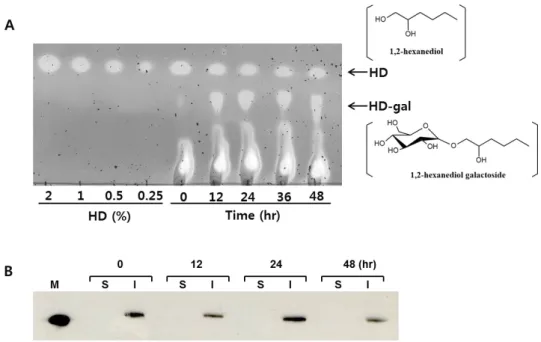
물리화학적인 특성 분석, 항균력의 변화, 그리고 피부세포에 대한 독성 변화 등을 연구하기 위하 여, 반응액으로 부터 순수한 HD-gal의 정제가 반드시 필요하였다. Fig. 1A에서와 같이 고농도의 lactose (300 g/l) 존재 하에서 β-gal을 함유한 E. coli 세포를 이용하여, 48 시간 동안 75 mM 의 HD로 부터 HD-gal 합성을 실시하여 TLC 분석으로 확인하였다. HD spot은 반응이 진행되 면서 점점 감소하고, 합성된 HD-gal spot은 점 점 증가하였다. 이 때, HD의 두 개의 hydroxyl group (-OH) 중에서 어떤 위치에 galactose가 결합하는지는 아직 확인하지 않았으나, 추정되는 HD-gal의 분자구조를 Fig. 1A에 표시하였다. 그 리고, 시간 별로 sampling 한 반응액에서 E. coli 세포를 분리하고, soluble과 insoluble fraction을 분획한 후, Western blotting으로 β-gal의 존재 를 확인하였다(Fig. 1B). 이 때, 48 시간의 반응 동안에 insoluble fraction에서 β-gal이 존재하는 것을 확인하였다. 이러한 결과는 선행연구에서 chlorphenesin (CPN)과 phenoxyethanol (PE)의 galactoside 유도체인 CPN-gal과 PE-gal을 합성 할 때와 같은 결과이며[1, 2], 본 연구에 사용한 β-gal을 함유한 재조합 E. coli이 β-gal을 insoluble 형태로 발현되고, 효소로서 기능을 하 고 있다는 것을 보여주는 결과라고 할 수 있다.
또한, Fig. 1의 48 시간 동안의 HD-gal 합성 반응 결과에서 HD 변화량을 TLC image 분석을 통하여 정량적으로 계산하여 보았다. Fig. 2와 같 이 75 mM HD가 4.4 mM 까지 감소하는 것을 확인할 수 있었다. 이 때, HD가 오직 HD-gal로 만 conversion 된다고 가정하고, HD-gal과 percent conversion을 같이 graph에 그려보았다.
Fig. 2의 결과에서와 같이 48 시간 동안 약 94%
정도의 HD가 HD-gal로 conversion되는 것을 확인하였고, 이는 본 연구 팀의 β-gal을 이용한 CPN-gal [1, 3]과 PE-gal [2, 4]을 합성하는 연 구에서의 약 64-67%, 그리고 약 50%의 conversion yield 보다 높은 값이며, 다른 두 외 국 연구 팀의 CPN-gal 합성 연구의 결과인 15%와 12.5% 보다 더 높은 수치이다[5, 6].
Fig. 1. HD-gal synthesis using β-gal-containing E. coli cells. (A) TLC analysis for HD and HD-gal during 48 hr-reaction. (B) Western blot analysis of samples harvested during the HD-gal synthesis reaction. Sampling times are described at the top of each image. M, S, and I are β-gal standard (Sigma), soluble, and insoluble fractions from E. coli cells in the reaction mixture, respectively.
Fig. 2. Time-course profiles of HD and HD-gal during HD-gal synthesis using β-gal-containing E. coli cells. HD and HD-gal were analyzed by TLC.
Conversion (%) indicates the percent conversion of about 75 mM HD to HD-gal.
이렇게 합성된 HD-gal을 반응액으로 부터 정 제하기 위하여 먼저 선행연구에서 사용한 silica
gel chromatography를 실시하였다[1, 2, 4]. Fig.
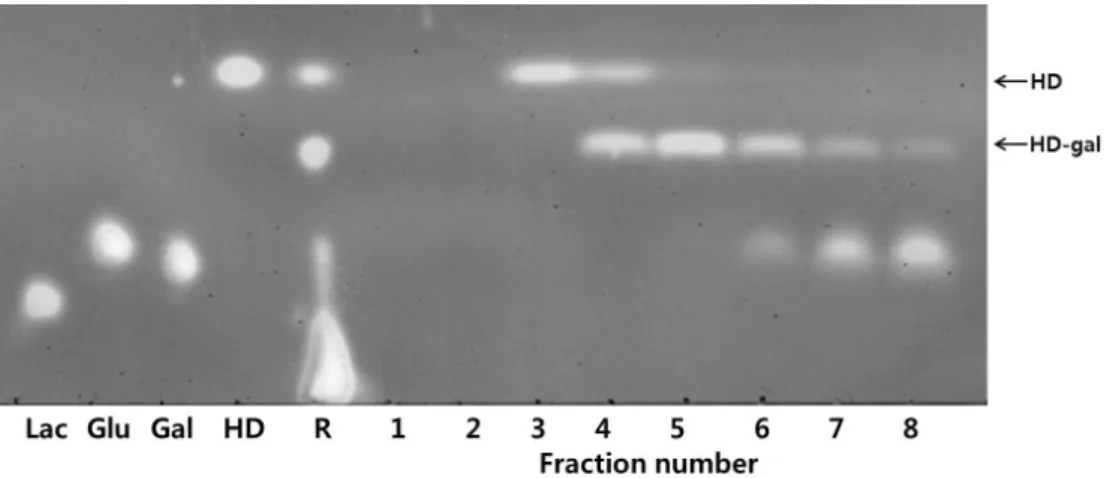
3에서와 같이 fraction number 4번에서 부터 HD-gal이 반응액에서 분리되는 것을 확인 하였 으나, fraction number 4, 5에서는 반응액 중의 잔여 HD가 섞여있었고, fraction number 6, 7, 8번에서는 glucose 혹은 galactose로 추정되는 물 질이 HD-gal 분획물에 섞여있었다.
3.2. 용매 추출과 silica gel chromatography를 이용한 HD-gal 정제
Fig. 3의 결과는 silica gel chromatography만 으로는 HD-gal을 순수하게 분리 할 수 없음을 보여주고 있다. 한편, 본 연구팀의 선행연구에서 PE에 galactose가 한 분자 붙은 PE-gal의 water solubility가 PE 보다 매우 좋음을 물에 녹지 않 는 용매를 이용한 분획실험으로 밝힐 수 있었다 [2]. 다른 연구팀의 연구에서도 이러한 galactosylation이 nucleoside의 water solubility를 증가시킨다는 연구 결과를 보고하고 있다[19]. 그 래서 HD-gal을 silica gel chromatography를 이 용하여 분리 정제하기 전에 물에 녹지 않는 용매
Fig. 3. TLC analysis of the fractions from silica gel chromatography for purifying HD-gal, where samples are at 48 hr from Fig. 1(A). Lac, Glu, Gal, and HD represent 1%
standards of lactose, glucose, galactose, and 1, 2-hexanediol, respectively. R indicates the reaction mixture at 48 hr. In the following figures, Lac, Glu, Gal, HD, and R represent the same abbreviation.
Fig. 4. TLC analysis after the extraction of reaction mixture at 48 hr using (A) methylene chloride and (B) ethyl acetate. MC and EA indicate the phases of methylene chloride and ethyl acetate, respectively, after the extraction of reaction mixture at 48 hr. W indicates water phase after extraction. Number 1, 2, 3, and 4 represent the first, second, third, and forth extraction, respectively, using MC and EA.
를 이용하여 반응액을 분획 처리하여, 물에 보다 더 잘 녹는 HD-gal과 상대적으로 용매에 잘 녹 는 HD를 분획 분리하기로 하였다. 물에 녹지 않 는 용매로는 methylene chloride (density = 1.33 g/ml)와 ethyl acetate (density = 0.90 g/ml)를 선정하여 비교 실험하였다. 반응액에 용매를 섞은 후, 1차 분획하여 물 층을 얻고, 이 물 층을 용매
로 2차 분획하여 다시 물 층을 얻는 방법으로 총 4회 분획 분리를 실시하였다(Fig. 4). Methylene chloride의 경우에 물 층으로 HD-gal이 이동하 는 것이 확인 되었으나, 잔여 HD도 계속해서 물 층에 남아 있는 것이 확인되었다(Fig. 4A). 그러 나, ethyl acetate의 경우에는 물 층으로 HD-gal 이 이동하고, 물 층으로 이동된 잔여 HD는 분획
Fig. 5. TLC analysis of the fractions from silica gel chromatography using the water fraction after forth extraction of reaction mixture at 48 hr.
횟수가 증가함에 따라서 대부분 사라지는 것으로 확인되었다(Fig. 4B).
이 결과를 바탕으로 silica gel chromatography 실시 전에 ethyl acetate로 분획 처리하여 반응액 에 남아 있는 잔여 HD를 선택적으로 제거하기로 하였다. Fig. 5는 ethyle acetate로 4회에 걸쳐서 분획 처리하여 물 층에서 잔여 HD를 제거 한 후, silica gel chromatography를 실시하고, 그 분 획물을 TLC로 분석한 결과이다. Fraction number 4, 5, 6에서 없는 비교적 순수한 HD-gal을 얻을 수 있었으며, 어느 분획물에서도 HD는 확인 할 수 없었다. 이 때, fraction number 4, 5, 6을 모아서 농축하여 정제된 HD-gal 용액을 제조하였다. 그러나, fraction number 7, 8에서는 단당류로 추정되는 물질이 관찰되었다. 그래서, fraction number 7, 8의 HD-gal 이외의 단당류 추정 물질이 무엇인지를 확인하기 위하여 이 fraction에 대한 TLC를 실시 한 후, 단당류를 염색하는 시약으로 처리하여 확 인해 보았다(Fig. 6). 그 결과 transgalactosylation 반응 후, 남아있는 glucose로 추정할 수 있었다 (② in Fig. 6). 이 glucose는 아마도 transgalactosylation 반응 시, lactose가 분해되며 galactose는 HD와 결합하고, 남은 glucose라고 추론할 수 있다. 보다 높은 수율의 HD-gal을 얻 기 위해서는 앞으로 잔여 glucose를 분리 제거하 는 정제방법에 대한 추가 연구가 필요할 것으로
생각된다.
Fig. 6. TLC analysis of the number 7 and 8 fractions of Fig. 5.
이러한 연구 결과를 종합하여 순수 분리된 HD-gal을 얻기 위하여, ethyl acetate 분획 분리 를 이용하여, 10 ml의 transgalactosylation 반응 액으로 부터 잔여 HD을 제거하고, 그 분획물을 silica gel chromatography에 loading 하여 순수 한 HD-gal 정제를 실시하였다. 이 때, silica gel chromatography에서 약 70 ml의 순수한 HD-gal이 포함된 분획을 모을 수 있었고, 약
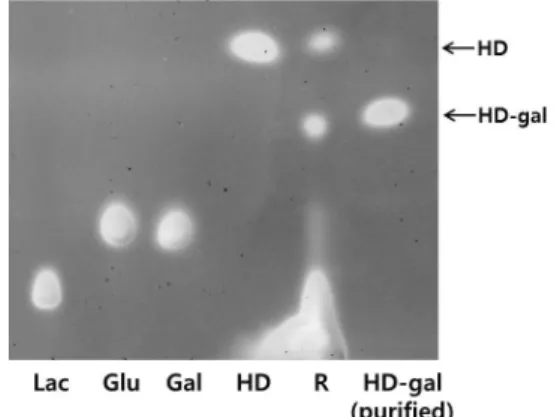
112 ml의 transgalactosylation 반응액을 이용하 여 14~15회의 EA 분획 분리 및 silica gel chromatography 과정을 통하여 약 1 liter의 순 수한 HD-gal이 포함된 분획물을 모을 수 있었 다. 이 분획물을 모아서 rotary vacuum evaporator로 이동상을 제거하고, HD-gal의 무 게를 측정한 후, 1.0 M 농도로 HD-gal 정제 용 액 약 700 μl을 얻을 수 있었다. 그리고, 정제된 HD-gal의 순도는 TLC 분석을 통하여 확인할 수 있었다(Fig. 7). Fig. 7의 TLC 결과에서 정제 된 HD-gal 용액의 농도는 1.0 M 이며, HD와 glucose, galactose, lactose가 완전히 제거 되었음 을 확인 할 수 있었다.
Fig. 7. TLC analysis of purified HD-gal.
Concentration of purified HD-gal was 1.0 M.
이 때, 75 mM HD가 포함된 112 ml의 반응 액으로 부터 1.0 M의 정제된 HD-gal 약 700 μl을 얻는 과정에서의 mole 기준으로의 수율을 아래와 같이 계산할 수 있다.
같은 방법으로 weight 기준으로 계산하면, 19.7 (%)를 얻을 수 있었다. 위의 HD-gal 정제를 2 회 더 실시 하여, 순수한 1 M의 HD-gal을 750 그리고 800 μl 얻을 수 있었다. 결론적으로, 이 상 총 3회 실시한 75 mM의 HD로부터 HD-gal 을 얻는 평균 수율은 mole 기준으로 약 8.9±0.6% (n=3), weight 기준으로 약 21.1±%
(n=3) 였다.
4. 결 론
본 연구에서는 75 mM의 HD를 이용하여 transgalactosylation 반응액을 수행하여 약 94%
의 수율로 HD-gal을 합성할 수 있었고, 이어서 ethyl acetate를 이용한 잔여 HD 추출제거, 그리 고 silica gel chromatography를 수행하여 정제된 순수한 HD-gal을 얻었다. 반응에 첨가된 75 mM의 HD를 기준으로 생산 수율을 계산하여 보 았는데, 최종 정제된 HD-gal의 수율은 mole 기 준으로는 약 8.9±0.6% (n=3), weight 기준으로 약 21.1±1.4% (n=3) 정도였다. 본 연구를 통하 여, HD-gal을 순수 정제하는 방법을 확립하였으 며, 앞으로 이러한 정제 방법을 이용하여 얻은 HD-gal로 항균력의 변화를 HD와 비교하여 수 행할 예정이고, 피부세포에 대한 독성 변화를 역 시 HD와 비교하여 분석할 예정이다. 선행연구의 CPN galactoside [1]와 PE galactoside [2]의 경 우와 같이 항균력은 유사하게 유지하면서, 피부세 포에 대한 독성이 감소된 새로운 화장품용 방부 제 확인을 기대하고 있다.
감사의 글
본 연구를 위하여 도움을 준 한국교통대학교 생명공학과 김진희 학생에게 감사의 말을 전합니 다.
References
1. S. –E. Lee, T. M. Jo, H. –Y. Lee, J. Lee, and K. –H. Jung, β-Galactosidase- catalyzed Synthesis of Galactosyl Chlorphenesin and its Characterization, Appl. Biochem. Biotechnol., 171(6), 1299 (2013).
2. K. –H. Jung and H. –Y. Lee, Escherichia coli β-Galactosidase-catalyzed Synthesis of 2-Phenoxyethanol Galactoside and its Characterization, Bioprocess Biosyst. Eng., 38(2), 365 (2015).
3. S. –E. Lee, H. –Y. Lee, and K. –H. Jung, Production of Chlorphenesin Galactoside by Whole Cells of β-Galactosidase-
containing Escherichia coli, J. Microbiol.
Biotechnol., 23(6), 826 (2013).
4. H. –Y. Lee and K. –H. Jung, Enzymatic Synthesis of 2-Phenoxyethanol Galactoside by Whole Cells of β-Galactosidase- containing Escherichia coli, J. Microbiol.
Biotechnol., 24(9), 1254 (2014).
5. N. Bridiau, S. Taboubi, N. Marzouki, M.
D. Legoy, and T. Maugard, β -Galactosidase Catalyzed Selective Galactosylation of Aromatic Compounds.
Biotechnol. Prog., 22(1), 326 (2006).
6. C. Scheckermann, F. Wagner, and L.
Fischer, Galactosylation of Antibiotics Using the β-Galactosidase from Aspergillus oryae. Enzyme Microb.
Technol., 20(8), 629 (1997).
7. M. Donho, T. Kimura, K. Hayashi, and H. Nakajima, Japanese Patent 08225588 (1996)
8. J. Huang, F. Gao, X. Tang, J. Yu, D.
Wang, S. Liu, and Y. Li, Liver-targeting Doxorubicin-conjugated Polymeric Prodrug with pH-Triggered Drug Release Profile, Polym. Int., 59(10), 1390 (2010).
9. D. Melisi, A. Curcio, E. Luongo, E.
Morelli, and M. G. Rimoli, D-Galactose as a Vector for Prodrug Design, Curr.
Top. Med. Chem., 11(18), 2288 (2011).
10. L. F. Tietze and K. Schmuck, Prodrugs for Targeted Tumor Therapies: Recent Developments in ADEPT, GDEPT and PMT, Curr. Pharm. Design, 17(32), 3527 (2011).
11. Y. -O. Kim and K. –H. Jung, Enzymatic Synthesis of 1, 2-Hexanediol Galactoside by Whole Cells of β-Galactosidase- containing Recombinant Escherichia coli, J.
Life Sci., 26(5), 608 (2016).
12. Y. –O. Kim, H. –Y. Lee, and K. –H. Jung, NMR Spectroscopy and Mass Spectrometry of 1, 2-Hexanediol Galactoside synthesized using Escherichia coli β-Galactosidase, J. Korean Oil Chem. Soc., 33(2), 286 (2016).
13. S. B. Levy, A. M. Dulichan, and M.
Helman, Safety of a Preservative System containing 1, 2-Hexanediol and Caprylyl Glycol, Cutan. Ocu.l Toxicol., 28(1), 23 (2009).
14. E. Lee, S. An, S. -A. Cho, Y. Yun, J.
Han, Y. K. Hwang, H. K. Kim, and T.
R. Lee, The influence of Alkane Chain Length on the Skin Irritation Potential of 1, 2-Alkanediols, Int. J. Cosmet. Sci., 33(5), 421 (2011).
15. W. Johnson Jr., W. F. Bergfeld, D. V.
Belsito, R. A. Hill, C. D. Klaassen, D.
Liebler, J. G. Marks Jr., R. C Shank, T.
J. Slaga, P. W. Snyder, and F. A.
Andersen, Safety Assessment of 1, 2-Glycols as Used in Cosmetics. Int. J.
Toxicol., 31(5 Suppl), 147S (2012).
16. K. –H. Jung, Enhanced Enzyme Activities of Inclusion Bodies of Recombinant β -Galactosidase via the Addition of Inducer Analog after L-Arabinose Induction in the araBAD Promoter System of Escherichia coli, J. Microbiol. Biotechnol., 18(3), 434 (2008).
17. K. –H. Jung, J. -H. Yeon, S. –K. Moon, and J. -H. Choi, Methyl α -D-Glucopyranoside Enhances the Enzymatic Activity of Recombinant β -Galactosidase Inclusion Bodies in the araBAD Promoter System of Escherichia coli. J. Ind. Microbiol. Biotechnol., 35(7), 695 (2008).
18. J. -H. Yeon and K. -H. Jung, Change in Compactness of Inclusion Bodies of Recombinant β-Galactosidase Expressed in the araBAD Promoter System of Escherichia coli, Biotechnol. Bioprocess Eng., 15(4), 620 (2010).
19. L. Q. Yan, N. Li, and M. H. Zong, First Enzymatic Galactosylation of Acyclic Nucleoside Drugs by β-Galactosidase:
Synthesis of Water-soluble β -D-Galactosidic Prodrugs, Biotechnol.
Bioprocess Eng., 19(4), 586 (2014).