755
FOREST SOCIETY
The Effect of Antecedent Moisture Conditions on the Contributions of Runoff Components to Stormflow in the
Coniferous Forest Catchment
Hyung Tae Choi
1*, Kyongha Kim
2and Choong Hwa Lee
11Division of Forest Restoration, Department of Forest Conservation, Korea Forest Research Institute, Seoul 130-712, Korea
2Division of Research Planning & Coordination, Korea Forest Research Institute, Seoul 130-712, Korea
Abstract :This study analyzed water quality data from a coniferous forest catchment in order to quantify the contributions of runoff components to stormflow, and to understand the effects of antecedent moisture conditions within catchment on the contributions of runoff components. Hydrograph separation by the two- component mixing model analysis was used to partition stormflow discharge into pre-event and event components for total 10 events in 2005 and 2008. To simplify the analysis, this study used single geochemical tracer with Na+. The result shows that the average contributions of event water and pre-event water were 34.8% and 65.2% of total stormflow of all 10 events, respectively. The event water contributions for each event varied from 18.8% to 47.9%. As the results of correlation analysis between event water contributions versus some storm event characteristics, 10 day antecedent rainfall and 1 day antecedent streamflow are significantly correlated with event water contributions. These results can provide insight which will contribute to understand the importance of antecedent moisture conditions in the generation of event water, and be used basic information to stormflow generation process in forest catchment.
Key words :hydrograph separation, geochemical tracer, coniferous forest catchment, antecedent moisture condition
Introduction
Understanding on flow paths and runoff components plays an important role in predicting quantities and qual- ities of stream water in mountainous landscape (Chris- tophersen et al., 1990; Hooper, 2001; Kim et al., 2006).
Studies on the runoff component by hydrograph separa- tion have dealt with several kinds of tracers such as a stable isotope (i.e. 18O and 2H), a radioactive isotope (i.e. 3H) and a geochemical element (i.e. Na+, SO42−, Mg2+, Ca2+, Cl− and Br−) (Frits et al., 1976; Muraoka and Hirata, 1988;
Hooper et al., 1990; Bazemore et al., 1994; Buttle, 1994;
Burns et al., 2001; Yoo et al., 2006).
The analysis of stormflow chemical patterns has become a tool to infer flow path contributions of pre-event and event water components. As a result, the research on tracers to identify pathways of water in the catchment has been conducted, and Pinder and Jones (1969) intro- duced the basic hydrograph separation technique based
on a mass balance approach. This two-component model has been applied widely and it can be expanded to three- component model in cases where either the discharge of one of the components was known or two tracers were used simultaneously (Genereux et al., 1993).
Christophersen et al. (1990) and Hooper et al. (1990) introduced a new technique to predict proportions of contributing sources; it assumes that stream flow water quality is determined by a mixture of subsurface sources (e.g. groundwater and soil water) from various depths.
These sources are called end-members because their chemical compositions constitute the extremes of possi- ble stream water observations.
The contributions of pre-event water and event water in the streamflow through the two-component mixing model can be calculated by solving mass balance equa- tions for the water and tracer fluxes in the stream, where pre-event water and event water tracer concentrations are known. In general, increasing rainfall intensity increases saturated overland flow with increasing event water con- tribution to streamflow (Elsenbeer et al., 1995).
The identification of flow sources and pathways using
*Corresponding author E-mail: [email protected]
tracers in forest lands of Korea has been started only a few years ago. In their pioneering work, Kim and Jeong (2002) investigated the contribution of event and pre- event water in the stream depending on forest types including the natural-mature deciduous and two planted- young coniferous forests through the two-component mixing model using electrical conductivity (EC) as a natural chemical tracer. They concluded that the hydrograph sepa- ration technique using two-component mixing model is useful for searching a fingerprint of hydrological com- ponent, and EC served as a good tracer. Kim et al. (2006) also tested the EMMA model in the coniferous forest catchment, and showed that three components including groundwater, soil water and throughfall con- tribute to the formation of streamflow.
These studies have been continued now, and the results clearly suggest that natural geochemical tracers such as Na+, Ca2+ and Acid Neutralizing Capacity (ANC) were useful to the two-component mixing analysis, and Na+ concentration was especially meaningful in the all sam- pled events (Yoo et al., 2006). In many preliminary stud- ies, Na+ concentration already acted as a good tracer for a two-component hydrograph separation to identify the streamflow runoff components in mountainous or alpine areas, because Na+ concentration in streamflow was mainly determined by weathering of rocks (i.e. geolog- ical controlled) (Caissie et al., 1996). Sueker et al. (2000) used Na+ concentration data in snowmelt and baseflow for flow path separation in stream waters of the Colorado Rocky Mountains, and suggested that using Na+ as a tracer in a two-component hydrograph separa- tion model provides an estimate of the amount of ‘event water’ that reaches a stream without interacting with soils or acquiring mineral weathering products along the way. Liu et al. (2004) also used Na+ concentration as one of the major geochemical tracers that may reveal source waters and flow paths in an alpine catchment.
The objectives of this study is to quantify the contri- butions of runoff components to stormflow, and to under- stand the effects of antecedent moisture conditions within catchment on the contributions of runoff components using water quality data from a coniferous forest catch- ment. The contributions of pre-event and event water will be evaluated by hydrograph separation using the two-component mixing model analysis with Na+ as a single geochemical tracer, and correlation analysis will be carried out to find out the environmental character- istics related to the contributions of runoff components.
Material and Mathods
1. Study site
This study was performed in the coniferous experi-
mental catchment (13.6 ha; Figure 1), located on Gwang- neung experiment forest (N 37° 45, E 127° 09), Gyeonggi- do near Seoul metropolitan, Korea. This coniferous for- est of Pinus Korainensis and Abies holophylla was planted at stocking rate of 3,000 stems ha−1 in 1976.
Thinning and pruning were carried out two times in the spring of 1996 and 2004. The altitude of the experimen- tal catchment ranges from 160 m to 290 m. The slope shows from 13° to 35°. The underlying bedrock consists of gneiss and the soil texture is classified as sandy loam.
This site is also one of the sites for a 22 year forest hydrological research project aimed at long-term hydro- logical monitoring on the water cycle in forested catch- ments since 1979.
2. Water sampling and chemical analysis
Streamflow level was measured every 10 minutes using the float-encoder water level gauge (OTT, Thalimedes) at the catchment outlet with a 120° V-notch weir. Rain- fall was recorded at 10 minutes interval in the weighing rain gauge with a data logger (OTT, Pluvio). Stream water samples were collected by the ISCO automatic water sam- pler (ISCO, 6712FR). The ISCO automatic water sampler was triggered when rainfall exceeded about 3 mm per 15 minutes. The time interval between the ISCO samples were 2 hours, and the streamflow sampling was continued during 48 hours for each storm event. Groundwater was sampled periodically from 5 screen wells established in the main valley bottom in the middle part of experimental catchment. The depths of the screen wells ranged from 0.5 to 1.0 m. The samples of rain were collected by a rainfall collector with 30 liter capacity established in the outlet of the experimental catchment. All water samples were deliv- ered to the laboratory immediately and analyzed. Na+ con- centration was determined with an ion chromatography (Dionex, DX320 IC System).
3. Two-component mixing model
Two-component mixing models are used to separate runoff components in stream flow water. It is necessary for Figure 1. Location and topography of the experimental catchment in Gwangneung, Gyeonggi-do.
this two-component model: (1) Tracer concentrations of each component must be significantly different, (2) there are only two components contributing to streamflow, and (3) the tracer composition of each component is constant for the duration of the event, or variation is known from measurements (Buttle, 1994; Liu et al., 2004).
In this study, Na+ concentration data of rainfall, ground- water and streamflow were applied to two-component mixing model through mass balance equation 1 and 2.
fa + fb = 1 (1)
Cafa + Cbfb = Cst (2)
where, the subscript a and b refer to the runoff compo- nents, f is the contribution of each runoff component, C is the tracer concentration and the subscript st refers to the streamflow.
Results and Discussion
1. Storm event characteristics
In the experimental catchment, rainfall-runoff and water quality monitoring are being conducted as a part of long-term forest hydrological monitoring. During two years of 2005 and 2008, 10 storm events which had rain- fall totals of at least 40 mm and were selected for hydrograph separation, because of high interception loss from small rainfall events in forests. The interval between each selected storm event was at least 2 days to minimize the influence of an antecedent rainfall event.
The characteristics of the sampled storm events are listed in Table 1. The amounts of total rainfall for each storm event were varied from 40.6 mm to 248.5 mm, and the maximum rainfall intensity was 51.2 mm in 1 hour recorded during the storm event 2, and maximum peak flow rate was 5.3 mm/hr in the storm event 2.
5-day and 10-day antecedent rainfall amounts for each storm event were calculated to evaluate the antecedent moisture condition for each storm event. 5-day anteced- ent rainfall was varied from 0 to 216.0 mm, and 10-day antecedent rainfall was varied from 1.3 to 349.4 mm. 1- day and 5-day antecedent streamflow, which means sum of the streamflow during 1 day and 5 days before the event start, respectively, may become a factor which can indirectly represent the antecedent moisture condition within the catchment. 1-day antecedent streamflow ranged from 0.58 to 5.36 mm, and 5-day antecedent streamflow ranged from 2.91 to 92.04 mm.
As shown in Table 1, it seems to be clear that runoff rates are correlated with antecedent rainfall amounts. For instance, the storm event 1, which had the amount of rainfall of 147.2 mm and 5 day antecedent rainfall of 0 mm, was less one fifth times in the runoff rate than the storm event 2, which had the amount of rainfall of 105.6 mm and 5 day antecedent rainfallof 161.9 mm. It seems to be caused that there is difference between antecedent moisture conditions of two storm events. High anteced- ent moisture condition may be easy to produce saturated overland flow in the catchment.
2. Temporal variations of Na
+concentrations
Caissie et al. (1996) show in their paper based on the stream water chemistry in a small forested catchment with till and glaciofluvial deposits cover that Na+ con- centration in streamflow is negatively correlated with discharge as a result of dilution. This negative correla- tion can be found in this study, and is more remarkable as the rainfall amount is larger. Figure 2 illustrates the temporal variations of rainfall, runoff and Na+ concen- trations for 2 heavy rainfall events with amount exceed- ing 100 mm. As shown in Figure 2, Na+ concentration decreased rapidly as runoff increased, and increased Table 1. Characteristics of the sampled storm events.
Characteristics Storm event
1 2 3 4 5 6 7 8 9 10
Observed period 26~28,
June,
2005 1~2, July, 2005 9~10,
July, 2005
24~26, Aug., 2005
13~15, Sept.,
2005
19~21, July, 2008
24~25, July, 2008
2~4, Aug., 2008
12~14, Aug.,
2008
1~3, Sept., Total rainfall (mm) 147.2 105.6 40.6 83.5 85.5 210.5 248.5 58.9 142.8 200895.2 Maximum rainfall intensity (mm/hr) 34.0 51.2 8.2 15.5 31.5 29.9 39.5 18.4 43.5 9.6 5-day antecedent rainfall (mm) 0.0 161.9 1.3 1.5 7.0 17.3 216.0 24.9 6.9 1.5 10-day antecedent rainfall (mm) 1.3 161.9 154.3 19.5 7.0 74.3 233.3 349.4 70.1 77.7 Total runoff (mm) 14.96 51.18 9.26 16.89 14.24 58.36 152.42 20.50 42.00 16.67
Peak flow rate (mm/hr) 0.89 4.52 0.27 0.62 0.58 4.56 12.65 0.70 1.73 0.58
1-day antecedent streamflow (mm) 0.58 2.29 2.06 1.54 1.28 0.56 5.36 4.03 1.73 1.57 5-day antecedent streamflow (mm) 2.91 20.72 21.95 9.97 6.83 4.98 92.04 28.08 11.63 10.77 Runoff rate (%)
(Total runoff / Total rainfall) 10.2 48.5 22.8 20.2 16.7 27.7 61.3 34.8 29.4 17.5
slowly in a recession limb of the hydrographs. It indi- cates that Na+ concentration controlled geologically became diluted in response to rainfall and enriched to pre-event concentration as groundwater flow was prevailing after peak flow (Caissie et al., 1996).
3. Contributions of pre-event and event water to stormflow
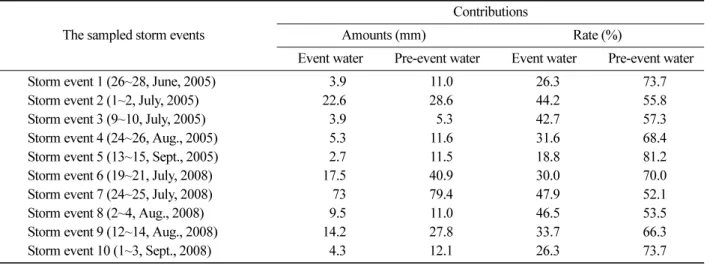
The contributions of pre-event and event water to
stormflow for the 10 sampled storm events are shown in Table 2. As shown in Table 2, the contributions of pre- event water ranged from 52.1% to 81.2%, and the small- est value of pre-event water contribution was produced for the storm event 7, which has largest rainfall and run- off volume among sampled storm events. These results agree reasonably well with an earlier study (Caissie et
al., 1996), in which the contributions of pre-event water to streamflow could account for as much as 91% of the total peak flow for small events and 55% of total stream- flow for higher flow events, respectively. In this study area, the research on the hydrograph separation had been tried (Kim and Jeong, 2002). They used the two-com- ponent mixing model analysis with electrical conductiv- ity as a natural tracer, providing similar results that the contributions of pre-event water to streamflow were evaluated to 91.3% and 84.6% for two events from 2000, respectively.
4. Correlation analysis of storm event characteristics on event water contributions
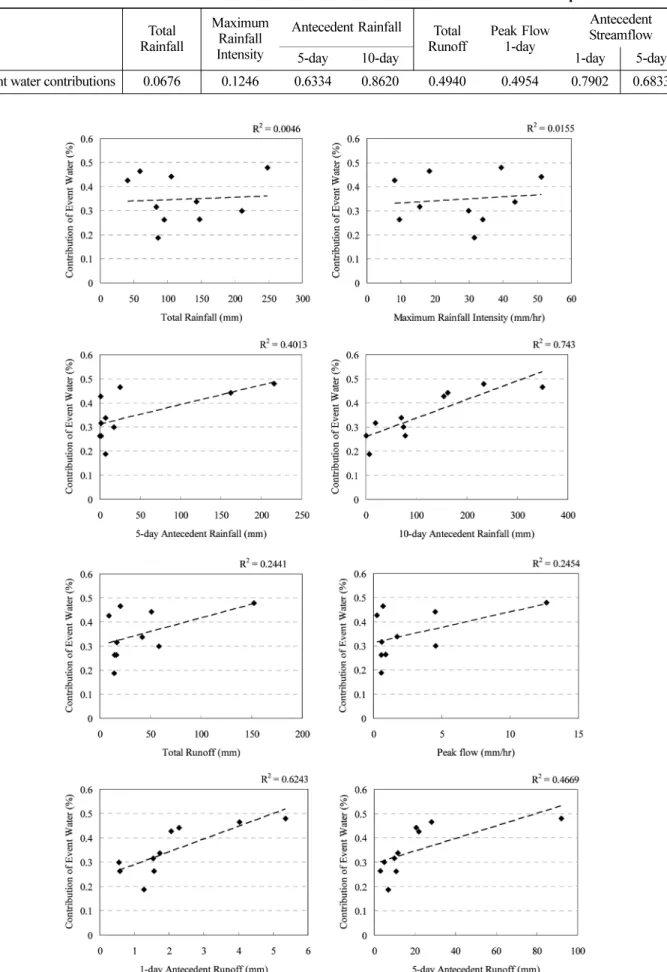
Table 3 presents correlation coefficients of event water contributions with storm event characteristics for sam- pled storm events. Runoff-related characteristics such as total runoff, peak flow and antecedent streamflows were also used in the correlation analysis, because event water contributions may affect runoff responses of the catch- ment.
Event water contribution is correlated strongest with the 10-day antecedent rainfall, and correlated stronger with the 1-day antecedent streamflow. In succession, event water contribution is correlated with 5-day antecedent streamflow and 5-day antecedent rainfall. Total runoff and peak flow correlate less to event water contribution.
No associations are found between event water contri- bution and total rainfall or maximum rainfall intensity.
Each diagram of Figure 3 shows the relationship between Figure 2. The temporal changes of rainfall, runoff and
Na+ concentrations for the storm event 1 (a) and the storm event 2 (b). Open circles mean Na+ concentration.
Table 2. Contributions of event and pre-event water to stormflow for the sampled storm events.
The sampled storm events Contributions
Amounts (mm) Rate (%)
Event water Pre-event water Event water Pre-event water
Storm event 1 (26~28, June, 2005) 3.9 11.0 26.3 73.7
Storm event 2 (1~2, July, 2005) 22.6 28.6 44.2 55.8
Storm event 3 (9~10, July, 2005) 3.9 5.3 42.7 57.3
Storm event 4 (24~26, Aug., 2005) 5.3 11.6 31.6 68.4
Storm event 5 (13~15, Sept., 2005) 2.7 11.5 18.8 81.2
Storm event 6 (19~21, July, 2008) 17.5 40.9 30.0 70.0
Storm event 7 (24~25, July, 2008) 73 79.4 47.9 52.1
Storm event 8 (2~4, Aug., 2008) 9.5 11.0 46.5 53.5
Storm event 9 (12~14, Aug., 2008) 14.2 27.8 33.7 66.3
Storm event 10 (1~3, Sept., 2008) 4.3 12.1 26.3 73.7
Table 3. Correlation coefficients of event water contributions with storm event characteristics for sampled storm events.
Total
Rainfall Maximum Rainfall Intensity
AntecedentRainfall Total
Runoff PeakFlow 1-day
Antecedent Streamflow
5-day 10-day 1-day 5-day
Event water contributions 0.0676 0.1246 0.6334 0.8620 0.4940 0.4954 0.7902 0.6833
Figure 3. Relationships of the event water contribution versus the storm event characteristics for sampled storm events.
event water contribution and each storm event charac- teristics. As shown in Figure 3, event water contribution is well associated with changes in 10 day antecedent rainfall and the 1 day antecedent streamflow, respectively.
The results may indicate that 10 day antecedent rain- fall can considerably represents moisture conditions within the catchment prior to the storm event, but 5 day antecedent rainfall can not do it. It means that the soil moisture conditions in forest catchments is not changed rapidly, and the effect of heavy rain event may continue after more than 5 days at least in this experimental catchment.
The catchment soil moisture condition can usually be illustrated by the antecedent baseflow conditions (Sun et
al., 2002). Baseflow conditions before event start have been already used for assuming initial moisture condi- tions to operate hydrological models such as TOP- MODEL (Beven and Kirkby, 1979; Beven et al., 1995).
The relationship between the event water contribution and 1 day antecedent streamflow also shows that the generation of event water may be determined by catch- ment moisture conditions.
The effect of antecedent moisture condition on the event water contribution is remarkable in the storm event 1, 2 and 3. Although the storm event 1 had largest total rainfall amount among sampled storm events, the event water contribution to stormflow was smallest. It can be due to a large soil moisture deficit after long dry period. In the storm event 2, which occurred during very wet condition, highest event water contribution has been recorded. The storm event 3 showing high event water contribution also occurred during relatively wet condi- tion. The large difference between the storm even 1 and 2 can demonstrate that the subsurface flow is very important in the generation of streamflow in forested catchments (Hursch, 1933; Torres et al., 1998; Renshaw
et al., 2003) and saturated overland flow can be a sig- nificant runoff generating mechanism locally (Dunne and Black, 1970; Hoggon, 1997; Renshaw et al., 2003).
Conclusion
Hydrograph separation based on the temporal varia- tions of Na+ concentration as a geochemical tracer was conducted as a part of the research on the sources and pathways of stormflow in a forested catchment. The 10 storm events sampled in 2005 and 2008 showed very different contributions of event and pre-event water to generating stormflow. As the results of correlation anal- ysis between event water contributions versus some storm event characteristics, it was founded that 10-day antecedent rainfall and 1-day antecedent streamflow are significantly correlated with event water contributions.
These results can provide insight which will contribute to understand the importance of antecedent moisture conditions in the generation of event water, and be used basic information to stormflow generation process in for- est catchment.
Literature Cited
1. Buttle, J.M. 1994. Isotope hydrograph separations and rapid delivery of pre-event water from drainage basins.
Progress in Physical Geography 18(1): 16-41.
2. Bazemore, D.E., Eshleman, K.N. and Hollenbeck, K.J.
1994. The role of soil water in stormflow generation in a forested headwater catchment: synthesis of natural tracer and hydrometric evidence. Journal of Hydrology 162: 47-75.
3. Beven, K.J. and Kirkby, M.J. 1979. A physically-based variable contributing area model of basin hydrology.
Hydrological Sciences Bulletin 24(1): 43-69.
4. Beven, K.J., Lamb, R., Quinn, P., Romanowicz, R. and Freer, J. 1995. TOPMODEL. In: Singh, V.P., Editor, 1995.
Computer Models of Watershed Hydrology, Water Resource Publications, Colorado, 627-668.
5. Burns, D.A., Hooper, R.P., McDonnell, J.J., Peters, N.E., Freer, J.E., Kendall, C. and Beven, K. 2001. Quantifying contributions to storm runoff using end-member mixing analysis and hydrologic measurements at the Panola mountain research watershed (Georgia, USA). Hydro- logical Processes 15: 1903-1924.
6. Caissie, D., Pollock, T.L. and Cunjak, R.A. 1996: Vari- ation in stream water chemistry and hydrograph sepa- ration in a small drainage basin. Journal of Hydrology 178: 137-157.
7. Christophersen, N., Neal, C., Hooper, R.P., Vogt, R.D.
and Andersen, S. 1990: Modeling streamwater chem- istry as a mixture of soil water end-members-A step towards second generation acidification models. Jour- nal of Hydrology 116: 307-320.
8. Elsenbeer, H., Lorieri, D. and Bonell, M. 1995. Mixing model approaches to estimate storm flow sources in an overland flow-dominated tropical rain forest catchment.
Water Resources Research 31(9): 2267-2278.
9. Fritz, P., Cherry, J.A., Weyer, K.V. and Sklash, M.G.
1976. Runoff analysis using environmental isotope and major ions. In: Interpretation of environmental isotope and hydrochemical data in groundwater hydrology.
International Atomic Energy Agency, Vienna. pp. 230.
10. Genereux, D.P., Hemond, H.F. and Mulholland, P.J.
1993. Use of radon 222 and calcium as tracers in al three-end-member mixing model for streamflow gener- ation on the West Fork of Walker Branch watershed.
Journal of Hydrology 142: 167-211.
11. Hoggon, D.H. 1997. Computer-Assisted Floodplain Hydrol- ogy and Hydraulics. McGraw-Hill, New York, 676pp.
12. Hooper, R.P. 2001. Applying the scientific method to small catchment studies: a review of the Panola Moun- tain experience. Hydrological Processes 15: 2039-2050.
13. Hooper, R.P., Christophersen, N. and Peters, N.E. 1990.
Modeling streamwater chemistry as a mixture of soil water end-members - An application to the Panola Moun- tain catchment, Georgia, USA. Journal of Hydrology 116: 321-343.
14. Hursch, C.R. 1933. The role of infiltration in the hydro- logic cycle. Transactions - American Geophysical Union 14: 446-460.
15. Kim, K. and Jeong, Y.H. 2002. Hydrograph separations using the two-component mixing model with electrical conductivity as a chemical tracer in the three small for- ested catchments. Journal of Korean Forestry Society 91(5): 624-631.
16. Kim, K., Yoo, J.Y., Jun, J.H., Choi, H.T. and Jeong, Y.H. 2006. Hydrograph Separation by using EMMA model for the Coniferous Forest Catchment in Gwang- neung Gyeonggido, Republic of Korea (I) - Determi- nation of the End Members and Tracers - Journal of Korean Forestry Society 95(5): 556-561.
17. Liu, F., Williams, M.W. and Caine, N. 2004. Source waters and flow paths in an alpine catchment, Colorado Front Range, United States. Water Resources Research
40(9), W09401, doi:10.1029/2004WR003076. 1-16.
18. Muraoka, K. and Hirata, T. 1988. Streamwater chem- istry during rainfall events in a forested basin. Journal of Hydrology 102: 235-253.
19. Pinder, G.F. and Jones, J.F. 1969. Determination of the groundwater component of peak discharge from the chemistry of total runoff water. Water Resources Research
5(2): 438-445.
20. Renshaw, C.E., Feng, X., Sinclair, K.J. and Dums, R.H.
2003. The use of streamflow routing for direct channel precipitation with isotopically-based hydrograph sepa- rations: the role of new water in stormflow generation.
Journal of Hydrology 273: 205-216.
21. Sueker, J.K., Ryan, J.N., Kendall, C. and Jarrett, R.D.
2000. Determination of hydrologic pathways during snowmelt for alpine/subalpine basins, Rocky Mountain National Park, Colorado. Water Resources Research 36(1): 63-75.
22. Sun, H., Cornish, P.S. and Daniell, T.M. 2002. Spatial Variability in Hydrologic Modeling Using Rainfall- Runoff Model and Digital Elevation Model. Journal of Hydrologic Engineering 7(6): 404-412.
23. Torres, R., Dietrich, W.E., Montgomery, D.R., Ander- son, S.P. and Loague, K. 1998. Unsaturated zone pro- cesses and the hydrologic response of a steep, unchanneled catchment. Water Resources Research 34: 1865-1879.
24. Yoo, J.Y., Kim, K., Jun, J.H., Choi, H.T. and Jeong, Y.H. 2006. Searching the natural tracers for separation of runoff components in a small forested catchment.
Journal of the Korea Society for Environmental Res- toration & Revegetation Technology 9(4): 52-59.
(Received September 6, 2010; Accepted October 12, 2010)